

Linerless Labels Market Size and Forecast — 2026 - 2033
The Global Linerless Labels Market size is estimated to be valued at USD 1.2 billion in 2026 and is expected to reach USD 2.1 billion by 2033, exhibiting a compound annual growth rate (CAGR) of 8.2% from 2026 to 2033.
Overview
The Linerless Labels market comprises primarily of self-adhesive label solutions that eliminate the need for a backing liner, enhancing material efficiency and reducing waste. Product types include roll-fed labels, which are widely used in retail and logistics for their compatibility with automated printing systems, and die-cut labels, designed for high-precision branding and packaging applications. Specialty labels, such as thermal transfer and direct thermal linerless labels, are increasingly adopted for healthcare, food, and e-commerce sectors due to their durability and print quality. Additionally, eco-friendly and recyclable linerless labels are gaining traction, driven by sustainability trends and regulatory incentives across global packaging industries.
Key Takeaways
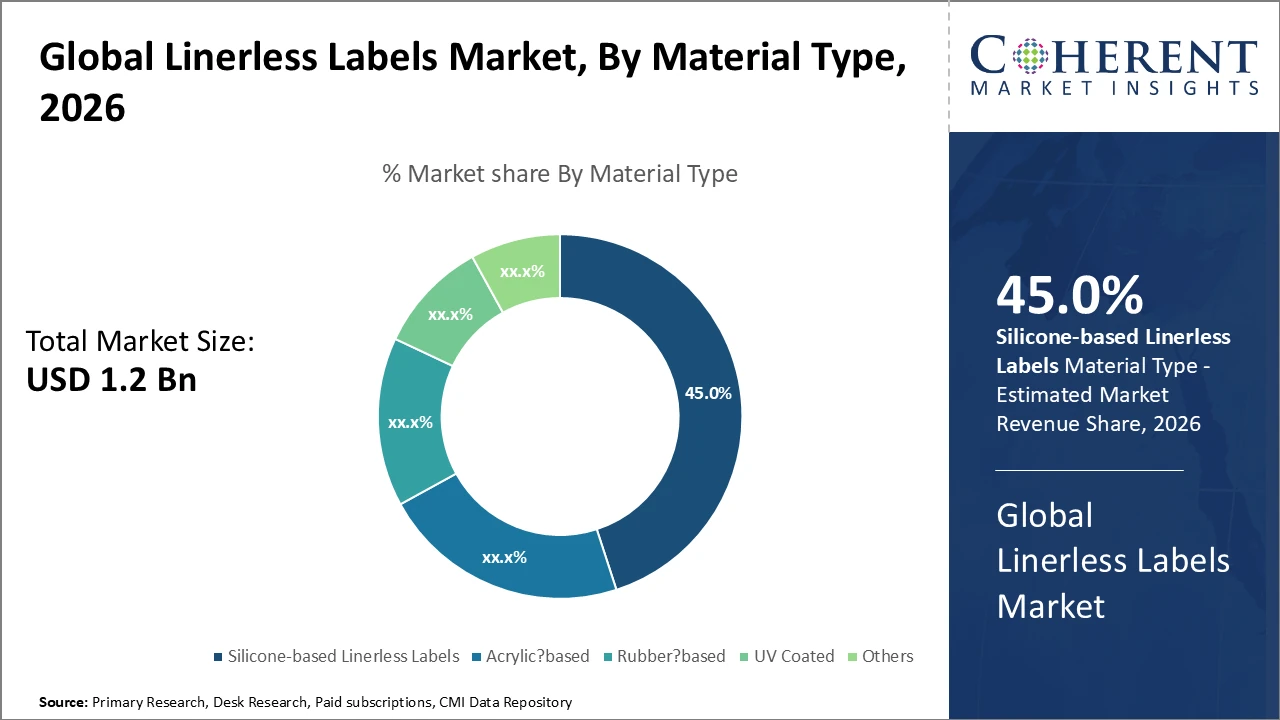
The silicone-based linerless label segment dominates the market with 45% share, valued for its substrate versatility and environmental resistance.
Food & Beverage applications represent a significant revenue contributor, driven by innovations in freshness indicators and tamper-evident solutions.
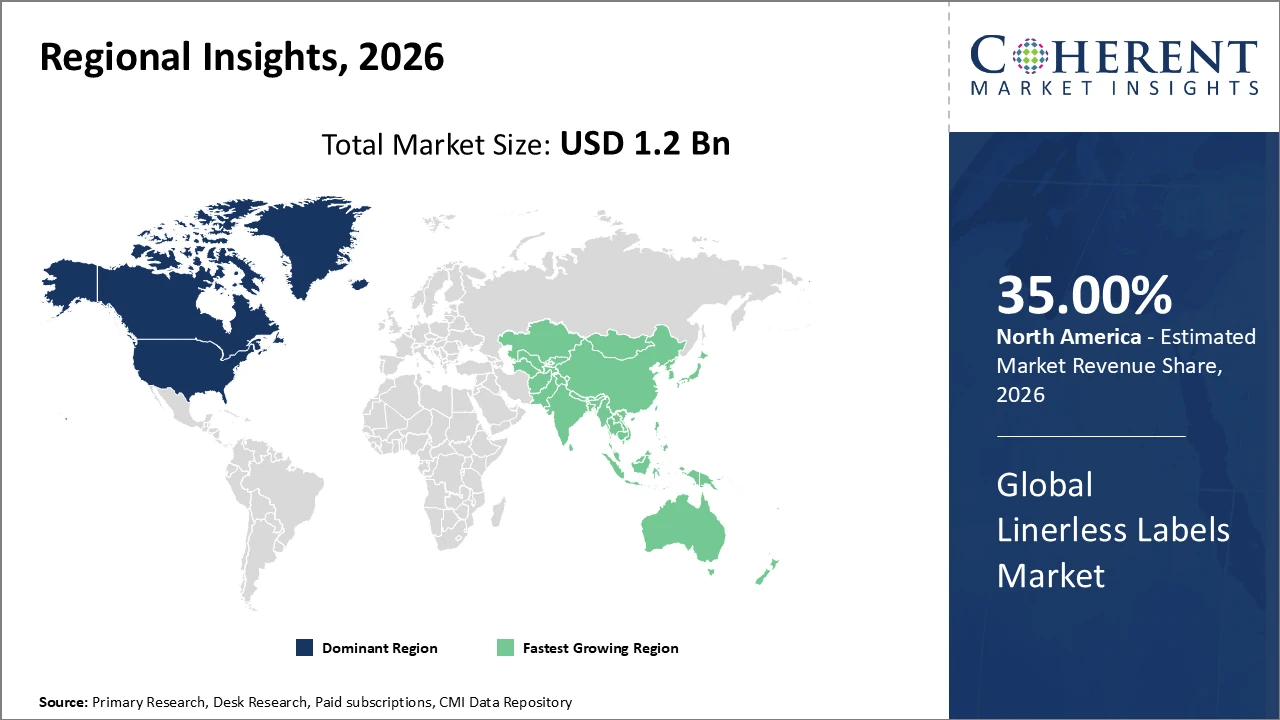
North America holds the largest regional market share at over 35%, supported by advanced packaging technologies and stringent environmental regulations.
Asia Pacific is the fastest-growing region with a CAGR exceeding 9%, propelled by expanding manufacturing sectors and government initiatives promoting sustainable packaging practices.
Linerless Labels Market Segmentation Analysis
Linerless Labels Market Insights, By Material Type
Silicone-Based Linerless Labels lead the market with a 45% share, valued for excellent release properties and thermal stability, making them ideal for high-temperature applications in pharmaceuticals and food packaging. Ongoing improvements in adhesive formulations enhance shelf life and recyclability, sustaining their dominance. The Acrylic-Based segment is the fastest growing, driven by demand for cost-effective, durable solutions in logistics and warehousing, thanks to strong substrate adhesion. Rubber-Based and UV Coated labels occupy niche applications, with moderate adoption focused on short-term labeling and specialty packaging. Together, these subsegments diversify offerings across industrial and consumer sectors.
Linerless Labels Market Insights, By Application
The Food & Beverages segment dominates the linerless labels market, driven by strict freshness, safety, and tamper-evident packaging requirements. Innovations like freshness indicators, barcode integration, and smart labeling have strengthened its market position. The Pharmaceuticals segment is the fastest-growing application, propelled by serialization mandates and increasing demand for track-and-trace solutions to ensure regulatory compliance. Logistics & Warehousing labels provide operational efficiency, particularly in e-commerce and supply chain management, experiencing steady growth. Personal Care & Cosmetics leverage linerless labels for premium aesthetics, brand differentiation, and space-saving packaging, though their overall market share remains smaller compared to Food & Beverage and Pharmaceuticals.
Linerless Labels Market Insights, By End Use Industry
Retail dominates the linerless labels market by volume, supported by increasing adoption of sustainable packaging and smart labeling solutions that improve consumer interaction and brand loyalty. The Healthcare segment is the fastest-growing end-use sector, driven by stringent regulatory requirements, the need for accurate medication labeling, and track-and-trace compliance, boosting demand for linerless solutions. Transportation benefits from enhanced supply chain visibility and operational efficiency through the use of linerless labels, while Manufacturing applies them for product identification, inventory management, and quality assurance. Although Manufacturing contributes steadily to market revenue, its growth pace is slower compared to the rapid expansion observed in Healthcare.
Linerless Labels Market Trends
Increasing adoption of sustainable adhesive technology is driving growth in the linerless labels market.
Integration of smart labeling systems enables real-time tracking and anti-counterfeiting, particularly in pharmaceuticals.
QR-enabled linerless labels saw a 20% adoption increase in 2025 in developed markets, highlighting digitization in labeling.
Regulatory demands in healthcare and food sectors are accelerating smart label implementation.
Manufacturers are developing compostable linerless label substrates to reduce environmental impact.
Plastic waste bans in Europe and North America are fueling demand for eco-friendly linerless labels.
Linerless Labels Market Insights, By Geography
North America Linerless Labels Market Analysis and Trends
North America dominates the linerless labels market, holding approximately 35% of global share, driven by its well-established packaging industry and strong emphasis on sustainability. Advanced manufacturing infrastructure and widespread adoption of automated labeling technologies support this leadership position. Regulatory frameworks, including initiatives by the U.S. Environmental Protection Agency targeting plastic waste reduction, further encourage the shift to linerless labels. Additionally, leading market players in the region continually innovate in adhesive formulations and smart labeling solutions, boosting adoption across key end-use sectors such as food & beverages, pharmaceuticals, and retail. These factors collectively reinforce North America’s market dominance and growth trajectory.
Asia Pacific Linerless Labels Market Analysis and Trends
Asia Pacific is witnessing the fastest growth in the linerless labels market, with a CAGR exceeding 9%, driven by rapidly expanding manufacturing sectors in countries like China and India. Favorable government policies, increasing foreign investments, and the region’s focus on modernizing packaging infrastructure support market expansion. Growing demand from the food & beverage sector, coupled with rising awareness of sustainable packaging solutions, further fuels adoption. Additionally, manufacturers are investing in local production capabilities and technological innovations, such as smart and eco-friendly labels, to meet regional regulatory standards and consumer expectations, solidifying Asia Pacific’s position as the fastest-growing market.
Linerless Labels Market Outlook for Key Countries
USA Linerless Labels Market Analysis and Trends
The U.S. leads the linerless labels market owing to its mature packaging infrastructure and stringent environmental regulations promoting waste reduction. In 2025, adoption of linerless labels in food and pharmaceutical sectors surged over 15%, driven by innovations such as RFID and QR code integration for tracking and anti-counterfeiting. Major players leveraged this trend through investments in advanced production technologies and partnerships with end-users to deliver customized, compliance-ready solutions. Additionally, the development of ultra-thin adhesive films reduced material usage and costs, enhancing sustainability and operational efficiency, reinforcing the U.S. market’s dominance and competitive advantage in North America.
Germany Linerless Labels Market Analysis and Trends
Germany’s linerless labels market is growing rapidly, supported by a robust manufacturing sector and strict EU packaging waste regulations. Public-private initiatives promoting circular economy practices have driven adoption, with usage in automotive and chemical industries rising by 12% in 2025. Leading companies focus on developing bio-based adhesives and integrating digital labeling technologies, leveraging government incentives for sustainable innovation. The emphasis on eco-friendly production and compliance with environmental standards positions Germany as a key regional market. Its combination of industrial capability, regulatory support, and technological advancement ensures continued expansion and leadership in Europe’s linerless labels sector.
Analyst Opinion
Global production capacity of linerless label materials increased by over 22% in 2025, strengthening supply-side potential, especially in Asia Pacific, where investments in biodegradable substrates fueled rapid manufacturing expansion.
Rising demand in fresh food packaging drove linerless label imports up by 18% year-on-year in 2024, reflecting consumer preference for convenience and sustainability, with adoption growing across retail and FMCG sectors.
Pricing competition intensified due to raw material cost fluctuations; in 2026, efficiency improvements allowed manufacturers to reduce label prices by 5%, boosting market share in emerging economies.
Pharmaceutical applications expanded rapidly, with linerless labels meeting compliance and serialization standards, accounting for 15% of revenue in 2025 versus 9% in 2023.
- Current Industry Events of 2026
- Market Size Estimation
- Regional Breakdown
- Competitive Landscape
- Customer Intelligence
- Segmental Analysis
- Pricing Analysis
- Key Market Drivers, Challenges & Future Trends
- Customized Insights Section
Market Scope
| Report Coverage | Details | ||
|---|---|---|---|
| Base Year: | 2025 | Market Size in 2026: | USD 1.2 billion |
| Historical Data for: | 2020 To 2024 | Forecast Period: | 2026 To 2033 |
| Forecast Period 2026 to 2033 CAGR: | 8.2% | 2033 Value Projection: | USD 2.1 billion |
| Geographies covered: |
| ||
| Segments covered: |
| ||
| Companies covered: | CCL Industries Inc., 3M Company, UPM Raflatac, LINTEC Corporation, JSP Labels, Mark Andy Inc., GPA Global Ltd., Flexcon Company Inc., Huhtamaki Oyj, Ritrama S.p.A. | ||
| Growth Drivers: |
| ||
Linerless Labels Market Growth Factors
The global linerless labels market has grown significantly due to stringent sustainability regulations in Europe and North America, encouraging businesses to reduce label waste. Rising demand in the food & beverage sector for tamper-evident, space-efficient packaging further supports adoption. Innovations in near-zero waste adhesive coatings have lowered production costs while improving label durability. Additionally, the expansion of e-commerce and logistics, accelerated by digital transformation, has increased the need for flexible and high-performance linerless labeling solutions. Together, these factors have driven robust market growth, particularly in North America and Asia Pacific, over recent years.
Linerless Labels Market Development
In December 2025, Aldus Tronics announced plans to launch the Aldus M360+ Linerless Labeller in 2026, following the acquisition of intellectual property from JBT Marel to develop and produce the machine.
Key Players
Leading Companies of the Market
LINTEC Corporation
UPM Raflatac
JSP Labels
3M Company
Mark Andy Inc.
GPA Global Ltd.
Huhtamaki Oyj
Ritrama S.p.A.
Flexcon Company Inc.
Competitive strategies among key market players focus on technological innovation and regional expansion. Avery Dennison recently introduced an ultra-thin adhesive linerless film, reducing material waste by 15% and enhancing sustainability credentials across packaging applications. Simultaneously, UPM Raflatac strengthened its presence in Asia Pacific through strategic partnerships with local converters, enabling faster market penetration and driving a 12% revenue increase in 2025. These initiatives highlight the dual approach of improving product performance while leveraging regional collaborations to capture emerging opportunities, reinforcing the companies’ leadership positions in the rapidly growing linerless labels market.
Linerless Labels Market Future Outlook
The future of the linerless labels market is set for sustained growth, driven by increasing demand for sustainable and waste-reducing packaging solutions across food, pharmaceutical, and retail sectors. Innovations in ultra-thin adhesives, digital integration such as QR codes and RFID tracking, and bio-based substrates will enhance product functionality and environmental compliance. Expansion into emerging markets, particularly in Asia Pacific and Latin America, will create new revenue streams, while regulatory mandates on packaging waste reduction in Europe and North America will continue to encourage adoption. Overall, technological advancements and sustainability trends will define the market’s trajectory over the next decade.
Linerless Labels Market Historical Analysis
The linerless labels market has experienced steady growth over the past decade, initially driven by the need to reduce packaging waste and improve operational efficiency. Early adoption was led by the food and beverage sector, with retailers seeking space-saving and tamper-evident labeling solutions. Technological advancements in silicone and acrylic adhesives, combined with improvements in substrate materials, enhanced product performance and durability. North America and Europe initially dominated the market due to mature packaging industries and regulatory pressures, while Asia Pacific emerged later as a growth hub. By 2025, increased digital integration and sustainability initiatives further accelerated market adoption and revenue expansion.
Sources
Primary Research Interviews:
Packaging managers, procurement heads, and operations directors at leading FMCG, food & beverage, and pharmaceutical companies
Chief technology officers, R&D heads, and production managers at linerless label manufacturers and converters
Sustainability officers, supply chain consultants, and packaging solution advisors focusing on eco-friendly labeling and operational efficiency
Magazines:
Packaging World – Innovations in Sustainable Packaging and Labeling Solutions
Labels & Labeling – Industry Trends, Material Developments, and Adhesive Technologies
Packaging Strategies – Operational Efficiency and Linerless Label Applications
Food & Beverage Packaging – Freshness Preservation, Compliance, and Smart Label Integration
Journals:
Journal of Packaging Technology – Advances in Eco-Friendly Label Materials and Adhesives
International Journal of Advanced Manufacturing Technology – Linerless Label Production and Automation
Journal of Sustainable Packaging – Environmental Impact and Recycling Innovations
Newspapers:
The Wall Street Journal – Packaging Industry Updates and Sustainability Regulations
Financial Times – FMCG Packaging Trends and Linerless Labels Investments
Packaging Europe – Innovations, Startups, and Market Movements
Business Insider – Market Developments and Competitive Strategies in Eco-Friendly Labels
Associations:
Flexible Packaging Association (FPA) – Best Practices and Standards for Packaging Materials
Association for Packaging and Processing Technologies (PMMI) – Guidelines for Sustainable Labeling
European Federation for Print and Digital Communication (FESPA) – Innovations in Labeling Technology
Get access to 250+ pages report
Every segment, forecast, competitor profile and data table behind the analysis above — available for instant download.
- ESOMAR Member
- ISO 9001:2015 Certified
- D-U-N-S Registered
- GDPR & CCPA Compliant
Missing comfort of reading report in your local language? Find your preferred language:
Transform your Strategy with Exclusive Trending Reports
Frequently Asked Questions
The market is primarily led by LINTEC Corporation, UPM Raflatac, and CCL Industries Inc., leveraging advanced adhesive technologies and extensive global distribution networks to maintain leadership.
The Linerless Labels market is projected to reach USD 2.1 billion by 2033, growing at a CAGR of 8.2% from 2026 to 2033, fueled by increasing sustainability mandates and technology adoption across industries.
Retail Sector presents the most significant growth potential, driven by demand for tamper-proof packaging, freshness indicators, and waste-reducing labeling solutions.
Emerging trends include hybrid adhesive solutions, smart labels with digital integration, and region-specific customization, addressing regulatory requirements and evolving consumer preferences.
The market features consolidation and innovation, with challenges including raw material cost volatility and complex regulatory compliance across global regions.
Key strategies involve strategic partnerships, regional expansions, and R&D investments in eco-friendly technologies to capture new opportunities and sustain market leadership.