

Non-Invasive Blood Pressure Monitors Market Size and Share Analysis- 2026 To 2033
The Non-Invasive Blood Pressure Monitors Market size is estimated to grow at a CAGR of 6.9%, from USD 34.61 Bn in 2026 to USD 55.32 Bn in 2033. The growth of the market can be attributed to the increasing prevalence of hypertension and cardiovascular diseases, increasing adoption of home-based and ambulatory blood pressure monitoring, increasing demand for automated and digital monitoring devices, and increasing integration of connected healthcare technologies. As of September 23, 2025, the World Health Organization (WHO) estimates that about 1.4 Bn adults worldwide had hypertension in 2024, but only just over 1 in 5 had their blood pressure under control.
Key Takeaways
- Automated BP Monitors are likely to dominate the device type segment with 42.5% in 2026. The segment’s growth is owing to increasing replacement of manual auscultatory measurement with automated oscillometric devices, greater standardization of BP measurement, and rising use across hospitals and primary care facilities. In May 2026, WHO highlighted that clinically validated automated BP measurement devices are important for achieving the SEAHEARTS target of placing 100 million people with hypertension on protocol-based management and achieving controlled blood pressure in at least 60 million people by 2030.
- The Digital technology segment is expected to lead with 68.0% in 2026. Growth is supported by automated measurement, digital storage, connectivity, remote transmission of readings and integration with hypertension-management programs. The 2025 AHA/ACC High Blood Pressure Guideline supports home blood pressure monitoring, along with standardized treatment protocols and regular interaction with multidisciplinary care teams, as a key tool for improving blood pressure control.
- Blood Pressure Cuffs is expected to hold the largest share in 2026 with 59.5% of the accessory segment. The leadership is supported by repeated application in automated, ambulatory and conventional BP monitoring devices, availability in different patient sizes and replacement demand in clinical environments. Limited availability of validated blood pressure measurement devices is explicitly identified in the WHO’s 2025 Global Hypertension Report as a key barrier to the diagnosis and management of hypertension in a number of countries, highlighting the need for validated cuff-based measurement systems and related accessories.
- Hospitals are expected to dominate the end-user segment with 45.0% in 2026. This section benefits from routine BP measurement in emergency departments, operating rooms, ICUs, inpatient wards and outpatient departments, and the need to frequently monitor cardiovascular and high-risk patients. The 2025 AHA/ACC High Blood Pressure Guideline, updated August 14, 2025, emphasizes the need for accurate and standardized BP measurement in all clinical care settings and broadens the role of both in-office and out-of-office monitoring for the management of hypertension.
- North America is expected to lead the global Non-Invasive Blood Pressure Monitors Market with about 38.5% market share in 2026. High prevalence of hypertension, widespread use of automated and home-based blood pressure monitoring, sophisticated hospital infrastructure, and increasing integration of self-measured blood pressure programs into standard care, all support the leadership of the region. In September 2025, the American Heart Association reported that 122.4 million U.S. adults were living with high blood pressure, while only about one-quarter had their blood pressure under control.
Market Drivers
Expanding Use of Self-Measured Blood Pressure Monitoring is Accelerating Demand for Non-Invasive BP Monitors
The Non-Invasive Blood Pressure Monitors Market is growing at a fast pace owing to the rising acceptance of self-measured blood pressure monitoring (SMBP) outside hospitals and physician offices. Automated non-invasive devices allow patients to record blood pressure regularly at home and share the readings with healthcare professionals, enabling earlier intervention and long-term hypertension management.
In May 2026, the U.S. CDC stated that SMBP with clinical support is an evidence-based intervention for improving hypertension control. CDC modeling also suggests that greater use of SMBP programs could reduce heart attacks by 4.9% and strokes by 3.8%, and save about USD 7,794 in healthcare costs per person over 20 years.
Increasing Focus on Validated and Accurate Blood Pressure Measurement is Driving Device Deployment
Healthcare systems are increasingly stressing the need for accurate and standardized blood pressure measurement. Clinically validated non-invasive BP monitors are increasingly in demand in primary care centers, hospitals, outpatient facilities and community health programs. The automated upper arm devices are especially important because measurement techniques are not always consistent, which can lead to an inaccurate diagnosis and treatment of hypertension.
The World Health Organization’s Global Report on Hypertension 2025 states that one of the main obstacles to the effective diagnosis and management of hypertension is the lack of access to validated devices for blood pressure measurement.
Current Events and Their Impact on the Non-Invasive Blood Pressure Monitors Market
Current Event | Description and its Impact |
FDA Issues Draft Guidance for Cuffless Non-Invasive Blood Pressure Devices (January 2026) |
|
CMS Expands Technology-Supported Chronic Care Through the ACCESS Model (July 2026) |
|
- Current Industry Events of 2026
- Market Size Estimation
- Regional Breakdown
- Competitive Landscape
- Customer Intelligence
- Segmental Analysis
- Pricing Analysis
- Key Market Drivers, Challenges & Future Trends
- Customized Insights Section
Segmental Insights
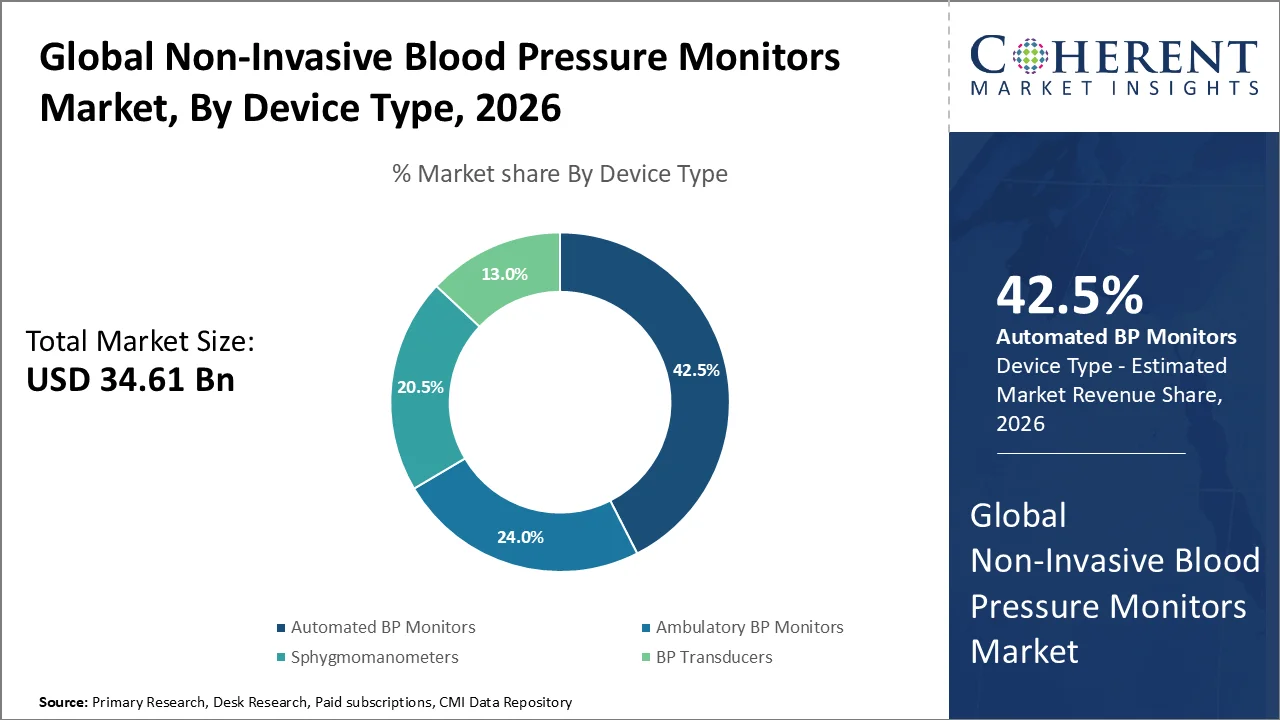
Why are Automated BP Monitors Acquiring the Largest Share?
On the basis of device type, Automated BP Monitors are projected to account for the largest Non-Invasive Blood Pressure Monitors Market share of 42.5% in 2026. The segment’s growth is owing to ease of operation, reduced observer-related measurement errors, growing adoption for home blood pressure monitoring, and increasing preference for validated oscillometric devices across hospitals and outpatient settings.
In May 2025, OMRON Healthcare introduced the new generation of home automated blood pressure monitors with its IntelliSense AFib technology. Each blood pressure measurement is automatically screened for atrial fibrillation using a machine-learning algorithm built into these monitors, providing cardiovascular screening capability to routine automated BP monitoring.
Why is Digital Technology Holding the Largest Market Share?
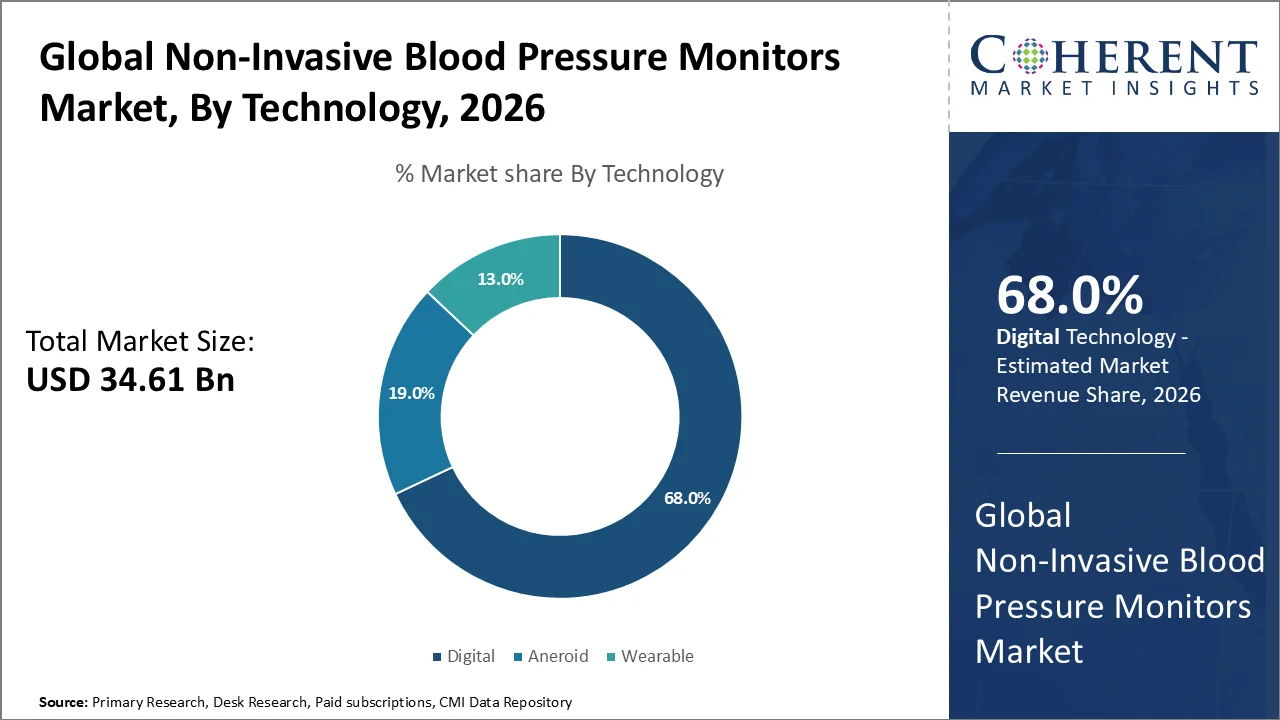
Based on technology, the digital segment is expected to rule with 68.0% share in 2026. Digital NIBP monitors are preferred because of automatic inflation and deflation, digital readouts, memory storage, ease of use and connection with remote patient monitoring platforms.
A 2025 network meta-analysis of 24 randomized controlled trials found that telemonitoring was associated with a larger reduction in systolic blood pressure (3.69 mmHg) and diastolic blood pressure (1.82 mmHg) than usual-care monitoring. This supports the clinical utility of digital-connected BP monitoring and its integration in hypertension management programs.
In March 2026, Samsung Electronics announced the launch of its blood pressure monitoring feature for some Galaxy Watch users in the U.S. via the Samsung Health Monitor app. The feature allows users to measure and monitor blood pressure right from the wrist, and syncs measurements to Samsung Health.
Why are Blood Pressure Cuffs Acquiring the Largest Share?
On the basis of accessory, Blood Pressure Cuffs is projected to account for 59.5% of the market in 2026. Their leadership is driven by their essential role in automated, ambulatory and conventional BP measurement, their frequent replacement needs, their availability in various arm sizes and the increasing importance of proper cuff sizing for accurate diagnosis.
A 2025 hospital inpatient clinical trial of 223 patients. Cuff size matters, in patients who needed a small cuff, the oversized cuff led to a reduction in systolic BP values up to 6.9 mmHg. This highlights the necessity of using the appropriate cuff for accurate BP measurement.
Why are Hospitals Holding the Largest Market Share?
On the basis of end user, Hospitals are anticipated to lead the Non-Invasive Blood Pressure Monitors Market with 45.0% share in 2026. The segment’s dominance is owing to high-frequency BP monitoring across emergency departments, operating rooms, intensive care units, inpatient wards, cardiology departments, and perioperative care settings.
Hospital demand is also supported by tightening performance standards. The FDA recognized the amended ISO 81060-2:2024 standard for clinical investigation of automated non-invasive sphygmomanometers in May 2026, with a transition period to the amended 2024 standard until December 20, 2026. This emphasizes the need for hospitals to acquire validated devices that meet the revised accuracy standards.
In June 2026, Philips announced the launch of its IntelliVue Patient Monitor 6000 Series for use in hospitals, ambulatory surgery centers and other clinical care settings. Integrated core vital sign measurements are available on the platform with expansion capabilities to allow clinicians to monitor patients across acuity levels.
Non-Invasive Blood Pressure Monitors Market Trends
- Rising adoption of connected and remote blood pressure monitoring is pushing the Non-Invasive Blood Pressure Monitors Market toward digitally enabled devices that automatically send readings to healthcare providers. In May 2026, CMS reiterated that Medicare generally covers remote patient monitoring, and specifically pointed out that connected blood pressure cuffs are covered devices. Eligible devices must report readings on at least 2 days within 30 days.
- Growing use of home blood pressure monitoring is boosting demand for upper-arm automated NIBP devices. The 2025 AHA/ACC High Blood Pressure Guideline emphasizes the need for integrated approaches, such as home BP monitoring, standardized measurement protocols, and routine engagement with multidisciplinary care teams, to improve BP control.
- Cuffless and wearable BP technologies are fast growing and a key trend of innovation. The American Heart Association reported a significant increase in the number and types of cuffless BP devices, including smartwatches, rings, patches, and fingertip monitors, over the past decade, according to the report, which was released in December 2025.
- However, the AHA also emphasized that many devices still require stronger real-world accuracy validation before widespread clinical adoption
Regional Insights
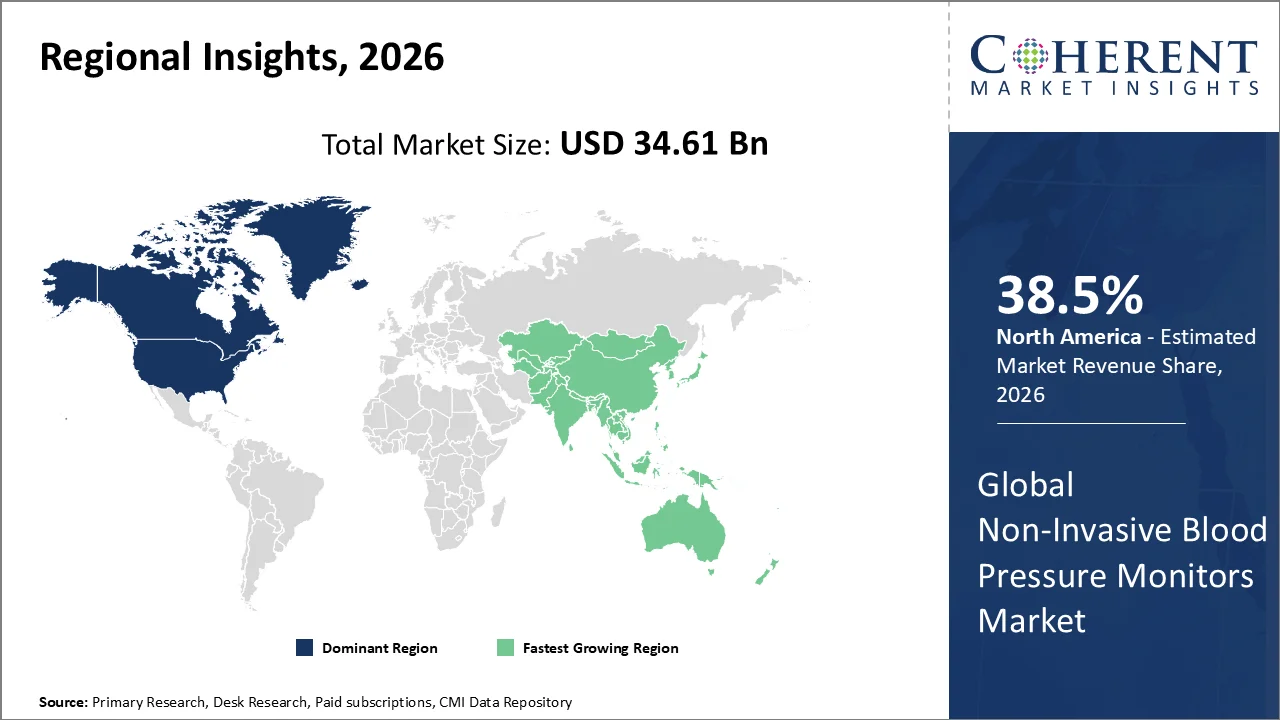
North America Dominates Owing to High Adoption of Validated Automated BP Monitoring Systems
The North America region accounts for approximately 38.5% of the Non-Invasive Blood Pressure Monitors Market share in 2026. The region’s dominance is owing to strong penetration of automated BP monitors, high use of home and ambulatory monitoring, well-established hospital infrastructure, favorable reimbursement for connected monitoring, and increasing emphasis on clinically validated devices.
In Canada, Hypertension Canada currently recommends validated automated devices for blood pressure assessment and notes that only about 10% of BP devices globally have evidence of validation for accuracy.
In March 2026, Beurer North America announced expanded U.S. availability of its clinically supported upper-arm blood pressure monitors. The company emphasized validation against internationally recognized accuracy standards such as ISO 81060-2, positioning its devices for more reliable home BP monitoring and confirmation of readings generated by wearables or digital health apps
Asia Pacific Non-Invasive Blood Pressure Monitors Market Trends
Asia Pacific is expected to be the fastest-growing region 2026-2033. The growth in the region is attributed to large scale screening and treatment programs for hypertension, substantial growth in primary healthcare infrastructure, introduction of digital monitoring systems, and government initiatives to improve the management of cardiovascular diseases.
Southeast Asian countries have established a regional target to put 100 million people with hypertension on protocol-based management and achieve controlled blood pressure in at least 60 million people by 2030, under the WHO-supported SEAHEARTS program. Accurate and clinically validated BP measurement has been recognized as a critical need for achieving these targets by WHO, thus directly supporting acquisition of automated and digital NIBP devices.
In February 2026, Otsuka Pharmaceutical signed an agreement with South Korea-based Sky Labs for exclusive commercialization rights in Japan for the ring-type automated blood pressure monitor CART BP pro.
High Hypertension Burden and Strong Home-Monitoring Adoption are Accelerating the Non-Invasive Blood Pressure Monitors Market in the United States
The U.S. non-invasive blood pressure monitor market is rapidly growing due to high prevalence of hypertension, increasing trend of self-monitoring blood pressure and wider adoption of connected home monitoring devices in primary care and chronic disease management.
According to the CDC, June 2, 2026, nearly 48.1% of U.S. adults, equivalent to 119.9 million people, have high blood pressure. In addition, 92.9 million adults with hypertension do not have their blood pressure controlled below 130/80 mmHg, creating a large addressable population requiring repeated clinical and home-based monitoring.
China Non-Invasive Blood Pressure Monitors Market Trends
China is expected to witness strong growth in the Non-Invasive Blood Pressure Monitors Market over the forecast period. Growth is being supported by government-led hypertension management programs, increasing emphasis on routine blood pressure screening, rising home-monitoring adoption, and growing use of fully automatic electronic sphygmomanometers.
According to the WHO Global Report on Hypertension 2025, China had approximately 271.5 million adults aged 30–79 years with hypertension in 2024. Of these, only 18% had their blood pressure controlled, meaning roughly 221.4 million adults remained uncontrolled. This creates substantial demand for repeated BP measurement across hospitals, primary care, pharmacies, and home settings.
Who are the Major Companies in Non-Invasive Blood Pressure Monitors Industry
Some of the major key players in Non-Invasive Blood Pressure Monitors Market are GE healthcare, SOMNOmedics, Eccosur SA, Koninklijke Philips N.V., Huntleigh Technology Ltd, Mortara Instrument, Schiller Americans Inc, American Diagnostic Corporation and Welch Allyn.
Key News
- In January 2026, ADC introduced its next-generation ADC@Home blood pressure monitoring lineup, comprising three upper-arm models and one wrist model. The new range includes ADC’s curved Comfort Contour cuff, inflation-based measurement, large digital displays, automatic fit checking on selected models, and two-user memory with date/time tracking.
- In December 2025, SCHILLER launched the ARGUS PRO LifeCare 3 monitor-defibrillator. The system monitors multiple vital signs, including NIBP, ECG, SpO₂, invasive BP, EtCO₂, and temperature.
Market Report Scope
Non-Invasive Blood Pressure Monitors Market Report Coverage
| Report Coverage | Details | ||
|---|---|---|---|
| Base Year: | 2025 | Market Size in 2026: | USD 34.61 Bn |
| Historical Data for: | 2020 To 2024 | Forecast Period: | 2026 To 2033 |
| Forecast Period 2026 to 2033 CAGR: | 6.9% | 2033 Value Projection: | USD 55.32 Bn |
| Geographies covered: |
| ||
| Segments covered: |
| ||
| Companies covered: | GE healthcare, SOMNOmedics, Eccosur SA, Koninklijke Philips N.V., Huntleigh Technology Ltd, Mortara Instrument, Schiller Americans Inc, American Diagnostic Corporation and Welch Allyn. | ||
| Growth Drivers: |
| ||
| Restraints & Challenges: |
| ||
Analyst Opinion
- The Non-Invasive Blood Pressure Monitors Market is increasingly shifting toward validated automated and digital monitoring systems, supported by healthcare-system efforts to improve hypertension detection and long-term control. The WHO Global Report on Hypertension 2025 identifies reliable access to validated blood pressure devices as a cornerstone of effective hypertension care, indicating that procurement standards and device accuracy are becoming increasingly important determinants of market adoption.
- Regulatory scrutiny is likely to accelerate innovation while also raising the entry barrier for newer cuffless technologies. In January 2026, the U.S. FDA released a draft guidance specifically related to clinical performance testing and evaluation of cuffless non-invasive blood pressure measuring devices, aiming to improve consistency in premarket submissions and increase confidence in next-generation wearable BP technologies.
- The market is expected to benefit from continued convergence between traditional cuff-based monitors, wearable devices, and connected patient-monitoring platforms. As of August 17, 2026, FDA’s NIBP device classification references standards covering intermittent automated measurement, continuous automated measurement, and wearable cuffless blood pressure devices, reflecting the broadening technological landscape beyond conventional sphygmomanometers.
Speak to the analyst
Want personalized insights?
Take the findings above to one of our principal consultants, or have the report rebuilt around the segments, geographies and competitors you actually track.
Market Segmentation
- By Device Type (Revenue, USD Bn, 2021-2033)
- Automated BP Monitors
- Ambulatory BP Monitors
- Sphygmomanometers
- BP Transducers
- By Technology (Revenue, USD Bn, 2021-2033)
- Digital
- Aneroid
- Wearable
- By Accessory (Revenue, USD Bn, 2021-2033)
- Blood Pressure Cuffs
- Manometers
- Valves and Tubing
- Bulbs
- Pulmonary Pressure Monitor
- By End User (Revenue, USD Bn, 2021-2033)
- Hospital
- Home Care Settings
- Ambulatory Surgical Centers and Clinics
- Diagnostic Laboratories
- By Region (Revenue, USD Bn, 2021-2033)
- North America
- U.S.
- Canada
- Latin America
- Brazil
- Mexico
- Argentina
- Rest of Latin America
- Europe
- Germany
- U.K.
- France
- Italy
- Spain
- Russia
- Rest of Europe
- Asia Pacific
- China
- India
- Japan
- Australia
- South Korea
- ASEAN
- Rest of Asia Pacific
- Middle East
- GCC
- Israel
- Rest of Middle East
- Africa
- South Africa
- Central Africa
- North Africa
- North America
Sources
Primary Research Interviews
- Blood pressure monitor manufacturers and product managers
- Cardiologists and hypertension specialists
- Hospital biomedical engineering and clinical engineering teams
- Physicians, nurses, and primary care practitioners
- Home healthcare providers and remote patient monitoring specialists
- Medical device distributors and procurement managers
- Key opinion leaders (KOLs) in cardiovascular monitoring and digital health
Databases
- World Health Organization (WHO)
- Centers for Disease Control and Prevention (CDC)
- U.S. Food and Drug Administration (FDA)
- Centers for Medicare & Medicaid Services (CMS)
- World Bank
- Organisation for Economic Co-operation and Development (OECD)
- National Center for Health Statistics (NCHS)
Magazines
- Medical Device and Diagnostic Industry (MD+DI)
- MedTech Dive
- Medical Device Network
- Healthcare IT News
- MedTech Intelligence
Journals
- Hypertension
- Journal of Hypertension
- American Journal of Hypertension
- Journal of the American Heart Association
- Blood Pressure Monitoring
- The Lancet
- Journal of Clinical Hypertension
Newspapers
- The Wall Street Journal
- Financial Times
- The New York Times
- Reuters
- The Economic Times
Associations
- American Heart Association (AHA)
- American College of Cardiology (ACC)
- European Society of Hypertension (ESH)
- International Society of Hypertension (ISH)
- Hypertension Canada
- Association for the Advancement of Medical Instrumentation (AAMI)
- European Society of Cardiology (ESC)
Public Domain Sources
- Company Annual Reports and Investor Presentations
- FDA 510(k) Clearances and Medical Device Databases
- WHO Global Hypertension Reports and Country Profiles
- CDC Hypertension and Cardiovascular Disease Publications
- CMS Remote Patient Monitoring and Reimbursement Publications
- Government Public Health and Hypertension Management Guidelines
- Clinical Trial Registries and Peer-Reviewed Research Publications
- ISO and IEC Standards Related to Non-Invasive Blood Pressure Monitoring
- Company Product Launches, Press Releases, and Regulatory Announcements
Proprietary Elements
- CMI Data Analytics Tool
- Proprietary CMI Existing Repository of Information for the Last 10 Years
Get access to 250+ pages report
Every segment, forecast, competitor profile and data table behind the analysis above — available for instant download.
- ESOMAR Member
- ISO 9001:2015 Certified
- D-U-N-S Registered
- GDPR & CCPA Compliant
Missing comfort of reading report in your local language? Find your preferred language:
Transform your Strategy with Exclusive Trending Reports
Frequently Asked Questions
The Non-Invasive Blood Pressure Monitors Market is expected to reach USD 55.32 Bn in 2033, increasing from USD 34.61 Bn in 2026.
Major players operating in the global Non-Invasive Blood Pressure Monitors Market include GE Healthcare, SOMNOmedics, Eccosur SA, Koninklijke Philips N.V., Huntleigh Technology Ltd, Mortara Instrument, Schiller Americans Inc., American Diagnostic Corporation, and Welch Allyn.
High device and technology costs and accuracy concerns associated with emerging cuffless blood pressure monitoring devices are the key factors hampering market growth.
The increasing prevalence of hypertension and cardiovascular diseases, rising adoption of home blood pressure monitoring, growing demand for automated and digital monitoring devices, and integration of connected healthcare technologies are driving market growth.
The Non-Invasive Blood Pressure Monitors Market is anticipated to grow at a CAGR of 6.9% between 2026 and 2033.
Among regions, North America is expected to account for the largest market share, representing approximately 38.5% of the global market in 2026.
Non-invasive blood pressure monitors are medical devices used to measure blood pressure without inserting a catheter into an artery. The market includes automated BP monitors, ambulatory BP monitors, sphygmomanometers, and BP transducers.