

Opioids Agonist Drugs Market Size and Share Analysis - 2026 To 2033
The Opioids Agonist Drugs Market is anticipated to grow at a CAGR of 4.2% with USD 26,936.0 Mn share in 2026 and is expected to reach USD 35,945.2 Mn in 2033. Rising prevalence of chronic pain disorders, increasing use of opioid agonists in pain management and anesthesia, growing cancer and post-operative patient population, and expanding palliative care services are driving market growth, supported by advancements in extended-release formulations and increasing healthcare access globally.
Key Takeaways from the Opioids Agonist Drugs Market Report
- Fentanyl segment is expected to lead the market with a share of approximately 28.4% in 2026 owing to its extensive usage in chronic pain management, surgical anesthesia, and cancer pain treatment due to its high potency and rapid therapeutic action. According to the CDC of the United States, chronic pain affects nearly 24.3% of adults in America as of 2023. This emphasizes the increasing need for opioid agonists to manage the condition.
- Pain Management segment is expected to dominate the market, accounting for around 67.9% share in 2026 due to the growing prevalence of arthritis, cancer pain, neuropathic pain, and postoperative pain diseases. As per the statistics of WHO, it is anticipated that one in six individuals across the globe will be aged 60 years and older by 2030.
- The North American region is anticipated to take the lead in the global Opioids Agonist Drugs Market with a market share of almost 41.3% in 2026 due to high incidences of chronic pain diseases and robust healthcare facilities. As per the Organisation for Economic Co-operation and Development (OECD), millions of surgeries are performed each year in developed countries, leading to increased demand for opioids agonist drugs during pre- and post-surgery pain treatment.
Segmental Insights
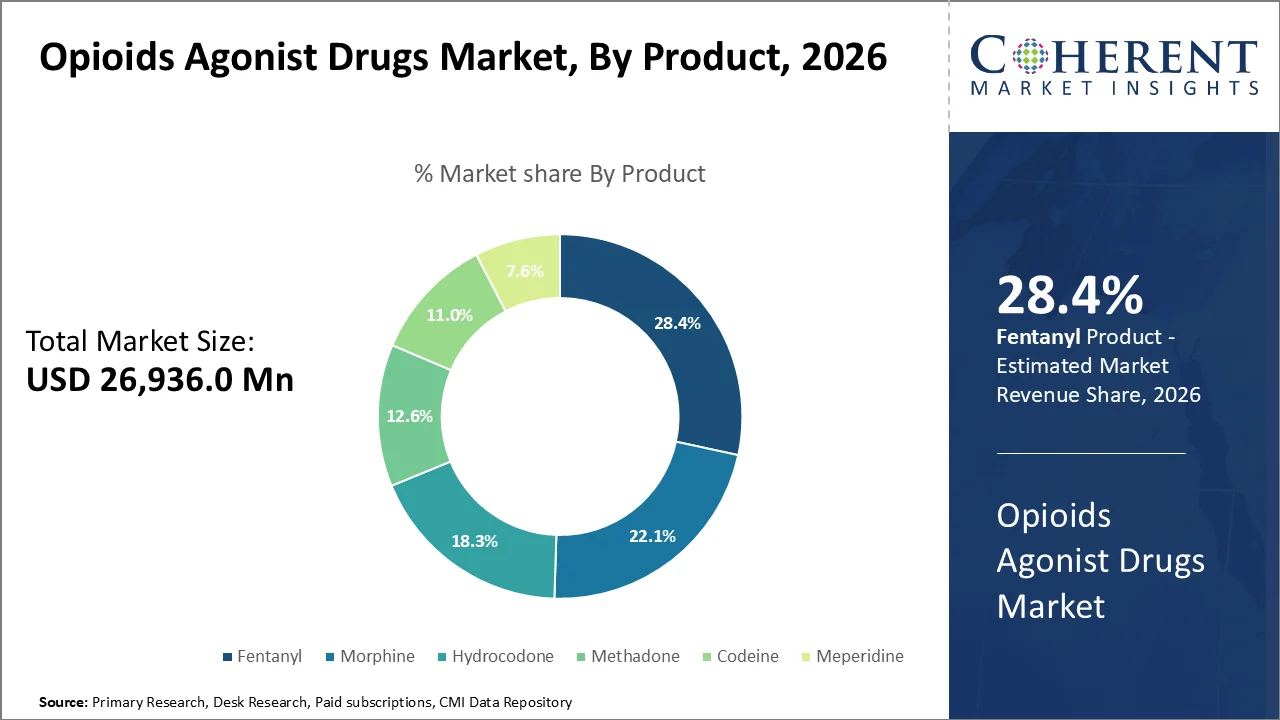
Why is Fentanyl the Leading Product Segment in the Opioids Agonist Drugs Market?
The Fentanyl opioid agonist drugs market is expected to occupy the highest revenue share in 2026, with an estimated product segment share of about 28.4%. Its domination is due to the high strength of Fentanyl compared to morphine (by 50 to 100 times), fast acting, and wide use in treating intense pain.
As per the U.S. Food and Drug Administration (FDA), fentanyl and fentanyl analogs are Schedule II drugs because of their strong analgesic effects, and they play a crucial part in treating pain despite being under strict regulation.
- Current Industry Events of 2026
- Market Size Estimation
- Regional Breakdown
- Competitive Landscape
- Customer Intelligence
- Segmental Analysis
- Pricing Analysis
- Key Market Drivers, Challenges & Future Trends
- Customized Insights Section
Which Therapeutic Application Segment Dominates the Market?
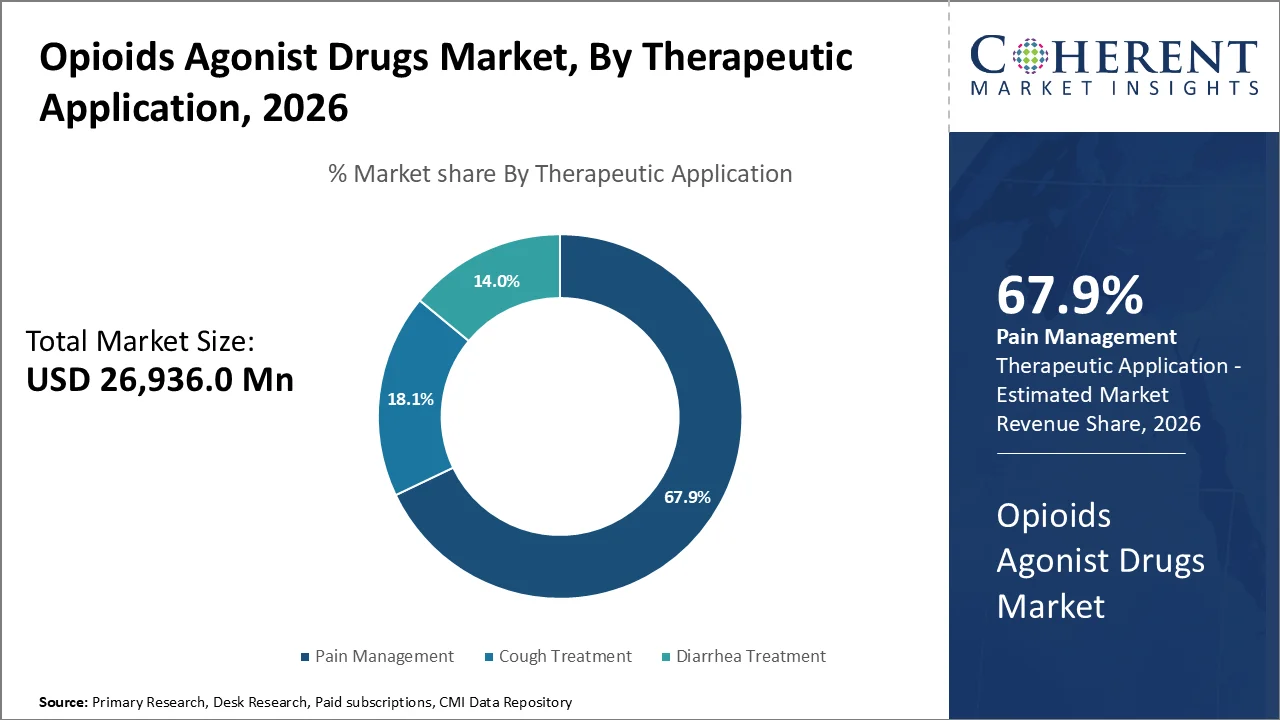
The Pain Management category is anticipated to lead the opioids agonists drugs market in 2026 with a share of around 67.9%. The increasing global prevalence of conditions like arthritis, neuropathic pain, cancer pain, and post-operative pain is expected to be the main reason behind the leading share of the market.
The opioid agonists are still among the most potent pharmacological agents for treating moderate-to-severe pain, especially for hospital and palliative care patients. The prevalence of their application is directly related to increased surgery cases and an aging population that is likely to develop degenerative bone and joint diseases.
As per the report by the CDC, opioids are often prescribed for pain, and around 3% to 4% of American adults are on long-term opioid treatment, which highlights their significance in modern medicine.
Rising Prevalence of Chronic Pain Disorders is Driving Growth in the Opioids Agonist Drugs Market
The growing prevalence of chronic pain disorders is fueling the global consumption of opioid agonist medicines. Opioid agonists have continued to play a key role in the treatment of cancer-related pain, postoperative pain, neuropathic pain, pain caused by osteoarthritis, and serious musculoskeletal disorders. The increasing elderly population, growing number of surgeries, and escalating incidence of chronic diseases are boosting the requirement for pain relief medicines.
According to the WHO, by the year 2030, 1 in 6 persons around the world would be more than 60 years old, thus making them susceptible to chronic pain syndrome, arthritis, and cancers that cause pain and are treated using opioids.
Rising Cancer Burden and Palliative Care Demand are Accelerating Market Expansion
The increasing prevalence of cancers around the globe has led to an increased demand for opioid agonists. The International Agency for Research on Cancer (IARC) estimates that cancer patients worldwide will increase to 35 million by 2050, which is an increase of 77% compared to the number of patients. There will be a surge in the use of opioids in managing pain and supporting care. Fentanyl, morphine, and methadone are examples of opioid analgesics that can be used to alleviate moderate to severe cancer pain. Growth in palliative care service provision and knowledge regarding pain relief is contributing to the market's development.
Current Events and Their Impact on the Opioids Agonist Drugs Market
Current Event | Description and its Impact |
2025 U.S. Opioid Prescribing Guideline Implementation and Monitoring Expansion |
|
Rising Global Cancer Burden and Expansion of Palliative Care Services |
|
Opioids Agonist Drugs Market Trends
- The aging population leads to greater need for long-term pain management: By 2030, 1 in 6 persons worldwide will be over age 60, resulting in a higher incidence of arthritis and chronic pain.
- Increased regulatory oversight for prescribing opioids: The FDA requires implementation of REMS programs for risk evaluation and safe prescribing practices.
- More non-opioid analgesics used to decrease acute opioid use: FDA has approved the first-ever non-opioid pain medication (2025) for acute pain relief purposes.
- The opioid overdose epidemic affecting prescribing practices worldwide: Approximately 105,000 deaths occurred from drug overdoses (2023 in the U.S.), with 76% caused by opioids
Regional Insights
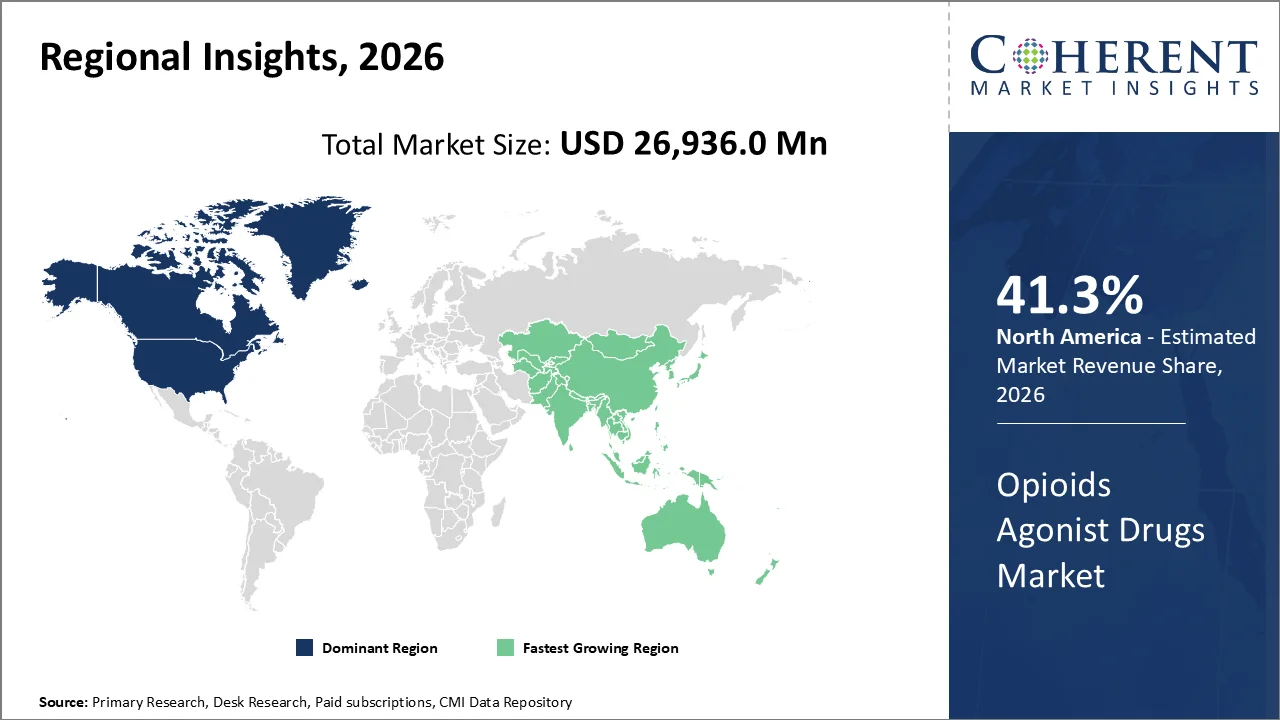
North America Dominates the Opioids Agonist Drugs Market
North America is projected to take the lead in the global Opioids Agonist Drugs Market, contributing around 41.3% market share by 2026, owing to the presence of many chronic pain cases, good health care facilities, and increased use of prescription pain management drugs.
Additionally, the National Institutes of Health (NIH) highlights the high surgical and clinical burden in the U.S., which continues to drive analgesic usage in hospitals and post-operative care.
Asia Pacific is the Fastest-Growing Region in the Opioids Agonist Drugs Market
The Asia-Pacific region is estimated to become the fastest-growing market from 2026 to 2033 because of increasing healthcare spending, growing chronic disease burden, and increased accessibility to surgery. Aging trends worldwide are becoming increasingly rapid, resulting in higher chronic disease incidence rates, according to the World Health Organization (WHO).
In January 2025, the U.S. Food and Drug Administration (FDA) approved Journavx (suzetrigine) developed by Vertex Pharmaceuticals for the treatment of moderate-to-severe acute pain in adults.
Growing Chronic Pain Burden is Accelerating the Opioids Agonist Drugs Market Demand in United States
The United States opioids agonist drugs market is witnessing consistent increase in demands on account of a high incidence of chronic pain ailments, cancer cases, and post-surgical pains. Fentanyl, morphine, and methadone belong to the opioid agonists drugs used to treat patients suffering from extreme pain in hospitals.
As per the data presented by the Centers for Disease Control and Prevention, around 24.3% of adults in the United States (or 1 out of every 4 people) suffered from chronic pain conditions in 2023, whereas 8.5% faced high-impact chronic pain.
Japan Opioids Agonist Drugs Market Trends
The Japan opioids agonist drugs market is experiencing steady growth due to its population being among the fastest aging in the world. Opioid agonists are mainly administered under controlled settings in hospitals for managing cancer pain and post-operative care.
Japan is classified as a “super-aged society,” with nearly 30% of its population aged 65 or older, significantly increasing demand for long-term pain management therapies and oncology care.
Who are the Major Companies in Opioids Agonist Drugs Industry
Some of the major key players in Opioids Agonist Drugs are Pfizer Inc., Purdue Pharma, Boehringer Ingelheim, Janssen Pharmaceuticals, Inc., Actavis Plc., Sanofi, Sun Pharmaceutical Industries Ltd., Mallinckrodt Pharmaceuticals, Egalet Corporation, and Endo Pharmaceuticals Inc.
Key News
- In March 2025, Mallinckrodt plc and Endo Inc. announced a definitive merger agreement valued at approximately $6.7 billion, combining two pharmaceutical companies with significant exposure to generic pharmaceuticals and a history of opioid litigation.
Market Report Scope
Opioids Agonist Drugs Market Report Coverage
| Report Coverage | Details | ||
|---|---|---|---|
| Base Year: | 2025 | Market Size in 2026: | USD 26,936.0 Mn |
| Historical Data for: | 2020 To 2024 | Forecast Period: | 2026 To 2033 |
| Forecast Period 2026 to 2033 CAGR: | 4.2% | 2033 Value Projection: | USD 35,945.2 Mn |
| Geographies covered: |
| ||
| Segments covered: |
| ||
| Companies covered: | Pfizer Inc., Purdue Pharma, Boehringer Ingelheim, Janssen Pharmaceuticals, Inc., Actavis Plc., Sanofi, Sun Pharmaceutical Industries Ltd., Mallinckrodt Pharmaceuticals, Egalet Corporation, and Endo Pharmaceuticals Inc. | ||
| Growth Drivers: |
| ||
| Restraints & Challenges: |
| ||
Analyst Opinion
- Opioid agonist drugs remain a core and non-substitutable therapy for severe pain, especially in cancer, trauma, and post-surgical care. Despite regulatory pressure, their clinical necessity ensures stable baseline demand across global healthcare systems.
- The market is inherently buoyed by the significant prevalence of chronic pain in the world, which comprises about 20% to 25% of adults suffering from chronic pain in the developed world, based on data provided by the CDC.
- The demand is structural rather than cyclical, because the opioids are required in emergency situations, intensive care units, and oncology departments where there are no alternatives to opioids in managing extreme pain.
- Increasing surgical volumes globally continue to reinforce opioid use in perioperative and post-operative pain management, where fast-acting agents like fentanyl and morphine remain standard care options.
- However, the market is facing persistent structural constraints, including strict regulatory controls, prescription monitoring programs, and DEA manufacturing quotas due to concerns around misuse, addiction, and overdose risks.
- The competitive landscape is shifting toward abuse-deterrent formulations and controlled-release opioids, rather than volume expansion, reflecting a transition from growth-driven to compliance-driven market dynamics.
- Growing adoption of non-opioid analgesics and multimodal pain management approaches is gradually moderating opioid growth in acute pain segments, but has limited impact on severe and cancer-related pain demand.
- Overall, the market is evolving from expansion-led growth to regulated, necessity-driven demand, where innovation is focused on safety, controlled distribution, and reduced abuse potential rather than replacement of opioids entirely.
Speak to the analyst
Want personalized insights?
Take the findings above to one of our principal consultants, or have the report rebuilt around the segments, geographies and competitors you actually track.
Market Segmentation
- By Product (Revenue, USD Mn, 2021-2033)
- Codeine
- Fentanyl
- Meperidine
- Methadone
- Morphine
- Hydrocodone
- By Therapeutic Application (Revenue, USD Mn, 2021-2033)
- Pain Management
- Neuropathic Pain Migraine
- Back Pain
- Osteoarthritis Pain
- Cancer Pain
- Others
- Cough Treatment
- Diarrhea Treatment
- Pain Management
- By Region (Revenue, USD Mn, 2021-2033)
- North America
- U.S.
- Canada
- Latin America
- Brazil
- Mexico
- Argentina
- Rest of Latin America
- Europe
- Germany
- U.K.
- France
- Italy
- Spain
- Russia
- Rest of Europe
- Asia Pacific
- China
- India
- Japan
- Australia
- South Korea
- ASEAN
- Rest of Asia Pacific
- Middle East
- GCC
- Israel
- Rest of Middle East
- Africa
- South Africa
- Central Africa
- North Africa
- North America
Sources
Primary Research Interviews
- Pain management specialists
- Anesthesiologists
- Oncologists and palliative care physicians
- Hospital administrators
- Pharmacy procurement managers
- Medical device and pharmaceutical distributors
- Key opinion leaders (KOLs) in pain management and anesthesia
Databases
- World Health Organization (WHO)
- Centers for Disease Control and Prevention (CDC)
- National Institutes of Health (NIH)
- Organisation for Economic Co-operation and Development (OECD)
- U.S. Food and Drug Administration (FDA)
- European Medicines Agency (EMA)
- U.S. Drug Enforcement Administration (DEA)
Magazines
- Pain Medicine News
- The Pain Practitioner
- Pharmaceutical Executive
- Medscape News
- com News Section
Journals
- Pain (International Association for the Study of Pain Journal)
- The Journal of Pain
- Pain Medicine
- Anesthesiology
- The Lancet Neurology
- JAMA Network Open
Newspapers
- The New York Times
- The Guardian
- The Wall Street Journal
- Financial Times
- Reuters Health
Associations
- International Association for the Study of Pain (IASP)
- American Pain Society (APS)
- American Society of Anesthesiologists (ASA)
- European Pain Federation (EFIC)
- World Federation of Societies of Anaesthesiologists (WFSA)
Public Domain Sources
- Company Annual Reports and Investor Presentations
- U.S. FDA Drug Approval Database
- Government Health Ministry Publications (U.S., EU, Japan, India)
- Clinical Trial Registries such as ClinicalTrials.gov
- WHO Global Health Observatory Data
Proprietary Elements
- CMI Data Analytics Tool
- Proprietary market intelligence repository (10+ years historical dataset)
Get access to 250+ pages report
Every segment, forecast, competitor profile and data table behind the analysis above — available for instant download.
- ESOMAR Member
- ISO 9001:2015 Certified
- D-U-N-S Registered
- GDPR & CCPA Compliant
Missing comfort of reading report in your local language? Find your preferred language:
Transform your Strategy with Exclusive Trending Reports
Frequently Asked Questions
The Opioids Agonist Drugs Market is expected to reach USD 35,945.2 Mn in 2033, growing from USD 26,936.0 Mn in 2026 at a CAGR of 4.2%.
Major players operating in the global opioids agonist drugs market include Pfizer Inc., Purdue Pharma, Boehringer Ingelheim, Janssen Pharmaceuticals, Inc., Actavis Plc., Sanofi, Sun Pharmaceutical Industries Ltd., Mallinckrodt Pharmaceuticals, Egalet Corporation, and Endo Pharmaceuticals Inc.
Strict regulatory controls, risk of addiction and overdose, and increasing adoption of non-opioid pain management therapies are limiting market expansion.
Rising chronic pain prevalence, increasing cancer cases, growing aging population, and higher surgical volumes are key factors driving market growth.
The Opioids Agonist Drugs Market is anticipated to grow at a CAGR of 4.2% between 2026 and 2033.
North America is expected to account for the largest market share in the global opioids agonist drugs market over the forecast period.
The opioids agonist drugs market refers to pharmaceutical drugs that activate opioid receptors in the brain to relieve moderate-to-severe pain, commonly used in cancer care, surgery, and chronic pain management.