Pasta Filata Cheese Market Analysis & Forecast: 2026-2033

The Pasta Filata Cheese Market is estimated to be valued at USD 24,000 Mn in 2026 and is expected to reach USD 35,000 Mn by 2033, growing at a compound annual growth The rate (CAGR) of 5.5% from 2026 to 2033.
Pasta filata cheese is also referred to as spun paste or stretched curd. The process involves heating and stretching curd just before forming the final cheese product. It is mainly used to produce mozzarella cheese by utilizing a traditional method where fresh curd is submerged in hot water and stretched by hand. In commercial production, mechanical mixers are employed to create pasta filata cheese in bulk.
The demand for pasta filata cheese is expected to surge owing to its increasing use in both residential and commercial food production. This cheese offers several advantages over others, including desirable elasticity when heated and the ability to form long strips when pulled. In particular, the trend of using pasta filata cheese for baking pizzas and pastas is growing in European and North American markets. However, residential use is anticipated to represent a smaller share of the market during the forecast period, as more individuals in both genders join the workforce.
In addition, companies in the pasta filata market are making investments in the development of cheese processing equipment to meet the rising demand. For instance, Tetra Pak International S.A. has developed a fully automated system for the production of pasta filata cheese. This system is engineered to regulate various parameters such as maintaining a specified pH range for the cheese and guaranteeing optimal form stability. These parameters are essential for the subsequent processing stages.
|
Current Event |
Description and the Impact |
|
Consumer Trends and Market Demand Shifts
|
|
|
Technological Innovation and Market Disruption |
|
Uncover macros and micros vetted on 75+ parameters: Get instant access to report
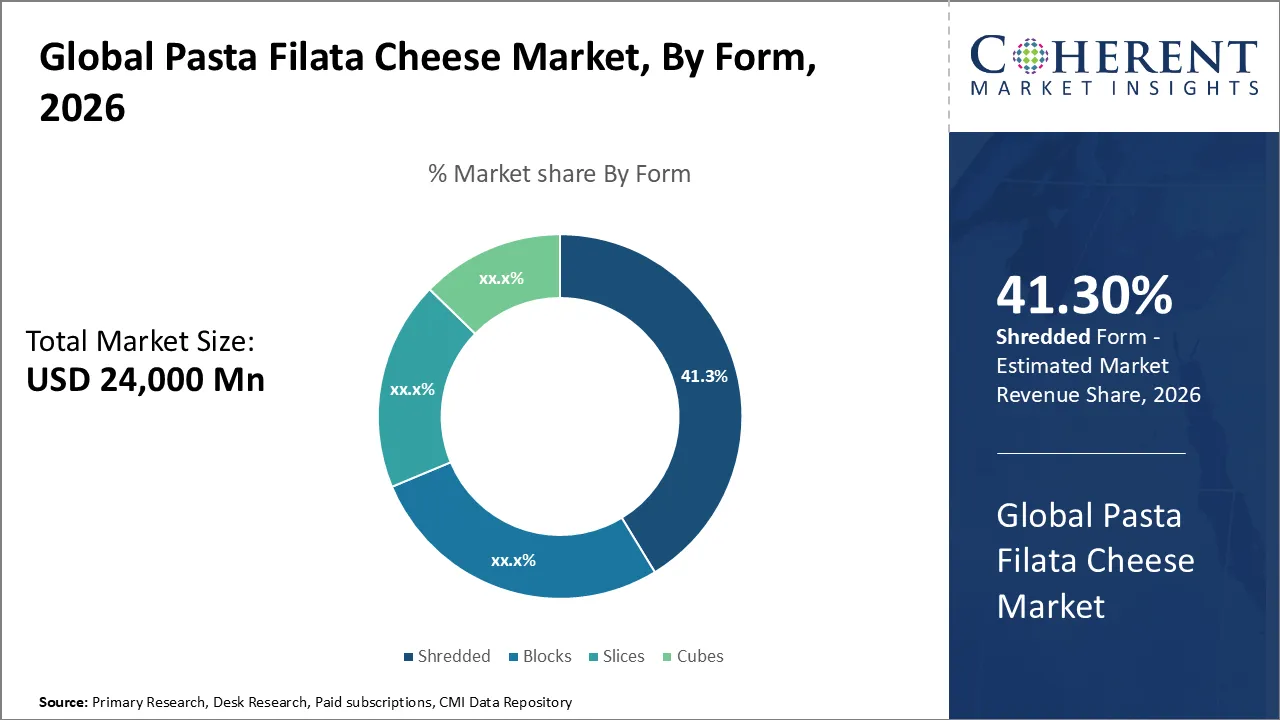
In terms of form, the shredded segment contributes the highest share of 41.30% in the market in 2026. This leadership is owing to its essential role in the booming global pizza industry and the increasing consumer demand for convenience in home cooking. Consumers prefer pre-shredded formats that eliminate the need for manual preparation as lifestyles become more fast-paced. This is significant, particularly in North America and Europe where shredded mozzarella and provolone are staples for quick residential meals. In the commercial sector, pizzerias and fast-casual restaurants are dependent on shredded pasta filata for consistent portion control and reduced labor costs.
For instance, in May 2024, Kraft Natural Cheese has introduced Signature Shreds, a new type of thick-cut, restaurant-style cheese. The collection offers ultimate recipe versatility. It is available in three initial varieties namely Cheddar Blend, Mozzarella Blend, and Mexican Blend.
In terms of cheese type, the mozzarella segment contributes the highest share of 66.40% in 2026 of the market. This is due to its role in global cuisines, particularly Italian-style foods like pizza and pasta. Mozzarella cheese demonstrates functional properties like exceptional meltability, stretchability, and elasticity, thus making it ideal for pizza toppings and baked dishes. The availability of mozzarella in diverse forms has increased its adoption, propelling the growth in this segment. The shredded mozzarella is becoming popular due to its convenience for both home cooks and quick-service restaurants. The fast expansion of international pizza chains and the popularity of frozen pizza, which provide a massive, steady demand, are also contributing to the growth. The manufacturers are coming up with health-conscious and premium products to meet evolving consumer preferences.
For instance, in March 2024, Arla Foods, one of the world's leading mozzarella producers, has announced its largest investment to date in the UK, totaling USD 210 million. This investment will implement advanced production technologies at the Taw Valley dairy in southwest England.
To learn more about this report, Download Free Sample
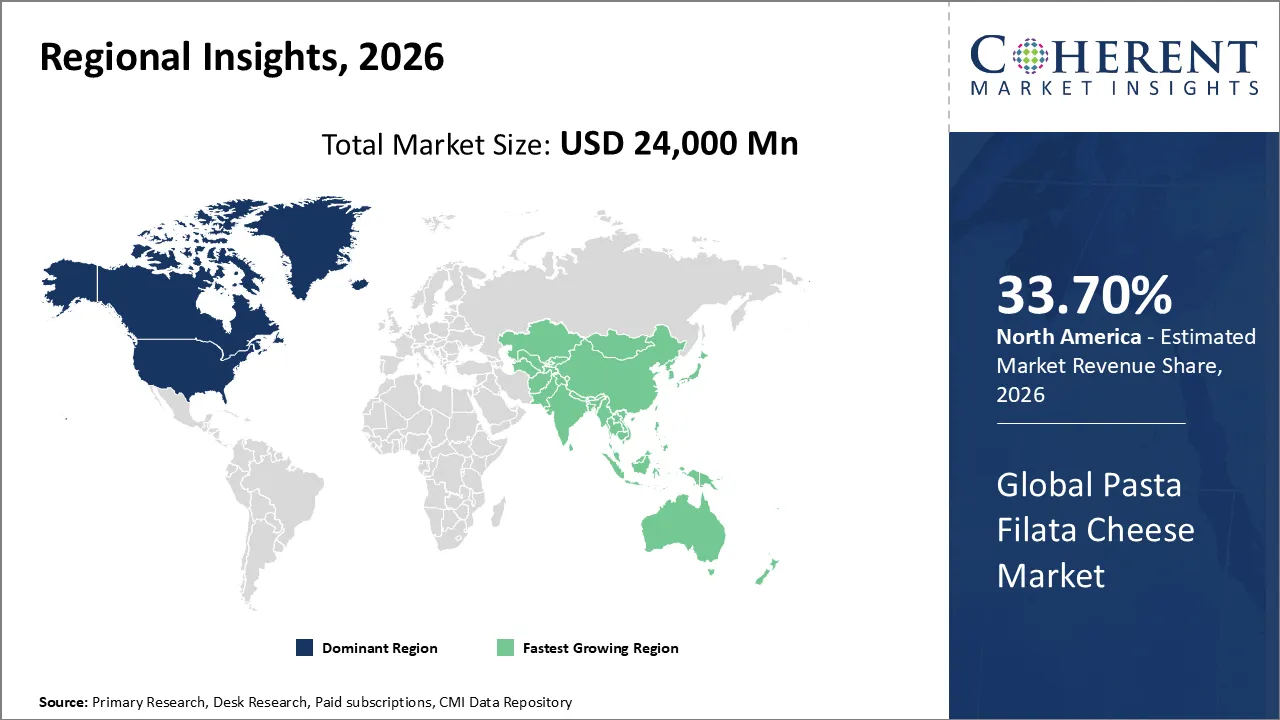
North America has remained the dominant region with 33.70% in 2026 of the global Pasta Filata Cheese Market over the past decade. The US, with its massive dairy infrastructure and insatiable consumer appetite for cheese-heavy cuisines, is the driving force behind this growth. The region's highly developed foodservice sector, particularly the prevalence of pizza chains and fast-casual Italian restaurants, which consume vast quantities of shredded mozzarella and provolone, is also contributing to this growth. In addition, the market's growth is also propelled by high disposable income and a shift toward convenience-oriented retail products. Consumers in this region are the primary drivers of the shredded and sliced segments, favoring ready-to-use formats for home cooking.
For instance, in July 2025, Lactalis USA intends to invest more than USD 75 million to increase production at its two dairy facilities in New York, responding to the growing demand for high-protein meals. The Buffalo plant, operating under the Galbani brand, produces provolone, mozzarella, and ricotta.
The Asia Pacific region stands out as the fastest-growing segment in the market. This growth is owing to the Westernisation of dietary habits among a burgeoning middle class, particularly in powerhouse economies like China and India. The demand for convenience foods and Western-style cuisines is rising, making pasta filata varieties like mozzarella essential ingredients as urban populations grow and lifestyles become more fast-paced. The expansion of global fast-food chains and Quick Service Restaurants (QSRs) across the region acts as a massive catalyst for this growth. The proliferation of international pizza franchises and local Italian-inspired eateries has created a stable, high-volume demand for shredded mozzarella, which is prized for its superior melting and stretching properties.
Governments in the region are also playing a role by improving cold chain logistics and infrastructure, which allows for the wider distribution of perishable cheese products beyond major metropolitan hubs. While cow milk remains the primary source, the region's massive dairy industry is increasingly diversifying into specialty pasta filata to meet both domestic and export needs. This combination of demographic shifts, infrastructure investment, and the booming foodservice sector ensures that Asia Pacific remains the most dynamic landscape for market investors and global dairy exporters.
For instance, in March 2025, at the AAHAR 2025 exhibition, Paras Dairy, a prominent dairy business in India, unveiled its premium cheese brand, Galacia. This launch signifies a milestone in the Indian dairy sector and highlights the company’s dedication to quality, innovation, and meeting consumer demands.
The US leads the market owing to its extensive industrial dairy infrastructure and a consumer culture that values convenience and high-volume consumption. The country is a global hub for the foodservice sector, especially within the pizza industry, which is the largest consumer of mozzarella. The leading firms like Leprino Foods and Saputo are propelling the market growth via advanced manufacturing techniques. These techniques improve the stretch and melt properties that are essential for industrial pizzerias and frozen food producers. In addition, there is a shift toward premiumization, characterized by increasing demand for organic and grass-fed cow milk sources, along with artisanal varieties like burrata and provolone.
China is the principal contributor to growth in the Asia Pacific, driven by a burgeoning urban middle class is increasingly incorporating cheese into its daily diet. This shift is most visible in the foodservice sector, where the explosive expansion of global pizza franchises and local bakery chains has created an insatiable demand for mozzarella. A critical driver of this growth is the rising disposable income of the Chinese population, paired with a nationwide push for high-protein nutritional standards. The parents are viewing pasta filata, particularly in convenient, snackable forms like string cheese or pearls, as a healthy alternative to traditional snacks. This has led to a increase in the shredded and snack-form segments within major retail hubs like Shanghai, Beijing, and Guangzhou. In addition, the growth of E-commerce and rapid delivery apps has revolutionized accessibility, allowing chilled dairy products to be delivered to doorsteps within minutes, bypassing traditional logistical hurdles.
| Report Coverage | Details | ||
|---|---|---|---|
| Base Year: | 2025 | Market Size in 2026: | USD 24,000 Mn |
| Historical Data for: | 2020 To 2024 | Forecast Period: | 2026 To 2033 |
| Forecast Period 2026 to 2033 CAGR: | 5.5% | 2033 Value Projection: | USD 35,000 Mn |
| Geographies covered: |
|
||
| Segments covered: |
|
||
| Companies covered: |
The Kraft Heinz Company, Fonterra Co-operative Group Limited, Lactalis International, Grande Cheese Company, Arla Foods Inc., BelGioioso Cheese Inc., Organic Valley, That’s Amore Cheese, M.J. Dairies, and Sheepka 99 JSC. |
||
| Growth Drivers: |
|
||
| Restraints & Challenges: |
|
||
Uncover macros and micros vetted on 75+ parameters: Get instant access to report
The increasing demand for pizza and ready-to-eat meals is the main driver behind the growth of the pasta filata cheese market. The rising urbanization and time-constrained lifestyles are driving consumers toward convenient yet high-quality food options. The pasta filata cheese, particularly mozzarella, is widely favored in these applications. This is due to its functional performance like excellent melting characteristics, uniform browning, and the distinctive stretch associated with pizza consumption. In addition, the growth of frozen and chilled ready-to-eat products has led consumers to maintain consistency in texture and flavor. The demand is also driven by the global adoption of Western dairy habits and the continual expansion of quick-service restaurant chains in emerging economies.
The Pasta Filata cheese market demonstrates sustained expansion, supported by strong consumption fundamentals and broad applicability across foodservice and retail channels. The category is structurally anchored by mozzarella, which accounts for the majority of production and consumption volumes due to its extensive use in pizza, pasta, bakery toppings, and ready-to-eat foods. Industry data consistently show mozzarella contributing well over half of total Pasta Filata cheese volumes, underscoring its central role in market stability.
From a regional perspective, North America remains the leading consumption hub, driven by high per-capita cheese intake, a mature quick-service restaurant ecosystem, and advanced cold-chain infrastructure. Europe continues to benefit from strong artisanal and protected-origin cheese traditions, while Asia Pacific is witnessing accelerated uptake, supported by urbanization, westernization of diets, and rising demand for convenience foods.
Distribution dynamics highlight the dominance of supermarkets, hypermarkets, and foodservice distributors, which together account for a substantial portion of sales due to scale efficiency and consistent demand from institutional buyers. Additionally, shredded, sliced, and processed formats represent a significant share of volumes, reflecting the growing emphasis on convenience and operational efficiency in commercial kitchens.
Product innovation remains a key competitive lever, with increasing launches of low-fat, high-protein, and clean-label variants. Overall, the Pasta Filata cheese market reflects a mature yet evolving landscape, where volume stability is reinforced by format innovation, expanding foodservice penetration, and shifting consumer preferences toward functional dairy products.
Definition: The Pasta filata cheese market is a distinct sector of the global dairy industry focused on the production and trade of stretched curd cheeses created through a specific heating and kneading process. The market is mainly categorized by diverse product varieties like mozzarella, provolone, scarmoza, and kashkaval. It is structurally divided into various formats, including blocks, shreds, and slices, to accommodate both industrial and retail needs. Distribution pathways for these products are split between the food service sector, industrial food manufacturers, and direct consumer retail via supermarkets. Geographically, the market is well established in Asia Pacific and North America while experiencing rising trade activity and market penetration across emerging economies. The industry is characterized by a mix of high-volume cow milk production and a growing niche for premium buffalo or goat milk varieties.
Share
Share
About Author
Sakshi Suryawanshi is a Research Consultant with 6 years of extensive experience in market research and consulting. She is proficient in market estimation, competitive analysis, and patent analysis. Sakshi excels in identifying market trends and evaluating competitive landscapes to provide actionable insights that drive strategic decision-making. Her expertise helps businesses navigate complex market dynamics and achieve their objectives effectively.
Missing comfort of reading report in your local language? Find your preferred language :
Transform your Strategy with Exclusive Trending Reports :
Frequently Asked Questions
Joining thousands of companies around the world committed to making the Excellent Business Solutions.
View All Our Clients
 Schedule a meeting with report Author