Patient Portal Software Market Analysis & Forecast: 2026-2033

The Patient Portal Software Market is estimated to be valued at USD 3.16 Bn in 2026 and is expected to reach USD 6.43 Bn by 2033, exhibiting a compound annual growth rate (CAGR) of 12.1% from 2026 to 2033.
Healthcare providers are rapidly advancing the Patient Portal Software Market by adopting digital platforms that improve patient engagement, streamline clinical and administrative workflows, and strengthen care coordination. Patient portals give users secure, convenient access to medical records, appointments, test results, and direct communication with providers through web and mobile platforms. Providers increasingly integrate these portals with electronic health records and telehealth services, while prioritizing patient-centric care, which continues to accelerate adoption across hospitals, clinics, and modern healthcare systems.
|
Current Events |
Description and its impact |
|
Regulatory and Policy Developments in Healthcare Data Privacy |
|
|
Technological Advancements in AI and Interoperability |
|
|
Geopolitical Events Affecting Global Healthcare Technology Supply Chains |
|
Uncover macros and micros vetted on 75+ parameters: Get instant access to report
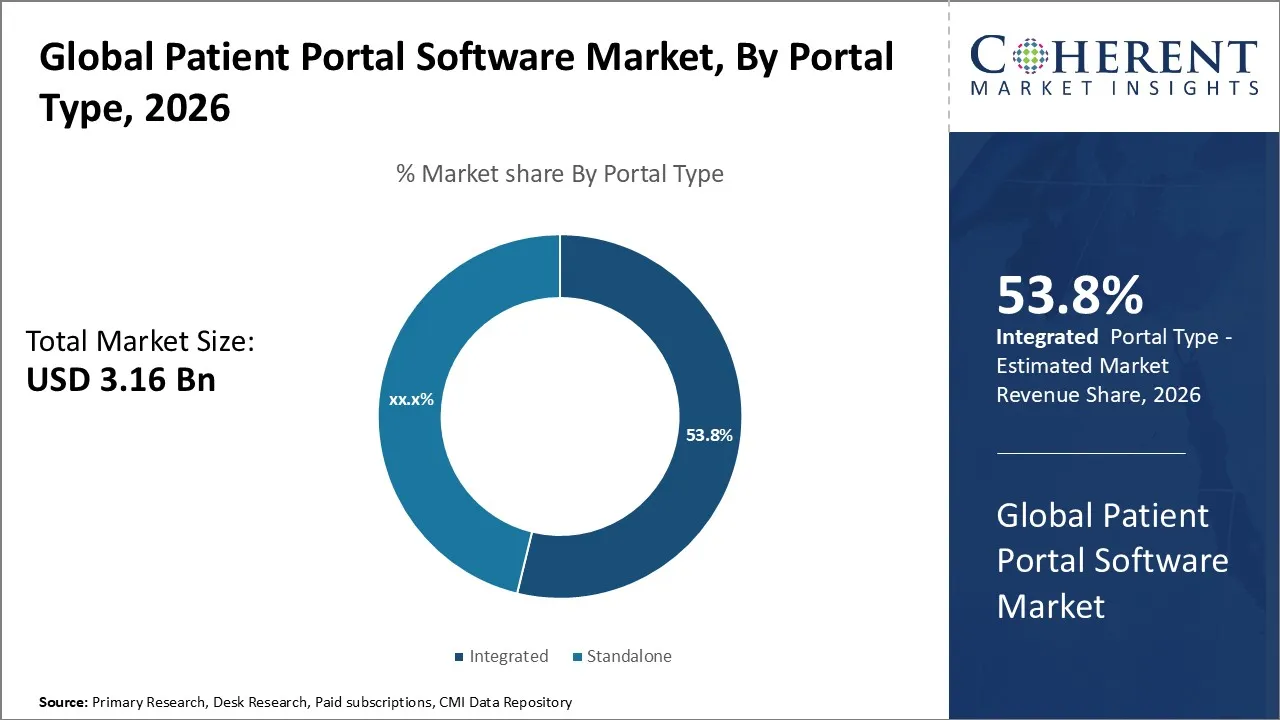
Integrated hold the largest market share of 53.8% in 2026. Healthcare organizations increasingly adopt integrated patient portal software to unify clinical, administrative, and financial operations. By connecting with electronic health records, providers access real-time patient data, reduce duplication, and make informed decisions. These solutions enable secure data exchange, improve care coordination, and streamline workflows. Growing demands for interoperability, accurate data, and digital care drive hospitals to implement fully integrated portals.
For instance, in September 2025, Patients using the Oracle Health Patient Portal can now access AI features that provide secure, plain-language explanations of diagnoses, test results, and treatments, and ask questions directly within the portal.
Web/cloud based expected to hold largest market share of 52.8% in 2026. Healthcare providers drive the adoption of web- and cloud-based patient portals by prioritizing flexible, accessible, and cost-efficient digital solutions. Cloud deployment accelerates implementation, enables remote patient data access, and allows continuous system updates without heavy infrastructure. These portals support real-time patient-provider interactions across devices, and as telehealth and scalable IT expand, organizations increasingly use them to enhance care delivery and operational efficiency.
For instance, in September 2025, Milliman MedInsight® launches the MedInsight Innovation Portal, offering healthcare organizations advanced analytics, intuitive workflows, and cloud services to accelerate innovation and support data-driven decisions.
Hospitals & Clinics acquired the prominent market share of 43.8% in 2026. Hospitals and clinics adopt patient portal software to enhance operational efficiency and strengthen patient relationships. The portals streamline administrative tasks like scheduling and billing while providing patients secure access to records and test results. By enabling clear communication and coordinated care, providers improve outcomes and satisfaction. Growing emphasis on digital healthcare, engagement, and compliance drives portals as a core component of modern care.
For instance, in October 2025, Healthcare organizations across Louisiana launched MyChart Central statewide, providing patients with a secure, unified platform to access medical records, communicate with care teams, and manage their care.
To learn more about this report, Download Free Sample
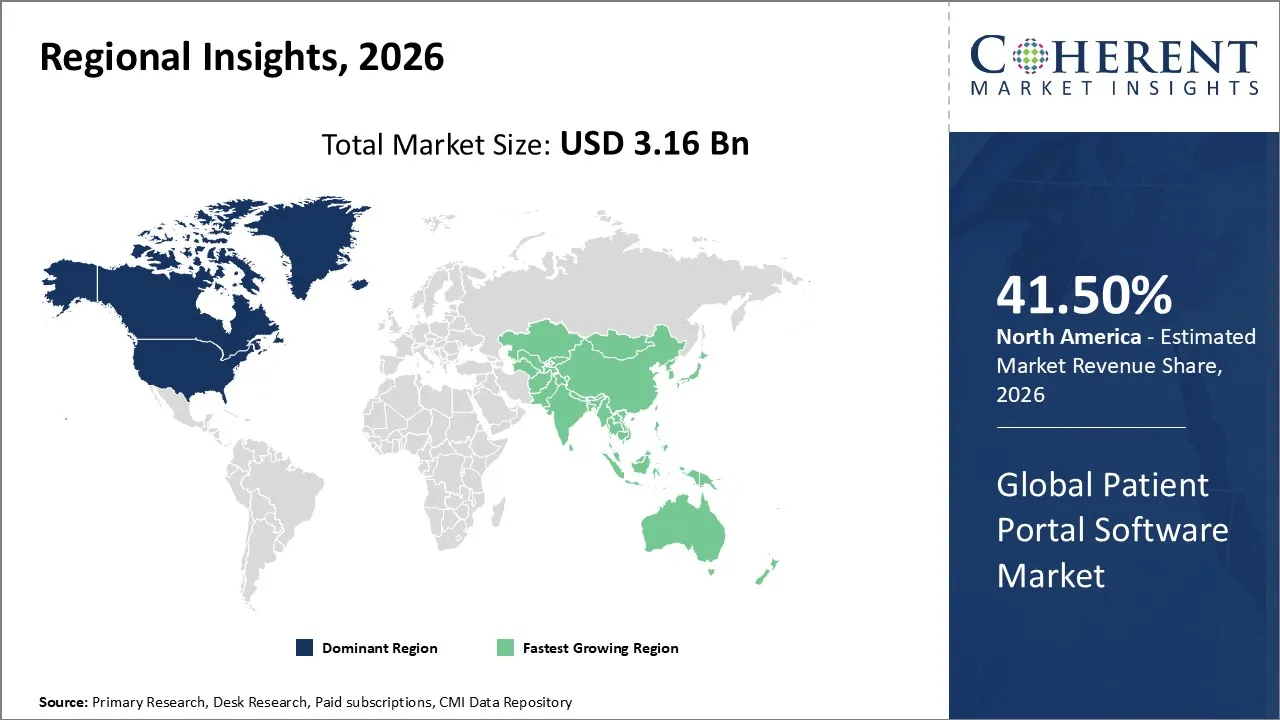
North America dominates the overall market with an estimated share of 41.50% in 2026. Healthcare providers in North America are shaping the Patient Portal Software Market by adopting advanced health IT systems and prioritizing greater interoperability. They are enhancing patient engagement through secure messaging, mobile access, and integrated digital services. Telehealth integration, along with regulatory initiatives promoting data access and transparency, is driving continuous innovation. Vendors are actively improving user experience with intuitive interfaces and advanced analytics. These developments demonstrate the region’s commitment to delivering patient-centric, connected care across hospitals, clinics, and healthcare networks. For instance, in November 2025, Novartis unveiled a direct-to-patient platform in the US, allowing cash-paying patients prescribed Cosentyx® (secukinumab) to buy it at a 55% discount.
Healthcare providers across the Asia Pacific region are driving the adoption of patient portal software as they digitize services and expand telehealth and mobile health offerings. Rising internet and smartphone usage is prompting patients to schedule appointments, access medical records, and communicate with providers online. Governments and healthcare organizations are investing in IT infrastructure to enhance access and efficiency, while demand grows for scalable, cloud-based portals in both urban and emerging markets. These trends highlight the region’s push toward modern, patient-focused digital healthcare. For instance, in July 2025, AIIMS Jhajjar launched the digital portal www.Sahaym.in to provide senior citizens with health resources, preventive care tools, and mental wellness support.
Healthcare providers in the United States are driving trends in the patient portal software market by enhancing patient engagement and expanding digital access to care. They are integrating portal features directly into electronic health record systems to enable secure access to medical records, manage appointments, and facilitate direct communication, meeting growing patient demand for convenient online healthcare tools. Providers are also incorporating telehealth services and strengthening data security, while leading U.S. vendors actively innovate to streamline workflows and enhance the overall user experience. For instance, in May 2025, Sanford Health enables patients to register as organ, eye, and tissue donors through MyChart, simplifying the process for those who wish to become registered donors.
Healthcare providers and government initiatives in India are driving the growth of patient portal software by digitizing health services. The expansion of the Ayushman Bharat Digital Mission is promoting connected digital health systems, enabling patients to access records and communicate with providers online. Increasing internet and smartphone usage is fueling demand for mobile-friendly, cloud-based portal tools, while hospitals, clinics, and remote communities are adopting telehealth and healthcare IT investments to improve digital access and streamline patient communication.
Healthcare providers are tailoring portal functions to individual needs, offering customized dashboards, targeted health reminders, and patient‑specific care recommendations. This personalization improves engagement and makes portals feel more relevant to users. Patients increasingly expect features like tailored wellness content, reminders for preventive care, and visuals that help interpret their health records. This trend is pushing vendors to embed adaptive interfaces and intelligent patient insights into their platforms.
Hospitals and clinics are prioritizing portals that integrate not just with electronic health records, but also with scheduling, billing, laboratory, and pharmacy systems. This unified approach eliminates double entry and improves workflow efficiency for staff while presenting a single, cohesive view of healthcare activities to patients. The focus is on interoperability and real‑time data exchange, enabling smoother transitions between care settings and enhancing overall clinical coordination.
Patient portals can leverage artificial intelligence to deliver tailored health insights, predictive care suggestions, and adaptive learning tools. By offering personalized health recommendations, automated reminders, and intuitive interfaces that adjust to user behavior, portals create deeper engagement. This opportunity extends to building chatbots, smart triage support, and tailored preventive care nudges, helping patients take proactive control of their health and driving long‑term portal adoption and loyalty.
| Report Coverage | Details | ||
|---|---|---|---|
| Base Year: | 2025 | Market Size in 2026: | USD 3.16 Bn |
| Historical Data for: | 2020 To 2024 | Forecast Period: | 2025 To 2032 |
| Forecast Period 2026 to 2033 CAGR: | 12.1% | 2032 Value Projection: | USD 6.43 Bn |
| Geographies covered: |
|
||
| Segments covered: |
|
||
| Companies covered: |
Napier Healthcare Solutions, Inc., Allscripts Healthcare Solutions Inc., Curemd Healthcare, Athenahealth Inc., Cerner Corporation, Nextgen Healthcare Information Systems LLC, GE Healthcare, Greenway Health LLC, Medfusion Inc., Eclinicalworks LLC, and PrognoCIS. |
||
| Growth Drivers: |
|
||
| Restraints & Challenges: |
|
||
Uncover macros and micros vetted on 75+ parameters: Get instant access to report
Share
Share
About Author
Komal Dighe is a Management Consultant with over 8 years of experience in market research and consulting. She excels in managing and delivering high-quality insights and solutions in Health-tech Consulting reports. Her expertise encompasses conducting both primary and secondary research, effectively addressing client requirements, and excelling in market estimation and forecast. Her comprehensive approach ensures that clients receive thorough and accurate analyses, enabling them to make informed decisions and capitalize on market opportunities.
Missing comfort of reading report in your local language? Find your preferred language :
Transform your Strategy with Exclusive Trending Reports :
Frequently Asked Questions
Joining thousands of companies around the world committed to making the Excellent Business Solutions.
View All Our Clients
 Schedule a meeting with report Author