

Plastisols Market Size and Forecast – 2026 to 2033
The Plastisols Market is anticipated to grow at a CAGR of 6.3% with USD 7.3 Bn in 2026 and is expected to reach USD 10.4 Bn in 2033. The Plastisols Market benefits from growing demand for durable coatings in automotive, construction, textiles, and consumer goods. Manufacturers increasingly use plastisols for screen printing, protective coatings, and flexible applications.
Key Takeaways
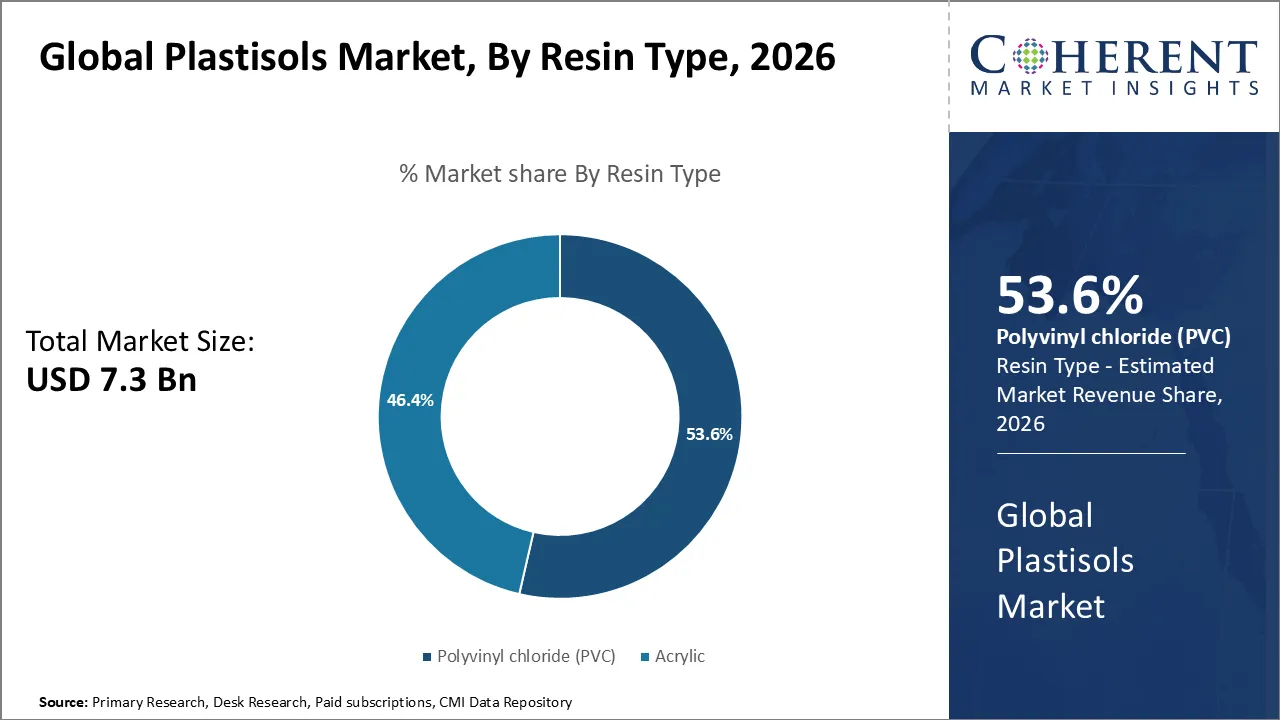
- Polyvinyl chloride (PVC) holds the largest market share of 53.6% in 2026 owing to the growing demand from automotive applications. India’s automobile exports increased 24% year-on-year to more than 6.7 million units in FY2026.
- Coatings expected to hold largest market share of 39.7% in 2026 owing to its expansion of construction activities. Public investment in India’s road and rail infrastructure has remained around USD 60 Bn annually, supporting the development transportation infrastructure.
- Automotive acquired the largest market share of 42.1% in 2026 owing to the growth in global vehicle production. India produced 34.71 million vehicles across passenger vehicles, commercial vehicles, three-wheelers, two-wheelers, and quadricycles in FY2025–26.
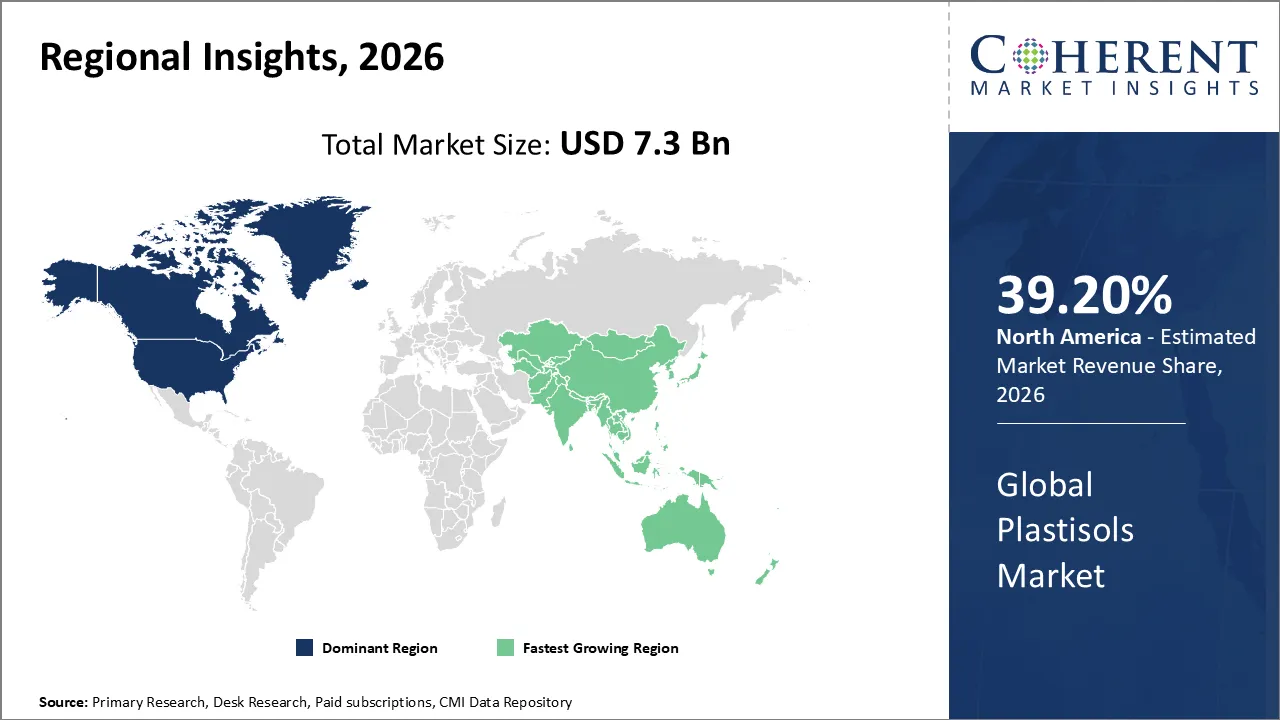
- North America is expected to acquire the dominant share of 39.2% in 2026 owing to its strong automotive manufacturing base.
Current Events and Their Impact on the Plastisols Market
Current Event | Description and its Impact |
DGTR recommends anti-dumping duty on PVC Paste Resin from the EU and Japan — March 2026 |
|
BIS Compliance for PVC Paste Resin |
|
Segmental Insights
- Current Industry Events of 2026
- Market Size Estimation
- Regional Breakdown
- Competitive Landscape
- Customer Intelligence
- Segmental Analysis
- Pricing Analysis
- Key Market Drivers, Challenges & Future Trends
- Customized Insights Section
Why is Polyvinyl chloride (PVC) Acquiring the Largest Market Share?
Polyvinyl chloride (PVC) holds the largest market share of 53.6% in 2026. Polyvinyl chloride (PVC) drives the Plastisols Market through its versatility, durability, and cost-effectiveness. Manufacturers use PVC-based plastisols extensively in automotive coatings, textiles, synthetic leather, flooring, roofing, and industrial applications. These materials deliver strong adhesion, flexibility, chemical resistance, and weatherability, meeting the performance requirements of various industries. Growing construction and automotive activities, rising demand for protective coatings, and expanding textile printing applications continue to increase PVC consumption. Manufacturers are also improving plastisol formulations to enhance processing efficiency and expand their applications.
Coatings expected to hold largest market share
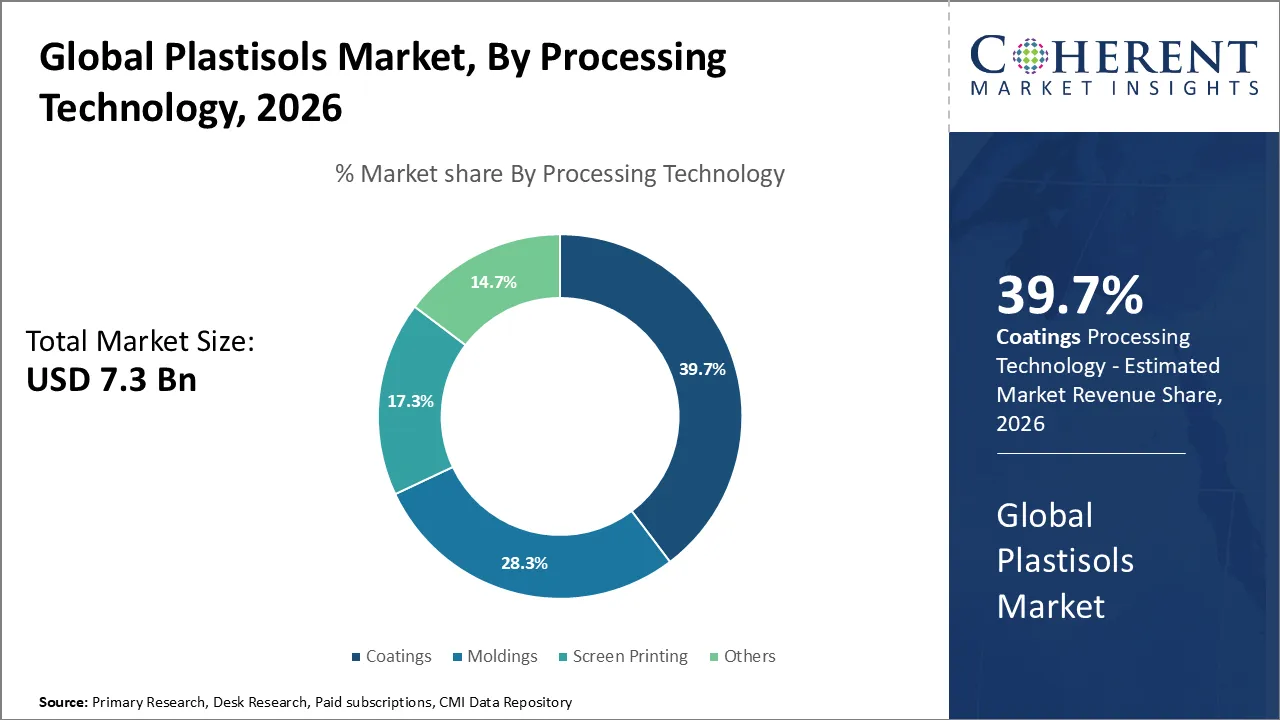
Coatings expected to hold largest market share of 39.7% in 2026 owing to its increasing demand for decorative finishes. The growing demand for durable, flexible, and protective surface solutions drives the Coatings segment in the Plastisols Market. Manufacturers apply plastisol coatings across automotive underbody protection, construction materials, metal finishing, flooring, roofing, and industrial products. These coatings protect surfaces against corrosion, weathering, chemicals, and abrasion while providing strong adhesion. Rising vehicle production, infrastructure development, renovation projects, and demand for long-lasting surface protection continue to expand their use. Manufacturers also develop advanced plastisol formulations to enhance performance, processing efficiency, and application flexibility.
Which End Use Industry segment dominates the market?
Automotive acquired the largest market share of 42.1% in 2026. The automotive industry fuels the Plastisols Market by increasing demand for durable coatings, sealants, and protective solutions. Automotive manufacturers apply plastisols to underbodies, seams, and components to prevent corrosion, reduce vibration, and protect surfaces from stone chips. Protective plastisol coatings reduce noise, wear, and damage caused by component-to-component contact, helping improve vehicle durability and reduce operating noise. Growing vehicle production and expanding electric vehicle manufacturing continue to create new demand. In March 2026, India produced approximately 2.98 million passenger vehicles, three-wheelers, two-wheelers, and quadricycles, bringing FY2026 production to 34.71 million units. Two-wheelers and passenger vehicles account for the largest share of India’s domestic automotive market. Plastisol formulations deliver flexibility, strong adhesion, chemical resistance, and weather protection, making them suitable for various automotive applications. Increasing automotive investments and manufacturing activities in emerging markets further broaden their use.
Plastisols Market Trends
- Growing demand for sustainable and compliant plastisol formulations: Regulatory restrictions on substances used in plasticised materials are increasing pressure on manufacturers to reformulate. In the EU, REACH restrictions cover DEHP, DBP, DIBP and BBP at concentrations of 0.1% or higher in covered plasticised materials, including PVC and surface coatings. This is supporting demand for phthalate-free and alternative-plasticiser plastisol formulations, particularly for products sold into regulated European applications.
- Increasing adoption of plastisol coatings in automotive applications: India's automotive industry produced 34.71 million vehicles across passenger vehicles, commercial vehicles, three-wheelers, two-wheelers and quadricycles in FY2025–26, according to SIAM. Passenger-vehicle production reached 5.54 million units, while two-wheeler production reached 26.69 million units. The scale of vehicle production supports demand for plastisol-based underbody coatings, seam sealants, anti-chip coatings and vibration/noise-control applications used in vehicle manufacturing.
- Expansion of construction and infrastructure activity: India's construction sector recorded 6.6% real GVA growth in Q3 FY2025–26, according to the Ministry of Statistics and Programme Implementation (MoSPI). In addition, the Union Budget 2026–27 provides INR 37,750 crore for railway line doubling and INR 65,497 crore for rolling stock, indicating continued public infrastructure investment. This supports demand for durable coated materials used in flooring, wall coverings, roofing systems and coated metal products, although the impact varies by application and region.
- EU packaging regulations are creating additional formulation requirements: The EU's Packaging and Packaging Waste Regulation (PPWR), Regulation (EU) 2025/40, began applying on 12 August 2026. The regulation introduced PFAS restrictions for food-contact packaging, with packaging containing PFAS above specified limits prohibited from being placed on the EU market. For plastisol suppliers serving affected packaging applications, this increases the need for PFAS screening, substance disclosure and compliant formulations.
Regional Insights
North America dominates owing to growth of renovation and remodeling activities
North America is expected to acquire the dominant share of 39.20% in 2026. North America supports Plastisols Market growth through its established automotive and construction industries and strong demand for protective coatings. Automotive manufacturers use plastisols for underbody protection, seam sealing, corrosion prevention, and vibration control. Infrastructure development and renovation projects increase demand for plastisol-coated roofing, flooring, and building materials. The region’s textile and apparel manufacturers also use plastisol inks for screen printing. Rising electric vehicle production, formulation innovations, and demand for durable and sustainable materials further strengthen regional market opportunities. For instance, International Coatings Company launched Unicorn White, a plastisol ink for polyester and synthetic fabrics that reduces dye migration and delivers fast, vibrant prints.
Asia Pacific Plastisols Market Trends
Rapid industrialization, expanding textile and apparel production, and growing demand for screen-printing inks drive the Asia Pacific plastisols market. Increasing construction and infrastructure development across China, India, and Southeast Asia boosts the use of plastisols in coatings, sealants, and flooring. The region’s expanding automotive sector also raises demand for underbody coatings, corrosion protection, and interior components. Furthermore, manufacturers benefit from strong production capabilities, readily available raw materials, cost-efficient operations, urbanization, and supportive industrial policies. For instance, PVC-free plastisol inks now offer textile screen printers an alternative to traditional PVC-based inks, delivering easy processing, high productivity, good opacity, and cost efficiency.
United States Plastisols Market Trends
Rising demand across the automotive, construction, and textile industries drives the United States plastisol market. Manufacturers use plastisol coatings to deliver durability, corrosion resistance, weather protection, and electrical insulation in automotive underbody coatings, sealants, and industrial products. Growing demand for customized apparel and screen printing also boosts plastisol ink consumption, as printers value its vibrant colors, durability, and easy application. In addition, technological advancements, functional printing, and smart textile development continue to create new opportunities for market growth.
China Plastisols Market Trends
China’s large textile and apparel manufacturing sector drives demand for plastisols used in screen-printing inks. The growing automotive industry, including electric vehicle production, also uses plastisols for underbody coatings, seam sealants, vibration damping, and interior components. Construction and infrastructure development further boost demand for PVC-based coatings, flooring, synthetic leather, and sealants. China’s strong manufacturing capabilities, well-established PVC supply chains, and export-oriented industries continue to support the country’s plastisol market.
Who are the Major Companies in Plastisols Industry
Some of the major key players in Plastisols are PolyOne Corporation, Fujifilm Corporation, DOW Corning Corporation, PolyBlend UK Ltd, Plastisol Products Inc., Croda International Plc, Monarch Color Corporation, Huber Group International Coatings Company, Polysol Polymers, Rutland Plastic Technologies, U.S. Plastic Coatings, and Hernon Manufacturing, Inc.
Key News
- In June 2024, Avient Corporation launched Rutland Evolve Bio Plastisol Inks, containing 56–59% bio-derived content, to help screen printers reduce their reliance on fossil-based inks.
Market Report Scope
Plastisols Market Report Coverage
Report Coverage | Details | ||
Base Year: | 2025 | Market Size in 2026: | USD 7.3 Bn |
Historical Data for: | 2020 to 2024 | Forecast Period: | 2026 to 2033 |
Forecast Period 2026 to 2033 CAGR: | 6.3% | 2033 Value Projection: | USD 10.4 Bn |
Geographies covered: |
| ||
Segments covered: |
| ||
Companies covered: | PolyOne Corporation, Fujifilm Corporation, DOW Corning Corporation, PolyBlend UK Ltd, Plastisol Products Inc., Croda International Plc, Monarch Color Corporation, Huber Group International Coatings Company, Polysol Polymers, Rutland Plastic Technologies, U.S. Plastic Coatings, and Hernon Manufacturing, Inc. | ||
Analyst Opinion
- Plastisol demand is fundamentally anchored in applications where durability, opacity, flexibility, and thick-film performance matter more than low-cost substitution. Screen printing remains particularly important: plastisol accounted for about 40% of screen-printing ink demand in 2024, demonstrating that water-based and digital alternatives have not displaced its core advantages in high-volume textile decoration. In our view, the strongest demand will continue to come from apparel, sportswear, promotional products, and industrial textiles where wash resistance and vibrant color reproduction remain critical.
- Automotive applications provide a second structural demand pillar. Plastisol-based underbody coatings and sealants deliver corrosion protection, vibration damping, and noise reduction, making them difficult to replace in applications where thick, flexible protective layers are required. Industry estimates placed automotive applications at nearly one-third of plastisol end-user demand in 2025. The rise of electric vehicles adds another opportunity, particularly for protective coatings around battery-related components where corrosion resistance and durable insulation are important.
- The market’s most consequential shift is not volume expansion but formulation transformation. Regulatory pressure on phthalates and growing demand for lower-impact chemistries are forcing producers to redesign conventional plastisol formulations. This creates a clear competitive divide: suppliers that can deliver phthalate-free, low-migration, and bio-derived systems without sacrificing curing behavior, print quality, or durability will capture higher-value applications. Avient’s 2024 launch of Rutland Evolve Bio Plastisol inks, containing 56%–59% bio-derived ingredients, illustrates how major suppliers are already commercializing this transition rather than treating sustainability as a future concept.
- Asia-Pacific will remain the operational center of gravity because plastisol demand follows manufacturing concentration. Textile production, automotive assembly, construction activity, and PVC-processing infrastructure are deeply established across China, India, and Southeast Asia. China is particularly important because its manufacturing ecosystem supports both textile printing and industrial coating consumption. However, competitive advantage will depend less on commodity-volume production and more on formulation expertise, regulatory compliance, and the ability to supply specialized non-phthalate grades consistently.
- Plastisol should therefore not be viewed as a single commodity chemistry. Its strongest position is in applications where manufacturers cannot easily compromise on film thickness, flexibility, adhesion, abrasion resistance, or processing reliability. The continued use of plastisol despite competition from water-based and powder systems supports this view. Suppliers that focus on specialty coatings, automotive protection, high-performance textile inks, and environmentally compliant formulations are better positioned to defend customer relationships than producers competing primarily on conventional PVC-based formulations.
Speak to the analyst
Want personalized insights?
Take the findings above to one of our principal consultants, or have the report rebuilt around the segments, geographies and competitors you actually track.
Market Segmentation
- By Resin Type (Revenue, USD Bn, 2021-2033)
- Polyvinyl chloride (PVC)
- Acrylic
- By Processing Technology (Revenue, USD Bn, 2021-2033)
- Coatings
- Moldings
- Screen Printing
- Others
- By End-Use Industry (Revenue, USD Bn, 2021-2033)
- Automotive
- Textiles
- Construction
- Others
- By Region (Revenue, USD Bn, 2021-2033)
- North America
- U.S.
- Canada
- Latin America
- Brazil
- Mexico
- Argentina
- Rest of Latin America
- Europe
- Germany
- U.K.
- France
- Italy
- Spain
- Russia
- Rest of Europe
- Asia Pacific
- China
- India
- Japan
- Australia
- South Korea
- ASEAN
- Rest of Asia Pacific
- Middle East
- GCC
- Israel
- Rest of Middle East
- Africa
- South Africa
- Central Africa
- North Africa
- North America
Sources
Primary Research interviews
- Interviews with plastisol manufacturers, PVC resin producers, plasticizer suppliers, coating formulators, ink manufacturers, textile coating companies, automotive component manufacturers, and distributors.
- Discussions with procurement, production, R&D, sales, and technical personnel involved in plastisol formulation and applications.
- Interviews with downstream users across automotive, textiles, flooring, screen printing, synthetic leather, wire & cable, and industrial coating applications.
- Primary discussions with regional distributors, importers, exporters, and application specialists to validate market trends, pricing movements, demand patterns, and supply conditions.
Databases
- UN Comtrade Database
- UNdata
- International Trade Centre (ITC) Trade Map
- World Bank DataBank
- OECD Data
- Eurostat
- U.S. Census Bureau – International Trade Data
- U.S. International Trade Commission (USITC) DataWeb
- India Ministry of Commerce & Industry trade data
- Directorate General of Commercial Intelligence and Statistics (DGCI&S)
- Government statistical databases and customs/trade databases of major plastisol-consuming and producing countries.
Magazines
- Plastics Technology
- Plastics News
- Coatings World
- Ink World
- PCI Magazine
- European Coatings Journal
- CoatingsTech
- Textile World
- Technical Textiles
- Automotive World
- Industry-specific trade publications covering plastics, coatings, textiles, printing inks, automotive materials, and polymer processing.
Journals
- Journal of Applied Polymer Science
- Journal of Colloid and Interface Science
- Polymer Engineering & Science
- Progress in Organic Coatings
- Journal of Cleaner Production
- Journal of Elastomers & Plastics
- Polymer Testing
- Materials & Design
- Industrial & Engineering Chemistry Research
- Peer-reviewed research covering PVC plastisols, rheology, plasticization, gelation/fusion, coatings, printing applications, and alternative plasticizers.
Newspapers
- The Economic Times
- Business Standard
- Financial Times
- The Hindu BusinessLine
- Reuters
- Bloomberg
- The Times of India
- Regional and international business newspapers covering manufacturing, automotive, chemicals, plastics, textiles, construction, and industrial production.
Associations
- Plastics Industry Association
- Society of Plastics Engineers (SPE)
- Vinyl Institute
- European Plastics Converters (EuPC)
- European Council of Vinyl Manufacturers (ECVM)
- PlasticsEurope
- American Coatings Association (ACA)
- National Association of Printing Ink Manufacturers (NAPIM)
- Textile Institute
- Association of the Nonwoven Fabrics Industry (INDA)
- Relevant national plastics, coatings, textile, automotive, and chemical industry associations.
Public Domain sources
- Government ministries and departments
- National statistical offices
- Customs and international trade authorities
- Environmental protection agencies
- Regulatory publications and chemical substance databases
- World Bank
- OECD
- UN agencies
- International Trade Centre
- Eurostat
- U.S. Census Bureau
- U.S. International Trade Commission
- Publicly available company filings and annual reports
- Patent databases and publicly available technical literature
- Academic publications and university research repositories
- Government publications concerning PVC, plasticizers, coatings, plastics processing, environmental regulations, and industrial production.
Proprietary Elements
- CMI Data Analytics Tool
- Proprietary CMI Existing Repository of information for last 10 years
Get access to 250+ pages report
Every segment, forecast, competitor profile and data table behind the analysis above — available for instant download.
- ESOMAR Member
- ISO 9001:2015 Certified
- D-U-N-S Registered
- GDPR & CCPA Compliant
Missing comfort of reading report in your local language? Find your preferred language:
Transform your Strategy with Exclusive Trending Reports
Frequently Asked Questions
The Plastisols Market is anticipated to grow at a CAGR of 6.3% with USD 7.3 Bn in 2026 and is expected to reach USD 10.4 Bn in 2033.
The Plastisols Market is primarily driven by demand from automotive, textile, construction, and industrial applications.
Polyvinyl chloride (PVC) dominates the Plastisols Market because it offers a combination of flexibility, durability, chemical resistance, adhesion, and cost efficiency.
PVC provides the processing flexibility and performance characteristics required for many plastisol applications. It can deliver strong adhesion, flexibility, weather resistance, and chemical resistance while supporting thick-film applications.
Coatings represent the leading processing technology segment in the provided market assessment.
Automotive represents the leading end-use industry in the provided assessment.