

Polyacrylamide Market Size and Forecast — 2026 - 2033
The Global Polyacrylamide Market size is estimated to be valued at USD 6.8 billion in 2026 and is expected to reach USD 11.3 billion by 2033, exhibiting a compound annual growth rate (CAGR) of 8.1% from 2026 to 2033.
Overview
The polyacrylamide comprises synthetic polymers widely used in water treatment, oil recovery, paper manufacturing, and agriculture. Key product types include anionic, cationic, and non-ionic polyacrylamides, each tailored for specific applications. Anionic variants are commonly employed in wastewater treatment for flocculation and sludge dewatering, while cationic polyacrylamides enhance oil recovery and paper retention processes. Non-ionic types offer versatility in soil conditioning and water clarification. The growing demand for efficient water management, enhanced oil extraction, and sustainable agricultural practices is driving innovation and adoption. Advancements in high-performance and environmentally friendly polyacrylamides are further expanding market applications globally.
Key Takeaways
The anionic polyacrylamide segment dominates over 40% of the market share due to its extensive use in water treatment applications requiring high charge neutralization efficiency.
Asia Pacific holds the largest market share, supported by robust manufacturing hubs and industrial expansion.
North America exhibits the fastest CAGR, driven mainly by enhanced oil recovery and upgraded wastewater infrastructure.
Europe shows steady growth, supported by stringent environmental regulations promoting polyacrylamide use in municipal water treatment and agriculture.
Polyacrylamide Market Segmentation Analysis
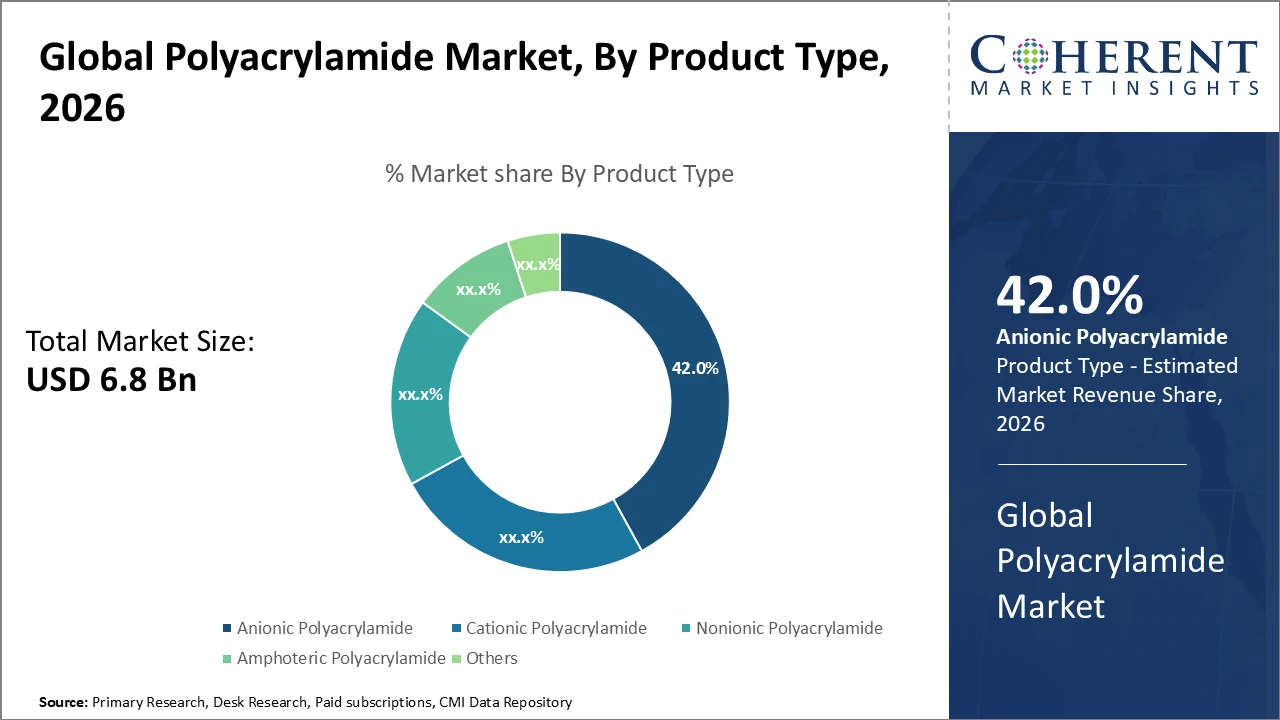
Polyacrylamide Market Insights, By Product Type
Anionic polyacrylamide dominates the market share, with its superior charge neutralization and flocculation efficiency making it the preferred choice for water treatment plants and enhanced oil recovery, accounting for over 42% of market revenue. The fastest-growing subsegment is cationic polyacrylamide, widely used in paper processing and textile industries due to its excellent binding properties, with adoption accelerating alongside industrial output growth in Asia. Nonionic polyacrylamide remains relevant for its low toxicity and stability, frequently applied in niche agricultural and construction sectors. Amphoteric polyacrylamide, offering flexible charge properties, serves specialty soil conditioning and sludge dewatering needs, while the ‘Others’ category includes customized polymer blends for specific industrial applications but holds a comparatively smaller market share.
Polyacrylamide Market Insights, By Application
Water treatment dominates the market, controlling over 45% of the share, driven by the rising challenges of urban wastewater and stringent industrial effluent regulations worldwide. Large-scale use of polyacrylamide as flocculants and coagulants enhances purification efficiency while reducing sludge volume. Oil recovery is the fastest-growing subsegment, fueled by increased polymer flooding in mature fields, particularly in North America and the Middle East, where crude price fluctuations have prompted optimized polymer applications. The agriculture segment shows steady growth through soil amelioration techniques that improve moisture retention and crop productivity. Paper making and textile segments maintain stable shares by leveraging polyacrylamide to enhance paper quality, improve textile processing efficiency, and reduce water consumption, while the others category includes diverse industrial applications with incidental growth.
Polyacrylamide Market Insights, By Form
Powder form holds a dominant position in the market due to its broad usability and ease of storage, commanding the highest global market share. The emulsion form is the fastest-growing segment, benefiting from advantages in large-scale water treatment and oil recovery processes, including improved dispersion and faster reaction times that enhance operational efficiency. Flake polyacrylamide serves niche industrial applications such as paper and textiles, where controlled dosing is essential. Liquid forms are preferred in agriculture for uniform soil penetration but currently occupy a smaller market share. The others segment includes specialty forms designed for customized operational needs, though it remains limited to select industrial applications.
Polyacrylamide Market Trends
The polyacrylamide market trend emphasizes sustainability, with bio-based and biodegradable polymer variants gaining traction due to regulatory mandates and consumer preferences.
In 2026, Asia Pacific experienced a 14% increase in demand for eco-friendly polymers, driven by expanding municipal water treatment projects and agricultural applications.
Digital integration in manufacturing is emerging as a key trend, with automation and real-time quality monitoring helping manufacturers ensure product consistency and reduce operational costs.
The enhanced oil recovery segment continues to grow steadily, supported by rising crude prices and increased capital expenditure in mature oilfields, with North America leading adoption.
Polyacrylamide Market Insights, By Geography
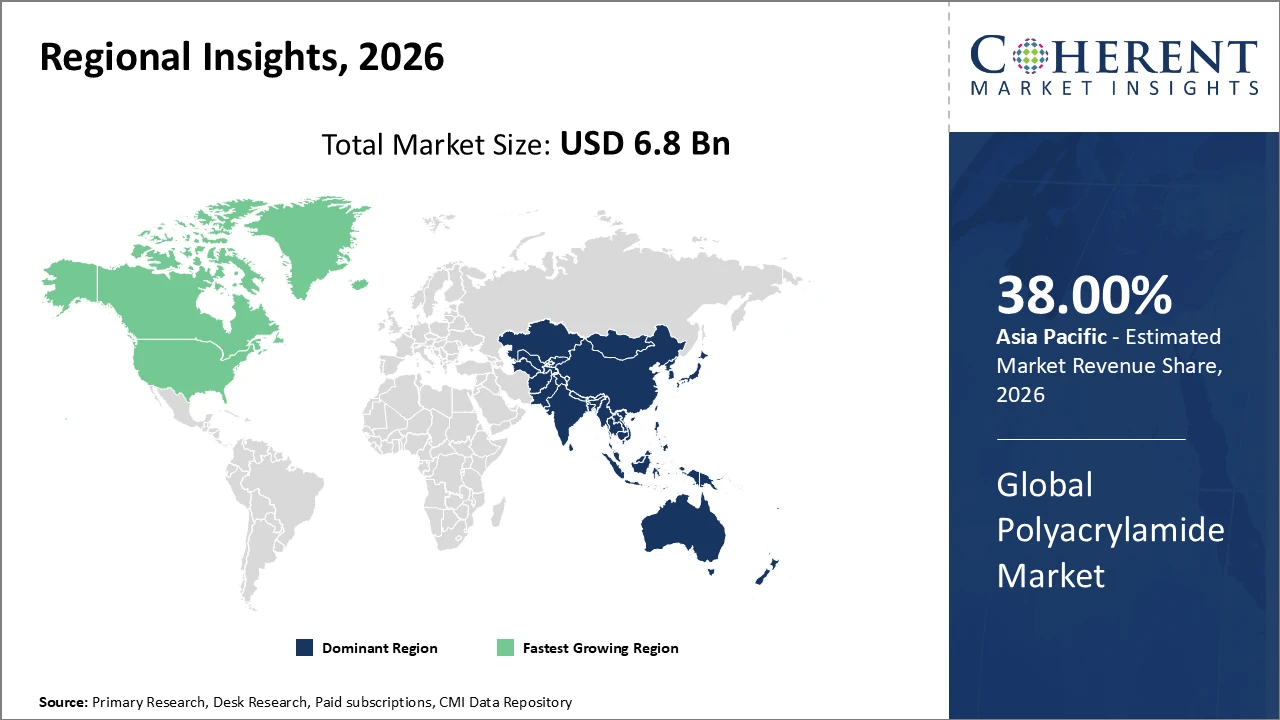
Asia Pacific Polyacrylamide Market Analysis and Trends
In Asia Pacific, dominance in the polyacrylamide market is driven by large-scale municipal water treatment projects, rapid industrialization, and a growing oil and gas sector. The region accounts for nearly 38% of the global market share, supported by significant infrastructure and agricultural investments in countries such as China and India. Additionally, the presence of numerous manufacturing hubs offering cost advantages and strong export capabilities further strengthens the region’s leadership, enabling it to meet both domestic demand and international market requirements while sustaining competitive growth in the polyacrylamide industry.
North America Polyacrylamide Market Analysis and Trends
North America demonstrates the fastest growth in the polyacrylamide market, with a CAGR exceeding 8.5%, driven primarily by the modernization of oil recovery techniques and strict wastewater regulations in the United States. Significant investments in upgrading aging municipal and industrial water treatment infrastructure have increased demand for high-performance polyacrylamides used as flocculants and coagulants. Additionally, the adoption of polymer flooding in mature oilfields to enhance crude extraction efficiency has further propelled market growth. Combined, these factors are boosting regional revenue and establishing North America as a critical growth hub for advanced polyacrylamide solutions across water treatment, oil recovery, and industrial applications.
Polyacrylamide Market Outlook for Key Countries
USA Polyacrylamide Market Analysis and Trends
The U.S. polyacrylamide market is primarily driven by enhanced oil recovery and advanced wastewater treatment projects, with polymer flooding applications growing by 9% in 2025. Leading companies have made significant investments in producing specialty polyacrylamides designed to meet U.S. environmental standards, facilitating regulatory compliance and securing contracts in municipal and industrial water treatment. Additionally, government incentives promoting environmentally sustainable industrial processes are expected to sustain market growth and innovation. Increased adoption in the agricultural sector, particularly for leveling soil moisture in arid regions, further contributes to expanding demand and reinforces the country’s position as a key market for polyacrylamide products.
Germany Polyacrylamide Market Analysis and Trends
The Germany polyacrylamide market is characterized by steady growth driven by stringent environmental regulations, infrastructure modernization, and the need for sustainable water treatment solutions. Non-ionic and anionic polyacrylamides dominate applications in municipal wastewater treatment, industrial effluent management, and paper manufacturing, ensuring high purification efficiency and compliance with EU standards. Growing adoption of biodegradable and eco-friendly polymers reflects increasing emphasis on sustainability. The country also witnesses gradual integration of digital manufacturing technologies to enhance product consistency and operational efficiency. Robust industrial activity, coupled with government-backed initiatives in water and oil sectors, positions Germany as a stable and innovative market in Europe.
Analyst Opinion
Supply-side dynamics have significantly influenced the polyacrylamide market, with production capacities in Asia Pacific increasing by over 12% in 2025 compared to 2024, driven by escalating infrastructure projects. These expansions stabilized pricing and improved product availability, contributing to steady revenue growth. Chinese manufacturers, for example, boosted exports by 15% in 2026, reinforcing their dominant regional market share.
Demand-side indicators show that the water treatment segment remains the primary revenue driver, commanding nearly 45% of the market share in 2026. Global emphasis on sustainable water management and wastewater recycling, such as India expanding municipal water treatment capacities by 8.5% in 2025, increased polyacrylamide consumption.
Micro-indicators highlight growing use in enhanced oil recovery, with polymer flooding applications in the oil & gas industry rising approximately 7% globally in 2024, fueled by higher crude prices and renewed exploration, diversifying revenue streams.
Nano-size indicators reflect the development of specialty polyacrylamides with tailored molecular weights. In 2025, Europe saw a 10% increase in application-specific grades, boosting niche segments, supporting premium pricing, and emphasizing product differentiation strategies.
- Current Industry Events of 2026
- Market Size Estimation
- Regional Breakdown
- Competitive Landscape
- Customer Intelligence
- Segmental Analysis
- Pricing Analysis
- Key Market Drivers, Challenges & Future Trends
- Customized Insights Section
Market Scope
| Report Coverage | Details | ||
|---|---|---|---|
| Base Year: | 2025 | Market Size in 2026: | USD 6.8 billion |
| Historical Data for: | 2020 To 2024 | Forecast Period: | 2026 To 2033 |
| Forecast Period 2026 to 2033 CAGR: | 8.1% | 2033 Value Projection: | USD 11.3 billion |
| Geographies covered: |
| ||
| Segments covered: |
| ||
| Companies covered: | SNF Group, BASF SE, Kemira Oyj, Solenis LLC, Solvay S.A., Kuraray Co. Ltd., Gulf Chemicals & Industrial Oils Co., Anhui Wanwei Group, Nouryon | ||
| Growth Drivers: |
| ||
Polyacrylamide Market Growth Factors
The polyacrylamide market growth is largely driven by increasing demand in wastewater treatment, propelled by tightening environmental regulations worldwide. Cities implementing stricter pollutant discharge standards in 2024 have accelerated polymer adoption, with Europe experiencing a 9% increase in treatment capacities that year. Enhanced oil recovery (EOR) represents another key growth driver, particularly in North America, where aging oil fields require advanced polymer flooding, resulting in a 7.5% rise in polyacrylamide consumption in 2025. Agricultural applications are also expanding, with polyacrylamide used as soil conditioners to improve water retention and crop yields, as seen in India’s 6% usage increase in 2026. Additionally, rising global infrastructure investments have bolstered demand in paper and textile industries, where polymers enhance product quality and operational efficiency.
Polyacrylamide Market Development
In 2025, SNF Group completed a major capacity expansion at its manufacturing facility in Louisiana, U.S., adding 50,000 metric tons of annual polyacrylamide production. This development was aimed at meeting the rising demand from municipal wastewater treatment plants following stricter environmental discharge regulations. The upgraded facility also incorporated advanced automation technologies to improve product consistency and reduce lead times, supporting both domestic consumption and export orders across North America.
Key Players
Leading Companies of the Market
SNF Group
BASF SE
Kemira Oyj
Solenis LLC
Gulf Chemicals & Industrial Oils Co.
Nouryon
Anhui Wanwei Group
Solvay S.A.
Kuraray Co. Ltd.
Competitive strategies in the polyacrylamide market focus on capacity expansion, product innovation, and sustainability initiatives. For instance, SNF Group’s 2025 capacity increase in Southeast Asia led to a 12% growth in its market share, while BASF’s development of eco-friendly polymer formulations facilitated partnerships with municipal water authorities, resulting in an 18% rise in contract renewals in 2026. These strategic initiatives highlight the intense competition among leading players and simultaneously drive overall market growth by enhancing product availability, meeting environmental standards, and strengthening long-term client relationships across key industrial and municipal sectors.
Polyacrylamide Market Future Outlook
The polyacrylamide market is poised for strong growth, driven by increasing demand in wastewater treatment, enhanced oil recovery, and sustainable agriculture. Rising environmental regulations and the global emphasis on water management are fueling the adoption of biodegradable and eco-friendly polymers. Technological advancements, including digital manufacturing, tailored molecular weight formulations, and emulsion-based products, are expanding application efficiency across industrial, municipal, and agricultural sectors. Emerging markets in Asia Pacific, Latin America, and the Middle East offer significant growth opportunities due to infrastructure expansion and industrialization. Overall, continued investment in R&D, sustainability, and process innovation is expected to sustain long-term market expansion.
Polyacrylamide Market Historical Analysis
The polyacrylamide market has experienced consistent growth over the past decade, primarily driven by increasing infrastructure development, industrialization, and stringent environmental regulations. Initially dominated by powder and nonionic forms, the market gradually shifted toward anionic and cationic variants due to their superior performance in water treatment, enhanced oil recovery, and paper and textile applications. Rising urbanization and the need for efficient wastewater management boosted adoption across municipal and industrial sectors, particularly in Europe and North America. Simultaneously, Asia Pacific emerged as a high-growth region, supported by rapid industrial expansion, agricultural modernization, and expanding oil and gas operations, laying the foundation for current market trends.
Sources
Primary Research Interviews:
Chemical Engineers
Agricultural Scientists and Soil Experts
Industrial Polymer Manufacturers
Process Engineers in Water Treatment Plants
Databases:
World Bank Infrastructure and Water Management Data
OECD Environmental and Industrial Chemicals Data
FAO Soil and Water Resources Statistics
Magazines:
Chemical Week
Water & Wastewater International
Oil & Gas Journal
Polymer Technology Journal
Industrial WaterWorld
Journals:
Journal of Applied Polymer Science
Water Research Journal
Journal of Petroleum Science and Engineering
Desalination and Water Treatment Journal
Newspapers:
The Financial Times (Industry & Chemicals)
The Guardian (Environment & Industry)
The Economic Times (Chemicals & Water Treatment)
Reuters (Industrial Materials & Sustainability)
The Hindu Business Line (Infrastructure & Water Management)
Associations:
International Water Association (IWA)
American Water Works Association (AWWA)
European Polymer Federation (EPF)
American Chemical Society (ACS) – Polymer Division
Get access to 250+ pages report
Every segment, forecast, competitor profile and data table behind the analysis above — available for instant download.
- ESOMAR Member
- ISO 9001:2015 Certified
- D-U-N-S Registered
- GDPR & CCPA Compliant
Missing comfort of reading report in your local language? Find your preferred language:
Transform your Strategy with Exclusive Trending Reports
Frequently Asked Questions
The market is led by prominent companies such as SNF Group, BASF SE, Kemira Oyj, Anhui Wanwei Group, and Solenis LLC, who hold significant market shares due to capacity expansions and innovative product portfolios.
The polyacrylamide market size is expected to expand from USD 6.8 billion in 2026 to USD 11.3 billion by 2033, reflecting consistent growth accelerated by rising applications and regulatory support.
Water treatment remains the largest application.
Emerging trends include a pivot towards bio-based polymers, smart polymer blends with tailored properties, and digitization in manufacturing, collectively transforming product offerings and application methods across industries.
The competitive landscape is characterized by strategic capacity expansion, product innovation, and sustainability initiatives, with challenges related to raw material volatility and compliance with evolving environmental standards.
Leading companies emphasize geographic expansion, customized product development, strategic partnerships with end-users, and focus on eco-friendly polymer solutions to strengthen market position and revenue streams.