

Pyridine And Pyridine Derivative Market Size and Share Analysis - 2026 To 2033
The Global Pyridine and Pyridine Derivative Market is anticipated to grow at a CAGR of 7.3% with USD 1,466.8 Mn in 2026 and is expected to reach USD 2,310.9 Mn in 2033. The global Pyridine and Pyridine Derivatives Market is driven by growing demand from agrochemicals, pharmaceuticals, electronics, and specialty chemicals. In 2026, Jubilant Ingrevia reported strong volume momentum in Pyridine and Picolines, supported by global demand and downstream applications. ScienceDirect highlights pyridine derivatives in crop protection and drug development, while WHO and CDC emphasize responsible handling and occupational safety.
(Source: ScienceDirect)
Key Takeaways
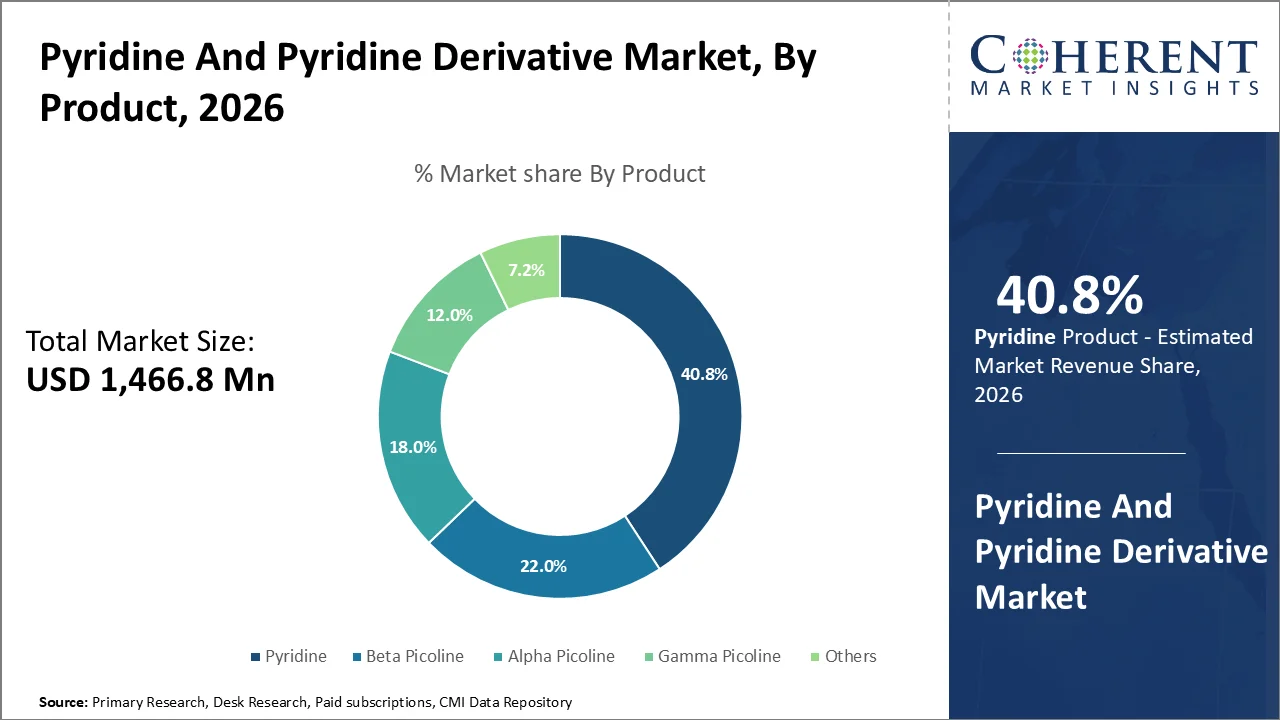
- Pyridine will be led by 40.8% in 2026, as due to its extensive use as a versatile chemical building block in pharmaceuticals, agrochemicals, and medicinal chemistry. Its broad therapeutic relevance strengthens demand. For instance, a 2026 PubMed-indexed review confirms pyridine’s importance in antitumor drug design, while the U.S. EPA documents pyridine-based herbicides used across numerous crops and non-agricultural applications.
- Agrochemicals hold the leading share of 37.8% in 2026, because pyridine derivatives provide strong biological activity, structural flexibility, selectivity, and efficacy at relatively low application rates. They are widely incorporated into herbicides, fungicides, insecticides, and nematicides for crop protection. For instance, a 2025 peer-reviewed review confirms pyridine-based agrochemicals are commercially successful and help address pest resistance and environmental-efficiency requirements. Furthermore, in 2026 WHO/FAO’s JMPR evaluated 38 pesticides for residue, toxicity, and dietary-risk management, underscoring continuing agricultural pesticide demand.
(Source: Science Direct; WHO)
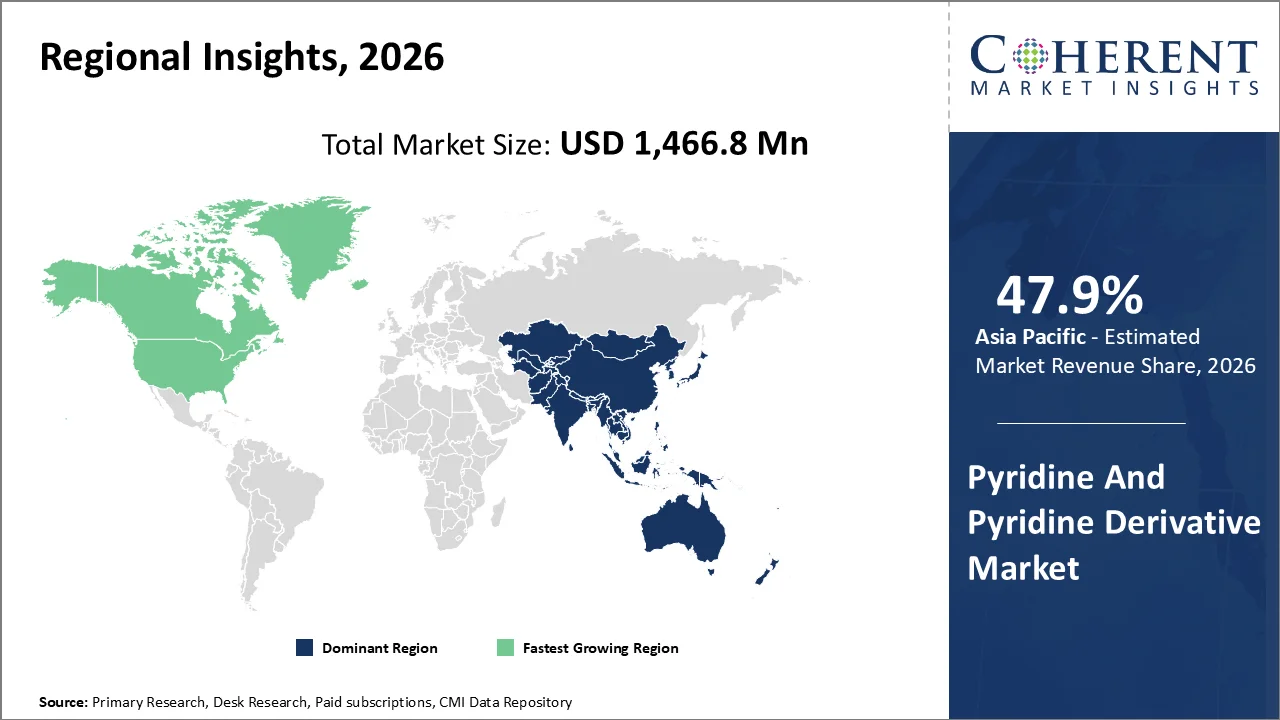
- Asia Pacific is expected to acquire the dominant share of 47.9% in 2026, due to its large chemical-manufacturing base, extensive agrochemical production, expanding pharmaceutical industries, and strong agricultural demand in China and India. Rapid industrialization, food-security requirements, and growing pesticide consumption further support regional demand. For instance, in 2026, India’s government is reporting 261,099 MT of agrochemical production through February 2026, with approximately 42,000 MT required for Kharif 2026.
(Source: PIB)
Market Drivers
Growing Pharmaceutical Applications of the Pyridine and Pyridine Derivative
Pyridine and its derivatives are increasingly demanded by the pharmaceutical industry because the pyridine ring offers structural versatility, favorable biological activity, and the ability to improve potency, selectivity, solubility, and pharmacokinetic properties. These characteristics make pyridine a valuable scaffold for developing medicines targeting cancer, infectious diseases, neurological disorders, metabolic conditions, and inflammatory diseases. For instance, a 2026 peer-reviewed review indexed by PubMed highlights the extensive therapeutic relevance of pyridine derivatives and their importance in drug discovery, including oncology and infectious diseases. Another 2026 study specifically reviews pyridine-containing antitumor agents and their structure–activity relationships. Thus, continuing pharmaceutical R&D and demand for new therapeutics are important drives the pyridine and pyridine derivatives market growth over the forecast period.
Rising Agrochemical Demand
Growing agricultural requirements for effective crop protection products support demand for pyridine and its derivatives. Pyridine-based structures are used in the development of herbicides, fungicides, insecticides, and other biologically active agrochemicals because their chemical flexibility enables targeted biological activity. Increasing pressure to improve crop productivity, manage pests, and address resistance further encourages development of improved agrochemical molecules. A peer-reviewed review indexed by PubMed notes that pyridine derivatives have substantial agricultural applications alongside pharmaceutical uses. For instance, in 2026 research review, current scientific work continues to emphasize the synthesis and biological activity of pyridine-based compounds, supporting their relevance to agrochemical innovation and market demand.
Expanding Pyridine Derivatives into Advanced Materials and Clean-Energy Technologies
Pyridine derivatives offer opportunities beyond pharmaceuticals and agrochemicals because their nitrogen-containing structures can provide useful electronic, thermal, chemical, and proton-conducting properties. This creates potential applications in high-performance polymers, membranes, electronic materials, and fuel-cell technologies. For instance, in August 2025, an ACS Applied Polymer Materials review describes pyridine/piperidine-based membranes as promising candidates for high-temperature proton-exchange membrane fuel cells. Furthermore, in April 2026, according to the Royal Society of Chemical Science review on electrochemical functionalization of pyridines, highlighting applications across pharmaceuticals, agrochemicals, ligands, and materials science.
(Source: ACS Publications; Royal Society of Chemistry Publishing)
Current Events and Their Impact on the Global Pyridine and Pyridine Derivative Market
Current Event | Description and its Impact |
FDA Approval of Orforglipron |
|
EPA Pesticide Registration and Risk-Assessment Framework |
|
EPA Approval/Label Update for a Pyridine-Based Pesticide |
|
- Current Industry Events of 2026
- Market Size Estimation
- Regional Breakdown
- Competitive Landscape
- Customer Intelligence
- Segmental Analysis
- Pricing Analysis
- Key Market Drivers, Challenges & Future Trends
- Customized Insights Section
Segmental Insights
Why is Pyridine Acquiring the Largest Market Share?
Based on the product, pyridine is projected to account for the largest share in global pyridine and pyridine derivative market in 2026, representing approximately 40.8% of the total volume. The pyridine is the dominant one as pyridine is a versatile nitrogen-containing heterocycle used directly as a chemical intermediate, solvent, reagent and building block for pharmaceuticals, agrochemicals, specialty chemicals and functional materials. The electron-deficient aromatic system and basic nitrogen allow a wide variety of chemical functionalization and hence many downstream derivatives. For instance, in 2026, a Chemical Science review published by researchers from the Indian Institute of Science states that pyridines have wide applications in pharmaceuticals, agrochemicals, ligands, and materials science. It also highlights recent electrochemical methods for efficiently functionalizing pyridines, supporting their expanding industrial and research utility. Additionally, a 2025 RSC Medicinal Chemistry review found 54 pyridine-containing drugs among U.S. FDA-approved small molecules from 2014–2023, demonstrating the strong pharmaceutical importance of the pyridine scaffold.
(Source: Royal Society of Chemistry Publications; RSC)
Agrochemicals holds the Largest Market Share
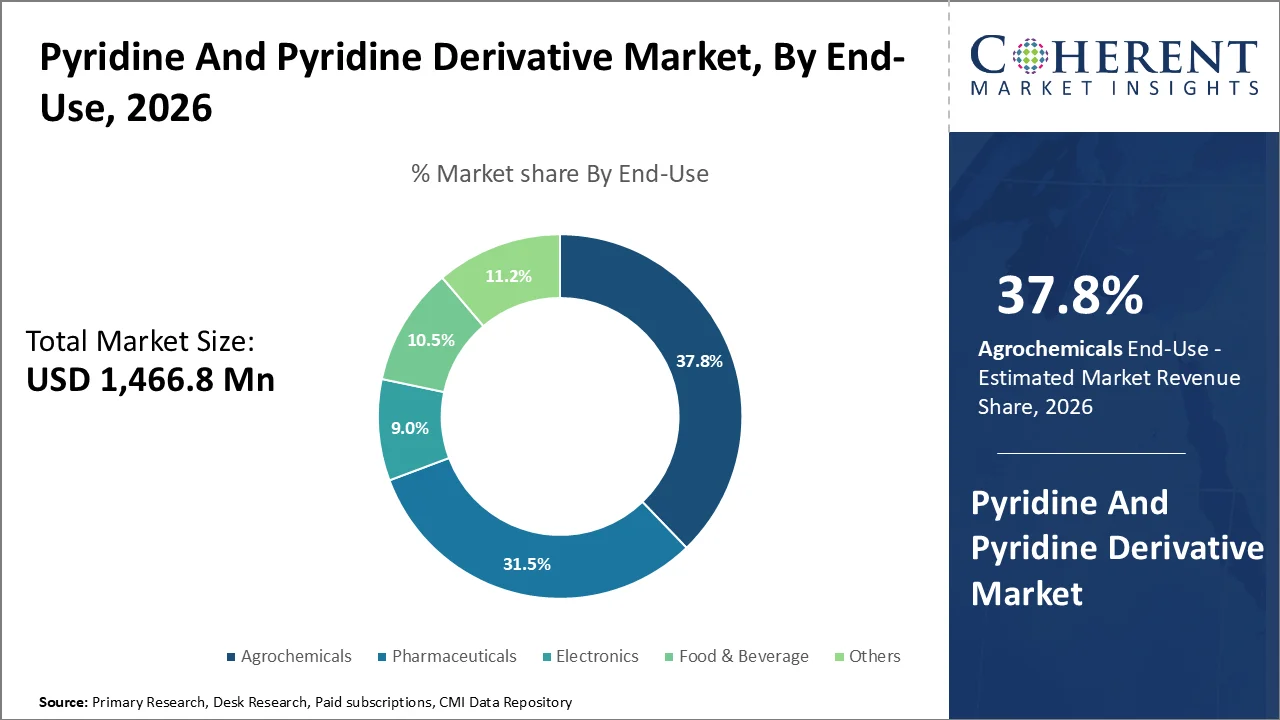
Based on end-use, agrochemicals dominate the market, accounting for a significant 37.8% share in 2026. The agrochemicals segment is the most dominant segment as pyridine derivatives have strong biological activity and structural flexibility which allows them to be used in herbicides, fungicides and insecticides. Their utility against pests, weeds and plant diseases, the need to boost crop production and to fight pesticide resistance keep demand for them alive. The pyridine moiety is also an important part of agrochemicals, thus allowing the opportunity for new active ingredients with better selectivity and efficacy. For instance, in June 2026, Pest Management Science study developed 28 novel pyridine-based fungicidal compounds against Botrytis cinerea, demonstrating strong antifungal activity and highlighting pyridine’s continuing importance in crop-protection innovation. Additionally, the U.S. EPA's 2026 pesticide framework continues to identify pyridine herbicides, including aminopyralid, clopyralid, fluroxypyr, picloram and triclopyr, for agricultural weed control and regulatory review.
Global Pyridine and Pyridine Derivative Market Trends
Shift toward greener and more sustainable synthesis
A major trend is the development of electrochemical and photocatalytic methods for producing pyridine derivatives with fewer hazardous reagents, milder conditions, and improved sustainability. For instance, in April 2026, Chemical Science published a review from the Indian Institute of Science describing electrochemical pyridine functionalization as a sustainable alternative to conventional methods.
(Source: Royal Society of Chemistry Publications)
Growing pharmaceutical applications
Pyridine remains an important scaffold in drug discovery, particularly because its structure can be selectively modified to optimize biological and drug-like properties. For instance, in April 2026, Chemical Science reported a selective C2-methylation method for pyridine, specifically highlighting its potential to tune metabolic stability and solubility of pharmaceutical compounds.
Increasing use of advanced photochemistry
Visible-light photocatalysis is emerging as an important approach for creating complex pyridine derivatives while enabling late-stage molecular diversification. For instance, in February 2026, RSC Advances published a review of visible-light-mediated functionalization of 4-cyanopyridines, highlighting their applications in pharmaceuticals, agrochemicals, functional materials, and synthetic chemistry.
Regional Insights
Asia Pacific dominates owing to expanding pharmaceutical industries
Asia Pacific account 47.9% market share in 2026, because of its large-scale chemical manufacturing base, expanding pharmaceutical and agrochemical industries, strong agricultural demand, cost-competitive production, and growing investments in domestic chemical supply chains. China is a major global agrochemical producer and exporter, while India is strengthening pharmaceutical, API, and chemical manufacturing capacity. Pyridine derivatives are particularly relevant to these industries because of their extensive pharmaceutical and agrochemical applications. For instance, in March 2026, the Government of India reported that its Bulk Drugs PLI Scheme had created approximately 56,800 MT/year of domestic manufacturing capacity for critical KSMs, drug intermediates and APIs, with INR 4,814 crore invested. This expansion strengthens Asia Pacific's pharmaceutical-chemical manufacturing ecosystem and supports demand for chemical intermediates such as pyridine derivatives. Furthermore, India's chemical-sector policy: the 2026–27 Budget proposed dedicated Chemical Parks to increase domestic chemical production, strengthen supply-chain integration and reduce import dependence. India is already the third-largest chemical producer in Asia, manufacturing more than 80,000 chemical products across bulk chemicals, specialty chemicals, agrochemicals and related sectors.
(Source: Science Direct; PIB; PIB)
North America Pyridine and Pyridine Derivative Market Trends
The North America region is poised to be as the fastest-growing region through 2026-2033, owing to advanced pharmaceutical industry, established chemical-manufacturing infrastructure, high R&D spending, and substantial agrochemical demand. The United States also has a sophisticated regulatory framework that supports continued commercialization of pharmaceutical and pesticide products containing pyridine-based chemistry. For instance, in June 2026, the U.S. FDA selected seven companies for its PreCheck Pilot Program, designed to expand domestic pharmaceutical manufacturing, increase production capacity, and strengthen U.S. drug-supply-chain resilience. The U.S. Department of Commerce also reported approximately $400 billion in commitments to reshore pharmaceutical manufacturing in 2026.
Furthermore, in 2025, the U.S. EPA updated its pesticide registration-review framework in February 2026 and continues to regulate pyridine herbicides, including aminopyralid, clopyralid, fluroxypyr, picloram, and triclopyr. These products are used across crops, pasture, rangeland, and other agricultural applications.
(Source: U.S.FDA; Commerce; U.S. EPA)
Extensive Domestic Demand and export-oriented production is Accelerating the Global Pyridine and Pyridine Derivative Market Demand in China
China’s leading position in the Asia Pacific pyridine and pyridine derivatives market is supported by its large chemical-manufacturing capacity, integrated petrochemical supply chains, strong pharmaceutical and agrochemical industries, extensive domestic demand, and export-oriented production. China’s Ministry of Industry and Information Technology states that the country is the world’s largest producer and consumer of petrochemical and chemical products, with more than 20 major basic-chemical products having globally leading production capacity. For instance, China’s 2025–2026 petrochemical industry plan emphasizes technological innovation, high-end specialty chemicals, pesticide upgrading, digitalization, and greener production. This strengthens the industrial ecosystem supporting pyridine and its derivatives. Furthermore, during January–June 2026, China approved 38 innovative drugs, including 31 developed domestically. Pharmaceutical industrial value-added output increased 6.4% year-on-year, while pharmaceutical export delivery value exceeded ¥210 billion, up 9%.
U.S. Global Pyridine and Pyridine Derivative Market Trends
The U.S. is a leading country in the North American pyridine and pyridine derivatives market because of its large pharmaceutical industry, advanced chemical R&D capabilities, established agrochemical sector, strong regulatory infrastructure, and high demand for pharmaceutical and specialty-chemical intermediates. Pyridine chemistry is particularly important in pharmaceutical and agrochemical synthesis, making the country's manufacturing and research ecosystem a major source of demand. For instance, in June 2026, the U.S. FDA selected seven companies for its PreCheck Pilot Program, designed to expand domestic pharmaceutical manufacturing, increase production capacity, and strengthen U.S. drug-supply-chain resilience. The U.S. EPA maintains an extensive pesticide registration and scientific risk-assessment framework, supporting continued use and regulatory oversight of pesticide chemicals in American agriculture.
Who are the Major Companies in Global Pyridine and Pyridine Derivative Market
Some of the major key players in Global Pyridine and Pyridine Derivative Market are Jubilant Ingrevia, Vertellus Holdings LLC, Lonza Group AG, Nanjing Redsun Co. Ltd., Resonance Specialties Ltd., Shandong Luba Chemical Co. Ltd., Hubei Sanonda Co. Ltd., Chang Chun Petrochemical Co. Ltd., Koei Chemical Co. Ltd., C-Chem Co., Ltd.
Key News
- In Marc 2026, Green Chemistry published research demonstrating bioconversion of a lignin monomer into a new pyridine-dicarboxylic acid building block, with a polymer derived from the product showing potential as a sustainable platform chemical. Creates opportunities for pyridine derivatives in sustainable polymers, materials and circular-chemistry application.
(Source: Royal Society of Chemistry Publications)
- In March 2026, Researchers reported new pyridine-linked 1,2,4-oxadiazoles investigated as EGFR and BRAF inhibitors; some compounds showed potent antiproliferative activity. Strengthens opportunities for pyridine derivatives in oncology drug discovery and advanced pharmaceutical research.
(Source: RSC)
- In June, 2026, Researchers published an enzyme-catalysed route to synthesize pyridines from biomass-derived feedstocks, demonstrating production of substituted pyridines from renewable lignin-derived materials. Supports the trend toward bio-based and sustainable pyridine production, potentially reducing dependence on fossil-derived feedstocks.
(Source: RSC)
Market Report Scope
Pyridine and Pyridine Derivative Market Report Coverage
| Report Coverage | Details | ||
|---|---|---|---|
| Base Year: | 2025 | Market Size in 2026: | USD 1,466.8 Mn |
| Historical Data for: | 2020 To 2024 | Forecast Period: | 2026 To 2033 |
| Forecast Period 2026 to 2033 CAGR: | 7.3% | 2033 Value Projection: | USD 2,310.9 Mn |
| Geographies covered: |
| ||
| Segments covered: |
| ||
| Companies covered: | Jubilant Ingrevia, Vertellus Holdings LLC, Lonza Group AG, Nanjing Redsun Co. Ltd., Resonance Specialties Ltd., Shandong Luba Chemical Co. Ltd., Hubei Sanonda Co. Ltd., Chang Chun Petrochemical Co. Ltd., Koei Chemical Co. Ltd., C-Chem Co., Ltd. | ||
Analyst Opinion
- The Global Pyridine and Pyridine Derivatives Market is expected to benefit from the broad and diversified use of pyridine chemistry across pharmaceuticals, agrochemicals, ligands, and advanced materials. The pyridine’s electron-deficient aromatic system and basic nitrogen atom make it an important building block for the development of biologically active molecules and specialty chemicals. Researchers from the Indian Institute of Science in a 2026 review published in Chemical Science confirm that pyridines are widely used in these sectors.
(Source: Chemical Science – Electrochemical functionalization of pyridines (2026))
- There is a need to give more space to green chemistry and sustainability in a competitive environment. Functionalizing pyridine usually requires harsh conditions, prefunctionalized starting materials, or stoichiometric reagents. Electrochemical synthesis is a more environmentally friendly method, as electricity is used as a clean redox agent under mild and tunable conditions. Chemical Science, April 2026, report Development of scalable electrochemical and other green synthesis technologies would reduce environmental impact and provide access for producers to a larger pool of more valuable and structurally complex pyridine derivatives for use in materials, pharmaceuticals and agrochemicals.
(Source: Royal Society of Chemistry – Chemical Science (2026))
- Agrochemicals will remain an important demand base, particularly because pyridine-class herbicides are used extensively to control broadleaf weeds across agricultural and non-agricultural settings. The U.S. EPA identifies aminopyralid, clopyralid, fluroxypyr, picloram and triclopyr among pyridine/pyrimidine herbicides and continues their regulatory evaluation. In February 2026, EPA updated its pesticide registration-review information, demonstrating continued regulatory attention to this chemical class. This supports ongoing demand while simultaneously encouraging development of safer and more environmentally compatible derivatives.
(Source: U.S. EPA – Registration Review of Pyridine and Pyrimidine Herbicides)
- Analyst view: The strongest long-term opportunity is likely to be in high-value and specialized pyridine derivatives, rather than only conventional commodity pyridine. Innovation in selective functionalization, electrochemical synthesis, late-stage diversification, and greener production can enable manufacturers to serve pharmaceutical, agrochemical and materials customers with differentiated products. The 2026 Chemical Science review specifically identifies scalable late-stage pyridine diversification as an emerging opportunity, suggesting that technological innovation will increasingly become a key competitive differentiator in the market.
Speak to the analyst
Want personalized insights?
Take the findings above to one of our principal consultants, or have the report rebuilt around the segments, geographies and competitors you actually track.
Market Segmentation
- By Product (Revenue, USD Mn, 2026-2033)
- Pyridine
- Beta Picoline
- Alpha Picoline
- Gamma Picoline
- Others
- By End-use (Revenue, USD Mn, 2026-2033)
- Agrochemicals
- Pharmaceuticals
- Electronics
- Food & Beverage
- Others
- By Region (Revenue, USD Mn, 2026-2033)
- North America
- U.S.
- Canada
- Latin America
- Brazil
- Mexico
- Argentina
- Rest of Latin America
- Europe
- Germany
- U.K.
- France
- Italy
- Spain
- Russia
- Rest of Europe
- Asia Pacific
- China
- India
- Japan
- Australia
- South Korea
- ASEAN
- Rest of Asia Pacific
- Middle East
- GCC
- Israel
- Rest of Middle East
- Africa
- South Africa
- Central Africa
- North Africa
- North America
Sources
Primary Research Interviews
- Interviews with pharmaceutical manufacturers, medicinal chemists, agrochemical researchers, chemical engineers, procurement managers and formulation specialists to understand demand for pyridine and pyridine derivatives, key applications, product-performance requirements, purity specifications, raw-material availability, pricing pressures, supply-chain challenges and the factors influencing the selection of pyridine-based intermediates and active ingredients.
- Insights from pyridine manufacturers, specialty-chemical companies, process engineers, R&D scientists and academic researchers about new technologies, including greener pyridine synthesis, electrochemical functionalization, catalytic processes, bio-based feedstocks, selective C–H functionalization, process intensification and development of high-value pharmaceutical and agrochemical derivatives; how these technologies improve yield, selectivity, sustainability and production economics.
- Consultations with chemical-industry consultants, regulatory specialists, pharmaceutical and agrochemical market researchers regarding market trends, competitive positioning, capacity expansions, customer requirements, import/export dynamics, regulatory developments, environmental requirements, product registration, and the adoption of pyridine derivatives across pharmaceuticals, crop protection, specialty chemicals and advanced materials.
- Liaison with chemical manufacturers, pharmaceutical and agrochemical companies, procurement and sourcing managers, distributors, government regulatory authorities and industry associations to identify purchasing priorities, product specifications, manufacturing costs, capacity utilization, inventory levels, supplier qualification criteria, supply-chain risks, sustainability requirements, regulatory compliance and future investment plans related to pyridine and pyridine derivatives. Particular attention is given to applicable requirements administered by agencies such as the U.S. FDA and EPA, as well as relevant chemical-safety and environmental regulations.
Databases
- U.S. Environmental Protection Agency (EPA) – CompTox Chemicals Dashboard
- U.S. Environmental Protection Agency (EPA) – Chemical Data Reporting (CDR) Database
- European Chemicals Agency (ECHA) – REACH Chemicals Database
- European Chemicals Agency (ECHA) – Classification & Labelling Inventory (C&L Inventory)
- PubChem – National Center for Biotechnology Information (NCBI)
- Chemical Abstracts Service (CAS) – CAS Registry and Chemical Databases
- OECD – eChemPortal Global Portal to Information on Chemical Substances
- U.S. Geological Survey (USGS) – Mineral Commodity and Chemical Industry Data
- United Nations Comtrade Database – International Trade Statistics
- International Trade Centre (ITC) – Trade Map Database
Magazines
- Chemical & Engineering News (C&EN)
- Chemical Week
- ICIS Chemical Business
- Chemistry World
- Chemical Processing
- Specialty Chemicals Magazine
- Chemical Industry Digest
- European Chemical News
- Chemical Engineering
- Chemicals Technology
Journals
- Industrial & Engineering Chemistry Research
- Chemical Engineering Journal
- Journal of Chemical Technology & Biotechnology
- Organic Process Research & Development
- Journal of Heterocyclic Chemistry
- Tetrahedron
- Green Chemistry
- ACS Sustainable Chemistry & Engineering
- Journal of Environmental Chemical Engineering
- Process Safety and Environmental Protection
Newspapers
- Reuters – Chemicals and Industrial Markets
- Financial Times – Chemicals and Industrials
- The Wall Street Journal – Chemicals and Manufacturing
- Bloomberg – Chemicals and Commodities
- The Economic Times – Chemicals & Petrochemicals
- Business Standard – Chemicals and Petrochemicals
- The Hindu BusinessLine – Chemicals & Industry
- The Japan Times – Chemicals and Manufacturing
Associations
- American Chemistry Council (ACC) – Chemical Industry Data & Policy
- Society of Chemical Manufacturers & Affiliates (SOCMA) – Specialty Chemicals
- Royal Society of Chemistry (RSC) – Chemical Industry & Research
- International Council of Chemical Associations (ICCA)
- European Chemical Industry Council (CEFIC)
- Indian Chemical Council (ICC)
Public Domain Sources
- U.S. Environmental Protection Agency (EPA) – Chemical Safety, Risk & Regulatory Data
- European Chemicals Agency (ECHA) – REACH & Chemical Safety Information
- PubChem / National Center for Biotechnology Information (NCBI) – Chemical Information
- OECD – eChemPortal & Chemical Safety Data
- United Nations Comtrade – Global Import & Export Trade Data
- International Trade Centre (ITC) – Trade Statistics
- World Bank – Commodity, Industry & Macroeconomic Data
- United Nations Industrial Development Organization (UNIDO) – Industrial Statistics
Proprietary Elements
- CMI Data Analytics Tool
- Proprietary CMI Existing Repository of information for last 10 years
Get access to 250+ pages report
Every segment, forecast, competitor profile and data table behind the analysis above — available for instant download.
- ESOMAR Member
- ISO 9001:2015 Certified
- D-U-N-S Registered
- GDPR & CCPA Compliant
Missing comfort of reading report in your local language? Find your preferred language:
Transform your Strategy with Exclusive Trending Reports
Frequently Asked Questions
The Global Pyridine and Pyridine Derivative Market is expected to reach USD 2,310.9 Mn in 2033.
Major players operating in the global pyridine and pyridine derivative market include Jubilant Ingrevia, Vertellus Holdings LLC, Lonza Group AG, Nanjing Redsun Co. Ltd., Resonance Specialties Ltd., Shandong Luba Chemical Co. Ltd., Hubei Sanonda Co. Ltd., Chang Chun Petrochemical Co. Ltd., Koei Chemical Co. Ltd., C-Chem Co., Ltd.
Strict environmental and occupational regulations, availability of substitutes and restrictions on pyridine-derived agrochemicals are the major factors hampering the growth of the pyridine and pyridine derivative market.
Growing pharmaceutical applications of the pyridine and pyridine derivative and rising agrochemical demand are the factors driving the growth of the pyridine and pyridine derivative market.
The Global Pyridine and Pyridine Derivative Market is anticipated to grow at a CAGR of 7.3% between 2026 and 2033.
Among regions, Asia Pacific is expected to account for a largest market share in the global pyridine and pyridine derivative market over the forecast period.
China is a significant producer and consumer of pyridine and pyridine derivatives. Its large chemical, pharmaceutical, and agrochemical industries support domestic demand while its manufacturing capacity also influences global supply and pricing.