

Small Molecule API Market Size and Trends: 2026-2033
The global small molecule API industry has been estimated to be valued at USD 130.4 Bn in 2026 and will reach USD 177.4 Bn by 2033, at a compound annual growth rate CAGR of 4.5% from 2026 to 2033.
Key Takeaways
- By API Type, the Synthetic segment is expected to lead the global small molecule API market with around 86% share in 2026, driven by its cost-effectiveness, well-established manufacturing processes, and wide usage across multiple therapeutic areas.
- By Application, the Oncology segment is expected to dominate the market with approximately 30% share in 2026, owing to the rising global cancer burden and strong demand for small-molecule cancer therapeutics.
- By Region, North America is set to lead the small molecule API market with 38% share in 2026. While, Asia Pacific is anticipated to be the fastest growing region.
Market Overview
Increasing demand for effective and quality-active pharmaceutical ingredients has emerged as a major driving factor for the development of the global market for small molecule APIs. Small molecule APIs have been widely used for treating a range of therapeutic indications such as cancer, cardiovascular, neurological, metabolic, and infectious diseases. This has been on account of their well-proven therapeutic benefits, ability to be orally absorbed by the body, as well as their ease of manufacturing techniques on a commercial scale.
Current Events and Its Impacts on the Small Molecule API Market
Current Events | and its impact |
US-China Trade Relations and Geopolitical Tensions |
|
India's Pharmaceutical Manufacturing Expansion and Policy Changes |
|
How is product innovation driving growth in the small molecule API market?
- Continuous Flow Synthesis: The use of continuous flow reactors for API synthesis at higher speeds, greater safety, and lower cost.
- Green Chemistry Projects: Implementing eco-friendly production processes that can minimize production waste and energy usage.
- High Potency APIs (HPAPIs): Increasing demand for specialized APIs in Targeted Therapies, specifically in Oncology and Rare Diseases.
- Customized Contract Manufacturing: These specialized API services would aid biotechnology and pharmaceutical companies in launching new medications to the market much quicker.
- Digital Twin Modeling: Digital twin modeling can be described as basically the reproduction of chemical process predictions for improved efficiency and reduced production costs.
- Combination Therapies: Development of API formulations for multi-drug regimens to treat the kind of complex ailments like cancer and auto-immune disorders.
- Current Industry Events of 2026
- Market Size Estimation
- Regional Breakdown
- Competitive Landscape
- Customer Intelligence
- Segmental Analysis
- Pricing Analysis
- Key Market Drivers, Challenges & Future Trends
- Customized Insights Section
Segmental Insights
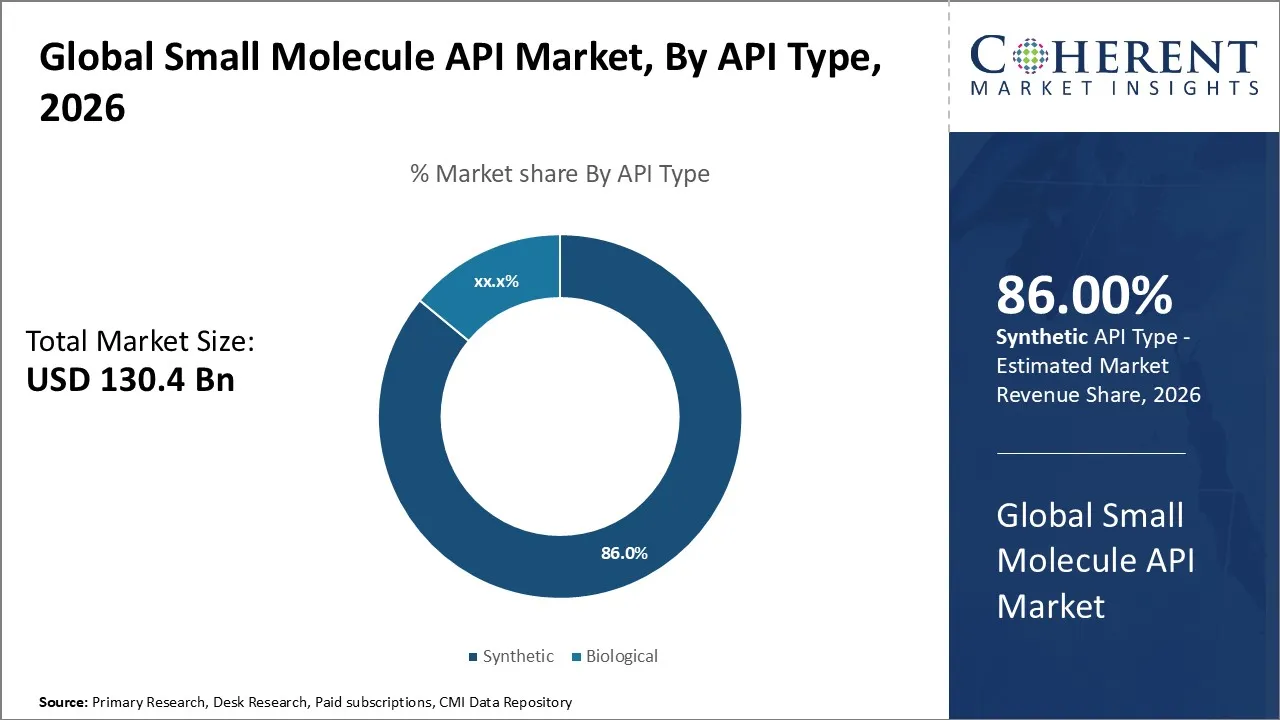
Small Molecule API Market Insights, By API Type – Synthetic dominates due to cost-effectiveness and wide usage
By API type, the Synthetic category is expected to share the largest market value of approximately 86% in 2026 due to its relative cost-effectiveness and well-established manufacturing process. Synthetic APIs have remained the central pillar of the pharmaceutical industry due to their capacity to be manufactured on a large scale while adhering to regulatory requirements.
For instance, in December 2025, Eli Lilly and Company announced its plan to invest over USD 6 billion in building a new small molecule synthetic active pharmaceutical ingredient API facility in Huntsville, Alabama, which is dedicated to producing API ingredients for small molecule synthetics such as its oral GLP 1 Receptor Agonist Orforglipron.
Small Molecule API Market Insights, By Application – Oncology leads due to rising cancer burden
By application, the Oncology segment is expected to capture the largest market share of around 30% by 2026 due to the growing cancer incidence and increased demand for cancer treatments using small molecules. Due to the targeting approaches, including oral route administration, small molecule oncology APIs are preferred and offer flexible treatment regimens and allows combination therapy modalities.
For instance, in June 2025, EVA Pharma and CHICO Pharmaceutical signed a Memorandum of Understanding (MOU) for the transfer of technology and local synthesis of oncology APIs, as a strategy to improve the cancer drug ingredient value chain.
Regional Insights
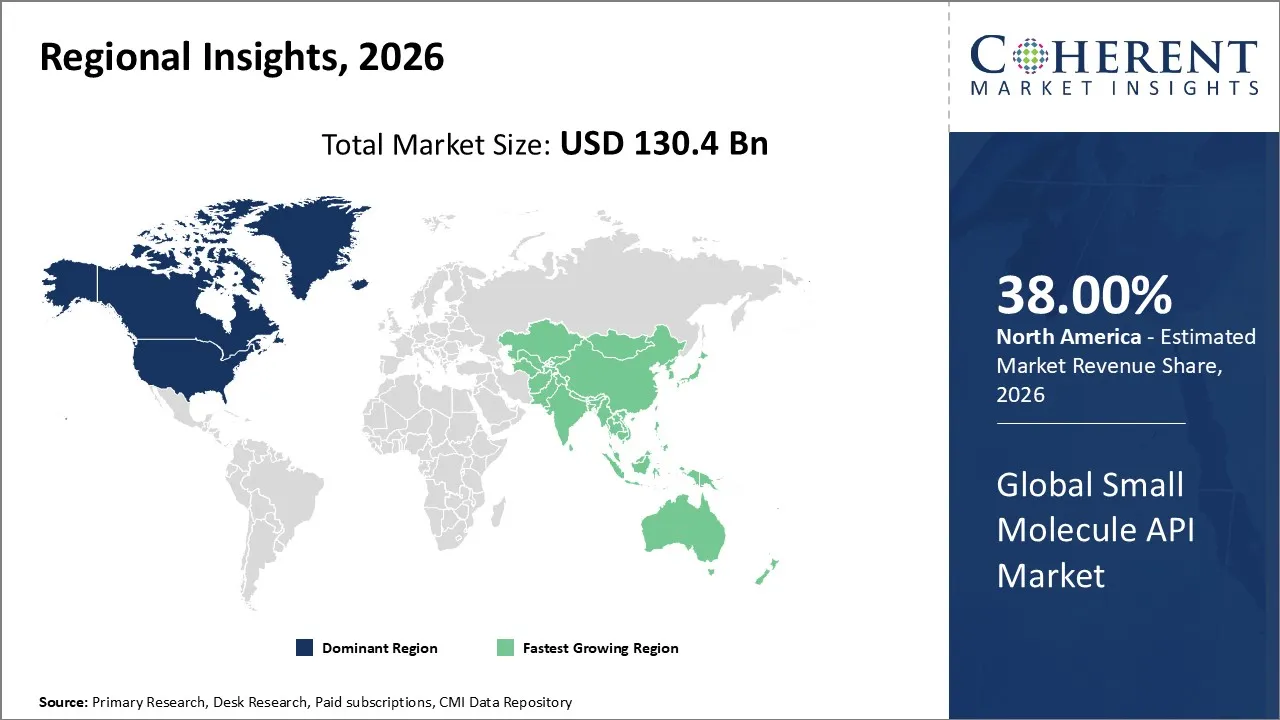
North America Small Molecule API Market Analysis & Trends
North America is projected to lead the market for small molecule APIs in 2026, accounting for approximately 38% of the market. The market in North America can be ascribed to the presence of an already established pharmaceutical sector, extensive R&D expenditure, and the latest technology infrastructure, which increase the need for innovative and generic versions of small molecule APIs.
For instance, in October 2025, Cambrex announced a $120 million investment to expand its U.S. API manufacturing operations, aimed at increasing capacity for active pharmaceutical ingredient development and production, including small‑molecule APIs, at its Charles City, Iowa facility.
Asia Pacific Small Molecule API Market Analysis & Trends
The Asia Pacific region is expected to be the fastest-growing small molecule API market in 2026, driven by cost-effective manufacturing, rapidly growing pharmaceutical industries in India and China, and rising domestic demand for both generic and innovative APIs. Government support and the development of contract manufacturing organizations and production facilities are adding to the market’s trajectory.
For instance, in June 2025, Divi’s Laboratories announced their strong second quarter, fueled by their increasing Active Pharmaceutical Ingredients (API) division, including custom chemical manufacture and export growth, in order to meet the growing demand in international markets for India-based manufacture of Active Pharmaceutical ingredients, specifically in the smaller molecule segment used in high-volume treatments.
Small Molecule API Market Outlook for Key Countries
Is the U.S. small molecule API market expanding due to R&D investment and domestic manufacturing?
The U.S. small molecule API market is increasing with robust investments in pharmaceutical R&D, increasing drives for generics and novel medicines, and onshore manufacturing plans. The domination of the North American market is further accentuated by advanced manufacturing infrastructure, along with compliance with regulations and big pharma fixed infrastructure.
For instance, in October 2025, Cambrex announced a $120 million investment in a Charles City, Iowa API manufacturing facility. This will add capacity for the production of small molecule APIs. The reason is that the global pharmaceutical industry is increasing their pipeline development for various therapeutic areas such as oncology, cardio, and metabolic.
Is India’s API manufacturing boom driving Asia Pacific market growth?
India’s rising prominence as a global API manufacturing hub is boosting the Asia Pacific small molecule API market. The country offers cost-effective production, a skilled workforce, and supportive government policies, making it a key supplier of small-molecule APIs for global pharmaceutical companies.
For instance, in June 2025, EVA Pharma and CHICO Pharmaceutical signed an MoU on the transfer of technology and manufacturing of oncology APIs. This move improves regional manufacturing capabilities in India, ensures quality of high-demand oncology drugs, and again proves the importance of the Indian market in the Asia-Pacific API market.
Is China’s focus on pharmaceutical innovation driving small molecule API growth?
China's focus on innovation in the pharmaceutical sector and increasing the production of APIs domestically is driving the growth of the market in the Asia-Pacific region. The government's support in terms of trade shows and implementation of technology is facilitating China becoming a prominent player in the development of small molecule APIs.
For instance, in October 2025, API China held its 93rd exhibition of pharmaceutical ingredients in Chongqing, which drew over 1,200 exhibition participants and 30,000 professionals from the industry focusing on small-molecule active pharmaceutical ingredients innovation and production collaborations.
Market Report Scope
Small Molecule API Market Report Coverage
| Report Coverage | Details | ||
|---|---|---|---|
| Base Year: | 2025 | Market Size in 2026: | USD 130.4 Bn |
| Historical Data for: | 2020 To 2024 | Forecast Period: | 2026 To 2033 |
| Forecast Period 2026 to 2033 CAGR: | 4.5% | 2033 Value Projection: | USD 177.4 Bn |
| Geographies covered: |
| ||
| Segments covered: |
| ||
| Companies covered: | ALLERGAN, Aurobindo Pharma, Cambrex Corporation, Albemarle Corporation, D.r. Reddy’s Laboratories Ltd., Johnson Matthey, Siegfried Holding AG, Pfizer, Sanofi S.A., Novartis AG, Johnson & Johnson, Bristol-Myers Squibb, Bachem Holding AG, Boehringer Ingelheim GmbH, F. Hoffmann-La Roche Ltd, GlaxoSmithKline PLC, GILEAD Science Inc., Albany Molecular Research Inc., Sun Pharmaceuticals, AstraZeneca, Merck & Co, Inc., BASF SE, and Teva Pharmaceuticals | ||
| Growth Drivers: |
| ||
| Restraints & Challenges: |
| ||
Small Molecule API Market Driver
Rising demand for generic and specialty drugs
Rising cases of chronic conditions like cancer, cardiovascular problems, diabetes, and neurological diseases are fueling the use of small molecule APIs. Generic drug acceptance, expiry of patents of widely prescribed pharmaceuticals, and greater emphasis on the use of cost-effective medications are contributing to increased use of APIs. Companies are expanding their outsourcing of APIs to cater to this need effectively.
Small Molecule API Market Opportunity
Advancements in API manufacturing and technology
Growth opportunities in the market include innovations in manufacturing technology. These innovations include continuous flow synthesis, high potencies API development, and process analytical technology. Emerging markets offer increased capacity, which, combined with green chemistry programs and contract manufacturing partnerships, ensure the company meets global demand at a lower cost. Focusing on special APIs for Cancer, Metabolic, or Neurological products would add to the revenue generation capabilities.
Analyst Opinion (Expert Opinion)
- The small molecule API market has emerged as an essential backbone of the pharmaceuticals market and is influencing the innovation and supply chain strategies associated with it. There is an observable drift in the demand from generic APIs to specialized APIs, especially in the cancer and high-potency segments.
- Developments in manufacturing technology, such as continuous flow synthesis and real-time quality analysis, are changing the nature of production efficiency and quality. Companies investing in these technologies are able to maintain high standards of quality while reducing production risks, giving them a competitive advantage in an industry where regulatory compliance and process control are paramount.
- Regionally, established markets such as North America enjoy strong regulatory frameworks, mature pharmaceutical ecosystems, and strategic investments in domestic API production, which strengthen supply chain security. At the same time, Asia Pacific is emerging rapidly as a major manufacturing hub, on account of cost-effective capacity for production, rich pools of skilled talent, and favorable initiatives by governments.
- Overall, the small molecule API market is evolving from a commoditized, volume-driven sector to one defined by innovation, specialization, and resilience. Companies that are involved in the innovation of advanced manufacturing, specialty APIs, and partnering will be at the forefront, while others will lag behind. The industry will remain very competitive.
Speak to the analyst
Want personalized insights?
Take the findings above to one of our principal consultants, or have the report rebuilt around the segments, geographies and competitors you actually track.
Small Molecule API Industry News
- In March 2025, Pfizer announced the expansion of its biologics and small molecule API manufacturing facility in Kalamazoo, Michigan, investing significantly to increase production capacity for oncology and cardiovascular APIs to strengthen supply reliability for key therapeutic areas.
- In November 2025, Dr. Reddy’s Laboratories announced that its API facility in Srikakulam, India, passed a USFDA Good Manufacturing Practice (GMP) inspection with zero observations, highlighting its commitment to maintaining regulatory quality standards in API production.
- In May 2025, Lonza introduced its Design2Optimize platform, a model‑based system to accelerate small‑molecule API development and improve manufacturing readiness, helping shorten time‑to‑clinical supply and enhance process reliability for drug developers.
- In February 2025, SK Pharmteco launched an advanced analytical testing laboratory dedicated to High‑Potency Active Pharmaceutical Ingredients (HPAPIs), expanding core capabilities in specialized API testing and quality assurance.
Market Segmentation
- API Type Insights (Revenue, USD Bn, 2026 - 2033)
- Synthetic
- Biological
- Application Insights (Revenue, USD Bn, 2026 - 2033)
- Oncology
- Neurology
- Metabolic
- Infectious
- Cardiovascular
- Regional Insights (Revenue, USD Bn, 2026 - 2033)
- North America
- U.S.
- Canada
- Latin America
- Brazil
- Argentina
- Mexico
- Rest of Latin America
- Europe
- Germany
- U.K.
- Spain
- France
- Italy
- Russia
- Rest of Europe
- Asia Pacific
- China
- India
- Japan
- Australia
- South Korea
- ASEAN
- Rest of Asia Pacific
- Middle East
- GCC Countries
- Israel
- Rest of Middle East
- Africa
- South Africa
- North Africa
- Central Africa
- North America
- Key Players Insights
- ALLERGAN
- Aurobindo Pharma
- Cambrex Corporation
- Albemarle Corporation
- r. Reddy’s Laboratories Ltd.
- Johnson Matthey
- Siegfried Holding AG
- Pfizer
- Sanofi S.A.
- Novartis AG
- Johnson & Johnson
- Bristol-Myers Squibb
- Bachem Holding AG
- Boehringer Ingelheim GmbH
- Hoffmann-La Roche Ltd
- GlaxoSmithKline PLC
- GILEAD Science Inc.
- Albany Molecular Research Inc.
- Sun Pharmaceuticals
- AstraZeneca
- Merck & Co, Inc.
- BASF SE
- Teva Pharmaceuticals
Sources
Primary Research Interviews
- Pharmaceutical & API Manufacturers (Small Molecule Focus)
- R&D & Process Development Managers
- API Production & Quality Control Heads
- Regulatory Affairs & Compliance Officers
- Contract Manufacturing Organization (CMO) Executives
- Procurement & Supply Chain Managers in Pharma
- Biotech & Specialty API Startups
- Others
Databases
- Bloomberg Terminal
- Thomson Reuters Eikon
- S&P Global Market Intelligence
- PubChem
- ChemSpider
- ClinicalTrials.gov
- Others
Magazines
- Pharmaceutical Technology
- Pharmaceutical Executive
- Pharma Manufacturing
- Chemical & Engineering News (C&EN)
- BioPharm International
- Others
Journals
- Journal of Pharmaceutical Sciences
- International Journal of Pharmaceutics
- Drug Development and Industrial Pharmacy
- European Journal of Pharmaceutical Sciences
- Current Pharmaceutical Design
- Others
Newspapers
- Financial Times
- The Wall Street Journal
- Reuters
- Bloomberg News
- The New York Times (Health/Pharma Section)
- Others
Associations
- International Pharmaceutical Federation (FIP)
- Pharmaceutical Research and Manufacturers of America (PhRMA)
- European Federation of Pharmaceutical Industries and Associations (EFPIA)
- American Chemical Society (ACS) – Pharmaceutical Division
- Others
Public Domain Sources
- U.S. Food & Drug Administration (FDA) Publications & Updates
- European Medicines Agency (EMA) Reports
- India’s Central Drugs Standard Control Organization (CDSCO) Publications
- World Health Organization (WHO) – Pharmaceutical Data
- Patents & Clinical Trial Registries
- Others
Proprietary Elements
- CMI Data Analytics Tool
- Proprietary CMI Existing Repository of Information for the Last 8 Years
Get access to 250+ pages report
Every segment, forecast, competitor profile and data table behind the analysis above — available for instant download.
- ESOMAR Member
- ISO 9001:2015 Certified
- D-U-N-S Registered
- GDPR & CCPA Compliant
Missing comfort of reading report in your local language? Find your preferred language:
Transform your Strategy with Exclusive Trending Reports
Frequently Asked Questions
The Small Molecule API Market is estimated to be valued at USD 130.4 Bn in 2026, and is expected to reach USD 177.4 Bn by 2033.
The CAGR of the Small Molecule API Market is projected to be 4.5% from 2026 to 2033.
Growing demand for cost-effective therapeutics, innovation in manufacturing processes, expansion in oncology and rare disease therapies, and increasing global pharmaceutical production are key drivers of market growth.
Stringent regulatory requirements, high operational costs for advanced API production, and competition from biologics and alternative therapies are primary factors constraining growth.
In terms of API type, the synthetic segment is expected to dominate the market due to cost-effectiveness, well-established manufacturing processes, and wide therapeutic applicability.
Major players include Allergan, Aurobindo Pharma, Cambrex Corporation, Albemarle Corporation, Dr. Reddy’s Laboratories, Johnson Matthey, Siegfried Holding AG, Pfizer, Sanofi, Novartis, Johnson & Johnson, Bristol-Myers Squibb, Bachem Holding AG, Boehringer Ingelheim, Roche, GlaxoSmithKline, Gilead Sciences, Albany Molecular Research, Sun Pharmaceuticals, AstraZeneca, Merck, BASF, and Teva Pharmaceuticals.
North America is expected to lead the market, supported by strong regulatory frameworks, established pharmaceutical infrastructure, and high demand for specialty APIs.