Smart Offices Market Analysis & Forecast: 2026-2033

The Smart Offices Market is estimated to be valued at USD 55,000 Mn in 2026 and is expected to reach USD 125,000 Mn by 2033, growing at a compound annual growth The rate (CAGR) of 10.8% from 2026 to 2033.
The smart offices market is advancing significantly, driven by its expanding role in hybrid work strategies, sustainable building management, and the Internet of Things (IoT) ecosystem. Moreover, increasing demand for energy efficiency and tightening environmental standards are expected to drive market growth over the forecast period. A smart office is a technology-integrated workspace mainly composed of interconnected sensors, AI driven software, and automated hardware formed from the convergence of digital and physical infrastructure. It plays a critical role across the commercial, corporate, and real estate sectors due to its ability to optimize space utilization and enhance operational performance.
The smart office industry is entering a phase of structural transformation driven by advances in edge computing and the growing integration of unified communication platforms. There is an increasing need for specialized solutions in areas such as office wellness, real-time occupancy analysis, smart lighting, and automated HVAC systems. Such solutions are enhancing energy efficiency, productivity analysis, and data-driven operational management.
|
Current Event |
Description and the Impact |
|
Technological Advancements and Standards Development |
|
|
Shifting Workforce Dynamics and Hybrid Work Models |
|
|
Regulatory and Environmental Initiatives |
|
Uncover macros and micros vetted on 75+ parameters: Get instant access to report
AI plays a crucial role in the smart office market by enhancing workspace productivity, sustainability, and flexibility. One of the key areas where AI influences operations is through improving efficiency, as it can automate numerous repetitive tasks such as data entry and scheduling. In terms of space management, AI analyzes occupancy data from IoT sensors to optimize the use of desks and conference rooms. This assists in reducing wasted space and also lowering operational expenses. AI technologies help in personalizing the workplace by adjusting lighting and temperature in real time based on occupancy levels and individual preferences. This personalization leads to better health and productivity among employees.
For instance, in August 2025, the UAE has unveiled plans for the world's first office building that was fully researched, imagined, and planned using artificial intelligence (AI). Al Marwan Real Estate Development Group in Sharjah is developing a project called District 11.
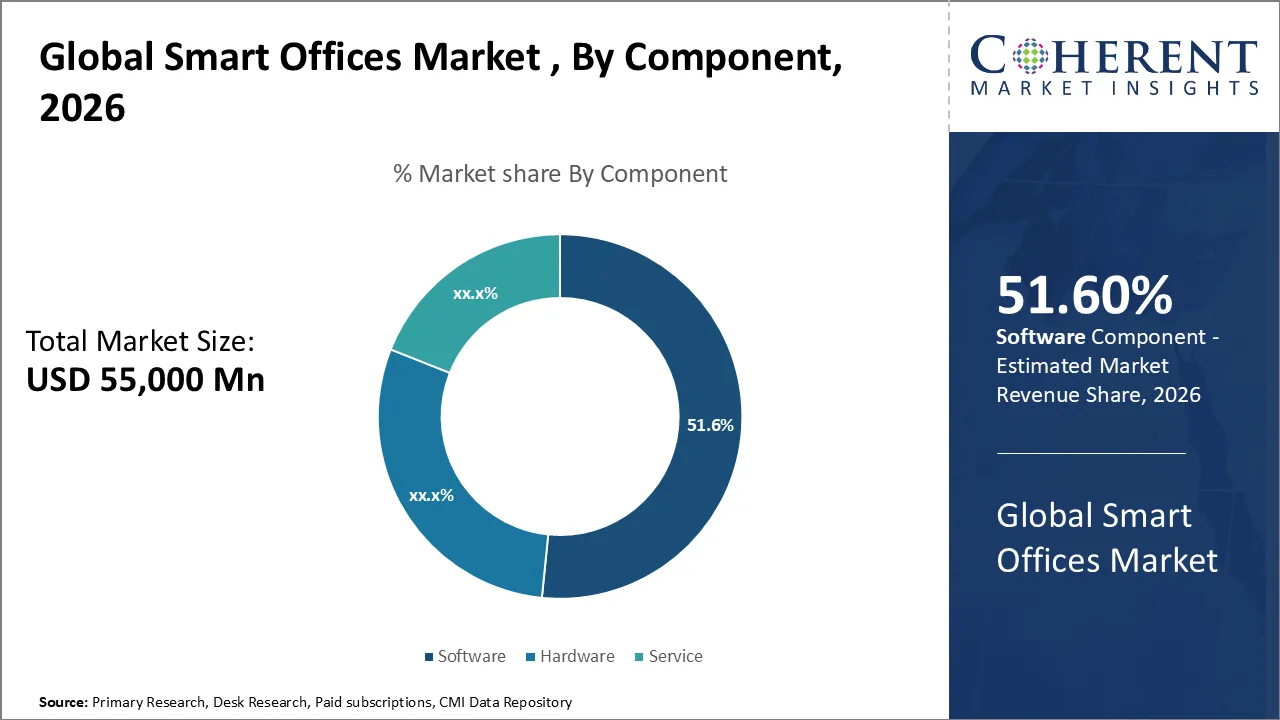
In terms of component, the software segment contributes the highest share of 51.60% in 2026 of the market. Businesses are increasingly prioritizing AI-driven analytics and cloud-based platforms to manage their digital ecosystems. These software solutions function as the central nervous system of the modern workplace, thus integrating data from various IoT devices into a single, actionable dashboard. The firms are utilizing these tools to coordinate tools, to coordinate hybrid teams, to track real-time occupancy, and to enhance employee productivity through seamless mobile applications. Furthermore, the shift toward subscription as a service model ensures that organizations receive continuous security patches and feature updates without replacing physical hardware. Ultimately, software provides the essential intelligence that allows managers to make data-informed decisions about their office resources.
IntelePeer, a leading provider of AI-driven communications automation, has launched SmartOffice, a solution designed to help regional offices and retail locations improve local customer experiences while increasing operational efficiency and reducing costs.
In terms of product type, the energy management system segment contributes the highest share of 29.40% in the market in 2026 driven by stringent global sustainability regulations and a corporate desire to slash operational costs. Modern EMS systems use predictive algorithms to automate climate control and lighting systems based on actual room usage, preventing the waste of electricity in empty spaces. The adoption of these systems allows corporations to directly address their ESG (Environmental, Social, and Governance) targets and move closer to achieving net zero carbon emissions. These systems also empower facility managers to monitor consumption patterns and identify inefficiencies before they lead to expensive utility bills. The clear financial return on investment makes EMS the primary choice for businesses looking to modernize their physical infrastructure.
In terms of office type, the retrofit office segment contributes the highest share of 55.30% in 2026 of the market because property owners must modernize a vast global inventory of legacy buildings to meet current efficiency standards. Several enterprises view retrofitting existing facilities as a more cost-effective and environmentally sustainable alternative to constructing new green buildings from the ground up. This approach allows landlords to install advanced IoT sensors and wireless controls within older structures, thereby substantially increasing the property’s rental value and appeal to high-tech tenants.
To learn more about this report, Download Free Sample
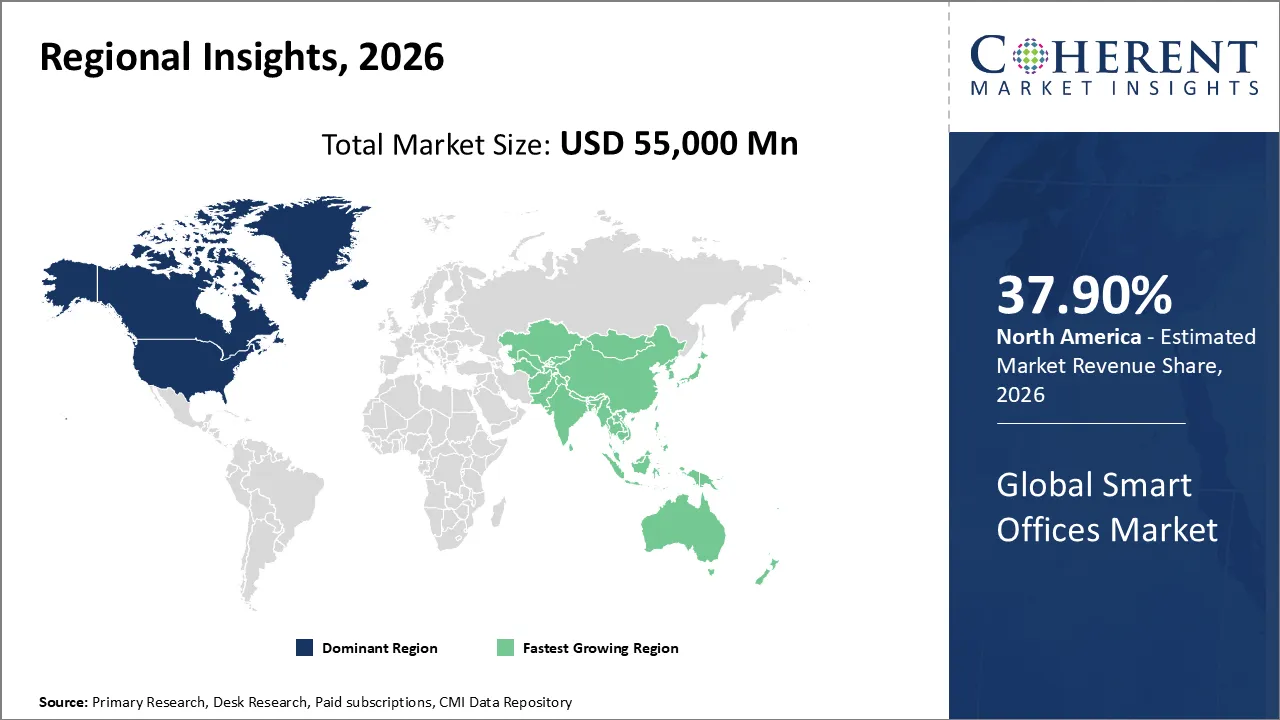
North America has remained the dominant region, with 37.90% in 2026 of the global Smart Offices Market over the past decade. The region hosts a substantial presence of leading technology providers and early-adopting multinational companies. The companies across the US and Canada are taking proactive steps to implement AI enabled occupancy sensors and real-time data analytics in an attempt to optimize their vast real estate portfolios and minimize operational expenses. Moreover, the stringent regulatory frameworks and green building certifications like LEED and ENERGY STAR provide substantial financial incentives for businesses that invest in high-end energy management systems. The firms in this region are sustaining an edge in talent retention initiatives to focus on employee welfare and workplace security.
For instance, in September 2024, IntelePeer, a prominent provider of AI-powered communications automation solutions, has released its SmartOffice solution. This innovation aims to enhance the customer experience at regional offices and retail stores while also streamlining operations to be more efficient and cost-effective.
The Asia Pacific region is likely to register the fastest expansion in the smart office industry throughout the forecast period. This is owing to emerging economies undergoing massive urbanization and building new commercial hubs. The governments in nations like China, India, and Vietnam are fueling the market demand by introducing Smart City initiatives that mandate high-tech infrastructure and modern high-tech infrastructure and modern energy efficiency standards for all the new construction projects. In addition to this, the region's booming IT and services sectors are creating a surge in co-working and flexible workplaces that rely on IoT-enabled security and mobile-first management tools.
For instance, in August 2025, KDDI will begin delivering KDDI Smart Space Design to Japan and other nations, primarily targeting Southeast Asia. This solution aims to create environments where people work and visit, utilizing AI, robotics, and communications technology.
The US maintains its lead in the smart office market as major corporations aggressively scale their AI-native workflows and cloud-based collaboration platforms. American firms leverage these technologies to manage high-density hybrid workforces while simultaneously improving real-time data security. Furthermore, the US government enforces strict sustainability mandates and energy efficiency standards, which compel businesses to install advanced HVAC and lighting controls. By integrating IoT sensor networks with predictive analytics, US companies slash operational costs and create high-performance environments that successfully attract top-tier talent.
China is expected to register fast growth in the smart office sector due to the rapid deployment of high-speed 5G networks and advanced internet infrastructure across major metropolitan hubs. The government boosts the market’s growth with the concept of Digital China, which promotes the embedding of intelligence in all new commercial construction projects. In addition, the establishment of the Smart Cities has led to the rapid rise in office buildings incorporating AI powered facility management and biometric security systems. As tech hubs in Beijing and Shenzhen mature, they bypass legacy hardware to adopt the world's most advanced automated office ecosystems. This rapid modernization allows businesses in the country to optimize their operations with unprecedented speed using locally developed AI integrated management tools.
| Report Coverage | Details | ||
|---|---|---|---|
| Base Year: | 2025 | Market Size in 2026: | USD 55,000 Mn |
| Historical Data for: | 2020 To 2024 | Forecast Period: | 2026 To 2033 |
| Forecast Period 2026 to 2033 CAGR: | 10.8% | 2033 Value Projection: | USD 125,000 Mn |
| Geographies covered: |
|
||
| Segments covered: |
|
||
| Companies covered: |
ABB Ltd., Cisco Systems, Inc., Crestron Electronics, Inc., Honeywell International Inc., Johnson Controls International PLC, Lutron Electronics Co. Inc., Philips Lighting Holding B.V., Miracle Group Inc., Siemens AG, Schneider Electric SA, Sensorsuite Inc., United Technologies Corporation |
||
| Growth Drivers: |
|
||
| Restraints & Challenges: |
|
||
Uncover macros and micros vetted on 75+ parameters: Get instant access to report
The focus on sustainability and energy efficiency is the primary driver for the smart office market growth. The modern enterprises are adopting intelligent technologies to meet environmental goals and reduce their overall ecological impact. Automated lighting and smart climate control systems respond dynamically to room occupancy, thus ensuring that offices consume energy only when necessary. These innovations allow facilities managers to track resource usage patterns and identify areas where they can minimize waste. In addition, the widespread desire for ecofriendly building certifications encourages developers to embed sophisticated sensors and data analytics into the core of office infrastructure. This shift toward sustainable design contributes to the development of high-performance workplaces that lower operational costs and promote a healthier environment for employees. By incorporating these innovative solutions, companies are able to convert traditional offices into modern centers of efficiency and environmental stewardship.
The Smart Offices market is progressing from isolated automation deployments toward integrated, data-driven workplace ecosystems. Industry data indicates that more than 60% of large enterprises have adopted at least one smart office solution, such as connected lighting, HVAC automation, or digital access control. Among these, IoT-enabled occupancy monitoring and space utilization tools are increasingly prioritized, with studies showing 20–30% improvements in space efficiency through real-time analytics and sensor-based planning.
Energy optimization remains a central adoption driver. Smart lighting systems combined with automated climate control have demonstrated energy consumption reductions of up to 30–40% in commercial office buildings. These measurable efficiency gains align with corporate sustainability targets and tightening building performance regulations, particularly in North America and Europe.
Technology penetration is also accelerating across Asia-Pacific, where large-scale commercial developments are increasingly designed with embedded smart infrastructure. Hardware components such as sensors, controllers, and connected devices continue to account for a significant portion of deployments, while software platforms and managed services are expanding rapidly due to demand for centralized monitoring, predictive maintenance, and workplace analytics.
Overall, data suggests the Smart Offices market is evolving toward intelligent, AI-enabled environments that support operational efficiency, energy accountability, and employee productivity. As enterprises seek quantifiable returns from real estate and facility investments, smart office solutions are becoming a standard component of modern commercial building strategies rather than optional enhancements.
Definition: The Smart Offices Market is defined as the ecosystem of hardware, software, and services that convert traditional workplaces into technology-optimized environments. This industry leverages Internet of Things (IoT) sensors, Artificial Intelligence (AI), and cloud computing to automate critical functions such as lighting, climate regulation, and security management. Businesses drive market growth because they seek to enhance employee productivity, increase energy efficiency, and implement data-driven space management. Core segments within this industry include smart lighting, intelligent security, and unified communication systems. As companies adopt hybrid work models, the market prioritizes the creation of connected and sustainable environments that lower operational costs while improving the overall employee experience.
Share
Share
About Author
Ankur Rai is a Research Consultant with over 5 years of experience in handling consulting and syndicated reports across diverse sectors. He manages consulting and market research projects centered on go-to-market strategy, opportunity analysis, competitive landscape, and market size estimation and forecasting. He also advises clients on identifying and targeting absolute opportunities to penetrate untapped markets.
Missing comfort of reading report in your local language? Find your preferred language :
Transform your Strategy with Exclusive Trending Reports :
Frequently Asked Questions
Joining thousands of companies around the world committed to making the Excellent Business Solutions.
View All Our Clients
 Schedule a meeting with report Author