

Stearyl Alcohol Market Size and Forecast — 2026 - 2033
The Global Stearyl Alcohol Market size is estimated to be valued at USD 560 million in 2026 and is expected to reach USD 885 million by 2033, exhibiting a compound annual growth rate (CAGR) of 6.2% from 2026 to 2033.
Overview
Stearyl alcohol is a long-chain fatty alcohol commonly derived from natural fats and oils or synthesized petrochemically. It appears as a white, waxy solid and functions primarily as an emollient, thickening agent, and stabilizer. Stearyl alcohol is widely used in personal care and cosmetic formulations such as creams, lotions, shampoos, and conditioners to improve texture and moisture retention. It is also used in pharmaceuticals, lubricants, coatings, and plastics as a processing aid and consistency enhancer.
Key Takeaways
Market segments indicate a dominant share of Primary Stearyl Alcohol owing to its wide applicability across personal care and pharmaceutical industries, driving consistent market expansion.
The industrial lubricants segment is the fastest-growing subsegment due to increased mechanization and automotive sector requirements for superior quality additives.
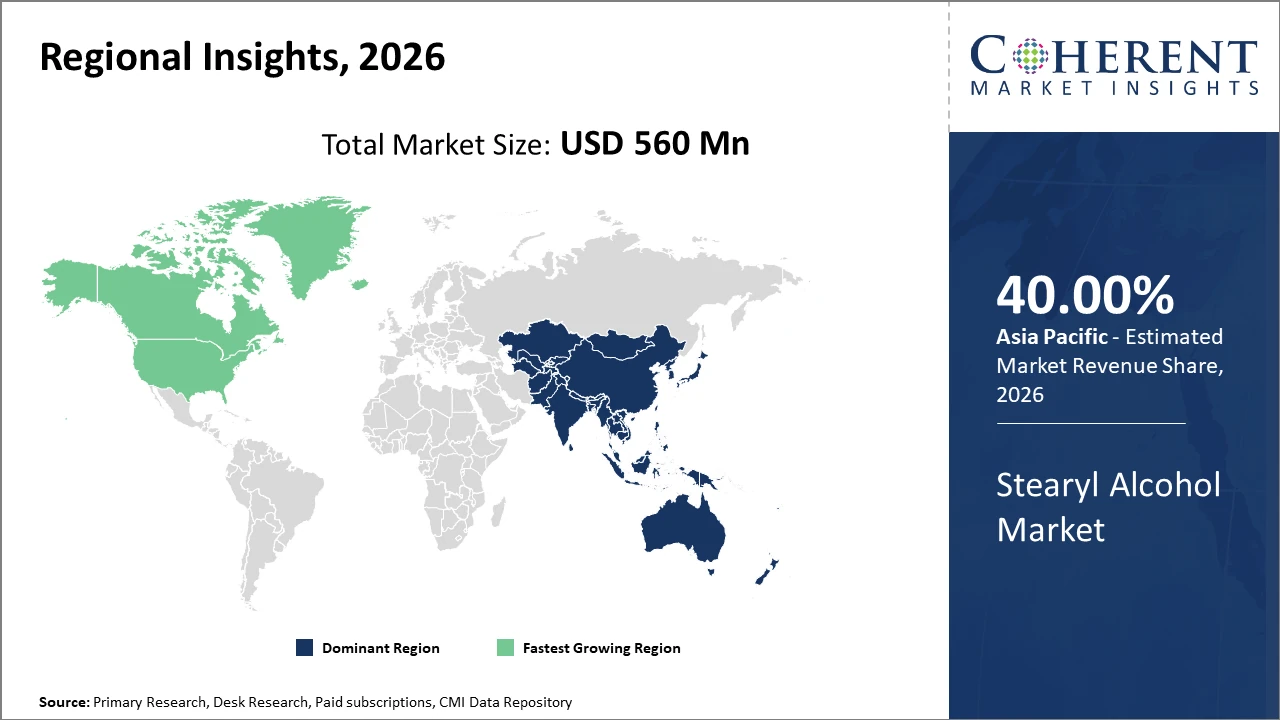
Regional analysis highlights Asia Pacific as a revenue leader with high industry activity, while North America represents the fastest-growing region, benefiting from government initiatives promoting high-value product manufacturing and research investment.
Europe maintains steady growth supported by regulatory compliance, fostering product innovation and sustainability initiatives.
Stearyl Alcohol Market Segmentation Analysis
Stearyl Alcohol Market Insights, By Product Type
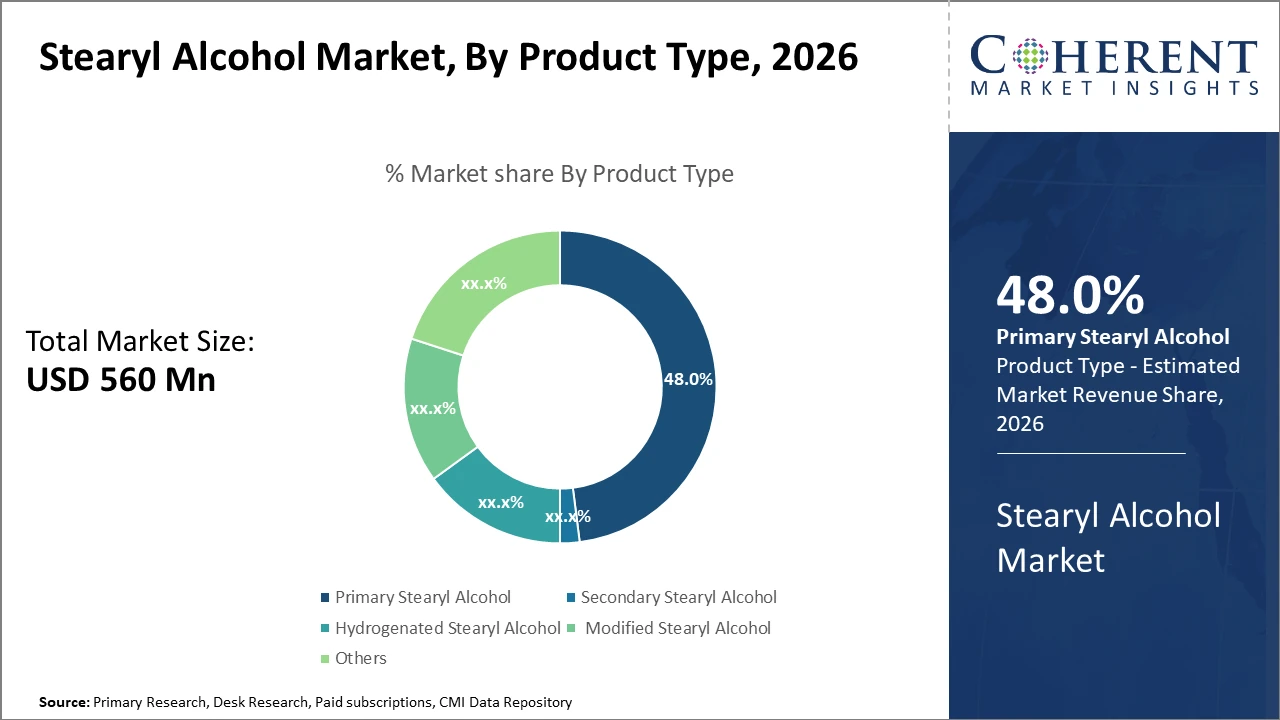
Primary Stearyl Alcohol dominates the market share at 48%. Primary Stearyl Alcohol’s dominance can be attributed to its widespread usage in personal care and pharmaceutical applications due to its superior purity and multifunctional characteristics. Secondary Stearyl Alcohol is witnessing rapid growth due to its increased adoption in industrial lubricants and specialty chemical formulations offering specific performance benefits. Hydrogenated Stearyl Alcohol maintains moderate usage primarily in cosmetics for enhanced stability and skin compatibility, while Modified Stearyl Alcohol finds applications in niche areas requiring customized molecular structures.
Stearyl Alcohol Market Insights, By Application
Personal Care & Cosmetics is emerging as the dominating segment. Its dominance is largely due to continuous product innovation focused on natural and efficacy-enhancing formulations that increasingly rely on Stearyl Alcohol. The fastest growing application subsegment is Industrial Lubricants, driven by expanding automotive production and heavy machinery operations demanding synthetic oils and additives with enhanced physical properties. Pharmaceuticals hold a stable share with growing requirements in topical formulations and ointments. Packaging applications are modest but growing, propelled by biodegradable and eco-friendly material development trends.
Stearyl Alcohol Market Insights, By End-Use Industry
Household Care commands the largest market share. This is supported by skyrocketing demand for home & personal cleaning agents and cosmetics integrating Stearyl Alcohol for improved texture and stability. The Pharmaceuticals & Healthcare segment is recognized as the fastest growing due to increased R&D investments in drug delivery systems and topical creams requiring refined Stearyl Alcohol grades. Food & Beverages use is comparatively limited but growing owing to its emulsifier and stabilizer properties in specialty food products. Automotive continues to expand steadily, relying increasingly on Stearyl Alcohol derivatives in grease and lubricants.
Stearyl Alcohol Market Trends
Recent years have seen a notable shift in the market towards sustainable and bio-based production pathways.
For instance, in 2026, a leading manufacturer introduced a certified vegetable-derived Stearyl Alcohol line generating a 20% sales uplift in North America.
The rise in digital tools for supply chain optimization has decreased lead times by up to 15% in certain European markets, enhancing market efficiency.
Furthermore, innovation in multifunctional additive formulations is accelerating, as reflected by pharmaceutical companies reformulating topical creams with Stearyl Alcohol blends that provide enhanced stability and sensory characteristics, improving consumer acceptance rates globally.
These evolving trends underscore the market’s adaptability to environmental imperatives and technological advancements, driving future growth trajectories.
Stearyl Alcohol Market Insights, By Geography
Asia Pacific Stearyl Alcohol Market Analysis and Trends
In the Asia Pacific, the dominance in the Stearyl Alcohol market is highlighted by substantial production and consumption volumes, supported by rapidly growing personal care industries in China and India. This region accounts for over 40% of the industry share, driven by favorable government policies facilitating bio-based chemical manufacturing and a proliferating cosmetics sector. Manufacturers like Wilmar International and Godrej Industries significantly influence regional market dynamics through extensive product portfolios and collaborations.
North America Stearyl Alcohol Market Analysis and Trends
Meanwhile, North America exhibits the fastest growth with a CAGR exceeding 7%, propelled by investments in pharmaceutical-grade and specialty Stearyl Alcohol products. Regulatory frameworks coupled with consumer demand for natural and functional ingredients have catalyzed innovation and adoption. The U.S. market, in particular, benefits from advanced manufacturing technologies and strategic expansions by major players such as Croda International and BASF SE, further amplifying market development.
Stearyl Alcohol Market Outlook for Key Countries
USA Stearyl Alcohol Market Analysis and Trends
The U.S. market is robust, supported by advanced cosmetic and pharmaceutical industries adopting high-purity Stearyl Alcohol grades. Increasing consumer awareness around sustainable personal care ingredients has driven leading manufacturers to launch eco-certified product lines. For example, Croda International expanded its U.S. production capacity by 12% in 2021, contributing to local supply security and market share growth. Strategic alliances between chemical producers and pharmaceutical companies have accelerated product innovation, bolstering steady business revenue in the U.S.
India Stearyl Alcohol Market Analysis and Trends
India’s market is expanding rapidly, fueled by a growing personal care sector and burgeoning pharmaceutical manufacturing. Domestic companies, including Godrej Industries and VVF Ltd, dominate production, capitalizing on the availability of raw materials and cost advantages. The government’s Make in India initiative has enhanced local capacity by incentivizing investments, resulting in a 15% increase in production volumes in 2026. Rising disposable incomes and increasing urbanization stimulate demand for quality personal care formulations containing Stearyl Alcohol, positioning India as a significant growth hub in the Asia Pacific region.
Analyst Opinion
Increasing production capacities across emerging economies have significantly shifted the supply-side dynamics of the Stearyl Alcohol market. For example, capacity expansions in Southeast Asian chemical plants increased global supply by 8% in 2021, easing pricing pressures and enabling competitive market growth.
Demand-side indicators reveal a surge in end-user adoption, notably in the personal care sector. The incorporation of Stearyl Alcohol in premium sunscreen products witnessed a 12% increase in volume sales globally in 2026, emphasizing its demand elasticity in cosmetics formulations.
Regional micro-indicators highlight Asia Pacific as a burgeoning consumption hub, with India alone recording a consumption growth of 10% year over year driven by domestic cosmetic manufacturing and pharmaceutical production houses expanding their footprint.
Nano-scale analysis of pricing trends shows moderate fluctuations influenced by crude oil price volatility and raw material availability, where a 5% price increase in 2021 was promptly neutralized by alternative supplier negotiations, fostering stable market revenue trajectories.
- Current Industry Events of 2026
- Market Size Estimation
- Regional Breakdown
- Competitive Landscape
- Customer Intelligence
- Segmental Analysis
- Pricing Analysis
- Key Market Drivers, Challenges & Future Trends
- Customized Insights Section
Market Scope
| Report Coverage | Details | ||
|---|---|---|---|
| Base Year: | 2025 | Market Size in 2026: | USD 560 million |
| Historical Data for: | 2021 To 2024 | Forecast Period: | 2026 To 2033 |
| Forecast Period 2026 to 2033 CAGR: | 6.2% | 2033 Value Projection: | USD 885 million |
| Geographies covered: |
| ||
| Segments covered: |
| ||
| Companies covered: | Sasol Limited, Croda International Plc, Wilmar International, Global Bio-Chem Technology Group Company Limited, Kao Corporation, BASF SE, Godrej Industries, Desmet Ballestra Group, VVF Ltd, Emery Oleochemicals. | ||
| Growth Drivers: |
| ||
Stearyl Alcohol Market Growth Factors
Growing awareness of natural and bio-based ingredients in personal care products is a critical driver, as manufacturers prefer Stearyl Alcohol derived from renewable sources, boosting industry size. Technological advancements in refining methods have enhanced product purity, stimulating uptake in sensitive pharmaceutical formulations. Increasing urbanization and disposable incomes in emerging regions contribute to the expanding end-user base, directly influencing market revenue. Furthermore, stringent regulatory frameworks emphasizing product safety have pushed major market companies to invest in high-grade Stearyl Alcohol, ensuring compliance and catalyzing market growth.
Stearyl Alcohol Market Development
In November 2024, Sasol introduced NACOL 18-98, a palm-free, bio-based stearyl alcohol derived from segregated rapeseed oil, developed to comply with the EU Deforestation Regulation (EUDR). The launch addressed growing demand for traceable, sustainable fatty alcohols in personal care, cosmetics, and industrial applications.
In 2024, AVYA Skincare incorporated stearyl alcohol into new product launches, including its Hydroveda collection, leveraging the ingredient’s emollient, stabilizing, and conditioning properties to enhance skin feel, formulation stability, and consumer appeal in premium skincare products.
Key Players
Leading Companies of the Market
Sasol Limited
Croda International Plc
Wilmar International
Global Bio-Chem Technology Group Company Limited
Kao Corporation
BASF SE
Godrej Industries
Desmet Ballestra Group
VVF Ltd
Emery Oleochemicals
Competitive strategies witnessed in 2021 include Croda International’s strategic acquisition of local fatty alcohol producers in Asia Pacific, resulting in a 15% growth in regional market revenue. Sasol Limited enhanced their production efficiency through technology upgrades in South Africa, reducing production costs by 10% and increasing market share in industrial lubricants. Wilmar International’s expansion into customized Stearyl Alcohol blends for pharmaceutical applications broadened its customer base, contributing to business growth and improved market penetration in North America and Asia Pacific.
Stearyl Alcohol Market Future Outlook
The stearyl alcohol market is poised for continued diversification and innovation driven by sustainability trends and functional performance demands. In personal care and cosmetics, consumer preferences for natural and renewable ingredients will increase the emphasis on bio-based stearyl alcohol—particularly those derived from certified sustainable vegetable sources—as opposed to petrochemical-derived products. Formulators will continue to leverage its thickening and moisturizing properties in multifunctional and clean-label cosmetic formulations. Technical-grade stearyl alcohol will remain relevant in industrial applications, particularly where lubricity, water resistance, or structural modification are required. Regulatory pressures on chemical safety and environmental impact will encourage greener processing technologies and waste reduction strategies.
Stearyl Alcohol Market Historical Analysis
The stearyl alcohol market has roots in the broader evolution of fatty alcohols derived from natural fats and petrochemical feedstocks. Initially, long-chain fatty alcohols were extracted from animal fats and vegetable oils for use in soaps, lubricants, and cosmetic preparations in the early 20th century. With the rise of industrial chemistry and the availability of petrochemical feedstocks in the mid-20th century, synthetic routes were developed, allowing stearyl alcohol to be produced at scale with greater purity and consistency. Its favorable organoleptic and physical properties—such as its waxy solid form, emollient behavior, and thickening effects—made it a staple ingredient in personal care formulations, including creams, lotions, conditioners, and shampoos by the late 20th century.
Sources
Primary Research Interviews:
Chemical Engineers
Cosmetic Formulators
Oleochemical Producers
Product Development Managers
Distributors
Databases:
UN Comtrade Chemicals
OECD Chemical Statistics
Magazines:
Chemical Week
Cosmetics & Toiletries
Personal Care Magazine
SpecialChem
Chemical Engineering World
Journals:
Industrial Crops and Products
Journal of Cosmetic Science
Applied Chemistry Journal
Organic Process Research
Newspapers:
Financial Times (Chemicals)
Reuters Chemicals
The Hindu BusinessLine
Economic Times
Bloomberg Industry
Associations:
American Oil Chemists’ Society
International Soap Detergent Association
European Chemicals Agency
Indian Chemical Council
Cosmetics Europe
Get access to 250+ pages report
Every segment, forecast, competitor profile and data table behind the analysis above — available for instant download.
- ESOMAR Member
- ISO 9001:2015 Certified
- D-U-N-S Registered
- GDPR & CCPA Compliant
Missing comfort of reading report in your local language? Find your preferred language:
Transform your Strategy with Exclusive Trending Reports
Frequently Asked Questions
Dominance resides with companies such as Sasol Limited, Croda International Plc, and Wilmar International, holding significant market share through strategic expansions and technological innovations.
The market is set to reach approximately USD 885 million by 2033, growing at a CAGR of 6.2% due to expanding applications in cosmetics, pharmaceuticals, and industrial uses.
The personal care and cosmetics segment shows the highest growth opportunity, fueled by increasing demand for bio-based ingredients and multifunctional additives.
Trends will increasingly focus on sustainable raw material sourcing, digital supply chain management, and integration of advanced refining technologies improving product efficacy and market competitiveness.
The landscape is competitive, driven by capacity expansions and innovation, with challenges including raw material price volatility and regulatory compliance pressures on product standardization.
Market players concentrate on regional acquisitions, product diversification towards natural and pharmaceutical-grade alcohols, and technology-driven cost optimization to enhance market footprint and revenue.