

Sterile Medical Packaging Market Size & Trends
Sterile Medical Packaging Market is estimated to be valued at USD 75.82 Bn in 2026 and is expected to reach USD 146.81 Bn in 2033, exhibiting a compound annual growth rate (CAGR) of 9.9% from 2026 to 2033.
Key Takeaways
- Based on Material Type, the Plastics-PP, Polyester, PS, PVC, HDPE, etc. segment is projected to capture 46% of the global sterile medical packaging market in 2026, owing to its unique combination of functionality, cost-efficiency, and compliance with sterility requirements.
- Based on Product Type, the thermoform trays segment will lead the market with the largest share in 2026, due to their ability to provide superior protection, sterility, and ease of use for high-value medical devices and surgical instruments.
- Based on Application Type, Pharmaceuticals segment is expected to dominate the global sterile medical packaging market in 2026, due to their high sensitivity to contamination and strict regulatory requirements.
- Based on Region, North America is expected to lead the market, holding a share of 47% in 2026. While, Asia Pacific is anticipated to be the fastest growing region during the forecast period.
Market Overview
The sterile medical packaging market is witnessing strong growth, driven by rising surgical procedures, increased use of single-use medical devices, and expanding pharmaceutical production. Strict regulatory standards and growing emphasis on infection control are pushing demand for high-quality, contamination-resistant packaging. The sterile medical packaging market demand is further supported by innovations in sustainable materials and smart packaging technologies.
Current Events and their Impact on the Sterile Medical Packaging Market
Current Event | Description and its Impact |
Regulatory Harmonization and Standards Evolution |
|
US Trade Policy and Tariff Implementation (2025) |
|
End-User Feedback and Unmet Needs in the Sterile Medical Packaging Market
End-User Feedback
Healthcare providers and sterile processing departments have consistently emphasized the importance of packaging solutions that guarantee sterility while maintaining ease of use. Key feedback points include:
- Sterility Assurance: End-users require packaging that reliably maintains sterility throughout the supply chain and during storage, minimizing the risk of contamination and subsequent infections.
- Ease of Handling: Packaging must be intuitive and ergonomically designed to facilitate quick and safe opening, especially in high-pressure clinical environments.
- Durability and Integrity: The packaging materials should withstand mechanical stresses such as transportation, handling, and sterilization processes without compromising barrier properties.
- Clear Labeling and Traceability: End-users stress the need for clear, legible labels that include critical information such as lot numbers, expiration dates, and sterilization indicators to enhance traceability and compliance.
Unmet Needs
Despite advancements, several unmet needs persist within the sterile medical packaging market:
- Innovative Materials: There is a demand for novel, biodegradable, or recyclable materials that balance sterility assurance with environmental sustainability.
- Improved Barrier Technologies: Enhanced barrier properties that can withstand extended storage times and diverse environmental conditions remain a priority.
- Cost-Effective Solutions: Healthcare facilities seek packaging that provides high performance without significantly increasing costs, particularly in resource-constrained settings.
- Current Industry Events of 2026
- Market Size Estimation
- Regional Breakdown
- Competitive Landscape
- Customer Intelligence
- Segmental Analysis
- Pricing Analysis
- Key Market Drivers, Challenges & Future Trends
- Customized Insights Section
Segmental Insights
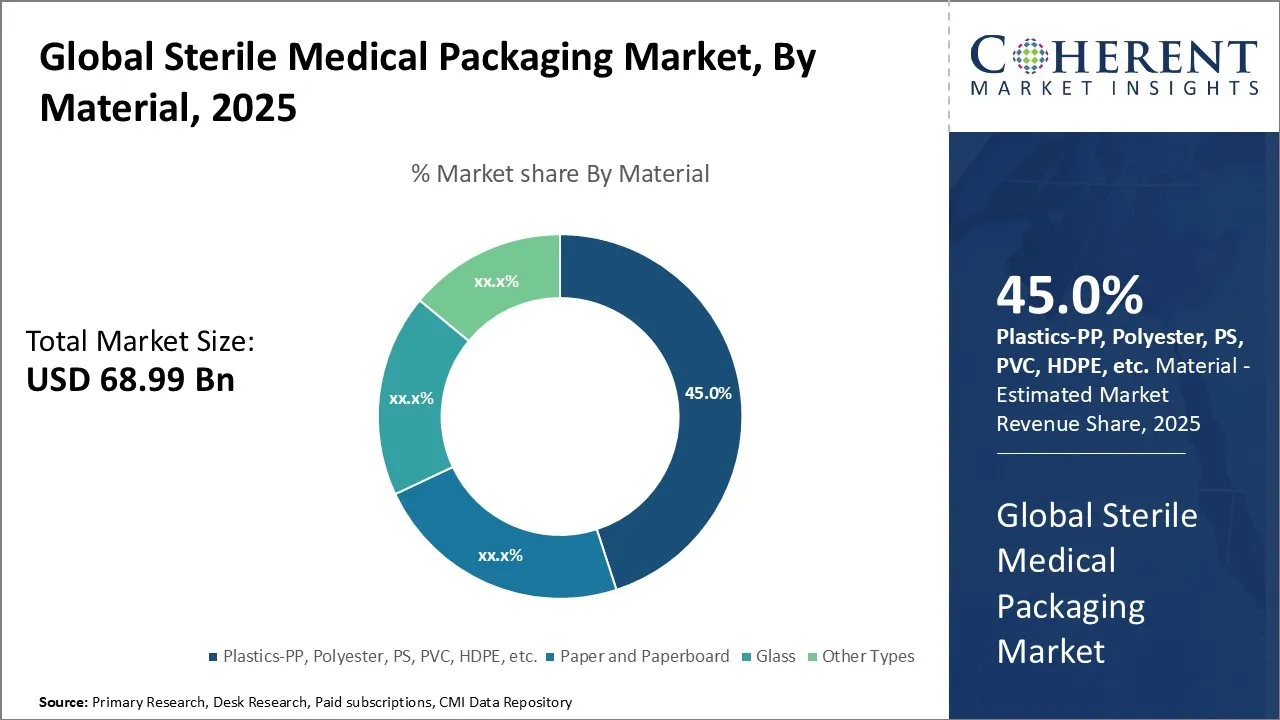
Sterile Medical Packaging Market Insights, By Material - Plastics-PP, Polyester, PS, PVC, HDPE, etc. Acquires the largest share
In terms of material type, the Plastics-PP, Polyester, PS, PVC, HDPE, etc. segment is expected to contribute the dominating share of 46.0% in the global sterile medical packaging market in 2026, owing to its unique combination of functionality, cost-efficiency, and compliance with sterility requirements. Materials such as polyethylene (PE), polypropylene (PP), and PET offer excellent barrier protection against moisture, air, and microbial contamination which is critical for preserving the sterility of medical products. Plastics are also highly versatile, allowing for easy molding and thermoforming into trays, pouches, clamshells, and other custom packaging formats to accommodate a wide range of devices and pharmaceutical products. Their lightweight nature and lower cost make them ideal for high-volume production and global distribution. Additionally, plastic packaging is compatible with key sterilization methods like ethylene oxide (EtO), gamma irradiation, and e-beam, ensuring that both the packaging and the product remain intact and sterile throughout the supply chain. The material’s transparency also allows for visual inspection, and tamper-evident features can be easily integrated for added safety. With the growing global reliance on single-use medical devices and the need for infection prevention, plastic continues to play a central role in meeting the evolving demands of sterile medical packaging.
In June 2024, Cherwell Laboratories unveiled its new Redipor® terminally sterilised plastic bottle media range, designed to help pharmaceutical companies meet sustainability targets. Developed in response to a major client request, these plastic bottles offer a more environmentally friendly and cost-effective alternative to traditional glass media bottles.
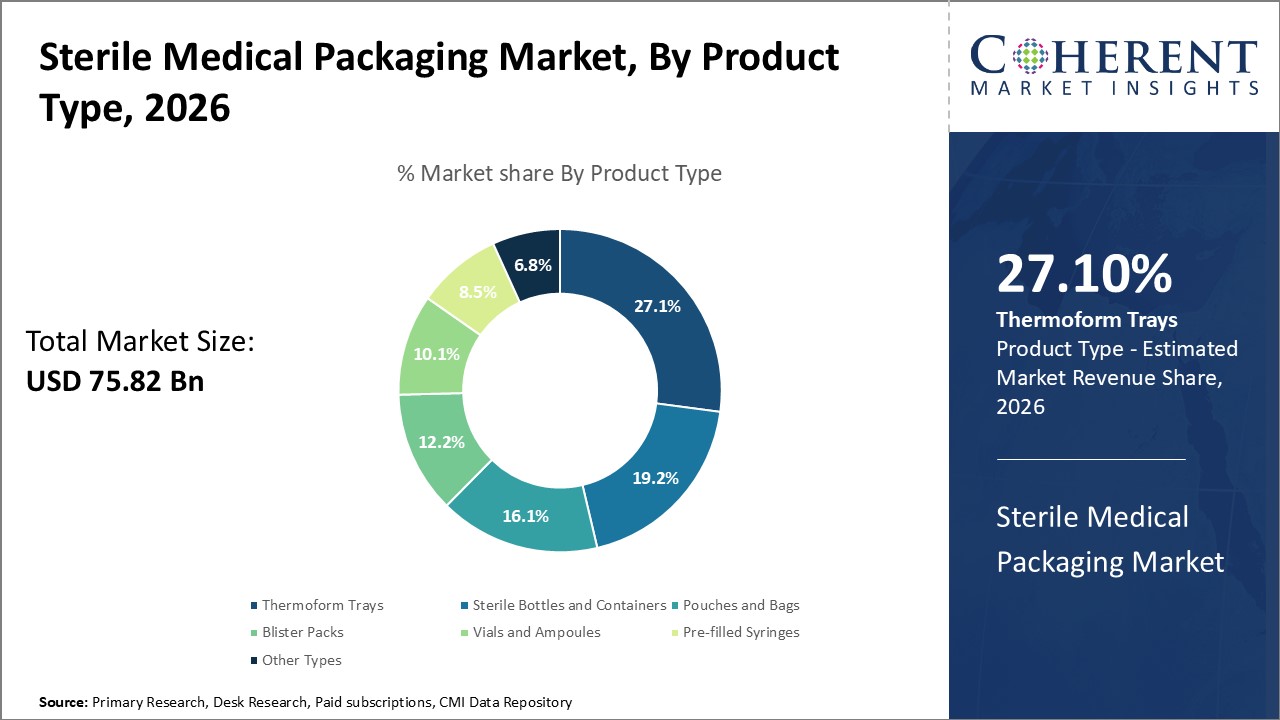
Sterile Medical Packaging Market Insights, By Product Type - Thermoform Trays Holds the dominant share as it Provide Superior Protection and Ease of Use
In terms of product type, the thermoform trays segment is expected to hold the largest market share in 2026, due to their ability to provide superior protection, sterility, and ease of use for high-value medical devices and surgical instruments. These trays offer a rigid, structured design that prevents physical damage and maintains the sterility of contents during storage, transportation, and handling. Their compatibility with a range of sterilization methods, such as ethylene oxide (EO), steam, and gamma irradiation makes them a reliable choice for manufacturers aiming to meet strict regulatory standards. In addition, thermoform trays can be precisely molded to fit specific instruments or kits, reducing movement and risk of contamination while improving clinical workflow efficiency. Their transparency allows for quick visual inspection, and their ease of opening is valued in fast-paced medical environments. As the healthcare industry increasingly adopts automated packaging lines, thermoform trays also offer high compatibility with automation, further supporting operational efficiency.
In October 2024, North American packaging leader Amcor Flexibles is expanding its thermoforming production at the Oshkosh, Wisconsin facility to support rising demand in pharmaceutical, medical device, and consumer‑health markets.
Sterile Medical Packaging Market Insights, By Application Type - Pharmaceuticals Holds the Largest Share
In terms of application type, the pharmaceuticals segment dominates the global sterile medical packaging market with highest share in 2026, due to their high sensitivity to contamination and strict regulatory requirements. Many pharmaceutical products, especially injectables, vaccines, and biologics, require sterile barrier systems to ensure product safety, stability, and efficacy throughout their shelf life. Regulatory agencies such as the FDA and EMA mandate sterile packaging for certain drug formats, particularly those administered through parenteral routes. Additionally, the increasing use of pre-filled syringes and biologic therapies has heightened the need for advanced packaging solutions that can maintain sterility during storage and transport. Large-scale vaccine distribution efforts and growing global demand for safe pharmaceutical exports further contribute to the sterile medical packaging market demand, as manufacturers prioritize packaging that offers both protection and compliance across varied supply chains.
In July 2025, LINUO Pharmaceutical Packaging launched its lean digital‑twin intelligent factory for borosilicate pharmaceutical glass, revolutionizing sterile packaging with real‑time data, AR‑assisted workflows, and predictive bulk‑material purchase planning. This digital upgrade enhances product quality, boosts manufacturing efficiency, cuts costs and emissions, while promoting ESG goals and carbon neutrality.
Regional Insights
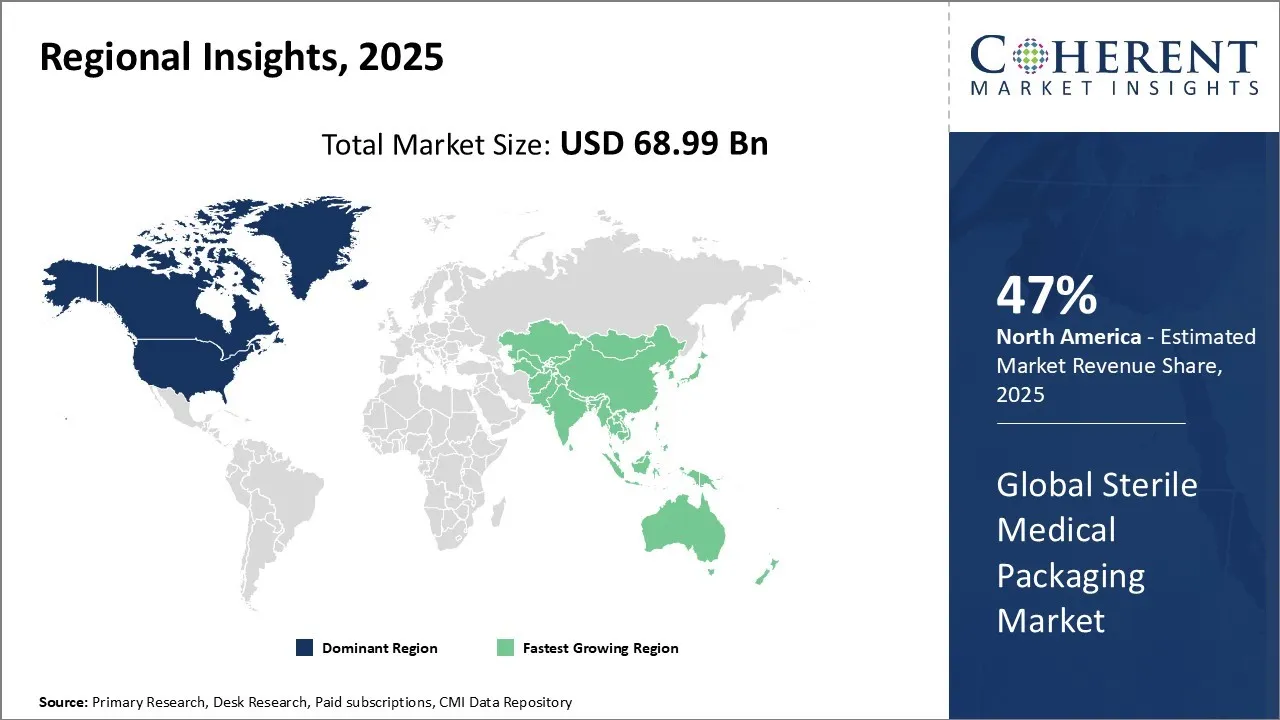
North America Sterile Medical Packaging Market Analysis & Trends
North America is expected to lead the global sterile medical packaging market with a 47% share in 2026, driven by its aging population, high healthcare spending, and advanced medical infrastructure. In the United States, a significant portion of the aging population requires medical treatment, with nearly 93% of adults aged 65 and older having at least one chronic condition, and 79% having two or more. Furthermore, about 27% of community-dwelling older adults need assistance with daily living activities, increasing reliance on pharmaceuticals and medical devices that require sterile packaging. The region also benefits from strong GDP levels and the widespread use of modern drug delivery systems. Additionally, growing investments by key industry players in product innovation, capacity expansion, and sustainable packaging solutions are further fueling market growth across pharmaceuticals, biologics, and medical devices.
Nelipak, a Netherlands-based provider of rigid and flexible packaging for healthcare and other specialized industries, has announced the opening of its first flexible packaging manufacturing facility in North America, located in Winston-Salem, North Carolina. The company also supplies sterile barrier packaging solutions.
Asia Pacific Sterile Medical Packaging Market Analysis & Trends
Asia Pacific is expected to witness the fastest growth in the global sterile medical packaging market over the forecast period, primarily due to the rapid expansion of the pharmaceutical industry in key countries such as India and China. Both nations are emerging as global manufacturing hubs for generic drugs, biologics, and vaccines, supported by government initiatives, low production costs, and strong export potential. This growing pharmaceutical output is driving significant demand for sterile packaging solutions to ensure product safety, regulatory compliance, and export readiness. For instance, India is the largest producer of generic medicines, supplying 40% of generic drugs to the U.S. and 25% to the UK.
Furthermore, rising healthcare awareness, increasing investments in medical infrastructure, and the expansion of domestic pharmaceutical companies in the region are accelerating the adoption of sterile packaging. In addition, the growing burden of chronic diseases and a rise in injectable drug consumption are prompting local drug manufacturers to invest in high-quality, sterile packaging systems. As regulatory standards in the region continue to align with global benchmarks, the need for advanced sterile packaging technologies is expected to surge, positioning Asia Pacific as a key contributor to global market growth.
In June 2026, Covestro began production of its new Desmopan Rx medical-grade Thermoplastic Polyurethane (TPU) at its Changhua facility in Taiwan, which was recently approved for manufacturing medical-grade TPU.
Sterile Medical Packaging Market Outlook Country-Wise
The U.S. Sterile Medical Packaging Market Trends
The United States plays a leading role in the sterile medical packaging market due to its advanced pharmaceutical and biotech sectors, along with strict FDA regulations. The country produces a high volume of sterile products, including biologics, vaccines, and injectable drugs, all requiring reliable sterile packaging. Large-scale vaccine manufacturing, rising biologics usage, and frequent surgical procedures further drive demand. Additionally, strong regulatory oversight and a mature healthcare infrastructure continue to push innovation in high-barrier, contamination-resistant packaging solutions.
According to U.S. Centers for Disease Control and Prevention, Vaccine manufacturers have projected that they will supply the United States with 148 million doses of influenza vaccines for the 2024-2026 season. This is further propelling the sterile medical packaging market demand.
China Sterile Medical Packaging Market Trends
China is a key growth market for sterile medical packaging, driven by its expanding pharmaceutical manufacturing, strong government investment in healthcare, and rising drug exports. The increasing prevalence of chronic diseases is boosting demand for injectable and biologic drugs, which require high-integrity sterile packaging. As regulatory standards tighten, pharmaceutical companies are upgrading packaging processes to meet sterility and export compliance. These factors are collectively fueling the rising sterile medical packaging market demand in China.
Market Report Scope
Sterile Medical Packaging Market Report Coverage
| Report Coverage | Details | ||
|---|---|---|---|
| Base Year: | 2025 | Market Size in 2026: | USD 75.82 Bn |
| Historical Data for: | 2020 To 2024 | Forecast Period: | 2026 To 2033 |
| Forecast Period 2026 to 2033 CAGR: | 9.9% | 2033 Value Projection: | USD 146.81 Bn |
| Geographies covered: |
| ||
| Segments covered: |
| ||
| Companies covered: | Amcor PLC, Dupont De Nemours Inc., Steripack Ltd, Wipak Group, Placon Corporation, Riverside Medical Packaging Company Ltd, Tekni-Plex Inc., BillerudKorsnäs AB, Sonoco Products Company, DWK Life Sciences GmbH, Technipaq Inc., 3M Co. (3M Packaging), and Nelipak Healthcare | ||
| Growth Drivers: |
| ||
| Restraints & Challenges: |
| ||
Global Sterile Medical Packaging Market Drivers
- Growing utilization of pharmaceutical sector capacity
The growing utilization of pharmaceutical sector capacity is significantly propelling the growth of the sterile medical packaging market. As pharmaceutical companies expand their production to meet increasing global demand, particularly for injectables, biologics, and vaccines, the need for reliable, high-quality sterile packaging rises in parallel. This heightened production activity includes both domestic consumption and international exports, requiring packaging solutions that ensure product safety, extend shelf life, and comply with stringent regulatory standards. Furthermore, the expansion of contract manufacturing organizations (CMOs) and third-party logistics providers has increased the throughput of pharmaceutical products, placing additional pressure on packaging operations. As a result, sterile packaging is not only a regulatory necessity but also a critical component of maintaining efficiency, safety, and scalability across the pharmaceutical supply chain.
For instance, in July 2025, Thermo Fisher Scientific has announced its acquisition of Sanofi’s Ridgefield, New Jersey facility, an active sterile fill‑finish and packaging site employing over 200 people. This move reflects strong demand pressures in sterile pharmaceutical manufacturing as companies scale up operations to meet growing global needs.
Global Sterile Medical Packaging Market Opportunities
- Glass vials, ampoules, and containers are in high demand
The rising demand for glass vials, ampoules, and sterile containers, driven by increased production of vaccines, biologics, and injectables is creating strong growth opportunities for packaging manufacturers. Glass remains a preferred material due to its durability, sterility, and chemical stability. To meet this demand, key players are expanding capacity and investing in advanced production technologies. According to the sterile medical packaging market forecast, this trend is expected to play a crucial role in shaping future market expansion and innovation.
- The growing concern about the environment is generating demand for biodegradable packaging solutions
Rising environmental concern is driving demand for biodegradable packaging solutions for medical devices. In response to this, the HyperBioCoat project, which was supported by the European Union, created new biodegradable hybrid organic-inorganic coatings for food, cosmetics, and medical device packaging. By incorporating biopolymers into the material class of bioORMOCERs, a coating material based on biopolymers was derived from lignocellulosic biomass. The Fraunhofer Institute for Silicate Research produced the bioORMOCER coatings, which are bio-based and biodegradable. The development of such biodegradable packaging solutions will provide profitable market opportunities in the near future.
Key Developments
- In July 2025, Cronus Pharma LLC—a fully integrated company specializing in research, development, manufacturing, sales, and marketing in the animal health pharmaceutical industry—announced the launch of Butorphic® (Butorphanol Tartrate) Sterile Injectable Solution. The product is now immediately available in the U.S. animal health market through both national and regional distributors.
- In June 2025, DuPont launched a 16,000‑square‑foot expansion at its healthcare manufacturing facility in Heredia, Costa Rica, marking the country’s first production site for sterile medical packaging using Tyvek materials such as pouches, header bags and lids. The enlargement also boosts capacity for the site’s existing medical tubing operations. The facility certified to ISO 13485:2016 and ISO 9001:2015, now operates on a 24/7 schedule, serving healthcare customers across the Caribbean and Americas.
- In April 2025, Nelipak® Corporation, a global leader in sterile medical packaging, announced to enhance its presence in the Asia‑Pacific region through direct engagement and strengthened preferred‑partner networks. The company offers bespoke sterile‑barrier solutions, including coated roll‑stock, pouches, lids, sheets, thermoformed trays, and sealing equipment, built on materials such as Tyvek®, medical paper, film and foil laminates, plus proprietary heat‑seal coatings (CR27, SBP2000, PS‑series).
- In October 2024, Berry Global introduced a new line of clarified polypropylene (PP) bottles designed for healthcare use, providing improved sustainability and better product protection than conventional colored PET pill bottles.
Market Segmentation
- By Material Type (Revenue, USD Bn, 2021 - 2033)
- Plastics-PP, Polyester, PS, PVC, HDPE, etc.
- Paper and Paperboard
- Glass
- Other Types
- By Product Type (Revenue, USD Bn, 2021 - 2033)
- Thermoform Trays
- Sterile Bottles and Containers
- Pouches and Bags
- Blister Packs
- Vials and Ampoules
- Pre-filled Syringes
- Wraps
- By Application Type (Revenue, USD Bn, 2021 - 2033)
- Pharmaceuticals
- Surgical and Medical Appliances
- IVD
- Other Applications
- By Region (Revenue, USD Bn, 2021 - 2033)
- North America
- U.S.
- Canada
- Latin America
- Brazil
- Argentina
- Mexico
- Rest of Latin America
- Europe
- Germany
- U.K.
- Spain
- France
- Italy
- Russia
- Rest of Europe
- Asia Pacific
- China
- India
- Japan
- Australia
- South Korea
- ASEAN
- Rest of Asia Pacific
- Middle East
- GCC Countries
- Israel
- Rest of Middle East
- Africa
- South Africa
- North Africa
- Central Africa
- North America
- Global Sterile Medical Packaging Market Companies
- Amcor PLC
- Dupont De Nemours Inc.
- Steripack Ltd.
- Wipak Group
- Placon Corporation
- Riverside Medical Packaging Company Ltd.
- Tekni-Plex Inc.
- BillerudKorsnäs AB
- Sonoco Products Company
- DWK Life Sciences GmbH
- Technipaq Inc.
- 3M Co. (3M Packaging)
- Nelipak Healthcare
Sources
Primary Research Interviews from the following stakeholders
Stakeholders
- Interviews with sterile packaging manufacturers, hospital procurement managers, medical device packaging engineers, pharmaceutical cold chain logisticians, infection control specialists, and regulatory compliance officers across global healthcare systems.
Specific Stakeholders
- Procurement heads at leading hospital networks and surgical centers
- Sterile processing department (SPD) managers and infection prevention leads at public and private hospitals
- Quality assurance and packaging design teams at pharma and biotech companies
- Cold chain logistics coordinators at vaccine and biologics distributors
- Regulatory and compliance managers in sterile packaging divisions of medical device firms
- Sterile barrier system specialists and engineers at packaging OEMs
Databases
- World Health Organization (WHO) Medical Device Statistics
- UN Comtrade Database
- World Trade Organization (WTO) Trade Statistics – Packaging Materials
- European Medicines Agency (EMA) Regulatory Reports
- U.S. Food and Drug Administration (FDA) Device and Packaging Filings
- China Customs Statistics – Healthcare Packaging Imports/Exports
- Ministry of Health & Family Welfare (India) – Medical Supplies Procurement Portal
- Eurostat – Medical Packaging Trade
- National Center for Biotechnology Information (NCBI) Clinical Trial Packaging Data
- Japan External Trade Organization (JETRO) – Healthcare Packaging Insights
Magazines
- Medical Device Packaging News
- Healthcare Packaging
- Medical Design & Outsourcing
- Pharmaceutical Manufacturing
- MedTech Insight
- Biopharma Dive
- Medline Industries Publications
- Packaging Strategies (Healthcare section)
- Pharma Packaging & Labeling
Journals
- Journal of Packaging Technology and Research
- International Journal of Pharmaceutics
- Journal of Applied Packaging Research
- Journal of Biomedical Materials Research
- Journal of Pharmaceutical Sciences
- Packaging Technology and Science
- Annals of Biomedical Engineering
Newspapers
- The Wall Street Journal – Healthcare & Pharma
- The Economic Times – Healthcare Packaging & Logistics
- Business Standard – Medical Device and Packaging Industry
- The Hindu Business Line – Biotech & Pharma Section
- Financial Times – HealthTech Supply Chain
- Nikkei Asia – Medical Devices and Materials
- South China Morning Post – Pharma and Export Trends
Associations
- Institute of Packaging Professionals (IoPP) – Medical Device Packaging Division
- International Medical Device Regulators Forum (IMDRF)
- Association for the Advancement of Medical Instrumentation (AAMI)
- Health Industry Distributors Association (HIDA)
- International Organization for Standardization (ISO) – Packaging Committees
- Parenteral Drug Association (PDA)
- Medical Device Innovation Consortium (MDIC)
- Indian Drug Manufacturers' Association (IDMA) – Packaging Committee
Public Domain Sources
- Ministry of Health and Family Welfare (India)
- U.S. FDA Medical Packaging Regulatory Guidelines
- European Commission Medical Device Regulations Portal
- National Institute of Standards and Technology (NIST), U.S.
- Ministry of Economy, Trade and Industry (METI), Japan – Healthcare Materials
- India Pharma Portal – Medical Device Packaging Schemes
- NITI Aayog – Pharma and Biotech Innovation Reports
- Reserve Bank of India – Healthcare Manufacturing Sector Reports
- EU Medical Device Coordination Group (MDCG) Notices on Packaging
Proprietary Elements
- CMI Data Analytics Tool, and Proprietary CMI Existing Repository of information for last 8 years
*Definition: Sterile medical packaging is an essential step in the medical industry and is necessary for minimizing the chances of contamination and disease transmission.
Get access to 250+ pages report
Every segment, forecast, competitor profile and data table behind the analysis above — available for instant download.
- ESOMAR Member
- ISO 9001:2015 Certified
- D-U-N-S Registered
- GDPR & CCPA Compliant
Missing comfort of reading report in your local language? Find your preferred language:
Transform your Strategy with Exclusive Trending Reports
Frequently Asked Questions
The Sterile Medical Packaging Market is estimated to be valued at USD 75.82 Bn in 2026, and is expected to reach USD 146.81 Bn by 2033.
The CAGR of the Sterile Medical Packaging Market is projected to be 9.9% from 2026 to 2033.
Strict regulation regarding the control of infection and the growing utilization of pharmaceutical sector capacity are fueling the market.
The Plastics-PP, Polyester, PS, PVC, HDPE, etc. segment is the leading component segment in the market.
Challenges associated with maintaining medical packaging integrity and environmental concerns regarding the use of plastic for medical packaging are the major factors restraining growth of the market.
Amcor PLC, Dupont De Nemours Inc., Steripack Ltd, Wipak Group, Placon Corporation, Riverside Medical Packaging Company Ltd, Tekni-Plex Inc., BillerudKorsnäs AB, Sonoco Products Company, DWK Life Sciences GmbH, Technipaq Inc., 3M Co. (3M Packaging), and Nelipak Healthcare.
Plastic, especially polyethylene and polypropylene, is the leading raw material in sterile medical packaging due to durability.