

Sterile Powder Filling Machine Market Size and Forecast – 2026 to 2033
The Sterile Powder Filling Machine Market is estimated to be valued at USD 1.3 Bn in 2026 and is expected to reach USD 2.7 Bn by 2033, exhibiting a compound annual growth rate (CAGR) of 5.1% from 2026 to 2033.
Key Takeaways
- By Production Rate, 20 to 60 Fills/Minute hold the largest market share of 36.6% in 2026 owing to its rising demand for sterile pharmaceutical products.
- By Product Type, Nuclear Medicine expected to hold largest market share of 41.1% in 2026 owing to the growing nuclear medicine & radiopharmaceutical market.
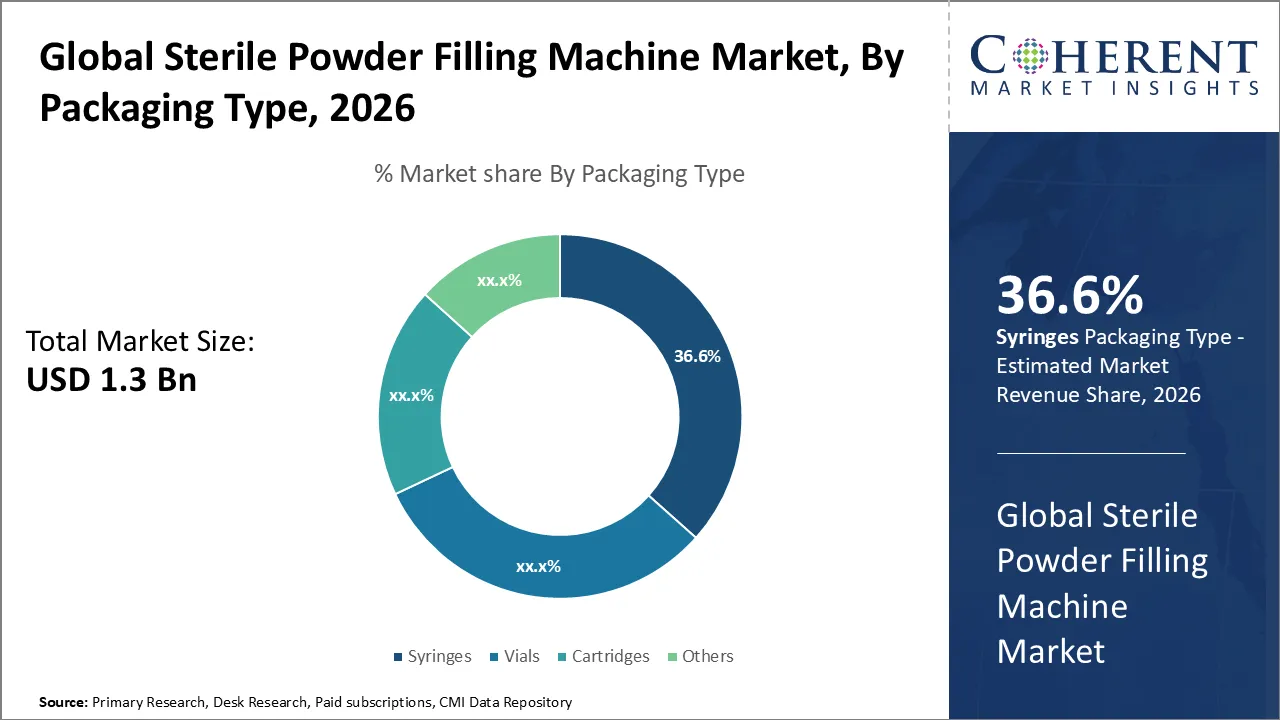
- By Packaging Type, Syringes acquired the prominent market share of 36.6% in 2026 owing to the rising demand for sterile injectable medications.
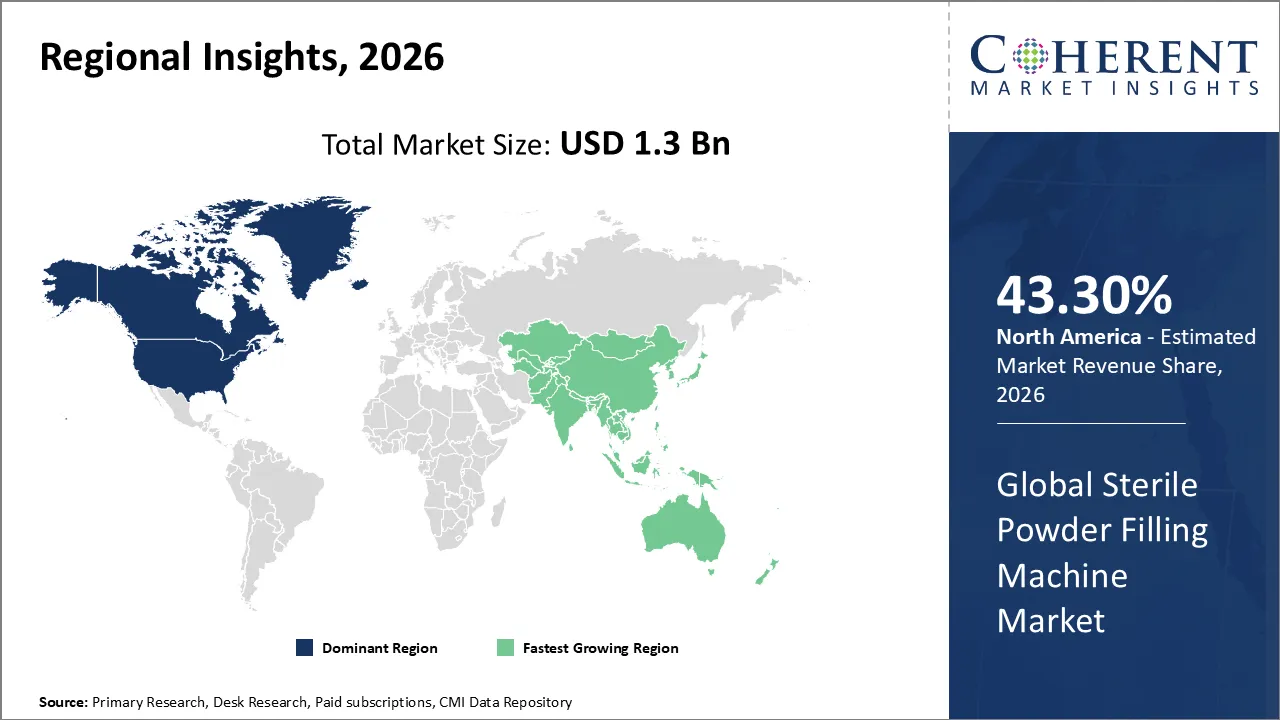
- By Region, North America dominates the overall market with an estimated share of 43.3% in 2026 owing to the well‑established pharmaceutical & biotechnology industry.
Market Overview
The Sterile Powder Filling Machine market focuses on machines that precisely and hygienically fill powdered pharmaceutical products into vials, syringes, and cartridges while maintaining strict sterile conditions. Growing production of complex injectable drugs and vaccines, combined with the pharmaceutical industry’s emphasis on contamination‑free processing, fuels market expansion. Manufacturers increasingly adopt advanced automated filling technologies, and pharmaceutical and biotechnology companies actively drive demand for reliable, high‑precision sterile filling solutions across global production facilities.
Current Events and their Impact on the Sterile Powder Filling Machine Market
Current Events | Description and its impact |
Geopolitical and Regulatory Developments |
|
Technological Advancements and Industry Innovation |
|
Regional Market Expansion and Emerging Markets |
|
Segmental Insights
- Current Industry Events of 2026
- Market Size Estimation
- Regional Breakdown
- Competitive Landscape
- Customer Intelligence
- Segmental Analysis
- Pricing Analysis
- Key Market Drivers, Challenges & Future Trends
- Customized Insights Section
Sterile Powder Filling Machine Market Insights, By Packaging Type: Syringes contribute the highest share of the market owing to its stringent regulatory & quality requirements.
Syringes acquired the prominent market share of 36.6% in 2026. The rising demand for syringe‑ready formats fuels the Sterile Powder Filling Machine market as manufacturers produce more prefilled, user‑friendly delivery systems. Pharmaceutical companies invest in machines that fill sterile powders into syringes because healthcare providers and patients prioritize accuracy, convenience, and lower contamination risk. Advancements in automation and precision dosing reinforce this shift, while expanding production of biologics and specialty injectables drives the need for dependable, aseptic syringe filling solutions across the pharmaceutical industry. For instance, in January 2025, Vetter, a global Contract Development and Manufacturing Organization (CDMO), has announced to launch the latest version of its proprietary V-OVS syringe closure system. The new V-OVS next builds on the proven performance of the original system, enhancing support for and differentiation of a wide range of sterile injectable products.
Sterile Powder Filling Machine Market Insights, By Production Rate: 20 to 60 Fills/Minute contribute the highest share of the market owing to its stringent regulatory standards and quality requirements.
20 to 60 Fills/Minute hold the largest market share of 36.6% in 2026. The 20 to 60 fills per minute segment of the Sterile Powder Filling Machine market thrives as pharmaceutical companies seek mid‑level production flexibility for small to medium batches. Manufacturers rely on this speed range to produce niche biologics, specialty injectables, and pilot batches that demand precision and strict sterility. Increasing adoption of automated, contamination‑resistant filling systems and the expanding use of dry powder formulations drive companies to invest in reliable machines that deliver accurate dosing while maintaining moderate throughput.
Sterile Powder Filling Machine Market Insights, By Product Type: Nuclear Medicine contribute the highest share of the market owing to its advancement in radiopharmaceutical production technologies.
Nuclear Medicine expected to hold largest market share of 41.1% in 2026. The expansion of nuclear medicine drives the Sterile Powder Filling Machine market by increasing demand for aseptic systems used in radiopharmaceuticals and injectable therapies. Manufacturers produce sterile pharmaceutical agents for nuclear diagnostic procedures (such as PET and SPECT) and targeted radiotherapies, requiring precise dosing and contamination‑free handling. Healthcare providers and pharmaceutical companies implement automated, closed‑system processes to enhance safety, comply with regulations, and support emerging theranostic treatments, prompting greater investment in advanced, high‑quality sterile filling technologies.
Regional Insights
North America Sterile Powder Filling Machine Market Trends
North America dominates the overall market with an estimated share of 43.3% in 2026. In North America, strong pharmaceutical and biotech activity drives the Sterile Powder Filling Machine market, with the United States leading demand through its advanced healthcare infrastructure and strict regulatory oversight that encourages manufacturers to adopt aseptic solutions. Producers implement automated, flexible systems to handle various sterile formats, including vials and syringes, while Canadian manufacturers upgrade their production lines to maintain quality standards. Investments in biologics, vaccines, and modernization of fill‑finish operations further propel market growth across the region. For instance, Nelipak, a Netherlands-based healthcare packaging supplier, has opened its first North American flexible packaging facility in Winston-Salem, NC. The site actively produces high-quality sterile-barrier packaging solutions, supporting customers’ sustainability goals and business continuity.
Asia Pacific Sterile Powder Filling Machine Market Trends
In the Asia Pacific region, pharmaceutical manufacturers in China, India, Japan, and Southeast Asia are expanding production of sterile injectables, vaccines, and biosimilars, driving growth in the Sterile Powder Filling Machine market. Companies invest in healthcare infrastructure and quality control systems to upgrade automated and mid‑speed filling lines that maintain aseptic conditions. Regional firms implement flexible machines to serve domestic and export markets, while cost‑effective solutions and the rise of biotech hubs promote wider adoption of sterile powder filling equipment across the region. For instance, WuXi STA, a subsidiary of WuXi AppTec, has launched a new parenteral formulation manufacturing line at its Wuxi, China site. The advanced sterile lipid nanoparticle (LNP) facility enables the site to deliver formulation development and manufacturing for oligonucleotides and their conjugates.
United States Sterile Powder Filling Machine Market Trends
In the United States, strong pharmaceutical and biotechnology production drives the Sterile Powder Filling Machine market as manufacturers expand aseptic capacity to supply sterile injectables, vaccines, and biologics. U.S. companies adopt automated, closed‑system filling equipment to meet strict FDA sterility and quality standards while enhancing efficiency and reducing contamination. Contract manufacturers increase fill‑finish capabilities to strengthen domestic supply and address growing demand for flexible, multi‑format sterile powder filling solutions across the industry.
India Sterile Powder Filling Machine Market Trends
In India, local pharmaceutical manufacturers are driving growth in the Sterile Powder Filling Machine market by scaling up sterile injectable and vaccine production to meet domestic and export demand. Companies adopt automated, aseptic powder filling systems to comply with global quality standards and WHO‑GMP guidelines, while government initiatives and infrastructure investments enable technological upgrades. Indian biotech and pharmaceutical plants increasingly implement cost‑effective, flexible machines capable of handling diverse formulations and batch sizes, supporting broader adoption of advanced sterile filling solutions.
Sterile Powder Filling Machine Market Trend
Automation and Smart Manufacturing
Manufacturers are increasingly adopting automated sterile powder filling machines with advanced control systems to improve precision, reduce human error, and enhance production efficiency. Smart technologies, including IoT-enabled monitoring, predictive maintenance, and real-time data analytics, allow companies to optimize operations, maintain consistent quality, and ensure compliance with stringent regulatory standards. This trend reflects the broader move toward Industry 4.0 in pharmaceutical manufacturing, where connected and intelligent systems support aseptic production and reduce operational risks.
Shift Toward Prefilled Syringes and Multi-Format Flexibility
The market is witnessing growing adoption of prefilled syringes, cartridges, and vials to meet patient convenience and dosage accuracy requirements. Manufacturers increasingly prefer machines that can switch between multiple container types and batch sizes with minimal downtime. This flexibility helps pharmaceutical companies serve niche biologics, vaccines, and specialty injectables while maintaining sterility, supporting small and large-scale production simultaneously, and reducing operational costs linked to frequent equipment changeovers.
Sterile Powder Filling Machine Market Opportunity
Growth in Biologics and Specialty Injectables
The rising development of biologics, vaccines, and high-value specialty injectables presents a significant opportunity for sterile powder filling machine manufacturers. These products require precise dosing, strict aseptic conditions, and contamination-free handling. Companies can expand offerings with advanced automated machines that handle sensitive powders and support small to mid-sized batches, enabling pharmaceutical firms to meet increasing demand while ensuring product quality and compliance with regulatory standards, creating new avenues for market penetration and innovation.
Market Report Scope
Sterile Powder Filling Machine Market Report Coverage
| Report Coverage | Details | ||
|---|---|---|---|
| Base Year: | 2025 | Market Size in 2026: | USD 1.3 Bn |
| Historical Data for: | 2020 To 2024 | Forecast Period: | 2026 To 2033 |
| Forecast Period 2026 to 2033 CAGR: | 5.1% | 2033 Value Projection: | USD 2.7 Bn |
| Geographies covered: |
| ||
| Segments covered: |
| ||
| Companies covered: | Duke Technologies, Adinath International, Multi Pack Machinery, Harsiddh Engineering, SB Machines, OPTIMA Packaging, Ambica Pharma Machines Pvt. Ltd, N.K. INDUSTRIES, COZZOLI MACHINE COMPANY, METACRAFTS Packaging Machinery, Romaco S.r.l., Lodha International LLP, SHIBUYA CORPORATION, MAR USA Inc., PPS A/S, Parth Engineers & Consultant, Bausch + Ströbel Maschinenfabrik Ilshofen GmbH + Co. KG, Syntegon, DEC Group, Dosa Srl, Harro Höfliger Verpackungsmaschinen GmbH, Tofflon Science, M&O Perry Industries, Inc. | ||
| Growth Drivers: |
| ||
| Restraints & Challenges: |
| ||
Sterile Powder Filling Machine Market News
- In April 2025, 3P Innovation introduced the DPI filling technology as an improved alternative to the original high-speed powder filling system for the GSK Diskus DPI, later integrating it into the GSK Ellipta inhaler.
Analyst Opinion (Expert Opinion)
- The Sterile Powder Filling Machine market is experiencing a shift toward higher precision and containment technologies that goes beyond traditional volume growth narratives. Recent data indicate that aseptic and sterile powder fillers — particularly hybrid gravimetric/volumetric systems — are commanding price premiums because pharmaceutical manufacturers are prioritizing dose accuracy within ±1 % and real‑time batch verification over basic throughput capabilities, illustrating a clear industry preference for quality assurance tools that enable regulatory compliance and reduce risk in biologics and lyophilized product lines.
- Contract manufacturers and top‑tier CDMOs are reshaping demand patterns by selectively investing in fully automated sterile filling suites that integrate vision inspection, automated stoppering, and electronic batch records. In aseptic fill‑finish deployments, fully automatic systems now represent ~72 % of orders, reducing manual interventions by up to 80 % and enabling batch size scaling of 30–200 % in formats like vials and syringes, underlining that operational efficiency and sterility assurance are now non‑negotiable competitive differentiators.
- Geographically, while North America holds a dominant share of sterile dry powder filling equipment, Asia‑Pacific’s rapid expansion underscores a strategic realignment of global sterile manufacturing capacity. Pharmaceutical firms in India, China, and Southeast Asia are not merely buying more machines — they are leapfrogging to flexible, modular platforms that can handle multi‑format production campaigns with shorter changeovers, reflecting a maturation in quality expectations and export ambitions.
- Despite these advances, suppliers face stark technical barriers unique to sterile powder filling: powder flow variability, moisture sensitivity, and containment for high‑potency APIs remain persistent engineering challenges that demand bespoke solutions, not off‑the‑shelf fixtures. Until vendors innovate around advanced powder handling dynamics and barrier technology, sterile powder filling will continue to be viewed as a niche requiring specialist engineering rather than a commoditized machinery segment.
Speak to the analyst
Want personalized insights?
Take the findings above to one of our principal consultants, or have the report rebuilt around the segments, geographies and competitors you actually track.
Market Segmentation
- By Production Rate
- 20 to 60 Fills/Minute
- 50 to 100 Fills/Minute
- 100 to 300 Fills/Minute
- 300 to 500 Fills/Minute
- By Product Type
- Anti-cancer Drugs
- Nuclear Medicine
- Others (Antifungals, Antibiotics, and other Pharmaceutical Products)
- By Packaging Type
- Vials
- Cartridges
- Syringes
- Others
- By Regional Insights
- North America
- U.S.
- Canada
- Latin America
- Brazil
- Argentina
- Mexico
- Rest of Latin America
- Europe
- Germany
- U.K.
- Spain
- France
- Italy
- Russia
- Rest of Europe
- Asia Pacific
- China
- India
- Japan
- Australia
- South Korea
- ASEAN
- Rest of Asia Pacific
- Middle East
- GCC Countries
- Israel
- Rest of Middle East
- Africa
- South Africa
- North Africa
- Central Africa
- North America
- Key Players Insights
- Duke Technologies
- Adinath International
- Multi Pack Machinery
- Harsiddh Engineering
- SB Machines
- OPTIMA Packaging
- Ambica Pharma Machines Pvt. Ltd
- N.K. INDUSTRIES
- COZZOLI MACHINE COMPANY
- METACRAFTS Packaging Machinery
- Romaco S.r.l.
- Lodha International LLP
- SHIBUYA CORPORATION
- MAR USA Inc.
- PPS A/S
- Parth Engineers & Consultant
- Bausch + Ströbel Maschinenfabrik Ilshofen GmbH + Co. KG
- Syntegon
- DEC Group
- Dosa Srl
- Harro Höfliger Verpackungsmaschinen GmbH
- Tofflon Science
- M&O Perry Industries, Inc.
Sources
Primary Research interviews
- Plant managers and production heads in pharmaceutical and biotech manufacturing facilities
- R&D and process engineers involved in aseptic fill-finish operations
- Quality assurance and regulatory compliance officers in injectable drug manufacturing
Databases
- PubMed for pharmaceutical manufacturing studies
- ClinicalTrials.gov for data on injectable drug development
- WHO Vaccine Production Database
- FDA Establishment Registration & Drug Listing database
Magazines
- Pharmaceutical Technology
- BioPharm International
- Manufacturing Chemist
- European Pharmaceutical Review
Journals
- Journal of Pharmaceutical Innovation
- International Journal of Pharmaceutics
- PDA Journal of Pharmaceutical Science and Technology
- AAPS PharmSciTech
Newspapers
- The Wall Street Journal – Health & Pharmaceuticals section
- The Economic Times – Pharma & Biotech segment
- The Times of India – Healthcare and Pharmaceutical section
Associations
- Parenteral Drug Association (PDA)
- International Society for Pharmaceutical Engineering (ISPE)
- Indian Pharmaceutical Association (IPA)
- European Federation of Pharmaceutical Industries and Associations (EFPIA)
Public Domain sources
- FDA and EMA public guidances on sterile manufacturing
- WHO GMP Guidelines and technical reports
- National Institutes of Health (NIH) publications
- Government healthcare and pharmaceutical policy reports
Proprietary Elements
- CMI Data Analytics Tool
- Proprietary CMI Existing Repository of information for last 8 years
Get access to 250+ pages report
Every segment, forecast, competitor profile and data table behind the analysis above — available for instant download.
- ESOMAR Member
- ISO 9001:2015 Certified
- D-U-N-S Registered
- GDPR & CCPA Compliant
Missing comfort of reading report in your local language? Find your preferred language:
Transform your Strategy with Exclusive Trending Reports
Frequently Asked Questions
The Sterile Powder Filling Machine Market is estimated to be valued at USD 1.3 Bn in 2026 and is expected to reach USD 2.7 Bn by 2033.
The market is estimated to be valued at USD 1.3 Bn in 2026.
Duke Technologies, Adinath International, Multi Pack Machinery, Harsiddh Engineering, SB Machines, OPTIMA Packaging, Ambica Pharma Machines Pvt. Ltd, N.K. INDUSTRIES, COZZOLI MACHINE COMPANY, METACRAFTS Packaging Machinery, Romaco S.r.l., Lodha International LLP, SHIBUYA CORPORATION, MAR USA Inc., PPS A/S, Parth Engineers & Consultant, Bausch + Ströbel Maschinenfabrik Ilshofen GmbH + Co. KG, Syntegon, DEC Group, Dosa Srl, Harro Höfliger Verpackungsmaschinen GmbH, Tofflon Science, M&O Perry Industries, Inc. are some of the prominent players operating in the market.
The market is expected to be valued at USD 2.7 Bn in 2033.
North America is the prominent region in the market.
Nuclear Medicine is the prominent segment among the product type segment in the market.