

Textile Auxiliaries Market Size and Forecast — 2026-2033
The Global Textile Auxiliaries Market size is estimated to be valued at USD 14.63 billion in 2026 and is expected to reach USD 20.9 billion by 2033, exhibiting a compound annual growth rate (CAGR) of 6.8% from 2026 to 2033.
Overview
Textile auxiliaries are specialty chemical formulations essential in various stages of textile manufacturing, including pretreatment, dyeing, printing, and finishing. These products improve fiber properties, enhance color fastness, and impart specific functional characteristics such as softness, water repellency, or antimicrobial resistance. Key auxiliary categories include wetting agents, dispersants, detergents, softeners, leveling agents, and fixing agents. Technological advancements have led to the development of eco-friendly and biodegradable auxiliaries, aligning with global sustainability and wastewater reduction goals. Modern auxiliaries are tailored for high-performance fabrics and synthetic fibers, offering superior compatibility with low-liquor ratio dyeing systems and digital textile printing processes.
Key Takeaways
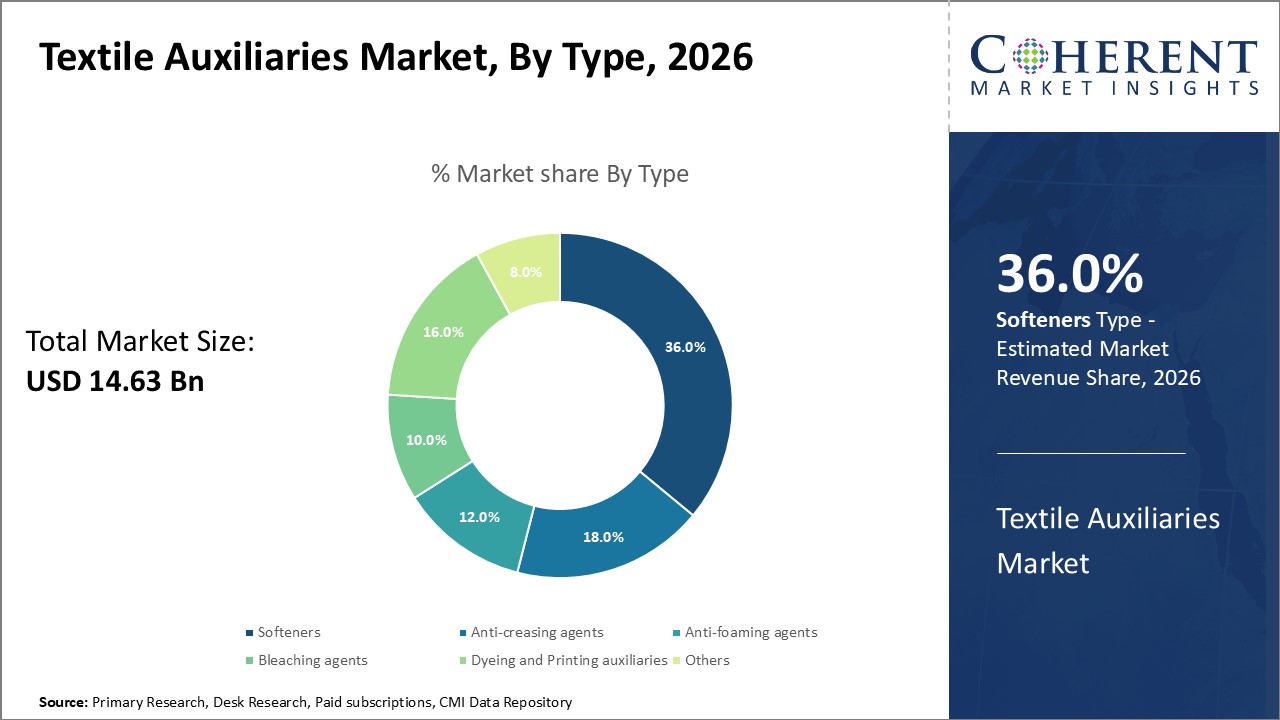
Softeners dominate the textile auxiliaries market segment with a 36% share, driven by their critical role in improving textile handle and softness
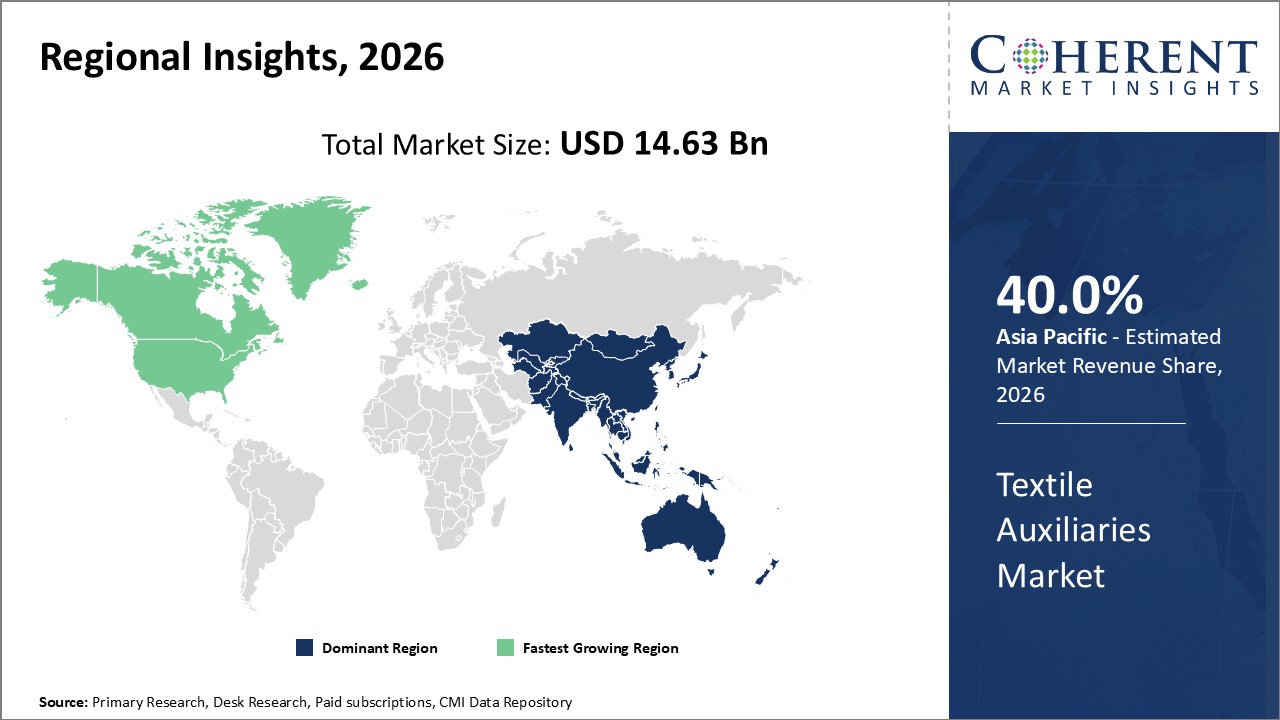
Asia Pacific dominates the overall market on account of expanding textile manufacturing bases and rising exports from countries like India and China
Textile Auxiliaries Market Segmentation Analysis
Textile Auxiliaries Market Insights, By Type
Softeners dominate the market share, representing 35%, due to their pivotal role in enhancing fabric hand feel and consumer acceptance. Their widespread compatibility with diverse textile fibers and contribution to premium quality apparel drive this segment. The fastest-growing subsegment is Dyeing and Printing auxiliaries, which are gaining traction due to expanding fashion trends demanding vibrant and durable coloration combined with eco-friendly processing. Anti-creasing agents reduce fabric wrinkling during wear and washing, thereby ensuring durability, while anti-foaming agents improve process efficiency in wet treatments.
Textile Auxiliaries Market Insights, By Application
Apparel textiles are the dominating subsegment due to rising global clothing consumption and fast fashion dynamics. The demand for improved textile surface finishes and better dyeing outcomes supports auxiliaries consumption in this segment. Industrial/technical textiles represent the fastest-growing subsegment, fueled by growing adoption in automotive, medical, and protective gear applications, where textile auxiliaries enhance performance attributes such as durability and resistance. Home textiles benefit from auxiliaries that improve fabric softness and longevity.
Textile Auxiliaries Market Insights, By Function
Finishing auxiliaries dominate the market as they impart critical properties like water repellency, anti-microbial effects, and wrinkle resistance, contributing significantly to perceived product value and industry revenue. Pre-treatment agents play a foundational role in preparing textile substrates for subsequent processing, ensuring quality output. Dyeing auxiliaries facilitate even coloration and fastness, which is increasingly vital with expanding diversified fiber blends and vibrant color demand.
Textile Auxiliaries Market Trends
Recent advances in biodegradable and enzymatic auxiliaries underline the thrust towards sustainability, with many manufacturers reducing chemical footprints by replacing synthetic auxiliaries.
For example, some Asian producers reported a 26% reduction in water usage due to the adoption of enzymatic pre-treatment aids in 2026.
Furthermore, digitalization of auxiliaries in dyeing and finishing is increasing process efficiencies and reducing defects, highlighted by European textile processors achieving 15% waste reduction through AI-enabled controls.
Textile Auxiliaries Market Insights, By Geography
Asia Pacific Textile Auxiliaries Market Analysis and Trends
In the Asia Pacific region, the dominance in the Textile Auxiliaries market is attributed to the region’s expansive textile manufacturing ecosystem and rising exports, primarily driven by China and India. The region accounts for over 40% of the global industry share due to robust investments in production capacity and escalating demand from apparel and technical textile segments. Government initiatives promoting sustainability and industrial advancement further bolster market growth.
North America Textile Auxiliaries Market Analysis and Trends
Meanwhile, North America exhibits the fastest growth trajectory with a CAGR outpacing other regions, underpinned by stringent environmental regulations and greater adoption of sustainable auxiliaries. Advanced textile finishing industries and rising product innovations led by key U.S. companies augment this expansion.
Textile Auxiliaries Market Outlook for Key Countries
USA Textile Auxiliaries Market Analysis and Trends
The USA's market showcases a robust framework influenced by regulatory frameworks emphasizing reduced chemical emissions in textile processing. Leading companies focusing on sustainable auxiliaries and digital technologies have driven considerable innovations. In 2025, approximately 45% of U.S. textile auxiliaries revenue arose from bio-based and specialty auxiliaries, signaling industry readiness for future environmental compliance. Research partnerships between manufacturers and end-users have accelerated tailored auxiliary solutions, strengthening overall business growth.
India Textile Auxiliaries Market Analysis and Trends
India’s textile auxiliaries market continues to expand swiftly, supported by increasing textile exports and government incentives promoting textile modernization under schemes like the Production Linked Incentive (PLI). The surge in demand for softeners and dyeing auxiliaries stems from the dominant apparel sector, comprising over 55% of total auxiliaries consumption. Local production capabilities have increased, with companies investing in eco-friendly auxiliaries to meet export compliance, resulting in a marked rise in India’s market share within the Asia Pacific region.
Analyst Opinion
Increasing adoption of bio-based and environmentally friendly textile auxiliaries is a pivotal growth driver. For instance, the usage of enzymatic auxiliaries has escalated by nearly 19% year-on-year in 2025, reflecting growing compliance with global sustainability standards such as REACH and EPA. This shift is instrumental in augmenting market revenue by catering to eco-conscious end users.
Supply chain optimization through advanced manufacturing processes is boosting production efficiency. Textile auxiliaries manufacturing capacity rose by 12% in the Asia Pacific in early 2026, largely credited to automation and the adoption of Industry 4.0 technologies. This capacity expansion is contributing significantly to market share gains in key industrial hubs.
Demand diversification across end-use industries like technical textiles and home furnishings is reshaping market dynamics. Technical textiles’ consumption of specialty auxiliaries saw a 15% increase in 2025, underpinned by rising demands in automotive and medical textile applications, thereby opening new avenues for market players to broaden their client base and increase penetration.
Pricing strategies aligned with volatile raw material costs have been critical for market players. In 2025, fluctuations in petrochemical derivatives led to a 8% price variation across the auxiliaries product range, compelling manufacturers to innovate on cost-efficiency to retain profitability without compromising quality, which in turn influenced overall industry trends.
- Current Industry Events of 2026
- Market Size Estimation
- Regional Breakdown
- Competitive Landscape
- Customer Intelligence
- Segmental Analysis
- Pricing Analysis
- Key Market Drivers, Challenges & Future Trends
- Customized Insights Section
Market Scope
| Report Coverage | Details | ||
|---|---|---|---|
| Base Year: | 2025 | Market Size in 2026: | USD 14.63 billion |
| Historical Data for: | 2020 To 2024 | Forecast Period: | 2026 To 2033 |
| Forecast Period 2026 to 2033 CAGR: | 6.8% | 2033 Value Projection: | USD 20.9 billion |
| Geographies covered: |
| ||
| Segments covered: |
| ||
| Companies covered: | Clariant AG, Huntsman Corporation, Archroma Management LLC, BASF SE, Dow Inc., Songwon Industrial Co., Ltd., N.S. International, Dystar, Pulcra Chemicals GmbH, LANXESS AG, Zschimmer & Schwarz GmbH & Co KG, Huntsman Textile Effects. | ||
| Growth Drivers: |
| ||
Textile Auxiliaries Market Growth Factors
The surge in demand for sustainable textile auxiliaries is driven by stringent environmental regulations and growing consumer awareness of eco-friendly products. Recent data indicate a 23% year-over-year growth in demand for bio-based auxiliaries in 2025. Expansion in technical textiles applications, including automotive and medical sectors, is another primary growth driver, with technical textiles accounting for approximately 29% growth in auxiliary consumption. Additionally, rapid growth in the apparel sector, especially in emerging economies like India and China, is propelling auxiliary demand due to increasing textile processing activities. Lastly, enhanced R&D investments fostering novel formulations for durability and multi-functionality are fueling product innovations that directly contribute to market revenue and share growth.
Textile Auxiliaries Market Development
In April 2025, Archroma introduced a highly sustainable, durable water repellent (DWR) specifically designed for outerwear and apparel fabrics, offering enhanced softness, durability, and environmental performance. Formulated with non-fluorinated, bio-based ingredients, the new DWR technology provides long-lasting water protection while maintaining the comfort and feel of natural fabrics. This launch reinforces Archroma’s leadership in eco-conscious textile chemistry, supporting the industry’s transition toward PFAS-free and sustainable performance finishes.
In August 2023, Huntsman partnered with local textile manufacturers in Vietnam to pilot its latest eco-enzymatic bleaching agents, marking a step forward in sustainable textile processing. The pilot aimed to demonstrate significant reductions in water and energy consumption while maintaining fabric whiteness and quality, aligning with Huntsman’s broader vision for eco-efficient, biotechnology-driven textile innovations.
Key Players
Leading Companies of the Market
Clariant AG
Huntsman Corporation
Archroma Management LLC
BASF SE
Dow Inc.
Songwon Industrial Co., Ltd.
N.S. International
Dystar
Pulcra Chemicals GmbH
LANXESS AG
Zschimmer & Schwarz GmbH & Co KG
Huntsman Textile Effects
Several leading companies have adopted integrated growth strategies combining sustainable product innovation and strategic acquisitions to enhance global reach. For example, after launching a new line of biodegradable textile auxiliaries in 2025, a leading chemical company expanded its market penetration across Europe, resulting in a 9% uplift in regional revenue. Another key player’s collaborative approach with textile manufacturers to customize auxiliaries not only improved client retention but also accelerated adoption by 15% in the Asia Pacific region.
Textile Auxiliaries Market Future Outlook
The textile auxiliaries market is poised for continued expansion driven by innovation, sustainability mandates, and advancements in fabric technology. The rise of functional and smart textiles, including antimicrobial, moisture-wicking, and flame-retardant fabrics, is expanding the demand for specialty auxiliaries. The integration of nanotechnology and enzyme-based formulations will redefine fabric treatment efficiency while reducing water and energy consumption. As textile production increasingly shifts toward circular models, eco-certified and biodegradable auxiliaries are expected to become the industry standard. Asia-Pacific will continue to dominate production, while European and North American markets focus on high-value functional textiles and digital printing auxiliaries. Overall, sustainability and performance optimization will shape the next generation of textile chemistry.
Textile Auxiliaries Market Historical Analysis
The market has grown alongside the expansion of global textile manufacturing and finishing technologies. Initially dominated by traditional chemical-based agents for dyeing and finishing, the market underwent a significant transformation in the 1980s and 1990s with the rise of synthetic fibers and eco-conscious textile processing. Manufacturers began focusing on enhancing performance while minimizing environmental damage, leading to the adoption of low-toxicity surfactants, biodegradable emulsifiers, and nonionic softeners. Growth in textile hubs such as China, India, and Bangladesh spurred the development of localized auxiliary production, while European companies led innovation in sustainable chemistry. Regulatory pressures from REACH and the EPA accelerated the transition to safer, more efficient formulations.
Sources
Primary Research Interviews:
Textile Chemists
Fabric Technologists
Sustainability Officers
Dyeing Process Engineers
Databases:
Textile Exchange Data Hub
Statista Textiles
WTO Trade Data
UNIDO Industrial Statistics
Magazines:
Textile World
Fibre2Fashion
Technical Textile Review
Textile Today
Journals:
Journal of Textile Engineering
Coloration Technology
Textile Research Journal
Dyes and Pigments
Newspapers:
The Times of India (Industry
The Guardian Sustainable Business
Business Standard Manufacturing
Financial Times Markets
Associations:
International Textile Manufacturers Federation (ITMF)
American Association of Textile Chemists and Colorists (AATCC)
European Textile Services Association (ETSA)
The Textile Institute
Get access to 250+ pages report
Every segment, forecast, competitor profile and data table behind the analysis above — available for instant download.
- ESOMAR Member
- ISO 9001:2015 Certified
- D-U-N-S Registered
- GDPR & CCPA Compliant
Missing comfort of reading report in your local language? Find your preferred language:
Transform your Strategy with Exclusive Trending Reports
Frequently Asked Questions
Key market players include Clariant AG, Huntsman Corporation, Archroma Management LLC, BASF SE, and Dow Inc., known for continual innovation and strategic expansions across global regions.
The market is projected to grow from USD 14.63 billion in 2026 to USD 20.9 billion by 2033, reflecting a steady compound annual growth rate of 6.8%.
Finishing auxiliaries dominate the market.
Sustainability-driven demand, digital integration, and advanced bio-based innovations will continue to shape market evolution, driving product development and business growth.
Market competition is intensified by factors such as raw material price volatility and the push towards eco-friendly formulations, necessitating agile growth strategies and innovation for market players.
Leading companies focus on strategic partnerships, regional expansions, and sustainability-oriented product portfolios to enhance market share and revenue.