

Thin Insulation Market Size and Forecast — 2026 - 2033
The Global Thin Insulation Market size is estimated to be valued at USD 4.8 billion in 2026 and is expected to reach USD 8.5 billion by 2033, exhibiting a compound annual growth rate (CAGR) of 8.0% from 2026 to 2033.
Overview
The Thin Insulation Market is driven by growing demand for energy-efficient buildings, lightweight construction materials, and thermal management solutions across residential, commercial, and industrial sectors. Increasing emphasis on reducing energy consumption and complying with stringent environmental and building regulations is boosting adoption of thin insulation products. Rapid growth in the automotive and aerospace industries, where weight reduction directly impacts fuel efficiency and performance, further propels market expansion. Technological advancements, such as high-performance aerogels, vacuum insulation panels, and flexible composite materials, enhance thermal resistance while minimizing thickness. Rising awareness of sustainable and eco-friendly materials also supports market growth globally.
Key Takeaways
The aerogel material segment dominates the Thin Insulation Market share due to its superior thermal performance, lightweight structure, and growing adoption across construction, automotive, and industrial applications.
Building & construction remains the leading application segment, contributing significantly to market revenue because of rising demand for energy-efficient buildings and strict insulation regulations.
Asia Pacific holds the largest regional market share, supported by rapid urbanization, infrastructure development, and increasing investments in sustainable construction projects.
North America is projected to be the fastest-growing region with a CAGR of 9%, driven by technological advancements, growing adoption of green building materials, and stringent energy-efficiency standards.
Thin Insulation Market Segmentation Analysis
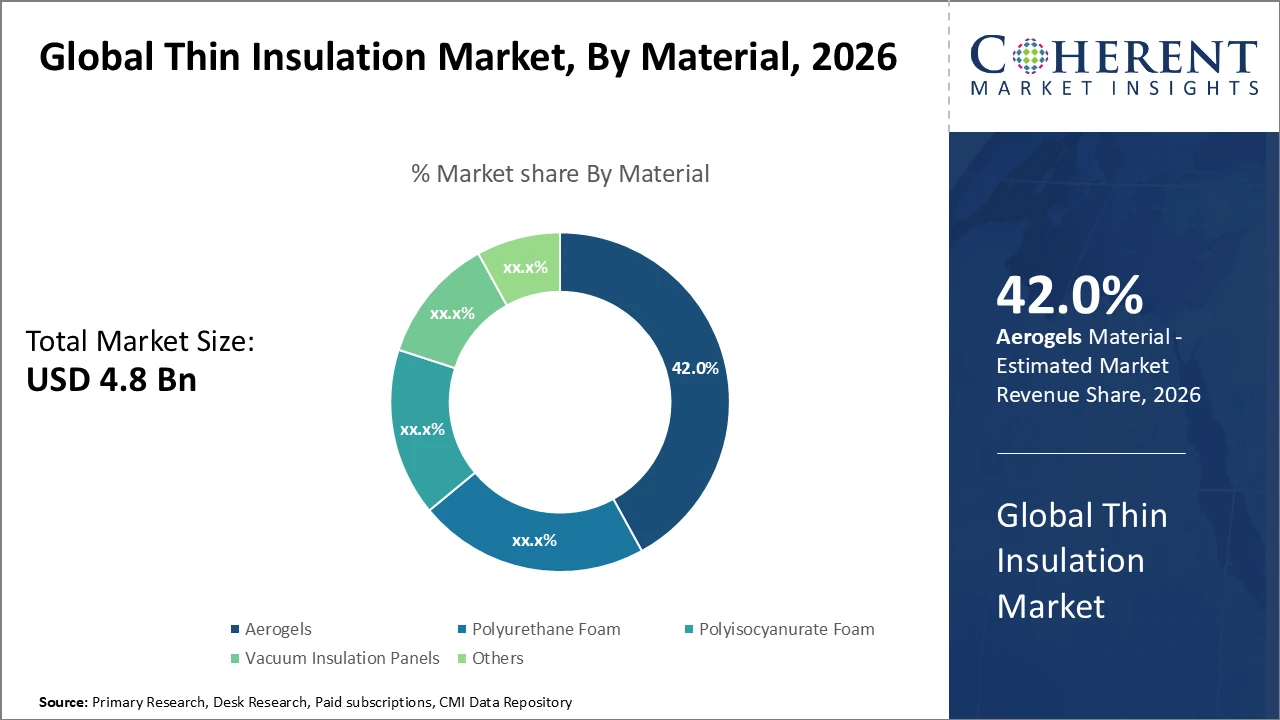
Thin Insulation Market Insights, By Material
Aerogels dominate the Thin Insulation Market due to their exceptional thermal resistance, lightweight properties, and expanding use across aerospace, automotive, electronics, and construction industries. Their ability to deliver high insulation performance with minimal thickness has significantly increased market demand, supported by improvements in manufacturing scalability and cost efficiency. Vacuum Insulation Panels (VIPs) represent the fastest-growing subsegment because they provide superior insulation efficiency in limited spaces, particularly in refrigeration and cold-chain logistics applications. Polyurethane foam and polyisocyanurate foam continue to witness stable demand in conventional building insulation projects. Emerging materials, including bio-based thin insulation products, are also gaining attention due to rising sustainability and environmental concerns.
Thin Insulation Market Insights, By Application
Building & Construction dominates the Thin Insulation Market due to increasing demand for energy-efficient buildings, renovation activities, and stricter environmental regulations. Thin insulation materials help reduce heat loss while maintaining compact structural designs, making them highly suitable for modern infrastructure projects. Automotive insulation is the fastest-growing application segment, driven by rising adoption of lightweight materials for improved fuel efficiency and electric vehicle battery protection. Industrial applications also contribute significantly by enhancing energy efficiency in equipment and piping systems. Aerospace applications require ultra-thin, high-performance insulation for lightweight aircraft structures. Additional opportunities are emerging in household appliances, refrigeration systems, and compact electronic devices requiring advanced thermal insulation solutions.
Thin Insulation Market Insights, By Type
Rigid thin insulation materials dominate the Thin Insulation Market because they provide superior structural stability, durability, and thermal performance for demanding construction and industrial applications. Their strong resistance to compression and efficient thermal conductivity make them widely preferred in commercial buildings and infrastructure projects. Composite insulation types are the fastest-growing subsegment, combining materials such as aerogels and foams to deliver improved fire resistance, mechanical strength, and multifunctional insulation properties. Flexible insulation materials are also gaining popularity, particularly in automotive, industrial, and retrofitting applications where adaptability to irregular surfaces is essential.
Thin Insulation Market Trends
The Thin Insulation Market continues to advance through significant technological integration that enhances thermal efficiency, durability, and overall insulation performance across multiple industries.
Nano-structured insulation materials have emerged as a major innovation by 2026, expanding applications in compact spaces such as automotive, aerospace, and advanced electronics sectors.
Retrofitting older buildings with advanced thin insulation solutions has increased rapidly across Europe, supported by government incentives and sustainability-focused renovation programs, with adoption rates rising by nearly 18% since 2024.
Digital monitoring systems integrated within insulation materials are transforming industrial energy management by enabling predictive maintenance, improving operational efficiency, and optimizing thermal performance in real-time applications.
Thin Insulation Market Insights, By Geography
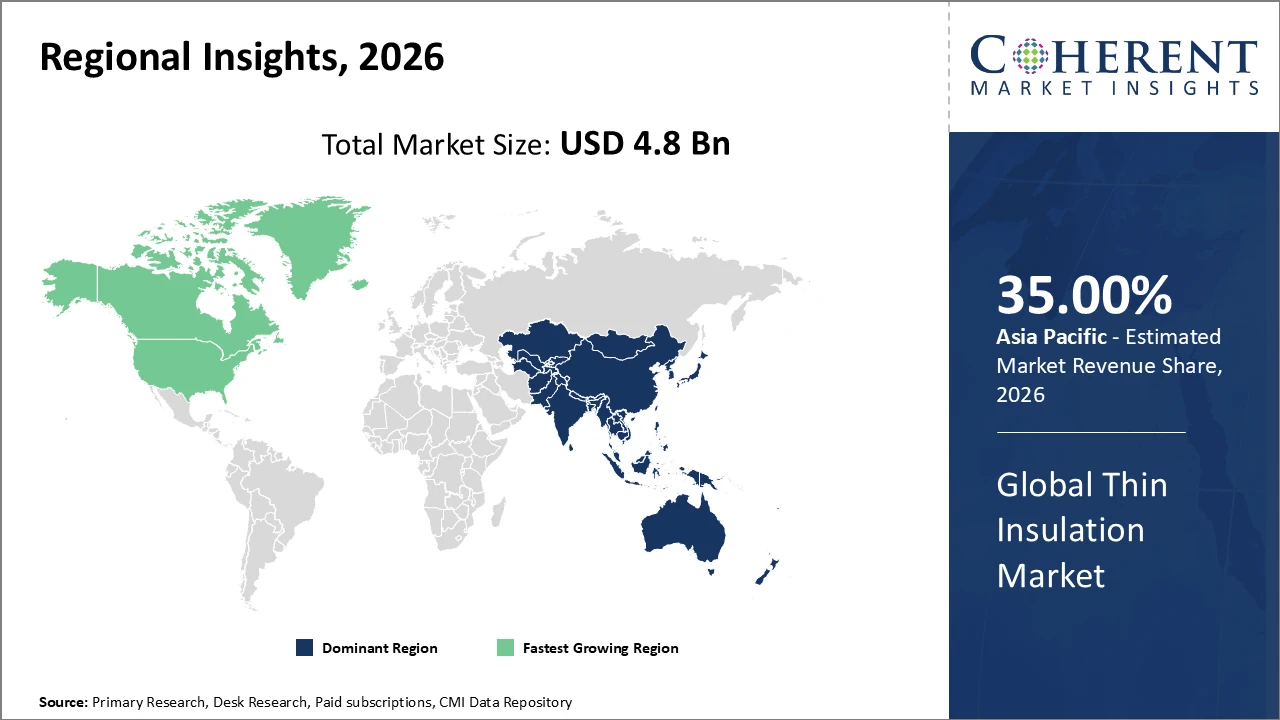
Asia Pacific Thin Insulation Market Analysis and Trends
Asia Pacific dominates the Thin Insulation Market due to rapid urbanization, expanding industrialization, and strong government initiatives promoting energy efficiency and sustainable construction. The region accounts for nearly 35% of the global market share, with China and India leading demand through large-scale infrastructure development and green building projects. Rising investments in commercial and residential construction further support market expansion across emerging economies. Both regional manufacturers and international companies are increasing production capacity and introducing advanced insulation technologies tailored to varying climate conditions. Growing awareness regarding energy conservation, combined with supportive regulations and modernization projects, continues to strengthen the market position of Asia Pacific globally.
North America Thin Insulation Market Analysis and Trends
North America is projected to be the fastest-growing region in the Thin Insulation Market, expanding at a CAGR of 9% due to strict energy-efficiency regulations, increasing adoption of sustainable construction practices, and continuous advancements in insulation technologies. The United States remains the primary growth contributor, driven by rising retrofitting activities in residential and commercial buildings aimed at reducing energy consumption and improving thermal performance. Government incentives supporting green infrastructure and carbon reduction initiatives further accelerate market demand. Major industry participants are heavily investing in research and development to introduce advanced thin insulation materials with improved durability, fire resistance, and energy-saving capabilities across multiple end-use industries.
Thin Insulation Market Outlook for Key Countries
USA Thin Insulation Market Analysis and Trends
The United States Thin Insulation Market is driven by stringent federal and state-level energy-efficiency regulations that encourage the adoption of advanced thermal insulation solutions across residential, commercial, and industrial sectors. Major companies such as Owens Corning and Johns Manville have introduced high-performance aerogel-based insulation products designed to improve thermal efficiency while minimizing space usage. In 2025, the retrofitting segment recorded approximately 14% growth as demand increased for energy-saving building upgrades. Strategic collaborations between insulation manufacturers, construction firms, and technology providers have further accelerated innovation, expanded distribution networks, and strengthened market penetration across the United States.
Germany Thin Insulation Market Analysis and Trends
Germany’s Thin Insulation Market is experiencing steady growth due to rising demand for energy-efficient buildings, strict environmental regulations, and increasing renovation activities across residential and commercial sectors. Advanced products such as vacuum insulation panels, aerogel insulation, and reflective foil materials are gaining popularity because they provide high thermal performance while saving space. The automotive and industrial sectors are also supporting market expansion through lightweight insulation adoption. Growing focus on sustainable construction and carbon reduction targets further boosts demand for thin insulation solutions. However, high product costs and installation complexity remain key challenges for manufacturers and end users in the German market.
Analyst Opinion
Demand-side dynamics indicate that the industrial sector remains a major growth driver for the Thin Insulation Market, with increasing adoption in manufacturing facilities, power generation plants, and process industries to improve energy efficiency and thermal management. Industrial applications of thin insulation rose by nearly 15% in 2024, contributing significantly to overall market revenue growth.
Supply chain optimization efforts, particularly across Asia Pacific, have strengthened production capabilities, with leading manufacturers expanding output capacity by approximately 20% in 2025. Improved raw material sourcing strategies and advanced manufacturing processes have helped reduce operational costs and enhance market competitiveness.
Pricing trends show rising demand for premium thin insulation materials featuring advanced fire resistance, lightweight structures, and environmentally friendly compositions. High-performance insulation products recorded nearly 10% price growth in 2026 due to increasing preference for sustainable and technologically advanced solutions.
Import-export trends from 2024 reveal that Asia Pacific thin insulation exports increased by around 18%, reinforcing the region’s position as a major global manufacturing and supply hub, while North America maintained stable import levels supported by strong domestic demand and ongoing construction modernization projects.
- Current Industry Events of 2026
- Market Size Estimation
- Regional Breakdown
- Competitive Landscape
- Customer Intelligence
- Segmental Analysis
- Pricing Analysis
- Key Market Drivers, Challenges & Future Trends
- Customized Insights Section
Market Scope
| Report Coverage | Details | ||
|---|---|---|---|
| Base Year: | 2025 | Market Size in 2026: | USD 4.8 billion |
| Historical Data for: | 2020 To 2024 | Forecast Period: | 2026 To 2033 |
| Forecast Period 2026 to 2033 CAGR: | 8.0% | 2033 Value Projection: | USD 8.5 billion |
| Geographies covered: |
| ||
| Segments covered: |
| ||
| Companies covered: | 3M, Owens Corning, BASF SE, Saint-Gobain, Kingspan Group, Johns Manville, Huntsman Corporation, Cabot Corporation, Panasonic Corporation, ROCKWOOL Group | ||
| Growth Drivers: |
| ||
Thin Insulation Market Growth Factors
The Thin Insulation Market is experiencing strong growth due to increasingly stringent energy-efficiency regulations aimed at reducing energy consumption in residential and commercial buildings worldwide since 2024. Rapid urbanization and infrastructure expansion, especially across emerging economies, are further driving demand for space-saving insulation solutions that maintain high thermal performance. Technological advancements in materials such as aerogels and vacuum insulation panels have significantly improved insulation efficiency while minimizing product thickness, making them highly suitable for aerospace, automotive, and advanced industrial applications. Additionally, growing environmental awareness and sustainability initiatives are accelerating the adoption of eco-friendly thin insulation materials, particularly within the green building sector, which recorded an estimated 20% CAGR between 2024 and 2026.
Thin Insulation Market Development
In August 2025, Outlast Technologies introduced Aersulate®, a composite fabric integrating aerogel into flexible textiles, delivering ultra-thin, lightweight thermal insulation that maintains performance under compression and moisture, even in extreme conditions.
Key Players
Leading Companies of the Market
3M
Owens Corning
BASF SE
Saint-Gobain
Kingspan Group
Johns Manville
Huntsman Corporation
Cabot Corporation
ROCKWOOL Group
Panasonic Corporation
Recent competitive developments in the Thin Insulation Market highlight increasing focus on innovation and sustainable product expansion. In 2025, BASF SE introduced bio-based aerogel insulation panels, strengthening its sustainability portfolio and expanding its market presence by approximately 8%. Similarly, Owens Corning enhanced its thin insulation product offerings through the acquisition of advanced vacuum insulation panel technology in 2024. This strategic move improved the company’s technological capabilities, increased market revenue, and reinforced its position as a leading innovator in high-performance thermal insulation solutions for construction and industrial applications.
Thin Insulation Market Future Outlook
The Thin Insulation Market is expected to witness strong growth over the coming years due to rising demand for energy-efficient buildings, lightweight automotive components, and advanced thermal management systems. Increasing adoption of aerogel insulation, vacuum insulation panels, and reflective materials across construction, aerospace, refrigeration, and electric vehicle industries will continue driving innovation and market expansion. Governments worldwide are also implementing stricter energy-efficiency regulations, encouraging the use of compact and high-performance insulation materials. Technological advancements, sustainable construction practices, and growing investments in green infrastructure are expected to create significant opportunities for manufacturers, while Asia-Pacific and Europe are projected to remain key growth regions.
Thin Insulation Market Historical Analysis
The Thin Insulation Market has experienced gradual growth over the past decade, driven by increasing awareness of energy conservation and space-efficient construction materials. Early demand primarily came from the building and refrigeration sectors, where thin insulation products helped improve thermal efficiency without increasing structural thickness. Over time, advancements in aerogel technology, vacuum insulation panels, and reflective insulation materials expanded applications into automotive, aerospace, and electronics industries. Europe and North America initially dominated the market due to strict energy regulations, while Asia-Pacific later emerged as a major growth region because of rapid urbanization and industrialization. Continuous innovation and sustainability trends have consistently supported market development.
Sources
Primary Research Interviews:
Building insulation manufacturers, construction contractors, and energy-efficient building solution providers utilizing thin insulation materials in residential, commercial, and industrial projects.
Supply chain executives, insulation material suppliers, and procurement specialists responsible for sourcing aerogels, vacuum insulation panels, reflective foils, and advanced thermal insulation components.
Market analysts, R&D directors, and sustainability experts involved in insulation technology innovation, green building standards, and energy-efficiency regulations.
Magazines:
Insulation Outlook – Updates on insulation technologies, building efficiency trends, and thermal performance innovations.
Construction Europe – Insights into sustainable construction materials, infrastructure projects, and energy-saving technologies.
Engineering News-Record – Coverage of commercial construction trends, advanced insulation systems, and infrastructure development.
Journals:
Energy and Buildings – Research on thermal insulation performance, energy-efficient buildings, and sustainable construction technologies.
Journal of Building Engineering – Studies on advanced insulation materials, building envelopes, and thermal management systems.
Construction and Building Materials – Research focused on insulation materials, aerogels, vacuum insulation panels, and sustainable building products.
Newspapers:
Financial Times – Coverage of global construction investments, sustainability initiatives, and energy-efficiency market developments.
Reuters – Reporting on insulation product launches, manufacturing expansions, and developments in the construction and energy sectors.
Bloomberg – Insights into mergers, acquisitions, R&D investments, and sustainability strategies within the insulation and building materials industries.
Associations:
European Insulation Manufacturers Association – Regulatory updates, sustainability initiatives, and insulation industry research.
North American Insulation Manufacturers Association – Industry standards, insulation technology insights, and market developments.
International Association for Energy Economics – Research and policy insights related to energy efficiency, thermal management, and sustainable infrastructure.
Get access to 250+ pages report
Every segment, forecast, competitor profile and data table behind the analysis above — available for instant download.
- ESOMAR Member
- ISO 9001:2015 Certified
- D-U-N-S Registered
- GDPR & CCPA Compliant
Missing comfort of reading report in your local language? Find your preferred language:
Transform your Strategy with Exclusive Trending Reports
Frequently Asked Questions
Leading companies include 3M, Owens Corning, BASF SE, Saint-Gobain, and Kingspan Group, recognized for their innovative insulation technologies and global market expansion strategies.
The Thin Insulation Market is projected to grow from USD 4.8 billion in 2026 to USD 8.5 billion by 2033, registering a CAGR of 8.0% during the forecast period.
The Building & Construction sector offers the largest growth opportunity due to rising global emphasis on energy-efficient buildings, sustainable infrastructure, and strict thermal insulation regulations.
Technological advancements such as nanotechnology-based insulation materials, aerogel innovations, and IoT-enabled thermal monitoring systems are expected to drive market transformation and product adoption.
The market remains highly competitive with companies focusing on product innovation, strategic partnerships, and sustainability initiatives, while challenges include fluctuating raw material prices and supply chain disruptions.
Key strategies include mergers and acquisitions, expansion of manufacturing capacity, sustainable product development, strategic collaborations, and geographic market expansion to strengthen global presence.