

U.S. Ambulatory Surgery Centre Market Analysis & Forecast 2026-2033
U.S. Ambulatory Surgery Centre Market is estimated to be valued at USD 76.50 Bn in 2026 and is expected to reach USD 110.55 Bn in 2033, exhibiting a compound annual growth rate (CAGR) of 5.4% from 2026 to 2033.
Key Takeaways
- By Procedure Type, Cardiovascular procedures are expected to account for approximately 19.0% of all surgeries performed in U.S. ambulatory surgery centres by 2026.
- By Specialty Type, Multispecialty centres are anticipated to dominate the U.S. ASC market, capturing around 65.0% of the total share in 2026.
Market Overview
The U.S. Ambulatory Surgery Centre (ASC) Market is experiencing strong growth, driven by rising demand for outpatient procedures that offer cost savings, efficiency, and reduced hospital stays. Favourable reimbursement policies, physician ownership models, and increasing investment in ASC infrastructure are accelerating adoption, positioning ASCs as a vital component of the evolving U.S. healthcare landscape.
Current Events and its Impact on the U.S. Ambulatory Surgery Centre Market
Current Event | Description and its impact |
Digital Transformation and Equipment Modernization |
|
Network Expansion and Strategic Alliances |
|
Policy Shifts and Financial Incentives |
|
Pipeline Analysis – U.S. Ambulatory Surgery Centre Market
The U.S. Ambulatory Surgery Centre (ASC) market is witnessing an active development pipeline, driven by healthcare providers’ strategic shift toward cost-efficient outpatient care models. Multiple new multispecialty and single-specialty ASCs are under development across high-density urban areas and underserved rural regions to meet rising patient demand and reduce hospital burden. Strategic partnerships between private equity firms, hospital networks, and physician groups are accelerating project approvals and construction timelines.
Technological advancements in robotic surgery, imaging systems, and anaesthesia are also influencing the pipeline, with many upcoming ASCs incorporating state-of-the-art infrastructure to support complex procedures in outpatient settings.
Moreover, pipeline centres are increasingly being designed with digital integration, telehealth compatibility, and value-based care frameworks to align with U.S. Ambulatory Surgery Centre Market payer reimbursement policies. As reimbursement structures evolve to incentivize outpatient services, developers are tailoring new centres to meet these criteria, ensuring financial sustainability and expanded access. The ASC pipeline is expected to grow steadily through 2030, particularly in orthopaedics, cardiovascular, and gastroenterology specialties.
- Current Industry Events of 2026
- Market Size Estimation
- Regional Breakdown
- Competitive Landscape
- Customer Intelligence
- Segmental Analysis
- Pricing Analysis
- Key Market Drivers, Challenges & Future Trends
- Customized Insights Section
Patent Landscape – U.S. Ambulatory Surgery Centre Market
The patent landscape of the U.S. Ambulatory Surgery Centre (ASC) market reflects a dynamic ecosystem of innovation focused on improving efficiency, safety, and patient outcomes in outpatient surgical environments. Key patent filings over the past five years involve advanced surgical tools, portable diagnostic devices, real-time monitoring systems, and integrated data platforms specifically tailored for ASC use.
Innovations in minimally invasive procedures, robotic-assisted surgery, and sterilization equipment are frequently patented by leading medical device firms aiming to expand their presence in ASCs.
Additionally, patents related to workflow automation, electronic health record (EHR) integration, and remote patient monitoring are gaining traction, supporting the digital transformation of outpatient care.
Start-ups and mid-sized medtech companies are actively contributing to the IP landscape, often collaborating with physician-led ASC networks to co-develop proprietary technologies. As ASCs continue to expand their scope of procedures, IP development remains critical to securing competitive advantages and driving future growth.
Reimbursement Scenario – U.S. Ambulatory Surgery Centre Market
The reimbursement landscape for U.S. Ambulatory Surgery Centres (ASCs) is evolving in response to healthcare cost containment strategies and the shift toward value-based care. The Centres for Medicare & Medicaid Services (CMS) continues to expand the list of reimbursable procedures in ASCs, including cardiovascular, orthopaedic, and gastrointestinal surgeries. This expansion has significantly enhanced the financial viability of ASCs by incentivizing outpatient care over hospital-based alternatives.
Private payers are also aligning with CMS by offering bundled payments and shared savings models to encourage efficient, high-quality surgical care. Reimbursement rates for ASCs are generally lower than those for hospital outpatient departments (HOPDs), offering cost advantages for payers and patients alike.
However, challenges persist, including complex billing codes, documentation requirements, and varying reimbursement structures across states and insurers. Despite these hurdles, continued regulatory support and payer collaboration are expected to drive further adoption and profitability of ASCs in the coming years.
Prescribers’ Preference – U.S. Ambulatory Surgery Centre Market
Prescribers across the United States are increasingly favouring Ambulatory Surgery Centres (ASCs) due to their efficiency, reduced patient wait times, and streamlined workflows. Physicians value ASCs for offering greater control over scheduling, access to specialized staff, and state-of-the-art surgical equipment tailored to outpatient procedures. This autonomy allows prescribers to deliver care in a patient-centric environment while maintaining high clinical standards.
Additionally, ASCs enable quicker turnover of cases and lower overhead costs compared to traditional hospital settings, which appeals to both individual practitioners and group practices. For specialists in fields such as orthopaedics, ophthalmology, gastroenterology, and pain management, ASCs offer the flexibility to handle high volumes with minimal administrative burden.
The preference is further reinforced by favourable patient outcomes, reduced risk of hospital-acquired infections, and consistent reimbursement frameworks. As minimally invasive techniques become more widespread, physician inclination toward ASCs is expected to grow, strengthening the outpatient surgical care ecosystem.
U.S. Ambulatory Surgery Centre Market Trends
- Increasing Prevalence of Chronic Diseases
Increasing prevalence of chronic diseases are expected to drive the market growth thus Market players are adopting strategies such as new product launches, and this is expected to drive the market growth. According to the WHO, increasing incidence rate of neurogenerative diseases such as Parkinson's disease, Alzheimer's disease, and dementiais expected to drive the market growth.
For instance, an article published by Springer Nature on September 12, 2020 Chronic pain is very common and has traditionally been managed with daily opioid regimens. It is estimated that up to 30% of patients presenting for elective surgery use long-term opioids.
- Increasing Strategic Activities
Strategic activities including product launches, mergers & acquisitions, collaborations, and others is expected to drive the market growth. For instance, in January 2021 HST Pathways, a cloud-based ambulatory surgery centre software company, launched HST One, a premium membership programme for ambulatory surgical centres (ASCs).
The end users of this membership programme will have the option to choose popular items that are packaged together as part of their membership, with the option to add on additional services as necessary. The introduction of personalized care in ambulatory surgery centres will attract more patients and lead to significant market growth.
Segmental Insights
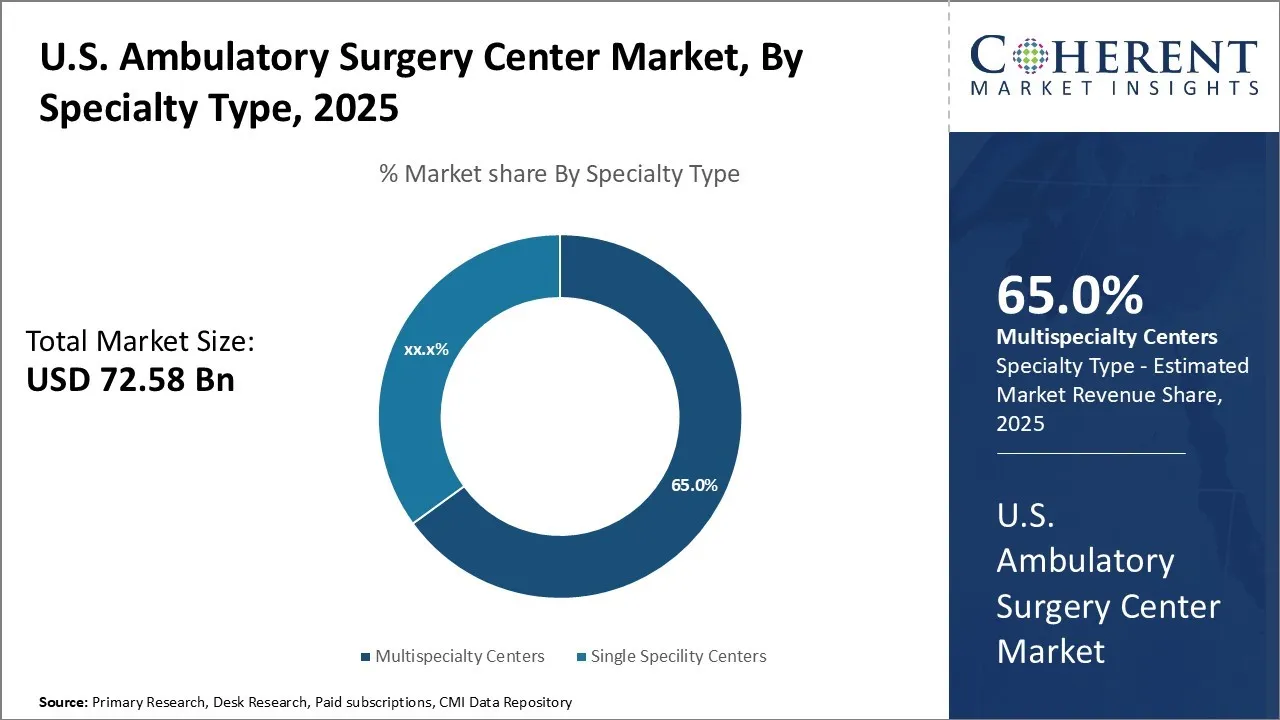
U.S. Ambulatory Surgery Centre Market Insights, By Specialty Type
Multispecialty ambulatory surgery centres are projected to dominate the U.S. ASC market, capturing around 66.0% of the total share by 2026. These facilities provide a wide range of surgical services spanning orthopaedics, gastroenterology, ophthalmology, urology, and pain management within a single centre, enhancing operational efficiency and patient convenience.
The ability to accommodate varied procedure types under one roof makes multispecialty centres ideal for maximizing equipment utilization and streamlining scheduling logistics. Their modular infrastructure, scalable design, and cross-specialty appeal have attracted significant investor interest and led to accelerated expansion across both urban and suburban regions.
Additionally, supportive regulatory policies, strategic payer-provider collaborations, and higher margins compared to single-specialty centres are expected to keep multispecialty ASCs at the forefront of outpatient surgical care in the U.S.
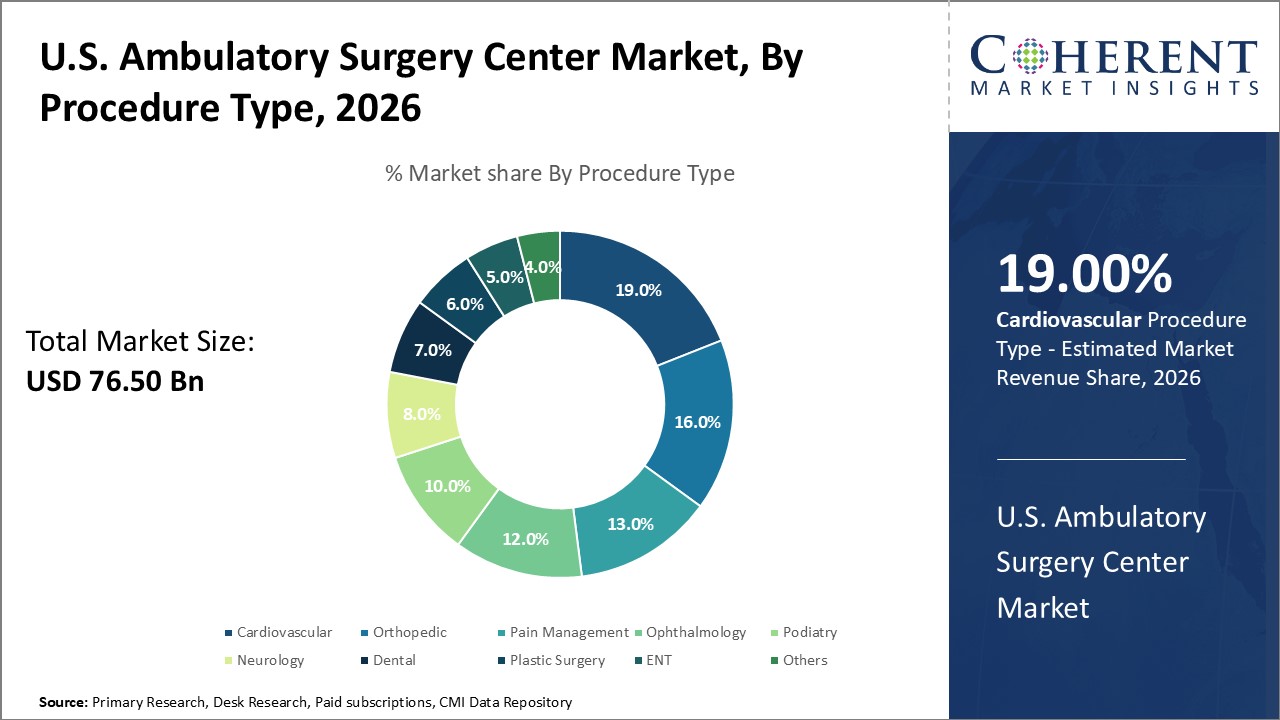
U.S. Ambulatory Surgery Centre Market Insights, By Procedure Type
Cardiovascular procedures are expected to constitute approximately 19.0% of all surgeries performed in U.S. ambulatory surgery centres (ASCs) by 2026. This growth is attributed to the increasing shift of complex interventions—such as cardiac ablation, angioplasty, and pacemaker implants—into outpatient settings. Technological advancements in minimally invasive techniques, combined with shorter recovery times, have made ASCs a viable and cost-effective alternative to hospital-based care.
The integration of digital transformation in U.S. Ambulatory Surgery Centres, including remote monitoring, AI-assisted diagnostics, and electronic health record (EHR) interoperability, is playing a pivotal role in enhancing cardiovascular care delivery. These digital tools not only improve procedural accuracy and post-operative follow-up but also support patient engagement and data-driven decision-making.
Enhanced reimbursement frameworks from public and private insurers, along with growing patient trust in outpatient cardiovascular care, further strengthen this segment’s upward trajectory. The emphasis on value-based care and early discharge protocols is also expected to expand the range of cardiovascular services offered in ASCs moving forward.
Market Report Scope
U.S. Ambulatory Surgery Center Market Report Coverage
| Report Coverage | Details | ||
|---|---|---|---|
| Base Year: | 2025 | Market Size in 2026: | USD 76.50 Bn |
| Historical Data for: | 2020 To 2024 | Forecast Period: | 2026 To 2033 |
| Forecast Period 2026 to 2033 CAGR: | 5.4%2033 Value Projection: | USD 110.55 Bn | |
| Geographies covered: |
| ||
| Segments covered: |
| ||
| Companies covered: | AmSurg Corp., Getinge Group, Tenet Healthcare, Regent surgery Health L.L.C, Covenant surgery Partners Inc, and Surgery Partners | ||
| Growth Drivers: |
| ||
| Restraints & Challenges: |
| ||
Analyst Viewpoint – U.S. Ambulatory Surgery Centre Market
- The U.S. Ambulatory Surgery Centre (ASC) market is experiencing sustained growth, fuelled by increasing demand for outpatient procedures across cardiovascular, orthopaedic, ophthalmology, and gastrointestinal specialties. ASCs offer efficient, cost-effective surgical care with shorter recovery times and lower infection risks, making them an attractive alternative to traditional hospital settings.
- Industry experts point to a rising preference for multispecialty ASCs, which are expected to capture around 65% of market share by 2025. These centres provide comprehensive surgical services under one roof, enhancing operational efficiency and patient convenience. Their adaptability to varying procedure volumes and specialty demands has driven rapid investment and expansion across suburban and urban areas.
- Cardiovascular procedures are also gaining prominence in the ASC landscape, accounting for an estimated 18% share. Technological advancements in minimally invasive techniques and supportive reimbursement policies are encouraging the shift of complex cardiac interventions to outpatient environments broadening ASC capabilities and market penetration in high-acuity care segments.
U.S. Ambulatory Surgery Centre Market: Key Development
- In March 2025, Distalmotion announced the acquisition of its DEXTER Robotic Surgery System by the First Ambulatory Surgical Center in the U.S.
- In March 2025, AMSURG, announced that around 64 of its surgery centers have been recognized by the U.S. News & World Report among the best ambulatory Surgery Centers worldwide.
Market Segmentation
- U.S. Ambulatory Surgery Centre Market, By (Revenue, USD Bn, 2021 - 2033) Specialty
- Single Specialty Centers
- Multispecialty Centers
- U.S. Ambulatory Surgery Centre Market, By (Revenue, USD Bn, 2021 - 2033) Ownership
- Physician-only
- Hospital-only
- Corporate-only
- Physician and Hospital
- Physician and Corporate
- Hospital and Corporate
- U.S. Ambulatory Surgery Centre Market, By (Revenue, USD Bn, 2021 - 2033) Procedure Type
- Orthopedic
- Cardiovascular
- Pain Management
- Ophthalmology
- Podiatry
- Neurology
- Dental
- Plastic Surgery
- ENT
- Others
- Key Players Insights
- AmSurg Corp.
- Getinge Group
- Tenet Healthcare
- Regent surgery Health L.L.C
- Covenant Surgery Partners Inc.
- Surgery Partners.
Sources
The Stakeholders Consulted
- Administrators and directors of ambulatory surgery centers (ASCs)
- Practicing surgeons and outpatient care specialists
- Medical device suppliers and surgical equipment manufacturers
- Healthcare reimbursement consultants and billing professionals
- Health insurance and managed care providers
- Public health policy advisors and regulatory consultants
- Healthcare infrastructure developers and real estate advisors
- End-users such as multispecialty hospitals, orthopedic clinics, and GI centers
Databases Opened
- U.S. Centers for Medicare & Medicaid Services (CMS) – Procedure Volume & Reimbursement Database
- American Hospital Association (AHA) – Annual Survey Database
- U.S. Census Bureau – Healthcare Infrastructure Statistics
- National Center for Health Statistics (NCHS) – Ambulatory Surgery Data
- Health Resources and Services Administration (HRSA) – Workforce & Access Reports
Magazines & Trade Publications
- Becker’s ASC Review
- Outpatient Surgery Magazine
- Modern Healthcare – Outpatient Services Section
- Medical Economics – ASC Reimbursement & Operations
- Healthcare Business Today – ASC Strategy & Growth
Scientific and Industry Journals
- Journal of Ambulatory Care Management
- Journal of the American Medical Association (JAMA) – Surgery
- Health Affairs – Ambulatory Services Policy
- American Journal of Surgery
- The Permanente Journal – Ambulatory Trends & Innovations
Newspapers & Media Outlets
- The Wall Street Journal – U.S. Healthcare Business
- Bloomberg – Healthcare Market Trends
- Reuters – Outpatient Services News
- The New York Times – Healthcare Reform & Policy
- Business Standard – Global Surgery Market Developments
Associations and Regulatory Bodies
- Ambulatory Surgery Center Association (ASCA)
- Centers for Medicare & Medicaid Services (CMS)
- U.S. Food and Drug Administration (FDA)
- American College of Surgeons (ACS)
- Agency for Healthcare Research and Quality (AHRQ)
Public Domain Sources
- U.S. Department of Health & Human Services (HHS) – Ambulatory Policy Briefs
- Medicare Payment Advisory Commission (MedPAC) – Outpatient Payment Reports
- National Institutes of Health (NIH) – Surgery Outcome Studies
- Congressional Budget Office (CBO) – Healthcare Cost Analyses
- World Health Organization (WHO) – Outpatient Procedure Trends
Proprietary Research Elements
- CMI Data Analytics Tool
- Proprietary CMI Repository of ASC Market Data (covering the last 8 years)
- CMI Expert Interviews and Transcripts (covering trends in outpatient care, reimbursement shifts, and surgical procedure migration)
Get access to 250+ pages report
Every segment, forecast, competitor profile and data table behind the analysis above — available for instant download.
- ESOMAR Member
- ISO 9001:2015 Certified
- D-U-N-S Registered
- GDPR & CCPA Compliant
Missing comfort of reading report in your local language? Find your preferred language:
Transform your Strategy with Exclusive Trending Reports
Frequently Asked Questions
The U.S. Ambulatory Surgery Center Market size is estimated to be valued at USD 76.50 Bn in 2026, and is expected to reach USD 110.55 Bn by 2033.
The CAGR of the U.S. market is projected to be 5.4% from 2026 to 2033.
Increasing prevlance of chronic diseases and Increasing Strategic Activities are expected to drive the U.S. ambulatory surgery center market growth.
Cardiovascular is the leading specialty area segment in the market.
Disappearance of out-of-network reimbursement is expected to hinder the market growth over the forecast period.
Major players operating in the market include AmSurg Corp., Getinge Group, Tenet Healthcare, Regent surgery Health L.L.C., Covenant surgery Partners inc, and Surgery Partners.
The shift from inpatient to outpatient care is fueling rapid growth in the U.S. Market by lowering costs, reducing hospital stays, and enabling quicker recovery through minimally invasive procedures.