

Vascular Ulcers Treatment Market Size and Share Analysis - 2026 To 2033
The Vascular Ulcers Treatment market is anticipated to grow at a CAGR of 4.7% with USD 3.3 Bn in 2026 and is expected to reach USD 4.6 Bn in 2033. The emerging prevalence of diabetes (589 million), one of the main causes of vascular ulcers, is expected to bolster the growth of global vascular ulcers treatment market. Increasing number of clinical trials is expected to aid in the growth of the global vascular ulcers treatment market over the forecast period.
Key Takeaways
- Venous Ulcers are expected to account the largest share of 46% in 2026, driven by their high prevalence, chronic nature, and dependence on long-term compression-based therapy, which ensures sustained demand for wound care products and clinical services. The prevalence of at least one chronic condition increased from 72.3% to 76.4%.
- Antibiotics will dominate with 30% in 2026, driven by the high incidence of infection in chronic wounds, their routine use in clinical protocols, and widespread adoption across hospital and outpatient care settings. The prevalence of chronic wounds in India is estimated to be 4.5 per 1,000 people.
- Hospital pharmacies will dominate with 50% in 2026, due to the high clinical complexity of vascular ulcers, reliance on hospital-based wound care centers, and the need for physician-led prescribing of advanced therapeutics such as antibiotics, compression systems, and specialized dressings. Venous leg ulcers (VLUs) are an advanced manifestation of chronic venous insufficiency (CVI) with prevalence estimates ranging from 0.06% to 2%.
- North America is expected to acquire the dominant share of 40% in 2026, driven by a high prevalence of chronic conditions such as diabetes and peripheral arterial disease, advanced healthcare infrastructure, strong reimbursement systems, and rapid adoption of advanced wound care technologies. The 2025 U.S. Prevalence of Peripheral Artery Disease (PAD) Exceeded 22 Million.
Segmental Insights
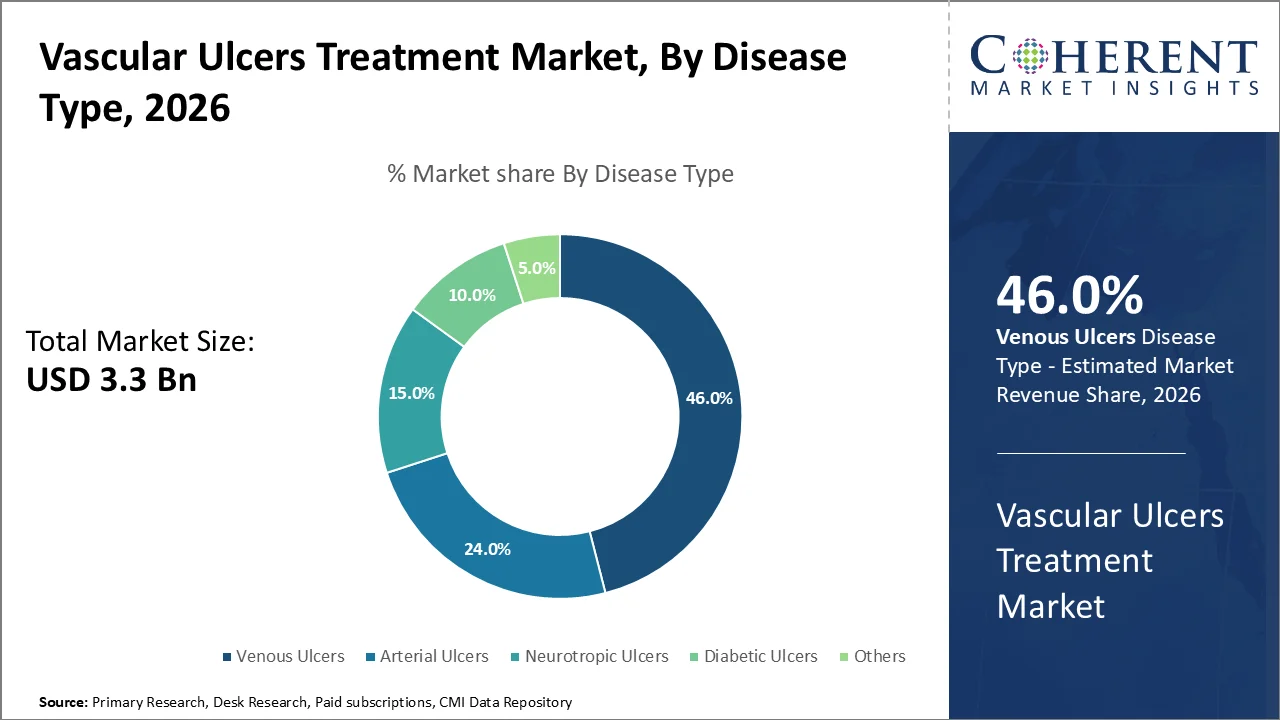
Why is Venous Ulcers Acquiring the Largest Market Share?
Venous ulcers drops is projected to account for the largest share of disease type in 2026, representing approximately 46% of the total volume. Owing to their remarkably high prevalence across the global population, well-established clinical management protocols, and the increasing burden of chronic venous insufficiency in aging demographics. The prevalence of CVD was 7.2%. The prominent forms of CVD were varicose veins (4.5%) as well as telangiectasias (2.1%).
Venous ulcers, also known as venous leg ulcers (VLUs), shows the most prevalent form of lower extremity ulceration globally, accounting for the majority of chronic wound cases managed in both outpatient and inpatient clinical settings.
The epidemiological burden of chronic venous insufficiency (CVI), a condition in which the venous valves of the lower extremities fail to function properly is growth inducing factor, leading to persistent venous hypertension, skin breakdown, and eventually ulcer formation.
- Current Industry Events of 2026
- Market Size Estimation
- Regional Breakdown
- Competitive Landscape
- Customer Intelligence
- Segmental Analysis
- Pricing Analysis
- Key Market Drivers, Challenges & Future Trends
- Customized Insights Section
Antibiotics holds the Largest Market Share
Based on drug class, antibiotics dominates the market, accounting for a significant 30% share in 2026. Owing to the critical role they play in managing infections that are commonly associated with vascular ulcers, particularly venous leg ulcers, arterial ulcers, as well as diabetic foot ulcers. Diabetic foot ulcers are a common and severe complication of T2DM, affecting between 19% and 34% of individuals with diabetes during their lifetime.
Vascular ulcers are highly susceptible to bacterial colonization and subsequent infection due to impaired blood flow, compromised immune responses, as well as prolonged wound exposure to the external environment. According to the World Health Organization (WHO), chronic wounds including vascular ulcers is one of the most major healthcare burdens globally, as well as infection management remains the cornerstone of effective treatment protocols.
Antibiotics are routinely prescribed topically as well as systemically to combat polymicrobial infections that frequently involve organisms such as Staphylococcus aureus, Pseudomonas aeruginosa, and methicillin-resistant Staphylococcus aureus (MRSA).
Hospital Pharmacies holds the Largest Market Share
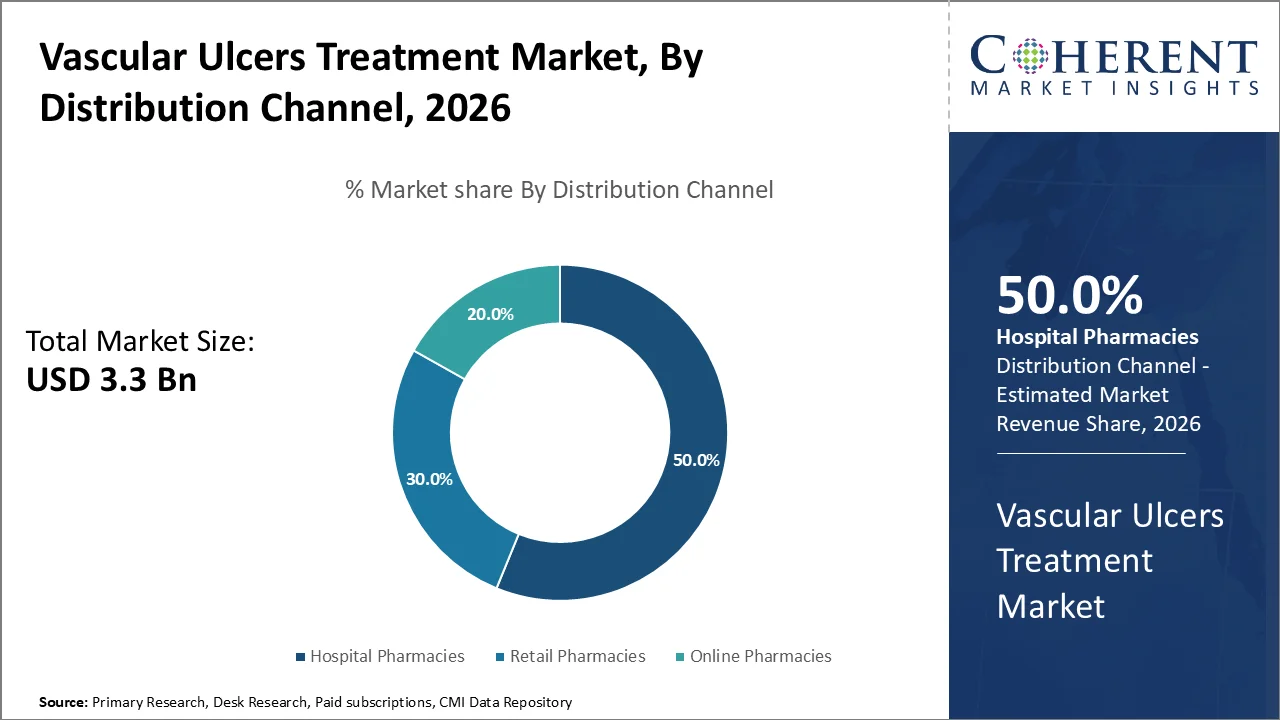
Based on distribution channel, hospital dominate the market, accounting for a significant 50% share in 2026, owing to the complexity of vascular ulcer conditions that inherently demand specialized clinical environments, multidisciplinary care teams, and access to prescription-grade wound care therapeutics that are exclusively dispensed through institutionalized pharmaceutical settings. Globally, wound care expenditure reached a staggering USD 148.65 billion in 2022.
Vascular ulcers, encompassing venous leg ulcers, arterial ulcers, as well as mixed etiology ulcers, are chronic, recalibrating conditions that frequently require concurrent management of underlying comorbidities such as chronic venous insufficiency, peripheral arterial disease, and diabetes mellitus, all of which necessitate close physician supervision and hospital-grade pharmacological dispensing infrastructure.
According to the World Health Organization (WHO), chronic wounds including vascular ulcers disproportionately affect elderly populations and individuals with cardiovascular-related comorbidities, and the management of these conditions often requires structured inpatient or outpatient hospital-level engagement where hospital pharmacies serve as the central node of therapeutic supply chains.
Market Drivers
Bioactive and Antimicrobial Dressings is transforming the Vascular Ulcers Treatment Industry
Modern wound dressings are no longer just simple covers. They are now active healing materials that help control infection, manage wound fluid, and speed up healing. One important type is bioactive as well as antimicrobial dressings, especially those containing silver. These dressings slowly release silver ions, which kill bacteria including MRSA, Pseudomonas, etc., that are commonly found in vascular ulcers and other chronic wounds.
Clinical studies show that silver dressings can reduce bacteria in wounds by up to 30–45%, lower the need for antibiotics, and may shorten healing time by 2–4 weeks in some chronic wound cases. They are highly used in vascular ulcers as infection control is one of the biggest challenges in treatment.
Current Events and Their Impact on the Vascular Ulcers Treatment Market
Current Event | Description and its Impact |
FDA approval and launch of next-generation antimicrobial wound dressings (e.g., nitric-oxide and silver-based dressings, 2025–2026) |
|
CMS reimbursement tightening and restructuring of wound care coverage (2025–2026) |
|
Vascular Ulcers Treatment Market Trends
- The market is experiencing a pronounced transition from traditional wound dressings to advanced wound care products, including bioactive dressings, negative pressure wound therapy (NPWT), growth factor therapies, as well as skin substitutes.
- Bioengineered skin substitutes, autologous platelet-rich plasma (PRP) therapies, as well as stem cell-based interventions are coming as transformative treatment modalities, particularly for refractory and non-healing vascular ulcers. Stem cell therapy success rates vary significantly by condition, cell type, and treatment protocol with studies reporting 60-70% success rates for certain transplant procedures and up to 80% or higher improvement rates in specific regenerative applications.
- Remote wound monitoring platforms, AI-driven wound assessment tools, as well as telehealth-enabled care management are redefining patient follow-up and treatment adherence. 1,248 patients enrolled onto the Isla wound monitoring platform over a six-month period, showed an SSI rate of 6.7% and an overall response rate.
- Compression therapy remains the cornerstone of venous ulcer management, with the market experiencing an inclination toward multi-layer compression systems, adjustable compression devices, as well as inelastic bandaging systems that offer improved patient compliance and clinical outcomes compared to conventional approaches.
Regional Insights
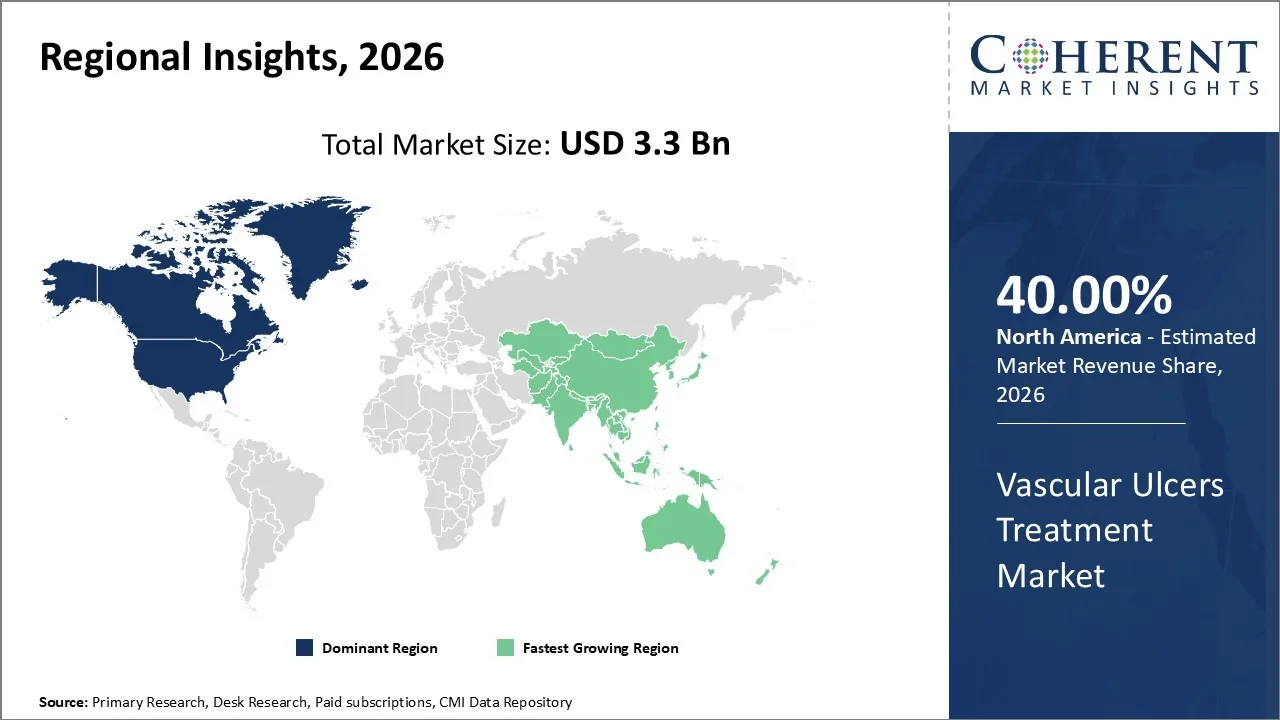
North America dominates owing to widespread adoption of advanced wound care technologies
North America account 40% market share in 2026, owing to its widespread adoption of advanced wound care technologies, and a significantly high prevalence of chronic vascular conditions that directly contribute to the development of vascular ulcers. According to the American Academy of Home Care Medicine, approximately 6.5 million people, or about 1 in 38 adults, are affected by chronic wounds each year in the US.
The United States, in particular, stands as a dominant force within this segment, largely fueled by the burden of conditions including chronic venous insufficiency, peripheral arterial disease, diabetes-related vascular complications, etc.
According to the Centers for Disease Control and Prevention (CDC), approximately 37.3 million Americans are living with diabetes, a condition strongly associated with peripheral vascular disease as well as subsequent ulcer formation, which directly amplifies the demand for effective vascular ulcer treatment solutions.
Furthermore, the American Heart Association has consistently showed that venous leg ulcers affect nearly 1% of the adult population in the United States, with recurrence rates exceeding 70% in untreated or inadequately managed cases.
Asia Pacific Vascular Ulcers Treatment Market Trends
The Asia Pacific region is poised to be the fastest-growing region through 2026-2033, expanding at a CAGR of approximately 8.2%. Driven by a rapidly expanding diabetic population, aging demographics, as well as accelerating improvements in healthcare access across emerging economies including China, India, Japan, South Korea, Southeast Asian nations, IDF projects that the number of people with diabetes in the SEA Region will increase by 73%, reaching 185 million by 2050.
The International Diabetes Federation has highlighted that Asia is home to the largest number of people living with diabetes globally, with China as well as India collectively accounting for an enormous proportion of global diabetes cases, both of which are primary risk factors for diabetic foot ulcers and peripheral arterial disease-related vascular wounds.
The World Health Organization has reported escalating trends of hypertension as well as cardiovascular disease across Asia Pacific nations, conditions that are closely related to the development of arterial ulcers. Governments across the region are responding proactively; for instance, Japan's Ministry of Health, Labour and Welfare has progressively updated its national health insurance coverage to include advanced wound care dressings and vascular intervention procedures.
Well-established healthcare infrastructure is Accelerating the Vascular Ulcers Treatment Market Demand in United States
The U.S. contributes the highest share in the market in North America owing to its well-established healthcare infrastructure, extensive reimbursement frameworks, and the disproportionately high prevalence of chronic conditions that directly predispose the population to vascular ulcers.
The United States remains the dominant subsegment within the North American vascular ulcers treatment landscape, driven by a convergence of epidemiological burden, healthcare expenditure patterns, and accelerated adoption of advanced wound care modalities. According to the Centers for Disease Control and Prevention (CDC), approximately 37.3 million Americans are living with diabetes, a condition closely associated with the development of diabetic foot ulcers as well as venous leg ulcers, creating an enormous patient pool requiring sustained wound management interventions.
Furthermore, the American Heart Association has consistently reported that peripheral artery disease (PAD), a leading driver of arterial ulcers, affects approximately 8.5 million Americans aged 40 and above, further reinforcing the country's dominant position in driving treatment demand.
China Vascular Ulcers Treatment Market Trends
China contributes the highest share in the vascular ulcers treatment market in Asia Pacific due to its extraordinarily escalating aging population base, which serves as the primary driver for the high prevalence of venous as well as arterial ulcers across the country.
According to the National Bureau of Statistics of China, by 2023, individuals aged 60 years and above accounted for approximately 21.1% of the total population, translating into nearly 297 million elderly citizens who are inherently more susceptible to chronic wound conditions including vascular ulcers.
China's robust healthcare infrastructure expansion under the national "Healthy China 2030" initiative has substantially increased access to advanced wound care treatment modalities, facilitating greater patient diagnosis and treatment uptake.
Who are the Major Companies in Vascular Ulcers Treatment Industry
Some of the major key players in Vascular Ulcers Treatment market include, Bristol Myers Squibb Co., Sanofi, Bayer AG, Pfizer Inc., Novo Nordisk A/S, and Cadila Pharmaceuticals Ltd.
Key News
- In June 2026, The Food and Drug Administration (FDA) has granted Fast Track designation to MTX-001, an investigational biologic therapy for the treatment of chronic, noninfected venous stasis ulcers, also known as venous leg ulcers (VLU).
- In April 2026, MediWound Ltd., a global leader in next-generation enzymatic therapeutics for tissue repair, announced multiple oral and poster presentations at three leading wound care conferences: the Wound Healing Society (WHS) and the Symposium on Advanced Wound Care (SAWC) Spring 2026, taking place April 8–12 in Charlotte, North Carolina, and the European Wound Management Association (EWMA) 2026, taking place May 6–8 in Bremen, Germany.
Market Report Scope
Vascular Ulcers Treatment Market Report Coverage
| Report Coverage | Details | ||
|---|---|---|---|
| Base Year: | 2025 | Market Size in 2026: | USD 3.3 Bn |
| Historical Data for: | 2020 To 2024 | Forecast Period: | 2026 To 2033 |
| Forecast Period 2026 to 2033 CAGR: | 4.7% | 2033 Value Projection: | USD 4.6 Bn |
| Geographies covered: |
| ||
| Segments covered: |
| ||
| Companies covered: | Bristol Myers Squibb Co., Sanofi, Bayer AG, Pfizer Inc., Novo Nordisk A/S, and Cadila Pharmaceuticals Ltd. | ||
| Growth Drivers: |
| ||
| Restraints & Challenges: |
| ||
Analyst Opinion
- The vascular ulcers treatment market is witnessing significant momentum driven by the rising prevalence of chronic venous insufficiency, peripheral arterial disease, and diabetes-related complications worldwide. Over 2 million individuals have advanced chronic venous disease, from which around 20% percent present with venous ulcers as a complication.
- An aging global population remains one of the most compelling growth drivers, as elderly individuals are disproportionately susceptible to developing chronic wound conditions including venous and arterial ulcers. The prevalence of VLUs in this population is estimated at 1.7% annually.
- Increasing awareness among healthcare professionals regarding advanced wound care management protocols has substantially improved early diagnosis and treatment adoption rates across developed economies.
- However, the market faces notable restraints, including high treatment costs associated with advanced wound care therapies, compression bandaging systems, and surgical interventions, which limit accessibility in low-income regions.
Speak to the analyst
Want personalized insights?
Take the findings above to one of our principal consultants, or have the report rebuilt around the segments, geographies and competitors you actually track.
Market Segmentation
- By Disease Type (Revenue, USD Bn, 2021-2033)
- Arterial Ulcers
- Venous Ulcers
- Neurotropic Ulcers
- Diabetic Ulcers
- Others
- By Drug Class (Revenue, USD Bn, 2021-2033)
- Antibiotics
- Hemorrheologic Agents
- Corticosteroids
- Non-steroidal Anti-inflammatory Drug (NSAID)
- Others
- By Distribution Channel (Revenue, USD Bn, 2021-2033)
- Hospital Pharmacies
- Retail Pharmacies
- Online Pharmacies
- By Region (Revenue, USD Bn, 2021-2033)
- North America
- U.S.
- Canada
- Latin America
- Brazil
- Mexico
- Argentina
- Rest of Latin America
- Europe
- Germany
- U.K.
- France
- Italy
- Spain
- Russia
- Rest of Europe
- Asia Pacific
- China
- India
- Japan
- Australia
- South Korea
- ASEAN
- Rest of Asia Pacific
- Middle East
- GCC
- Israel
- Rest of Middle East
- Africa
- South Africa
- Central Africa
- North Africa
- North America
Sources
Primary Research Interviews
- Vascular Surgeons
- Wound Care Specialists
- Dermatologists
- Healthcare Procurement Officers
- Others
Databases
- IQVIA
- Medscape Reference Database
- Others
Magazines
- Wounds International Magazine
- Journal of Vascular Surgery Magazine
- Advances in Wound Care Magazine
- Vascular Disease Management
- Others
Journals
- Journal of Vascular Surgery
- Wound Repair and Regeneration Journal
- International Wound Journal
- Others
Newspapers
- The Wall Street Journal (Healthcare Section)
- Financial Times (Pharma & Healthcare)
- Modern Healthcare News
- BioPharma Dive
- Others
Associations
- American Venous Forum (AVF)
- Wound Healing Society (WHS)
- Society for Vascular Surgery (SVS)
- European Wound Management Association (EWMA)
- Others
Public Domain Sources
- U.S. Food and Drug Administration (FDA)
- World Health Organization (WHO)
- Centers for Disease Control and Prevention (CDC)
- National Institutes of Health (NIH)
- Others
Proprietary Elements
- CMI Data Analytics Tool
- Proprietary CMI Existing Repository of information for last 10 years
Get access to 250+ pages report
Every segment, forecast, competitor profile and data table behind the analysis above — available for instant download.
- ESOMAR Member
- ISO 9001:2015 Certified
- D-U-N-S Registered
- GDPR & CCPA Compliant
Missing comfort of reading report in your local language? Find your preferred language:
Transform your Strategy with Exclusive Trending Reports
Frequently Asked Questions
The vascular ulcers treatment market is expected to reach USD 4.6 Bn in 2033.
Major players operating in the global vascular ulcers treatment market include Bristol Myers Squibb Co., Sanofi, Bayer AG, Pfizer Inc., Novo Nordisk A/S, and Cadila Pharmaceuticals Ltd.
Stringent regulatory approval processes delaying product commercialization is expected to restrain the vascular ulcers treatment market growth over the forecast period.
Rising prevalence of diabetes and obesity driving venous/arterial ulcer incidence are driving growth of the global Vascular Ulcers Treatment market.
The vascular ulcers treatment market is anticipated to grow at a CAGR of 4.7% between 2026 and 2033.
Among regions, North America is expected to account for a largest market share in the global vascular ulcers treatment market over the forecast period.
Vascular ulcers are wounds on your skin that develop because of problems with blood circulation. They are most common on your limbs — especially your lower legs and feet — but can also develop elsewhere on your body.