

Venipuncture Needle And Syringes Market Size and Forecast – 2026 to 2033
The Venipuncture Needle And Syringes Market is anticipated to grow at a CAGR of 5.7% with USD 833.7 Bn in 2026 and is expected to reach USD 1,234.5 Bn in 2033. Rising diagnostic testing, increasing chronic disease cases, and expanding hospital infrastructure drive the growth of the venipuncture needle and syringes market. The prevalence of at least one chronic condition rose from 72.3% to 76.4%, while the prevalence of multiple chronic conditions (two or more) increased from 47.3% to 51.4%.
Key Takeaways
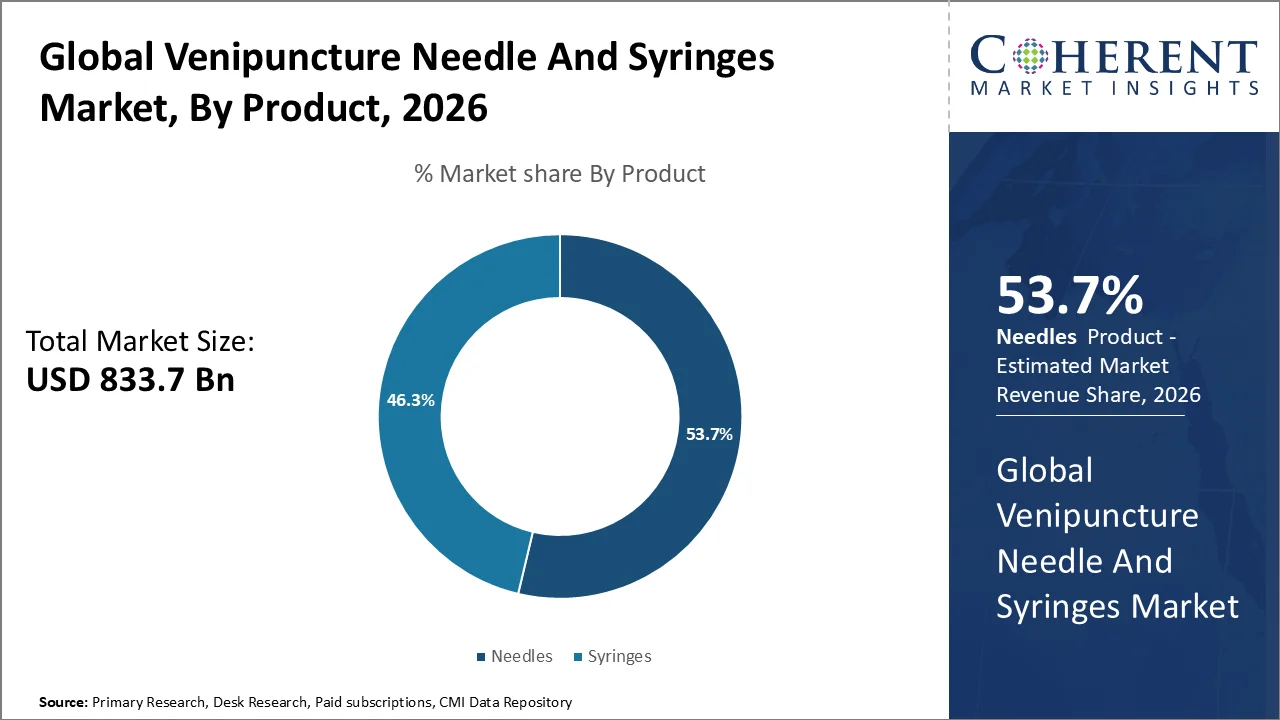
- Needles hold the largest market share of 53.7% in 2026 owing to its increasing diagnostic testing. The global diagnostic services industry is to surpass USD 616.32 Bn by 2033.
- Cephalic Vein expected to hold largest market share of 38.8% in 2026 owing to the superficial and accessible location.
- Hospitals acquired the largest market share of 39.7% in 2026 owing to its high patient volumes. Private hospitals in the UK recorded 953,000 admissions in 2025, marking the fourth consecutive year of record-high admissions.
- North America is expected to acquire the dominant share of 41.4% in 2026 owing to its advanced healthcare infrastructure.
Current Events and Their Impact on the Venipuncture Needle And Syringes Market
Current Event | Description and its Impact |
WHO Expansion of Prequalification Requirements for Reuse-Prevention Syringes
|
|
WHO's Continued Preference for Auto-Disable Syringes in Immunization
|
|
Segmental Insights
- Current Industry Events of 2026
- Market Size Estimation
- Regional Breakdown
- Competitive Landscape
- Customer Intelligence
- Segmental Analysis
- Pricing Analysis
- Key Market Drivers, Challenges & Future Trends
- Customized Insights Section
Why is Needles Acquiring the Largest Market Share?
Needles hold the largest market share of 53.7% in 2026. The needles segment in the Venipuncture Needles and Syringes Market is growing as hospitals, laboratories, and blood donation centers perform more blood collection and diagnostic tests. The rising prevalence of diabetes, cancer, cardiovascular diseases, and other chronic conditions increases the need for regular blood sampling and patient monitoring. According to the WHO, approximately 830 million people worldwide live with diabetes, with the majority residing in low- and middle-income countries (LMICs). Healthcare providers are also adopting safety-engineered and single-use needles to improve infection control and protect workers from needlestick injuries. Manufacturers further support demand by developing needles with improved designs, greater precision, enhanced blood flow, and increased patient comfort.
Cephalic Vein expected to hold largest market share
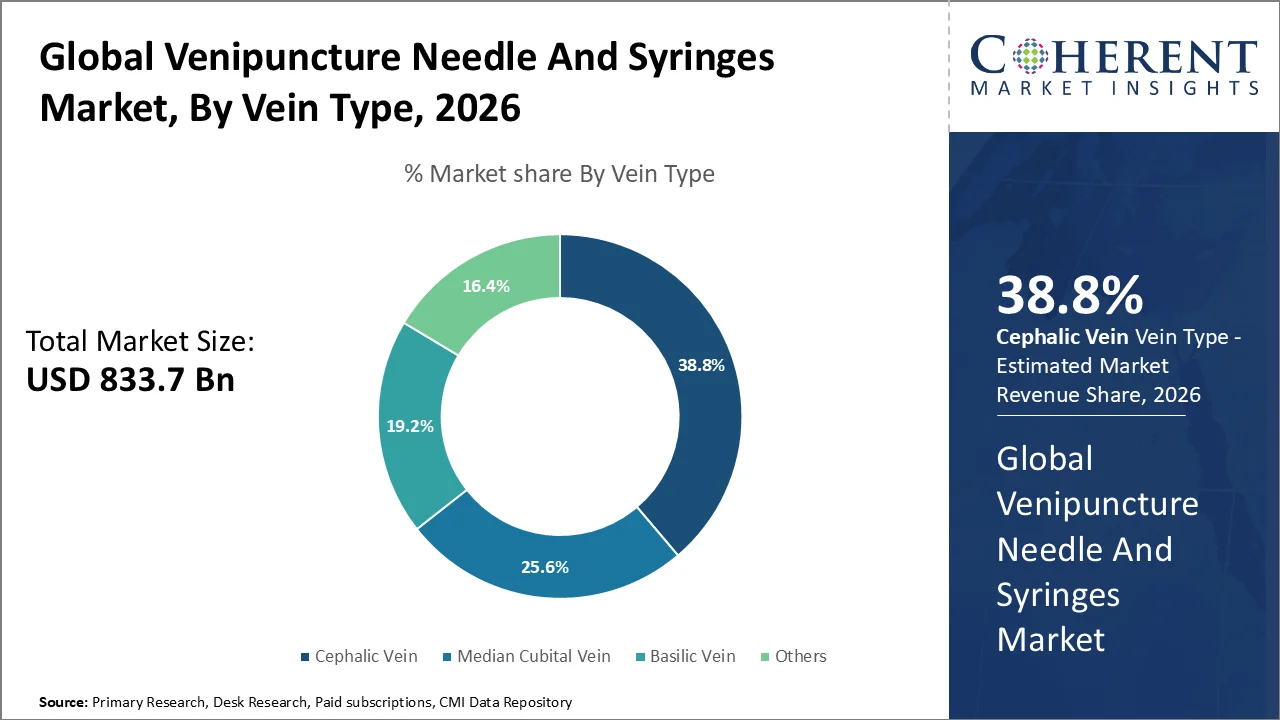
Cephalic Vein expected to hold largest market share of 38.8% in 2026 owing to the demand for peripheral venous access. The cephalic vein segment in the Venipuncture Needles and Syringes Market benefits from the vein’s superficial position, easy accessibility, and suitability for blood collection and peripheral venous access. Healthcare professionals often select the cephalic vein when they cannot access other preferred veins. Its relatively consistent anatomical pathway and separation from major nerves and arteries can facilitate safer cannulation. Rising diagnostic testing, expanding peripheral venous procedures, and increasing adoption of ultrasound-guided access techniques continue to drive demand for needles and syringes used in cephalic-vein procedures.
Which End User segment dominates the market?
Hospitals acquired the largest market share of 39.7% in 2026. The hospitals segment in the Venipuncture Needles and Syringes Market grows as hospitals manage high patient volumes and perform frequent blood collection, diagnostic testing, intravenous therapy, and surgical procedures. Increasing admissions for chronic diseases, emergencies, and surgeries drive hospitals to consume more venipuncture products. Hospitals also strengthen infection-control practices and protect healthcare workers by adopting sterile, single-use, and safety-engineered needles and syringes. Hospital infrastructure expansion, enhanced diagnostic capabilities, and greater adoption of advanced medical technologies further increase demand for these devices.
Venipuncture Needle And Syringes Market Trends
- Rising demand for minimally invasive and safer blood-collection procedures encourages healthcare providers to adopt advanced venipuncture needles and syringes that improve patient comfort, reduce complications, and support efficient sample collection. WHO estimates that 830 million people were living with diabetes in 2022, increasing the need for ongoing blood-glucose monitoring and clinical testing.
- Increasing adoption of safety-engineered needles and syringes strengthens market growth as hospitals and laboratories prioritize healthcare-worker protection against needlestick injuries and bloodborne infections. The CDC estimates that approximately 385,000 needlestick and other sharps injuries occur annually among hospital-based healthcare personnel in the U.S., supporting continued demand for engineered safety features such as retractable needles, shields, and protective mechanisms.
- Stronger occupational-safety requirements favor safety-engineered devices over conventional sharps. In the U.S., the Needlestick Safety and Prevention Act of 2000 led to revisions of OSHA's Bloodborne Pathogens Standard requiring greater use of engineering controls, including safety-engineered sharps devices. CDC continues to identify retractable needles, needle shields, and similar technologies as important engineering controls.
Regional Insights
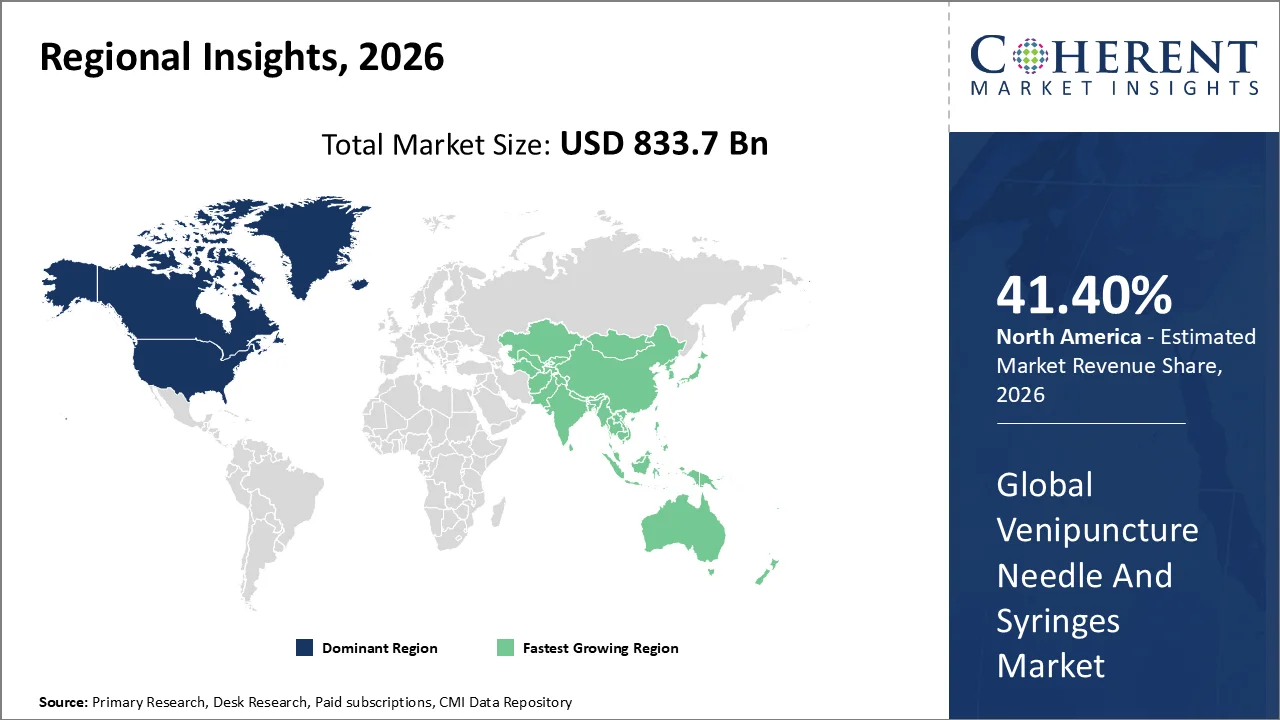
North America dominates owing to increasing vaccination and injectable therapies
North America is expected to acquire the dominant share of 41.40% in 2026. North America’s Venipuncture Needles and Syringes Market grows as healthcare providers expand diagnostic testing and adopt advanced medical technologies. Hospitals and laboratories perform frequent blood collection, increasing demand for reliable venipuncture devices. Rising chronic disease prevalence and an aging population further drive routine blood testing and patient monitoring. By 2040, approximately 20% of the U.S. population is projected to be aged 65 or older, compared with about 12.4% in 2000. Healthcare facilities strengthen infection-control measures and protect workers from needlestick injuries by adopting sterile, single-use, and safety-engineered products. High healthcare spending, strict safety regulations, and continuous product innovation also encourage market expansion across the region.
Asia Pacific Venipuncture Needle And Syringes Market Trends
Asia Pacific’s venipuncture needle and syringe market continues to expand as healthcare providers strengthen infrastructure and increase diagnostic testing and routine blood collection. Population growth, aging demographics, and the rising prevalence of chronic conditions, including diabetes and cardiovascular diseases, are increasing procedure volumes. Governments are also investing in healthcare access, vaccination initiatives, and disease-screening programs, supporting market demand. Growing infection-control awareness encourages healthcare facilities to adopt safety-engineered devices, while expanding domestic medical-device manufacturing further supports regional market development.
United States Venipuncture Needle And Syringes Market Trends
The United States venipuncture needles and syringes market benefits from increasing diagnostic testing, a growing chronic disease burden, and an aging population that requires frequent blood monitoring. Hospitals and laboratories conduct high volumes of tests, sustaining demand for venous blood collection products. Rising blood transfusion needs, expanding outpatient and point-of-care diagnostics, and stronger infection-control practices also drive demand. Furthermore, healthcare facilities increasingly adopt safety-engineered needles and syringes to comply with regulations and reduce needlestick injuries.
China Venipuncture Needle And Syringes Market Trends
China’s venipuncture needle and syringe market continues to expand as healthcare providers develop infrastructure and serve a large, aging population. China has approximately 323 million people aged 60 and above, representing around 23% of the country’s total population. Hospitals and laboratories also drive demand through rising diagnostic procedures, vaccination programs, and medical interventions. Government healthcare initiatives improve access to medical services and encourage product adoption. Meanwhile, manufacturers strengthen the market by expanding domestic production, introducing safety-engineered devices, and improving product technology.
Who are the Major Companies in Venipuncture Needle And Syringes Industry
Some of the major key players in Venipuncture Needle And Syringes are Smiths Medical, Becton, Dickinson and Company, and B. Braun Medical.
Key News
- In July 2025, Magnolia Medical Technologies launched the Steripath Gen2 Initial Specimen Diversion Device with an integrated syringe, enhancing blood-culture contamination prevention for difficult blood draws and syringe-based collection.
Market Report Scope
Venipuncture Needle And Syringes Market Report Coverage
| Report Coverage | Details | ||
|---|---|---|---|
| Base Year: | 2025 | Market Size in 2026: | USD 833.7 Bn |
| Historical Data for: | 2020 To 2024 | Forecast Period: | 2026 To 2033 |
| Forecast Period 2026 to 2033 CAGR: | 5.7% | 2033 Value Projection: | USD 1,234.5 Bn |
| Geographies covered: |
| ||
| Segments covered: |
| ||
| Companies covered: | Smiths Medical, Becton, Dickinson and Company, and B. Braun Medical. | ||
Analyst Opinion
- The strongest demand driver is the sheer frequency of injection-based care, not a temporary healthcare trend. The World Health Organization estimates that at least 16 billion injections are administered globally each year, with roughly 90% used in curative care. In our view, this makes needles and syringes a fundamental consumable rather than a discretionary medical product. The scale of recurring clinical use gives manufacturers a structurally resilient demand base, particularly as healthcare systems increasingly prioritize single-use and infection-control practices.
- Injection safety is shifting purchasing decisions toward higher-value needle and syringe products. WHO estimates that unsafe injection practices were associated with as many as 1.67 million hepatitis B infections, up to 315,120 hepatitis C infections, and as many as 33,877 HIV infections. This evidence strongly supports the transition away from basic commodity devices toward safety-engineered and reuse-prevention products. WHO and UNICEF have specifically recommended the exclusive use of auto-disable and reuse-prevention syringes for immunization programs, reinforcing safety technology as a procurement priority rather than an optional feature.
- China represents an especially compelling recurring-use market because chronic disease management continuously generates injection and blood-collection requirements. The International Diabetes Federation estimates that China had approximately 148 million adults aged 20–79 living with diabetes in 2024, the highest number globally, while nearly 74 million remained undiagnosed. This creates sustained clinical demand for glucose monitoring, injectable therapies, routine blood collection, and related disposable devices. The scale of China’s diabetes population therefore supports recurring utilization rather than one-off procedural demand.
- Vaccination remains an important volume channel, but product differentiation will increasingly determine competitive positioning. China’s national immunization program provides eligible children with vaccines at no cost and protects against 12 vaccine-preventable diseases, creating a large recurring requirement for injection devices. However, suppliers that compete solely on unit price will face greater pressure than manufacturers offering safety-engineered, low-dead-space, auto-disable, or other specialized syringe configurations. The market is consequently moving toward a “safety plus performance” purchasing model rather than a simple volume-driven commodity model.
Speak to the analyst
Want personalized insights?
Take the findings above to one of our principal consultants, or have the report rebuilt around the segments, geographies and competitors you actually track.
Market Segmentation
- By Product (Revenue, USD Bn, 2021-2033)
- Needles
- Syringes
- By Vein Type (Revenue, USD Bn, 2021-2033)
- Cephalic Vein
- Median Cubital Vein
- Basilic Vein
- Others
- By End-User (Revenue, USD Bn, 2021-2033)
- Hospitals
- Diagnostic Laboratories
- Blood Donation Camps
- Others
- By Region (Revenue, USD Bn, 2021-2033)
- North America
- U.S.
- Canada
- Latin America
- Brazil
- Mexico
- Argentina
- Rest of Latin America
- Europe
- Germany
- U.K.
- France
- Italy
- Spain
- Russia
- Rest of Europe
- Asia Pacific
- China
- India
- Japan
- Australia
- South Korea
- ASEAN
- Rest of Asia Pacific
- Middle East
- GCC
- Israel
- Rest of Middle East
- Africa
- South Africa
- Central Africa
- North Africa
Sources
Primary Research Interviews
- Hospital procurement managers
- Phlebotomists and laboratory professionals
- Clinical laboratory directors
- Physicians and nursing professionals
- Medical-device distributors and suppliers
- Blood-bank and diagnostic-center personnel
Databases
- World Health Organization (WHO) Global Health Observatory
- U.S. Centers for Disease Control and Prevention (CDC) databases
- U.S. Food and Drug Administration (FDA) medical-device databases
- National Center for Biotechnology Information (NCBI) databases
- World Bank Health, Nutrition and Population database
- OECD Health Statistics
- UNICEF health and immunization databases
Magazines
- Medical Device Network
- Medical Design & Outsourcing
- MDDI (Medical Device + Diagnostic Industry)
- Healthcare Purchasing News
- Laboratory Equipment
Journals
- Journal of Clinical Laboratory Analysis
- Journal of Hospital Infection
- Clinical Chemistry and Laboratory Medicine
- American Journal of Infection Control
- The Lancet
- BMJ
- Journal of Clinical Nursing
Newspapers
- Reuters
- The New York Times
- The Wall Street Journal
- Financial Times
- The Guardian
- China Daily
Associations
- World Health Organization (WHO)
- Association for the Advancement of Blood & Biotherapies (AABB)
- American Society for Clinical Pathology (ASCP)
- Clinical and Laboratory Standards Institute (CLSI)
- Association for Diagnostics & Laboratory Medicine (ADLM)
- International Federation of Clinical Chemistry and Laboratory Medicine (IFCC)
- International Organization for Standardization (ISO)
Public Domain Sources
- WHO Guidelines on Drawing Blood: Best Practices in Phlebotomy
- WHO Injection Safety Guidelines
- WHO Injection Safety and Infection Prevention resources
- CDC Safe Injection Practices guidance
- NCBI Bookshelf – WHO Guidelines on Drawing Blood
- FDA medical-device and product-safety information
- World Bank healthcare and population datasets
- OECD healthcare statistics
- National health ministry and government healthcare databases
- National immunization and disease-surveillance databases
Proprietary Elements
- CMI Data Analytics Tool
- Proprietary CMI Existing Repository of information for last 10 years
Get access to 250+ pages report
Every segment, forecast, competitor profile and data table behind the analysis above — available for instant download.
- ESOMAR Member
- ISO 9001:2015 Certified
- D-U-N-S Registered
- GDPR & CCPA Compliant
Missing comfort of reading report in your local language? Find your preferred language:
Transform your Strategy with Exclusive Trending Reports
Frequently Asked Questions
The Venipuncture Needle And Syringes Market is anticipated to grow at a CAGR of 5.7% with USD 833.7 Bn in 2026 and is expected to reach USD 1,234.5 Bn in 2033.
The market is primarily driven by rising diagnostic testing, increasing chronic disease prevalence, higher blood-collection volumes, and stronger adoption of sterile and safety-engineered devices.
The Needles segment dominates the market, supported by frequent blood collection, and increasing adoption of single-use and safety-engineered venipuncture needles.
Needles benefit from their extensive use across hospitals, diagnostic laboratories, and blood donation centers. Rising testing requirements for diabetes, cancer, and other chronic conditions further increase recurring demand.
The Cephalic Vein segment holds the leading position because its superficial and accessible anatomical location makes it suitable for peripheral venous access and blood collection.
Hospitals generate substantial demand because they handle high patient volumes and conduct frequent blood collection, diagnostic testing, intravenous procedures, surgeries, and emergency treatments.