

Medical Device Cleaning Market Analysis & Forecast: 2026 to 2033
Medical Device Cleaning Market is estimated to be valued at USD 10.40 Bn in 2026 and is expected to reach USD 19.01 Bn in 2033, exhibiting a compound annual growth rate (CAGR) of 9.0% from 2026 to 2033.
Key Takeaways
- Based on Device, the Critical Medical Devices segment is expected to lead the market at the largest share in 2026, driven by rising surgeries and strict sterilization standards.
- Based on Process, the Disinfections segment is expected to capture 50.4% share in 2026, driven by broad applicability and infection control focus.
- Based on End -user, the Hospitals segment is projected to account for the highest share of the market in 2026, driven by high device volumes and advanced infection control systems.
- Based on Region, North America is set to lead the medical device cleaning market with 35% share in 2026. While, Asia Pacific is anticipated to be the fastest growing region.
Market Overview
The global medical device cleaning market is experiencing strong growth due to the rising hospital-acquired infections (healthcare-associated infections) and increase in patient pool (rise in burden of chronic and/or infectious disease). However, factors such as growing demand for single-use/disposable medical devices and concerns regarding the safety of reprocessed medical devices are expected to hamper the market growth.
Current Events and Its Impacts on the Medical Device Cleaning Market
Current Event | Description and its Impact |
Regulatory Harmonization and Stringency Evolution |
|
Technological Advancement in Cleaning Automation |
|
Advanced Medical Device Cleaning Technologies
- Healthcare-associated infections (HAIs) remain an ongoing issue that affects 7–10% of hospitalized patients around the world. This shows how important it is to have strong medical device cleaning technologies to keep patients safe and stop cross-contamination.
- Automated cleaning systems are changing the game by cutting down on manual reprocessing mistakes by as much as 40%. These systems make it easier to follow international sterilization standards by standardizing cleaning procedures. This greatly improves patient safety outcomes.
- Hospitals that use advanced cleaning technologies have seen a 25% drop in readmissions due to infections. This lowers healthcare costs and makes operations run more smoothly. This shows that better patient care and financial stability can go hand in hand.
- Current Industry Events of 2026
- Market Size Estimation
- Regional Breakdown
- Competitive Landscape
- Customer Intelligence
- Segmental Analysis
- Pricing Analysis
- Key Market Drivers, Challenges & Future Trends
- Customized Insights Section
Segmental Insights
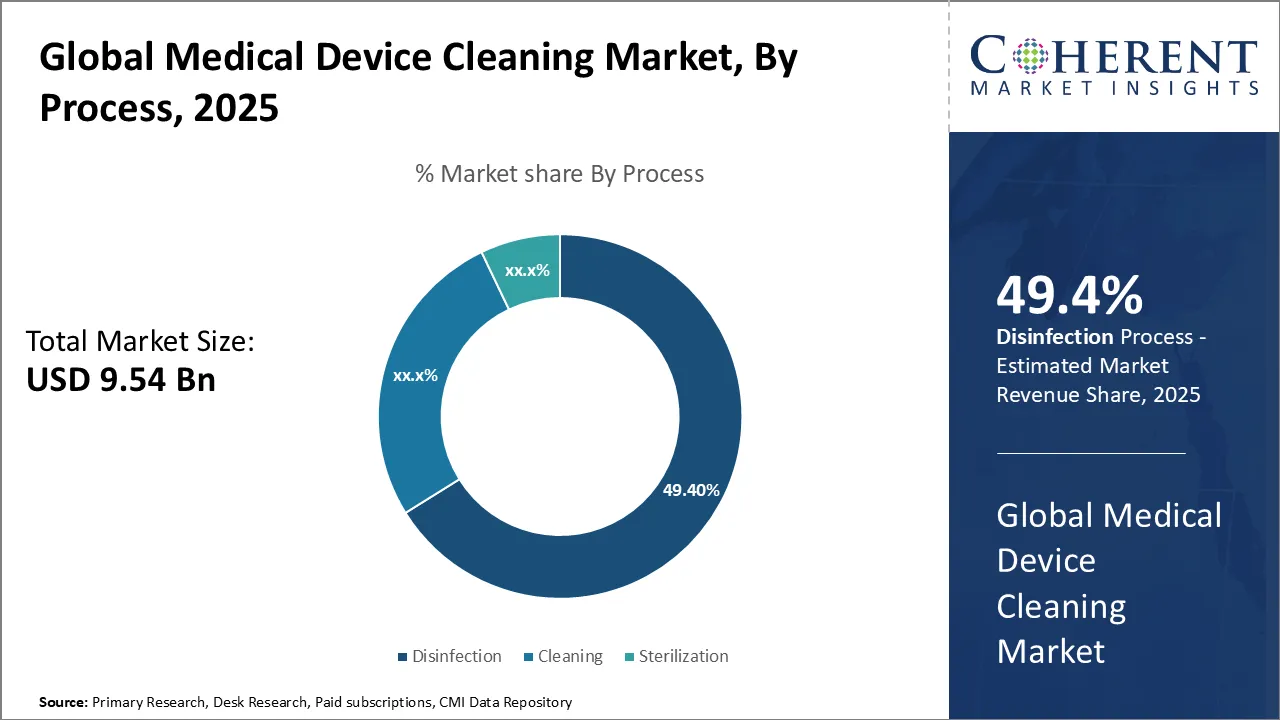
Global Medical Device Cleaning Market Insights, By Process: Disinfection Dominance Is Driven by Broad Applicability and Infection Control Focus
In terms of process, the disinfection segment is expected to hold 50.4% share of the market in 2026. Disinfection is more commonly used than sterilization because it works on a wider range of reusable medical equipment, including semi-critical and non-critical devices.
Chemical disinfectants, automated washer-disinfectors, and UV-based technologies that work well to lower microbial contamination are all part of the process. Because people are more concerned about preventing healthcare-associated infections (HAIs), hospitals, clinics, and diagnostic labs now routinely disinfect. Also, the use of eco-friendly disinfectants and faster, automated systems has made it more popular.
For instance, in June 2025, Geisinger announced that it will be installing the latest disinfection devices in all of its hospitals. This shows that the company is serious about keeping patients safe and preventing infections. The new systems use advanced automated and eco-friendly technologies to help stop infections that happen in hospitals and make cleaning medical devices more efficient. This is in line with trends around the world in hospital disinfection practices.
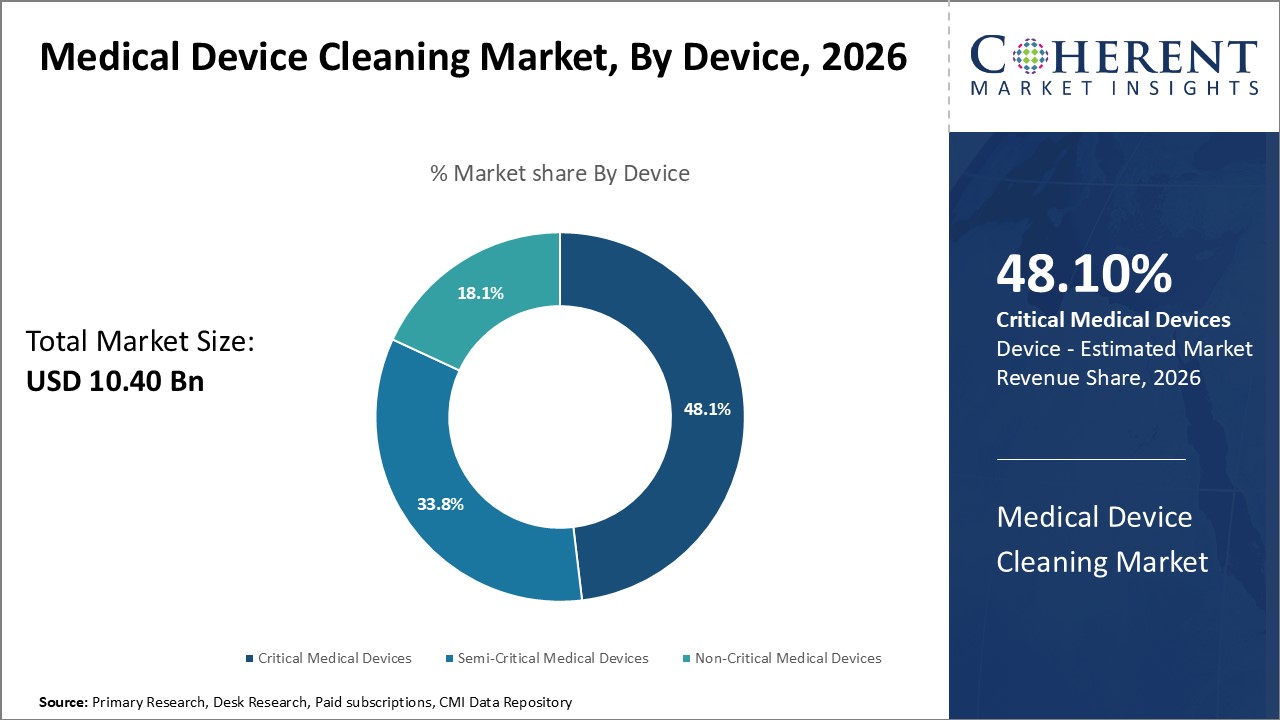
Global Medical Device Cleaning Market Insights, By Device: Critical Medical Devices Lead Is Driven by Rising Surgeries and Strict Sterilization Standards
In terms of device, the critical medical devices segment is expected to lead the market with 2026. These are devices like surgical tools, endoscopes, and other tools that go through sterile tissues or the vascular system. Because they are directly involved in invasive procedures, the risk of infection transmission is very high if cleaning procedures are not followed correctly.
The FDA and WHO, among other regulatory bodies, require strict standards for sterilization and disinfection for these devices. This increases the need for advanced cleaning technologies. This segment is becoming even more dominant because there are more and more surgeries being done around the world and more and more chronic diseases that need invasive treatments.
For instance, in January 2025, Johnson & Johnson released self-sterilizing surgical tools, which is a significant advancement forward in cleaning important medical devices. These new technologies cut down on the need for outside sterilization processes and make hospital workflows more efficient. The launch shows that critical device cleaning is getting better and better, which will help it stay at the top of the global medical device cleaning market in 2025.
Global Medical Device Cleaning Market Insights, By End User: Hospitals Lead Is Driven by High Device Volumes and Advanced Infection Control Systems
In terms of end User, the hospitals segment is projected to account for highest share of the market in 2026. They deal with the most reusable medical devices, from surgical tools to diagnostic tools, so they need strong cleaning and sterilization systems. Most hospitals have separate central sterile services departments (CSSDs) that make sure strict infection control rules are followed.
The growing number of patients, surgeries, and emergencies around the world has made hospitals need better ways to clean. Hospitals also use advanced cleaning technologies like automated sterilizers, ultrasonic cleaners, and AI-driven monitoring systems early on.
for instance, in September 2025, University Hospitals Birmingham rolled out an innovative device for cleaning medical equipment, strengthening infection control and patient safety. The new technology enhances efficiency in reprocessing reusable instruments, supporting hospitals’ central sterile services departments. This launch shows that hospitals are leaders in the market for cleaning medical devices and are dedicated to using cutting-edge solutions for long-term healthcare.
Regional Insights
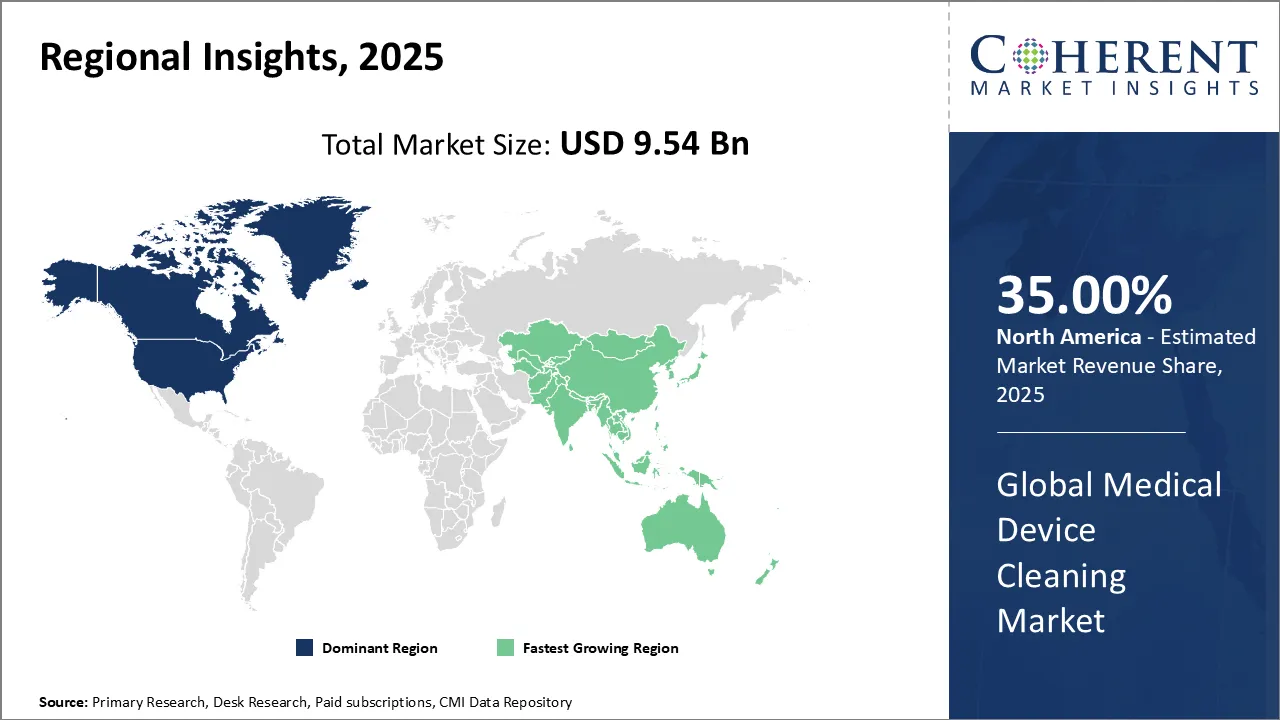
North America Medical Device Cleaning Market Analysis & Trends
North America is expected to gain highest share of 35% in the market in 2026, owing to the rising prevalence of chronic disorders, rising hospital-acquired infections, and increase in demand for medical device cleaning services or solutions in the region. For instance, according to the Center for Diseases Control and Prevention, 5% of all hospital admissions result in a healthcare-associated infection (hospital-acquired infections, or HAIs), culminating in around 722,000 infections and 75,000 deaths each year as well as USD 28 to 33 Bn in excess costs. HAIs are infections people get while they are receiving health care for another condition.
For instance, in February 2026, Chlorine dioxide is now an official part of the new U.S. healthcare standards for sterilants and high-level disinfectants. The addition strengthens infection prevention practices and makes it safer to reprocess reusable medical devices because it is known for its broad antimicrobial effectiveness. This update shows that North America is at the forefront of developing new technologies for cleaning medical devices, which has effects on hospitals and patient safety around the world.
Asia Pacific Medical Device Cleaning Market Analysis & Trends
Asia Pacific is projected to be the fastest growing region, due to healthcare infrastructure is growing rapidly, more surgeries are taking place, and chronic diseases are becoming more common. The region is the fastest-growing market in the world because more people are aware of how to prevent infections, the government is working to improve hospital standards, and people are using new, environmentally friendly cleaning technologies.
For instance, in October 2024, a Japanese logistics company stated that it plans to disinfect medical equipment for hospitals in India. The goal of the program is to improve infection control and promote environmentally friendly reprocessing methods in Asia's rapidly growing healthcare sector. This partnership shows that there is a growing need for professional medical device cleaning services in the Asia-Pacific region.
Medical Device Cleaning Market Outlook Country-Wise
The U.S. Medical Device Cleaning Market Trends
In 2026, the U.S. market for medical devices cleaning is going to be highly competitive considering that there are more hospital-acquired infections, stricter rules, and more reusable instruments being used in surgeries and diagnostics. To meet safety standards, lower the risk of infection, and support sustainability, hospitals and clinics need advanced cleaning and disinfection technologies. This is driving strong market growth.
For instance, in August 2026, MicroCare Medical launched Spec Clean™, a new way to clean surgical tools and medical devices that can be used again and again. The company is based in the United States and wants to make hospital reprocessing more efficient by stopping soils from drying out before sterilization. The new idea helps stop infections and proves beneficial for the environment.
Australia Medical Device Cleaning Market Trends
In 2026, the market for medical devices cleaning in Australia will be exceptionally competitive driven by stricter infection control standards, more surgeries, and more use of reusable instruments. To cut down on infections that happen in hospitals and clinics, they are spending money on new cleaning technologies. Sustainability and following the rules are also driving adoption, which is helping the market grow quickly across the country.
For instance, in September 2026, the University of Queensland demonstrated a small hydrogen peroxide technology that can be made on-site. This gives hospitals and labs a long-lasting way to sterilize things. This new idea improves the cleaning of medical devices by making sure that they are properly disinfected while also making them less dependent on large chemical supplies. It is marketed as eco-friendly and smart, and it improves infection control practices in healthcare facilities in Australia and other countries.
Market Report Scope
Medical Device Cleaning Market Report Coverage
| Report Coverage | Details | ||
|---|---|---|---|
| Base Year: | 2025 | Market Size in 2026: | USD 10.40 Bn |
| Historical Data for: | 2020 To 2024 | Forecast Period: | 2026 To 2033 |
| Forecast Period 2026 to 2033 CAGR: | 9.0% | 2033 Value Projection: | USD 19.01 Bn |
| Geographies covered: |
| ||
| Segments covered: |
| ||
| Companies covered: | 3M, Ecolab, STERIS, Getinge Group, and Cantel Medical, among others. | ||
| Growth Drivers: |
| ||
| Restraints & Challenges: |
| ||
Global Medical Device Cleaning Market Drivers
Rising hospital-acquired infections to drive market growth
One of the key factors expected to propel the growth of the global medical device cleaning market over the forecast period is the rising hospital-acquired infections (healthcare-associated infections) worldwide. For instance, healthcare-acquired infections (HAIs) are infections that people get while receiving treatment at a healthcare facility and/or from a healthcare professional. According to the World Health Organization (WHO), out of every 100 patients in acute-care hospitals, 7 patients in high-income countries, and 15 patients in low- and middle-income countries acquire at least one health care-associated infection (HAI) during their hospital stay.
Rising patient pool to underpin market growth
Another factor which is driving the growth of the global medical device cleaning market is the rise in patient pool (rise in burden of chronic and/or infectious disease) around the world. For instance, with the rise in patient pool or rise in burden of chronic and/or infectious disease, the demand for medical devices is also increasing rapidly, which in turn is exported to increase demand for medical device cleaning services or solutions worldwide. Chronic and/or infectious disease are the leading causes of death and disability across the globe, particularly in low-income countries. This in turn is expected to augment the growth of the market.
Global Medical Device Cleaning Market Opportunities
Increasing number of surgical procedures across the globe is expected to offer significant growth opportunities for players in the global medical device cleaning market. For instance, an increasing number of surgeries boost the need for cleaning of devices used during the surgery, which in turn, is expected to augment the growth of the market. According to the National Institutes of Health, more than 310 million major surgeries are performed each year around the world; around 40-50 million in the United States and 20 million in Europe. The geriatric population is more vulnerable to various diseases, leading to an increase in the number of surgeries.
Global Medical Device Cleaning Market Trends
Demand for effective cleaning solutions is a recent trend
Increasing prevalence of chronic diseases and rise in burden of HAIs, as well as a growing geriatric population and growing number of surgeries, are increasing the demand for safe/effective cleaning and disinfection services or solutions. These services or solutions are widely used to clean/disinfect surgical equipment or instruments. This in turn is expected to drive growth of the market, and this trend is expected to continue during the forecast period.
Increasing healthcare expenditure is another trend
Public pressure to improve the quality of hospital care, increasing number of hospitals and clinics, increasing cost of HAIs in healthcare systems, emergence of multidrug-resistance microorganism, and favorable government initiatives or support are playing an important role in the growth of the global medical device cleaning market. This in turn is expected to propel the growth of the market, and this trend is also expected to continue over the forecast period.
Analyst Opinion (Expert Opinion)
The medical devices cleaning market value is evolving in a big way because of stricter global reprocessing standards, the growth of surgical and endoscopic procedures, and the quick shift toward automated, validated cleaning technologies. Published research consistently indicates a multi-billion-dollar global market; however, reported totals vary significantly due to differences in scope, some studies include only cleaning equipment, while others incorporate consumables and service contracts. This difference shows how important it is to have clear definitions of market boundaries when making predictions or comparisons.
The most important type of product is still automated washer-disinfectors. This is because they have a high throughput, a consistent cleaning performance, and the detailed documentation needed to meet regulatory requirements. Consumables like enzymatic detergents, neutralizers, and specialty chemistries make up a strong base of recurring revenue. Vendors are also more and more often pairing equipment with proprietary chemistries to lock in lifecycle value. Reports show that as the number of procedures in orthopedics, cardiology, and gastrointestinal endoscopy goes up, so does the need for more automated cleaning capacity.
North America has the highest rate of adoption of validated systems because of strong regulatory oversight. Asia-Pacific, on the other hand, is growing the fastest because of improvements in hospital infrastructure and more surgical cases.
In general, the market is moving toward more automation, validated workflows, and integration of chemistry equipment. This is good for companies that offer end-to-end reprocessing solutions and long-term service models.
Speak to the analyst
Want personalized insights?
Take the findings above to one of our principal consultants, or have the report rebuilt around the segments, geographies and competitors you actually track.
Global Medical Device Cleaning Market: Key Developments
- In September 2025, Aston University and PFE Medical teamed up to make a new endoscope cleaning product that will make it easier to clean complex reusable devices. Endoscopes are very important for diagnosing problems, but they are very hard to clean, which can lead to infections. This innovation strengthens hospital infection control, ensuring safer patient care and advancing the medical device cleaning market in the UK and beyond.
- In October 2025, Ensera opened its doors, offering new ways to clean and reprocess medical devices. The company is based in Ireland and has operations in North America, Europe, and Asia. It focuses on using automated, environmentally friendly technologies to improve hospital infection control. Ensera is a major player in promoting environmentally friendly practices in the medical device cleaning.
- In November 2023, Ethos®, an automated ultrasound probe cleaner and disinfectant, been cleared by the FDA. Ethos cleans and disinfects endocavity and surface probes at a high level, making reprocessing easier. The new idea cuts down on manual labor, improves infection control, and helps hospitals and diagnostic labs meet strict safety standards.
Market Segmentation
- Global Medical Device Cleaning Market, By Device (Revenue, USD Bn, 2021 - 2033)
- Semi-critical Medical Devices
- Critical Medical Devices
- Non-critical Medical Devices
- Global Medical Device Cleaning Market, By Process (Revenue, USD Bn, 2021 - 2033)
- Cleaning
- Disinfection
- Sterilization
- Global Medical Device Cleaning Market, By End User (Revenue, USD Bn, 2021 - 2033)
- Hospitals
- Clinics & Physician Offices
- Diagnostic Laboratories
- Stand-alone Reprocessing Facilities
- Others
- Global Medical Device Cleaning Market, By Geography (Revenue, USD Bn, 2021 - 2033)
- North America
- U.S.
- Canada
- Latin America
- Brazil
- Argentina
- Mexico
- Rest of Latin America
- Europe
- Germany
- U.K.
- Spain
- France
- Italy
- Russia
- Rest of Europe
- Asia Pacific
- China
- India
- Japan
- Australia
- South Korea
- ASEAN
- Rest of Asia Pacific
- Middle East & Africa
- GCC Countries
- Israel
- Rest of Middle East & Africa
- North America
- Key Companies Insights (Revenue, USD Bn, 2021 - 2033)
- 3M
- Ecolab
- STERIS
- Getinge Group
- Cantel Medical
Sources
Primary Research Interviews
- Hospital Sterile Processing / Central Sterile Services Departments (CSSD)
- Medical Device Manufacturers (surgical instruments, implants, endoscopes)
- Endoscope & Reprocessing Specialists
- Clinical/Healthcare Infection Control Officers
- Biomedical / Clinical Engineering Teams
- Contract Sterilization & Medical Device Reprocessing Providers
- Dental & Outpatient Clinic Sterilization Managers
- Clinical Microbiologists & Laboratory Managers
- Healthcare Procurement & Supply Chain Managers
- Distributors / Aftermarket Service Providers
- Regulatory & Compliance Consultants
- Others
Databases
- Bloomberg Terminal
- Thomson Reuters Eikon
- IHS Markit
- Euromonitor International
- S&P Global Market Intelligence
- Clarivate Analytics (Web of Science, Derwent)
- PubMed / MEDLINE (database access)
- Others
Magazines
- Medical Device + Diagnostic Industry (MD+DI)
- Infection Control Today
- Healthcare Hygiene / Healthcare Purchasing News
- Sterile Processing Journal (trade magazine)
- Medical Device Network
- Others
Journals
- Journal of Hospital Infection
- American Journal of Infection Control (AJIC)
- Journal of Clinical Microbiology
- Journal of Medical Devices (ASME / device engineering)
- Journal of Applied Microbiology
- Others
Newspapers
- Financial Times
- The Wall Street Journal
- Reuters
- Bloomberg News
- Others
Associations
- Association for the Advancement of Medical Instrumentation (AAMI)
- Association for Professionals in Infection Control and Epidemiology (APIC)
- ECRI Institute
- European Centre for Disease Prevention and Control (ECDC)
- International Society for Infection Prevention and Control (ISIPC) / International Federation of Infection Control (IFIC)
- Others
Public Domain Sources
- U.S. Food & Drug Administration (FDA) – device guidance & recalls
- U.S. Centers for Disease Control & Prevention (CDC) – reprocessing & HAI guidance
- World Health Organization (WHO) – infection prevention resources
- European Medicines Agency (EMA) – device safety communications
- NHS England / NHS Improvement – reprocessing standards and audits
- OECD Health Data / World Bank Health Data
- Others
Proprietary Elements
- CMI Data Analytics Tool
- Proprietary CMI Existing Repository of Information for the Last 8 Years
Definition: Medical device cleaning services or solutions are used to remove contaminants (e.g., dirt, pathogens, organic material, and other contaminants) from a device and is usually done with detergent or enzyme liquid and by using other cleaning methods.
Get access to 250+ pages report
Every segment, forecast, competitor profile and data table behind the analysis above — available for instant download.
- ESOMAR Member
- ISO 9001:2015 Certified
- D-U-N-S Registered
- GDPR & CCPA Compliant
Missing comfort of reading report in your local language? Find your preferred language:
Transform your Strategy with Exclusive Trending Reports
Frequently Asked Questions
The Medical Device Cleaning Market is estimated to be valued at USD 10.40 Bn in 2026, and is expected to reach USD 19.01 Bn by 2033.
The CAGR of the Medical Device Cleaning Market is projected to be 9.0% from 2026 to 2033.
Rising hospital-acquired infections (healthcare-associated infections) and rise in patient pool (rise in burden of chronic and/or infectious disease) is fueling the growth of the market.
Disinfection segment is the leading process segment in the market.
Growing demand for single-use/disposable medical devices and concerns regarding the safety of reprocessed medical devices are major factors restraining the market.
Major players operating in the market are 3M, Ecolab, STERIS, Getinge Group, and Cantel Medical, among others.