

White Spirits Market Size and Trends
White spirits market is estimated to be valued at USD 7.14 Bn in 2026 and is expected to reach USD 9.71 Bn by 2033, exhibiting a compound annual growth rate (CAGR) of 4.5% from 2026 to 2033.
Key Takeaways
- Based on Material, the Type 0 segment dominates the global white spirits market, holding an estimated market share of 57.9% in 2026, owing to its superior performance characteristics.
- Based on Flash point, the Low Flash Point segment leads the market, contributing 33% share in 2026, owing to its enhanced safety benefits over other options.
- Based on Application, the Paint thinner segment captures the largest share, accounting for 29.7% of the market in 2026, owing to its excellent solvency properties.
- Based on Region, Asia Pacific is expected to lead the market, holding a share of 48.2% in 2026. While, Europe is anticipated to be the fastest growing region during the forecast period.
Market Overview
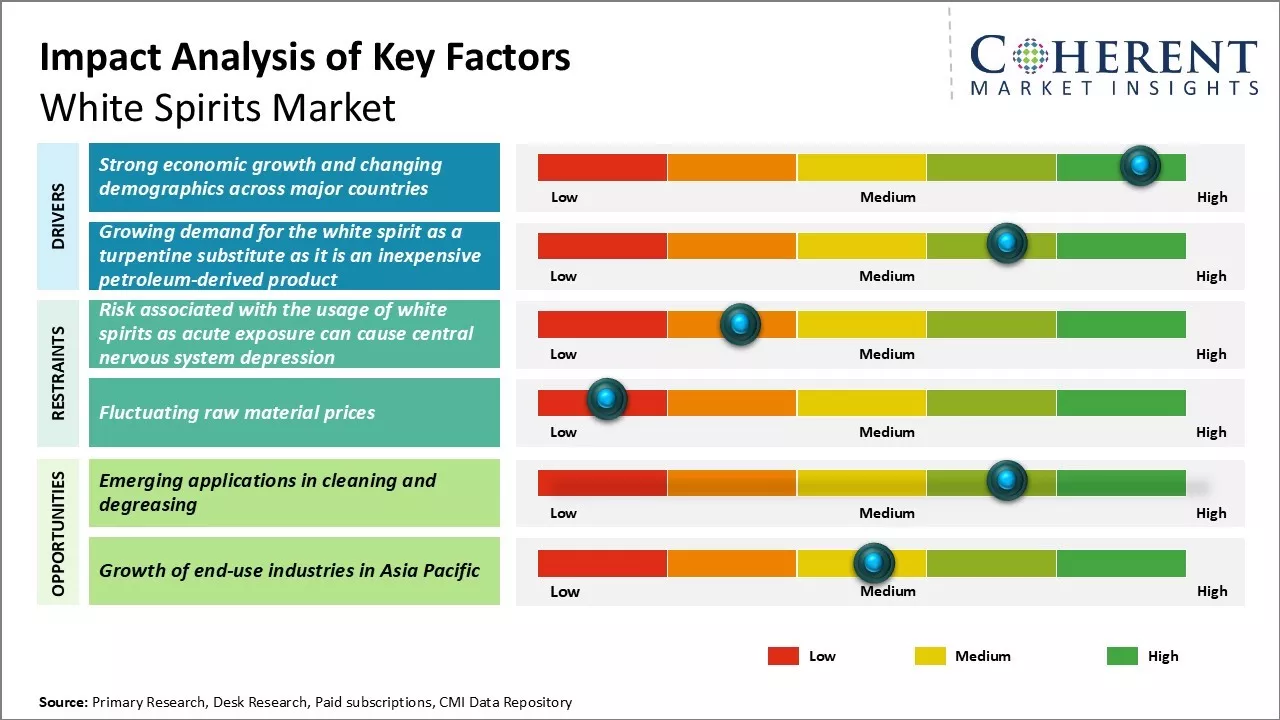
The white spirits market demand is driven by rising consumption of white spirits in paints, coatings, and other applications. Increasing construction activities, along with rapid industrialization in developing nations of the Asia Pacific, can also drive the market growth. Moreover, changing preference towards eco-friendly solvents from hazardous organic compounds can provide growth opportunities to the players. However, stringent environmental regulations regarding VOC emissions and the availability of substitutes can hamper the market growth.
Current Events and their Impact on the White Spirits Market
Current Event | Description and Its Impact |
Crude/refining dynamics and capacity availability |
|
Regulatory and environmental policy shifts |
|
Price Analysis
The global white spirit market has experienced notable price fluctuations from 2023 to 2025, driven by raw material costs, regional demand, and environmental regulations. In 2023, European industrial-grade white spirit was priced at approximately €930 per metric ton. By 2024, a 20-liter container in the UK ranged between £30 and £55 (around $37–$68 USD), while in the United States, a 1-liter bottle of artist-grade white spirit cost $33.69, and a 750ml bottle was available for $2.98. In the Asia-Pacific region, industrial-grade white spirit in India ranged from ₹250 to ₹600 per liter depending on purity and supplier, and in Ukraine, prices were approximately UAH 85–150 per liter, influenced by local production and demand.
- Current Industry Events of 2026
- Market Size Estimation
- Regional Breakdown
- Competitive Landscape
- Customer Intelligence
- Segmental Analysis
- Pricing Analysis
- Key Market Drivers, Challenges & Future Trends
- Customized Insights Section
Segmental Insights
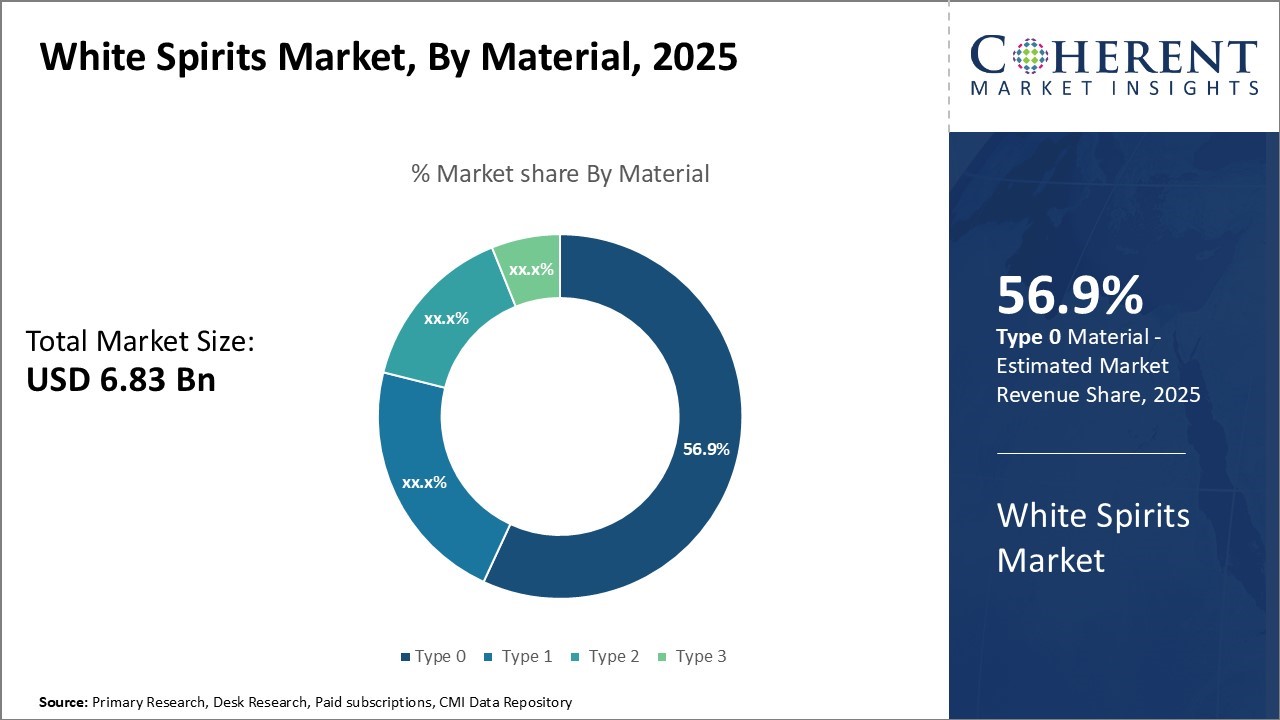
White Spirits Market Insights, By Material: Superior Performance Boosts Demand for Type 0 Material
In terms of material, the type 0 segment is estimated to contribute the highest market share of 57.9% in 2026, owing to its superior performance characteristics. Type 0 white spirit, also known as industrial spirit, has a low aromatic content and extremely low reactivity, making it suitable for a wide variety of industrial applications. Its chemical inertness allows it to act as an effective solvent, thinner, and cleaner without causing any unwanted chemical reactions. This purity and stability provide type 0 white spirit a significant advantage over other materials.
For instance, in September 2024, HighChem Co., Ltd. Collaborated with Shenzhen Prechem New Materials Co., Ltd., to introduce the high-performance solvent EEP (Ethyl 3-ethoxypropionate) in Japan this fall. Widely used as an industrial spirit or industrial solvent in automotive and industrial applications, EEP offers a high boiling point, strong dissolving power, and slow volatility, making it ideal for painting.
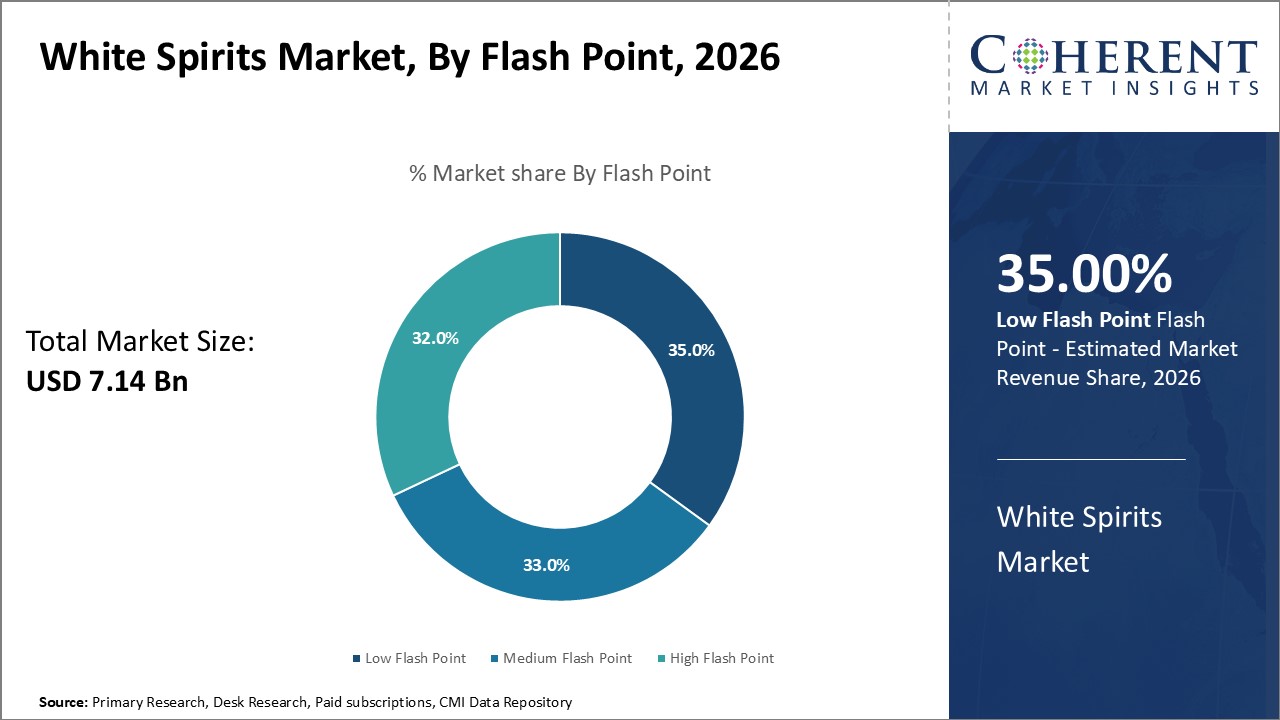
White Spirits Market Insights, By Flash Point: Safety Makes Low Flash Point Variant Predominate
In terms of flash point, the low flash point segment is estimated to contribute the highest market share of 33% in 2026, owing to its enhanced safety benefits over other options. White spirit with a low flash point of around 24°C offers crucial advantages in industrial processing and storage environments. Its higher ignition temperature reduces flammability risks significantly as compared to medium and high flash point grades.
Low-flash-point white spirit is used as a cleaning solvent in industrial painting and surface finishing applications. The low flash point allows these activities to be carried out safely even in confined spaces like inside fuel tanks and engine components. Low-flash-point white spirit is also widely utilized as a cleaner in industrial processes like metal degreasing, parts washing, and electronics manufacturing.
For instance, Esti Chem offers ESTISOL 163, a low flash points white spirit alternative, which is utilized in metal degreasing and parts washing. This product is designed to evaporate quickly, facilitating efficient cleaning processes while maintaining safety standards.
White Spirits Market Insights, By Application: Paint Thinner Dominates Due to Versatile Solvency
In terms of application, the paint thinner segment is estimated to contribute 29.7% market share in 2026, owing to its excellent solvency properties. As an oil-based solvent, white spirit displays strong solvency abilities towards cured alkyd, polyurethane, and epoxy paints without reacting with the polymers. This allows it to smoothly break down paint films for stripping or maintenance work.
For instance, in March 2026, the General Company for Mining Industries, under the Ministry of Industry and Minerals, reported that a new solvent production facility in Salah al-Din province has reached 85% completion. Developed in collaboration with the private sector and adhering to global standards, the plant is slated to produce 1,000 tonnes per day of white spirit, a solvent commonly used as a paint thinner and cleaning agent.
Regional Insights
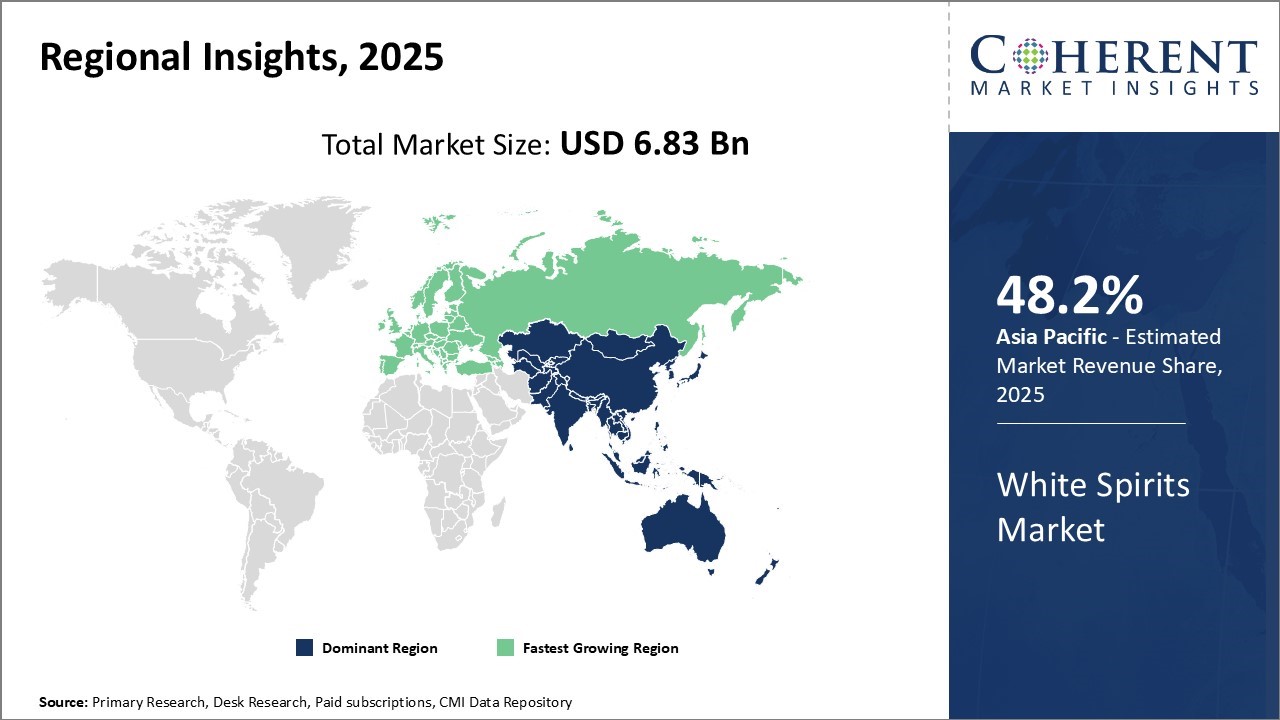
Asia Pacific White Spirits Market Analysis & Trends
The white spirits market is anticipated to be dominated by Asia Pacific, with a projected 48.2% market share in 2026. This dominance is fueled by the region’s strong downstream industries, particularly paints, coatings, and chemicals, in major markets such as China and India. Rapid urbanization and large-scale construction projects, including India’s plan to invest around $1.3 trillion over the next seven years to build 60 million new homes, are significantly boosting demand for architectural coatings where white spirit is widely used as a thinning and cleaning agent.
In China, Paints and coatings giant Jotun has signed a letter of intent to invest $200 million in a new high-performance coating production plant in Jiangsu province’s Zhangjiagang Bonded Zone, aiming for an annual capacity of 200,000 metric tons. With the Asia-Pacific paints and coatings market valued at over $89 billion and dominated by China, the demand for white spirits is set to rise steadily, supported by robust economic growth, expanding housing needs, and continuous industrial investments across the region.
Europe White Spirits Market Analysis & Trends
Europe region exhibits the fastest growth, led by countries such as Germany, and U.K. Germany’s chemical sector, generating €218 billion in 2023, fuels regional solvent supply, with government-backed subsidies aiming to support energy-intensive industries. The UK’s manufacturing activity recently hit a 26-month high, while its chemical sector returned to growth in early 2024. Both countries are advancing sustainable coatings and green chemistry initiatives, aligning with EU environmental goals and boosting demand for high-performance, eco-friendly solvent systems.
White Spirits Market Outlook for Key Countries
The U.S. White Spirits Market Trends
The U.S. white spirits market is dominated by multinationals like ExxonMobil, Shell, and TotalEnergies, backed by strong global supply chains and capacity expansions. For instance, in February 2024, The United States produced an unprecedented 13.5 million barrels of crude oil per day, setting a national and possibly global record. Meanwhile, India is emerging as a key hub, with companies like Bharat Petroleum and Indian Oil adopting low-VOC formulations and expanding production. Projects like Hindustan Petroleum’s Barmer refinery highlight India’s growing role in the global supply chain.
China White Spirits Market Trends
China is a leading global producer of white spirits, supported by strong end-use industries like paints, coatings, automotive, and construction. The country’s manufacturing base drives both domestic use and significant exports to markets such as Vietnam, the U.S., and Russia. Producers are upgrading facilities to meet stricter quality standards and develop low-VOC variants, aligning with global environmental trends. This combination of high demand and improved production capabilities cements China’s position as a key supplier worldwide.
For instance, in May 2026, Shenzhen city unveiled a draft standard aimed at reducing volatile organic compound (VOC) content in cleaning agents used within the electronics assembly sector, imposing hazardous-chemical limits to address air quality and occupational safety concerns.
India White Spirits Market Trends
India is set to lead South Asia’s white spirits market growth, driven by a strong manufacturing push and infrastructure expansion. Recent developments include Safex Chemicals’ new Bharuch, Gujarat facility, boosting local production and supply. Gujarat remains the country’s chemical hub, contributing 46% of exports in FY 2024–25, supported by robust infrastructure and compliance systems. Initiatives like Petroleum, Chemicals, and Petrochemicals Investment Regions (PCPIRs) and government programs such as “Make in India” and “Atmanirbhar Bharat” are attracting investments, enhancing capacity, and positioning India as a key white spirits production and export hub in the region.
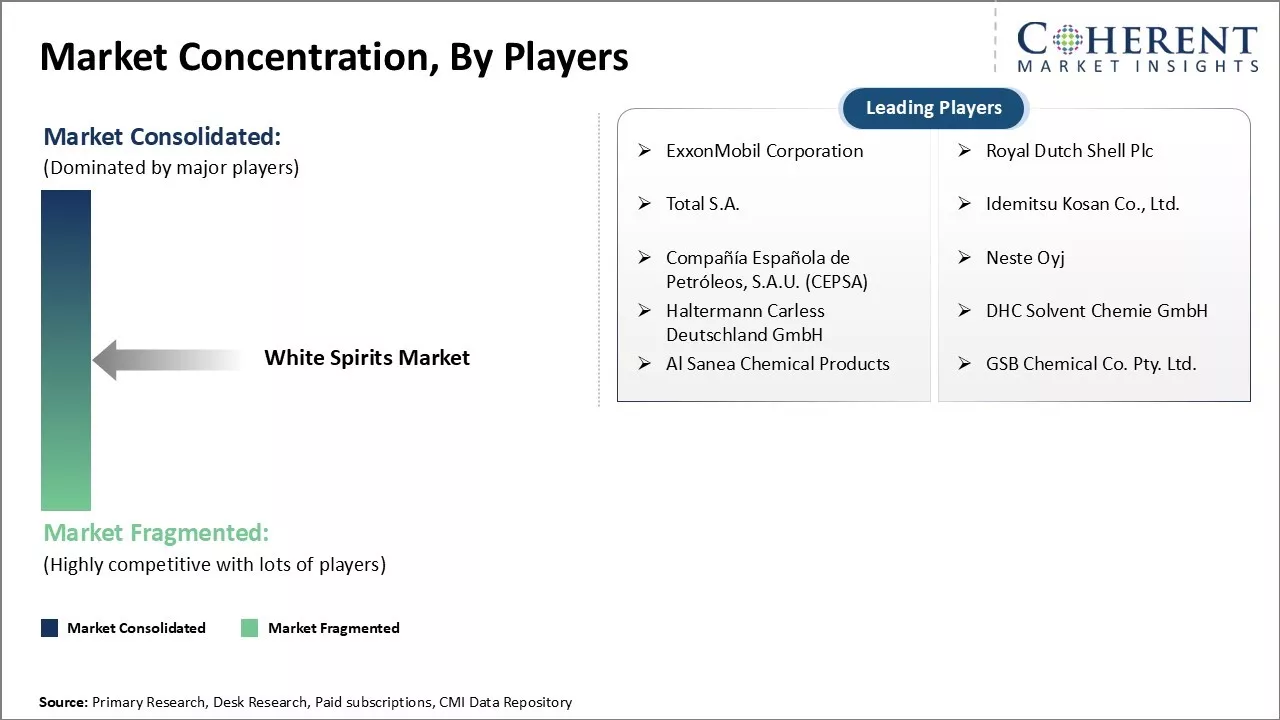
Market Concentration and Competitive Landscape
White Spirits Industry News
- In December 2022, ExxonMobil announced its five-year corporate plan, which features a considerable increase in investments aimed at reducing emissions and supporting lower-emission projects including its Low Carbon Solutions division. By 2027, the plan aims to sustain annual capital expenditures between USD 20-25 billion, while boosting investments in lower-emission initiatives to approximately USD 17 billion. ExxonMobil Corporation is a prominent American multinational oil and gas company, recognized as the largest direct descendant of John D. Rockefeller's Standard Oil.
- In July 2022, Adnoc Distribution , UAE's petroleum and retail distributor, announced its acquisition of a 50% stake in TotalEnergies Marketing Egypt for about USD 186 million. It entered into a supply agreement for white spirit with Adnoc, and this can enhance the company's market share over time.
Analyst Opinion (Expert Opinion)
The white spirits market value is undergoing a gradual yet discernible transformation, driven by evolving regulatory landscapes, shifting end-use dynamics, and an increasing emphasis on performance optimization in paints, coatings, and industrial applications. While traditionally dominated by solvent-based paint formulations, the segment’s growth trajectory is now significantly influenced by tightening VOC emission norms in regions such as the EU and North America, which has led to a pronounced shift toward low-aromatic and dearomatized grades. According to the European Chemicals Agency, low-aromatic white spirits with aromatic content below 2% have witnessed a double-digit increase in adoption across professional coatings over the past five years, reflecting a clear pivot toward compliance-driven demand.
Industrial cleaning remains a resilient application area, particularly in emerging economies where white spirits’ cost-efficiency and solvency power continue to outweigh environmental concerns. For instance, in Southeast Asia, the use of Type 3 white spirits in metal degreasing has grown steadily, supported by the expansion of automotive component manufacturing hubs in Indonesia and Thailand. Similarly, the Middle East has seen robust usage in oilfield maintenance, leveraging white spirits’ efficacy in dissolving heavy hydrocarbon residues, especially in upstream operations.
The long-term outlook hinges on the industry’s ability to align with environmental compliance without compromising performance benchmarks. Regions with active regulatory enforcement and high industrial innovation are expected to drive specialty-grade development, whereas cost-sensitive markets will likely remain dominated by conventional products. As such, strategic positioning—balancing compliance, cost, and performance will be the determining factor for competitive advantage in the next phase of market evolution.
Speak to the analyst
Want personalized insights?
Take the findings above to one of our principal consultants, or have the report rebuilt around the segments, geographies and competitors you actually track.
Market Report Scope
White Spirits Market Report Coverage
| Report Coverage | Details | ||
|---|---|---|---|
| Base Year: | 2025 | Market Size in 2026: | USD 7.14 Bn |
| Historical Data for: | 2020 To 2024 | Forecast Period: | 2026 To 2033 |
| Forecast Period 2026 to 2033 CAGR: | 4.5% | 2033 Value Projection: | USD 9.71 Bn |
| Geographies covered: |
| ||
| Segments covered: |
| ||
| Companies covered: | ExxonMobil Corporation, Royal Dutch Shell Plc, Total S.A., Idemitsu Kosan Co., Ltd., Compañía Española de Petróleos, S.A.U. (CEPSA), Neste Oyj, Haltermann Carless Deutschland GmbH, DHC Solvent Chemie GmbH, Al Sanea Chemical Products, and GSB Chemical Co. Pty. Ltd. | ||
| Growth Drivers: |
| ||
| Restraints & Challenges: |
| ||
White Spirits Market Driver
Strong economic growth and changing demographics across major countries
Global economy has been steadily growing over the past few years, with many emerging and developing nations experiencing notably high GDP growth rates. Countries such as India and several Southeast Asian countries continue to urbanize at a rapid pace as their populations shift towards cities for employment and lifestyle opportunities. This high economic activity fueled by expanding populations has boosted infrastructure development across sectors. For instance,iIn April 2023, according to the World bank Population Division estimated that two-thirds of the global population will be living in urban centers by 2050. This increased population density and creation of new residential and commercial developments necessitate ongoing refurbishment and renovations, catapulting the paints and coatings industry and supporting white spirits demand.
Market Segmentation
- By Material Insights (Revenue, USD Bn, 2026 - 2033)
- Type 0
- Type 1
- Type 2
- Type 3
- By Flash Point Insights (Revenue, USD Bn, 2026 - 2033)
- Low Flash Point
- Medium Flash Point
- High Flash Point
- By Application Insights (Revenue, USD Bn, 2026 - 2033)
- Paint Thinner
- Cleansing Agent
- Degreasing Agent
- Fuel
- Disinfectant
- Other
- By Regional Insights (Revenue, USD Bn, 2026 - 2033)
- North America
- U.S.
- Canada
- Latin America
- Brazil
- Argentina
- Mexico
- Rest of Latin America
- Europe
- Germany
- U.K.
- Spain
- France
- Italy
- Russia
- Rest of Europe
- Asia Pacific
- China
- India
- Japan
- Australia
- South Korea
- ASEAN
- Rest of Asia Pacific
- Middle East
- GCC Countries
- Israel
- Rest of Middle East
- Africa
- South Africa
- North Africa
- Central Africa
- North America
- Key Players Insights (Revenue, USD Bn, 2021 - 2033)
- ExxonMobil Corporation
- Royal Dutch Shell Plc
- Total S.A.
- Idemitsu Kosan Co., Ltd.
- Compañía Española de Petróleos, S.A.U. (CEPSA)
- Neste Oyj
- Haltermann Carless Deutschland GmbH
- DHC Solvent Chemie GmbH
- Al Sanea Chemical Products
- GSB Chemical Co. Pty. Ltd.
Sources
Primary Research Interviews from the following stakeholders
Stakeholders
- Interviews with solvent manufacturers, paint and coatings producers, cleaning chemical formulators, industrial maintenance contractors, automotive refinishing professionals, and procurement heads in global markets.
Specific Stakeholders
- Procurement managers at leading paint and coatings companies (e.g., Asian Paints, Sherwin-Williams, Akzo Nobel)
- Operations heads at industrial cleaning and degreasing service providers
- Raw material sourcing managers in adhesives and sealants manufacturing units
- Plant managers in automotive refinishing workshops and OEM aftersales service centers
- R&D chemists and formulation experts in chemical blending companies
- Packaging and logistics managers at petrochemical distribution hubs
- Safety and compliance officers in manufacturing units using white spirits for process cleaning and surface preparation
Databases
- World Trade Organization (WTO) Trade Statistics
- UN Comtrade Database
- U.S. Energy Information Administration (EIA)
- Eurostat
- China Customs Statistics
- Korea Customs Service Data Portal
- Japan External Trade Organization (JETRO)
- Directorate General of Commercial Intelligence and Statistics (DGCIS), India
- U.S. International Trade Commission (USITC)
- Organisation for Economic Co-operation and Development (OECD) – Chemicals and Environment Data
Magazines
- Paint & Coatings Industry Magazine (PCI)
- Coatings World
- European Coatings Journal
- Chemical Weekly
- Industrial Maintenance & Plant Operation
- Petrochemicals & Chemicals Review
- BIC Magazine (Business & Industry Connection – Industrial & Petrochemical section)
Journals
- Journal of Coatings Technology and Research
- Progress in Organic Coatings (Elsevier)
- Journal of Cleaner Production
- Surface Coatings International Part B Coatings Transactions
- Industrial & Engineering Chemistry Research
- Journal of Hazardous Materials
- Journal of Occupational and Environmental Hygiene
Newspapers
- The Wall Street Journal – Chemicals & Energy
- The Economic Times – Industry & Chemicals
- The Hindu Business Line – Manufacturing & Petrochemicals
- Financial Times – Energy and Chemical Industry Reports
- Nikkei Asia – Petrochemicals & Supply Chain
- Gulf News – Oil & Gas and Industrial Sectors
Associations
- American Coatings Association (ACA)
- European Council of the Paint, Printing Ink and Artists’ Colours Industry (CEPE)
- Indian Paint Association (IPA)
- The National Petrochemical Industrial Company (Saudi Arabia)
- Paint Manufacturers Association of Canada (PMAC)
- Federation of Indian Chambers of Commerce & Industry (FICCI) – Chemicals Division
- Gulf Petrochemicals and Chemicals Association (GPCA)
Public Domain Sources
- Ministry of Chemicals and Fertilizers (Government of India)
- National Institute of Standards and Technology (NIST), U.S. – Chemicals Standards
- Ministry of Economy, Trade and Industry (METI), Japan – Chemicals Data
- U.S. Environmental Protection Agency (EPA) – Solvent and VOC Regulations
- Central Pollution Control Board (CPCB), India – Hazardous Chemicals Guidelines
- European Chemicals Agency (ECHA) – White Spirit Classification and Regulation
- Reserve Bank of India (RBI) – Industrial Sector Reports
- India Petrochemicals Portal – Ministry of Petroleum & Natural Gas
Proprietary Elements
- CMI Data Analytics Tool, and Proprietary CMI Existing Repository of information for last 8 years
Get access to 250+ pages report
Every segment, forecast, competitor profile and data table behind the analysis above — available for instant download.
- ESOMAR Member
- ISO 9001:2015 Certified
- D-U-N-S Registered
- GDPR & CCPA Compliant
Missing comfort of reading report in your local language? Find your preferred language:
Transform your Strategy with Exclusive Trending Reports
Frequently Asked Questions
The White Spirits Market is estimated to be valued at USD 7.14 Bn in 2026, and is expected to reach USD 9.71 Bn by 2033.
The CAGR of the White Spirits Market is projected to be 4.5% from 2026 to 2033.
Strong economic growth and changing demographics across major countries and growing demand for the white spirit as a turpentine substitute as it is an inexpensive petroleum-derived product are the major factors driving the market growth.
Risk associated with the usage of white spirits as acute exposure can cause central nervous system depression and fluctuating raw material prices are the major factors hampering the market growth.
In terms of material, type 0 segment is estimated to dominate the market in 2026.
ExxonMobil Corporation, Royal Dutch Shell Plc, Total S.A., Idemitsu Kosan Co., Ltd., Compañía Española de Petróleos, S.A.U. (CEPSA), Neste Oyj, Haltermann Carless Deutschland GmbH, DHC Solvent Chemie GmbH, Al Sanea Chemical Products, and GSB Chemical Co. Pty. Ltd. are the major players.
Asia Pacific is expected to lead the white spirits market in 2026.