

X Ray Detectors Market Size and Forecast — 2026 - 2033
The global X-Ray Detectors market is forecast to grow from about USD 4.0 Bn in 2026 to around USD 6.43 Bn by 2033, expanding at a CAGR of approximately 5.95 % between 2025 and 2033. Growth is driven by rising medical imaging demand and digital adoption.
Overview
X-ray detectors are devices that convert X-ray radiation into visible light or electrical signals to create diagnostic or analytical images. They are widely used in medical imaging, dental diagnostics, mammography, security screening, industrial inspection, and scientific research. The main types include flat-panel detectors (FPDs), computed radiography (CR) detectors, and line-scan detectors. Modern digital detectors offer higher image quality, faster processing, lower radiation dose, and improved workflow efficiency compared to traditional film systems. Technologies such as amorphous silicon, CMOS, and cesium iodide scintillators enhance sensitivity and resolution. Growing demand for advanced imaging systems continues to drive innovation in detector performance and portability.
Key Takeaways
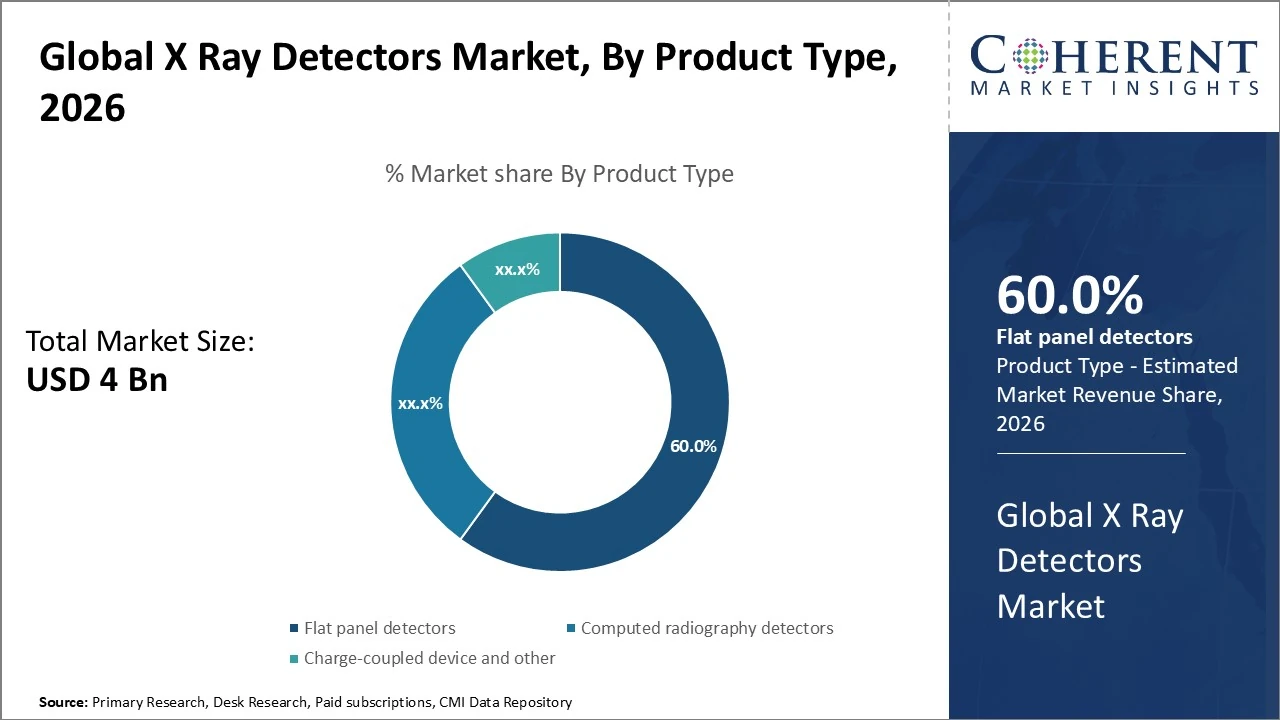
The X-Ray Detectors market is dominated by Flat panel detectors, holding the largest share of about 60 % of the product type segment.
In the global X-Ray Detectors market, Hospitals and diagnostic centers are the leading end users, generating about 67 % of total revenue.
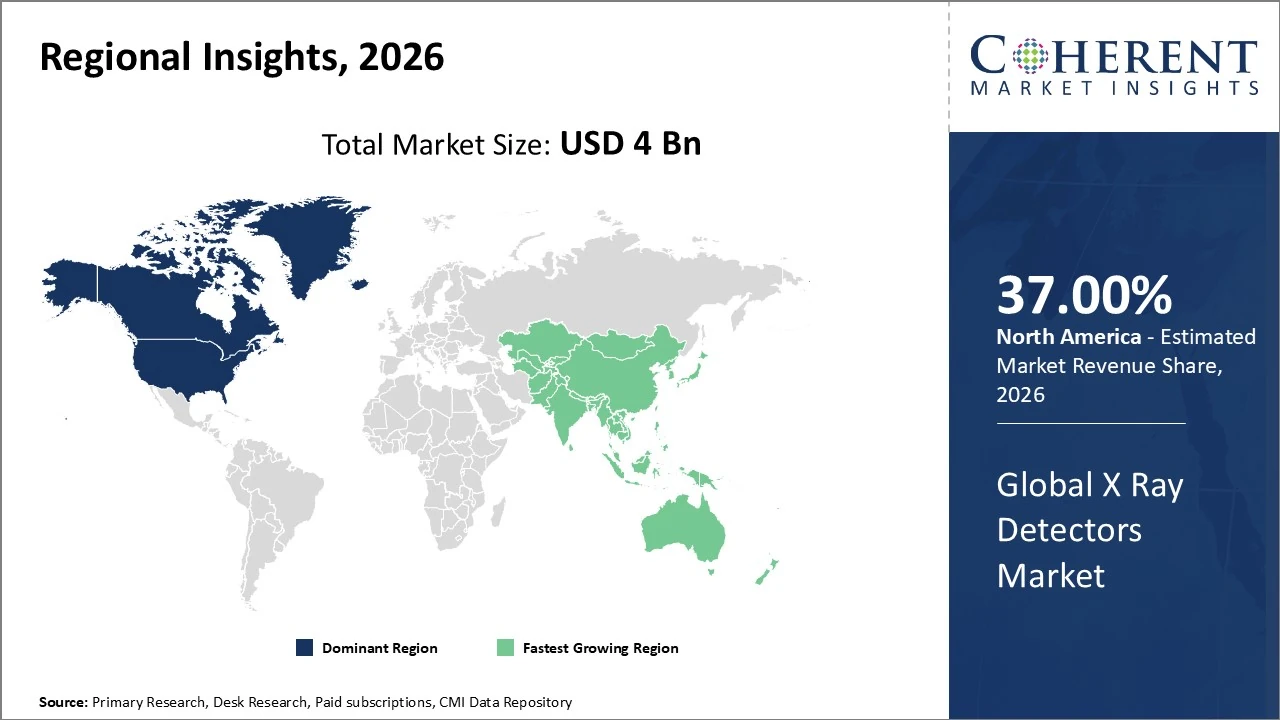
The North America X-Ray Detectors market leads globally, holding about 37 % of total revenue.
The Asia Pacific X-Ray Detectors market holds about 25 % of the global share, making it a key regional growth hub.
X Ray Detectors Market Segmentation Analysis
X Ray Detectors Market Insights, By Product Type
The X-Ray Detectors market is dominated by Flat panel detectors, holding the largest share about 60 % of the product type segment due to superior image quality, digital workflow, and lower radiation exposure. Computed radiography (CR) detectors account for a smaller but still significant ~30 % share, while Charge-coupled device (CCD) and other detector types make up the remaining ~10 % of the market. Flat panels continue to grow fastest as healthcare and industrial users replace analog systems with digital solutions, driven by demand for higher resolution and workflow efficiency.
X Ray Detectors Market Insights, By End-User
In the global X-Ray Detectors market, Hospitals and diagnostic centers are the leading end users, generating about 67 % of total revenue in 2026 as they deploy advanced imaging systems for comprehensive patient care. Outpatient and specialty clinics also contribute significantly, driven by point-of-care diagnostics and lower-cost imaging options. Industrial facilities account for around ~11 % share, using detectors for non-destructive testing and quality inspection. Research institutes and veterinary clinics represent smaller slices, with veterinary at around 3 %, while other segments (including dental and security agencies) make up the remaining ~7 % of demand.
X Ray Detectors Market Trends
Healthcare and industrial sectors are rapidly adopting digital flat-panel detectors for superior image quality, faster processing, and lower radiation doses.
AI analytics, CMOS sensors, and wireless connectivity are enhancing diagnostic accuracy and system efficiency.
Expanding healthcare infrastructure in Asia-Pacific and Latin America is driving increased deployment of X-ray detectors across hospitals and diagnostic centers.
X Ray Detectors Market Insights, By Geography
North America X Ray Detectors Market Analysis and Trends
The North America X-Ray Detectors market leads globally, holding about 37% of total revenue due to advanced healthcare infrastructure, high digital radiography adoption, and strong industrial use. Digital flat-panel detectors dominate regional demand, with hospitals driving the largest end-user spend. The U.S. accounts for roughly 80 % of the regional market, followed by Canada and Mexico. Growth is propelled by increasing diagnostic procedures, portable and AI-integrated systems, and upgrades from analog to digital. The region also sees rising demand in security screening and non-destructive industrial inspection. Continued innovation and supportive reimbursement policies sustain steady expansion through 2033.
Asia Pacific X Ray Detectors Market Analysis and Trends
The Asia Pacific X-Ray Detectors market holds about 25 % of the global share, making it a key regional growth hub driven by expanding healthcare infrastructure, rising diagnostic imaging adoption, and government digitization initiatives. China leads regionally with around 40 % of Asia Pacific installations, followed by Japan (~19 %) and India (~13 %) in flat-panel detector demand. The market is growing at a ~7.5 % CAGR, supported by digital radiography upgrades, rising chronic disease burden, and portable system deployment in underserved areas. Faster adoption of cost-effective local solutions also boosts regional penetration.
X Ray Detectors Market Outlook for Key Countries
USA X Ray Detectors Market Analysis and Trends
The U.S. X-Ray Detectors market is a major global driver. Adoption is powered by advanced digital flat-panel and portable systems, integration of AI for image analysis, and strong demand in medical imaging, industrial testing, and security screening. High healthcare spending, robust infrastructure, and rising chronic disease prevalence support growth, while cost and regulatory considerations can influence adoption pacing. The U.S. accounts for the largest share of the North American market.
Germany X Ray Detectors Market Analysis and Trends
The Germany X‑Ray Detectors market is a leading force in Europe, holding roughly ~27.9 % of the European regional share in 2026 thanks to a strong healthcare system, high digital radiography adoption, and robust hospital investments. Germany’s market is expanding with ~5.1 % CAGR forecast through 2033, driven by replacements of analog with flat‑panel detectors and rising demand for advanced imaging across medical and industrial sectors. Innovation in CMOS and AI‑enabled detectors enhances diagnostic quality, while regulatory compliance and reimbursement policies shape procurement. Growing chronic disease prevalence and government support for digital health further bolster growth.
Analyst Opinion
Analysts highlight that the shift from analog to digital flat-panel detectors is the primary growth driver across healthcare and industrial sectors.
Incorporation of AI and advanced imaging analytics improves diagnostic accuracy and workflow efficiency, making AI-enabled detectors increasingly preferred.
Asia-Pacific and Latin America are expected to offer significant growth potential due to expanding healthcare infrastructure and rising adoption of cost-effective digital systems.
Market growth is influenced by country-specific regulatory approvals and reimbursement policies, affecting the pace of new system adoption.
Analysts emphasize the rise of portable and wireless detectors for point-of-care applications, which are reshaping usage in hospitals, clinics, and remote diagnostic setups.
Market Scope
- Current Industry Events of 2026
- Market Size Estimation
- Regional Breakdown
- Competitive Landscape
- Customer Intelligence
- Segmental Analysis
- Pricing Analysis
- Key Market Drivers, Challenges & Future Trends
- Customized Insights Section
| Report Coverage | Details | ||
|---|---|---|---|
| Base Year: | 2025 | Market Size in 2026: | USD 4.0 Billion |
| Historical Data for: | 2020 To 2024 | Forecast Period: | 2026 To 2033 |
| Forecast Period 2026 to 2033 CAGR: | 5.95% | 2033 Value Projection: | USD 6.43 Billion |
| Geographies covered: |
| ||
| Segments covered: |
| ||
| Companies covered: | Varex Imaging, Canon Inc., GE Healthcare, Siemens Healthineers, Fujifilm, Konica Minolta | ||
| Growth Drivers: |
| ||
X Ray Detectors Market Growth Factors
The X‑Ray Detectors market is expanding due to rising global demand for advanced medical imaging and diagnostic procedures. Growth is driven by the shift from analog to digital flat-panel detectors, which offer higher resolution, faster processing, and lower radiation exposure. Increasing prevalence of chronic diseases, aging populations, and rising healthcare expenditure support adoption. Technological innovations, including AI-assisted imaging, portable detectors, and CMOS sensor integration, enhance efficiency and accuracy. Industrial and security applications, such as non-destructive testing and airport screening, further boost demand. Supportive government initiatives and investments in healthcare infrastructure also contribute to sustained market growth.
X Ray Detectors Market Development
In May 2025, Detection Technology, a global leader in X-ray detector solutions, launched the X-Panel 43108a FQI, the newest addition to its TFT flat panel detector portfolio. Developed to meet industry demand, it is the world’s largest dynamic flat panel digital detector array (DDA), delivering high performance for a wide range of industrial imaging applications.
Key Players
Leading Companies of the Market
Varex Imaging
Canon Inc.
GE Healthcare
Siemens Healthineers
Fujifilm
Konica Minolta
Key players in the X Ray detectors market are Varex Imaging, Canon Inc., GE Healthcare, Siemens Healthineers, Fujifilm, Konica Minolta. These companies lead global detector development and sales.
X Ray Detectors Market Future Outlook
The X‑Ray Detectors market is poised for steady growth over the next decade, driven by continued digital transformation in healthcare and industrial sectors. Adoption of flat-panel, AI-enabled, and portable detectors will accelerate, improving diagnostic precision and workflow efficiency. Emerging regions like Asia-Pacific and Latin America are expected to contribute significantly, fueled by expanding healthcare infrastructure and rising medical imaging demand. Technological innovations, including low-dose imaging, CMOS sensors, and wireless systems, will further enhance usability and safety. Strategic collaborations, mergers, and government support will sustain market expansion, positioning X-ray detectors as essential tools in modern diagnostics and industrial inspection.
X Ray Detectors Market Historical Analysis
The X‑Ray Detectors market has experienced significant evolution over the past two decades. Initially dominated by analog film-based systems, the market gradually shifted toward computed radiography (CR) and digital flat-panel detectors (FPDs), driven by the need for faster, higher-resolution imaging and reduced radiation exposure. Early adoption was led by developed regions like North America and Europe, with hospitals and diagnostic centers as primary end-users. Technological advancements in CMOS sensors, scintillator materials, and image processing software enhanced detector performance. Gradual expansion into industrial and security applications diversified the market, setting the foundation for modern digital and AI-enabled X-ray systems.
Sources
Primary Research Interviews:
Healthcare Providers
Medical Device Manufacturers
Distributors and Suppliers
Industry Experts and Consultants
Databases:
PubMed / MEDLINE
IEEE Xplore
ScienceDirect / Elsevier
Journals:
Radiology
Journal of Digital Imaging
European Radiology
Medical Physics
Newspapers:
The Wall Street Journal
Financial Times
The Economist
The New York Times
Associations:
Radiological Society of North America (RSNA)
American College of Radiology (ACR)
European Society of Radiology (ESR)
Society for Imaging Informatics in Medicine (SIIM)
Get access to 250+ pages report
Every segment, forecast, competitor profile and data table behind the analysis above — available for instant download.
- ESOMAR Member
- ISO 9001:2015 Certified
- D-U-N-S Registered
- GDPR & CCPA Compliant
Missing comfort of reading report in your local language? Find your preferred language:
Transform your Strategy with Exclusive Trending Reports
Frequently Asked Questions
Key players in the X Ray detectors market are Varex Imaging, Canon Inc., GE Healthcare, Siemens Healthineers, Fujifilm, Konica Minolta. These companies lead global detector development and sales.
The global X-Ray Detectors market is forecast to grow from about USD 4.02 B in 2026 to around USD 6.43 B by 2033, expanding at a CAGR of approximately 5.95 % between 2025 and 2033. Growth is driven by rising medical imaging demand and digital adoption.
The hospital and diagnostic center segment offers the highest growth potential in the X‑Ray Detectors market, driven by rising medical imaging demand, chronic disease prevalence, and ongoing upgrades from analog to digital systems. Adoption of AI-enabled, portable, and flat-panel detectors further accelerates growth in this end-user category.
Over the next five years, X‑Ray Detectors market development is expected to focus on digital transformation, AI integration, and portable systems. Adoption of flat-panel and low-dose detectors will rise, especially in emerging markets, while industrial and security applications expand. Innovation, collaborations, and regulatory support will further drive growth.
The X‑Ray Detectors market is highly competitive, dominated by players like Siemens, Canon, GE Healthcare, and Fujifilm. Key challenges include high equipment costs, stringent regulatory approvals, and technology standardization. Emerging competitors and price-sensitive markets intensify competition, while innovation and digital adoption remain critical for maintaining market leadership.
Companies in the X‑Ray Detectors market commonly use direct sales to hospitals and diagnostic centers, partnerships with distributors, and collaborations with healthcare providers. They leverage product demonstrations, service contracts, training programs, and digital marketing, while emphasizing after-sales support, technology upgrades, and customized solutions to strengthen adoption and customer loyalty.