

Xylitol Market Size and Share Analysis: (2026-2033)
The xylitol market size is anticipated to grow at a CAGR of 9.3% with USD 2,300 Mn in 2026 and is expected to reach USD 4,290 Mn in 2033. The primary drivers are largely defined by the growing demand for low-calorie sweeteners and sugar-free food and beverage products. Some of the other factors are the rising prevalence of diabetes, obesity, and dental health concerns, along with increasing consumer preference for natural and tooth-friendly ingredients. According to the latest International Diabetes Federation (IDF) Diabetes Atlas (2025), approximately 11.1% of adults aged 20–79—equivalent to 1 in 9—are currently living with diabetes, and more than 40% remain undiagnosed. Projections suggest that by 2050, the global prevalence will rise to about 1 in 8 adults, reaching around 853 million people, representing a 46% increase in total cases compared to current levels, thereby supporting the demand for low-calorie sweeteners like xylitol.
Key Takeaways
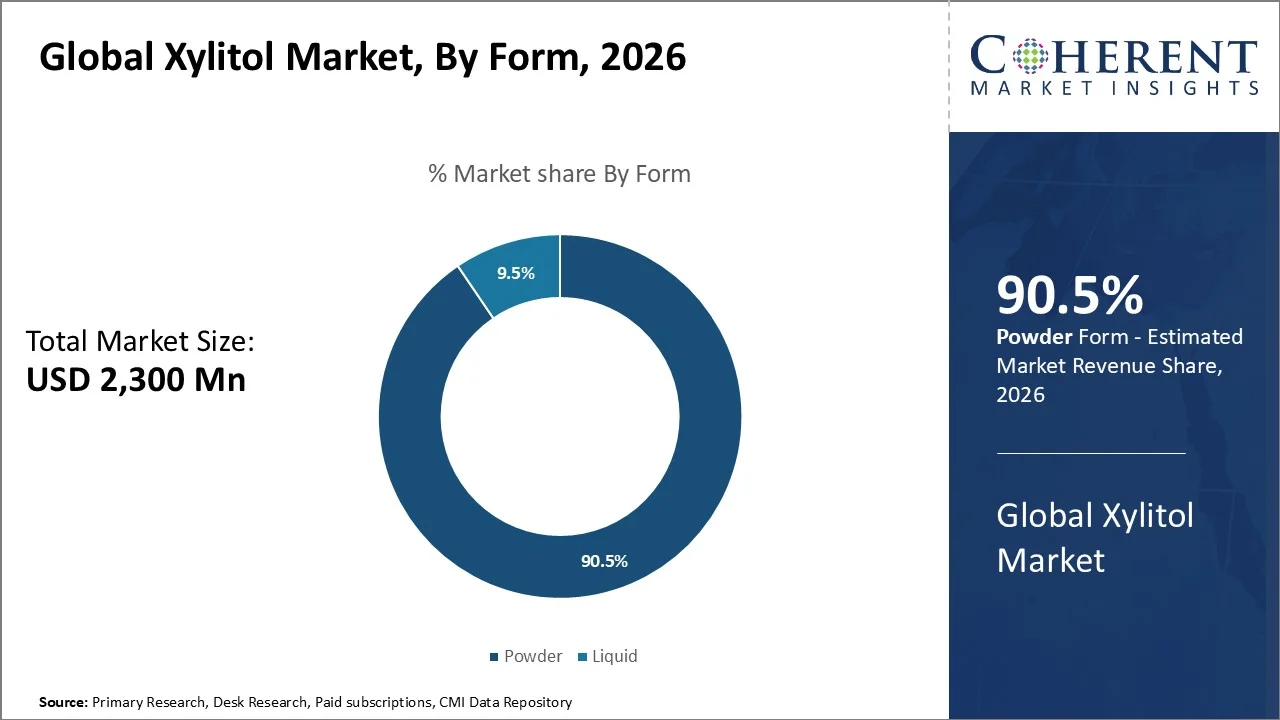
- The powder segment is likely to dominate the market with 90.5% in 2026. The segment’s growth is owing to its easy handling, longer shelf stability, and wider use in dry food mixes, chewing gums, tablets, powdered beverages, as well as oral care formulations. The CDC’s May 2024 oral health data states that 1 in 5 adults aged 20–64 years had at least one untreated cavity. This strengthens the demand for xylitol powder in products like oral care, chewing gum, lozenges, as well as dental-friendly formulations.
- The food & beverages segment is set to lead with 54.2% in 2026. The segment’s growth is owing to the rising use of xylitol in sugar-free confectionery, beverages, bakery products, and functional foods. The WHO’s sugar guideline recommends reducing free sugar intake to less than 10% of total energy intake, thus encouraging sugar replacement trends.
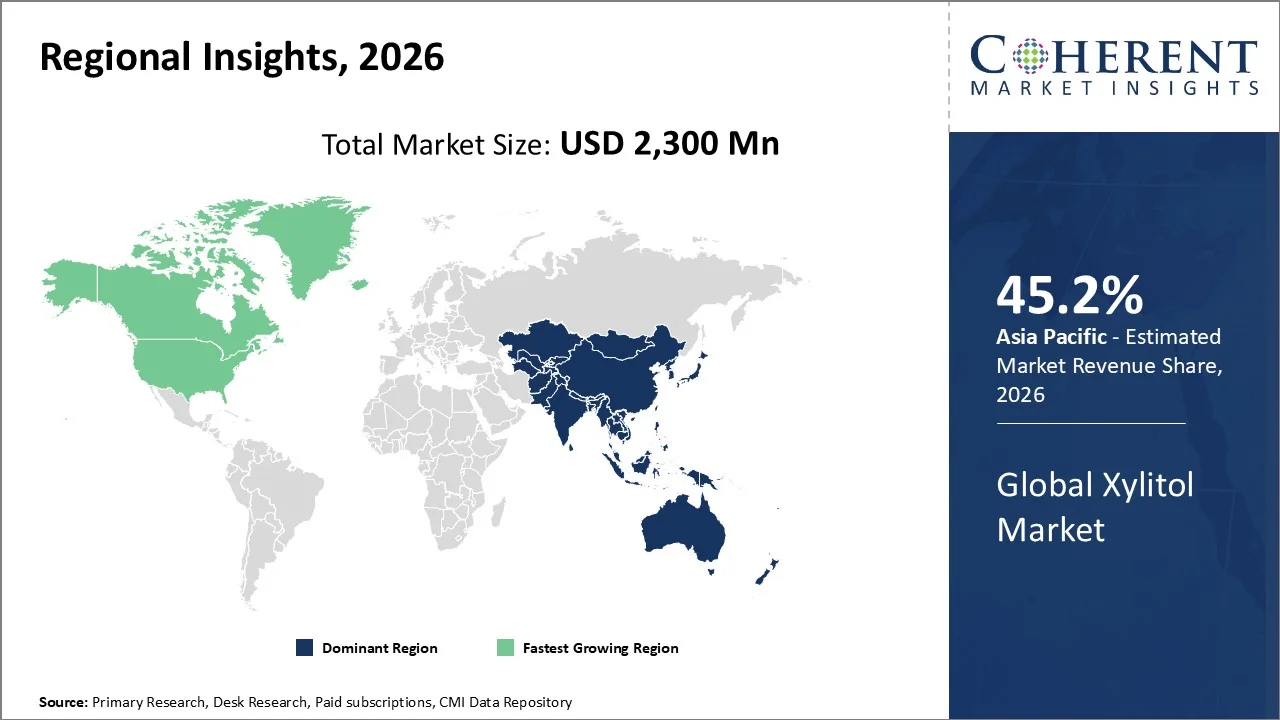
- The Asia Pacific region is expected to acquire the prominent share of 45.20% in 2026. This is due to region’s large diabetic population, rising health-conscious food consumption, and strong demand for sugar-free oral care and confectionery products. IDF’s 2025 Diabetes Atlas states that the Western Pacific region has 215 million adults with diabetes, accounting for 37% of global adults living with diabetes.
Segmental Insights
Why is Powder Acquiring the Largest Share?
On the basis of form, the powder segment is projected to account for the largest xylitol market share of 90.5% in 2026. The segment’s growth is owing to the easy blending, dosing, storage, and use across sugar-free confectionery, bakery, oral care, nutraceutical, and pharmaceutical formulations. The U.S. FDA permits the use of xylitol in foods for special dietary purposes when used at levels needed for its intended effect. This promotes the broad adoption of xylitol powder in food-grade applications.
In addition, the FDA allows sugar alcohols like xylitol to be declared on Nutrition Facts labels, thus enhancing the formulation transparency for consumers. The FAO’s Codex General Standard for Food Additives (GSFA) lists xylitol as a food additive approved for use under good manufacturing practice (GMP) conditions.
One such major development in this sector is Roquette’s xylitol-based ReadiLYCOAT XC, a sugar-free coating system designed for pharmaceutical applications in February 2025. This highlights the increasing utilization of powdered xylitol in various industries.
- Current Industry Events of 2026
- Market Size Estimation
- Regional Breakdown
- Competitive Landscape
- Customer Intelligence
- Segmental Analysis
- Pricing Analysis
- Key Market Drivers, Challenges & Future Trends
- Customized Insights Section
Food & Beverages hold the Largest Market Share
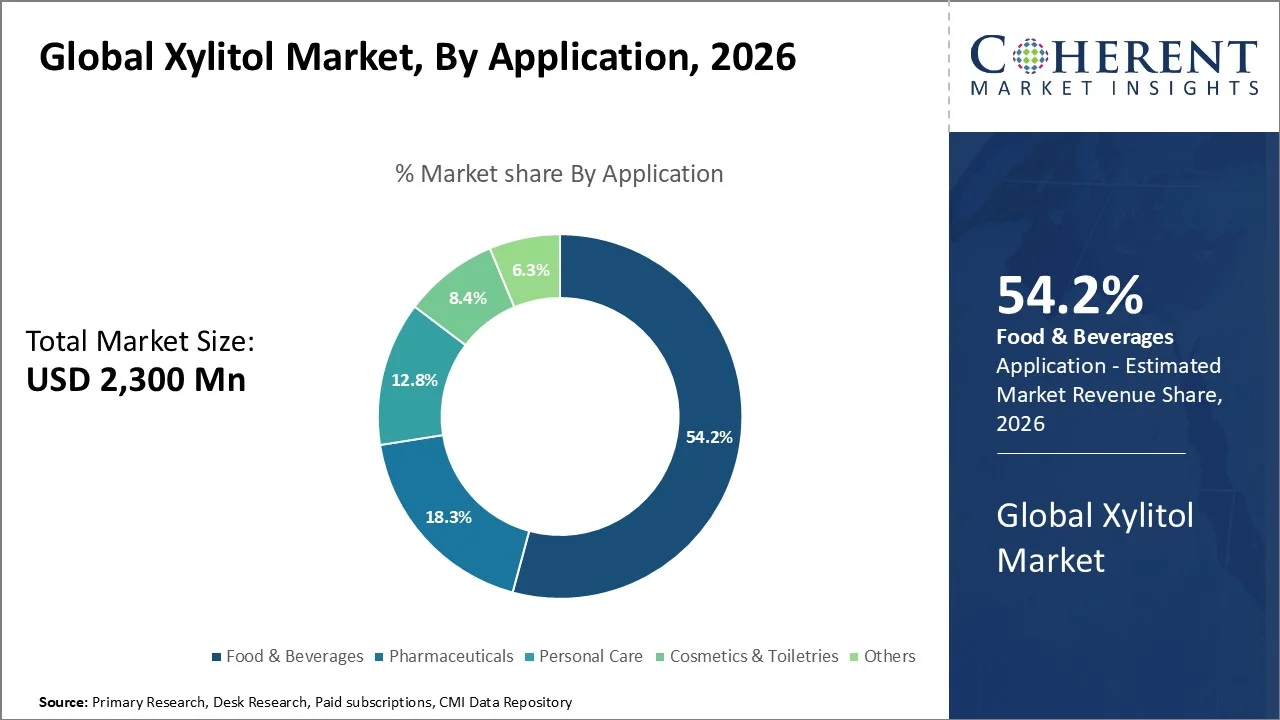
On the basis of application, food & beverages lead with a major 54.2% share in 2026. The segment’s growth is owing to the increasing consumer demand for sugar-free and low-calorie alternatives. Xylitol is a sugar alcohol which provides 2.4 kcal/g. It is favored for its ability to reduce calories while maintaining sweetness, thus making it ideal for sugar-free chewing gum, candies, as well as baked goods.
The U.S. FDA recognizes xylitol as safe for use in special Xylitol, as INS 967, is approved for use in food products following the Good Manufacturing Practices (GMP). This promotes its widespread application in both sugar-free as well as low-sugar beverages.
In April 2026, Lotte Chilsung Beverage unveiled Chum Churum Classic. It is a 20% ABV soju designed mainly for consumers who prefer the stronger taste of traditional soju. The product recreates the original Chum Churum formula from nearly 20 years ago, including additives like alanine, asparagine, and xylitol.
Growing Demand for Dental-friendly Oral Care Products is Transforming the Xylitol Market in the US
The U.S. xylitol market is witnessing substantial growth owing to the increasing demand for dental-friendly oral care products. Xylitol is a natural sugar alcohol and it has become a main ingredient in sugar-free gums, toothpaste, and mouthwashes. This is due to its dental health benefits.
According to the CDC’s 2024 Oral Health Surveillance Report, nearly 21% of the U.S. adults aged 20–64 and 22% of adults aged 20–34 suffer from untreated tooth decay. This strengthens the rising need for dental products which helps in preventing cavities and promoting overall oral health. In addition, xylitol has been endorsed by the FDA for its dental care properties. The regulations under 21 CFR 101.80 allow the inclusion of health claims for sugar alcohols like xylitol which help in the reduction of dental caries.
Moreover, a growing number of clinical trials such as those listed on ClinicalTrials.gov explore xylitol’s effectiveness in dental care, particularly its use in chewing gum to reduce tooth decay and promote oral hygiene. These developments are also propelling the demand for xylitol-based products in the U.S. market.
Shift Toward Bio-based and Fermentation-derived Xylitol: A Major Breakthrough in Xylitol Market
The shift toward bio-based and fermentation-derived xylitol is emerging as a major advancement in the xylitol market. The producers are moving away from conventional chemical hydrogenation and putting a greater focus on cleaner fermentation routes using agricultural biomass and food-processing by-products. The USDA-ARS stated that xylitol is used as a natural sweetener, dental caries reducer, as well as sugar substitute for diabetic consumers.
In one USDA study, 99 yeast strains were screened, and the best strains produced 3.35–4.96 g/L of xylitol, while Petrozyma xylosa produced 7.20 g/L from corn-stover hydrolysate. The regulatory acceptance also encourages the market use, as the European Commission lists xylitol as approved food additive E967.
In April 2022, Fazer opened a xylitol production plant in Lahti, Finland, which is notable for using oat hulls as its raw material. The facility uses a patented, circular economy model, and emphasizes on sustainability innovation. The new plant is expected to cater to the increasing global demand for Finnish xylitol. It is used in various industries like food, cosmetics, as well as pharmaceuticals.
Current Events and Their Impact on the Xylitol Market
Current Event | Description and its Impact |
FDA Front-of-Package Nutrition Labeling Proposal and “Healthy” Claim Update |
|
UK HFSS Advertising and Promotion Restrictions |
|
U.S. FDA Food Additive Permission for Xylitol under 21 CFR 172.395 |
|
Xylitol Market Trends
- The rising demand for sugar-reduced food and beverages is increasing the xylitol use in sugar-free chewing gums, candies, bakery products, and functional snacks. The WHO recommends limiting free sugar intake to below 10% of daily energy intake. The FDA’s March 2026 guidance states that added sugar Daily Value is 50 grams per day.
- The growing adoption of oral-care products is boosting the xylitol demand in toothpaste, mouth rinses, lozenges, as well as chewing gums. The oral diseases affect nearly 3.7 billion people globally, thereby creating strong demand for preventive dental-care ingredients.
- The increasing preference for diabetic-friendly as well as low-glycemic sweeteners strengthens the xylitol adoption as a sugar substitute. The IDF reported that 589 million adults were living with diabetes in 2024, thus strengthening the demand for alternatives with lower blood-sugar impact.
- Product innovation in functional oral-care formats is gaining traction. For instance, in July 2024, OraCare launched Ortho Protect Rinse formulated with xylitol for orthodontic patients, thereby showing wider use beyond conventional chewing gum.
- Sustainable and fermentation-based xylitol production is emerging, with 2025 research highlighting lignocellulosic biomass and engineered microbial cell factories as cost-effective production routes.
Regional Insights
Asia Pacific Dominates Owing to the Increasing Prevalence of Oral Diseases
The Asia Pacific region accounts for 45.2% of the market share in 2026. The region’s growth is owing to the increasing prevalence of oral diseases and the rising need for diabetes management solutions in the region. Additionally, xylitol’s growing use in sugar-free products such as confectionery, oral care items, nutraceuticals, and pharmaceuticals is a significant driving factor.
According to the World Health Organization (WHO) in November 2024, nearly 246 million people in South East Asia have diabetes. This propels the demand for both low-sugar as well as sugar-replacement ingredients like xylitol.
In addition, the WHO highlighted that nearly 900 million people in South-East Asia suffer from oral diseases, thereby driving the demand for xylitol-based products such as chewing gums, toothpaste, and mouthwashes.
In March 2026, Clockwork Rituals entered India’s oral care market with biomimetic toothpaste formulations focused on enamel repair. The brand’s kids and adult variants include 10% Organic Xylitol, positioned alongside Nano-Hydroxyapatite for science-led oral care.
North America Xylitol Market Trends
North America is expected to witness strong growth in xylitol market over the forecast period. The region’s growth is owing to the increasing demand for sugar-free sweeteners across industries such as oral care, confectionery, nutraceuticals, and pharmaceutical coatings.
In the U.S., the CDC's October 2024 Oral Health Surveillance Report revealed that approximately 50% of children aged 6–9 years had cavities in primary or permanent teeth, while nearly 17% had untreated decay. This facilitates the growing demand for non-cariogenic sweeteners like xylitol in various products including gums, lozenges, toothpaste, and pediatric oral-care products.
Similarly, in Canada, Statistics Canada reported in December 2025 that 57% of children aged 6–11 years and 93% of adults aged 20–79 years had at least one affected tooth in 2022–2024, thereby strengthening the market for preventive oral-care products.
In May 2026, Ruby Bio announced plans to launch fermentation-derived clean label emulsifiers by 2027. The company is also expanding its platform into polyols like xylitol. The firm can produce xylitol through fermentation using low-cost feedstocks, reducing dependence on traditional chemical hydrogenation of xylose from hardwoods or agricultural residues.
Need for Non-cariogenic Sweeteners is Accelerating the Xylitol Market in China
The China xylitol market is growing owing to the ongoing oral health issues, especially high rates of tooth decay. The Fourth National Oral Health Survey (2015–2016) revealed that nearly 50.8% of 3-year-olds in China had dental caries. This demonstrates a greater need for non-cariogenic sweeteners like xylitol in oral care products.
In response, the National Health Commission of China came up with the Healthy Oral Action Plan (2019–2025). The plan emphasizes the importance of reducing sugar intake as well as improving preventive care. As a result, the xylitol-based products are used extensively in oral care formulations like toothpaste and chewing gum.
In 2025, the domestic manufacturers collaborated with academic institutions to develop xylitol-fortified oral hygiene products, thereby expanding their use to better address widespread dental issues.
United States Xylitol Market Trends
The U.S. xylitol market is set to witness considerable growth. The growth is driven by the increasing public health efforts to reduce added sugar consumption and manage chronic conditions like diabetes. According to the CDC’s National Diabetes Statistics Report, more than 40 million Americans have been diagnosed with diabetes. This increases the demand for low-glycemic sugar alternatives like xylitol in both food as well as oral care products.
Additionally, the American Dental Association (ADA) recommends chewing sugar-free gum containing xylitol as a way to help prevent dental cavities and improve oral health by stimulating saliva flow. In October 2025, the American Dental Hygienists’ Association (ADHA) officially endorsed the use of xylitol as part of preventive strategies to reduce dental caries.
Who are the Major Companies in Xylitol Industry
Some of the major key players in xylitol market are Roquette Frères, NovaGreen, Inc., zuChem Inc., DuPont Danisco, Cargill, Inc., Zhejiang Huakang Pharmaceutical Co., Ltd., Foodchem International Corporation, A & Z Food Additives Co., Ltd., Shandong Lujian Biological Technology Co. Ltd., Herboveda.
Key News
- In July 2025, Nathan & Sons launched Pearl Powder Remineralizing Tooth Scrub as a fluoride-free alternative to regular toothpaste. The product contains xylitol, along with nanohydroxyapatite, pearl powder, eggshell calcium, erythritol, and antioxidants.
- In July 2024, OraCare launched Ortho Protect Rinse for patients using braces or clear aligners. The rinse includes xylitol, which helps support remineralization and reduce harmful oral bacteria.
Market Report Scope
Xylitol Market Report Coverage
| Report Coverage | Details | ||
|---|---|---|---|
| Base Year: | 2025 | Market Size in 2026: | USD 2,300 Mn |
| Historical Data for: | 2020 To 2024 | Forecast Period: | 2026 To 2033 |
| Forecast Period 2026 to 2033 CAGR: | 9.3% | 2033 Value Projection: | USD 4,290 Mn |
| Geographies covered: |
| ||
| Segments covered: |
| ||
| Companies covered: | Roquette Frères, NovaGreen, Inc., zuChem Inc., DuPont Danisco, Cargill, Inc., Zhejiang Huakang Pharmaceutical Co., Ltd., Foodchem International Corporation, A & Z Food Additives Co., Ltd., Shandong Lujian Biological Technology Co. Ltd., Herboveda. | ||
| Growth Drivers: |
| ||
| Restraints & Challenges: |
| ||
Analyst Opinion
- Xylitol demand is driven by oral-care need, not only by sweetener trends. WHO states that oral diseases affect nearly 3.7 billion people globally, while untreated dental caries remains the most common health condition. This supports steady use of xylitol in chewing gum, mints, toothpaste, mouthwash, and preventive dental products.
- Sugar reduction is becoming a major product reformulation driver. CDC’s April 2026 update highlights sugar-sweetened beverages as a key source of added sugars, increasing pressure on food and beverage brands to use lower-calorie and tooth-friendly alternatives. This directly supports xylitol adoption in confectionery, beverages, bakery, and functional foods.
- Xylitol has a stronger health-positioning advantage than many conventional sweeteners. U.S. FDA labeling rules allow claims that sugar alcohols such as xylitol do not promote tooth decay and may reduce dental caries risk. This regulatory backing strengthens xylitol’s use in oral-care and sugar-free products, helping brands justify premium, health-focused formulations.
Speak to the analyst
Want personalized insights?
Take the findings above to one of our principal consultants, or have the report rebuilt around the segments, geographies and competitors you actually track.
Market Segmentation
- By Form (Revenue, USD Mn, 2021-2033)
- Liquid
- Powder
- By Application (Revenue, USD Mn, 2021-2033)
- Pharmaceuticals
- Food & Beverages
- Cosmetics & Toiletries
- Personal Care
- Others
- Global Xylitol Market, By Region (Revenue, USD Mn, 2021-2033)
- North America
- U.S.
- Canada
- Latin America
- Brazil
- Mexico
- Argentina
- Rest of Latin America
- Europe
- Germany
- U.K.
- France
- Italy
- Spain
- Russia
- Rest of Europe
- Asia Pacific
- China
- India
- Japan
- Australia
- South Korea
- ASEAN
- Rest of Asia Pacific
- Middle East
- GCC
- Israel
- Rest of Middle East
- Africa
- South Africa
- Central Africa
- North Africa
- North America
- Key Players
- Roquette Frères
- NovaGreen, Inc.
- zuChem Inc.
- DuPont Danisco
- Cargill, Inc.
- Zhejiang Huakang Pharmaceutical Co., Ltd.
- Foodchem International Corporation
- A & Z Food Additives Co., Ltd.
- Shandong Lujian Biological Technology Co. Ltd.
- Herboveda
Sources
Primary Research Interviews
- Xylitol Manufacturers
- Sugar Alcohol and Polyol Producers
- Food Ingredient Suppliers and Distributors
- Confectionery and Chewing Gum Manufacturers
- Oral Care Product Manufacturers
- Pharmaceutical and Nutraceutical Formulators
- Bakery, Beverage, and Functional Food Manufacturers
- Procurement Managers from Food & Personal Care Companies
- Regulatory and Food Safety Consultants
- Others
Databases
- Bloomberg Terminal
- Thomson Reuters Eikon
- IHS Markit
- Euromonitor International
- UN Comtrade
- ITC Trade Map
- FAOSTAT
- Others
Magazines
- Food Business News
- Food Ingredients First
- FoodNavigator
- Confectionery Production Magazine
- Nutraceutical Business Review
- Chemical Engineering Magazine
- Prepared Foods Magazine
- Others
Journals
- Food Chemistry
- Journal of Food Science
- International Journal of Food Science & Technology
- Journal of Functional Foods
- Carbohydrate Polymers
- Applied Microbiology and Biotechnology
- Journal of Agricultural and Food Chemistry
- Others
Newspapers
- Financial Times
- The Wall Street Journal
- Reuters
- Bloomberg News
- The Economic Times
- China Daily
- Others
Associations
- International Sweeteners Association
- Calorie Control Council
- European Association of Polyol Producers
- International Chewing Gum Association
- FoodDrinkEurope
- FDI World Dental Federation
- American Dental Association
- International Food Additives Council
- Others
Public Domain Sources
- U.S. Food and Drug Administration (FDA)
- European Food Safety Authority (EFSA)
- Codex Alimentarius Commission
- WHO/FAO Joint Expert Committee on Food Additives (JECFA)
- U.S. Department of Agriculture (USDA)
- U.S. International Trade Commission DataWeb
- Eurostat
- UN Comtrade Database
- World Bank Open Data
- European Chemicals Agency (ECHA)
- Others
Proprietary Elements
- CMI Data Analytics Tool
- Proprietary CMI Existing Repository of Information for the Last 10 Years
Get access to 250+ pages report
Every segment, forecast, competitor profile and data table behind the analysis above — available for instant download.
- ESOMAR Member
- ISO 9001:2015 Certified
- D-U-N-S Registered
- GDPR & CCPA Compliant
Missing comfort of reading report in your local language? Find your preferred language:
Transform your Strategy with Exclusive Trending Reports
Frequently Asked Questions
The Xylitol Market is expected to reach USD 4,290 Mn in 2033.
Major players operating in the global Xylitol Market include Roquette Frères, NovaGreen, Inc., zuChem Inc., DuPont Danisco, Cargill, Inc., Zhejiang Huakang Pharmaceutical Co., Ltd., Foodchem International Corporation, A & Z Food Additives Co., Ltd., Shandong Lujian Biological Technology Co. Ltd., Herboveda.
The high production costs, supply chain volatility, potential digestive side effects, and strict regulatory hurdles are the key factors hampering growth of the market.
The low glycemic index (GI of 7), strong adoption in dental health products, and expanding use in functional food/beverage applications is boosting the demand for Xylitol.
The Xylitol Market is anticipated to grow at a CAGR of 9.3% between 2026 and 2033
Among regions, Asia Pacific is expected to account for a largest market share in the global Xylitol Market over the forecast period.