3d Printed Medical Implants Market Analysis & Forecast: 2026-2033

3D printed medical implants market is estimated to be valued at USD 1.40 Bn in 2026 and is expected to reach USD 4.77 Bn in 2033, exhibiting a compound annual growth rate (CAGR) of 19.1% from 2026 to 2033.
3D printing, also known as additive manufacturing, refers to addition of successive layers of raw material to produce objects forming three-dimensional file. In medical terms, 3D printed medical implants allow surgeons in surgery by implantation of biological objects, reduces risks involved during surgeries, decrease in anesthesia exposure duration, and risk of infection. 3D printing is a rapidly emerging technology which empowers key manufacturer in the medical field to form the customized medical products and implant them by replacing the damaged biological structure. 3D printed medical implantation allow patients in rapid recovery and thereby, it reduces hospital stay. Moreover, preclinical testing prior to implantation of 3D printed organs reduces chances of implant rejection.
|
Current Events |
Description and its Impact |
|
Regulatory Framework Evolution and Harmonization |
|
|
Breakthrough Material Science and Bioprinting Innovations |
|
Uncover macros and micros vetted on 75+ parameters: Get instant access to report
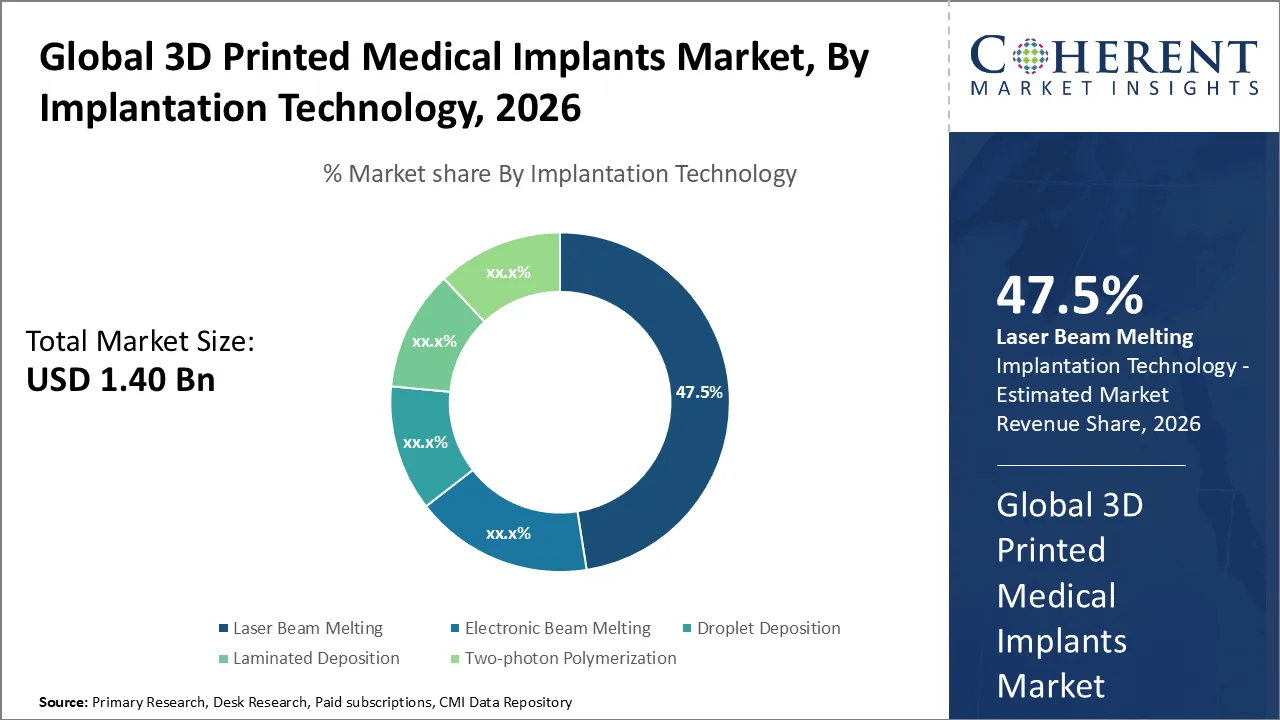
In terms of implantation technology, the laser beam melting segment is expected to lead the 47.5% share in 2026, due to its precision and scalability. It enables complex geometries, high accuracy, and cost‑effective production of orthopedic and dental implants. Its widespread adoption across hospitals and research centers solidifies its dominance over other additive manufacturing techniques.
For instance, in December 2025, Imaginarium joined GE Additive’s sales partner network to expand access to metal 3D printing in India. GE Additive’s Direct Metal Laser Melting systems enable precise, patient‑specific medical implants. This partnership accelerates adoption of Laser Beam Melting technology, reinforcing its dominance in orthopedic and dental applications within healthcare.
In terms of component type, the material segment is expected to hold 48% share in 2026, driven by titanium alloys and biocompatible polymers. These materials ensure durability, patient safety, and compatibility with human tissue. Their versatility across orthopedic, dental, and cranio‑maxillofacial applications makes them the backbone of implant production, capturing nearly half the market share.
For instance, in March 2025, Materialise announced that they would be performing a clinical trial for a 3D-printed bioresorbable implant made of polycaprolactone, a biodegradable polymer that dissolves safely in the body over time. This new technology shows the significance materials are in medical implants. It allows for patient-specific solutions and expands the use of implants beyond bone to soft tissue, which strengthens materials' position as the market leader.
In terms of application, the orthopedic segment is projected to account for 53% share of the market in 2026. Rising demand for hip, knee, and spinal replacements, fueled by aging populations and trauma cases, drives growth. 3D printing enables patient‑specific solutions, improving surgical outcomes and recovery rates, making orthopedics the most lucrative application segment.
For instance, in October 2025, Israel’s Sheba Medical Center achieved a breakthrough in orthopedics with the nation’s first 3D‑printed bone implant. Surgeons reconstructed a patient’s forearm using a custom PEKK lattice implant, enabling biological integration with grafts or stem cells. This innovation reduces rejection risks, improves fit, and advances personalized regenerative bone surgery.
In terms of end user, the medical and surgical centers segment is projected to capture 50% share in 2026. These institutions directly perform implant surgeries, requiring customized, patient‑specific solutions. Their adoption of advanced 3D printing systems enhances efficiency, reduces surgery times, and improves patient outcomes, ensuring their continued dominance in the industry.
For instance, in December 2025, Amandeep Hospitals in India launched a facility integrating 3D printing and virtual reality for surgical care. The center enables patient‑specific implants, prosthetics, and immersive pre‑surgical planning. This innovation enhances precision, safety, and recovery, positioning the hospital as a pioneer in advanced medical technology and personalized surgical solutions.
To learn more about this report, Request Free Sample
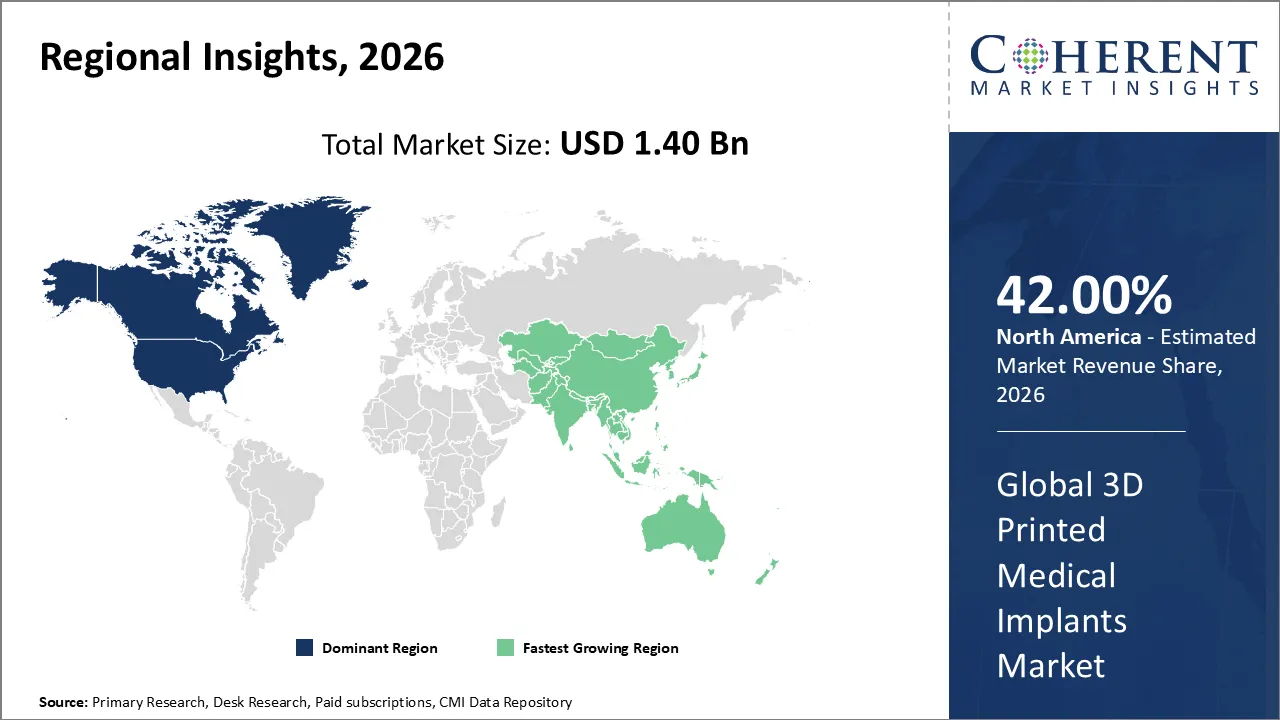
North America is expected to dominate the 3D printed medical implants market with 42% share in 2026, driven by advanced healthcare infrastructure, high adoption of personalized orthopedic and dental solutions, strong presence of key manufacturers, and supportive regulatory frameworks. Rising chronic conditions and aging populations further fuel market growth, ensuring dominance in innovative surgical technologies.
For instance, in May 2025, Durham‑based restor3d secured $38 million to expand its portfolio of 3D‑printed orthopedic implants. The funding supports commercialization of patient‑specific knee, ankle, hip, and shoulder systems, several already FDA cleared or pending approval. This investment strengthens personalized surgical solutions, advancing innovation in regenerative medicine and orthopedic implant technology.
Asia Pacific is expected to exhibit the fastest growth, fueled by expanding healthcare infrastructure, rising investments in advanced surgical technologies, and a large patient base requiring orthopedic and dental solutions. Rapid urbanization, government support, and growing awareness of personalized medicine make the region the fastest‑growing market globally.
For instance, in December 2025, Medi‑Mold announced a ₹100 crore investment to establish India’s first 3D‑printed orthopedic implant facility. The initiative will enable patient‑specific implants, enhancing surgical precision and recovery outcomes. This milestone positions India as a key player in the Asia‑Pacific market, advancing innovation and accessibility in personalized orthopedic healthcare solutions.
In 2026, the U.S. 3D‑printed medical implants market is driven by advanced healthcare infrastructure, strong R&D investment, and widespread adoption of personalized orthopedic and dental solutions. An aging population, rising chronic conditions, and supportive FDA regulatory approvals fuel demand, positioning the U.S. as the dominant global market leader.
For instance, in March 2025, Michigan Medicine launched a clinical trial to test a groundbreaking 3D‑printed airway splint for infants with tracheobronchomalacia, a rare respiratory disease. The bioresorbable implant supports breathing until airways strengthen naturally. This innovation highlights U.S. leadership in pediatric care and advances the role of 3D‑printed medical implants in life‑saving treatments.
In 2026, China’s 3D‑printed medical implants market is driven by rapid healthcare modernization, rising orthopedic and dental needs, and government support for additive manufacturing. An aging population, increasing chronic conditions, and domestic innovation in personalized implants fuel demand, positioning China as a leading force in Asia‑Pacific’s medical technology growth.
For instance, in March 2025, Researchers at Naton Biotech in China developed the first laser 3D‑printed total knee implant, marking a breakthrough in orthopedic surgery. The innovation enhances implant fit, durability, and patient outcomes, positioning China as a leader in additive manufacturing for medical devices and advancing personalized healthcare in the Asia‑Pacific region.
| Report Coverage | Details | ||
|---|---|---|---|
| Base Year: | 2025 | Market Size in 2026: | USD 1.40 Bn |
| Historical Data for: | 2020 To 2024 | Forecast Period: | 2026 To 2033 |
| Forecast Period 2026 to 2033 CAGR: | 19.1% | 2033 Value Projection: | USD 4.77 Bn |
| Geographies covered: |
|
||
| Segments covered: |
|
||
| Companies covered: |
3D Systems Corporations, Stratasys Ltd, EnvisionTEC, Arcam AB, Organovo Holdings, Inc., EnvisionTEC, Arcam AB, SLM Solutions Group AG, Oxford Performance Materials, Inc., Materialise NV, Bio3D Technologies, and Cyfuse Medical K.K. |
||
| Growth Drivers: |
|
||
| Restraints & Challenges: |
|
||
Uncover macros and micros vetted on 75+ parameters: Get instant access to report
Rapid progress in additive manufacturing has transformed the medical field by enabling the creation of complex, patient‑specific implants that traditional methods cannot replicate. The integration of AI and advanced digital design tools ensures greater precision, faster production cycles, and reduced costs. These innovations significantly enhance surgical outcomes and broaden clinical applications. As a result, technological breakthroughs are a major driver of the 3D printed medical implants market share, positioning it as a rapidly expanding segment in global healthcare.
For instance, in November 2025, Lynxter launched new 3D printing technology designed for medtech applications, advancing precision and customization in implant production. The innovation supports faster prototyping and patient‑specific solutions, improving surgical outcomes. This technological advancement strengthens additive manufacturing’s role in healthcare, driving progress in medical implants and expanding opportunities for personalized treatment.
Patients increasingly seek customized implants tailored to their unique anatomy, whether orthopedic, dental, or cranial. 3D printing allows faster prototyping, individualized solutions, and improved surgical precision, reducing complications and recovery times. This personalization trend aligns with the broader shift toward patient‑centric care. The growing preference for individualized treatments is fueling strong 3D printed medical implants market demand, making customization a critical factor in the adoption and expansion of additive manufacturing in modern medicine.
For instance, in February 2025, Apollo Hospitals partnered with Anatomiz3D Medtech to establish hospital‑based 3D printing labs in India. These labs will enable patient‑specific implants and surgical models, enhance precision and reduce risks in complex procedures.
Agencies such as the FDA in the United States and EMA in Europe are increasingly establishing clearer pathways for 3D‑printed medical devices, ensuring safety and efficacy while reducing uncertainty for manufacturers. These streamlined processes accelerate product commercialization, encourage global investment, and foster innovation in personalized healthcare. With faster approvals, companies can bring advanced implants to market more efficiently, strengthening confidence in additive manufacturing. This regulatory evolution is a critical driver shaping the 3D printed medical implants market forecast.
For instance, in July 2025, Holmes Nanochon’s 3D‑printed knee implant has received approval for human clinical trials, marking a key regulatory milestone. This clearance demonstrates growing support for innovative medical devices, accelerating commercialization and investment.
The market for 3D printed medical implants continues to evolve as a major part of advanced healthcare technology, with considerable amounts of use in orthopedic, dental, and craniofacial applications. Orthopedic implants are always the most popular application category, driven by larger number of individuals want personalized joint replacements and trauma-related implants that are made to fit their unique anatomical structures. Dental applications are also gaining an enormous amount of ground, in part to digital dentistry workflows that make design and placement easier and make patients happier.
Material trends indicate that titanium alloys and other biocompatible metals are the best choices for structural implants as they are strong and light and can withstand the stress of the body. People are also paying more attention to polymer and ceramic materials for certain situations where flexibility and biological integration are important. Advanced manufacturing technologies, like laser beam melting, make up a large part of the fabrication process. They allow for accuracy and consistency in complex shapes.
North America is the most important market due to it has a well-established healthcare system and was one of the first places to use additive manufacturing technologies. At the same time, the Asia-Pacific region is becoming a rapidly growing market owing to greater funds being spent on healthcare and more clinical uses. Hospitals and surgical centers are still the main end users, but ambulatory surgical centers and specialty clinics are becoming more interested as implant procedures diversify.
Overall, the market for 3D-printed medical implants is supported by new technologies, the growing usefulness of custom implants in the clinic, and the wider use of additive manufacturing solutions in surgery, which are changing demand and competition patterns around globally.
Share
Share
Manisha Vibhute is a consultant with over 5 years of experience in market research and consulting. With a strong understanding of market dynamics, Manisha assists clients in developing effective market access strategies. She helps medical device companies navigate pricing, reimbursement, and regulatory pathways to ensure successful product launches.
Joining thousands of companies around the world committed to making the Excellent Business Solutions.
View All Our Clients