

Intraoperative Neuromonitoring Market Size and Share Analysis - 2026 To 2033
The global intraoperative neuromonitoring market is estimated to be valued at USD 4,712 Mn in 2026 and is projected to grow at a compound annual growth rate (CAGR) of 6% during the forecast period (2026-2033), surpassing USD 7,100 Mn by 2033. This growth can be attributed to increasing prevalence of complex surgical procedures requiring real-time monitoring of neural structures, rising incidence of neurological disorders and spinal injuries, and growing adoption of minimally invasive surgeries.
Key Takeaways from the Intraoperative Neuromonitoring Market Report
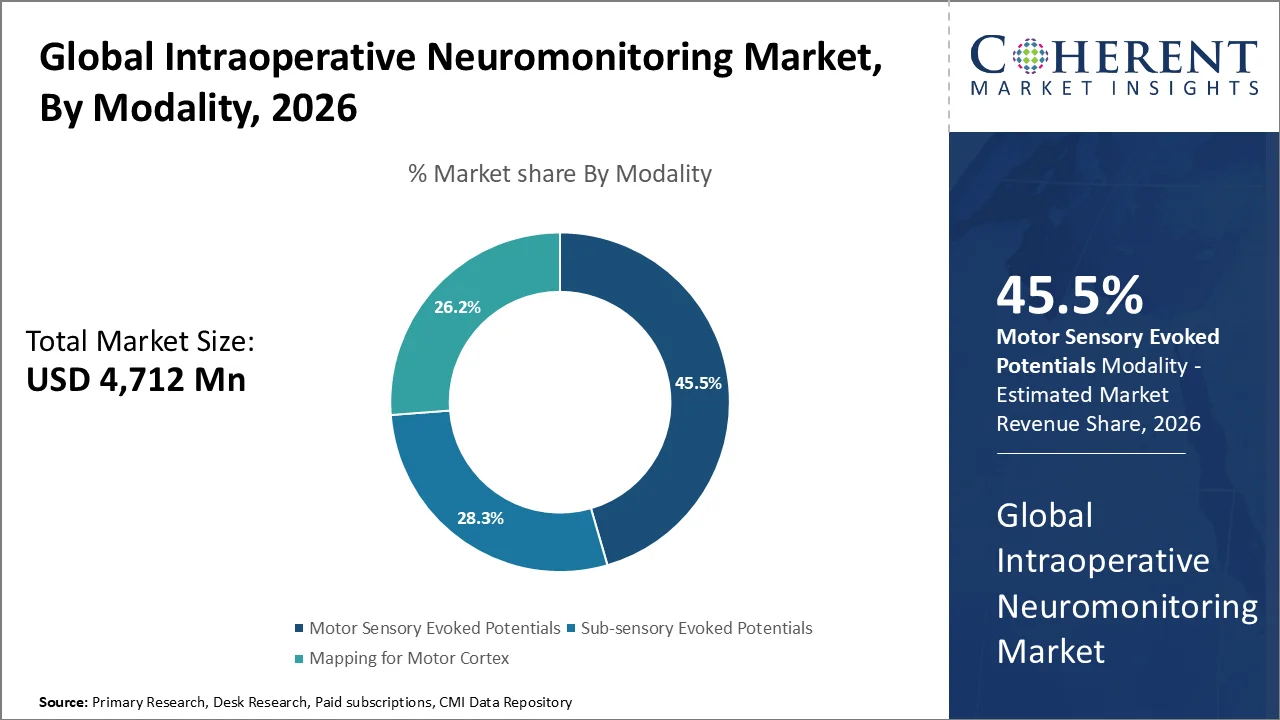
- Motor Sensory Evoked Potentials segment is expected to lead the market with a share of 45.5% in 2026, owing to its widespread clinical use as a key baseline monitoring modality in spinal and neurosurgical procedures. For example,
- Insourced monitoring is slated to account for the largest market share of 60% in 2026 because hospitals prefer insourced neuromonitoring teams for quality control, surgical coordination, and high-acuity procedures.
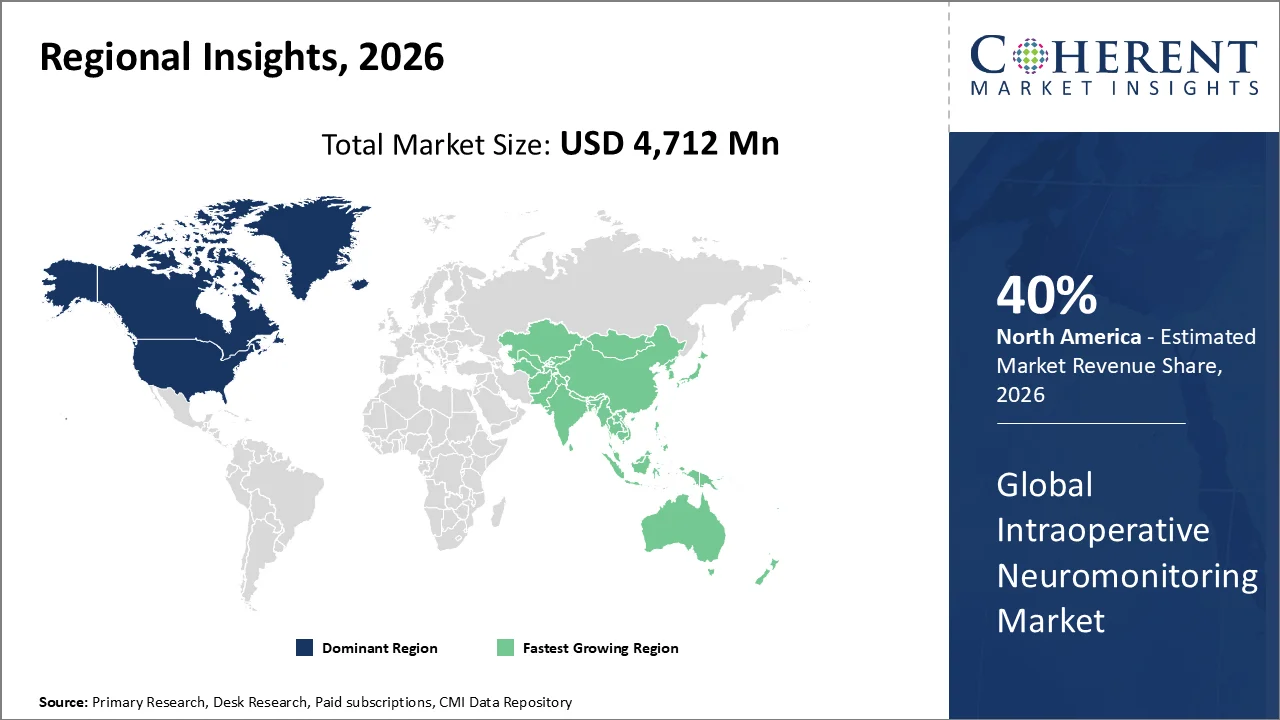
- North America is expected to dominate the global intraoperative neuromonitoring industry with a share of 40% in 2026, owing to strong healthcare infrastructure, high adoption of advanced surgical technologies, and favorable reimbursement policies. For instance, national inpatient database data from the United States reports over 125,000 annual intraoperative neuromonitoring cases, reflecting large-scale clinical utilization and strong procedural adoption in hospital surgical practice.
- Asia Pacific, holding a share of 25% in 2026, is anticipated to emerge as the fastest growing market for intraoperative neuromonitoring during the forecast period, thanks to rising surgical volumes, expanding adoption of advanced neurosurgical procedures, and growing awareness of patient safety in complex surgeries.
Intraoperative Neuromonitoring Market Overview
The global intraoperative neuromonitoring market is expected to register steady growth during the forecast period. This is primarily due to increasing incidence of neurological disorders and spinal injuries and rising prevalence of complex surgical procedures requiring real-time monitoring of neural structures.
Advancements in intraoperative neuromonitoring technologies, such as improved electromyography (EMG), electroencephalography (EEG), and evoked potential systems, are enhancing surgical precision and patient safety. Similarly, rising agining population is expected to foster growth of the intraoperative neuromonitoring market during the forecast period.
Intraoperative Neuromonitoring (IONM), also known as intraoperative neurophysiological monitoring, is a technique used during surgical procedures to assess the functional integrity of the nervous system, including the brain, spinal cord, and peripheral nerves. It has the tendency to provide real-time feedback to surgeons, helping them identify and reduce the risk of iatrogenic neurological injury during complex surgeries, particularly in spine and neurosurgical procedures.
IONM utilizes multiple modalities such as somatosensory evoked potentials (SSEPs), motor evoked potentials (MEPs), electromyography (EMG), and in some cases electroencephalography (EEG), to monitor neural pathway activity throughout the surgery. These measurements help detect potential neural impairment at an early stage, allowing for immediate corrective action.
The procedure complements imaging techniques such as X-rays and CT scans by providing functional information about the nervous system, whereas imaging primarily provides structural details. Although IONM is non-invasive for the patient (who is under anesthesia during surgery), it requires specialized equipment and trained neurophysiological monitoring professionals.
IONM is widely adopted in spinal and neurological surgeries due to its ability to enhance surgical safety as well as improve patient outcomes. Rising number of complex spine procedures, growing emphasis on patient safety, and advancements in neurophysiological monitoring technologies are some key factors driving growth of the intraoperative neuromonitoring market.
Increasing incidence of complex spinal, neurosurgical, and otolaryngology procedures has significantly elevated the risk of intraoperative neurological injury, thereby driving demand for intraoperative neuromonitoring (IONM). Recent studies suggest that IONM is used in a substantial number of surgical cases annually in the United States, with spinal procedures representing a major share of overall utilization.
Expansion of minimally invasive and robotic surgeries is set to boost the intraoperative neuromonitoring market value. Minimally invasive techniques require higher precision in limited visual fields. They depend heavily on real-time neurophysiological feedback. Similarly, robotic-assisted surgery increases reliance on advanced monitoring systems.
Growing popularity of outsourced intraoperative neuromonitoring services is also supporting market expansion. Hospitals and other healthcare providers are increasingly opting for third-party neuromonitoring services because they help reduce operational costs, provide access to specialized neurophysiologists and technicians, and eliminate the need for hospitals to maintain fully in-house monitoring teams.
Segmental Insights
Which Modality Dominates the Intraoperative Neuromonitoring Market?
Motor Sensory Evoked Potentials Lead the Market
According to Coherent Market Insights’ latest intraoperative neuromonitoring market analysis, the Motor Sensory Evoked Potentials segment is expected to hold a substantial share of 45.5% in the global market. The segment is subdivided into Brainstem Auditory Evoked Potentials, Visual Evoked Potentials, and Somatosensory Evoked Potentials. Among these, the somatosensory evoked potentials (SSEP) sub-segment is set to account for a prominent share of 36% in 2026. This is attributable to its widespread adoption in spinal and neurosurgical procedures, where it provides real-time monitoring of sensory pathway integrity and helps reduce the risk of postoperative neurological deficits.
SSEP is particularly valued for its high reliability, ease of interpretation, and ability to detect ischemic or mechanical injury during critical phases of surgery. In addition, increasing volumes of complex spine surgeries, brain tumor resections, and vascular procedures continue to drive its clinical preference over other modalities, thereby boosting segment growth.
- Current Industry Events of 2026
- Market Size Estimation
- Regional Breakdown
- Competitive Landscape
- Customer Intelligence
- Segmental Analysis
- Pricing Analysis
- Key Market Drivers, Challenges & Future Trends
- Customized Insights Section
Why Is Insourced Monitoring Gaining Higher Adoption?
Increasing Preference for Cost Efficiency and In-House Clinical Control
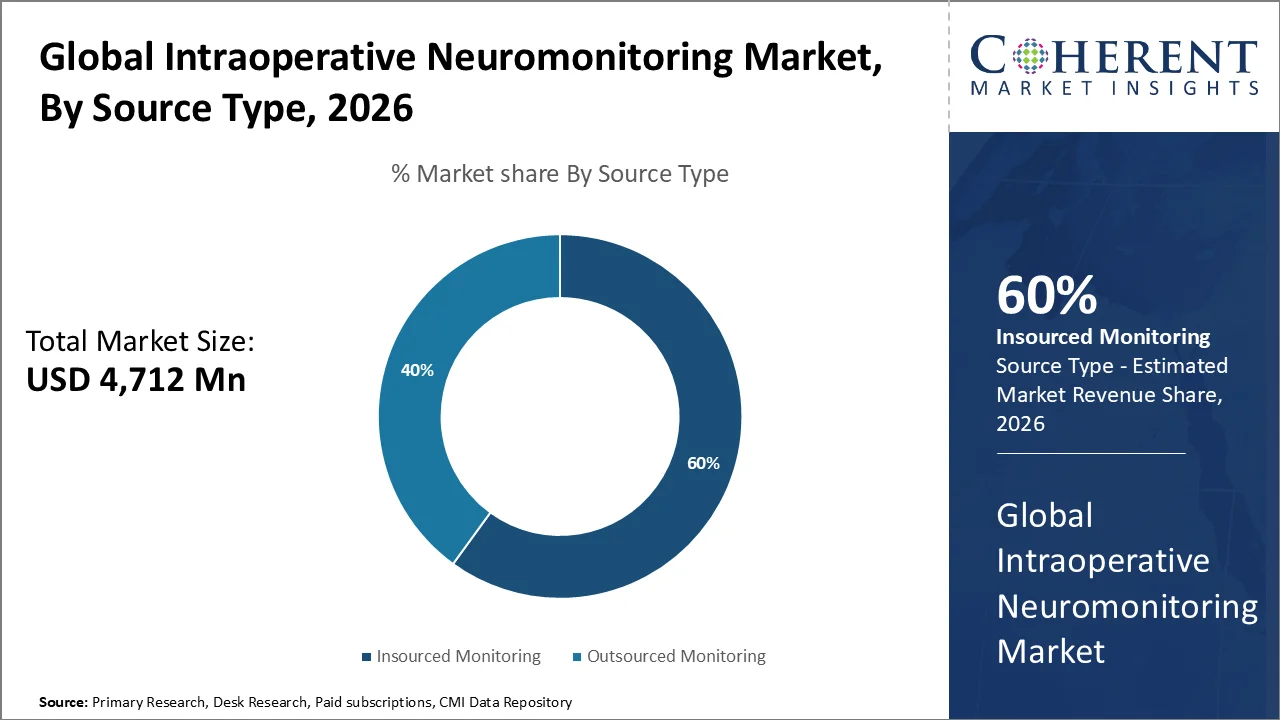
Based on source type, insourced monitoring is projected to account for the largest market share of 60% in 2026. This is mostly due to increasing focus of hospitals and ambulatory surgical centers on cost containment, improved clinical efficiency, and greater control over perioperative workflows.
Insourced monitoring enables healthcare providers to manage neuromonitoring services internally. This reduces reliance on third-party vendors as well as improves communication between surgical and neurophysiology teams and facilitates faster, more coordinated intraoperative decision-making. As a result, demand for insourced monitoring is increasing rapidly.
Intraoperative Neuromonitoring Market Growth Drivers
Rising Volume of Complex Surgeries
Increasing number of spinal, neurosurgical, orthopaedic, vascular, and cardiothoracic procedures is providing a strong impetus for the growth of the intraoperative neuromonitoring market. This is because these surgeries often require real-time monitoring of neural structures to help reduce the risk of neurological injury during operative procedures.
According to a global estimate published in The Lancet, approximately 234 million major surgical procedures are performed annually worldwide. This includes an increasing number of complex surgeries such as spinal, neurosurgical, orthopedic, cardiovascular, and vascular procedures that demand high precision and neurological protection. As a result, intraoperative neuromonitoring is increasingly being adopted in high-risk surgical procedures to support surgical decision-making and improve patient safety.
Intraoperative Neuromonitoring Market Opportunities
Increasing Prevalence of Neurological and Chronic Disorders
Increasing cases of neurological disorders are expected to create lucrative growth opportunities for the intraoperative neuromonitoring market during the forecast period. There is a rise in chronic conditions such as stroke, epilepsy, Parkinson’s disease, and degenerative spine disorders. For instance, recent This growing burden of neurological disorders is contributing to a higher number of neurosurgical and spinal procedures that require intraoperative nerve protection and monitoring.
Intraoperative Neuromonitoring Market Trends
Integration of AI and Machine Learning in IONM Systems
Leading manufacturers of intraoperative neuromonitoring systems are gradually using artificial intelligence (AI) and machine learning to enhance signal interpretation and detect subtle changes in neural activity. These technologies are being developed to support earlier identification of potential nerve injury risks and to assist clinicians in improving intraoperative decision-making accuracy.
For example, in March 2026, Natus Medical Incorporated announced the global launch of the autoSCORE™ AI analysis tool, expanding the availability of its AI-based EEG interpretation system integrated into the NeuroWorks platform. The tool is designed to provide automated clinical EEG interpretation with accuracy comparable to expert-level review. Such developments are expected to boost intraoperative neuromonitoring market growth during the assessment period.
Intraoperative Neuromonitoring Market Innovations
Technological Advancements in Intraoperative Neuromonitoring
Product innovation is taking center stage in the intraoperative neuromonitoring market. Manufacturers are increasingly focusing on improving accuracy, efficiency, and ease of use in surgical monitoring systems. Key innovations include multimodal monitoring such as EEG, EMG, SSEP, and MEP integration, AI-based signal interpretation, and real-time alerts combined with predictive analytics to enhance intraoperative decision-making.
There is also a rising trend towards developing portable and wireless intraoperative neuromonitoring solutions, which improve operational flexibility and workflow efficiency. These advancements are enhancing monitoring accuracy, supporting better surgical outcomes, and contributing to wider clinical adoption of intraoperative neuromonitoring technologies.
Current Events and Their Impact on the Intraoperative Neuromonitoring Market
Current Event | Description and its Impact |
Rising global surgical volume |
|
Increase in spine and back-related surgeries due to aging population |
|
Regional Insights
North America Remains at the Epicenter of Intraoperative Neuromonitoring Market Growth
North America is expected to retain its dominance over the global intraoperative neuromonitoring market during the forecast period, accounting for a share of 40% in 2026. This can be attributed to increasing volume of complex surgeries (spine, neurosurgery, and orthopedic procedures), strong healthcare infrastructure, and rising adoption of advanced surgical safety technologies such as multimodal monitoring systems.
Rising burden of neurological disorders and age-related conditions that increase surgical needs is playing a key role in boosting North America intraoperative neuromonitoring market. For example, according to the World Stroke Organization, over 12.2 million new strokes occur each year globally, many requiring neurosurgical intervention and monitoring support to reduce complications. This increasing disease burden is boosting demand for IONM systems in hospitals.
Asia Pacific to Emerge as Central Hub for Patient Positioning Device Manufacturers
Asia Pacific is set to emerge as a happy hunting ground for manufacturers of intraoperative neuromonitoring devices during the forecast period, holding a share of 25% in 2026. This is mostly due to increasing surgical volumes and healthcare infrastructure development. Similarly, rising hospital investments, growing awareness of patient safety during surgery, and increasing prevalence of chronic diseases are boosting Asia Pacific intraoperative neuromonitoring market.
Rising burden of noncommunicable diseases like cardiovascular and neurological disorders, which significantly increase surgical demand, is positively impacting sales of intraoperative neuromonitoring systems in the region. The World Health Organization estimates that NCDs account for around 52%–55% of all deaths in the South-East Asia Region, creating a strong need for advanced surgical care and monitoring systems like IONM.
Intraoperative Neuromonitoring Market Outlook – Country-wise
U.S. Intraoperative Neuromonitoring Market Trends
The United States is expected to remain the leading market for intraoperative neuromonitoring during the forecast period. This can be attributed to advanced healthcare infrastructure, high surgical volumes, and rapid adoption of technologies such as robotic-assisted and image-guided surgeries. Increasing demand for minimally invasive procedures and continuous upgrades in operating room systems that rely on real-time neural monitoring for safety and precision are also supporting market expansion.
China Intraoperative Neuromonitoring Market Forecast
The intraoperative neuromonitoring market in China is expected to grow steadily during the assessment period. This can be attributed to rapid expansion of healthcare infrastructure, rising hospital admissions, and increasing demand for advanced surgical procedures. Government investments in modern hospitals and hybrid operating rooms are also improving access to high-end surgical technologies, including neuromonitoring systems.
Who are the Major Companies in the Intraoperative Neuromonitoring Market?
Some of the major players in Intraoperative Neuromonitoring Market are Accurate Monitoring, Inomed Medizintechnik GmbH, Neuromonitoring Technologies, Natus Medical Incorporated, Medtronic, Biotronic NeuroNetwork, NuVasive Inc., Sentient Medical Systems, and SpecialityCare.
Key Strategies Adopted by Industry Players
Top intraoperative neuromonitoring companies are adopting various organic and inorganic strategies to boost their revenue as well as gain a competitive edge over the industry. These include new product launches and approvals, mergers, partnerships, acquisitions, and distribution agreements. Leading manufacturers are introducing advanced monitoring systems with higher accuracy and real-time feedback. They are also integrating AI and digital technologies to improve surgical outcomes and workflow efficiency.
- In July 2024, Soterix Medical received FDA 510(k) clearance for its MEGA-IOM Intraoperative Neuromonitoring System. The system integrates monitoring modalities such as motor evoked potentials, somatosensory evoked potentials, EEG, and peripheral nerve stimulation for intraoperative neurophysiologic monitoring.
- In April 2024, NeuroVigil announced the iBrain personal brain monitor. It is a portable, non-invasive EEG device that measures the brain’s electrical activity, including in people with neurological conditions.
- In 2024, Royal Philips launched Smart Quant Neuro 3D, an AI-based quantitative brain imaging solution. It is designed to support diagnosis and therapy assessment of brain disorders such as dementia, traumatic brain injury (TBI), and multiple sclerosis (MS).
Market Report Scope
Intraoperative Neuromonitoring Market Report Coverage
| Report Coverage | Details | ||
|---|---|---|---|
| Base Year: | 2025 | Market Size in 2026: | USD 4,712 Mn |
| Historical Data for: | 2020 To 2024 | Forecast Period: | 2026 To 2033 |
| Forecast Period 2026 to 2033 CAGR: | 6% | 2033 Value Projection: | USD 7,100 Mn |
| Geographies covered: |
| ||
| Segments covered: |
| ||
| Companies covered: | Accurate Monitoring, Inomed Medizintechnik GmbH, Neuromonitoring Technologies, Natus Medical Incorporated, Medtronic, Biotronic NeuroNetwork, NuVasive Inc., Sentient Medical Systems, and SpecialityCare. | ||
| Growth Drivers: |
| ||
| Restraints & Challenges: |
| ||
Analyst Opinion (Expert Opinion)
- Demand for intraoperative neuromonitoring is rising as more brain, spine, and complex surgical procedures are being performed worldwide. These surgeries need real-time nerve monitoring to reduce the risk of permanent nerve damage.
- A key growth driver is the increase in global surgical volume. According to a study published in The Lancet, there are an estimated over 300 million surgical procedures performed globally each year, creating a large base for IONM use in operating rooms.
- The aging population is also supporting market growth, as older patients are more likely to undergo neurological, cardiovascular, and spinal surgeries where nerve protection is critical.
- Advances in technology, such as more accurate signal detection systems and portable monitoring devices, are making intraoperative neuromonitoring easier to use and more widely accepted in hospitals and surgical centers.
Speak to the analyst
Want personalized insights?
Take the findings above to one of our principal consultants, or have the report rebuilt around the segments, geographies and competitors you actually track.
Market Segmentation
- By Modality Insights ( Revenue, USD Mn, 2021 - 2033)
- Somatosensory Evoked Potentials (SSEP)
- Motor Evoked Potentials (MEP)
- Electromyography (EMG)
- Brainstem Auditory Evoked Potentials (BAEP)
- Visual Evoked Potentials (VEP)
- Mapping for Motor Cortex
- Others
- By Source Type Insights ( Revenue, USD Mn, 2021 - 2033)
- Insourced Monitoring
- Outsourced Monitoring
- By End User Insights ( Revenue, USD Mn, 2021 - 2033)
- Hospitals
- Ambulatory Surgical Centers
- Others
- By Region Insights ( Revenue, USD Mn, 2021 - 2033)
- North America
- U.S.
- Canada
- Latin America
- Brazil
- Argentina
- Mexico
- Rest of Latin America
- Europe
- Germany
- U.K.
- Spain
- France
- Italy
- Russia
- Rest of Europe
- Asia Pacific
- China
- India
- Japan
- Australia
- South Korea
- ASEAN
- Rest of Asia Pacific
- Middle East
- GCC Countries
- Israel
- Rest of Middle East
- Africa
- South Africa
- North Africa
- Central Africa
- North America
Sources
Primary Research interviews
- Interviews with neurosurgeons, orthopedic surgeons, neurophysiologists, hospital procurement managers, operation theatre technicians, and clinical specialists involved in intraoperative neuromonitoring procedures across hospitals and surgical centers.
Databases
- PubMed
- National Library of Medicine (NLM)
- ClinicalTrials.gov
- World Health Organization (WHO) Global Health Observatory
- World Bank Data
- National Health Service (NHS) Digital
- U.S. National Institutes of Health (NIH) databases
Magazines
- Neurosurgery Practice News
- Medical Device & Diagnostic Industry (MD+DI)
- Neurology Today
- Journal of Clinical Neuroscience Highlights
- HealthTech Magazine
Journals
- Journal of Clinical Neurophysiology
- Neurosurgery
- Clinical Neurophysiology
- Journal of Neurosurgery
- Spine Journal
- World Neurosurgery
- Brain Sciences
Newspapers
- The New York Times (Health section)
- The Guardian (Science & Health)
- The Washington Post (Health)
- The Hindu (Science/Health)
- Financial Times (Healthcare coverage)
Associations
- American Association of Neurological Surgeons (AANS)
- Congress of Neurological Surgeons (CNS)
- International Society of Intraoperative Neurophysiology (ISIN)
- American Clinical Neurophysiology Society (ACNS)
- World Federation of Neurosurgical Societies (WFNS)
- European Academy of Neurology (EAN)
Public Domain sources
- U.S. Food and Drug Administration (FDA) device approvals database
- European Medicines Agency (EMA) reports
- WHO reports
- Government health ministry publications
- Hospital annual reports
- Open-access academic repositories
- Conference abstracts
- Clinical guidelines
Proprietary Elements
- CMI Data Analytics Tool
- Proprietary CMI Existing Repository of information for last 10 years.
Get access to 250+ pages report
Every segment, forecast, competitor profile and data table behind the analysis above — available for instant download.
- ESOMAR Member
- ISO 9001:2015 Certified
- D-U-N-S Registered
- GDPR & CCPA Compliant
Missing comfort of reading report in your local language? Find your preferred language:
Transform your Strategy with Exclusive Trending Reports
Frequently Asked Questions
The global Intraoperative Neuromonitoring Market is estimated to be valued at USD 4,712 Mn in 2026.
The global Intraoperative Neuromonitoring Market value is expected to reach USD 7,100 Mn by 2033.
The global market is poised to exhibit a CAGR of 6% from 2026 to 2033.
Major growth factors include rising prevalence of neurological disorders and increasing number of surgical failure leading to iatrogenic damages.
Somatosensory evoked potentials (SSEP) segment is set to lead the market with a share of 36% in 2026.
Some major companies in the Intraoperative Neuromonitoring Market include Accurate Monitoring, Inomed Medizintechnik GmbH, Neuromonitoring Technologies, Natus Medical Incorporated, Medtronic, Biotronic NeuroNetwork, NuVasive Inc., Sentient Medical Systems, and SpecialityCare.
North America, with 40% share in 2026, is set to lead the market during the forecast period.