Activation Analysis Equipment Market, By Procedure (Instrumental Neutron Activation Analysis, Radiochemical Neutron Activation Analysis, Epithermal Neutron Activation Analysis, Prompt – gamma Neutron Activation Analysis, and Fast Neutron Activation Analysis), By Application (Pharmaceutical Industry, Food and Nutraceuticals Industry, Biotechnological Industry, and Others), By Geography (North America, Latin America, Europe, Asia Pacific, Middle East, and Africa)
The Activation Analysis Equipment Market is anticipated to grow at a CAGR of 6.5% with USD 432.1 Mn in 2026 and is expected to reach USD 649.7 Mn in 2033. The Activation Analysis Equipment Market is gaining relevance as industries shift toward precise, non-destructive elemental testing for pharmaceuticals, cement, minerals, metals, environmental samples, and nuclear research. Demand is supported by the need to detect trace impurities, validate raw-material chemistry, and improve real-time process control without extensive sample preparation. For instance, in January 2026, the IAEA listed a new Kuwait project to enhance nuclear analytical capability using instrumental neutron activation with a compact neutron generator, showing continued government-backed investment in NAA infrastructure. In February 2026, EMA adopted updated elemental-impurity risk-management guidance for veterinary medicinal products, reinforcing the need for validated analytical procedures in regulated manufacturing. FDA’s QMSR also became effective in February 2026, strengthening quality-system expectations for regulated device manufacturers. Industrial adoption is supported by PGNAA/PFTNA systems; Malvern Panalytical lists CNA Pentos as quantifying 12 elements across cement raw materials, while AZoM highlighted PGNAA process optimization in January 2026.
Key Takeaways
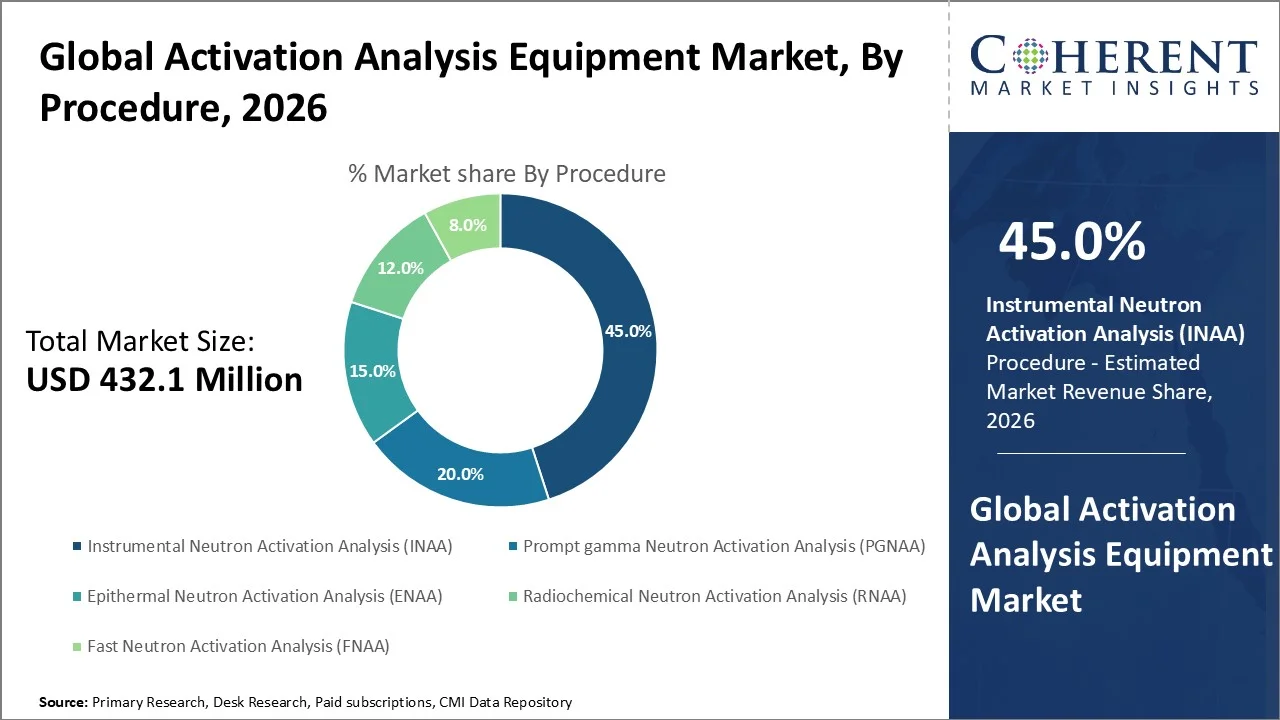
Instrumental Neutron Activation Analysis (INAA) is expected to account the largest share of 45.0% in 2026, because government scientific institutions and regulatory frameworks recognize it as a highly sensitive, non‑destructive multi‑element method essential for trace‑level elemental quantification across industries. For instance, in April 2024, the International Atomic Energy Agency (IAEA) notes INAA’s role in environmental monitoring, quality control, and materials research in reactors globally. National Institute of Standards and Technology (NIST) emphasizes INAA’s ability to measure dozens of elements at ultra‑low concentrations without chemical dissolution for certified reference materials (NIST database update, published May 2026). These authoritative sources underline INAA’s reliance as a benchmark analytical technique in regulatory and quality assurance frameworks.
Pharmaceutical industry will dominate with 40.0% in 2026, because drug makers require highly sensitive elemental-impurity, raw-material, API, excipient, and finished-product testing under strict quality systems. For instance, in March 2026, FDA’s CDER stated that its quality surveillance program tests selected drugs and APIs in FDA laboratories for identity, assay, impurities, and dissolution. FDA’s Office of Compliance report, published April 2026, recorded 314 warning letters, 321 drug recall events, 755 recalled products, and 10,922 drug listings inactivated in 2025, showing intense regulatory scrutiny. USP <233>, published April 2025 and official May 2026, further reinforces routine elemental-impurity procedure demand.
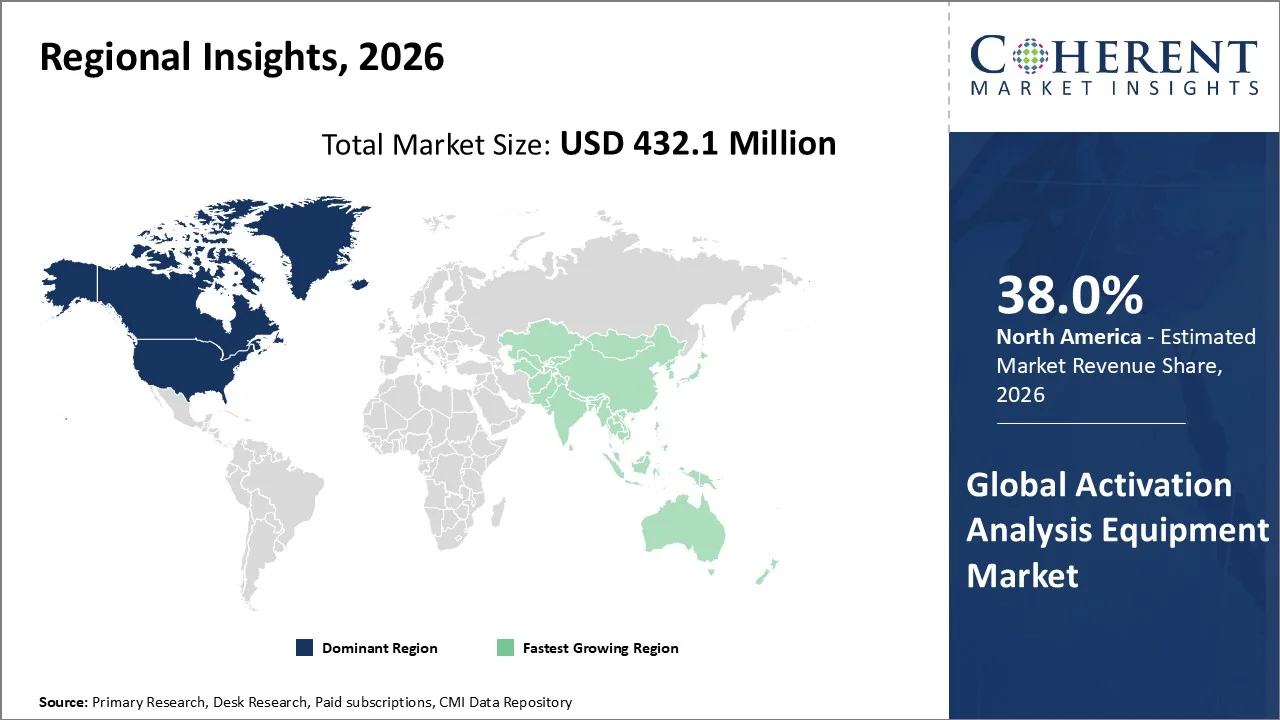
North America is expected to acquire the dominant share of 38.0% in 2026, because Filipino and Asian diaspora-led demand, strong café innovation, and clean-label reformulation are accelerating adoption. In January 2026, Starbucks confirmed Ube beverages for its spring menu; in April 2026, USDA projected food-away-from-home prices to rise 3.6%, supporting premium café formats. FDA’s April 2025 dye phase-out roadmap also supports natural, visually distinctive ingredients such as purple yam-based products.
Why is Instrumental Neutron Activation Analysis (INAA) Acquiring the Largest Market Share?
Instrumental Neutron Activation Analysis (INAA) is projected to account for the largest share of cognitive systems spending in 2026, representing approximately 45.0% of the total volume. Instrumental Neutron Activation Analysis (INAA) remains the dominant segment in the Activation Analysis Equipment Market because it delivers highly sensitive, non-destructive, multi-element analysis with minimal sample preparation, making it suitable for pharmaceuticals, food, water, mining, forensics, medicine, environmental testing, and advanced materials. The IAEA states that neutron activation analysis is one of the most widely used research-reactor applications after education and training, and even 10–30 kW reactors can provide sufficient neutron flux for selective analysis. This supports broad laboratory adoption where precise trace-element detection is required. For instance, in April 2026, the World Nuclear Association reported that the IAEA database listed 228 operational research reactors across 54 countries, creating a strong installed base for INAA services. Demand is further supported by regulated-product quality control, as FDA’s September 2022 ICH Q3D(R2) guidance requires risk assessment and control of elemental impurities in drug products.
Pharmaceutical Industry holds the Largest Market Share
Based on application, pharmaceutical industry dominates the market, accounting for a significant 40.0% share in 2026, because rigorous regulatory frameworks mandate comprehensive elemental and impurity testing to ensure drug safety, efficacy, and compliance. Global standards like ICH Q3D require risk‑based control and quantification of elemental impurities in drug substances and products, with harmonized permitted daily exposure (PDE) limits enforced by regulatory bodies including the US FDA and EMA (Nov 2025 and May 2026 guidelines). Analytical methods such as ICP‑MS and ICP‑OES are widely used to meet USP <232>/<233> validation requirements because they deliver precise, quantitative trace element data critical for drug approval. This intensive and routine testing across raw materials, APIs, packaging, and finished products drives sustained demand for advanced activation/elemental analysis equipment in pharmaceutical quality control and regulatory submissions.
Rising Need for Accurate Trace-Element Analysis & Stricter pharmaceutical and regulated-product quality control
Rising demand for accurate trace-element analysis is driving adoption of activation analysis equipment and the market growth because industries require non-destructive detection of low-concentration elements in medicine, food, water, environmental and mining samples. IAEA notes neutron activation analysis supports qualitative and quantitative elemental determination and is widely used in research reactors. Stricter pharmaceutical quality control further strengthens demand, as manufacturers must identify elemental impurities from catalysts, equipment, containers, water and excipients. In February 2026, EMA published elemental-impurity risk-management guidance, while FDA’s QMSR became effective in February 2026, reinforcing risk-based quality systems and validated testing for regulated device and medicinal product manufacturing workflows.
Additionally, FDA’s QMSR became effective in February 2026, aligning medical device quality systems with ISO 13485 and strengthening risk-management expectations. Europe Medicine Agency (EMA) also adopted elemental-impurity risk-management guidance in February 2026, increasing demand for validated impurity testing.
Growth in Nuclear Research and National Laboratory Investments
Growth in nuclear research and national laboratory investments is boosting the demand for activation analysis equipment, as these facilities require highly precise, non-destructive elemental testing for nuclear material characterization, fuel analysis, and environmental monitoring. Instrumental neutron activation analysis (INAA) and pulsed fast/thermal neutron activation (PFTNA) systems enable rapid, accurate quantification of multiple elements in a single sample. For instance, in January 2026, the IAEA reported a Kuwait project enhancing nuclear analytical capability using compact neutron generators for INAA, demonstrating continued government-backed investments in research infrastructure that directly increase procurement and adoption of activation analysis systems in laboratories worldwide.
Next-generation activation analysis systems and advanced detection technologies are accelerating the market growth
Next-generation activation analysis systems and advanced detection technologies are accelerating market growth by making elemental testing faster, more sensitive, and more reliable for regulated industries. HPGe-based gamma spectroscopy, automated sample handling, and improved spectral-processing tools help laboratories identify and quantify radionuclides and trace elements with lower analytical uncertainty. This supports wider use in pharmaceutical, environmental, nuclear, and materials-testing workflows. For instance, in April 2026, RSC highlighted that HPGe gamma-spectrum analysis needs optimized instrumental techniques to improve accuracy and reliability. FDA’s April 2026 Office of Compliance report recorded 314 warning letters and 321 drug recall events in 2025, strengthening demand for high-confidence analytical equipment.
Current Events and Their Impact on the Activation Analysis Equipment Market
Current Event
Description and its Impact
U.S. DOE Funding for Nuclear Research Infrastructure
Description: In April 2026, the U.S. Department of Energy awarded funding to university-led nuclear energy research projects through its Nuclear Energy University Program and related research programs. These awards support advanced nuclear technology research, nuclear materials studies, reactor safety, fuel-cycle research, and university research infrastructure.
Impact: This funding supports higher usage of research reactors, irradiation facilities, materials testing laboratories, and nuclear analytical infrastructure. As universities and national laboratories upgrade capabilities, demand increases for neutron activation analysis systems, gamma spectroscopy detectors, radiation monitoring systems, sample handling tools, calibration equipment, and analytical software. This creates steady demand from academic labs, government-funded research centers, and nuclear instrumentation suppliers.
India’s Nuclear Energy Mission and SMR R&D Push
Description: India announced a Nuclear Energy Mission under Union Budget 2025–26 with a ₹20,000 crore allocation for research, design, development, and deployment of Small Modular Reactors. The Department of Atomic Energy confirmed work on indigenous SMR designs such as BSMR-200 and SMR-55, while the government aims to expand nuclear power capacity toward 100 GW by 2047.
Impact: India’s nuclear R&D push will require stronger testing infrastructure for reactor materials, fuel behavior, radiation shielding, neutron irradiation, and safety validation. This supports demand for activation analysis equipment, neutron-based testing systems, HPGe gamma detectors, radiation measurement instruments, and laboratory shielding systems. The initiative can also attract private-sector participation, widening procurement opportunities for equipment suppliers serving nuclear laboratories and research institutions.
U.S. NRC Part 53 Rule for Advanced Reactor Licensing
Description: In March 2026, the U.S. Nuclear Regulatory Commission issued the Part 53 final rule, creating a risk-informed and technology-inclusive licensing framework for advanced nuclear reactors. The rule provides an optional pathway for commercial nuclear plants, including advanced reactors and SMR-type technologies.
Impact: A clearer licensing pathway encourages developers to generate technical evidence for reactor materials, fuels, shielding performance, and radiation behavior. This increases the need for non-destructive testing, elemental analysis, isotopic measurement, irradiation testing, and gamma spectroscopy. As reactor developers move faster from design to demonstration, laboratories may invest in activation analysis equipment to support qualification, safety documentation, and regulatory submissions.
FDA Lead Action Levels for Baby Food Under Closer to Zero Initiative
Description: In January 2025, the U.S. FDA issued final guidance setting action levels for lead in processed foods intended for babies and young children. The guidance forms part of FDA’s Closer to Zero initiative, which focuses on reducing exposure to toxic elements such as lead in children’s foods.
Impact: Stricter attention to toxic elements increases testing needs across food manufacturing, contract testing, and regulatory laboratories. While ICP-MS remains widely used for routine testing, activation analysis can support non-destructive multi-element confirmation, reference testing, and specialized trace-element validation. This regulatory pressure supports demand for gamma spectroscopy systems, sample preparation equipment, certified standards, and high-precision analytical services.
Canada’s Renewed Funding for Neutron Beam Research Infrastructure
Description: In March 2026, McMaster University received renewed federal research infrastructure support through the Canada Foundation for Innovation to expand the Canadian Neutron Beam Laboratory at the McMaster Nuclear Reactor. The facility strengthens Canada’s domestic neutron beam access for materials and scientific research.
Impact: Expansion of neutron beam infrastructure directly supports the ecosystem needed for activation analysis and neutron-based characterization. Improved access to neutron facilities can increase research volume in materials science, clean energy, nuclear engineering, and advanced manufacturing. This creates demand for neutron irradiation accessories, detectors, beamline instrumentation, sample transfer systems, analytical software, and laboratory support equipment.
Growing demand from healthcare & pharmaceuticals for ultra ‑ trace analysis — Regulatory pressure on impurity profiling (e.g., ICH Q3D/USP <232>) has intensified demand for sensitive elemental analysis systems like activation/ICP technologies for drug safety testing and quality control. This is driving labs and CDMOs to invest in high‑precision equipment capable of meeting stringent elemental impurity limits (latest FDA/EMA guidelines).
Expansion of advanced analytical techniques & hybrid workflows — Advances such as automated neutron activation analysis (including PGNAA) combined with computational modeling and software have improved throughput, accuracy, and multi‑element detection. These innovations make activation analysis more versatile for materials, semiconductor, environmental, and pharmaceutical research, boosting adoption in mainstream analytical labs.
Rise of portable & field ‑ deployable elemental analyzers with high sensitivity — Recent scientific studies highlight a significant shift toward compact, field‑usable analytical instruments that deliver rapid, reliable elemental data outside traditional laboratories. For instance, in April 2026, a peer‑reviewed journal article demonstrated a portable X‑ray fluorescence (pXRF) system coupled with a novel trapping medium that quantitatively measures mercury in soil onsite within 10 minutes, achieving detection limits as low as 12 ng/g with strong reproducibility. This reflects increasing demand for rugged, quick, non‑destructive elemental analysis in environmental monitoring, remediation assessment, and regulatory compliance without extensive sample digestion or transport delays.
Automation & AI ‑ Enhanced workflows in analytical instrumentation — Peer‑reviewed research in TrAC: Trends in Analytical Chemistry (April 2026) and spectroscopy trade literature shows that AI/ML is fundamentally transforming spectral and elemental analysis workflows by automating baseline correction, feature extraction, and multivariate modelling. These intelligent systems reduce reliance on manual interpretation, improve accuracy and reproducibility, and enable real‑time insights. AI‑driven chemometric and deep learning models are increasingly embedded into modern elemental and spectroscopic instruments, optimizing data processing, predictive analytics, and automated decision‑making across regulated analytical labs.
North America dominates owing to Strong Technological Infrastructure
North America account 38.0% market share in 2026, due to its strong research infrastructure and regulatory compliance environment. The U.S. hosts world‑class neutron research facilities (e.g., Oak Ridge National Laboratory HFIR/SNS and the NIST Center for Neutron Research) that are central to activation/neutron analytical science and multidisciplinary materials testing. A federal economic impact analysis (NIST/RTI International) highlights the outsized role of neutron science, including returns on investment and broad industrial use, driving advanced analytical demand. Top analytical instrument manufacturers such as Thermo Fisher Scientific and PerkinElmer have headquarters or major operations in the U.S., supporting technology availability and service networks.
Furthermore, U.S. regulatory bodies like the FDA continue to evolve analytical method policies, emphasizing flexibility in validating and employing modern analytical technologies; this reflects a regulatory environment that supports lab certification and advanced procedures without rigid, outdated methods.
Asia Pacific Activation Analysis Equipment Market Trends
The Asia-Pacific region is poised to be as the fastest-growing region through 2026-2033, owing to expanding scientific infrastructure, strong government research support, and integrated regional cooperation in science and technology. For instance, in February 2026, according to the United Nations ESCAP’s Asia and the Pacific SDG Progress Report 2026, Asia Pacific continues to outpace other regions in economic and development growth, enabling broader public investment in research and laboratory capabilities that require advanced analytical systems like elemental and activation analysis. Regional initiatives through government partnerships, such as India’s RCA Chairmanship 2026 under the IAEA totalling shared nuclear science applications, further strengthen capacity building and technology dissemination across member states, supporting analytical equipment adoption for healthcare, environmental, and industrial testing.
Growing Advancement in Healthcare Infrastructure and Innovation Ecosystem is Accelerating the Activation Analysis Equipment Market Demand in United States
The U.S. activation analysis equipment market dominates North America given due to its unmatched research and innovation ecosystem. According to The State of U.S. Science and Engineering 2026, the U.S. remains one of the world’s most R&D‑intensive economies, with high federal and business research activity driving scientific output and instrumentation demand. Federal agencies and national labs, supported by about US$181.4 billion in R&D appropriations for FY 2026 (Congressional Research Service report, Dec 23, 2025), fund advanced analytical science and infrastructure that require activation and elemental analysis tools. The combination of strong funding pipelines, world‑class laboratories, and robust industry–university partnerships ensure early adoption of cutting‑edge analytical equipment across pharmaceuticals, materials, and environmental sectors.
China Activation Analysis Equipment Market Trends
China has become the biggest player in the Asia Pacific activation analysis equipment market in 2026. China’s dominance stems from strategic national investment in science, technology, and advanced equipment infrastructure. For instance, in March 2026, Beijing outlined its drive for technological breakthroughs and self‑reliance in core tech sectors, including high‑end instruments and biotechnology, as part of its 15th Five‑Year Plan focus on innovation‑led growth. Government funding for science and technology increased central R&D spending and basic research investment in April 2026 budget reports, boosting laboratory equipment acquisition and national analytical capabilities. Additionally, China’s large industrial base spanning pharmaceuticals, environmental monitoring, semiconductors, and life sciences fuels adoption of elemental and analytical techniques for regulatory compliance and quality testing, backed by ongoing national equipment upgrade programs and science‑policy support.
Who are the Major Companies in Activation Analysis Equipment Market
Some of the major key players in Activation Analysis Equipment Market are ADVANCE RESEARCH INSTRUMENTS CO., Frontier Technology Corporation, Nucleonix Systems, Realtime Group Limited, Thermo Fisher Scientific, Malvern Panalytical Ltd. AMETEK, Inc., and Elemental Analysis, Inc.
Key News
In March 2026, Applied Rigaku Technologies launched the NEX QC II Series benchtop XRF analyzers at Pittcon 2026. These energy dispersive X‑ray fluorescence (EDXRF) systems deliver fast, non‑destructive elemental analysis from sodium to uranium with enhanced detector configurations and rugged industrial design for QC and at‑line labs.
In May 2026, Agilent Technologies, an American global leader in life sciences, diagnostics, and applied chemical introduced the 9500 Triple Quadrupole ICP‑MS system in Santa Clara, CA. This next‑generation inductively coupled plasma mass spectrometer improves trace elemental analysis with faster acquisition times, advanced interference removal, and greater data quality for environmental, food, pharmaceutical, and industrial labs.
In March 2026, PerkinElmer, laboratory equipment supplier unveiled the Avio 3000 ICP‑OES system at Analytica 2026. The Avio 3000 offers high‑throughput, cost‑efficient optical emission spectroscopy with a redesigned generator and detector, enhancing elemental analysis performance while reducing resource consumption.
In January 2026, Shimadzu launched the ALTRACE EDXRF spectrometer for efficient elemental analysis with sub‑ppm sensitivity and minimal sample preparation, accommodating liquids, powders, and solids for high‑throughput labs.
The Activation Analysis Equipment Market is evolving beyond a niche analytical segment into a core component of quality control, regulatory compliance, and R&D investment across industries. As laboratories, pharmaceutical companies, and environmental agencies expand their analytical capabilities, global spending on advanced elemental and activation analysis equipment is expected to rise significantly in 2026, reflecting the adoption of high‑sensitivity, multi-element instrumentation for trace analysis. This growth indicates that organizations continue to prioritize accuracy, regulatory adherence, and process efficiency in analytical workflows.
The pharmaceutical and biotech sectors are primary drivers of activation analysis adoption, particularly for elemental impurity profiling, compliance with ICH Q3D and USP <232>/<233> standards, and quality control of APIs and finished products. In 2026, the China National Medical Products Administration (NMPA) reported that over 75% of newly registered drugs incorporated advanced analytical testing including neutron and gamma activation, showing strong regulatory influence on market expansion.
Leading laboratories and contract research organizations (CROs) are investing heavily in automated and AI-enabled activation analysis systems, moving beyond pilot testing to full-scale deployment. A 2026 MDPI journal study highlighted that 68% of CROs and academic labs integrated automated elemental analysis platforms to improve throughput, reduce human error, and support regulatory reporting, emphasizing measurable operational value from these systems.
Asia Pacific is emerging as the fastest-growing regional market, driven by government-led R&D initiatives, expanding industrial and pharmaceutical testing infrastructure, and investment in research reactors and analytical laboratories. Countries such as China, India, and South Korea are adopting advanced activation and elemental analysis systems at scale. In 2026, UN ESCAP reported that Asia Pacific leads in public and private analytical instrumentation investment, highlighting the region’s increasing share of global market adoption.
Interviews with laboratory heads, analytical chemists, and QA/QC managers to understand adoption challenges, equipment performance issues, and integration of activation analysis systems into existing testing workflows.
Insights from equipment manufacturers, R&D managers, and service engineers on technological advancements, instrument automation, calibration processes, and emerging system capabilities.
Discussions with industry analysts, consultants, and market advisors to evaluate market trends, competitive landscape, regulatory influence, and activation analysis systems’ role in improving operational efficiency.
Conversations with decision-makers in pharmaceutical, environmental, nuclear, and public-sector laboratories to assess investment priorities, implementation hurdles, compliance requirements, and data management or safety concerns.
Databases
U.S. National Institute of Standards and Technology (NIST) – Instrumental Neutron Activation Analysis resources
U.S. Department of Energy (DOE) – Nuclear R&D and analytical instrumentation data
International Atomic Energy Agency (IAEA) – Analytical laboratories and neutron activation reports
OECD Science, Technology and Innovation (STI) Database – R&D statistics in analytical instrumentation
U.S. Environmental Protection Agency (EPA) – Elemental testing and monitoring databases
Magazines
Analytical Scientist – Laboratory instrumentation and elemental analysis updates
Lab Manager Magazine – Industry trends, lab automation, and analytical equipment features
Lab World Magazine – Market updates and lab technology reviews
Instrumentation Today – Equipment innovation and product launch coverage
Journals
Journal of Radioanalytical and Nuclear Chemistry – Activation analysis and nuclear techniques
Applied Radiation and Isotopes (Elsevier) – Elemental analysis studies and instrumentation research
Analytical Chemistry (ACS Publications) – Trace-element and non-destructive analysis research
MDPI Sensors – Gamma spectroscopy and neutron-based detection systems
ResearchGate – Peer-reviewed studies on neutron activation and analytical methodologies
Newspapers
Financial Times – Science & Technology Section
The New York Times – Science Section (instrumentation & lab technologies)
The Guardian – Technology & Environment Section
The Wall Street Journal – Science & Technology Section
Scientific American (News Section) – Analytical instrument market and innovations
Associations
American Chemical Society (ACS) – Division of Analytical Chemistry
International Union of Pure and Applied Chemistry (IUPAC) – Standardization in elemental analysis
American Society for Testing and Materials (ASTM International) – Standards for analytical equipment
Institute of Electrical and Electronics Engineers (IEEE) Instrumentation Section
International Atomic Energy Agency (IAEA) – Analytical instrumentation programs
Public Domain Sources
NIST Technical Reports – Neutron Activation Analysis and reference materials
DOE Research Publications – Nuclear analytical systems and lab infrastructure
IAEA Reports on Analytical Laboratories and Nuclear Techniques
U.S. Federal Government Environmental Monitoring Data (EPA)
Company Annual Reports and Investor Presentations from publicly listed analytical equipment manufacturers (Thermo Fisher Scientific, PerkinElmer, Agilent)
Proprietary Elements
CMI Data Analytics Tool
Proprietary CMI Existing Repository of information for last 10 years
Share
Share
About Author
Komal Dighe is a Management Consultant with over 8 years of experience in market research and consulting. She excels in managing and delivering high-quality insights and solutions in Health-tech Consulting reports. Her expertise encompasses conducting both primary and secondary research, effectively addressing client requirements, and excelling in market estimation and forecast. Her comprehensive approach ensures that clients receive thorough and accurate analyses, enabling them to make informed decisions and capitalize on market opportunities.
Missing comfort of reading report in your local language? Find your preferred language :
The Activation Analysis Equipment Market is expected to reach USD 649.7 Mn in 2033.
Major players operating in the global Activation Analysis Equipment Market include ADVANCE RESEARCH INSTRUMENTS CO., Frontier Technology Corporation, Nucleonix Systems, Realtime Group Limited, Thermo Fisher Scientific, Malvern Panalytical Ltd. AMETEK, Inc., and Elemental Analysis, Inc.
Stringent regulatory and licensing requirements and limited infrastructure in emerging economies are the major factors hampering the growth of the activation analysis equipment market.
Rising need for accurate trace-element analysis & stricter pharmaceutical and regulated-product quality control and growth in nuclear research and national laboratory investments are the key factors driving the growth of the activation analysis equipment market.
The Activation Analysis Equipment Market is anticipated to grow at a CAGR of 6.5% between 2026 and 2033.
Among regions, North America is expected to account for a largest market share in the global Activation Analysis Equipment Market over the forecast period.