Automotive Driving Simulator Market Analysis & Forecast: 2026-2033

The global automotive driving simulator market is estimated to be valued at USD 159.8 Mn in 2026 and is projected to grow at a compound annual growth rate (CAGR) of 3% during the forecast period (2026-2033), reaching to USD 196.5 Mn by 2033. This growth can be attributed to increasing adoption of advanced driver assistance systems (ADAS), rising investments in autonomous vehicle development, and expanding use of simulation technologies for driver training and vehicle testing.
The global automotive driving simulator market is anticipated to register steady growth during the assessment period. This is primarily due to rising demand for advanced driver training solutions, increasing emphasis on road safety, and growing adoption of simulation-based testing in the automotive industry.
Automotive driving simulators are increasingly being used by manufacturers, research institutions, and driving schools to replicate real-world driving conditions in a controlled virtual environment. These systems help in evaluating vehicle performance, testing autonomous driving technologies, and improving driver behavior without the risks associated with on-road testing.
Rapid advancements in virtual reality (VR), artificial intelligence (AI), and high-fidelity graphics are significantly enhancing simulator realism and effectiveness. The expansion of autonomous and semi-autonomous vehicle development programs is also fueling demand for sophisticated simulation platforms.
Growth in automotive R&D and virtual testing is expected to fuel demand for automotive driving simulator solutions during the forecast period. Automakers and suppliers are increasingly investing in simulation technologies to shorten vehicle development cycles, reduce prototype testing costs, and evaluate vehicle performance across thousands of virtual scenarios. This makes simulators a critical component of OEM engineering workflows.
Shift towards autonomous and software-based simulation platforms is also boosting automotive driving simulator market growth. Modern simulator platforms are becoming software-defined, cloud-enabled with remote access capabilities, and scalable for multi-user and multi-location environments.
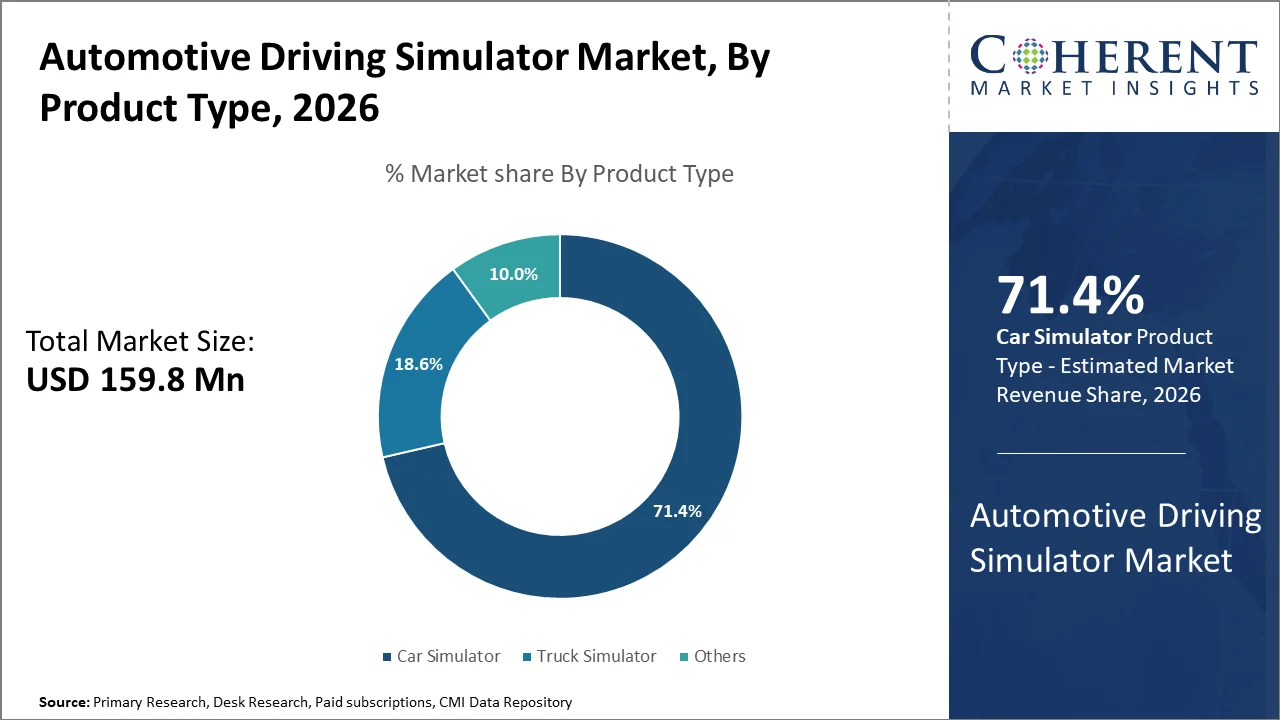
According to Coherent Market Insights’ latest automotive driving simulator market analysis, car simulator is set to lead the market, capturing a share of 71.4% in 2026. This dominance is mostly due to its rising adoption across driver training programs, automotive R&D centers, and advanced safety testing applications.
Car simulators offer a cost-effective and highly controlled environment for evaluating vehicle performance, driver behavior, and safety systems without the risks associated with real-world testing. As a result, their demand is expected to increase steadily during the forecast period.
Automakers and research institutions are increasingly integrating car simulation platforms to accelerate the development of autonomous driving technologies, ADAS (Advanced Driver Assistance Systems), and electric vehicle performance optimization. The growing emphasis on reducing testing costs, improving regulatory compliance, and enhancing road safety has further strengthened demand.
To learn more about this report, Request Free Sample
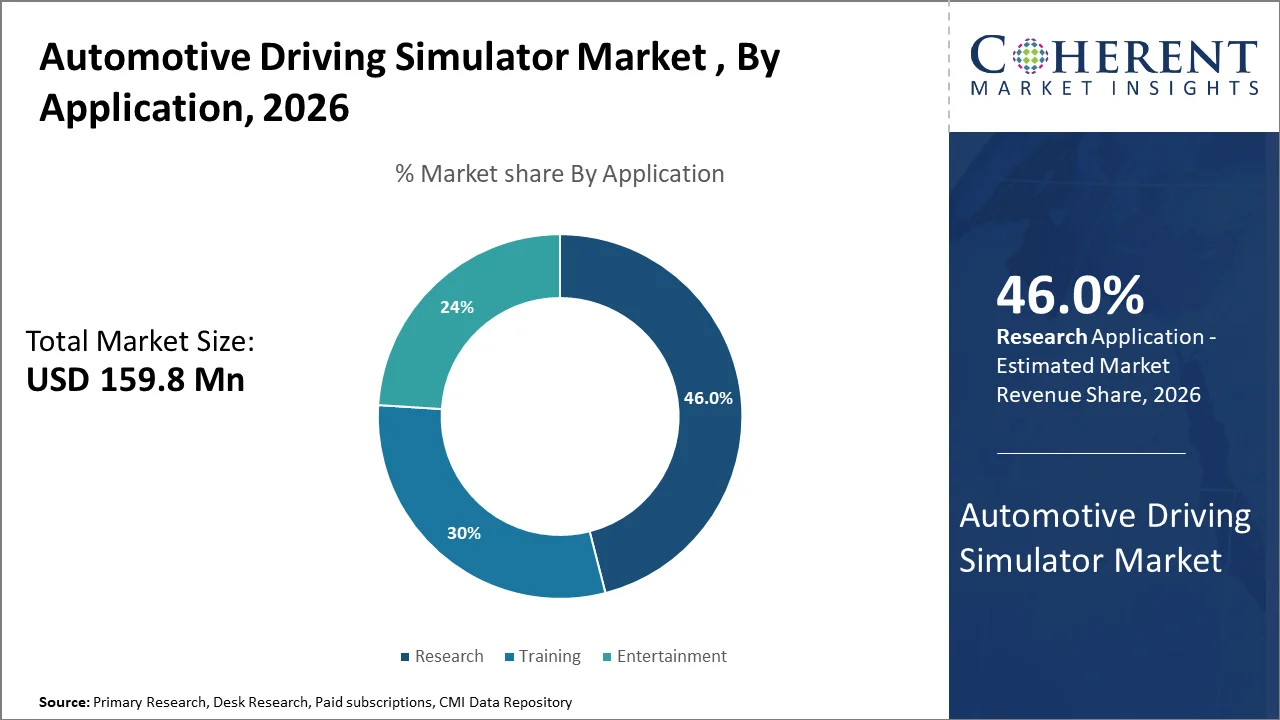
By application, research segment is projected to account for the largest market revenue share of 46% in 2026. This can be attributed to increasing use of driving simulators in automotive R&D programs for vehicle design validation, safety testing, and performance optimization. Manufacturers and research institutions in the contemporary world are increasingly adopting simulation-based environments to reduce dependency on real-world road testing.
In addition, rising emphasis on autonomous vehicle development and advanced driver-assistance systems (ADAS) are fueling demand for high-fidelity simulation platforms. These systems have the tendency to allow engineers to replicate complex driving scenarios, such as extreme weather conditions, urban traffic patterns, and edge-case events.
Increasing emphasis on road safety and accident prevention is a major driver of the automotive driving simulator market. Governments and transport authorities worldwide are increasingly promoting simulator-based training to minimize real-world driving risks. Driving simulators enable safe exposure to hazardous conditions such as fog, heavy rain, and emergency braking without endangering learners.
According to the This highlights road traffic accidents as a major global public health concern and is encouraging governments and training institutions to adopt simulator-based driver training as a safer and more scalable alternative to on-road training.
Increasing adoption of Advanced Driver Assistance Systems (ADAS) in the automotive industry is expected to create lucrative growth opportunities for the automotive driving simulator market during the forthcoming period. Modern vehicles increasingly rely on ADAS and partial automation, requiring controlled simulation environments to safely test complex driving scenarios and edge cases. Simulators are widely used to validate braking, lane-keeping, and collision avoidance systems, while also supporting autonomous vehicle algorithm training and validation. By enabling virtual testing, they significantly reduce dependence on expensive real-world road testing and improve development efficiency.
AI-powered driving simulation environments are increasingly being integrated into the automotive driving simulator market. Artificial Intelligence enhances simulations by improving the creation and management of virtual driving scenarios, making them more realistic, adaptive, and data-driven. It enables simulators to better replicate real-world driving conditions, improving their effectiveness for testing and training purposes.
AI is being increasingly used to generate realistic traffic behavior and driver interactions, create dynamic driving scenarios such as varying traffic density, pedestrian movement, and adverse road conditions, and personalize driver training modules based on user performance and learning needs. This technological advancement is expected to support the growth of the automotive driving simulator market during the forecast period.
|
Current Event |
Description and its Impact |
|
Strong rise in simulator use for ADAS & autonomous vehicle testing |
|
|
Rapid industry push toward simulation conferences & research ecosystem expansion |
|
Uncover macros and micros vetted on 75+ parameters: Get instant access to report
To learn more about this report, Request Free Sample
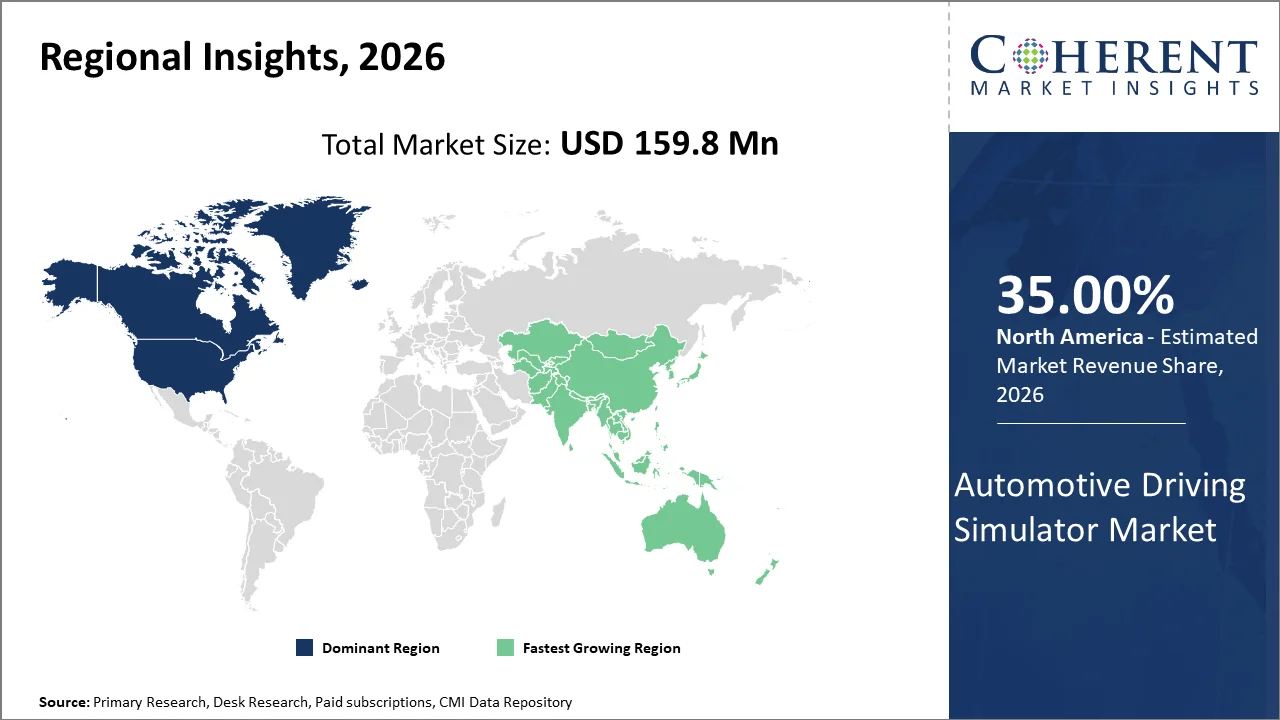
North America is expected to lead the global automotive driving simulator market, accounting for an estimated 35% share in 2026. This is mostly due to rising investments in autonomous driving research, ADAS validation, and advanced driver training systems across the U.S. and Canada.
The growing adoption of simulation platforms for testing autonomous and ADAS technologies, instead of relying solely on real-road testing, is boosting North America automotive driving simulator market. Companies such as Tesla, Ford, and General Motors are increasingly investing in simulation and digital twin-based testing to accelerate vehicle development as well as reduce costs.
Government and institutional initiatives in the region also support the use of driving simulators to improve road safety and enhance transportation research. For example, the University of Iowa’s NADS (National Advanced Driving Simulator) undertakes various research activities concerning automated driving and the conduct of drivers, through transportation safety programs funded by the United States.
Asia Pacific is expected to emerge as the fastest growing market for automotive driving simulators, exhibiting a CAGR of 7.1% during the forecast period. This can be attributed to strong vehicle production hubs, rapid urbanization, increasing vehicle ownership, and government’s focus on road safety and driver training systems.
Rising use of simulators for large-scale driver training and EV development programs, especially in China and India, where road safety remains a major concern, is boosting market growth in the region. For example, China has integrated simulation-based driving education in several provincial licensing and training systems to improve driver readiness under complex traffic conditions.
In Japan, companies like Honda and Toyota are using advanced simulation environments for autonomous driving and robotics-based mobility testing, reducing real-world testing risks as well as costs. Similarly, India’s transport modernization programs are increasingly promoting simulator-based training for commercial drivers to reduce accident rates and improve skill development.
The U.S. is expected to remain a leading market for automotive driving simulator solutions during the forecast period. This is due to rising adoption of ADAS technologies, high vehicle ownership, and strict road safety regulations. Increasing use of simulators in autonomous vehicle testing and driver training programs is also supporting market expansion.
Shift toward virtual testing environments, where companies use simulation to reduce real-world crash testing costs as well as speed up development, is a key growth-shaping market trend. For example, the U.S. Department of Transportation is actively supporting automated vehicle testing frameworks that encourage simulation-based validation for safety and performance evaluation.
China is emerging as a highly lucrative pocket for manufacturers of automotive driving simulator solutions. This is mostly due to massive vehicle production, rapid EV adoption, and increasing investment in autonomous driving technologies. Expansion of smart mobility ecosystems and growing urban traffic complexity are encouraging automakers to use simulators for safer and more efficient testing.
Some of the major players in automotive driving simulator market are AutoSim AS, Teknotrove Simulator System Pvt. Ltd, OKTAL, Cruden B.V., Mechanical Simulation Corporation, Dallara, Moog, Inc., IPG Automotive, ECA- Group, and Ansible Motion.
Leading automotive driving simulator manufacturers are adopting various organic and inorganic strategies to expand their customer base as well as boost their sales. These include new product launches, mergers, partnerships, acquisitions, distribution agreements, and facility expansions.
Many automobile driving simulators manufacturers have been working on the development of high realism simulations that mimic the exact situation experienced when a person drives in the real world. These manufacturers are utilizing the latest technology including VR, AR, and motion simulation technologies to create the most accurate simulations and to make users immersed.
| Report Coverage | Details | ||
|---|---|---|---|
| Base Year: | 2025 | Market Size in 2026: | USD 159.8 Mn |
| Historical Data for: | 2020 To 2024 | Forecast Period: | 2026 To 2033 |
| Forecast Period 2026 to 2033 CAGR: | 3% | 2033 Value Projection: | USD 196.5 Mn |
| Geographies covered: |
|
||
| Segments covered: |
|
||
| Companies covered: |
AutoSim AS, Teknotrove Simulator System Pvt. Ltd, OKTAL, Cruden B.V., Mechanical Simulation Corporation, Dallara, Moog, Inc., IPG Automotive, ECA- Group, and Ansible Motion. |
||
| Growth Drivers: |
|
||
| Restraints & Challenges: |
|
||
Uncover macros and micros vetted on 75+ parameters: Get instant access to report
Share
Share
Ameya Thakkar is a seasoned management consultant with 9+ years of experience optimizing operations and driving growth for companies in the automotive and transportation sector. As a senior consultant at CMI, Ameya has led strategic initiatives that have delivered over $50M in cost savings and revenue gains for clients. Ameya specializes in supply chain optimization, process re-engineering, and identification of deep revenue pockets. He has deep expertise in the automotive industry, having worked with major OEMs and suppliers on complex challenges such as supplier analysis, demand analysis, competitive analysis, and Industry 4.0 implementation.
Joining thousands of companies around the world committed to making the Excellent Business Solutions.
View All Our Clients