

Automotive Floor Mats Market Analysis & Forecast - 2026 to 2033
Automotive Floor Mats Market size is estimated to be valued at USD 14.3 Mn in 2026 and is expected to reach USD 19.8 Mn in 2033, exhibiting a compound annual growth rate (CAGR) of 4.7% from 2026 to 2033.
Key Takeaways
- By Product Type, The Textile Mats Segment is projected to register the highest CAGR of 54.5% during the forecast period, driven by their durability and flexibility.
- By Region, Asia Pacific is expected to lead the global automotive floor mats market outlook in 2026, holding approximately 35.00% of the revenue share due to rising vehicle production and increasing consumer spending.
Market Overview
The automotive floor mats market is expected to witness significant growth over the forecast period. This is owing to increasing preference for lighter, more efficient, and aesthetically-pleasing automotive floor mats in the automotive industry. Although automotive mats are one of the highest-selling accessories in terms of volume, their low average selling price does not offer high revenue and profit. Automotive floor mats that are custom-fit offer edge-to-edge protection and add to the aesthetic quotient of the vehicle. This growth is attributed to increasing automobile production worldwide. For instance, Chinese motorists purchased around 23.56 million passenger cars in 2022. Furthermore, increasing preference for comfort and safety among the populace in vehicles is expected to boost demand for automotive floor mats during the forecast period.
Current Events and Its Impacts on the Automotive Floor Mats Market
Event | Description and Impact |
Global Supply Chain Disruptions and Raw Material Shortages |
|
China’s Zero-COVID Policy Shifts and Manufacturing Recovery |
|
European Union Sustainability Regulations and Circular Economy Initiatives |
|
Pricing Analysis
The global automotive floor mats market offers a wide range of pricing options to suit different consumer needs, from budget-friendly economy mats to high-end luxury products. Prices vary based on material quality, customization, brand reputation, and sales channels.
The economy segment typically ranges from $10 to $50 and includes universal-fit mats made from basic rubber, vinyl, or carpet. These products target mass-market retail and focus on affordability. Brands like Motor Trend, BDK, and Armor All lead this segment by offering practical, value-driven mats.
In the mid-range segment ($50 to $150), mats are often semi-custom or model-specific, made from enhanced materials such as premium rubber and carpet. Well-known brands like Michelin and Goodyear operate here, offering a balance between quality and cost through widespread retail availability.
The premium segment ($150 to $300) features custom-fit mats made from high-quality materials like leather and premium carpet. Brands such as WeatherTech, 3D MAXpider, and Husky Liners provide precision-engineered products with superior durability and aesthetics, justifying higher price points.
At the top end, the luxury segment includes bespoke floor mats priced above $300. These mats use exclusive materials and advanced features, typically offered by luxury car manufacturers and through exclusive channels, appealing to buyers looking for premium customization.
- Current Industry Events of 2026
- Market Size Estimation
- Regional Breakdown
- Competitive Landscape
- Customer Intelligence
- Segmental Analysis
- Pricing Analysis
- Key Market Drivers, Challenges & Future Trends
- Customized Insights Section
Role of Advanced Technology
The automotive floor mats market is rapidly evolving through technological innovations that enhance performance, durability, and user experience. Advanced materials such as thermoplastic elastomers (TPE) and thermoplastic polyurethane (TPU) films offer superior flexibility and temperature resistance compared to traditional rubber. Hybrid polymers maintain flexibility in extreme cold while withstanding high heat, improving product longevity.
Nano-coating technologies provide stain resistance and antimicrobial properties, reducing maintenance by creating self-cleaning surfaces. Precision manufacturing, using 3D scanning, CAD design, and laser cutting, enables custom-fit mats tailored to specific vehicle models, ensuring seamless integration and optimal protection.
Injection molding and overmolding techniques allow complex designs combining rigid and soft materials for enhanced comfort and durability. Digital printing advances enable detailed customization with UV-resistant inks, appealing to consumers seeking personalized designs.
Smart integrations such as embedded RFID chips and QR codes offer product authentication, maintenance tracking, and warranty management, often paired with smartphone apps. Additionally, bio-based and recycled materials support sustainability goals, aligning with growing environmental regulations.
Technologies enhancing weather resistance, anti-slip performance, and moisture management further improve safety and convenience. Collectively, these advancements drive market growth, premium product demand, and new business models, reshaping competitive dynamics in the automotive floor
Segmental Insights
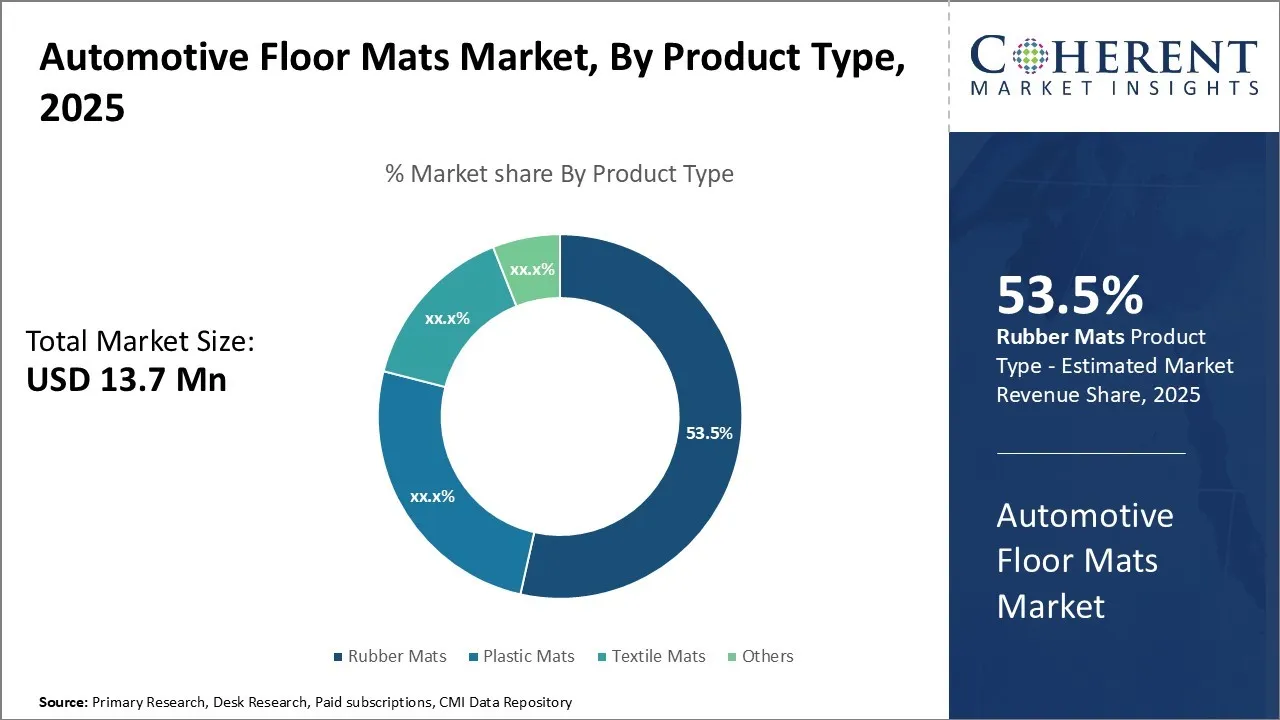
Global Automotive Floor Mats Market Insights, By Product Type
The product type segment in the automotive floor mats market comprises textile mats and rubber mats. The textile mat sub-segment is projected to register the highest CAGR of 54.5% during the forecast period, driven by its increasing use in passenger cars due to high durability and flexibility. Textile mats dominated the market in 2026 and are expected to maintain their leading position throughout the forecast period.
This growth is particularly prominent in emerging economies such as India and China within the Asia Pacific region, fueled by the rising production of passenger vehicles.
Rubber mats, known for their superior oil resistance, noise and vibration insulation, and absorption properties, benefit from the high density and consistency of rubber material. These features make rubber mats highly preferred for automotive applications, supporting robust growth in this segment over the forecast period.
Global Automotive Floor Mats Market: Regional Insights
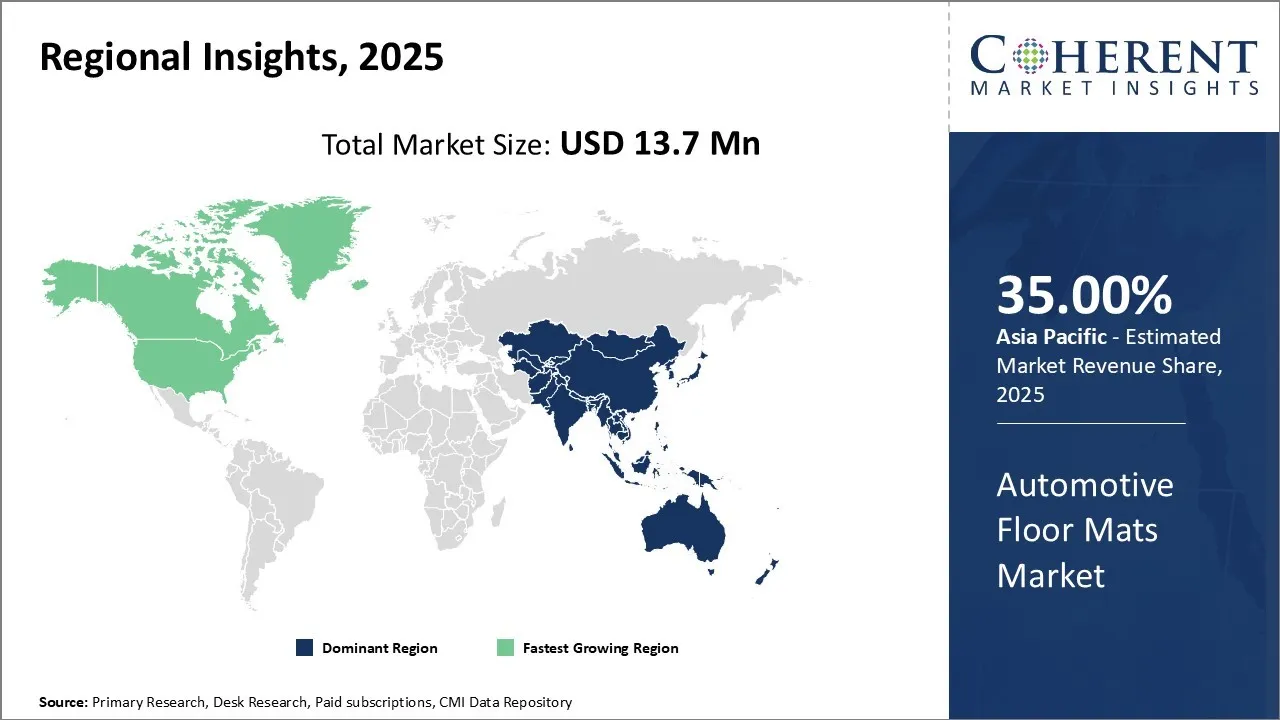
Asia Pacific Automotive Floor Mats Market Analysis and Trends
Asia Pacific held the largest share of 35.00% of the global automotive floor mats market in 2026, driven primarily by rising per capita income, expanding vehicle production and sales, and growing consumer awareness of safety and comfort. These factors are expected to sustain the region’s market dominance throughout the forecast period.
Additionally, government initiatives promoting fuel efficiency and environmental sustainability are anticipated to boost the demand for electric vehicles in major markets such as China and India, further elevating product demand in the region.
The expanding middle-class population and rapid urbanization are also key contributors to increased adoption of automotive accessories, including high-quality floor mats that enhance vehicle interiors and protection. The increasing preference for customized and durable mats suitable for diverse climates in Asia Pacific reinforces the market growth momentum.
North America Automotive Floor Mats Market Analysis and Trends
North America accounted for a significant portion of global automotive floor mats revenue in 2022, owing to strong consumer demand for luxury vehicles equipped with advanced safety technologies such as airbags, anti-lock braking systems (ABS), and start-stop mechanisms. These features necessitate premium floor mats designed to withstand harsh environmental conditions and offer superior protection.
Furthermore, stringent government regulations in the region restrict the use of certain floor mat types and combinations based on vehicle classifications, which is anticipated to further stimulate market growth during the forecast period. The region’s mature automotive industry, coupled with rising consumer expectations for vehicle safety and aesthetics, continues to underpin steady demand for high-end automotive floor mats.
Dominating Countries in the Automotive Floor Mats Market
China Automotive Floor Mats Market Analysis and Trends
China leads the Asia Pacific automotive floor mats market, supported by robust vehicle production and rising consumer spending on automotive accessories. Government policies encouraging new energy vehicle adoption contribute to increased demand for specialized floor mats compatible with electric vehicles. Urbanization and improved road infrastructure also drive demand for durable mats that can withstand varying terrain and weather conditions.
United States Automotive Floor Mats Market Analysis and Trends
The United States remains a key market within North America, where automotive manufacturers and aftermarket suppliers focus on integrating safety-compliant, high-quality floor mats into new and existing vehicle lines. Consumer preference for customization and eco-friendly materials is growing, supported by regulatory standards that ensure floor mat safety and performance. This regulatory environment, alongside a mature automotive ecosystem, continues to foster innovation and growth in the U.S. automotive floor mats market.
Market Report Scope
Automotive Floor Mats Market Report Coverage
| Report Coverage | Details | ||
|---|---|---|---|
| Base Year: | 2025 | Market Size in 2026: | USD 14.3 Mn |
| Historical Data for: | 2020 To 2024 | Forecast Period: | 2026 To 2033 |
| Forecast Period 2026 to 2033 CAGR: | 4.7% | 2033 Value Projection: | USD 19.8 Mn |
| Geographies covered: |
| ||
| Segments covered: |
| ||
| Companies covered: | 3M, Auto Custom Carpet Inc., Autotech Nonwovens Pvt Ltd., Conform Automotive, Feltex, GAHH LLC, RACEMARK International, LLC, Lloyd Mats Inc., German Auto Tops Inc., Lear Corporation (Masland Corporation), Low & Bonar PLC, Suminoe Textile Co., Ltd., Toyota Boshoku Corporation, Walser GmbH, MacNeil Automotive Products Limited (WeatherTech), Husky Liners, Inc. (Truck Hero, Inc.), and Lund International, Inc. | ||
| Growth Drivers: |
| ||
| Restraints & Challenges: |
| ||
Global Automotive Floor Mats Market- Drivers
- Increasing vehicle production
The global automotive industry has witnessed a consistent increase in vehicle production over the years. As more vehicles are manufactured and sold, the demand for automotive floor mats also rises. The growing automotive production, especially in emerging markets, creates a larger customer base for floor mat manufacturers.
- Rising consumer awareness and demand for interior aesthetics
Consumer demand and knowledge of the importance of interior aesthetics in automobiles are growing. As a result, consumers are looking for methods to improve their cars' aesthetic appeal. Automotive floor mats significantly enhance the interior's attractiveness by giving it a tidy, well-kept appearance. The need for aesthetically pleasing floor mats is driven by the desire for beautiful interiors.
Global Automotive Floor Mats Market- Opportunities
- Increasing Awareness
The market is expected to grow as more automotive floor mats, including rubber, textile and plastic mats are used by the automotive industry. The need for Automotive Floor Mats is foreseen to grow more by 2030 due to rising growth in the automobile sector in Asia Pacific region, particularly in China. For instance, Chinese motorists purchased around 23.56 million passenger cars in 2022.
- Increasing Demand for Customization
The demand for customised and distinctive car accessories, such as floor mats, is rising. The potential is in providing floor mats with a variety of customisable alternatives, including various materials, colours, patterns, and designs. Manufacturers may respond to specific tastes and set themselves apart in the market by offering custom floor mats that fit the interior design of automobiles.
Global Automotive Floor Mats Market-Trends
- The growing demand for comfort and safety
The growing demand for comfort and safety in vehicle cabins will fuel the global automotive floor mats market development. One of the most popular vehicle accessories are floor mats. Customers prefer floor mats for a number of primary reasons, including their low cost, ease of care, and accessibility to every local store or online platform.
Floor mats are a necessity in automobiles not only for hygiene reasons but also for their distinctive appearance and improved appearance. Additionally, they aid in preventing damage to the vehicle's floor. Floor mats are basically the same as entryway mats, as the soil and particles gathered in a specific region can be effortlessly taken out by cleaning or supplanting more seasoned or messy mats.
For instance, Honda once designed rubber mats to provide better protection than carpets for the floor of a car, which could withstand harsh weather and environments that were dusty or dirty. Subsequently, the huge interest for car floor mats to upgrade the stylish worth of vehicle lodges is supposed to help the development of the car floor mats market during the gauge time frame.
Analyst Viewpoint
- The global automotive floor mats market is experiencing strong growth fueled by rising vehicle production and increasing consumer focus on vehicle interior aesthetics and hygiene. Growing disposable incomes, especially in emerging markets, are encouraging consumers to invest in premium and customized floor mats as essential aftermarket accessories. Heightened awareness of cleanliness and maintenance, amplified by post-pandemic health concerns, is further accelerating demand.
- However, the market faces challenges from volatile raw material prices, particularly fluctuations in rubber and polymer costs, which put pressure on manufacturers' margins. Additionally, the shift toward electric vehicles with simpler interior designs may reduce demand for conventional floor mats, requiring adaptation in product offerings.
- Significant opportunities lie in the development of advanced smart floor mats featuring integrated sensors for functions such as theft detection and climate monitoring. The expanding electric vehicle sector offers potential for specialized floor mats designed to meet unique interior layouts and sustainability goals. Moreover, the growing trend of vehicle personalization creates a promising market for customized and branded floor mat solutions.
- Regionally, Asia-Pacific leads the market due to large automotive manufacturing bases in China, India, and Southeast Asia, combined with cost-efficient production and rising domestic vehicle ownership. North America stands out as the fastest-growing region, driven by a strong aftermarket culture, preference for premium vehicles, and increasing consumer expenditure on automotive accessories, making it a key focus for market expansion.
Global Automotive Floor Mats Market: Key Developments
- In March 2025, WeatherTech expanded its production facility in California, aiming to increase output of custom-fit textile and rubber floor mats to meet growing demand across North America.
- In January 2025, 3M launched an eco-friendly floor mat product line made from recycled rubber and biodegradable materials, underscoring its commitment to sustainability and innovation in automotive interiors.
- In late 2024, Husky Liners introduced a new smart floor mat equipped with embedded sensors capable of detecting moisture and dirt levels, providing real-time alerts to vehicle owners for enhanced maintenance.
- In 2023, a leading automotive OEM partnered with major floor mat suppliers to integrate customized floor mats directly into new vehicle production, enhancing fit, safety, and design aesthetics.
Market Segmentation
- Global Automotive Floor Mats, By Product Type (Revenue, USD Mn, 2021 - 2033)
- Rubber Mats
- Plastic Mats
- Textile Mats
- Others
- Global Automotive Floor Mats, By Application (Revenue, USD Mn, 2021 - 2033)
- Passenger Cars
- LCVs
- HCVs
- Global Automotive Floor Mats, By Sales Channel (Revenue, USD Mn, 2021 - 2033)
- OEMs
- After Market
- Global Automotive Floor Mats Market , By Region
- North America
- U.S.
- Canada
- Latin America
- Brazil
- Argentina
- Mexico
- Rest of Latin America
- Europe
- Germany
- U.K.
- Spain
- France
- Italy
- Russia
- Rest of Europe
- Asia Pacific
- China
- India
- Japan
- Australia
- South Korea
- ASEAN
- Rest of Asia Pacific
- Middle East
- GCC Countries
- Israel
- Rest of Middle East
- Africa
- South Africa
- North Africa
- Central Africa
- North America
- Company Profiles
- 3M.
- Auto Custom Carpet Inc.
- Autotech Nonwovens Pvt Ltd.
- Conform Automotive
- Feltex
- GAHH LLC
- RACEMARK International, LLC
- Lloyd Mats Inc.
- German Auto Tops Inc.
- Lear Corporation (Masland Corporation)
- Low & Bonar PLC
- Suminoe Textile Co., Ltd.
- Toyota Boshoku Corporation
- Walser GmbH
- MacNeil Automotive Products Limited (WeatherTech)
- Husky Liners, Inc. (Truck Hero, Inc.)
- Lund International, Inc.
Sources
Primary Research Interviews
- Automotive floor mat manufacturers and suppliers
- Automotive OEMs and aftermarket distributors
- Automotive interior designers and product managers
- Automotive retail chain executives
- Others
Databases
- Others
Magazines
- Automotive News
- Ward's AutoWorld
- Automotive Industries Magazine
- Motor Trend Business
- Others
Journals
- Journal of Automotive Engineering
- International Journal of Automotive Technology
- SAE International Journal of Materials and Manufacturing
- Others
Newspapers
- Financial Times
- The Wall Street Journal
- Reuters Business News
- Bloomberg News
- Automotive News Europe
- Others
Associations
- Society of Automotive Engineers (SAE)
- Automotive Aftermarket Industry Association (AAIA)
- Original Equipment Suppliers Association (OESA)
- International Organization of Motor Vehicle Manufacturers (OICA)
- Others
Public Domain Sources
- U.S. Bureau of Economic Analysis
- European Automobile Manufacturers Association (ACEA)
- China Association of Automobile Manufacturers (CAAM)
- Ministry of Heavy Industries and Public Enterprises (India)
- Others
Proprietary Elements
- CMI Data Analytics Tool
- Proprietary CMI Existing Repository of information for last 8 years
*Definition: Automotive floor mats, also known as vehicle mats, are manufactured and designed in order to protect the vehicle floor from wear & tear, dirt & dust as well as corrosion. Automotive floor materials are gaining preference in the automotive floor mats market mainly owing to the aesthetic look bestowed to the vehicles.
Get access to 250+ pages report
Every segment, forecast, competitor profile and data table behind the analysis above — available for instant download.
- ESOMAR Member
- ISO 9001:2015 Certified
- D-U-N-S Registered
- GDPR & CCPA Compliant
Missing comfort of reading report in your local language? Find your preferred language:
Transform your Strategy with Exclusive Trending Reports
Frequently Asked Questions
The Automotive Floor Mats Market size is estimated to be valued at USD 14.3 Mn in 2026, and is expected to reach USD 19.8 Mn by 2033.
The Global Market is expected to exhibit a CAGR of 4.7 % over the forecast period (2026-2033).
Major players operating in the market include 3M, Auto Custom Carpet Inc., Autotech Nonwovens Pvt Ltd., Conform Automotive, Feltex, GAHH LLC, RACEMARK International, LLC, Lloyd Mats Inc., German Auto Tops Inc., Lear Corporation (Masland Corporation), Low & Bonar PLC, Suminoe Textile Co., Ltd., Toyota Boshoku Corporation, Walser GmbH, MacNeil Automotive Products Limited (WeatherTech), Husky Liners, Inc. (Truck Hero, Inc.), and Lund International, Inc.
Among product type, textile mats segment held dominant position in the market in 2026, and it is expected to retain its dominance over the forecast period.
Increasing adoption of variety of automotive floor mats such as rubber mats, plastic mats, and textile mats in the automotive sector is one of the major factors that is expected to propel growth of the market over the forecast period.
Among regions, Asia Pacific has expected to hold dominant position in the market over the forecast period.