Bladder Scanners Market Analysis & Forecast: 2026-2033

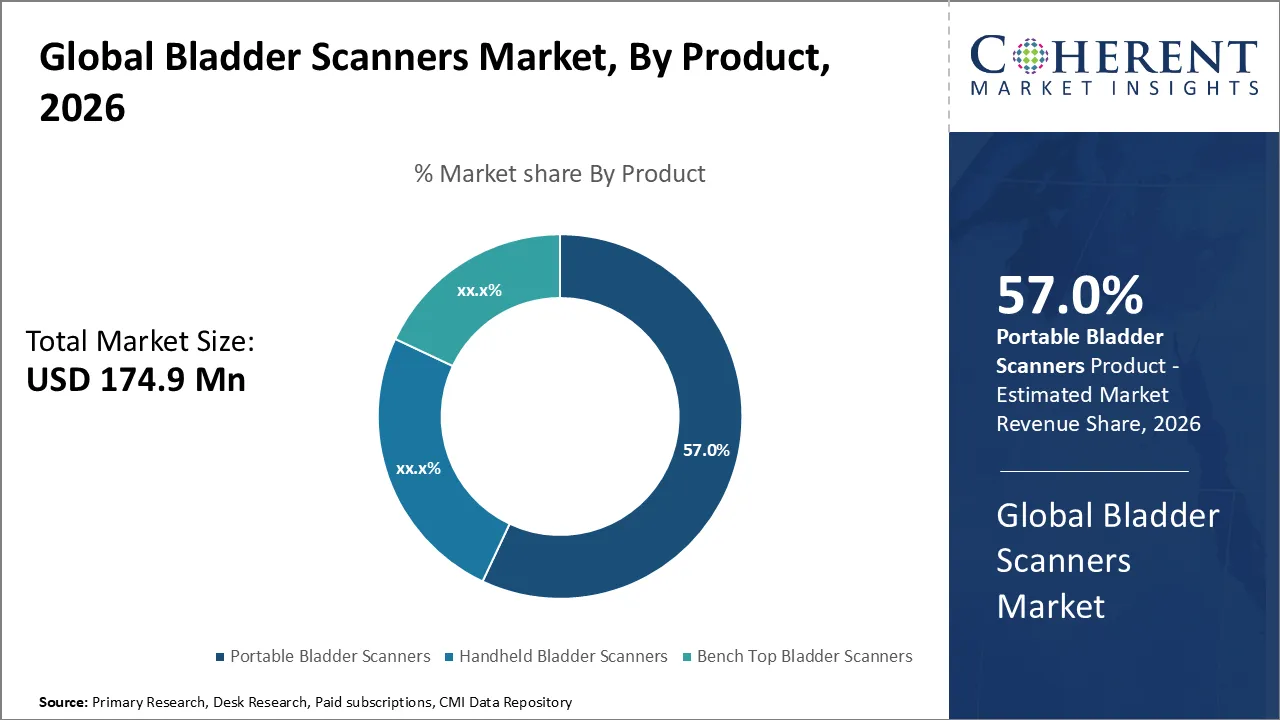
The global bladder scanners market was valued at USD 174.9 Mn in 2026 and is forecast to reach a value of USD 252.8 Mn by 2033 at a CAGR of 5.4% between 2026 and 2033.
The global bladder scanners market is experiencing strong growth owing to the increasing prevalence of urology related disorders worldwide. Moreover, increasing usage of mobile portable ultrasound devices is expected to boost the growth of the market. However, factors such as product recalls and stringent regulatory reforms are expected to hamper growth of the market.
|
Current Event |
Description and its Impact |
|
Aging Population and Healthcare Infrastructure Expansion
|
|
|
Technological Advancement and AI Integration |
|
Uncover macros and micros vetted on 75+ parameters: Get instant access to report
In terms of product, the portable bladder scanner segment is expected to hold 57% share of the market in 2026. They are essential for point-of-care diagnostics because of their mobility, use, and get accurate results. Hospitals and clinics prefer them for bedside assessments as they reduce invasive procedures, make patients more comfortable, and lower costs by doing urinary evaluations faster and without surgery.
For instance, in October 2025, to help frail patients avoid going to the hospital unnecessarily, the East of England Ambulance Service started using portable bladder scanning technology. Paramedics can quickly check the volume of a person's bladder, detect urinary retention, and give them care at home with handheld ultrasound devices. This new idea helps patients get better while also lowering hospital costs and strain on resources.
In term of end user, the hospital segment is expected to lead the market with 68% share in 2026. Bladder scanners help the most by reducing on infections caused by catheters, shortening patient stays, and making workflows more efficient. Hospitals are still the largest consumers of bladder scanning technology because they have large volume of patients, need to keep costs down, and want to connect with electronic health records.
For instance, Cleveland Clinic used a wireless catheter-free device to check on hospital patients with bladder problems. This new technology gives continuous, real-time bladder data without the need for invasive catheters, unlike traditional bladder scanners. It makes patients more comfortable, lowers the risk of infection, and fits with hospitals' goals of providing better care at lower costs.
To learn more about this report, Download Free Sample
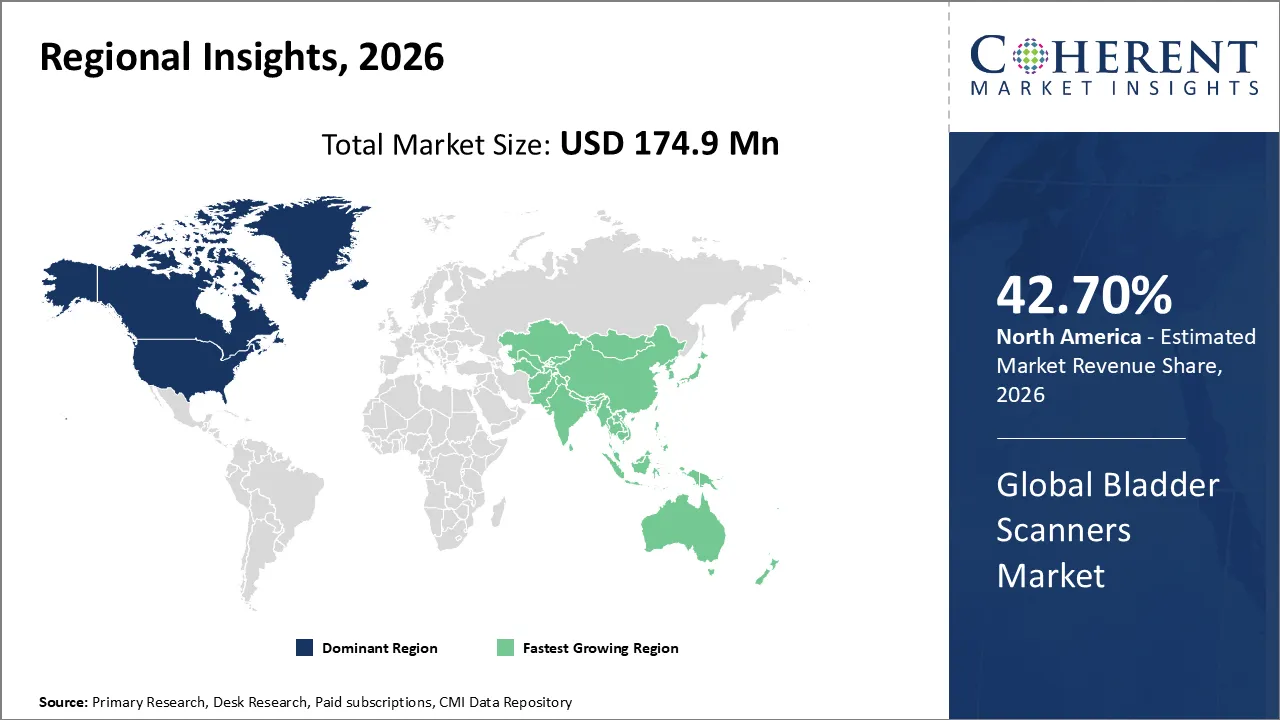
North America is expected to dominate the bladder scanner market with 42.7% share in 2026. This dominance is helped by a well-developed healthcare system, a strong presence of top manufacturers, and policies that make it easier to get paid back. The U.S. is an important reason for emphasizing on reducing on infections that people get in hospitals and likes non-invasive tests.
For instance, in December 2025, Butterfly Network is based in Burlington, Massachusetts, USA, and has offices in New York City, Palo Alto, and Taiwan. Its handheld
Asia Pacific is expected to exhibit the fastest growth, adoption is being driven by a greater amount going into healthcare, more hospitals being built, and a quickly aging population in countries like China, India, and Japan. More people are becoming aware of urological health, and the government is supporting medical technology, which speeds up growth even more.
The bladder scanners market is highly demanding in the U.S. in 2026 owing to advanced healthcare infrastructure, a high rate of use of non-invasive diagnostics, and good reimbursement policies. Hospitals are most concerned with lowering infections related to catheters. At the same time, the number of urological cases is rising and the aging population, which is driving the widespread use of bladder scanners across the country.
In 2026, the bladder scanners market is highly demanding in China because the healthcare system is growing quickly, people are becoming more aware of urological health, and the number of older people is growing. The Chinese government is investing in advanced medical technologies and pushing for non-invasive diagnostics, which speeds up adoption even more. This makes China a key driver of global growth.
| Report Coverage | Details | ||
|---|---|---|---|
| Base Year: | 2025 | Market Size in 2026: | USD 174.9 Mn |
| Historical Data for: | 2020 To 2024 | Forecast Period: | 2026 To 2033 |
| Forecast Period 2026 to 2033 CAGR: | 5.4% | 2033 Value Projection: | USD 252.8 Mn |
| Geographies covered: |
|
||
| Segments covered: |
|
||
| Companies covered: |
Vitacon, SRS Medical Systems Inc., Roper Technologies Inc., Patricia Industries (LABORIE), Echo-Son, Mcube Technology Co. Ltd., Caresono, General Electric Company (GE Healthcare Inc.), and Becton, Dickinson and Company (C. R. Bard Inc.), among others. |
||
| Growth Drivers: |
|
||
| Restraints & Challenges: |
|
||
Uncover macros and micros vetted on 75+ parameters: Get instant access to report
The rising prevalence of urinary retention, incontinence, and postoperative complications is markedly enhancing the utilization of bladder scanners. These devices quickly, accurately, and non-invasive measurements or bladder volume, which helps doctors take better care of their patients. The Bladder Scanners Market growth is because hospitals and clinics are seeing growing numbers of urological cases. There is an urgent need for safer diagnostic tools that lower the risk of complications and improve patient outcomes.
Healthcare providers are putting a growing value on non-invasive diagnostic methods to make patients safer and more comfortable. Bladder scanners eliminate the need for catheters, which lowers the risk of infection and makes the experience better for patients overall. This change is in line with a larger trend in healthcare toward technologies that are less invasive, easier to use, and less expensive. As a result of this, the bladder scanners market demand is rising as hospitals, nursing homes, and outpatient centers start using them in their everyday clinical work.
The combination of AI-powered imaging and 3D ultrasound technology is changing the way bladder scanners work. These new features make the devices more appealing to healthcare providers because they improve diagnostic accuracy, accelerate workflows, and make operators less dependency. AI-powered bladder scanners make hospitals, clinics, and nursing homes work better and help patients by giving them results faster and more accurately. As these technologies mature, the Bladder Scanners Market forecast predicts that they will be widely used. Advanced imaging will be a major factor in future demand and global growth.
In January 2024, Clarius Mobile Health received 510(k) clearance from the U.S. Food and Drug Administration for its Clarius Bladder AI, a noninvasive artificial intelligence tool that automatically measures bladder volume. The system offers a cost-effective alternative to conventional bladder scanners and delivers real-time results to clinicians.
The bladder scanner market shows that there remains a strong demand for non-invasive diagnostic tools in healthcare settings, due to rising awareness on urinary health and the need for clinical efficiency. Ultrasound-based scanners are the most common type of scanner, making up the vast majority of installed units. This is considering they are clinically accepted and can accurately measure bladder volume without needing to be invasive. Hospitals are still the main end users, using most devices for urology, geriatrics, critical care, and postoperative monitoring. Clinics and outpatient settings are a smaller but growing share.
Data from the industry show that the number of device installations is growing quickly around the world. The number of ultrasound bladder scanners shipment grew from more than 25,000 units in 2023 to an estimated more than 40,000 units by 2030. This shows that more people are using them in both developed and developing markets.
Trends in product technology show that 3D ultrasound systems are being used to a greater extent. These systems are more accurate in terms of volume and are being integrated with electronic health records and AI-based measurement tools, which makes workflows more efficient and diagnoses more consistent. Portable and handheld scanners are becoming more popular, especially in long-term care and ambulatory care facilities, because they are easy to use and convenient.
The competitive dynamics are strong, with the largest medical device companies having a big share of the market. This concentration shows the importance of distribution networks, clinical support, and ongoing product innovation are in influencing healthcare providers' buying decisions.
The bladder scanners market is changing as technology is added and more types of end users adopt them. Non-invasive diagnostic capabilities are replacing traditional catheterization and manual assessment methods on a daily basis.
*Definition: Bladder scanner (BS), a portable ultrasound device specialized in bladder volume measurement, has been developed and applied to clinical assessment of post-void residual urine, which is a requisite in evaluating patients with voiding dysfunction.
Share
Share
Komal Dighe is a Management Consultant with over 8 years of experience in market research and consulting. She excels in managing and delivering high-quality insights and solutions in Health-tech Consulting reports. Her expertise encompasses conducting both primary and secondary research, effectively addressing client requirements, and excelling in market estimation and forecast. Her comprehensive approach ensures that clients receive thorough and accurate analyses, enabling them to make informed decisions and capitalize on market opportunities.
Joining thousands of companies around the world committed to making the Excellent Business Solutions.
View All Our Clients