Directional Drilling Services Market Analysis & Forecast: 2026-2033

Global Directional Drilling Services Market Overview
Directional drilling refers to a process of drilling a well with a preferred deviation to reach the target location. This type of drilling is done for placing the wellbore precisely to get maximum recovery both on land and offshore regions. The main aim of this type of drilling is to cover large areas by the use of the single rig. Maturing and aging onshore oilfields has paved paths to increasing directional drilling in the onshore regions supported by offshore exploration and production activities in deep and ultra-deep regions over the past few decades. This is further backed by augmenting horizontal drilling services to maximize the productivity of the oil and gas well.
Directional Drilling Services Market Size and Forecast – 2026 – 2033
The Directional Drilling Services Market size is estimated to be valued at USD 13.63 billion in 2026 and is expected to reach USD 22.32 billion by 2033, exhibiting a compound annual growth rate (CAGR) of 7.3% from 2026 to 2033.
Key Takeaways
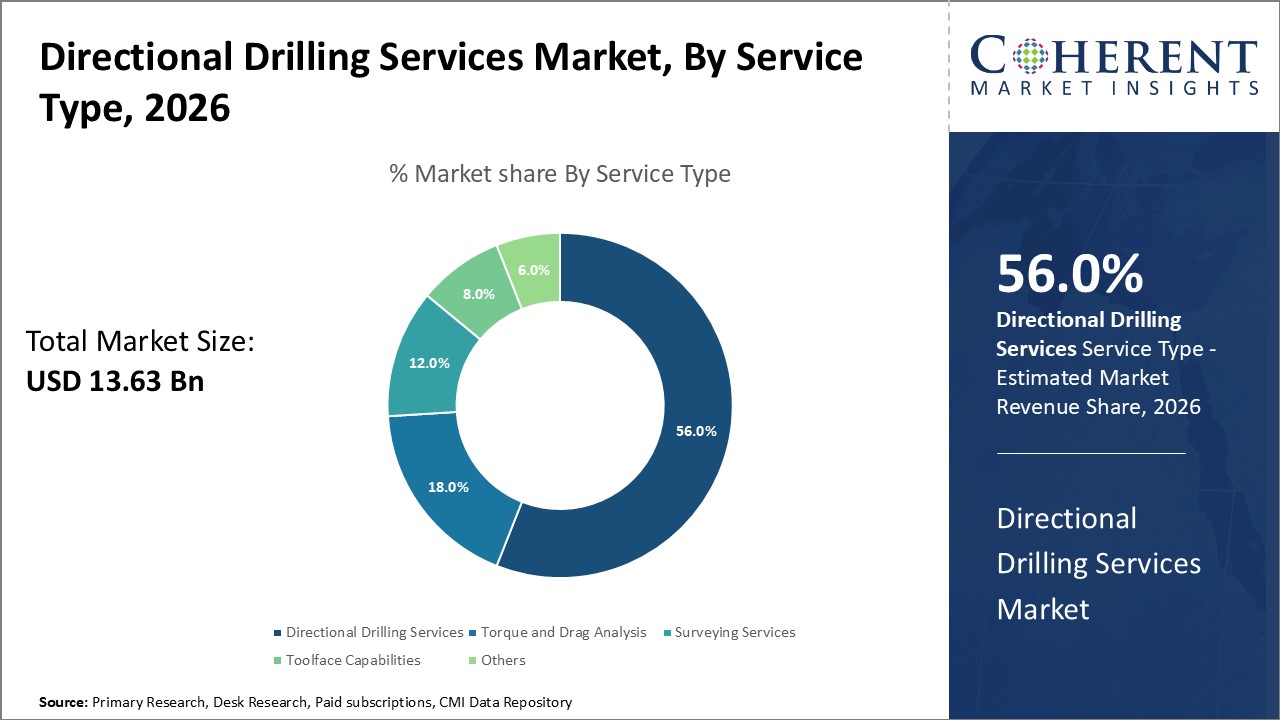
The Directional Drilling Services market analysis highlights the dominance of the Directional Drilling Services sub segment under the Service Type category, capturing 56% industry share due to its comprehensive application and technological integration.
The Onshore segment experiences rapid growth driven by increasing unconventional resource development.
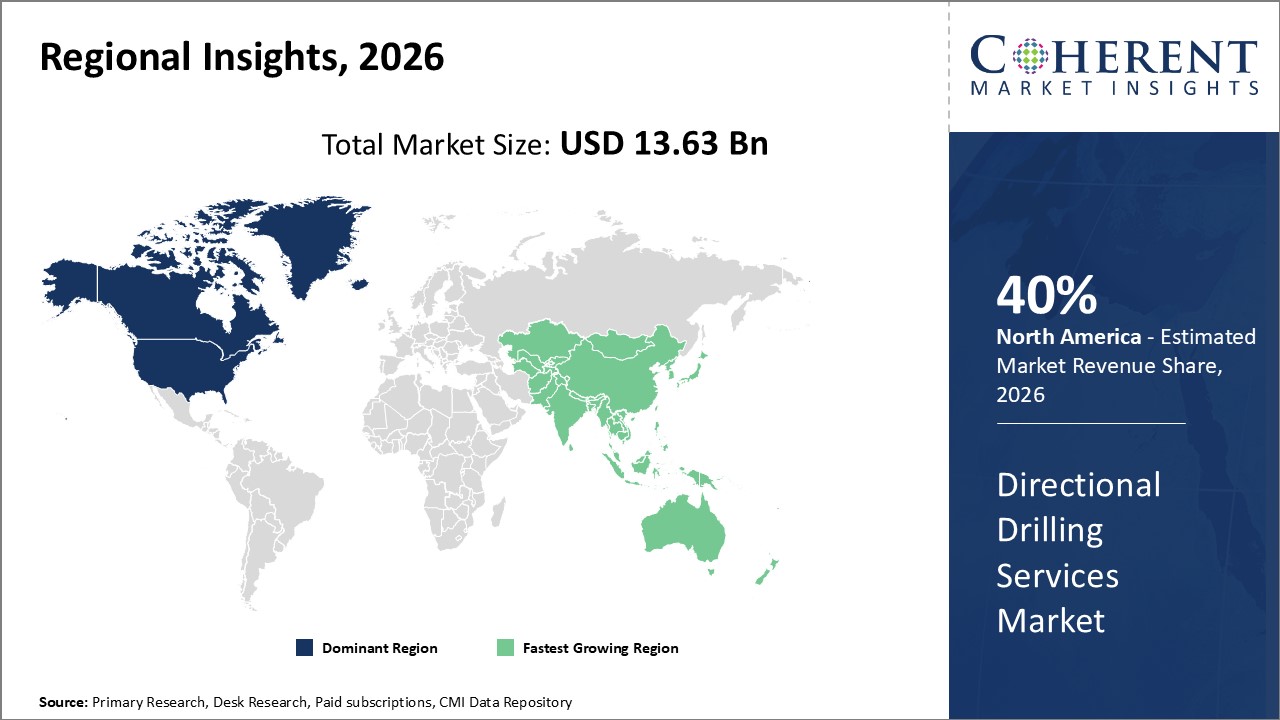
North America commands the highest market share, accounting for approximately 40% of the global industry size, supported by vast shale operations and infrastructure.
Asia Pacific emerges as the fastest-growing region with a CAGR exceeding 8%, propelled by rising offshore drilling investments and government incentives for energy exploration. These dynamics exemplify where market companies should focus their growth strategies and business growth initiatives to capitalize on emerging opportunities.
Directional Drilling Services Market – Segmentation Analysis
To learn more about this report, Request Free Sample
Directional Drilling Services Market Insights, By Service Type
In terms of Service Type, the market is segmented into Directional Drilling Services, Torque and Drag Analysis, Surveying Services, Toolface Capabilities, and Others among which Directional Drilling Services dominate the market share with 56%. Directional Drilling Services stand out due to their critical role in precision wellbore placement and reducing non-productive time, essential for operational efficiency in both onshore and offshore developments.
Directional Drilling Services Market Insights, By Application
In terms of Application, the market segments include Onshore, Offshore, Unconventional Reservoirs, and Others, with Onshore witnessing the largest market share due to the boom in unconventional shale oil extraction, where directional drilling improves well productivity and reduces environmental footprint. The Onshore subsegment benefits from cost-effectiveness and rapid deployment, especially in North America.
Directional Drilling Services Market Insights, By End-User
In terms of End-User, the market segments include Oil & Gas Operators, Drilling Contractors, Independent E&P Companies, National Oil Companies, and Others. Oil & Gas Operators dominate with the largest market share given their capital-intensive projects requiring precision drilling for optimal recovery.
Directional Drilling Services Market Insights, By Geography
To learn more about this report, Request Free Sample
North America Directional Drilling Services Market Analysis and Trends
In North America, the dominance in the Directional Drilling Services Market stems from the extensive shale gas and oil exploitation across the U.S. and Canada. This region accounts for approximately 40% industry share, underpinned by a mature market ecosystem, advanced drilling technologies, and strong industry presence by key market players such as Schlumberger and Halliburton. Government policies favoring energy independence and continuous investment in upstream infrastructure solidify this dominance.
Asia Pacific Directional Drilling Services Market Analysis and Trends
Meanwhile, the Asia Pacific region exhibits the fastest growth at a CAGR of over 8%, driven by escalating offshore drilling activities in countries such as China, India, and Australia. Investments in Deepwater exploration projects and government incentives for energy exploration fuel this expansion. The presence of emerging market companies and increased adoption of advanced directional drilling services also support rapid market revenue growth within the region.
Directional Drilling Services Market Outlook for Key Countries
Market Analysis and Trends for Directional Drilling Services in the United States
The U.S. market remains the largest contributor to the Directional Drilling Services industry, primarily due to its vast unconventional shale reserves in regions such as the Permian Basin and Bakken. In 2026, directional drilling accounted prominent share of overall wells drilled, facilitating enhanced extraction rates and cost efficiency. Major companies like Halliburton and Baker Hughes continue to innovate with technologies such as steerable downhole motors and rotary steerable systems, significantly advancing market size and market revenue.
Market Analysis and Trends for Directional Drilling Services in the Brazil
Brazil’s market is witnessing rapid growth propelled by offshore Deepwater exploration in the pre-salt basins. The country has attracted considerable investments, supported by Petrobras and other national players expanding directional drilling applications to overcome complex geological challenges. Technological advancements have decreased drilling cycle times by up to 15%, enhancing project economics and market growth prospects. Brazil’s focus on renewable integration alongside oil exploration positions it as a significant contributor to the regional and global market trends.
Analyst Opinion
The rising complexity of oil and gas reservoirs is driving an increased demand for advanced directional drilling services. For instance, in 2025, multi-lateral well engineering extended drilling reach by over 20% on average, enabling operators to maximize reservoir contact, directly impacting market revenue positively. This demand is evident as directional drilling contributes to nearly 30% of total wells drilled in North America.
Technological adoption, particularly in Measurement While Drilling (MWD) and Logging While Drilling (LWD) tools, significantly boosts operational efficiency. In 2026, deployment of these technologies increased operational runtime by 16% across offshore projects, translating into reduced non-productive time and cost efficiencies, which propel the industry’s business growth and market share.
Regulatory pressures around minimizing environmental footprints encourage the adoption of directional drilling to reduce the surface disturbance footprint. For example, in 2025, environmental compliance related to drilling in ecologically sensitive areas in Europe made directional drilling the preferred method for over 45% of new projects, influencing broader market dynamics and growth strategies.
The expanding unconventional oil and gas market, particularly in shale regions, has necessitated directional drilling service providers to diversify offerings. Data from 2026 shows directional drilling accounted for more than 61% of fracking wells in the United States, underscoring its importance in enabling cost-effective extraction and proving critical to market forecasts.
Market Scope
| Report Coverage | Details | ||
|---|---|---|---|
| Base Year: | 2025 | Market Size in 2026: | USD 13.63 billion |
| Historical Data for: | 2020 To 2024 | Forecast Period: | 2026 To 2033 |
| Forecast Period 2026 to 2033 CAGR: | 7.3% | 2033 Value Projection: | USD 22.32 billion |
| Geographies covered: |
|
||
| Segments covered: |
|
||
| Companies covered: | Schlumberger Limited, Halliburton Company, Baker Hughes Company, Weatherford International plc, National Oilwell Varco, Mitsubishi Heavy Industries, Nabors Industries Ltd., Helmerich & Payne, Inc., Parker Drilling Company, Torc Oil & Gas Ltd. | ||
| Growth Drivers: |
|
||
Uncover macros and micros vetted on 75+ parameters: Get instant access to report
Growth factors
The expansion of upstream exploration and production activities globally, primarily in unconventional reserves such as shale and tight oil, has triggered substantial demand for directional drilling services.
Advancements in drilling technology reduce operational downtime and boost precision, driving market growth. Increased offshore drilling endeavors, particularly in the Asia Pacific and Middle East, underpin significant business growth due to access to deeper and more complex reservoirs.
Similarly, cost efficiencies gained through better well placement and reduced environmental impacts are key enablers fostering further adoption. The continuous evolution of drilling tools and techniques delivers higher drilling speeds and accuracy, fueling sustainable industry growth trajectories.
Directional Drilling Services Market Development
Market Trends
The directional drilling landscape is increasingly shaped by digitalization and automation, with real-time data analytics steering drilling decisions that enhance accuracy and reduce cycle times.
Integration of machine learning algorithms to predict wellbore trajectories announced in 2026 has optimized drilling operations by cutting non-productive time by nearly 11%.
Additionally, sustainability trends are leading market players to innovate environmentally friendly drilling fluids and reduce hydrocarbon emissions associated with drilling operations.
Growth in Deepwater and ultra-Deepwater projects continues to shift demand toward advanced directional drilling services capable of operating in complex geological conditions.
Finally, emerging markets in Latin America and parts of Asia are investing in infrastructure, which will diversify demand patterns and contribute to market revenue growth.
Key Players
Schlumberger Limited
Baker Hughes Company
Weatherford International plc
National Oilwell Varco
Mitsubishi Heavy Industries
Nabors Industries Ltd.
Helmerich & Payne, Inc.
Parker Drilling Company
Torc Oil & Gas Ltd.
A number of prominent businesses have implemented technology licensing agreements and strategic partnerships to increase their market share and earnings. As an example, Siemens Energy's 2025 collaboration with up-and-coming Asian producers increased knowledge transfer effectiveness by 16%, increasing their market share in Asia Pacific. In a similar vein, Voith Hydro's investment in research and development for large-End-User turbines improved their competitive advantage by lowering output losses by as much as 7%, which resulted in higher returns in international competitive tendering for hydropower projects.
Future Prospects for the Directional Drilling Services Industry
Due to ongoing technological improvements that improve drilling efficiency and precision, such as automation, digital integration, and real-time monitoring, the market for directional drilling services has a very bright future. It is anticipated that growing offshore and Deepwater drilling projects, as well as increased global exploration, particularly in unconventional resources like shale gas and tight oil, will drive market expansion.
Sustainable drilling methods are becoming safer due to environmental concerns and governmental support, which is driving continuous innovation. The increase in natural gas and oil production, especially in the Middle East, Asia-Pacific, and North America, is also expected to maintain high demand.
Industry players are focusing on developing sophisticated solutions such as rotary steerable systems to reduce operational costs while improving accuracy and reducing environmental impact. Overall, the market is forecasted to experience robust growth supported by expanding energy needs, technological evolution, and strategic investments in exploration activities worldwide.
Historical Analysis
In May 2017, Halliburton Company launched drilling operations in the Zhuravlinaya area of the Vostochno-Taimyrsky license block for Lukoil. This launch was commenced to maximize the asset value of the company in the Vostochno-Taimyrsky block.
In March 2018, Nabors Industries announced the introduction of its Navigator software, which was developed for making directional drilling faster, accurate, and efficient for placing their wells in the target zone. Moreover, the software automatically documented, evaluated, and identified the areas of improvement in terms of the directional drilling decisions.
In October 2019, Schlumberger Limited introduced the NeoSteer, at-bit steerable system (ABSS) at Society of Petroleum Engineers Annual Technical Conference and Exhibition (SPE ATCE). This launch was aimed to improve the horizontal well drilling performance by providing an increase in the rate of penetration in the curve and the lateral.
Sources
Primary Research interviews:
Directional Drilling Contractors
Rig Operators & Drilling Engineers
Oil & Gas Exploration & Production Companies
Databases:
EIA (U.S. Energy Information Administration) Data
OPEC Statistical Database
BP Statistical Review of World Energy
Magazines:
Drilling Contractor Magazine
World Oil Magazine
Offshore Engineer
Journals:
SPE Drilling & Completion Journal
Petroleum Science and Engineering Journal
Energy Exploration & Exploitation Journal
Newspapers:
Financial Times (Energy Markets)
The Economic Times (Energy & Oil Section)
The Hindu Business Line (Energy Section)
Associations:
International Association of Drilling Contractors (IADC)
American Petroleum Institute (API)
International Association of Oil & Gas Producers (IOGP)
Share
Share

Credibility and Certifications

860519526


9001:2015

27001:2022


Need a Custom Report?
We can customize every report - free of charge - including purchasing stand-alone sections or country-level reports
Customize NowJoining thousands of companies around the world committed to making the Excellent Business Solutions.
View All Our Clients