Electric Scooter Market Analysis & Forecast: 2026-2033

The electric scooter market is estimated to be valued at USD 29.83 Bn in 2026 and is expected to reach USD 56.30 Bn by 2033, growing at a compound annual growth rate (CAGR) of 9.5% from 2026 to 2033.
To learn more about this report, Request Free Sample
The Electric Scooter Market is trending towards the greater digitalization of sales and distribution networks. Manufacturers are using tech-enabled platforms that combine real-time inventory management, order tracking, and digital payment systems to make things more open and efficient. Direct online sales channels and app-based rental platforms are also becoming more popular than traditional dealership models. This is because they are more convenient for customers, cost less to distribute, and give businesses useful data about consumer preferences and usage patterns.
|
Current Event |
Description and the Impact |
|
Regulatory and Policy Changes in Urban Mobility |
|
|
Technological Advancements in Battery and IoT Integration |
|
|
Environmental and Infrastructure Developments |
|
Uncover macros and micros vetted on 75+ parameters: Get instant access to report
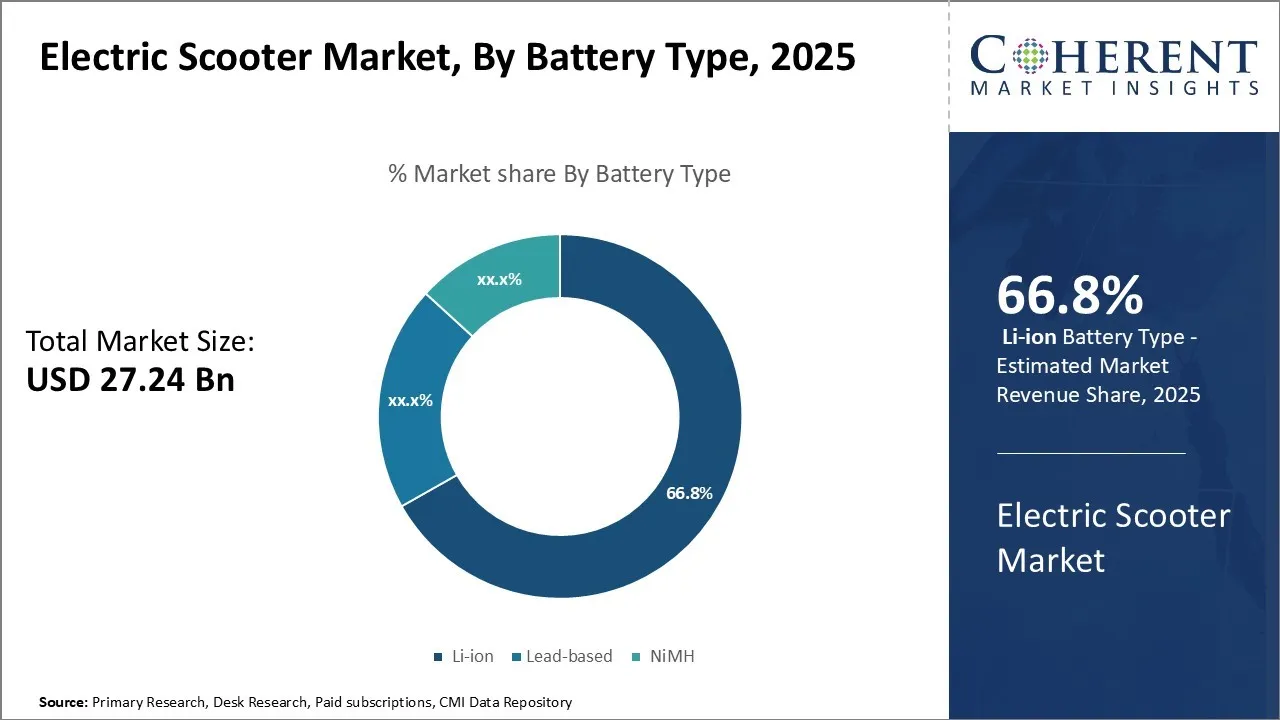
In terms of battery type, Li-ion segment contributes the highest share of 67.8% in 2026 owing to the superior recharging capabilities and performance characteristics. These batteries maintain charge retention over extended periods and provide greater range compared to lead acid or NiMH alternatives. The sealed construction of Li-on batteries eliminates routing maintenance tasks such as electrolyte motoring and thus provides improved convenience for end users. Li-on technology offers rapid acceleration and higher top speeds through its exceptional energy density. Most electric scooters provide range of 12-20 miles per charge catering to the daily community and urban transportation requirements. Manufactures are also focusing on developing cutting-edge cell chemistries to increase energy capacity.
For instance, in September 2025, Zelio E Mobility introduced its updated Gracyi electric scooter model. The model provides performance upgrades, increased ground clearance, and a choice of three batteries. The redesigned model focuses on improved performance and rider improved comfort for daily-commuters. Its Lithium-Ion variant uses a 60V/30Ah battery pack that provides approximately 90 to 100 kilometers distance travel on a single charge.
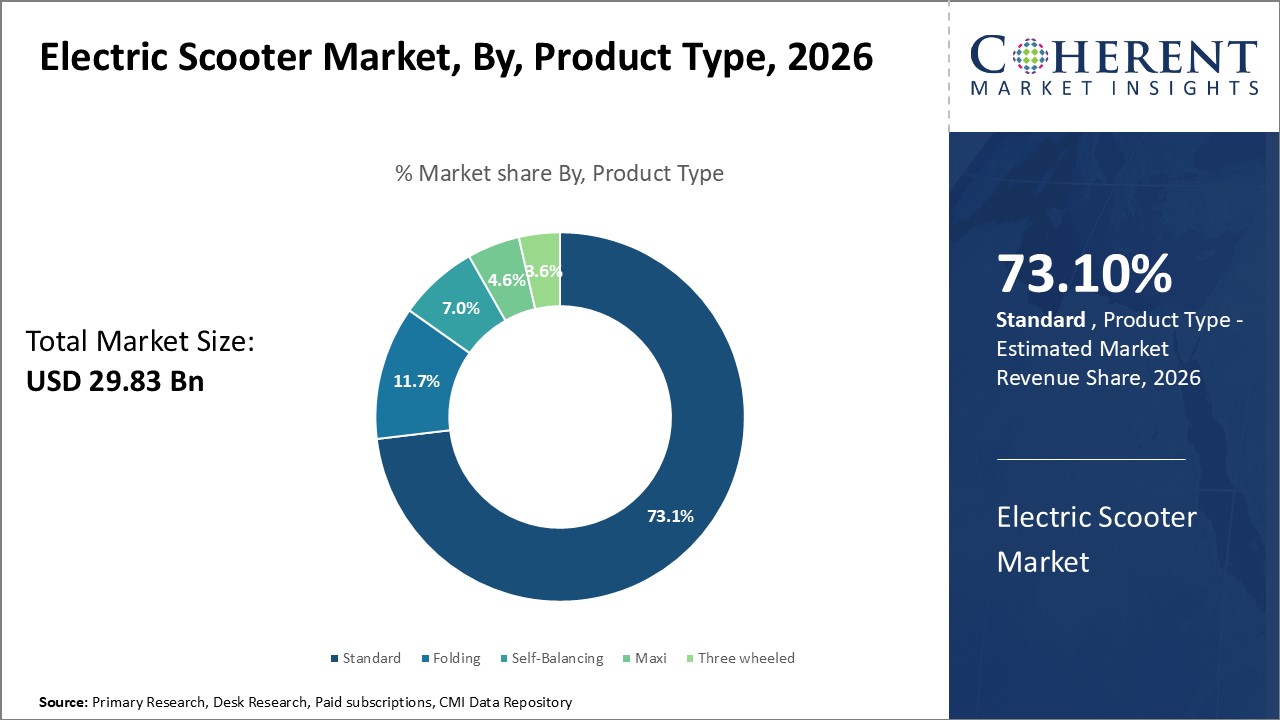
To learn more about this report, Request Free Sample
In terms of product type, the standard segment contributes the highest share of 73.1% in 2026 of the market owing to its straightforward design emphasizing essential commute focused functionality. Standard models incorporate the traditional kick scooter design which has small 10-inch wheels and a steering column that can be folded up. This traditional setup has many strategic advantages. The simplified construction method cuts down on manufacturing costs and gets rid of unnecessary features. These models are good for last mile transportation needs because they are easy to use right away. These scooters are easy for professionals to use when they need to carry work materials during rush hour.
In terms of voltage, the 48-59V electric segment contribute the highest share of 43.2% in 2026 of the market owing to it optimal balance between performance and affordability. This voltage range gives riders enough power to speed up and climb hills without raising costs unnecessarily. Major manufacturers have standardized components and battery packs within this range which makes them more reliable and lowers production costs. Most people who commute every day find cruising at 15 to 18 mph sufficient for last mile travel without exceeding regulatory limits. The 48-59V configuration sets a standard that most people can agree on, putting value ahead of extreme performance. This makes it appealing to a wider range of customers. A lot of people who first bought higher voltage models like 72V or 96V later switch to this range. They cite marginal speed improvements that fail to justify higher costs and technical issues like loose battery connections.

To learn more about this report, Request Free Sample
Asia Pacific has remained the dominant region with a share of 40.8% in 2026 over the past decade. The region is expected to exhibit the highest Compound Annual Growth Rate (CAGR) of 12.1% in 2026. The growth is due to supportive government policies and growing environmental consciousness. Major economies like China, India and Japan are leading this growth by making investments in electric mobility infrastructure and consumer incentives like subsidies and tax benefits. The increasing urbanization across the region is also speeding up the demand for efficient last mile transportation solutions that electric scooters provide effectively. Ongoing innovations in battery technology are resolving earlier constraints related to range anxiety and cost barriers. This helps in improving product accessibility for broader consumer segments. The establishment of comprehensive charging ecosystems and improved safety protocols also facilitates adoption in varied urban environments.
For instance, in November 2026, Yamaha Motor Co., Ltd. introduced two electric scooter models for the Indian market. These include AEROX E electric sport scooter and the EC-06 electric scooter co-created with River Mobility Private Limited. The AEROX E represents Yamaha’s premium positioning approach for ASEAN and developing markets.
The Europe region has emerged as the fastest growing market globally in recent years owing to increasing environmental awareness among urban consumers. The rising fuel costs is pushing commuters towards affordable electric alternatives that provide considerable long-term savings. Government initiatives are promoting zero emission transportation solutions via subsides and infrastructure development programs. The dense urban populations are creating high demand for small, easy-to-move vehicles that can get around busy city streets. The need for better last-mile connectivity is also driving the use of electric scooters for short trips. The technological upgrades are aiming to make batteries last longer thus improving their performance for daily commuting.
For instance, in July 2026, a micromobility firm, Bird teamed up with electric vehicle manufacturer Segway to deploy upgraded electric scooters in major North American cities. The collaboration combines Segway's technical design capabilities with Bird's fleet management experience to deliver improved urban mobility options.
In 2026, the market in the China is expected to be strong owing to government support that provides subsidies and creates policies which encourage people to switch from gas vehicles. Environmental concerns are using consumers toward cleaner transportation options that reduce pollution in crowded cities. Urbanization brigs more people into cities where electric scooters provide affordable solutions for daily commutes. Manufacturing strength lets Chinese companies build scooters at lower costs which makes them accessible to more buyers.
For instance, in September 2026, a Chinese company has revealed its plan to develop a $28 million project in Uzbekistan’s Samarkand region. This manufacturing plant includes electric scooter production along with others.
In 2026, the U.S. market is booming with more consumers choosing environmentally friendly transportation that helps minimize carbon emissions. Government programs are providing tax breaks and incentives that help lower the purchase price for buyers who want electric vehicles. The high gas prices are also pushing commuters toward electric options that save money on fuel costs. Sharing services are introducing electric scooters to users who might later purchase their own models. Technology upgrades are aiming to deliver batteries that last longer and charge faster to improve the riding experience.
For instance, in October 2024, Niu Technologies debuted its KQi 100F kick scooter for the U.S. market at the Electrify Expo. The launch aims to introduce the U.S. riders to an eco-friendly urban transportation option with strong capabilities.
| Report Coverage | Details | ||
|---|---|---|---|
| Base Year: | 2025 | Market Size in 2026: | USD 29.83 Bn |
| Historical Data for: | 2020 To 2024 | Forecast Period: | 2026 To 2033 |
| Forecast Period 2026 to 2033 CAGR: | 9.5% | 2033 Value Projection: | USD 56.30 Bn |
| Geographies covered: |
|
||
| Segments covered: |
|
||
| Companies covered: |
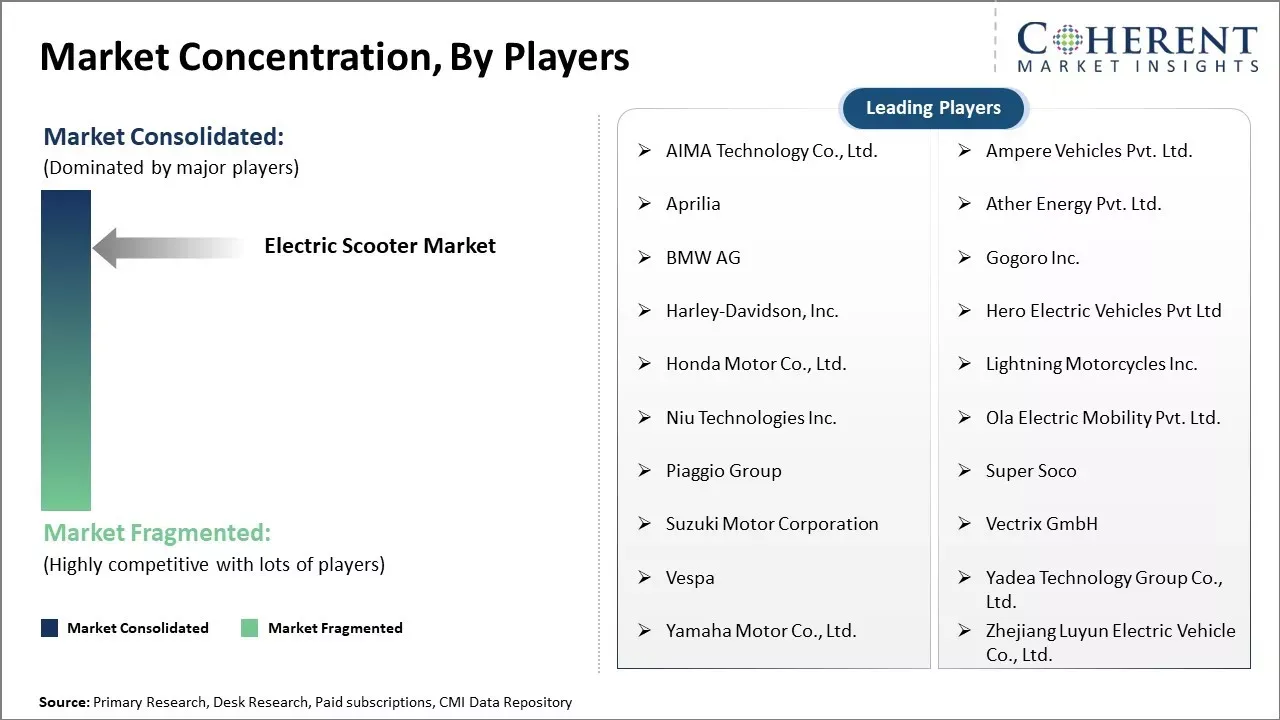
AIMA Technology Co.Ltd., Ampere Vehicles Pvt. Ltd., Aprilia, Ather Energy Pvt. Ltd., BMW AG, Gogoro Inc., Harley-Davidson, Inc., Hero Electric Vehicles Pvt Ltd, Honda Motor Co., Ltd., Lightning Motorcycles Inc., Niu Technologies Inc., Ola Electric Mobility Pvt. Ltd., Piaggio Group, Super Soco, Suzuki Motor Corporation, Vectrix GmbH, Vespa, Yadea Technology Group Co., Ltd., Yamaha Motor Co., Ltd., and Zhejiang Luyun Electric Vehicle Co., Ltd. |
||
| Growth Drivers: |
|
||
| Restraints & Challenges: |
|
||
Uncover macros and micros vetted on 75+ parameters: Get instant access to report
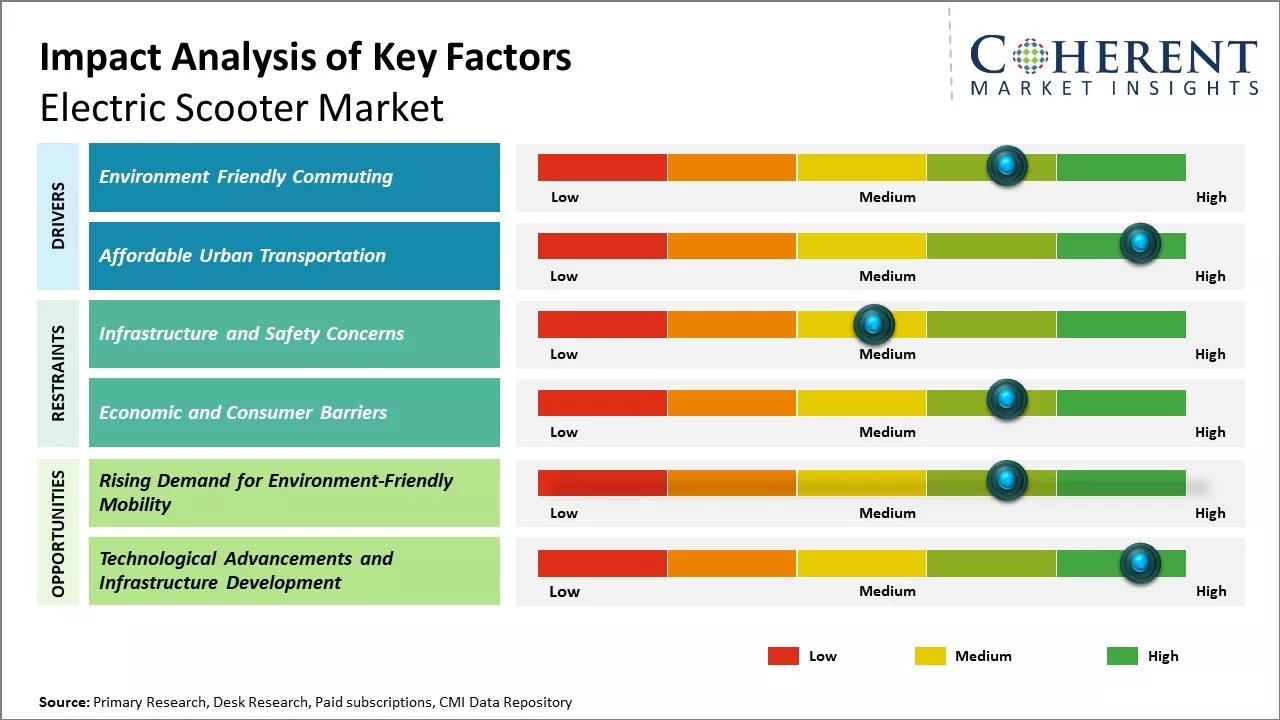
Vehicle manufacturers can increase their earnings and reach new markets as governments worldwide increase their investments in charging infrastructure. National authorities are providing financial benefits to encourage consumers to purchase electric vehicles. India has launched a significant program to promote the adoption and manufacturing of electric vehicles across multiple categories. The initiative has successfully supported the transition of thousands of vehicles to electric power since its production. Consumers are increasingly moving away from gasoline powered vehicles as fuel prices remain unpredictable and continue to rise. Electric scooter sales are experiencing substantial growth in several key international affordable alternatives. The combination of high petrol costs and attractive electric options is speeding up the shift toward sustainable transportation.
For instance, in October 2024, the Indian government launched the PM E-DRIVE Scheme with a budget of approved by Rs.10,900 crore. The program started on October 1, 2024, and will run until March 31, 2026. Its aims to encourage more people to buy electric vehicles (EVs), build more charging stations, and grow India’s EV manufacturing industry.
Cites around the world are struggling with issues like traffic jams, air pollution, and shortage of parking spaces. This has led to a growing awareness that alternative transportation methods are needed, one that are environmentally friendly and work efficiently. Electric scooters provide a strong solution to these problems since they run on clean energy and produce no emissions. They are also ideal for short trips within urban areas. They provide commuters with a convenient and affordable way to move through crowded streets and arrive at their destinations quickly. As urbanization increases and city populations expand, the demand for compact and agile transportation options that can easily navigate through congested traffic is also rising. The growth of ride sharing and rental services has added to the popularity of electric scooters, making them available to more people.
For instance, in May 2025, Langford is set to introduce Evolve, an e-bike and e-scooter sharing service run by BCAA. The program will provide electric bikes and scooters for public use.
The electric scooter market is demonstrating strong global expansion, supported by rising urban population density, increasing two-wheeler electrification, and advancements in battery technology. Industry data indicate that Asia Pacific accounts for the largest share of global electric scooter production and sales volumes, with China and India collectively contributing the majority of annual unit registrations. China alone records tens of millions of electric scooters in active use, supported by extensive charging infrastructure and localized manufacturing ecosystems.
Europe represents a key growth region, with electric scooter registrations exceeding one million units annually, driven by urban emission regulations and government incentives for electric mobility. North America shows comparatively lower volumes but steady adoption, particularly in urban commuting and shared micromobility programs, where electric scooters account for a significant portion of short-distance trips.
Lithium-ion batteries dominate the technology landscape, representing most newly sold models due to higher energy density, faster charging, and longer operational life compared to lead-acid alternatives. Shared mobility fleets and last-mile delivery services are increasingly adopting electric scooters, contributing meaningfully to annual deployment volumes in major cities. Product data show a growing number of models offering extended range, smart connectivity, and swappable battery systems.
Overall, statistical indicators reflect a structurally expanding electric scooter market, characterized by rising unit sales, improving infrastructure coverage, and increasing integration into urban transportation networks.
Definition: The Electric Scooter Market encompasses the production, distribution, and sales of electric powered scooters. It provides mobility solutions that allow consumers to travel short to medium distances in a fast, secure and convenient way. Consumers can use electric scooters for daily commutes, last mile connectivity, recreational riding, and urban transportation. The market includes personal ownership models, shared scooter services, and fleet solutions for businesses.
Share
Share
Gautam Mahajan is a Research Consultant with 5+ years of experience in market research and consulting. He excels in analyzing market engineering, market trends, competitive landscapes, and technological developments. He specializes in both primary and secondary research, as well as strategic consulting across diverse sectors.
Joining thousands of companies around the world committed to making the Excellent Business Solutions.
View All Our Clients