Fingerprint Module Market Analysis & Forecast: 2026-2033

Fingerprint Module Market Size and Forecast – 2026 – 2033
The Global Fingerprint Module Market size is estimated to be valued at USD 8.2 billion in 2026 and is expected to reach USD 15.4 billion by 2033, exhibiting a compound annual growth rate (CAGR) of 9.8% from 2026 to 2033.
Global Fingerprint Module Market Overview
The Fingerprint Module market is primarily segmented into optical, capacitive, and ultrasonic technologies. Optical modules capture fingerprint images using light sensors and are widely adopted for cost-effective applications, while capacitive modules offer higher accuracy and security by detecting electrical signals from skin ridges. Ultrasonic modules represent the fastest-growing segment, leveraging high-resolution 3D scanning for enhanced reliability, even with wet or dirty fingers. Applications span smartphones, laptops, access control systems, and banking devices. Modules are increasingly integrated with AI-enabled recognition software to improve authentication speed and accuracy. Overall, the market emphasizes miniaturization, durability, and seamless integration across consumer electronics and security systems.
Key Takeaways
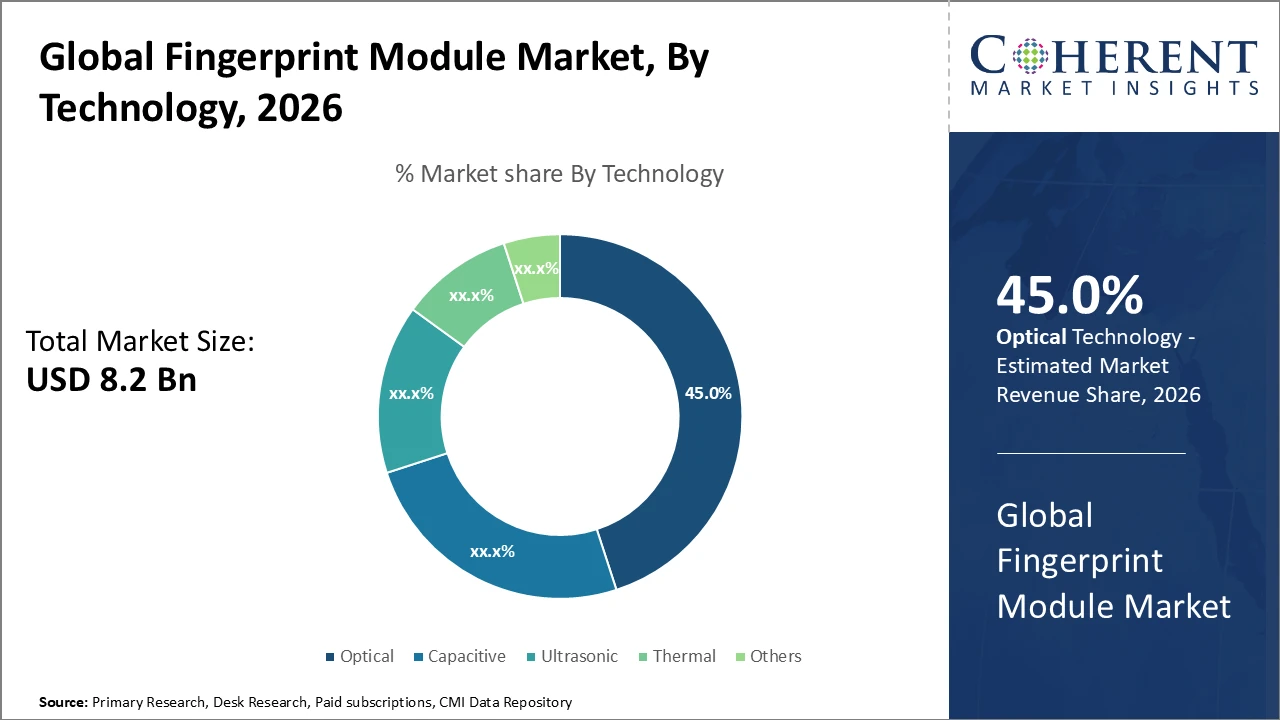
The optical fingerprint module segment leads with 45% market share, driven by widespread use in smartphones and consumer electronics requiring high accuracy and integration flexibility. Capacitive and ultrasonic modules are the fastest-growing subsegments, gaining traction in under-display and automotive applications.
The smartphone application segment dominates with 50% market share, fueled by global mobile device proliferation. Banking & financial services and automotive sectors are growing rapidly due to stringent security requirements and rising adoption of biometric solutions.
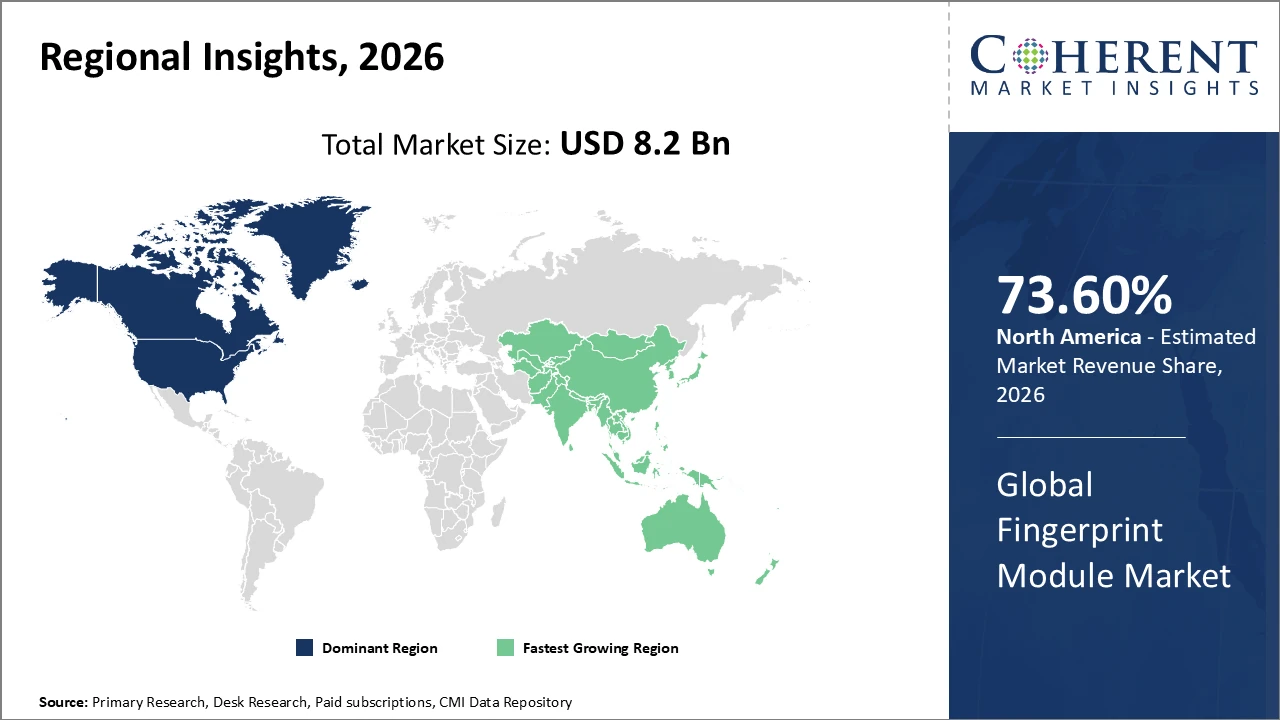
North America dominates the market owing to significant influence through high adoption rates and advanced biometric implementations in BFSI and government sectors.
The Middle East and Africa are emerging markets with a CAGR exceeding 12%, driven by IoT deployments and government-led digital identification programs.
Fingerprint Module Market Segmentation Analysis
To learn more about this report, Request Free Sample
Fingerprint Module Market Insights, By Technology
Optical fingerprint modules dominate the market due to their high accuracy and ease of integration across various applications, particularly in mid-to-high-end smartphones. Ultrasonic modules are the fastest-growing subsegment, offering under-display functionality that enhances device design flexibility and user experience. Capacitive sensors maintain a significant presence because of their durability, reliability, and low power consumption. Thermal and other niche fingerprint technologies cater to specialized requirements in industrial and high-security applications but occupy smaller portions of the market. Overall, the market reflects a balance of established optical solutions and emerging advanced technologies driving innovation in biometric security.
Fingerprint Module Market Insights, By Application
Smartphones dominate the fingerprint module market, driven by their extensive use for secure device unlocking, mobile payments, and personal data protection, making this segment the largest contributor to industry revenue. The Banking & Finance sector is the fastest-growing application, propelled by rising mobile and online transactions demanding reliable biometric authentication. Automotive applications are increasingly integrating fingerprint modules for driver identification and vehicle access, supporting steady market growth. Access Control Systems remain relevant in corporate and government environments, ensuring security for sensitive areas, though their growth is slower compared to consumer-driven markets where convenience and technology adoption are key drivers.
Fingerprint Module Market Insights, By End-User Industry
Consumer Electronics dominate the fingerprint module market, driven by the massive production and adoption of smartphones, laptops, and other personal devices that rely on biometric authentication. The BFSI sector is the fastest-growing end-user segment, leveraging fingerprint modules to enhance transaction security, prevent identity theft, and comply with regulatory standards. Automotive OEMs are increasingly integrating biometric modules to improve vehicle security, driver personalization, and user convenience, contributing to steady market growth. Government and Defense applications continue to rely on fingerprint authentication for secure identification and access control, though expansion is moderated by strict policy frameworks and compliance requirements.
Fingerprint Module Market Trends
Enhanced biometric security is driving market trends, with AI-powered fingerprint algorithms reducing False Acceptance Rates by approximately 30% in 2025, boosting market adoption and revenue.
The demand for seamless and secure authentication across banking, government, and automotive sectors is accelerating the shift toward multi-factor biometric verification systems.
Under-display fingerprint technologies are gaining traction, addressing both aesthetic and functional requirements in next-generation smartphones, leading to a 25% increase in module integration.
Integration of AI and sensor advancements improves accuracy, speed, and user experience, strengthening the overall market appeal.
Manufacturers are focusing on innovative module designs to meet evolving consumer and enterprise security needs.
Expansion into automotive and access control applications diversifies market opportunities beyond consumer electronics.
Fingerprint Module Market Insights, By Geography
To learn more about this report, Request Free Sample
North America Fingerprint Module Market Analysis and Trends
North America holds largest share in the Fingerprint Module market, driven by high adoption of biometric security across smartphones, banking, government, and enterprise applications. The U.S. leads the region, fueled by early technology adoption, robust R&D ecosystems, and strong regulatory emphasis on secure authentication. In 2025, over 55% of new mobile devices shipped incorporated fingerprint modules, reflecting widespread consumer demand. Enterprises increasingly deploy fingerprint-based access control and multi-factor authentication to enhance security. Key players like Apple, Qualcomm, and Synaptics are actively innovating with under-display and ultrasonic technologies, strengthening market growth and sustaining North America’s competitive leadership in the global fingerprint module landscape.
Asia Pacific Fingerprint Module Market Analysis and Trends
Asia Pacific is driven primarily by China and India’s strong manufacturing infrastructure, expanding smartphone penetration, and supportive government initiatives promoting biometric security. The region accounts for around 38% of global market revenue, benefiting from cost-effective production, robust electronics supply chains, and high consumer demand for mobile devices, laptops, and wearable technology. Local manufacturers are rapidly adopting advanced optical, capacitive, and ultrasonic fingerprint technologies to cater to both domestic and export markets. Additionally, rising investments in banking, automotive, and access control sectors further propel market expansion, positioning Asia Pacific as the dominant regional hub for fingerprint module production and adoption.
Fingerprint Module Market Outlook for Key Countries
USA Fingerprint Module Market Analysis and Trends
The USA remains a pivotal market for fingerprint modules, driven by strong adoption across BFSI, government, and consumer electronics sectors. In 2025, over 65% of mobile banking transactions incorporated biometric authentication, significantly boosting market revenue. Key industry players focused on AI-enhanced fingerprint technologies to improve accuracy, reduce fraud, and expand market share. Additionally, government initiatives in border security, digital identity programs, and public sector authentication further strengthen demand. Robust R&D, advanced manufacturing capabilities, and a tech-savvy consumer base position the USA as a global leader in fingerprint module innovation and adoption, fostering sustained market growth.
Germany Fingerprint Module Market Analysis and Trends
Germany remains a key European market for fingerprint modules, driven by strong automotive, industrial, and consumer electronics sectors emphasizing biometric security. In 2025, over 50% of new vehicles incorporated fingerprint-based access and ignition systems, reflecting increasing adoption in automotive OEMs. The country’s stringent data privacy regulations encourage secure authentication solutions across BFSI and government applications. Companies such as Infineon Technologies and Diebold Nixdorf have invested heavily in R&D, focusing on ultrasonic and AI-powered modules, enhancing product performance and reliability. Germany’s robust manufacturing ecosystem and regulatory support position it as a pivotal contributor to Europe’s fingerprint module market growth.
Analyst Opinion
A key demand-side driver is the growing integration of fingerprint modules into mobile devices. In 2024, over 1.5 billion smartphones shipped worldwide with fingerprint sensors, marking a 12% increase from 2023, supporting strong revenue growth from consumer electronics applications.
On the supply side, manufacturing capacities for optical and ultrasonic fingerprint modules expanded significantly. Leading fabrication plants increased production throughput by 18% in 2025, driven by semiconductor advancements and cost optimization, improving global availability and affordability of high-quality modules.
Financial services adoption is rising, with banks and fintech firms using fingerprint authentication for mobile banking. By 2026, 58% of global mobile banking transactions relied on biometric verification.
Micro-indicators such as falling sensor prices—down 10% between 2024 and 2025—enabled broader penetration in mid-tier and entry-level devices, particularly in cost-sensitive emerging markets.
Market Scope
| Report Coverage | Details | ||
|---|---|---|---|
| Base Year: | 2025 | Market Size in 2026: | USD 8.2 billion |
| Historical Data for: | 2020 To 2024 | Forecast Period: | 2026 To 2033 |
| Forecast Period 2026 to 2033 CAGR: | 9.8% | 2033 Value Projection: | USD 15.4 billion |
| Geographies covered: |
|
||
| Segments covered: |
|
||
| Companies covered: | FPC, Egis Technology Inc., Idex ASA, CrucialTec, Inc., Nitgen Co. Ltd., Goodix Technology, Inc., Precise Biometrics AB, Fingerprint Technologies Ltd, SecuGen Corporation, Ofil Technologies Ltd. | ||
| Growth Drivers: |
|
||
Uncover macros and micros vetted on 75+ parameters: Get instant access to report
Fingerprint Module Market Growth Factors
The integration of under-display fingerprint technology in premium smartphones is a key market driver, with adoption growing over 30% year-over-year between 2024 and 2026, significantly increasing market revenue. Rising security concerns in the BFSI sector, alongside regulatory compliance mandates, have fueled demand for biometric modules in financial services, with mobile banking apps using fingerprint authentication surging 25% in 2025 alone. Additionally, the expansion of connected automobiles and IoT devices has doubled biometric implementations in automotive applications from 2024 to 2026. Cost reductions from sensor manufacturing advances and economies of scale have also enabled broader adoption in price-sensitive regions like Asia Pacific and Latin America.
Fingerprint Module Market Development
In January 2026, RRP Electronics, an OSAT semiconductor company, launched Samved, India’s first indigenously developed fingerprint sensor module designed for high-resolution, low-power biometric authentication, addressing the country’s heavy reliance on imported fingerprint sensors.
Key Players
Leading Companies of the Market
FPC
Idex ASA
CrucialTec, Inc.
Fingerprint Technologies Ltd.
Nitgen Co. Ltd.
Egis Technology Inc.
Goodix Technology Inc.
SecuGen Corporation
Ofil Technologies Ltd
Precise Biometrics AB
Leading companies in the fingerprint module market continue to pursue aggressive growth strategies, including strategic partnerships and acquisitions. In 2025, Synaptics Incorporated partnered with a top-tier smartphone manufacturer, resulting in a 15% increase in market share for its ultrasonic fingerprint modules. Similarly, Goodix Technology’s focused investment in R&D for under-display optical modules drove a 20% rise in adoption across premium smartphone segments. These initiatives underscore the market’s emphasis on innovation and product diversification, enabling companies to strengthen their competitive positions while meeting growing demand for advanced, seamless biometric authentication solutions.
Fingerprint Module Market Future Outlook
The fingerprint module market is poised for robust growth, driven by increasing adoption of biometric authentication across smartphones, BFSI, automotive, and IoT sectors. Technological advancements such as under-display optical sensors, ultrasonic modules, and AI-enhanced recognition algorithms are expected to improve accuracy, speed, and security, fueling market expansion. Rising demand for seamless and contactless authentication, coupled with regulatory requirements in financial services and government applications, will further support adoption. Additionally, cost reductions in sensor manufacturing and growing production capacities in Asia Pacific are anticipated to enhance market accessibility. Overall, the sector is set for sustained innovation-driven growth through 2033.
Fingerprint Module Market Historical Analysis
The fingerprint module market has witnessed steady growth over the past decade, driven primarily by the proliferation of smartphones and increasing emphasis on digital security. From 2015 to 2025, optical and capacitive modules dominated due to their accuracy and cost-effectiveness, while ultrasonic and under-display technologies began emerging in premium devices. Early adoption in BFSI, government, and access control applications provided a strong revenue base. Asia Pacific, particularly China and India, became major production hubs, while North America and Europe led in innovation and high-end deployments. Market expansion was supported by declining sensor costs and growing awareness of biometric security solutions.
Sources
Primary Research Interviews:
Smartphone and consumer electronics manufacturers
Automotive OEMs and connected vehicle technology providers
Banking & financial service technology teams and fintech firms
Biometric technology consultants and research laboratories
Magazines:
Biometric Update – Fingerprint Technology & Innovations
Electronics For You – Consumer Electronics & Sensor Integration
Security Magazine – Biometric Access Control & Authentication
Semiconductor Digest – Sensor Manufacturing & Technology Trends
Journals:
Journal of Biometric Systems – Fingerprint Sensor Studies
IEEE Transactions on Biometrics, Behavior, and Identity Science
International Journal of Biometrics & Authentication Technology
Sensors – Biometric Sensor Integration and Application
Newspapers:
The Wall Street Journal – Consumer Electronics & Security Technology
Financial Times – Biometric Technology and Digital Security
Reuters – Technology & Biometric Market Trends
Bloomberg – Mobile Devices & Authentication Solutions
Nikkei Asia – Electronics Manufacturing & Sensor Technology
Associations:
International Biometrics + Identity Association (IBIA)
FIDO Alliance – Fast Identity Online Standards
European Association for Biometrics (EAB)
Share
Share
Suraj Bhanudas Jagtap is a seasoned Senior Management Consultant with over 7 years of experience. He has served Fortune 500 companies and startups, helping clients with cross broader expansion and market entry access strategies. He has played significant role in offering strategic viewpoints and actionable insights for various client’s projects including demand analysis, and competitive analysis, identifying right channel partner among others.

Credibility and Certifications

860519526


9001:2015

27001:2022


Need a Custom Report?
We can customize every report - free of charge - including purchasing stand-alone sections or country-level reports
Customize NowJoining thousands of companies around the world committed to making the Excellent Business Solutions.
View All Our Clients