

Data Fabric Market Analysis & Forecast: 2026-2033
Data Fabric Market is estimated to be valued at USD 4.45 Bn in 2026 and is expected to reach USD 21.57 Bn in 2033, exhibiting a compound annual growth rate (CAGR) of 25.3% from 2026 to 2033.
Key Takeaways
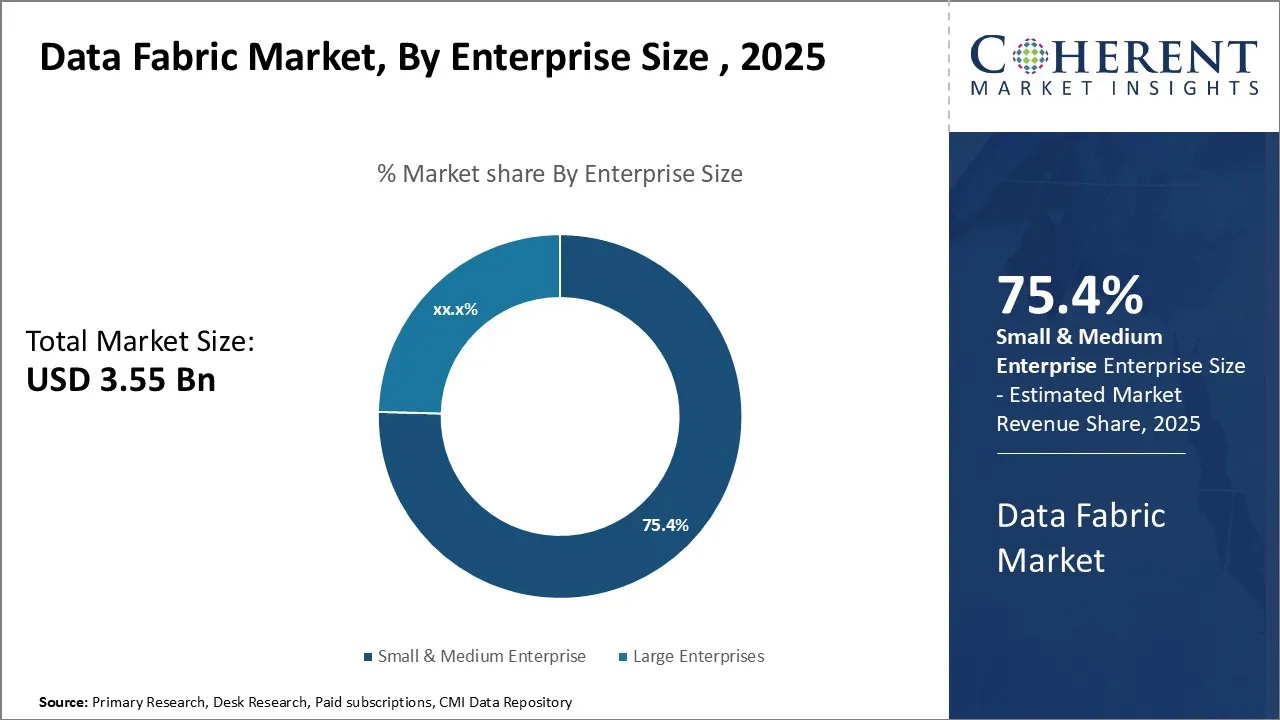
- By Enterprise Size, Small and Medium Enterprises (SMEs) are expected to dominate the global data fabric market in 2026, capturing a commanding 76.4% share due to their growing need for scalable and cost-effective data management solutions.
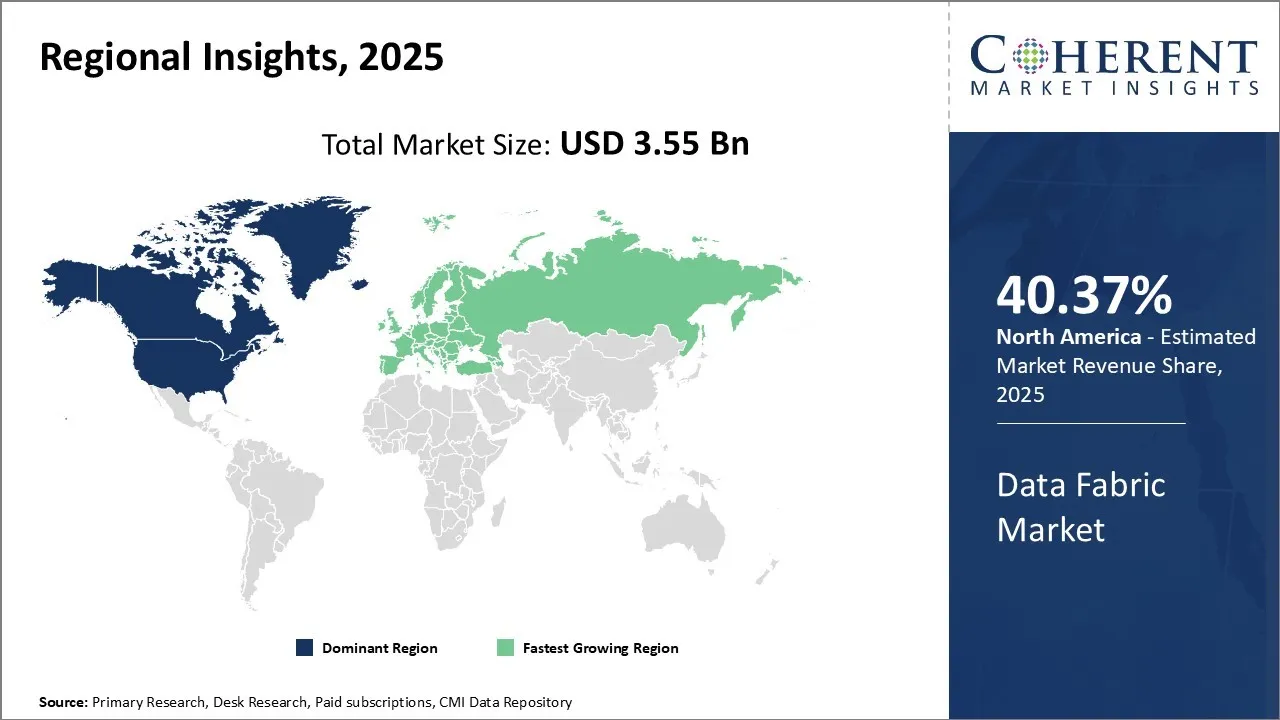
- By region, North America is projected to lead the global data fabric market in 2026, securing a significant 40.37% share, driven by advanced technological infrastructure, early adoption of data-driven strategies, and strong investments in digital transformation initiatives.
Market Overview
The Data Fabric Market is growing tremendously because of the growing need for organizational agility and the requirement for centralized data to be accessible securely. Consider the example of IBM Data Fabric Solutions for BFSI firms in 2024 and how they plan to help in data collaboration and advanced organizational analytics. The finance and banking industry is especially gaining from the need for improved data source accessibility and advanced analytics capabilities, driving the market significantly.
Current Events and Its Impact on the Data Fabric Market
Event | Description and Impact |
AI/ML Integration and Generative AI Adoption |
|
Global Data Privacy and Regulatory Compliance Evolution |
|
Multi-Cloud and Hybrid Infrastructure Modernization |
|
Pricing Analysis
The global data fabric market employs diverse pricing models tailored to different customer needs, including subscription-based (SaaS), node-based licensing, consumption-based, and hybrid approaches. Market-leading enterprise solutions like IBM Cloud Pak for Data use node-based pricing, starting at approximately $2,000 per node per month, with enterprise editions reaching up to $8,500 per node monthly. Palantir Foundry offers a consumption-based model with annual licenses ranging from $500,000 to $2 million, plus per-user fees and data processing costs.
Cloud-native platforms such as Microsoft Azure Purview charge based on capacity units, assets managed, and pipeline runs, providing flexible pay-as-you-go options. Mid-market solutions, including Informatica IDMC and Talend Data Fabric, primarily use subscription pricing with tiers based on data volume or user counts, with monthly fees ranging from a few thousand to over $20,000.
Specialized vendors like Denodo focus on server-based licensing with substantial annual fees, while emerging analytics-focused players like Starburst offer consumption-based models charged per compute hour.
Overall, pricing varies widely depending on deployment scale, features, and consumption, with professional services often billed separately. This variety enables organizations of all sizes to select data fabric solutions aligned with their budget and data management requirements.
- Current Industry Events of 2026
- Market Size Estimation
- Regional Breakdown
- Competitive Landscape
- Customer Intelligence
- Segmental Analysis
- Pricing Analysis
- Key Market Drivers, Challenges & Future Trends
- Customized Insights Section
Role of Advanced Technologies
Data fabric is a well-structured architecture that fundamentally transforms how organizations manage distributed data. Modern data fabric technology integrates artificial intelligence and machine learning to automate data discovery, cataloging, and quality assessment, enabling more efficient and accurate data management. Innovative data fabric solutions now incorporate AI-driven automation, natural language processing, and real-time anomaly detection to reduce manual effort and improve decision-making.
Identity Data Fabric plays a crucial role in strengthening security by embedding zero-trust architectures and advanced identity and access management. These systems provide dynamic, attribute-based controls that continuously monitor data access, ensuring compliance and preventing unauthorized activity.
Cloud-native architectures and multi-cloud integration allow data fabric platforms to support seamless data virtualization across diverse environments, with scalable containerized components managed via Kubernetes. Additionally, the convergence of data fabric technology with edge computing enables real-time data processing and analytics, essential for industries requiring immediate insights.
Innovative data fabric solutions also leverage graph-based data management and privacy-preserving technologies, fostering intelligent data federation and secure collaboration without compromising sensitive information. Together, these advanced technologies empower enterprises with unified, secure, and agile data ecosystems that accelerate digital transformation.
Segmental Insights
Global Market Insights, By Enterprise Size
By enterprise size, Small and Medium Enterprises (SMEs) are expected to dominate the market with a commanding 76.4% share in 2026. This significant leadership is largely attributed to the agility and adaptability of SMEs in adopting new technologies and responding to market dynamics swiftly. SMEs often drive innovation and cater to niche markets, which contributes to their strong presence.
Furthermore, increasing government initiatives and supportive policies aimed at fostering SME growth are expected to sustain this trend over the forecast period.
In contrast, Large Enterprises hold a smaller market share, reflecting their relatively slower pace of transformation compared to SMEs. However, large enterprises continue to play a crucial role by leveraging their extensive resources and established infrastructure to support large-scale projects and investments. The growing collaboration between large corporations and SMEs is also anticipated to enhance overall market growth and innovation.
Regional Insights
North America Data Fabric Market Analysis and Trends
North America is expected to witness significant growth in the global data fabric market, capturing approximately 40.37% of the market share by 2026. This expansion is driven by the rapid rise in cloud-enabled activities and a growing cloud marketplace across the region. For example, nearly 33% of companies in Canada have adopted a “cloud first” strategy, while 54% maintain a “cloud also” approach, highlighting the strong digital transformation momentum. The region benefits from a robust presence of leading market players who are actively addressing the increasing need to transform digital data ecosystems across businesses. These factors collectively position North America as a key growth hub for data fabric technologies.
Europe Data Fabric Market Analysis and Trends
Europe is projected to demonstrate strong growth in the data fabric market during the forecast period. The rising demand for efficient control, management, and automation of data processes across diverse industries drives this growth.
Additionally, the increasing adoption of hybrid cloud platforms is fueling market expansion, as many European enterprises shift to hybrid solutions to overcome architectural complexities and reduce cloud migration costs. Countries such as Germany, the U.K., and France are at the forefront of this transition, supported by advanced IT infrastructure and regulatory frameworks encouraging digital innovation.
Dominating Countries in the North America Data Fabric Market
United States
The U.S. leads the North American data fabric market due to extensive cloud adoption, presence of major technology providers, and strong investments in digital transformation initiatives.
Canada
Canada shows growing momentum with a high percentage of companies embracing cloud-first and hybrid cloud strategies, driving demand for advanced data fabric solutions.
Market Report Scope
Data Fabric Market Report Coverage
| Report Coverage | Details | ||
|---|---|---|---|
| Base Year: | 2025 | Market Size in 2026: | USD 4.45 Bn |
| Historical Data for: | 2020 To 2024 | Forecast Period: | 2026 To 2033 |
| Forecast Period 2026 to 2033 CAGR: | 25.3% | 2033 Value Projection: | USD 21.57 Bn |
| Geographies covered: |
| ||
| Segments covered: |
| ||
| Companies covered: | Denodo Technologies, Talend, Global IDs., Splunk Inc., Hewlett Packard Enterprise Company, Software AG, IBM Corporation, SAP SE, NetApp, and Oracle Corporation | ||
| Growth Drivers: |
| ||
| Restraints & Challenges: |
| ||
Global Data Fabric Market Drivers
- Growing variety and volume of business data to boost the market growth
With emergence of social media networks, the amount of data produced through online applications, portals, and websites has increased in recent years. The demand for fast accessibility to data such as images, text, and videos among people is driving the demand for data fabric solutions.
This is owing to the capability of data fabric to integrate various data sources and offer a platform accumulating unified environment seamlessly. Thus, rise amount of data generated by businesses is driving the adoption of data fabric, which in turn is expected to drive growth of the global data fabric market over the forecast period.
- Increasing need for business agility and data accessibility to drive the market growth
The need to ensure usability, accuracy, and secure transfer of velocity, variety, sheer volume, and access requirements of data in different silos is growing rapidly. Due to this, the adoption of data fabric solutions is rising across enterprises, as it offers unified data access portal including data virtualization, data movement, and application-to-application connections with in-built security.
Along with this, businesses are considering data fabric as a strategic tool to provide appropriate integration solution that can lucratively affect the strategic component of current data infrastructure, as it helps streamline and maximize use of data in the businesses. Thus, this factor is anticipated to support growth of the market in the coming future.
Global Data Fabric Market Opportunities
Rise in amount of data in emerging regions is expected to create ample opportunities in the global data fabric market over the forecast period. Due to emergence of Industry 4.0 and digitalization, specifically across emerging nations is proliferating the amount of data generated through these initiatives.
The advent of Industry 4.0 increases the amount of data generation through machine-to-machine communications systems, which are known as Industrial Internet of Things (IIoT) devices. Thus, demand for reliable and secure data architecture is increasing, which in turn is creating growth opportunities in the global market.
Positive return on investment in data fabric solutions is creating various opportunities in the global data fabric market over the forecast period. Investment in data fabrics offers positive RoI in different ways for organizations. Using data fabric systems, improves efficiency of operations. Eliminating paper forms and minimizing handoff delays becomes possible with the use of data fabric solutions. These solutions allow to target the best prospects, efficiently use available resources, and price risks with more accuracy. This in turn is translated into positive return on investment in many ways. Thus, this factor is likely to offer multiple opportunities in the market.
Global Data Fabric Market Trends
- Increasing adoption of data management solutions for better data security is a major trend
For successful outcomes and proper business operations, strong and secured data is important. Achieving secure data for businesses require adhering to global safeguarding regulations for sensitive data of consumers or clients. Several companies are looking for solutions to protect their data, which is leading to adoption of data management solutions. This in turn is expected to support growth of the global data fabric market over the forecast period.
- Implementation of artificial intelligence and machine learning solutions in the architecture
By implementing such advanced technologies including AI and machine learning increases operational capabilities of the architecture. In December 2021 for instance, Radiant Logic, an identity unification company introduced RadiantOne Intelligent Identity Data Platform as the Identity Data Fabric for strengthening compliance and security abilities. This further enhances data security features. As a result, the global digital fabric market is likely to show substantial growth in the near future.
Analyst Viewpoint
- The data fabric market is witnessing strong growth propelled by organizations’ urgent need to break down data silos and create unified data architectures spanning hybrid and multi-cloud environments. The rapid expansion of data volumes, alongside stringent regulatory compliance demands, is driving enterprises toward comprehensive data management solutions that offer real-time visibility, governance, and control.
- Key drivers fueling this market include accelerating digital transformation efforts, widespread adoption of artificial intelligence (AI) and machine learning (ML) technologies, and a growing emphasis on data security and privacy. Data fabric solutions attract organizations by enabling seamless data integration, automating data discovery, and supporting self-service analytics across distributed infrastructures.
- Despite the positive momentum, challenges persist. The complexity involved in integrating data fabric solutions with legacy IT systems, high upfront investment costs, and a shortage of skilled professionals capable of managing advanced data architectures hinder faster adoption. Moreover, concerns around data sovereignty and the risk of vendor lock-in continue to cause hesitation among potential users.
- Geographically, North America remains the dominant market, benefiting from advanced technological infrastructure and early adoption of data-driven strategies by enterprises. Meanwhile, the Asia-Pacific region is emerging as the fastest-growing market, driven by rapid digitalization, increased cloud adoption, and expanding investments in data analytics capabilities across emerging economies.
- Significant growth opportunities lie in industry-specific implementations, particularly in healthcare, financial services, and manufacturing sectors. Here, tailored data fabric solutions can address unique regulatory and operational challenges, while empowering organizations with advanced analytics and enhanced decision-making capabilities.
Global Data Fabric Market: Key Developments
- In April 2022, Privitar and Denodo announced partnership with the aim of advanced modern data provision and placing safe data at the core of all data mesh as well as logical data fabric charged through virtualization of data.
- In November 2021, Nasdaq introduced a managed data solution, Data Fabric, for offering support in investment management firms to scale their data infrastructure and improve governance, quality, and integrity.
- In August 2021, EY expanded its strategic partnership with Microsoft Corp. for further aligning EYs business ingenuity with cloud technologies of Microsoft for designing long-term value for their particular clients.
Market Segmentation
- Global Data Fabric Market, By Deployment
- On-premise
- Cloud
- Global Data Fabric Market, By Type
- Disk-based Data Fabric
- In-memory Data Fabric
- Global Data Fabric Market, By Enterprise Size
- Small & Medium Enterprises
- Large Enterprises
- Global Data Fabric Market, By Industry Vertical
- BFSI
- Telecommunications & IT
- Retail
- Healthcare
- Manufacturing
- Government
- Energy & Utilities
- Media & Entertainment
- Others
- Global Data Fabric Market, By Region
- North America
- U.S.
- Canada
- Latin America
- Brazil
- Argentina
- Mexico
- Rest of Latin America
- Europe
- Germany
- U.K.
- Spain
- France
- Italy
- Russia
- Rest of Europe
- Asia Pacific
- China
- India
- Japan
- Australia
- South Korea
- ASEAN
- Rest of Asia Pacific
- Middle East
- GCC Countries
- Israel
- Rest of Middle East
- Africa
- South Africa
- North Africa
- Central Africa
- North America
- Company Profiles
- Denodo Technologies
- Global IDs.
- Hewlett Packard Enterprise Company
- IBM Corporation
- NetApp
- Oracle Corporation
- SAP SE
- Software AG
- Splunk Inc.
- Talend
Sources
Primary Research Interviews
- Chief Technology Officers (CTOs) from leading technology companies
- Data Management Solution Providers and Vendors
- Enterprise Data Architects and Analytics Professionals
- IT Infrastructure and Cloud Service Managers
- Others
Databases
- Gartner IT Market Research Database
- IDC Technology Research Database
- Forbes Insights Enterprise Technology Database
- Others
Magazines
- CIO Magazine
- Information Management Magazine
- Data Management Review
- Enterprise Tech Magazine
- Others
Journals
- Journal of Database Management
- IEEE Transactions on Knowledge and Data Engineering
- International Journal of Information Management
- Others
Newspapers
- The Wall Street Journal Technology Section
- Financial Times Tech Coverage
- Reuters Technology News
- TechCrunch Enterprise Coverage
- Others
Associations
- Data Management Association International (DAMA)
- International Association for Information and Data Quality (IAIDQ)
- Enterprise Data Management Council (EDM Council)
- Cloud Security Alliance (CSA)
- Others
Public Domain Sources
- U.S. Bureau of Economic Analysis Technology Reports
- European Commission Digital Strategy Publications
- World Bank Digital Development Reports
- McKinsey Global Institute Technology Research
- Others
Proprietary Elements
- CMI Data Analytics Tool
- Proprietary CMI Existing Repository of information for last 8 years
*Definition: A data fabric is a new approach to accessing and leveraging a company’s data assets, regardless of their location – on-premises or in the cloud. It improves data access, availability and performance across an enterprise, and enables data-driven business transformation and innovation.
Get access to 250+ pages report
Every segment, forecast, competitor profile and data table behind the analysis above — available for instant download.
- ESOMAR Member
- ISO 9001:2015 Certified
- D-U-N-S Registered
- GDPR & CCPA Compliant
Missing comfort of reading report in your local language? Find your preferred language:
Transform your Strategy with Exclusive Trending Reports
Frequently Asked Questions
The Data Fabric Market size is estimated to be valued at USD 4.45 Bn in 2026, and is expected to reach USD 21.57 Bn by 2033.
The CAGR of the global Market is projected to be 25.3% from 2026 to 2033.
Growing variety and volume of business data and increasing need for business agility and data accessibility are fuelling the growth of market.
The Small and Medium Enterprise segment is the leading segment in the market.
Low awareness regarding data fabric and issues regarding integration of legacy systems are the major factors restraining growth of the market.
Denodo Technologies, Talend, Global IDs., Splunk Inc., Hewlett Packard Enterprise Company, Software AG, IBM Corporation, SAP SE, NetApp, and Oracle Corporation.
Data fabric optimizes data delivery by providing seamless integration, real-time access, and automated data management across hybrid and multi-cloud environments, improving efficiency and decision-making.