Formaldehyde Free Resin Market Analysis & Forecast: 2026-2033

Formaldehyde Free Resin Market Size and Forecast – 2026 – 2033
The Global Formaldehyde Free Resin Market size is estimated to be valued at USD 1.75 billion in 2026 and is expected to reach USD 3.35 billion by 2033, exhibiting a compound annual growth rate (CAGR) of 9.1% from 2026 to 2033.
Global Formaldehyde Free Resin Market Overview
The Formaldehyde Free Resin Market offers eco-friendly alternatives to traditional resins, catering to increasing environmental and health concerns. Key products include urea-melamine-formaldehyde (UMF) free resins, phenol-formaldehyde (PF) substitutes, and bio-based resins derived from renewable resources. These resins are primarily used in wood adhesives, laminates, coatings, and composites, providing low-emission, non-toxic bonding solutions. Manufacturers are innovating to enhance water resistance, durability, and cost-effectiveness, making these resins suitable for furniture, construction, and automotive applications. The market growth is driven by strict regulatory standards, rising consumer awareness, and the push for sustainable and green building materials.
Key Takeaways
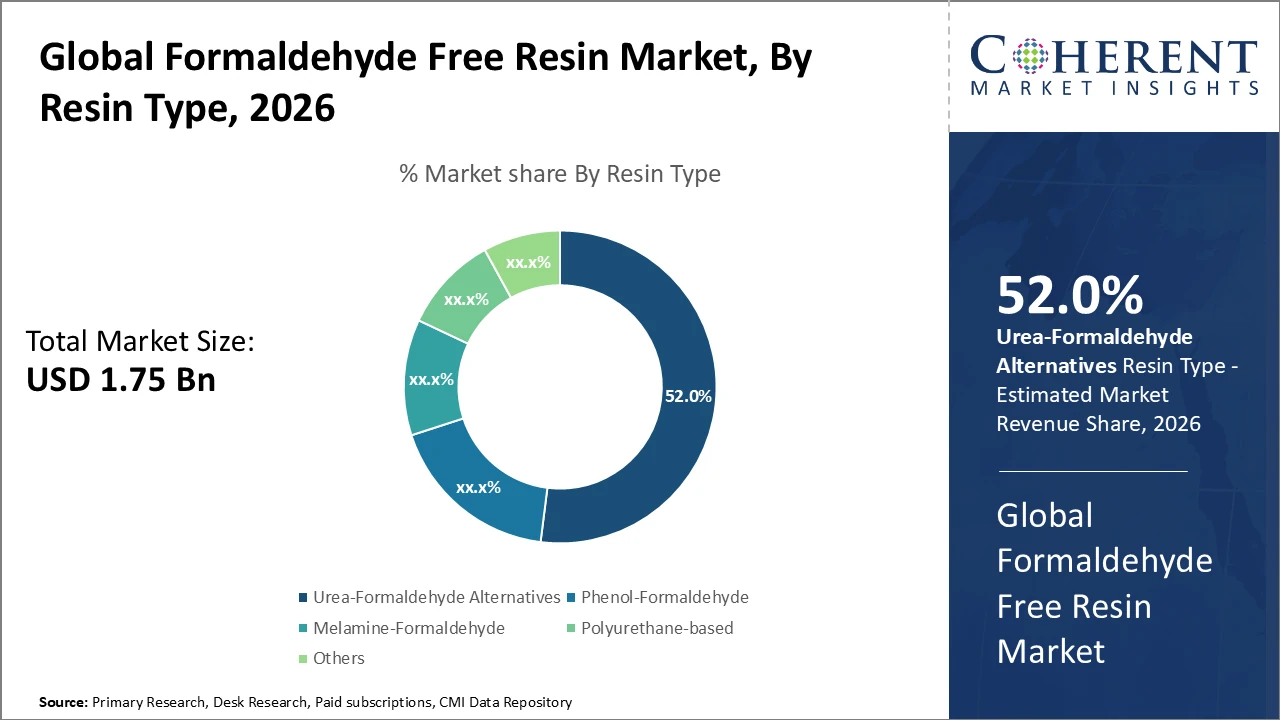
In the resin type segment, urea-formaldehyde alternatives dominate the market share, driven by their superior performance in wood composite applications and regulatory acceptance. Phenol-formaldehyde alternatives are rapidly gaining due to evolving environmental norms, offering potential for growth.
Within applications, the wood composites segment leads in market revenue owing to extensive usage in furniture and construction industries with stringent emission guidelines. Automotive components form the fastest-growing subsegment benefiting from enhanced resin properties catering to lightweight vehicle manufacturing.
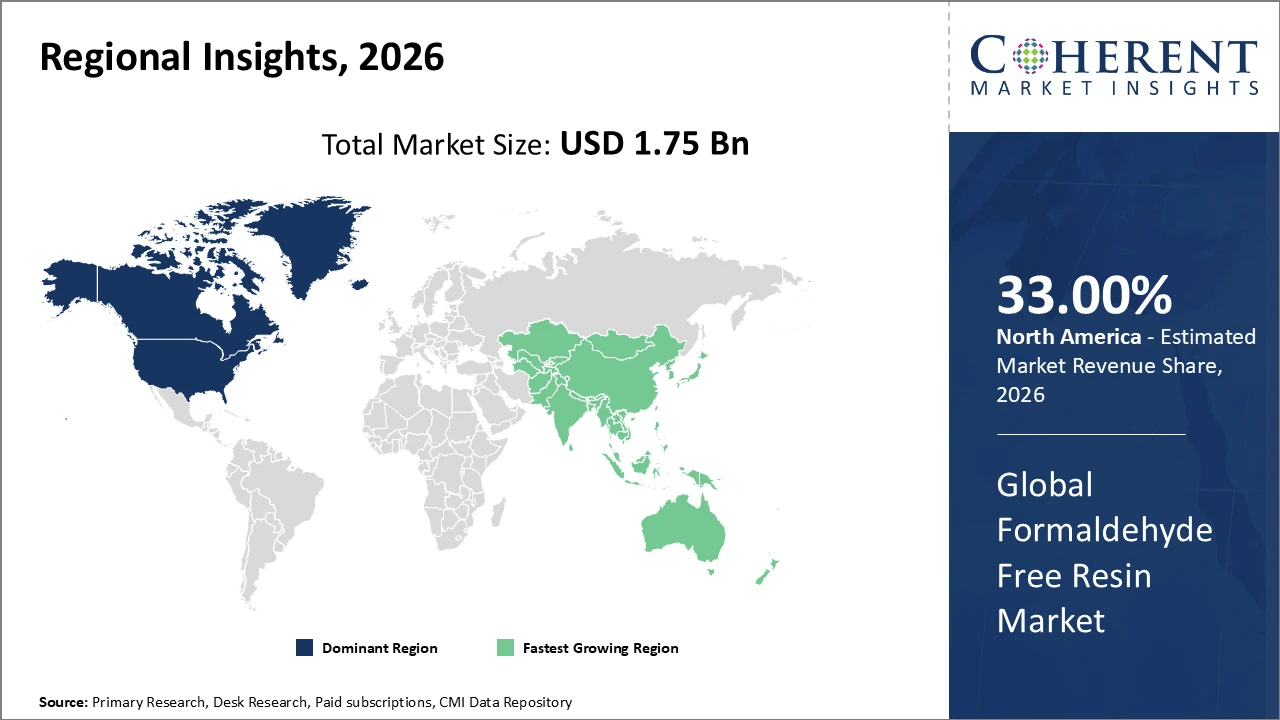
Regionally, North America commands the largest market share supported by stringent environmental standards and developed infrastructure. The Asia Pacific region showcases the fastest growth, driven by manufacturing expansion in China and India, alongside increasing government incentives for green materials adoption.
Formaldehyde Free Resin Market Segmentation Analysis
To learn more about this report, Request Free Sample
Formaldehyde Free Resin Market Insights, By Resin Type
Urea-Formaldehyde alternatives dominate the market, capturing over 52% due to cost-effectiveness and performance comparable to traditional resins in wood composites, benefiting from regulatory acceptance as a less toxic option. Phenol-Formaldehyde alternatives are the fastest-growing subsegment, driven by superior bonding and moisture resistance, expanding applications in automotive and exterior-grade composites. Melamine-Formaldehyde alternatives serve high-durability and heat-resistant applications, though their market share is limited by higher production costs. The polyurethane-based segment is emerging in specialized adhesives and coatings owing to flexible formulation adaptability. The others category, including bio-based and hybrid resins, represents innovation-driven growth opportunities in the market.
Formaldehyde Free Resin Market Insights, By Application
Wood composites dominate the market with a 45% share, driven by their extensive use in furniture manufacturing and building panels where formaldehyde emission reductions are highly regulated. This sector continues to invest in enhancing resin performance, supporting the industry trend toward low VOC and formaldehyde-free products. The automotive components segment is experiencing the fastest growth, fueled by increasing demand for lightweight, environmentally compliant adhesives essential for electric vehicles and advanced composites. Textiles and coatings & adhesives, though smaller segments, are emerging niches that leverage formaldehyde-free formulations for safer consumer goods and improved surface treatments. The others category includes various but less significant end-use applications.
Formaldehyde Free Resin Market Insights, By End-User
Construction dominates the industry with a 41% share, largely driven by regulatory efforts to reduce indoor air pollutants, positioning formaldehyde-free resins as effective inhibitors of harmful emissions in building materials. Market growth is supported by expanding urbanization and increased construction activity, which demand sustainable material sourcing. The automotive sector is the fastest-growing subsegment, driven by stringent vehicle emission standards and electrification trends that prioritize lighter, eco-friendly materials. Furniture, interiors, and packaging segments remain steady contributors, benefiting from the rising focus on sustainable product portfolios. The others category includes specialized industrial applications with a limited market share.
Formaldehyde Free Resin Market Trends
The Formaldehyde Free Resin market is experiencing multiple converging trends reshaping its ecosystem.
Transition from synthetic petrochemical feedstocks to bio-renewable materials has accelerated, with bio-based resin compositions accounting for nearly 30% of new product launches globally in 2024 and 2025.
This shift aligns with global sustainability mandates and rising consumer demand for low-emission products, positively impacting market size and revenue.
Integration of nanotechnology into resin formulations is enhancing resistance to moisture and mechanical stress, broadening applications in automotive and construction segments.
Digital R&D practices using artificial intelligence models are improving formulation accuracy and speeding commercialization timelines, promoting agile innovation in the market.
Formaldehyde Free Resin Market Insights, By Geography
To learn more about this report, Request Free Sample
North America Formaldehyde Free Resin Market Analysis and Trends
In North America, the dominance in the Formaldehyde Free Resin market is driven by stringent environmental norms, including CARB regulations, and proactive adoption by wood composite manufacturers. The region accounts for approximately 33% of the market, supported by advanced manufacturing ecosystems and high consumer awareness of low-emission products. Leading companies such as AkzoNobel and BASF have strengthened their presence through innovation hubs in the U.S. and Canada, actively engaging in sustainable product initiatives and driving the development and commercialization of formaldehyde-free resin solutions across various industrial applications.
Asia Pacific Formaldehyde Free Resin Market Analysis and Trends
Meanwhile, the Asia Pacific region is experiencing the fastest growth in the Formaldehyde Free Resin market, with a CAGR exceeding 11%, driven by expanding construction activities and increasing automotive production in China and India. Government incentives supporting green materials, along with rising exports from regional manufacturing hubs, have further accelerated market expansion. Leading companies such as Huntsman Corporation and Wanhua Chemical have made significant investments in regional production capacities, fueling strong business growth. Enhanced supply chain robustness and increasing environmental compliance are key factors contributing to the region’s rapid market trajectory.
Formaldehyde Free Resin Market Outlook for Key Countries
USA Formaldehyde Free Resin Market Analysis and Trends
The USA is a key market for formaldehyde-free resins due to its stringent regulatory framework aimed at reducing formaldehyde emissions, driving widespread adoption in construction and automotive sectors. Large-scale manufacturers investing in bio-based resin innovation and environmental certification programs have further strengthened market growth. In 2025, U.S. producers reported a 20% increase in the deployment of formaldehyde-free resins in engineered wood products, reflecting strong market demand. These factors underscore the USA’s critical role in influencing global market dynamics and advancing the adoption of sustainable, low-emission resin solutions.
Germany Formaldehyde Free Resin Market Analysis and Trends
Germany’s Formaldehyde Free Resin market is shaped by strict environmental regulations, including low VOC and formaldehyde emission standards, driving adoption in construction, furniture, and automotive industries. Urea-formaldehyde and phenol-formaldehyde alternatives dominate, supported by strong demand for eco-friendly wood composites and high-performance adhesives. The market is witnessing innovation through bio-based and hybrid resins, enhancing sustainability while maintaining durability and moisture resistance. Growth is further fueled by government incentives promoting green building materials and industrial R&D initiatives. Increasing awareness of indoor air quality and consumer preference for low-emission products reinforce Germany’s position as a leading market in Europe for formaldehyde-free resin solutions.
Analyst Opinion
Increasing Production Capacity: The surge in production capacity among major market players has been pivotal in meeting expanding demand in 2024 and 2025. New resin plants launched in the Asia Pacific region increased output capacity by approximately 18%, enhancing supply-side dynamics and contributing to higher market revenue.
Demand Diversification in End-use Industries: In 2026, the automotive and construction sectors accounted for a combined import increase of over 22% for formaldehyde-free resin, reflecting a broadened application spectrum that drives demand-side growth and supports steady market share gains.
Pricing Stability and Upside Potential: Despite raw material price volatility between 2024 and 2026, key companies maintained stable pricing with marginal upward adjustments averaging 4%, supporting revenue consistency and profitability-driven market growth strategies.
Regional Import-Export Balances: European export data in 2025 showed a 15% increase in formaldehyde-free resin shipments to North America, indicating shifting trade dynamics, emerging supply chain optimizations, and enhanced regional market complementarity.
Market Scope
| Report Coverage | Details | ||
|---|---|---|---|
| Base Year: | 2025 | Market Size in 2026: | USD 1.75 billion |
| Historical Data for: | 2020 To 2024 | Forecast Period: | 2026 To 2033 |
| Forecast Period 2026 to 2033 CAGR: | 9.1% | 2033 Value Projection: | USD 3.35 billion |
| Geographies covered: |
|
||
| Segments covered: |
|
||
| Companies covered: | AkzoNobel N.V., BASF SE, Huntsman Corporation, Ashland Global Holdings, Dynea AS, SI Group Inc., DIC Corporation, Sika AG, Aditya Birla Chemicals, ALLNEX | ||
| Growth Drivers: |
|
||
Uncover macros and micros vetted on 75+ parameters: Get instant access to report
Formaldehyde Free Resin Market Growth Factors
Key drivers accelerating growth in the formaldehyde-free resin market include the rising enforcement of environmental regulations worldwide, such as formaldehyde emission limits under the U.S. TSCA Title VI and European REACH regulations, which are pushing industries toward safer resin alternatives. Demand is also increasing from the construction and furniture sectors, where companies are adopting formaldehyde-free adhesives to comply with green building certifications and indoor air quality standards; this trend is supported by a 20% rise in global green construction projects between 2024 and 2026. Additionally, technological innovations have enhanced mechanical strength and reduced curing times, enabling broader end-use applications without compromising performance. Growing awareness among consumers and industrial stakeholders about formaldehyde-related health risks has further driven investment in safer resin formulations, resulting in a 13% increase in product launches labeled as formaldehyde-free in 2025.
Formaldehyde Free Resin Market Development
In October 2025, Fraunhofer WKI and its partners began testing formaldehyde-free lignin–HMF condensation resins to produce sustainable particleboards from regional wood residues, with the goal of developing fully bio-based binders and optimizing the value chain.
Key Players
Leading Companies of the Market
AkzoNobel N.V.
BASF SE
Huntsman Corporation
Ahland Global Holdings
Dynea AS
SI Group Inc.
DIC Corporation
Sika AG
Aditya Birla Chemicals
ALLNEX
In recent years, leading companies have pursued growth strategies aimed at expanding production capacities to meet the rising demand for formaldehyde‑free resins in North America and Asia Pacific. For example, Hexion Inc. expanded its bio‑based resin production facility in the U.S. in 2025, resulting in a 16% increase in regional market share. Similarly, BASF SE’s strategic collaboration with automotive OEMs in Europe allowed the company to offer tailored product lines that comply with stringent emission standards, driving a 12% growth in regional revenue by 2026. DIC Corporation strengthened its presence in Asia Pacific through acquisitions of niche resin producers, enhancing supply chain integration and overall competitiveness in the formaldehyde‑free resin market.
Formaldehyde Free Resin Market Future Outlook
The formaldehyde‑free resin market is poised for robust growth over the coming years, driven by tightening global regulations, rising demand for eco-friendly construction and furniture materials, and increasing consumer awareness of health and indoor air quality. Technological advancements in bio-based and low-VOC resins are expected to expand applications across engineered wood, automotive, and coatings sectors. North America and Asia Pacific are likely to remain key growth regions, supported by capacity expansions and strategic collaborations. Overall, the market outlook suggests continued innovation, sustainable product adoption, and stronger regulatory compliance, positioning formaldehyde‑free resins as a mainstream, high-demand solution.
Formaldehyde Free Resin Market Historical Analysis
The historical growth of the formaldehyde‑free resin market has been largely driven by increasing environmental and health regulations, particularly in North America and Europe. Early adoption was fueled by concerns over formaldehyde emissions in furniture, flooring, and construction materials, prompting manufacturers to seek safer alternatives. Technological innovations over the past decade improved mechanical strength, curing times, and cost efficiency of formaldehyde‑free resins, enabling wider industrial applications. Growing consumer awareness about indoor air quality further accelerated adoption, while green building initiatives created additional demand. These factors collectively shaped the market’s trajectory, laying a strong foundation for subsequent expansions in production capacities and global market penetration.
Sources
Primary Research Interviews:
Chemical Industry Experts
Construction and furniture sector procurement managers
Research & development professionals in adhesives and coatings
Databases:
U.S. Environmental Protection Agency (EPA) Chemical Data
TSCA Inventory (U.S.)
European Chemicals Agency (ECHA) REACH Database
Magazines:
Coatings World
Composite World
Woodworking Network
Chemical Week
Journals:
Journal of Coatings Technology and Research
International Journal of Adhesion and Adhesives
Wood Science and Technology
Progress in Organic Coatings
Journal of Applied Polymer Science
Newspapers:
The New York Times (Environment / Business)
The Guardian (Sustainable Business)
Financial Times (Chemicals & Materials)
Chemical & Engineering News
Reuters (Commodities & Chemicals)
Associations:
American Chemical Society (ACS)
Adhesive and Sealant Council (ASC)
European Chemical Industry Council (Cefic)
U.S. Green Building Council (USGBC)
Forest Stewardship Council (FSC) – for sustainable wood applications
Share
Share
Pankaj Poddar is a seasoned market research consultant with over 12 years of extensive experience in the fast-moving consumer goods (FMCG) and plastics material industries. He holds a Master’s degree in Business Administration with specialization in Marketing from Nirma University, one of India’s reputed institutions, which has equipped him with a solid foundation in strategic marketing and consumer behavior.
As a Senior Consultant at CMI for the past three years, he has been instrumental in harnessing his comprehensive understanding of market dynamics to provide our clients with actionable insights and strategic guidance. Throughout his career, He has developed a robust expertise in several key areas, including market estimation, competitive analysis, and the identification of emerging industry trends. His approach is grounded in a commitment to understanding client needs thoroughly and fostering collaborative relationships. His dedication to excellence and innovation solidifies his role as a trusted advisor in the ever-evolving landscape of not only FMCG but also chemicals and materials markets.

Credibility and Certifications

860519526


9001:2015
27001:2022


Need a Custom Report?
We can customize every report - free of charge - including purchasing stand-alone sections or country-level reports
Customize NowJoining thousands of companies around the world committed to making the Excellent Business Solutions.
View All Our Clients