Fruit Picking Robots Market Analysis & Forecast: 2026-2033

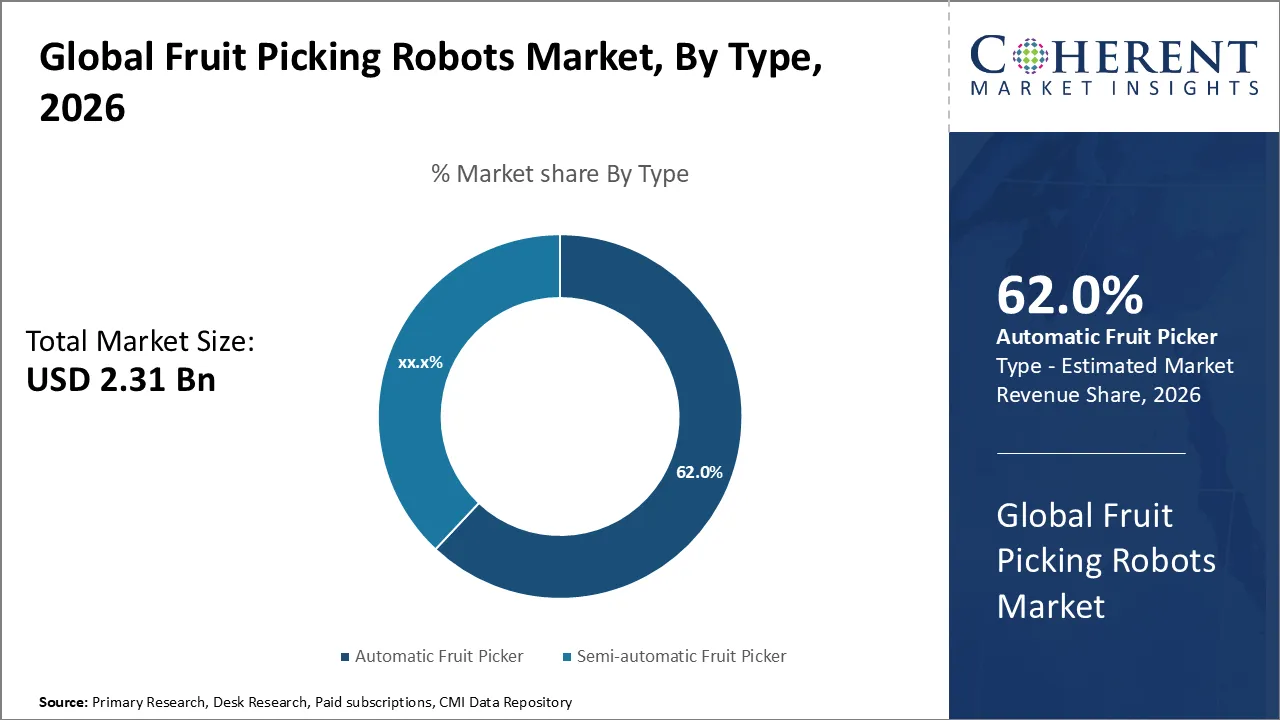
Fruit picking robots market is estimated to be valued at USD 2.31 Bn in 2026 and is expected to reach USD 7.64 Bn by 2033, exhibiting a compound annual growth rate (CAGR) of 18.7% from 2026 to 2033.
Rising requirements from the agriculture sector to implement automation, and also because of manpower shortages, are fueling the demand for fruit-picking robots. Robotic technology that has high precision, efficiency, and safe handling for high-value products such as apples, strawberries, and berries, has been in high demand. The companies are developing methods to implement innovation through fully automatic/semi-automatic fruit-picking robots that enhance productivity and reduce operation costs.
|
Current Events |
Description and its impact |
|
Agricultural Labor Crisis and Immigration Policies |
|
|
Supply Chain Disruptions and Semiconductor Shortages |
|
Uncover macros and micros vetted on 75+ parameters: Get instant access to report
Automation is transforming the fruit picking robots market in 2026 by integrating precision, efficiency, and smart technology to meet evolving agricultural and industry demands.
Robotic automation in the fruit harvesting industry, this relates to the implementation of technologies such as vision sensors, artificial intelligence for fruit identification, soft grippers, and data analytics for improving fruit harvesting techniques.
Rising trends in sustainable farming, labor shortages, and the emphasis on precision farming have also fueled the demand for fruit picking robots. Further, the integration of the fruit picking robot with the IoT platform and farm management software enables the farmer to monitor the efficiency, predict the maintenance requirements, and schedule the harvest, which is in line with the aim of smart farming. Firms are also working towards the development of energy-efficient, light, and modular fruit picking robots.
For instance, in August 2024, Fieldwork Robotics officially launched its latest autonomous berry harvesting robot, Fieldworker 1, which uses AI to identify and pick ripe berries at speeds and quality matching human pickers.
In terms of type, the automatic fruit picker segment is estimated to contribute the highest market share of 62% in 2026, owing to its ability to reduce dependency on manual labor while improving harvesting speed and efficiency. The use of these automatic fruit picker systems amidst increasing operational costs and human resource shortages for agricultural operations makes them a highly preferable choice for farmers for their orchards.
For instance, in August 2024, Fieldwork Robotics launched its AI-powered BerryBot, designed to detect ripe fruits with high accuracy and pick efficiently while minimizing bruising. This innovation demonstrates the growing adoption of fully autonomous fruit harvesting solutions.
In terms of application, the apple picking segment is expected to generate the highest market share of 42% in 2026, given large orchards' increasing adoption of automation systems to increase yield while decreasing labor costs. Apple orchards benefit most from AI-guided robotic arms and vision systems that can identify ripe fruits, navigate through tree branches, and harvest fruits efficiently. This reduces the need for manpower and further enhances the overall efficiency and quality of fruits from the orchard.
For instance, in February 2025, PeK Automotive showcased its autonomous grape and apple harvesting robot at World FIRA, highlighting precision picking and orchard adaptability. This development reflects the shift toward mechanized fruit harvesting and the increasing use of smart agricultural technologies.
To learn more about this report, Request Free Sample
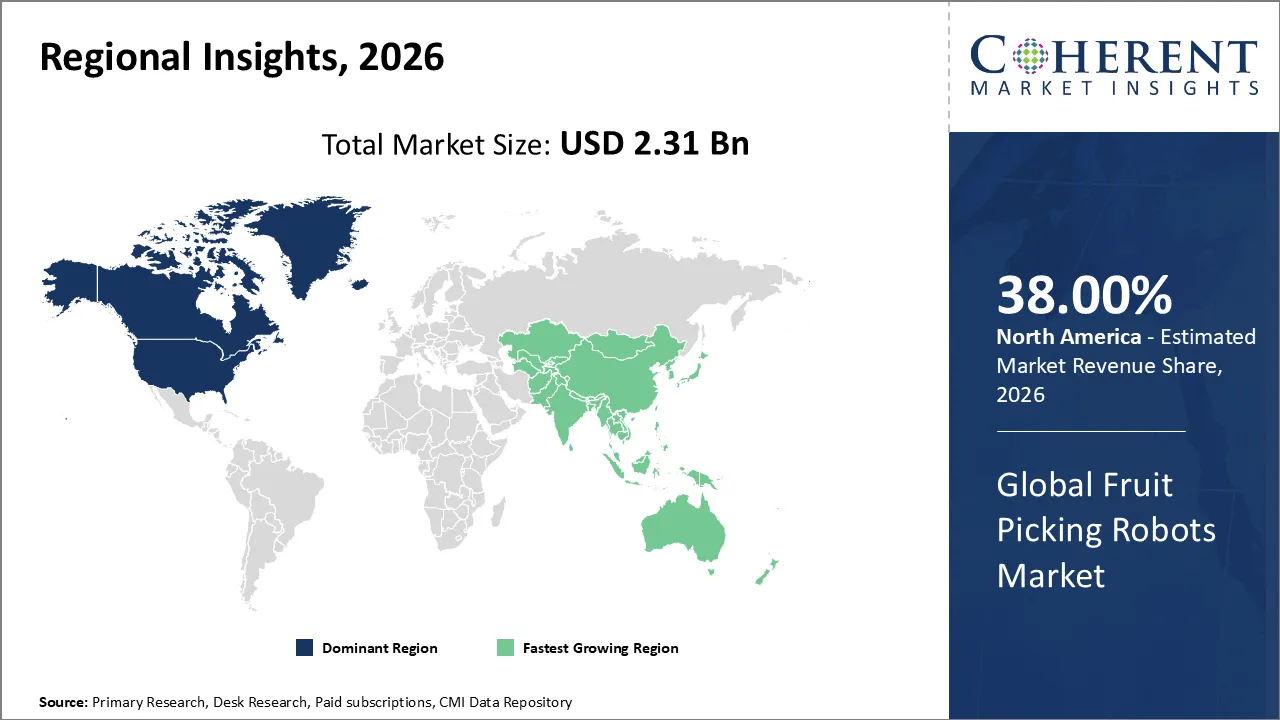
The fruit picking robots market in North America is projected to lead the industry in 2026, holding a potential market share of approximately 38%. The reason for the growth of the fruit picking robots market in North America is primarily because of its developed agricultural infrastructure, adoption rates, and labor shortages in orchards.
For instance, in October 2024, advanced. Farm showcased its robotic apple harvesting technology at FIRA USA 2024 in Davis, California, demonstrating vision‑guided orchard automation suited for North American growers.
The Asia Pacific market is expected to be the fastest-growing in the fruit picking robots market owing to its increasing adoption of precision farming techniques, rise in labor costs, investment in agricultural automation solutions and high-quality fruit farming in China, India, and Japan. New domestic manufacturers also focus on making cost-effective robotic solutions that can adapt to varied orchard and fruit types to compete in their domestic markets.
For instance, in December 2025, Agroz Robotics (in partnership with UBTECH Robotics) unveiled the Walker S humanoid agricultural robot at VIV Asia, designed to automate seeding, crop monitoring, harvesting, and optimization tasks for vertical farming and smart agriculture applications.
The U.S. fruit robots market is growing rapidly due to factors such as increasing labor costs and reduced availability of farm workers in the field. The farmers as well as large-scale growers of fruits in the country are adopting technological robots with artificial intelligence capabilities.
For instance, in April 2025, Harvest CROO Robotics announced that its automated strawberry harvesting machine successfully completed field trials showing commercial viability, achieving performance on par with human harvesters. This milestone reflects a major advancement in robotic harvesting capabilities for specialty crops in the United States.
The Chinese fruit picking robots industry is increasing in pace because of government encouragement for smart agriculture, rising labor cost, and investments in R&D for AI-based fruit harvesting solutions. The use of robotics automation is being explored in orchards and strawberry patches for improving efficiency, reducing post-harvest losses, and increasing the production of premium fruits.
For instance, in September 2025, the Chinese Farmers’ Harvest Festival in Shandong showcased a fruit‑picking robot developed by the Shandong Academy of Agricultural Machinery Sciences, which uses vision recognition and real‑time data fusion to pick ripe fruit with a bionic mechanical hand.
| Report Coverage | Details | ||
|---|---|---|---|
| Base Year: | 2025 | Market Size in 2026: | USD 2.31 Bn |
| Historical Data for: | 2020 To 2024 | Forecast Period: | 2026 To 2033 |
| Forecast Period 2026 to 2033 CAGR: | 18.7% | 2033 Value Projection: | USD 7.64 Bn |
| Geographies covered: |
|
||
| Segments covered: |
|
||
| Companies covered: |
Abundant Robotics, AGROBOT, Dogtooth Technologies, FFRobotics, Harvest CROO Robotics, Ripe Robotics, OCTINION, and others |
||
| Growth Drivers: |
|
||
| Restraints & Challenges: |
|
||
Uncover macros and micros vetted on 75+ parameters: Get instant access to report
The rising cost of manual labor and lack of skilled agriculture professionals to work in fruit orchards is fueling the adoption of fruit picking robots. The use of automation in farms ensures consistent production to meet the demand for products such as strawberries, apples, and berries. AI-enabled harvesting robots, vision-guided picking robots, and self-driven platforms for transportation enable farms to work at a reduced cost while preserving fruit to a higher extent.
Fruit picking robots are revolutionizing conventional agriculture due to labor shortages and the ability to harvest with precision. Fruit harvesting robots have been found to harvest strawberries with an accuracy of as much as 95% through artificial intelligence, while also reducing damage to the fruit by more than 30%. Harvest CROO Robotics has already successfully demonstrated their machinery harvesting more than 4 tons of strawberries per day, which indicates that large-scale farms can indeed adopt them without ending up with reduced yields.
The Asia Pacific region appears to be a breeding ground for adoption, with the presence of China, which tests robotics in jujube, lychee, and kiwifruit orchards. For instance, the lychee-harvesting robot developed by the South China Agricultural University was capable of picking as many as 60 pieces in a minute with minimal damage, demonstrating the degree of efficiency gain by the farm. Additionally, the introduction of gesture-operated collaborative robots in Shaanxi Province has enabled smaller farms to selectively implement robotics by harvesting high-value crops.
New robotic harvesters integrate computer vision, AI-based ripeness detection, and soft grippers that handle multiple fruit types. Farms that have used these solutions say post-harvest loss due to bruising and missed pickings has gone down up to 25%. Integration with IoT and farm management platforms enables further real-time monitoring and predictive maintenance to ensure higher up-time and operational efficiency.
Share
Share
Ramprasad Bhute is a Senior Research Consultant with over 6 years of experience in market research and business consulting. He manages consulting and market research projects centered on go-to-market strategy, opportunity analysis, competitive landscape, and market size estimation and forecasting. He also advises clients on identifying and targeting absolute opportunities to penetrate untapped markets.
Joining thousands of companies around the world committed to making the Excellent Business Solutions.
View All Our Clients