

Combine Harvesters Market Size and Share Analysis - Growth Trends and Forecast (2026 - 2033)
The global combine harvesters market is estimated to be valued at USD 5,100 Mn in 2026 and is projected to grow at a compound annual growth rate (CAGR) of 3.7% during the forecast period (2026-2033), reaching USD 6,600 Mn by 2033. This growth can be attributed to growing global food demand, rising agricultural mechanization, and increasing labor shortages in the farming sector.
Key Takeaways from the Combine Harvesters Market Report
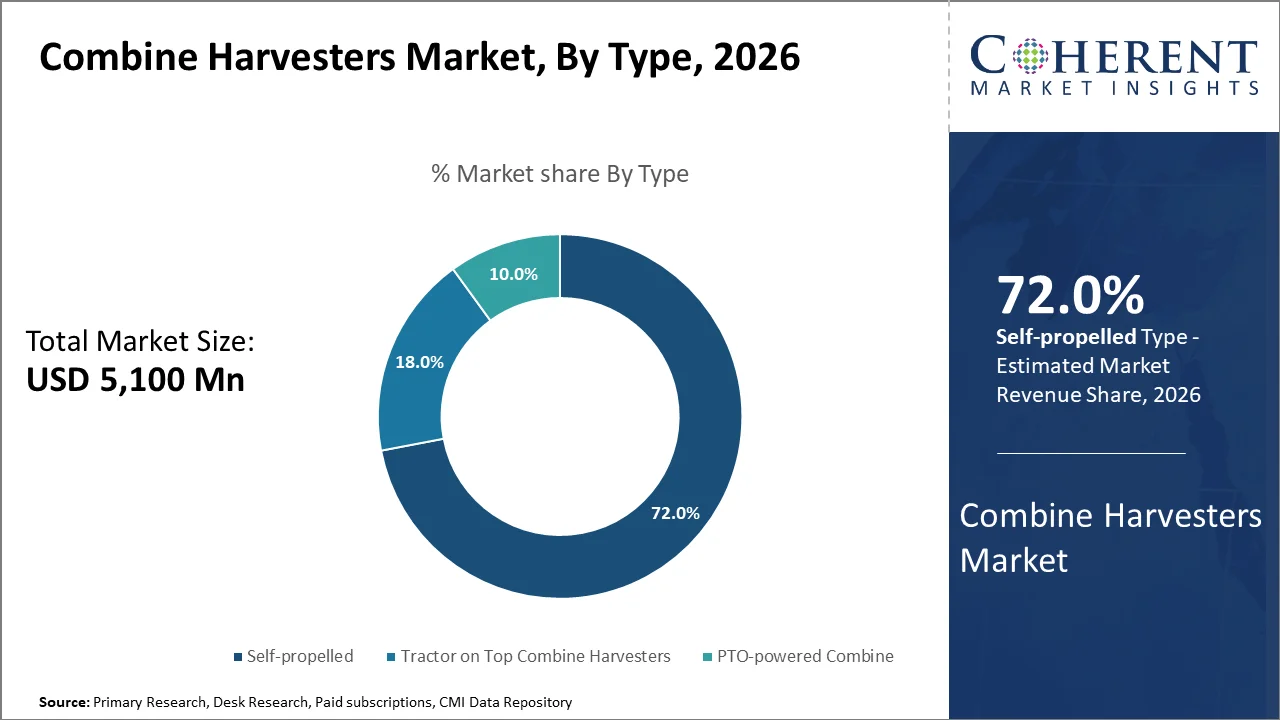
- Self-propelled combine harvesters are expected to lead the market with a share of over 72.0% in 2026 due to rising adoption of advanced agricultural machinery.
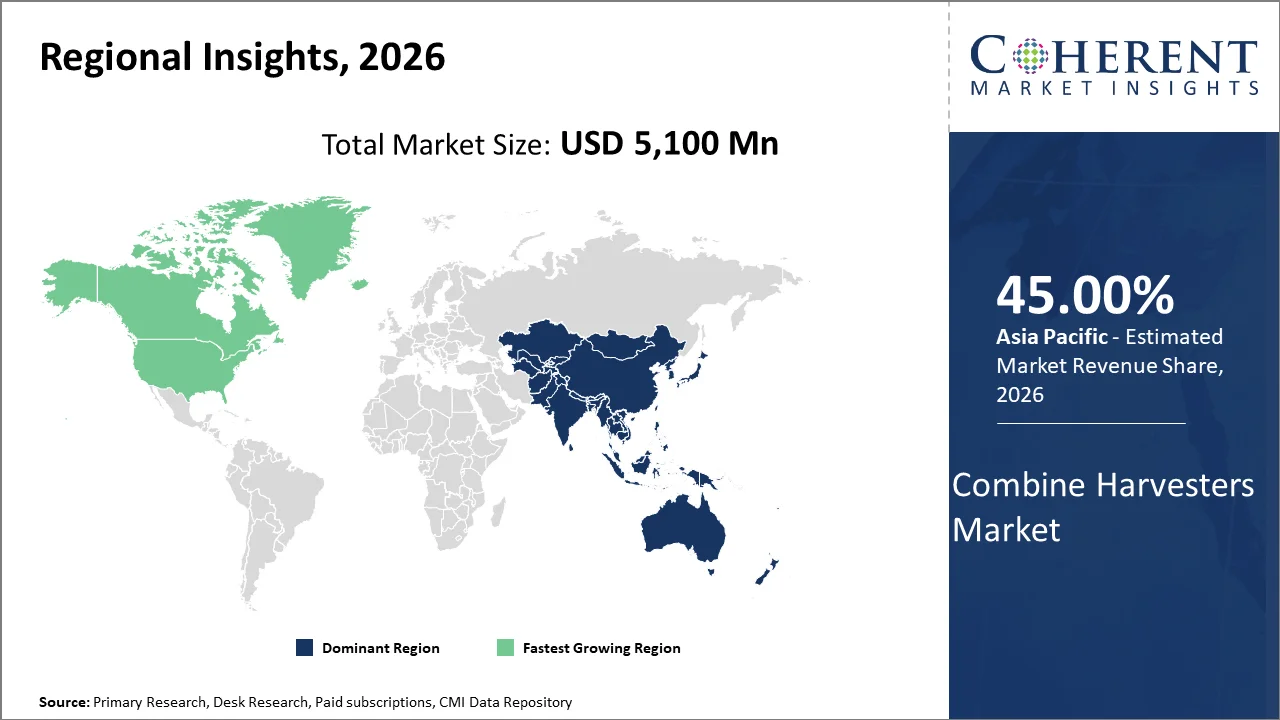
- Asia Pacific is likely to dominate the global combine harvesters industry during the forecast period, capturing a market share of more than 45% in 2026, mostly due to rapid mechanization in nations like China and India, large agricultural base, and government subsidies for farm automation. For example, Asia accounts for approximately 830 Mn people employed in agrifood systems, with China and India together representing nearly 60% of this workforce, supporting strong demand for agricultural machinery.
- North America, holding a market share of over 30% in 2026, is anticipated to create lucrative growth opportunities for combine harvester manufacturers during the assessment period, thanks to large-scale commercial farming operations and high mechanization levels. For instance, according to the USDA 2022 Census of Agriculture, the U.S. has more than 1.9 Mn farms covering 880 Mn acres. This large-scale farming structure fuels adoption of high-capacity agricultural machinery like combine harvesters to improve harvesting efficiency and reduce labor dependency.
Combine Harvesters Market Overview
The global combine harvesters market is poised to register steady growth during the forecast period. This is due to increasing agricultural mechanization, rising labor shortages in the farming sector, supportive government subsidies for farm equipment, and rising adoption of advanced harvesting machinery to improve crop productivity and reduce harvesting time across large-scale farming operations.
Rising demand for cereal crops such as wheat, rice, and maize is driving the adoption of combine harvesters. Increasing food consumption is encouraging large-scale agricultural production, thereby supporting mechanization in farming practices. The combine harvesters market is also expected to benefit from government support, especially in developing economies. In addition, ongoing technological advancements in agricultural machinery are expected to support agricultural combine harvesters market expansion during the forthcoming period.
Combine harvesters are large agricultural machines used for harvesting and processing crops in a single operation. They have the tendency to significantly reduce manual labor as well as improve efficiency. Modern combine harvesters are equipped with GPS and GIS technologies that help farmers navigate fields more precisely, create detailed field maps, and generate yield maps that show variations in crop productivity across different areas of a field.
Agricultural labor shortages and rising wages are increasingly driving adoption of advanced agricultural technologies like combine harvesters. Many nations are experiencing a shortage of seasonal farm labor, especially during peak harvesting periods. This is encouraging farmers and contractors to shift toward mechanized solutions like combine harvesters, thereby fueling market demand.
Continuous technological advancements are also boosting growth of the combine harvesters market. Modern combine harvesters are becoming highly advanced with features such as GPS-based auto-steering, yield mapping, grain-loss sensors, and AI-driven harvest optimization. These technologies improve productivity as well as reduce wastage and enhance operational accuracy, making machines more attractive to farmers.
Segmental Insights
Which is the Most Sought-After Combine Harvester Type in the Market?
Demand Remains High for Self-propelled Combine Harvesters
According to Coherent Market Insights’ latest combine harvesters market analysis, self-propelled segment is slated to lead the market, accounting for a share of more than 72.0% in 2026. This dominance can be attributed to rising adoption of self-propelled combine harvesters in large-scale agricultural farms due to their higher efficiency and throughput.
Self-propelled combine harvesters are also being preferred because they offer greater operational flexibility and reduced dependency on external tractors. This advanced agricultural equipment allows farmers to complete harvesting faster within narrow seasonal windows. Their integration with modern technologies such as GPS guidance, automated controls, and precision farming systems also enhances productivity as well as lowers labor requirements and crop losses.
- Current Industry Events of 2026
- Market Size Estimation
- Regional Breakdown
- Competitive Landscape
- Customer Intelligence
- Segmental Analysis
- Pricing Analysis
- Key Market Drivers, Challenges & Future Trends
- Customized Insights Section
Combine Harvesters Market Growth Drivers
Rising Need for Agricultural Mechanization
The global shift from manual to mechanized farming is boosting growth of the combine harvesters market. Farmers in the contemporary world are increasingly adopting combine harvesters to replace labor-intensive harvesting methods, as they can reap, thresh, and clean crops in a single operation, thereby significantly improves efficiency as well as reduces time and labor costs.
Combine Harvesters Market Opportunities
Government Subsidies and Financing Support
Governments, especially in developing regions, are promoting mechanization through subsidies on farm equipment, low-interest loans, and custom hiring centers (shared machinery services). This is making combine harvesters more affordable for small and medium-scale farmers. As a result, supportive government policies are expected to create lucrative growth opportunities for the combine harvesters market during the forecast period.
Combine Harvesters Market Trends
Precision Agriculture Transforming Harvest Operations
Integration of combine harvesters into precision agriculture and smart farming ecosystems is a key growth-shaping trend in the combine harvester machines market. Modern harvesters are increasingly equipped with GPS-guided auto-steering, IoT sensors, telematics, and yield monitoring systems, enabling real-time tracking of machine performance and crop output. These technologies allow farmers to optimize harvesting routes, reduce fuel consumption, minimize crop losses, and enhance overall operational efficiency through data-driven decision-making and predictive maintenance capabilities.
Companies like Case IH and John Deere are actively deploying combine harvesters with AI-based automated harvesting modes, real-time sensor-driven yield optimization, GPS, machine learning control systems, and telemetry for live machine performance tracking. For example, in 2025, Case IH’s Axial-Flow 160 Series combine harvesters were introduced with multiple real-time sensors and automated control systems that continuously adjust machine settings during harvesting, improving efficiency and reducing fuel usage through data-driven optimization.
Current Events and Their Impact on the Combine Harvesters Market
Current Event | Description and its Impact |
Record-level global cereal output stabilizing supply conditions |
|
Continued structural decline in agricultural labor availability worldwide |
|
Regional Insights
Rapid Farm Mechanization and Government Subsidies Driving Growth in Asia Pacific
Asia Pacific is set to dominate the global combine market during the forecast period, capturing a global market share of 45% in 2026. This is mainly due to rapid farm mechanization, rising labor shortages, and government subsidy programs supporting agricultural modernization. Nations like China and India are increasingly shifting from manual harvesting to machine-based farming to improve productivity as well as reduce harvest time.
Supportive government policies and financial support are playing a key role in boosting Asia Pacific combine harvesters market. For example, India’s Sub-Mission on Agricultural Mechanization (SMAM) provides 40–50% subsidies on farm equipment, encouraging farmers to adopt combine harvesters at a faster rate.
Large-Scale Farming and Precision Agriculture Technologies Fueling Growth in North America
North America is expected to emerge as a highly lucrative market for manufacturers of combine harvesters, accounting for a market share of 25% in 2026. This is mostly due to large-scale farming operations, high labor costs, and strong adoption of advanced agricultural machinery. Farmers in the United States and Canada increasingly rely on high-capacity combine harvesters to improve efficiency and manage large farmlands with minimal labor.
Rising use of precision agriculture technologies, including GPS-guided systems and automated harvesting solutions, which help optimize yield and reduce fuel and grain losses, is boosting market growth. Strong presence of leading manufacturers like John Deere is also supporting market expansion in the region.
Combine Harvesters Market Outlook – Country-wise
U.S. Combine Harvesters Market Trends
The United States is expected to remain a prominent market for combine harvesters during the projection period. This can be attributed to increasing commercial farming activities, rising labor costs, and rising adoption of precision agriculture technologies. Farmers across the U.S. are increasingly using advanced combine harvesters with GPS guidance, automation, and yield monitoring systems to improve efficiency and reduce operational costs.
China Combine Harvesters Market Forecast
China’s combine harvesters market is poised to witness steady growth during the assessment period. This is due to large-scale farm mechanization, government support for agricultural modernization, and rising demand for efficient harvesting in major grain-producing regions. The shift from traditional farming to mechanized agriculture is accelerating, especially in rice and wheat cultivation areas. This, in turn, is expected to boost sales of combine harvesters and other agricultural machinery.
Who are the Major Companies in the Combine Harvesters Market?
Some of the major players in combine harvesters market are Tractors and Farm Equipment Limited (TAFE), Claas KGaA mbH, Mahindra & Mahindra Ltd, Kubota Agricultural Machinery, Deere & Company, Yanmar Co. Ltd, Massey Ferguson (AGCO Corporation), Iseki & Co. Ltd, CNH Industries Nv, SDF, Renault Sonalika International, and PREET GROUP.
Key Strategies Adopted by Industry Players
Leading combine harvester companies are adopting various organic and inorganic strategies to boost their sales as well as stay ahead of the competition. Companies are heavily investing in smart harvesting technologies, GPS-enabled systems, and real-time data analytics platforms. They are introducing new harvesting technologies to woo more and more customers. For example, in 2025, AGCO showcased AI-enabled autonomous systems and mixed-fleet management solutions, showing the industry’s shift toward connected and intelligent machinery.
- In September 2025, Escorts Kubota Limited launched the PRO588i-G combine harvester in Punjab and Haryana. The machine cuts the crop stalk close to the ground, allowing full-length straw collection for reuse.
- In July 2025, CLAAS updated its TRION combine harvester series. It also introduced the new TRION 760 model as the top variant in the lineup.
- In January 2024, CNH announced a €150 million investment in its Harvesting Center of Excellence. The funds will be used for the development and production of the new CR11 next-generation flagship combine harvester.
Market Report Scope
Combine Harvesters Market Report Coverage
| Report Coverage | Details | ||
|---|---|---|---|
| Base Year: | 2025 | Market Size in 2026: | USD 5,100 Mn |
| Historical Data for: | 2020 To 2024 | Forecast Period: | 2026 To 2033 |
| Forecast Period 2026 to 2033 CAGR: | 3.7% | 2033 Value Projection: | USD 6,600 Mn |
| Geographies covered: |
| ||
| Segments covered: |
| ||
| Companies covered: | Tractors and Farm Equipment Limited (TAFE), Claas KGaA mbH, Mahindra & Mahindra Ltd, Kubota Agricultural Machinery, Deere & Company, Yanmar Co. Ltd, Massey Ferguson (AGCO Corporation), Iseki & Co. Ltd, CNH Industries Nv, SDF, Renault Sonalika International, and PREET GROUP | ||
| Growth Drivers: |
| ||
| Restraints & Challenges: |
| ||
Analyst Opinion (Expert Opinion)
- Combine harvesters are central to modern grain farming as they perform reaping, threshing, and cleaning in a single operation, significantly improving harvesting efficiency and reducing dependence on manual labor.
- Demand is strongly linked to global production of key staple crops such as wheat, rice, maize, and barley, where timely harvesting is critical to minimize crop losses as well as maintain yield quality.
- Adoption is increasing for high-capacity and GPS-enabled combine harvesters, as large-scale farms prioritize precision agriculture, fuel efficiency, and reduced operating time per hectare.
Speak to the analyst
Want personalized insights?
Take the findings above to one of our principal consultants, or have the report rebuilt around the segments, geographies and competitors you actually track.
Market Segmentation
- By Type Insights (Revenue, US$ Mn, 2021 - 2033)
- Self-propelled
- Tractor on Top Combine Harvesters
- PTO-powered Combine
- By Region Insights (Revenue, US$ Mn, 2021 - 2033)
- North America
- U.S.
- Canada
- Latin America
- Brazil
- Argentina
- Mexico
- Rest of Latin America
- Europe
- Germany
- U.K.
- Spain
- France
- Italy
- Russia
- Rest of Europe
- Asia Pacific
- China
- India
- Japan
- Australia
- South Korea
- ASEAN
- Rest of Asia Pacific
- Middle East & Africa
- GCC Countries
- Israel
- Rest of Middle East
- Africa
- South Africa
- North Africa
- Central Africa
- North America
Sources
Primary Research interviews
- Interviews with agricultural machinery dealers, farm equipment distributors, large-scale farmers, tractor and combine harvester operators, OEM engineers, and supply chain executives.
Databases
- FAOSTAT (Food and Agriculture Organization of the United Nations)
- World Bank Data
- UN Comtrade Database
- National agricultural statistics databases
- Government trade portals
- Customs import-export databases
Magazines
- Modern Agriculture
- Successful Farming
- Farm Equipment Magazine
- Agriculture Today
- CropLife Magazine.
Journals
- Journal of Agricultural Engineering
- Biosystems Engineering
- Computers and Electronics in Agriculture
- Agricultural Systems Journal
- International Journal of Agricultural Science and Technology
Newspapers
- The Hindu Business Line (Agriculture section)
- The Economic Times (Agri-business coverage)
- Financial Express
- The Times of India (Rural & Agriculture updates)
- Regional agricultural news publications
Associations
- Food and Agriculture Organization (FAO)-related agricultural bodies
- Agricultural Machinery Manufacturers Association
- International Farm Management Association
- National agricultural equipment associations, and farmer cooperatives federations
Public Domain sources
- Government agricultural ministry reports
- Census of agriculture data
- Rural development reports
- Policy papers
- Parliamentary agriculture committee publications
- Open-access university research papers
Proprietary Elements
- CMI Data Analytics Tool
- Proprietary CMI Existing Repository of information for last 8 years
Get access to 250+ pages report
Every segment, forecast, competitor profile and data table behind the analysis above — available for instant download.
- ESOMAR Member
- ISO 9001:2015 Certified
- D-U-N-S Registered
- GDPR & CCPA Compliant
Missing comfort of reading report in your local language? Find your preferred language:
Transform your Strategy with Exclusive Trending Reports
Frequently Asked Questions
The global Combine Harvesters Market is estimated to be valued at USD 5,100 Mn in 2026.
The global Combine Harvesters Market value is expected to reach USD 6,600 Mn by 2033.
The global market is poised to exhibit a CAGR of 3.7% from 2026 to 2033.
Major growth factors include rising mechanization trend, growing global food demand, and increasing adoption of precision agriculture technologies.
Self-propelled combine harvesting machines segment is expected to lead the market with a share of 72% in 2026.
Some major companies in the Combine Harvesters Market include Tractors and Farm Equipment Limited (TAFE), Claas KGaA mbH, Mahindra & Mahindra Ltd, Kubota Agricultural Machinery, Deere & Company, Yanmar Co. Ltd, Massey Ferguson (AGCO Corporation), Iseki & Co. Ltd, CNH Industries Nv, SDF, Renault Sonalika International, and PREET GROUP
Asia Pacific, with over 45% share in 2026, is expected to lead the market during the forecast period.