Network Slicing Market Analysis & Forecast: 2026-2033

Network slicing market size is estimated to be valued at USD 2.41 Bn in 2026 and is expected to reach USD 30.51 Bn in 2033, exhibiting a compound annual growth rate (CAGR) of43.6% from 2026 to 2033.
Network slicing is a method of virtual networking architecture in the same family as network functions virtualization (NFV) and software defined networking (SDN), they are two closely related network virtualization technologies that are moving modern networks to software-based automation. Network functions virtualization (NFV) and software defined networking (SDN) allow far better network flexibility through the partitioning of network architectures into virtual elements. Moreover, network slicing finds application in various industries such as healthcare, automotive, media & entertainment, government, and others.
|
Current Event |
Description and its Impact |
|
5G Rollout Acceleration and Standardization Evolution |
|
|
Enterprise Digital Transformation and Industry 4.0 Adoption |
|
Uncover macros and micros vetted on 75+ parameters: Get instant access to report
AI-powered slice orchestration leverages machine learning to intelligently manage and allocate network slices in real time. By using predictive analytics, operators can anticipate traffic demands and dynamically adjust resources across multiple slices, ensuring optimal performance for diverse applications. This automation minimizes manual intervention, reduces inefficiencies, and enhances scalability. As a result, operational expenditures (OPEX) can be lowered by 20–25%, while improving service quality, reliability, and responsiveness, making network slicing a cost-effective solution for enterprises and telecom providers alike.
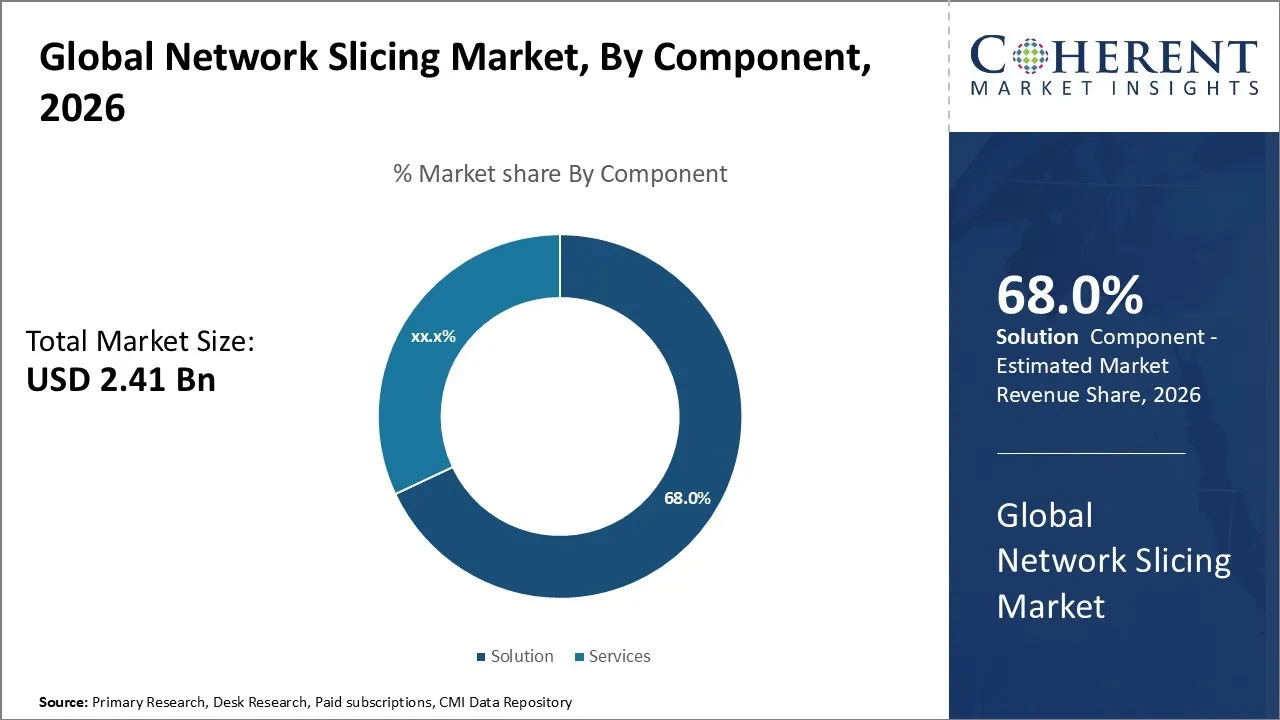
In terms of component, the solution segment is expected to hold 68% share of the market in 2026, driven by the rapid deployment of 5G infrastructure and virtualization technologies. Solutions encompass software-defined networking, orchestration platforms, and slicing management systems that enable telecom operators to create customized slices for diverse applications. These solutions are critical for delivering ultra-reliable low-latency communication, enhanced mobile broadband, and massive IoT connectivity. As enterprises demand tailored connectivity, solutions provide scalability, flexibility, and monetization opportunities, making them the largest revenue contributor compared to services.
For instance, in December 2025, Nokia and du were the first companies in the industry to use autonomous network slicing in 5G. This solution automates the creation and management of slices, which lets telecom companies offer personalized, safe, and fast connections. It makes the solution part of the network slicing market stronger, helping a wide range of industries, including healthcare, automotive, and entertainment.
In terms of end user, the telecom operators’ segment is expected to lead the market with 62% share in 2026, as they are the primary enablers of network slicing. Operators leverage slicing to monetize 5G by offering differentiated services for industries such as healthcare, automotive, and media. They deploy slicing solutions to manage bandwidth, latency, and security across multiple virtual networks simultaneously. Enterprises consume these slices but rely heavily on operators for deployment. With rising demand for smart cities, autonomous vehicles, and immersive entertainment, telecom operators lead adoption, driving the majority of market revenues.
For instance, Dependence Jio's push in India's IMT spectrum auction demonstrates how important telecom companies are to network slicing. Jio wants regulatory freedom to use standalone 5G to deploy dynamic slices, make money from services, and add tariff products. This strengthens operators' power to provide customized connectivity for industries like healthcare, automotive, and entertainment.
In terms of industry vertical, the healthcare segment is projected to account for 28% share of the market in 2026, due to its reliance on ultra-reliable low-latency communication (URLLC). Network slicing enables real-time applications such as remote surgery, telemedicine, and continuous patient monitoring, where milliseconds matter. Hospitals and medical institutions demand secure, isolated slices to protect sensitive patient data while ensuring uninterrupted connectivity. The pandemic accelerated digital healthcare adoption, and 5G slicing now supports advanced robotics, AI diagnostics, and wearable devices. This makes healthcare the most influential vertical, surpassing automotive and BFSI in market dominance.
To learn more about this report, Request Free Sample
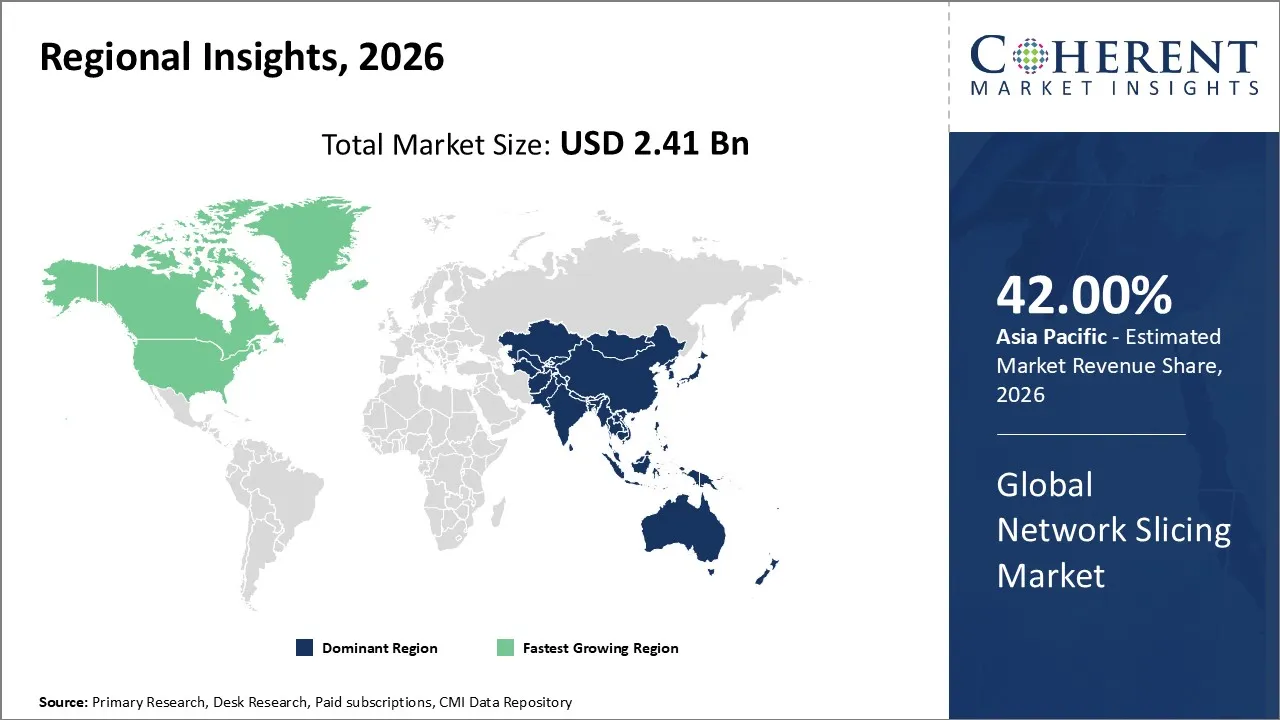
Asia Pacific is expected to dominant the network slicing market with 42% share in 2026, due to rapid 5G rollouts in China, Japan, South Korea, and India, supported by strong government initiatives and telecom investments. Enterprises across healthcare, manufacturing, and automotive sectors require customized connectivity for mission‑critical applications. Rising digital transformation, smart city projects, and IoT adoption further accelerate demand. With large populations and diverse industries, Asia Pacific leads global adoption, making it the dominant and fastest‑growing region for network slicing solutions in 2026.
For instance, in September 2025, Singtel and Tencent Games released Honor of Kings · Cloud in Singapore, using Singtel's 5G network slicing technology. This is the first nationwide slice for gaming in the world. It has very low latency and lets you play without having to download anything or use high-end devices. The new idea shows how slicing can be used in consumer products.
North America is projected to be the fastest growing region, due to strong investments by telecom operators like Verizon, AT&T, and T-Mobile in 5G infrastructure. Enterprises increasingly require SLA-backed slicing for AI, IoT, and cloud applications, ensuring guaranteed performance and security. Regulatory support, rapid digital transformation, and industry-specific adoption in healthcare, automotive, and manufacturing further drive demand. With operators focusing on monetization and enterprises seeking differentiated connectivity, North America emerges as one of the fastest-growing regions for network slicing in 2026.
For instance, in August 2025, T-Mobile launched with a 5G network slicing plan for businesses that includes satellite coverage. The solution gives businesses dedicated slices that provide reliable, SLA-backed connectivity even in remote areas. T-Mobile expands its reach by combining terrestrial 5G and satellite networks. This lets industries access secure, high-performance services in a wide range of operational settings.
The Network Slicing Market is highly demanding in China due to its massive 5G rollout, government-backed digital transformation, and strong investments by operators like China Mobile, China Telecom, and China Unicom. Industries such as manufacturing, healthcare, and smart cities require customized, low-latency connectivity for mission-critical applications. China’s focus on AI, IoT, and autonomous systems further accelerates adoption. With a large population, diverse industrial base, and strategic policies, China leads global demand, making network slicing essential for its digital economy growth.
For instance, in October 2025, China Telecom started a 5G AxaI-native private network in Shenzhen to help the low-altitude economy. The solution uses AI and network slicing to give drones and other aerial applications safe, very low-latency connections. It gives power to industries like logistics, inspections, and smart cities, showing that China is at the forefront of cutting-edge 5G technology.
The Network Slicing Market is highly demanding in the United States due to strong investments by operators like Verizon, AT&T, and T-Mobile in advanced 5G infrastructure. Enterprises require SLA-backed slicing to support AI, IoT, cloud, and mission-critical applications with guaranteed performance. Growing adoption in healthcare, automotive, and manufacturing drives demand, while regulatory support and digital transformation initiatives accelerate deployment. With a focus on monetization and differentiated services, the U.S. emerges as one of the fastest-growing regions for network slicing in 2026.
For instance, in December 2025, Verizon Business started offering a 5G fixed wireless access (FWA) network slice for businesses. The service offers dedicated connections that are safe, fast, and reliable, all tailored to the needs of businesses. Verizon shows innovation in business solutions by expanding slicing beyond mobile. This strengthens North America's position as the leader in advanced 5G adoption.
| Report Coverage | Details | ||
|---|---|---|---|
| Base Year: | 2025 | Market Size in 2026: | USD 2.41 Bn |
| Historical Data for: | 2020 To 2024 | Forecast Period: | 2026 To 2033 |
| Forecast Period 2026 to 2033 CAGR: | 43.6% | 2033 Value Projection: | USD 30.51 Bn |
| Geographies covered: |
|
||
| Segments covered: |
|
||
| Companies covered: |
Affirmed Networks, Amdocs, Argela Technologies, Cisco Systems, Inc., Cloudstreet, HCL Technologies Limited, Huawei Technologies Co., Ltd., Mavenir, Nokia Corporation, Parallel Wireless, Inc., RedZinc Services Ltd., Telefonaktiebolaget LM Ericsson, and ZTE Corporation. |
||
| Growth Drivers: |
|
||
| Restraints & Challenges: |
|
||
Uncover macros and micros vetted on 75+ parameters: Get instant access to report
Network slicing is a fundamental capability of 5G architecture, enabling operators to build multiple virtual networks on shared infrastructure. This flexibility supports ultra‑low latency, high bandwidth, and reliability for diverse applications such as autonomous vehicles, AR/VR, and telemedicine. As telecom providers expand 5G globally, slicing ensures tailored connectivity for different industries. This adaptability significantly boosts network slicing market share, positioning it as a critical enabler of next‑generation services and accelerating adoption across consumer, enterprise, and industrial ecosystems worldwide.
The integration of network slicing with edge computing allows localized data processing, reducing latency and improving efficiency. Industries like manufacturing, logistics, and healthcare benefit from real‑time analytics, predictive maintenance, and automation powered by this synergy. By enabling scalable and customized connectivity, enterprises can optimize operations and enhance responsiveness. This convergence drives adoption across enterprise ecosystems, directly fueling wireless connected devices market demand, as billions of IoT devices require reliable, low‑latency connections to function seamlessly in mission‑critical and consumer applications.
Enterprise digital transformation is a major driver of the network slicing market forecast, as industries demand customized connectivity with guaranteed SLAs. Healthcare, automotive, and manufacturing sectors rely on ultra‑low latency slices for mission‑critical applications like remote surgery, autonomous driving, and smart factories. By enabling secure, isolated, and programmable networks, slicing accelerates digital adoption, supports IoT expansion, and enhances operational efficiency. This creates vast opportunities for enterprises to modernize infrastructure and unlock new business models through advanced 5G capabilities.
Share
Share
Monica Shevgan has 9+ years of experience in market research and business consulting driving client-centric product delivery of the Information and Communication Technology (ICT) team, enhancing client experiences, and shaping business strategy for optimal outcomes. Passionate about client success.
Joining thousands of companies around the world committed to making the Excellent Business Solutions.
View All Our Clients