Oilfield Stimulation Chemicals Market Analysis & Forecast: 2026-2033
Oilfield Stimulation Chemicals Market Size and Forecast – 2026 – 2033
The Global Oilfield Stimulation Chemicals Market size is estimated to be valued at USD 9.8 billion in 2026 and is expected to reach USD 15.4 billion by 2033, exhibiting a compound annual growth rate (CAGR) of 6.8% from 2026 to 2033.
Global Oilfield Stimulation Chemicals Market Overview
The Oilfield Stimulation Chemicals market comprises specialized chemical formulations designed to enhance oil and gas production by improving reservoir permeability and well productivity. Key products include acidizing chemicals, fracturing fluids, corrosion inhibitors, scale inhibitors, and biocides, each serving specific functions in well stimulation and maintenance. Acidizing chemicals dissolve formation deposits, while fracturing fluids create fractures to increase hydrocarbon flow. Corrosion inhibitors and scale inhibitors protect equipment and pipelines, ensuring operational efficiency. Biocides control microbial growth that can impair production. These products are widely applied across onshore and offshore oilfields, supporting efficient extraction, prolonged equipment life, and optimized reservoir performance globally.
Key Takeaways
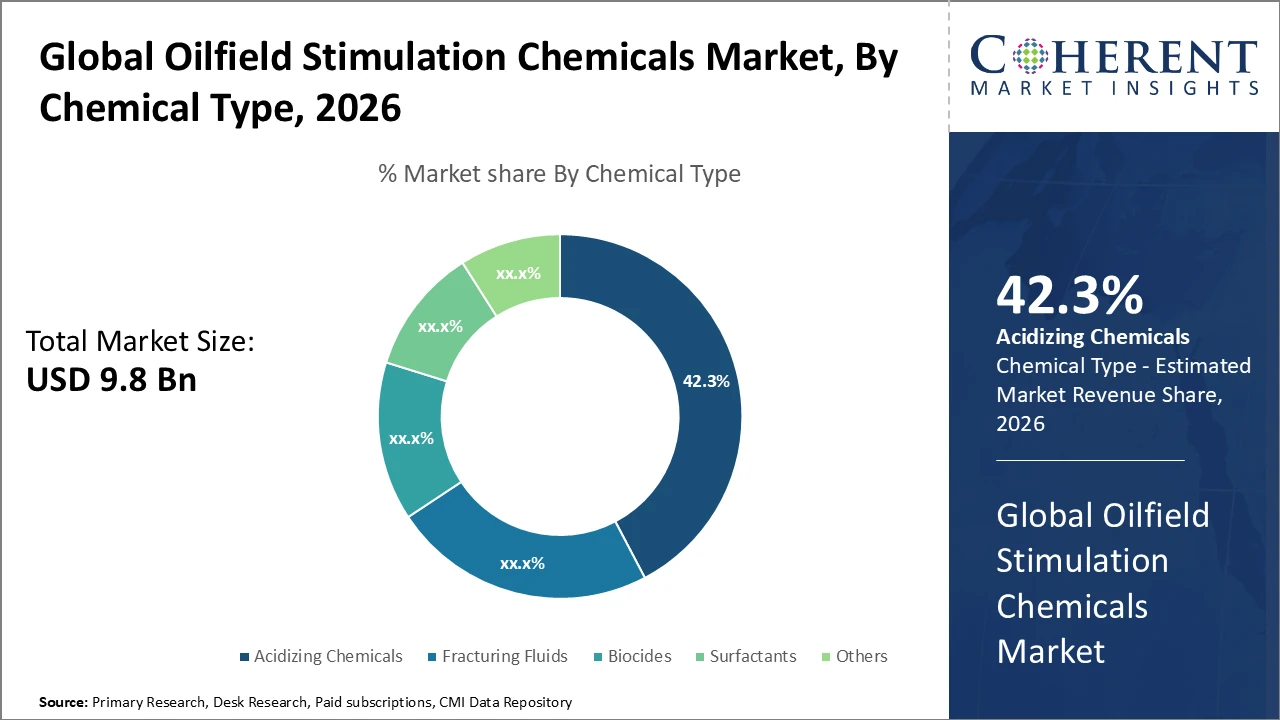
By chemical type, Acidizing Chemicals dominate the oilfield stimulation chemicals market with a 42.3% share, driven by their extensive use in carbonate reservoirs. Fracturing Fluids represent the fastest-growing subsegment, supported by expanding shale plays and multi-stage fracturing techniques.
Among application segments, Hydraulic Fracturing leads with nearly 40% market share, propelled by unconventional resource exploitation. Matrix Acidizing is experiencing rapid growth due to its effectiveness in enhancing well stimulation and improving reservoir permeability.
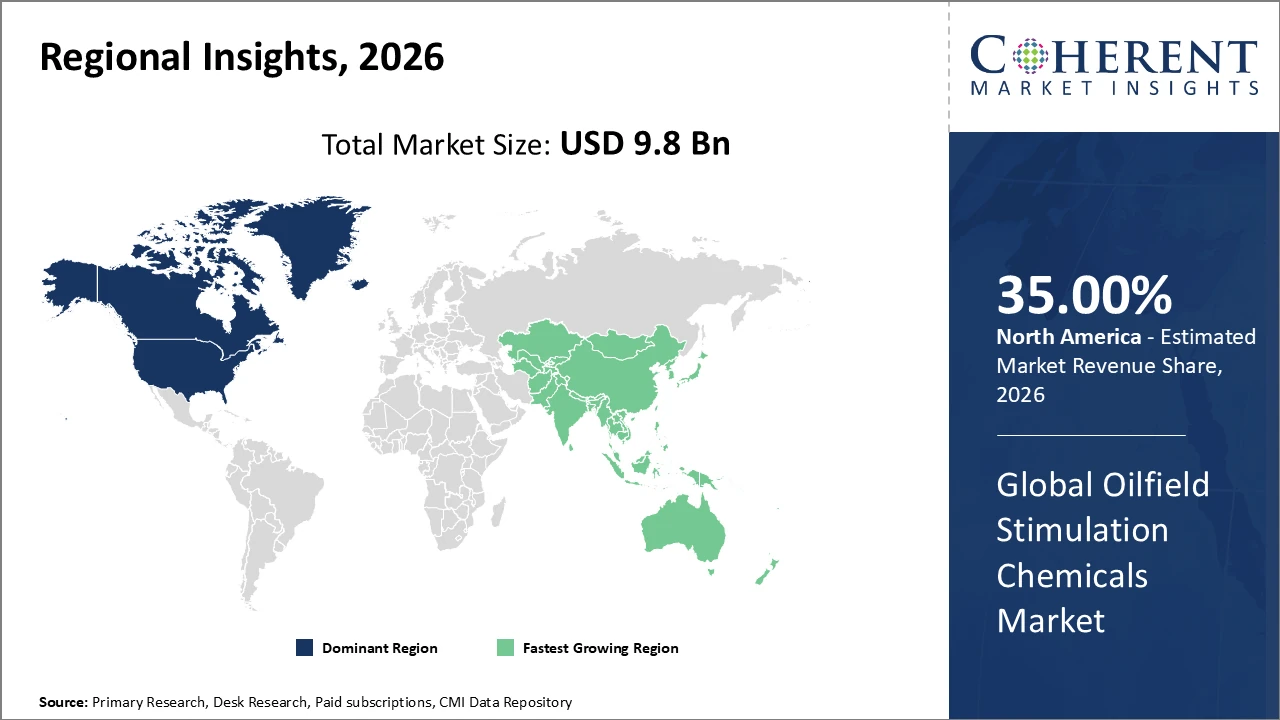
Regionally, North America holds a dominant share exceeding 35%, supported by advanced technology adoption and high shale gas production. Asia Pacific is the fastest-growing region with a CAGR over 8%, fueled by expanding energy infrastructure and supportive policies in India and China.
Oilfield Stimulation Chemicals Market Segmentation Analysis
To learn more about this report, Request Free Sample
Oilfield Stimulation Chemicals Market Insights, By Chemical Type
Acidizing Chemicals dominate the oilfield stimulation chemicals market, with hydrochloric acid-based blends being the most widely used due to their high efficiency in stimulating carbonate reservoirs. Their market leadership is attributed to their ability to dissolve formation damage and significantly enhance reservoir permeability. The fastest-growing subsegment is Biocides, driven by rising demand for microbial control to prevent souring and corrosion during stimulation processes. Fracturing Fluids, while holding the second-largest market share, continue to grow steadily due to the global expansion of hydraulic fracturing operations. Surfactants and other specialty chemicals, though smaller in share, play a crucial role in improving chemical dispersibility and reducing surface tension during stimulation.
Oilfield Stimulation Chemicals Market Insights, By Application
Hydraulic Fracturing dominates the oilfield stimulation chemicals market, driven by the growing exploitation of unconventional resources that require large volumes of stimulation chemicals for fracture propagation and proppant transport. Matrix Acidizing is the fastest-growing application segment, as operators increasingly adopt this technique to enhance reservoir permeability and improve production efficiency in both carbonate and sandstone formations. Well Cleanouts and Sand Control applications continue to maintain steady demand, addressing challenges such as formation damage and sand migration. Advances in chemical formulations for these applications have further improved operational effectiveness, reliability, and overall well performance.
Oilfield Stimulation Chemicals mixture Market Insights, By End-User Industry
Onshore Drilling dominates the oilfield stimulation chemicals market, driven by extensive shale plays in North America and other onshore basins worldwide. The fastest-growing end-user segment is Unconventional Oil & Gas, fueled by rising investments in tight shale formations and coal-bed methane extraction across global markets. Conventional Oil & Gas shows moderate growth, supported by mature field stimulation and enhanced oil recovery initiatives. Although Offshore Drilling holds a smaller volume share, it is increasingly adopting eco-friendly stimulation chemicals to meet environmental regulations and sustainability requirements in offshore basins, including regions such as Brazil and the North Sea.
Oilfield Stimulation Chemicals Market Trends
The oilfield stimulation chemicals market is increasingly emphasizing sustainability and operational efficiency, driven by environmental regulations and industry initiatives.
Rising demand for eco-friendly chemicals is a key trend, encouraged by government mandates and pressure to reduce environmental impact.
Asia Pacific has led this movement, with India’s strict discharge norms in 2025 increasing the consumption of biodegradable stimulation chemicals by 30%.
Digital chemical injection systems are being adopted to optimize dosage, minimize waste, and improve operational efficiency.
North American operators reported up to 15% cost savings in 2026 through real-time monitoring and adjustments enabled by these digital systems.
Oilfield Stimulation Chemicals Market Insights, By Geography
To learn more about this report, Request Free Sample
North America Oilfield Stimulation Chemicals Market Analysis and Trends
In North America, the oilfield stimulation chemicals market is dominated by extensive shale gas and tight oil developments, accounting for over 35% of the market share. The United States leads in the adoption of advanced hydraulic fracturing techniques, supported by established service providers and regulatory frameworks that encourage innovation. Major industry players, including Halliburton and Baker Hughes, have significantly contributed to the region’s leadership by introducing eco-friendly chemical blends, enhancing operational efficiency, and meeting environmental standards. These factors collectively reinforce North America’s position as a key driver of global market growth.
Asia Pacific Oilfield Stimulation Chemicals Market Analysis and Trends
The Asia Pacific region is experiencing the fastest growth in the oilfield stimulation chemicals market, with a CAGR exceeding 8%, driven by rising energy demands and expanding unconventional drilling activities. China and India serve as key markets, supported by government incentives and ongoing infrastructure development. Recent policies promoting clean energy and environmental sustainability are accelerating the adoption of eco-friendly stimulation chemicals. Additionally, local companies are forming joint ventures with multinational firms to advance formulation technologies tailored to diverse regional reservoir conditions, further strengthening the region’s market position and supporting long-term growth prospects.
Oilfield Stimulation Chemicals Market Outlook for Key Countries
USA Oilfield Stimulation Chemicals Market Analysis and Trends
The USA’s oilfield stimulation chemicals market is defined by diverse well operations across major basins, including Permian, Marcellus, and Bakken. In 2026, the country accounted for roughly 28% of global consumption, driven by extensive hydraulic fracturing and acidizing activities. Operators have increasingly implemented advanced polymer-free fracturing fluids and hybrid acid systems, improving recovery rates by 7%–10%. Leading companies such as Halliburton and Baker Hughes have made significant local R&D investments, resulting in enhanced chemical formulations, operational efficiency, and compliance with environmental standards. These innovations have reinforced the competitive landscape and sustained the U.S.’s leadership in the global oilfield stimulation chemicals market.
Germany Oilfield Stimulation Chemicals Market Analysis and Trends
Germany’s oilfield stimulation chemicals market is driven by its mature oil and gas sector, with a focus on conventional reservoirs and enhanced oil recovery projects. Acidizing chemicals and fracturing fluids remain key product segments, supporting efficiency and productivity in well operations. The market emphasizes sustainable and environmentally compliant formulations due to strict EU regulations on chemical use and waste management. Technological advancements in matrix acidizing and real-time chemical monitoring have improved operational precision and cost efficiency. Additionally, local and multinational service providers collaborate to develop tailored chemical solutions for both onshore and offshore projects, reinforcing Germany’s position as a technologically advanced and environmentally conscious market in Europe.
Analyst Opinion
Increasing Application of Advanced Acidizing Chemicals: In 2025, acidizing chemicals accounted for over 42% of the total market share, highlighting their dominance in well stimulation operations. Enhanced oil recovery (EOR) projects saw a 15% year-over-year increase in acid treatments, particularly in carbonate reservoirs across the Middle East, driving demand for specialty acid blends.
Growth in Hydraulic Fracturing Fluids Demand: Hydraulic fracturing fluid chemicals represented approximately 35% of oilfield stimulation chemicals demand in 2026. North America reported a 20% rise in fracturing fluid consumption from 2024 to 2026, fueled by increased shale gas production and multi-stage hydraulically fractured wells.
Emergence of Biodegradable and Green Stimulation Chemicals: In 2026, over 18% of total stimulants were eco-friendly formulations, reducing environmental impact and disposal costs. Adoption in offshore projects, including Brazil, grew by 33% from 2024 to 2026, reflecting sustainability trends.
Increasing Price Volatility in Raw Materials Affecting Market Revenue: Supply chain disruptions in 2025 caused a 12% rise in polymer-based stimulation chemical costs, impacting pricing strategies. U.S. operators responded by optimizing chemical usage, reducing average consumption per well by 8% in 2026, showing adaptive market dynamics.
Market Scope
| Report Coverage | Details | ||
|---|---|---|---|
| Base Year: | 2025 | Market Size in 2026: | USD 9.8 billion |
| Historical Data for: | 2020 To 2024 | Forecast Period: | 2026 To 2033 |
| Forecast Period 2026 to 2033 CAGR: | 6.8% | 2033 Value Projection: | USD 15.4 billion |
| Geographies covered: |
|
||
| Segments covered: |
|
||
| Companies covered: | BASF SE, NOV Inc., LG Chem, Solvay SA, Ecolab Inc., Innospec Inc., Kemira Oyj, Nouryon Chemicals, SNF Floerger, SI Group | ||
| Growth Drivers: |
|
||
Uncover macros and micros vetted on 75+ parameters: Get instant access to report
Oilfield Stimulation Chemicals Market Growth Factors
Several market players have emphasized innovation through R&D, introducing advanced eco-friendly stimulation chemicals to comply with stricter environmental regulations. For example, in 2025, Halliburton implemented polymer reduction technologies that lowered water usage by 10% per treatment, enhancing both operational efficiency and sustainability. Similarly, Baker Hughes secured multi-year contracts in the Asia Pacific region by customizing chemical blends for unconventional shale formations, resulting in a 12% year-over-year revenue increase from 2024 to 2026. These initiatives reflect the industry’s focus on sustainable solutions, technological advancement, and tailored offerings to meet regional reservoir requirements.
Oilfield Stimulation Chemicals Market Development
In January 2026, Syensqo completed the sale of its Oil & Gas business unit to SNF Group for an enterprise value of €135 million. The unit, a global supplier of oilfield stimulation chemicals, recorded about €400 million in net sales in 2024—around 6% of Syensqo’s total revenue—and employs roughly 600 people worldwide.
Key Players
Leading Companies of the Market
BASF SE
NOV Inc.
LG Chem
Solvay SA
Ecolab Inc.
Kemira Oyj
Innospec Inc.
Nouryon Chemicals
SI Group
SNF Florerger
Several market players have prioritized innovation through R&D, introducing advanced eco-friendly stimulation chemicals to comply with increasingly strict environmental regulations. For example, in 2025, Halliburton implemented polymer reduction technologies that decreased water usage by 10% per treatment, enhancing operational efficiency and sustainability performance. Similarly, Baker Hughes secured multi-year contracts in the Asia Pacific region by customizing chemical blends for unconventional shale formations, resulting in a 12% year-over-year revenue increase from 2024 to 2026. These initiatives highlight the industry’s focus on sustainable solutions, technological advancement, and tailored chemical formulations to meet regional reservoir requirements.
Oilfield Stimulation Chemicals Market Future Outlook
The future of the oilfield stimulation chemicals market is poised for steady growth, driven by rising global energy demand and increasing exploitation of unconventional oil and gas reserves. Sustainable and eco-friendly chemical formulations are expected to gain prominence, supported by stricter environmental regulations and offshore project requirements. Technological advancements such as digital chemical injection systems and polymer-free fracturing fluids will improve operational efficiency, reduce costs, and optimize reservoir performance. Regions like Asia Pacific are projected to witness the fastest growth due to expanding energy infrastructure and government incentives. Overall, innovation, sustainability, and regional market expansion will underpin long-term industry development.
Oilfield Stimulation Chemicals Market Historical Analysis
The oilfield stimulation chemicals market has experienced consistent growth over the past decade, driven by increasing oil and gas production and the adoption of advanced well stimulation techniques. Historically, acidizing chemicals and fracturing fluids dominated the market, supporting enhanced oil recovery and unconventional resource extraction. North America led early adoption due to extensive shale gas and tight oil operations, while Europe and the Middle East focused on conventional reservoirs and EOR projects. Technological innovations, including polymer-free fluids and biodegradable formulations, gradually emerged to improve operational efficiency and reduce environmental impact. These historical trends laid a strong foundation for current market expansion and future growth prospects.
Sources
Primary Research Interviews:
Oilfield stimulation chemical manufacturers and chemical producers
Oil and gas operators in upstream, midstream, and downstream sectors
Service companies providing hydraulic fracturing, acidizing, and EOR solutions
Databases:
Global Market Insights – Oilfield Stimulation Chemicals
Allied Market Research – Oilfield Chemicals & Enhanced Oil Recovery
Transparency Market Research – Petroleum & Stimulation Chemicals
Statista – Oil & Gas Chemicals Industry Statistics
Magazines:
Oil & Gas Journal
World Oil
Chemical Week
Offshore Engineer
Journals:
Journal of Petroleum Science and Engineering
SPE Journal
Energy & Fuels
Journal of Applied Polymer Science
Petroleum Science and Technology
Newspapers:
The New York Times – Energy & Chemicals
Financial Times – Oil & Gas
The Guardian – Energy & Environment
Reuters – Oilfield Services & Chemicals
Associations:
Society of Petroleum Engineers (SPE)
American Petroleum Institute (API)
International Association of Drilling Contractors (IADC)
World Petroleum Council (WPC)
Petroleum & Chemical Industry Association (PCIA)
Share
Share
Vidyesh Swar is a seasoned Consultant with a diverse background in market research and business consulting. With over 6 years of experience, Vidyesh has established a strong reputation for his proficiency in market estimations, supplier landscape analysis, and market share assessments for tailored research solution. Using his deep industry knowledge and analytical skills, he provides valuable insights and strategic recommendations, enabling clients to make informed decisions and navigate complex business landscapes.

Credibility and Certifications

860519526

9001:2015
27001:2022

Need a Custom Report?
We can customize every report - free of charge - including purchasing stand-alone sections or country-level reports
Customize NowJoining thousands of companies around the world committed to making the Excellent Business Solutions.
View All Our Clients