Predictive Analytics Market Analysis & Forecast: 2026-2033

Predictive Analytics Market Size and Forecast – 2026 – 2033
The Global Predictive Analytics Market size is estimated to be valued at USD 12.5 billion in 2026 and is expected to reach USD 27.8 billion by 2033, exhibiting a compound annual growth rate (CAGR) of 11.6% from 2026 to 2033.
Global Predictive Analytics Market Overview
The predictive analytics market is experiencing strong growth due to increasing adoption of artificial intelligence, machine learning, and big data technologies across industries. Organizations are using predictive analytics to improve decision-making, optimize operations, detect fraud, and enhance customer experiences through data-driven insights. Rising demand for real-time forecasting in sectors such as healthcare, banking, retail, manufacturing, and telecommunications is further accelerating market expansion. Cloud-based analytics solutions and advancements in data visualization tools are making predictive analytics more accessible to businesses of all sizes. Additionally, growing investments in digital transformation and the increasing availability of structured and unstructured data continue to drive global market development.
Key Takeaways
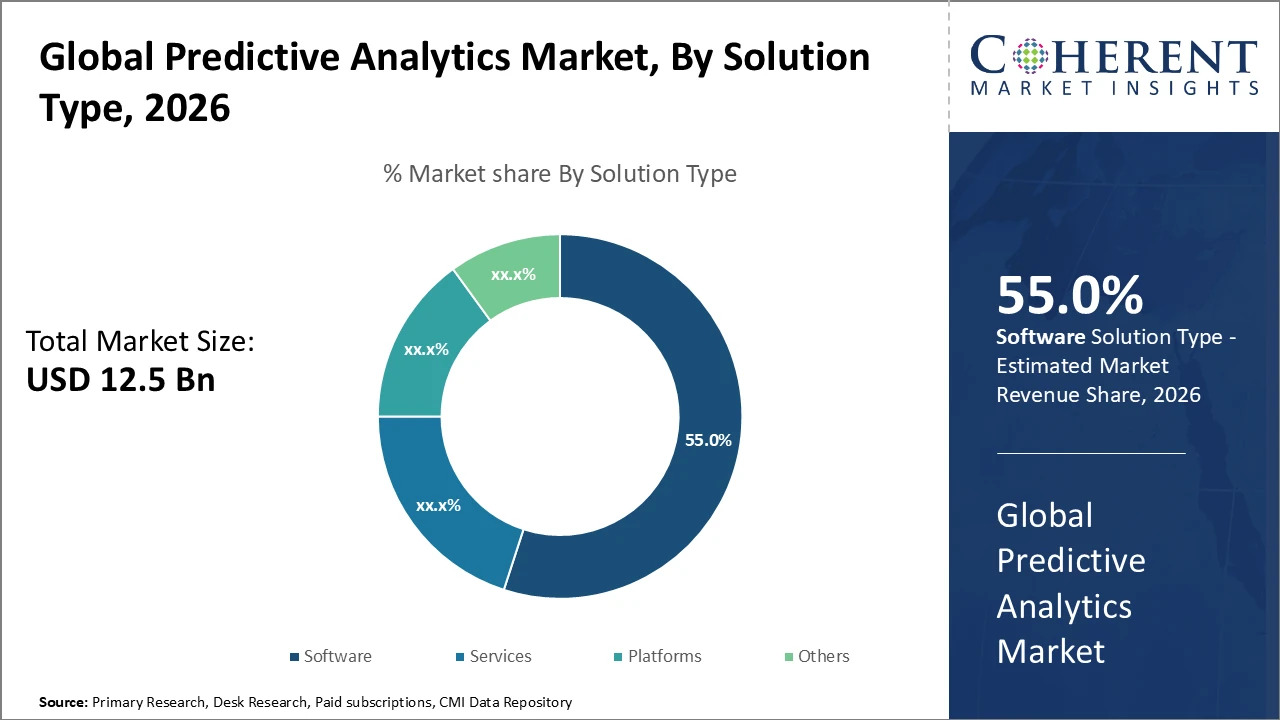
The software segment holds the largest market share at 55%, driven by innovations in AI-powered analytics platforms.
Healthcare and BFSI industries lead sectoral demand, leveraging predictive analytics for patient care optimization and risk management.
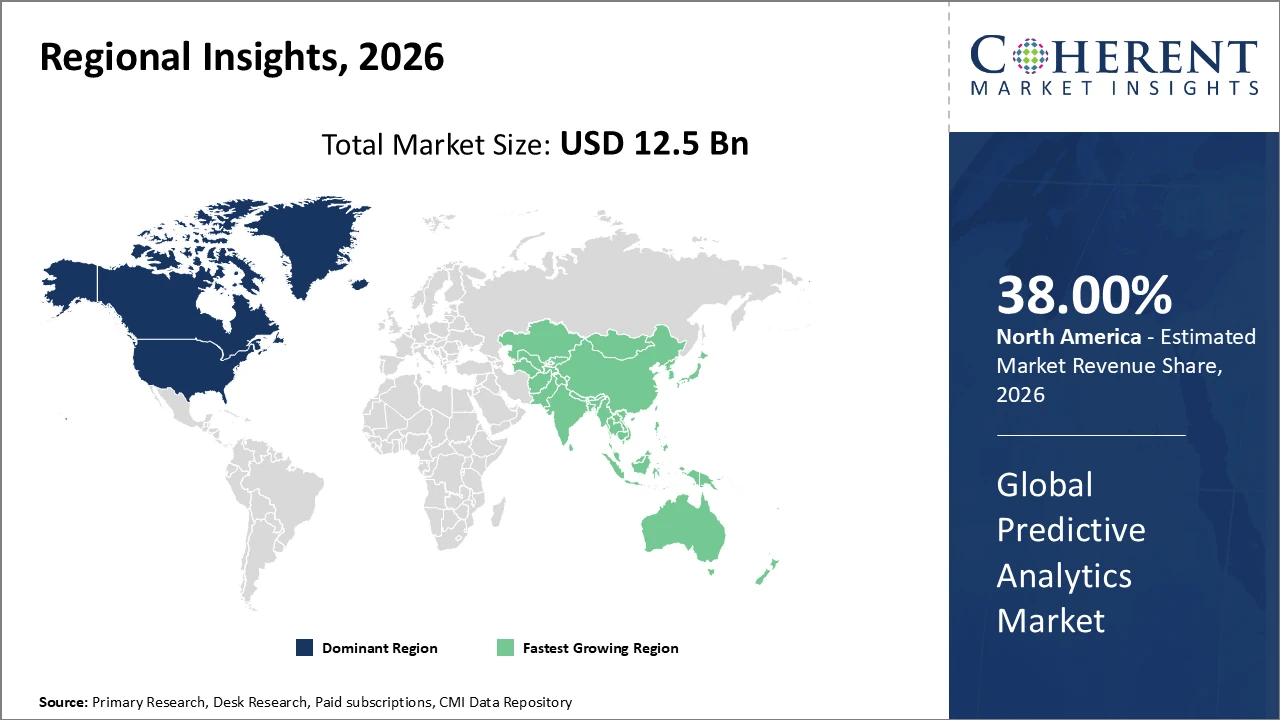
North America dominates the market, accounting for nearly 38% of the share, supported by the presence of leading companies and high technology adoption rates.
Asia Pacific exhibits the fastest CAGR, fueled by supportive policy frameworks, expanding IT infrastructure, and growing adoption in countries like India and China.
Predictive Analytics Market Segmentation Analysis
To learn more about this report, Request Free Sample
Predictive Analytics Market Insights, By Solution Type
Software dominates the predictive analytics market with a share of 55%, driven by its capability to integrate advanced AI and machine learning models, supporting diverse business processes and enabling high customization. Subscription-based offerings and AI-powered automation have enhanced software usability, making analytics more accessible across industries. The services subsegment, including consulting, implementation, and model integration, is the fastest-growing, as enterprises increasingly require expert support for deploying complex predictive solutions within existing IT infrastructures. Platforms provide scalable ecosystems for analytics deployment and are evolving with cloud-native architectures.
Predictive Analytics Market Insights, By Deployment
Cloud deployment captures the dominant share in the predictive analytics market, driven by its scalability, cost efficiency, and seamless integration capabilities, making it particularly attractive to SMEs and fast-growing digital enterprises. Hybrid deployment is the fastest-growing subsegment, allowing organizations to balance data sovereignty and regulatory compliance while leveraging cloud efficiency by integrating on-premises systems with public or private cloud environments. On-premises deployment remains important in highly regulated industries such as government, defense, and finance, where strict data security is mandated. Other deployment types, including edge computing and container-based solutions, are gaining traction for real-time analytics and low-latency processing needs.
Predictive Analytics Market Insights, By End User Industry
Healthcare holds the largest share in the predictive analytics market, driven by applications in patient care management, early diagnosis, and operational efficiency, with adoption growing over 20% annually. The BFSI sector is the fastest-growing subsegment, fueled by rising demand for credit scoring, fraud detection, and customer lifetime value prediction in a highly regulated and competitive environment. Retail uses predictive analytics for demand forecasting and personalized marketing, while Manufacturing leverages it for predictive maintenance and supply chain optimization. IT & Telecom focus on network optimization and churn reduction. Other sectors, including energy, transportation, and public utilities, are increasingly adopting these solutions.
Predictive Analytics Market Trends
AI-driven analytics integrated with edge computing is enhancing real-time data processing, with a 35% increase in deployments in manufacturing in 2026.
Cloud-native predictive analytics solutions saw a 50% adoption surge from 2024 to 2026, reflecting a shift toward flexible and scalable architectures.
Sustainable analytics is emerging, incorporating environmental data to guide decision-making in energy and utilities sectors.
Predictive insights from sustainable analytics are being used to monitor and reduce carbon footprints.
These trends collectively indicate a market focus on real-time, scalable, and environmentally conscious predictive analytics solutions across industries.
Predictive Analytics Market Insights, By Geography
To learn more about this report, Request Free Sample
North America Predictive Analytics Market Analysis and Trends
In North America, the predictive analytics market is dominated by a strong presence of innovative technology providers, abundant data resources, and early adoption of AI and cloud technologies. The U.S. alone represents over 30% of the regional market share, fueled by significant investments in healthcare, BFSI, and retail analytics solutions. Supportive regulations promoting data privacy and security enhance market confidence, while substantial venture capital funding accelerates the growth of analytics startups. Advanced infrastructure, combined with high digital literacy and corporate readiness for data-driven decision-making, positions North America as a leading hub for predictive analytics adoption and innovation.
Asia Pacific Predictive Analytics Market Analysis and Trends
The Asia Pacific region demonstrates the fastest growth in the predictive analytics market, with a CAGR exceeding 15%, driven by rapid digital transformation, rising awareness of data monetization, and strong government initiatives in countries such as India and China. Expanding e-commerce and manufacturing sectors are increasingly adopting predictive analytics solutions to optimize operations, enhance customer experiences, and improve decision-making. Local technology providers are customizing platforms to support regional languages and business requirements, increasing accessibility and adoption. Additionally, investments in AI, cloud infrastructure, and analytics education are further fueling the market, positioning Asia Pacific as a key growth hub for predictive analytics.
Predictive Analytics Market Outlook for Key Countries
USA Predictive Analytics Market Analysis and Trends
The USA maintains the largest predictive analytics market, driven by widespread adoption across healthcare, BFSI, and retail sectors. Key players like IBM, Microsoft, and Google have invested heavily in R&D and strategic partnerships, fostering a competitive and innovative ecosystem. In 2026, the healthcare segment experienced a 20% increase in demand for predictive risk models, supported by federal initiatives targeting population health management. BFSI institutions utilized predictive analytics to lower fraud losses by 18% year-over-year, highlighting its critical role in financial risk mitigation. Retailers also increasingly rely on analytics for personalized marketing and demand forecasting, further boosting market growth.
Germany Predictive Analytics Market Analysis and Trends
Germany’s predictive analytics market is driven by its advanced industrial base, strong digital infrastructure, and early adoption of Industry 4.0 initiatives. Manufacturing and automotive sectors are leading adopters, leveraging predictive maintenance, supply chain optimization, and quality control analytics to enhance operational efficiency. The healthcare and BFSI industries are also increasingly integrating predictive models for risk management, patient care optimization, and fraud detection. Government support for digital transformation, coupled with investments in AI research and skilled workforce development, further strengthens market growth. Rising demand for cloud-based and AI-enabled analytics solutions is expected to accelerate adoption across small and medium enterprises, shaping future trends.
Analyst Opinion
Rapid growth in data generation drives demand for predictive analytics, with global data expected to surpass 175 zettabytes by 2025, creating significant adoption opportunities.
Fortune 500 companies increased predictive analytics uptake by 25% year-over-year in 2024, reflecting robust market expansion.
Limited skilled analytics workforce poses a moderate supply-side constraint, but upskilling via online platforms grew 30% in 2026, helping bridge the talent gap.
Subscription-based pricing models by key developers reduce entry barriers, enabling wider adoption among mid-sized enterprises.
Healthcare use cases, including patient risk stratification and operational efficiency, accounted for 18% of market share in 2025.
Retail adoption for customer behavior prediction boosted revenue by 22% over two years.
Cloud-based integration and SaaS offerings captured 45% of market share in 2026, enhancing global accessibility and scalability of predictive analytics solutions.
Market Scope
| Report Coverage | Details | ||
|---|---|---|---|
| Base Year: | 2025 | Market Size in 2026: | USD 12.5 billion |
| Historical Data for: | 2020 To 2024 | Forecast Period: | 2026 To 2033 |
| Forecast Period 2026 to 2033 CAGR: | 11.6% | 2033 Value Projection: | USD 27.8 billion |
| Geographies covered: |
|
||
| Segments covered: |
|
||
| Companies covered: | IBM Corporation, Software Corporation, SAS Institute Inc., SAP SE, Oracle Corporation, Google LLC, Salesforce, Inc., Cloudera Inc., Accenture PLC, DataRobot Inc. | ||
| Growth Drivers: |
|
||
Uncover macros and micros vetted on 75+ parameters: Get instant access to report
Predictive Analytics Market Growth Factors
Increasing digital transformation initiatives are a key driver of predictive analytics adoption, as organizations aim to leverage data assets more effectively for strategic decision-making. Global IT spending on analytics software is projected to reach USD 124 billion in 2026, reflecting accelerated deployment across industries. The proliferation of IoT devices generates vast real-time data streams, enhancing predictive precision in sectors such as manufacturing and logistics. Cloud adoption reduces infrastructure costs and simplifies solution deployment, supported by government incentives for digital infrastructure, particularly in Asia Pacific. BFSI industries increasingly utilize predictive analytics for risk mitigation and fraud detection, with adoption rising 23% in 2025.
Predictive Analytics Market Development
In November 2025, EarthCam introduced solar predictive analytics capabilities to its control center platform to enhance data-driven monitoring and operational efficiency.
Key Players
Leading Companies of the Market
IBM Corporation
Microsoft Corporation
Oracle Corporation
SAS Institute Inc.
SAP SE
Google LLC
Salesforce, Inc.
Cloudera Inc.
Accenture PLC
DataRobot Inc.
Leading players in the predictive analytics market are actively pursuing strategic mergers and acquisitions to broaden their solution offerings and expand their customer base. For instance, Microsoft’s acquisition of Nuance Communications in 2024 strengthened its healthcare analytics capabilities, driving a 15% increase in associated cloud revenues. Similarly, IBM’s establishment of hybrid cloud analytics centers across North America in 2025 improved customer onboarding efficiency by 20%, reflecting how key market participants leverage infrastructure expansion and innovation to enhance service delivery and maintain competitive advantage in the rapidly evolving predictive analytics landscape.
Predictive Analytics Market Future Outlook
The Predictive Analytics market is expected to experience robust growth over the coming years, driven by increasing demand for data-driven decision-making across industries such as finance, healthcare, retail, and manufacturing. Advancements in artificial intelligence, machine learning, and cloud computing will enable more accurate forecasting, real-time insights, and automation of complex processes. The rise of big data, IoT, and edge computing will further expand predictive analytics applications, while growing adoption of SaaS-based solutions enhances accessibility for small and medium enterprises. Overall, the market outlook points to accelerated adoption, innovation in algorithmic capabilities, and integration into enterprise digital transformation strategies.
Predictive Analytics Market Historical Analysis
The Predictive Analytics market has experienced significant growth over the past decade, driven by the increasing availability of big data and advances in machine learning and statistical modeling. Between 2015 and 2020, enterprises across finance, healthcare, and retail increasingly adopted predictive tools to enhance decision-making, optimize operations, and reduce risk. Early investments in cloud-based analytics platforms enabled scalable deployment, while innovations in data visualization and automated modeling improved usability. The period also saw growing demand for customer behavior prediction, fraud detection, and supply chain optimization. Historical trends highlight steady adoption, rising software subscriptions, and an expanding range of industry-specific applications.
Sources
Primary Research Interviews:
Data scientists, CIOs, and business intelligence managers from enterprises implementing predictive analytics solutions.
Analytics consultants, IT managers, and operations leaders responsible for deploying predictive modeling and machine learning tools.
Industry experts from firms providing AI, machine learning, and predictive analytics consulting and software services.
Magazines:
Analytics Insight – Updates on analytics trends, AI-driven insights, and enterprise predictive solutions.
InformationWeek – Insights on enterprise IT adoption, business intelligence strategies, and predictive analytics innovations.
CIO Magazine – Case studies and analyses on data-driven decision-making and predictive model deployment.
Journals:
Journal of Big Data – Research on predictive modeling, machine learning algorithms, and analytics frameworks.
Computers & Industrial Engineering – Studies on predictive analytics applications in operations and risk management.
IEEE Access – Insights on emerging AI-driven predictive analytics technologies and frameworks.
Newspapers:
The Wall Street Journal – Company strategies, mergers, and investments in analytics and AI sectors.
Financial Times – Global IT spending, predictive analytics adoption trends, and business insights.
Reuters – News on predictive analytics product launches and enterprise adoption.
Bloomberg – Corporate performance and market insights for technology and analytics providers.
Associations:
International Institute of Analytics (IIA) – Guidelines, best practices, and frameworks for predictive analytics adoption.
Association for Computing Machinery (ACM) – Research, standards, and insights on machine learning and predictive modeling.
Data Science Association – Protocols, regulatory guidance, and professional recommendations for enterprise predictive analytics solutions.
Share
Share
Suraj Bhanudas Jagtap is a seasoned Senior Management Consultant with over 7 years of experience. He has served Fortune 500 companies and startups, helping clients with cross broader expansion and market entry access strategies. He has played significant role in offering strategic viewpoints and actionable insights for various client’s projects including demand analysis, and competitive analysis, identifying right channel partner among others.

Credibility and Certifications

860519526


9001:2015

27001:2022


Need a Custom Report?
We can customize every report - free of charge - including purchasing stand-alone sections or country-level reports
Customize NowJoining thousands of companies around the world committed to making the Excellent Business Solutions.
View All Our Clients