Video On Demand Market Analysis & Forecast: 2026-2033

Video On Demand Market Size and Forecast – 2026 – 2033
The Global Video On Demand Market size is estimated to be valued at USD 110.3 billion in 2026 and is expected to reach USD 220.6 billion by 2033, exhibiting a compound annual growth rate (CAGR) of 10.3% from 2026 to 2033.
Global Video On Demand Market Overview
The Video on Demand (VoD) market is driven by rapid growth in high-speed internet penetration, smartphone usage, and increasing consumer preference for on-demand, flexible entertainment over traditional broadcast television. Cord-cutting trends and rising subscription to platforms such as Netflix, Amazon, and The Walt Disney Company further accelerate adoption. Expansion of original and localized content, combined with AI-based personalized recommendations, enhances user engagement. Additionally, the growth of advertising-supported video on demand (AVOD) models, affordable data plans, and increasing demand in emerging markets collectively contribute to strong market expansion globally across diverse demographics and regions, driving sustained industry growth worldwide across multiple platforms services globally.
Key Takeaways
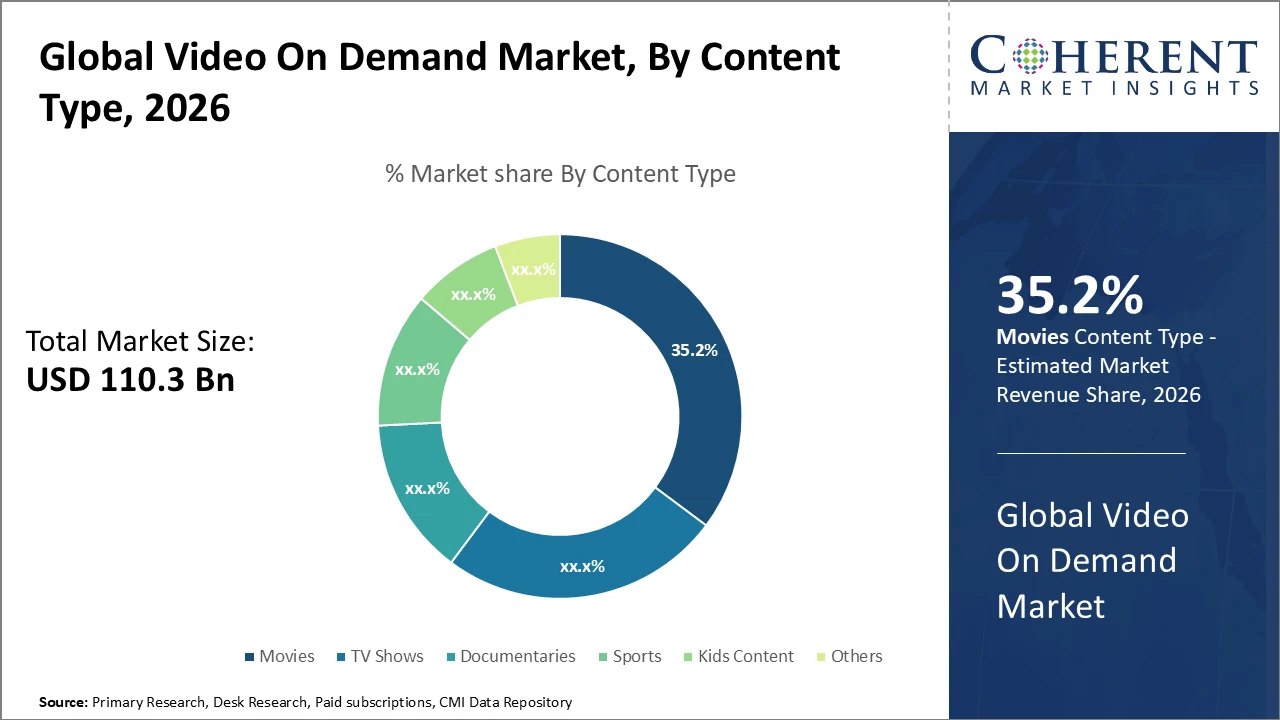
The Movies segment dominates the Video On Demand market with a 35.2% share, driven by high demand for exclusive theatrical releases and premium content libraries.
Subscription Video On Demand (SVOD) leads revenue models, maintaining dominance due to recurring revenues and customer loyalty programs.
OTT Devices are the most preferred platform type, reflecting the growing consumer preference for smart TV streaming.
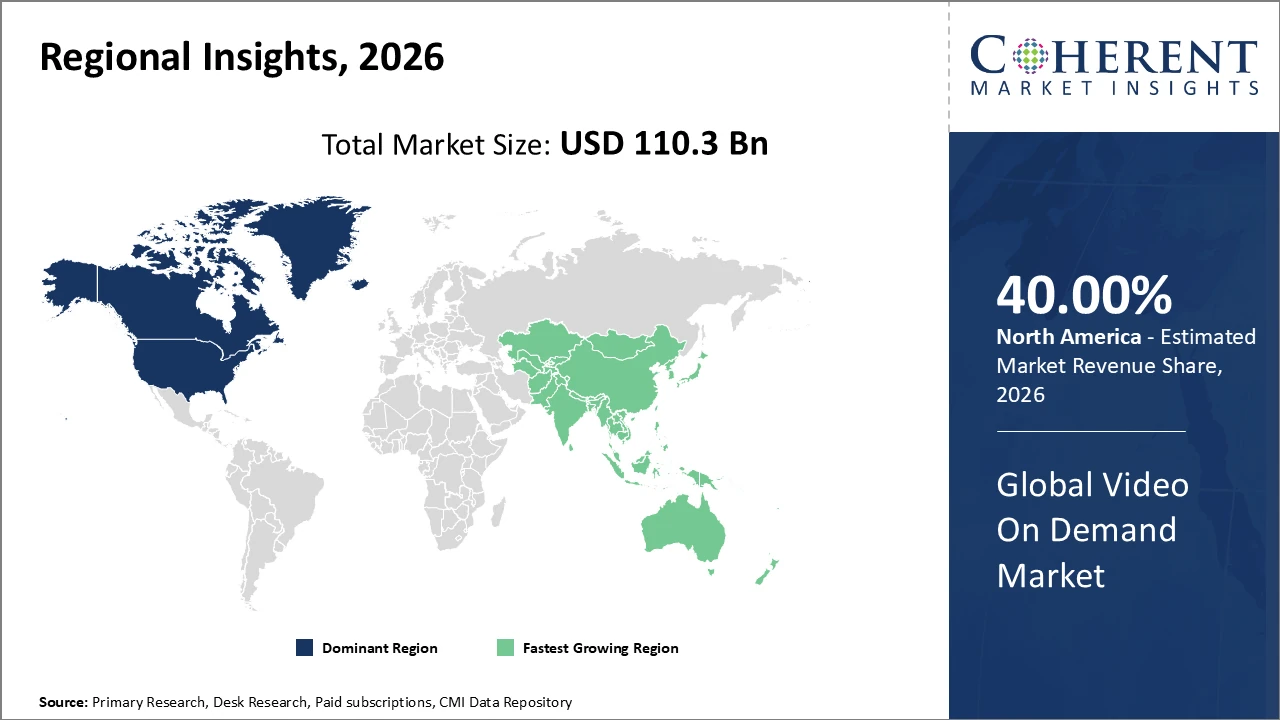
North America commands a significant industry share due to widespread infrastructure, established industry players, and high consumer spending on digital entertainment.
Asia Pacific is the fastest-growing region with a CAGR exceeding 12%, driven by expanding internet access, smartphone penetration, and regional content demand.
Europe remains a key market player with steady growth, supported by favorable regulatory frameworks and strategic partnerships between telcos and content providers.
Video On Demand Market Segmentation Analysis
To learn more about this report, Request Free Sample
Video On Demand Market Insights, By Content Type
Movies dominate the Video On Demand market with a 35.2% share, driven by strong demand for exclusive releases and premium content libraries that attract global subscribers. Significant investment in content acquisition and original production further reinforces their market position. TV Shows are the fastest-growing subsegment, fueled by binge-watching trends and simultaneous multi-season releases, which enhance viewer retention. Documentaries and Sports hold moderate shares but are gaining popularity due to increasing niche content consumption. Kids Content is expanding, supported by family-focused programming and enhanced streaming safety features, while Other genres cater to smaller, specialized audiences, contributing to overall market diversity.
Video On Demand Market Insights, By Revenue Model
Subscription Video On Demand (SVOD) dominates the revenue landscape, capturing the majority of market earnings through recurring subscriptions and loyalty programs offered by platforms like Netflix and Disney+. Its stable revenue is reinforced by personalized content libraries and premium offerings. Ad-Supported Video On Demand (AVOD) is the fastest-growing revenue model, driven by consumer preference for free, ad-supported content, particularly in cost-sensitive regions such as Latin America and parts of Asia Pacific. Transactional Video On Demand (TVOD) remains relevant for pay-per-view events and special releases but shows slower growth. Hybrid models combining SVOD and AVOD are gaining traction, offering flexibility and broader market reach.
Video On Demand Market Insights, By Platform Type
OTT Devices lead the Video On Demand market, driven by widespread adoption of connected TV boxes, smart sticks, and dedicated streaming appliances that integrate seamlessly with traditional televisions. Smart TVs are the fastest-growing subsegment, as built-in apps and intuitive content discovery enhance user experience, particularly in developed regions like North America and Europe. Mobile Devices remain crucial in markets with high smartphone penetration, such as Asia Pacific and Latin America, enabling on-the-go content consumption. PCs and laptops maintain a stable yet declining share due to shifting consumer preferences, while gaming consoles and other niche platforms serve specific demographics and regional audiences, supporting market diversity.
Video On Demand Market Trends
Elevated consumer demand for localized and regional language content drives platform differentiation, with platforms like Zee5 and iQIYI succeeding in India and China.
Adoption of AI-powered recommendation engines enhances personalized user experiences, increasing average watch time by up to 25% in 2025.
The emergence of ad-supported Video On Demand (AVOD) models complements subscription revenues, helping monetize untapped user segments.
Platforms are increasingly focusing on regional content production to cater to diverse audience preferences.
Integration of advanced analytics and AI helps optimize content discovery and engagement across multiple devices.
Video On Demand Market Insights, By Geography
To learn more about this report, Request Free Sample
North America Video On Demand Market Analysis and Trends
In North America, the Video On Demand market is dominated by extensive broadband infrastructure, established content creators, and high consumer spending power. The U.S. alone represents over 40% of the global market share. Leading platforms such as Netflix, Disney+, and HBO Max maintain headquarters in the region, enabling rapid innovation, strategic partnerships with telecom operators, and efficient content distribution. The mature market ecosystem fosters widespread adoption of subscription-based models (SVOD) and encourages significant investments in original and premium content. Consumer familiarity with streaming services, coupled with technological advancements, continues to reinforce North America’s leadership position in the global VOD industry.
Asia Pacific Video On Demand Market Analysis and Trends
The Asia Pacific Video On Demand market is experiencing the fastest growth, with a CAGR exceeding 12%. Key drivers include expanding smartphone penetration, a growing middle-class population, and government initiatives aimed at improving digital infrastructure and connectivity. Regional platforms such as Tencent Video and iQIYI have leveraged localized content creation, contributing to over 30% revenue growth in 2025. Mobile-first consumption patterns strongly influence market strategies, with an emphasis on app-based streaming and flexible viewing options. Combined with increasing internet access and rising consumer demand for regional and international content, these factors position Asia Pacific as a high-growth market in the global VOD landscape.
Video On Demand Market Outlook for Key Countries
USA Video On Demand Market Analysis and Trends
The U.S. Video On Demand market is propelled by a mature subscriber base and leading platforms with aggressive innovation strategies. In 2025, the SVOD segment generated over USD 40 billion in revenues, driven by diversified content offerings and bundled services from providers such as Amazon Prime Video and Hulu. Investments in original programming, exclusive releases, and AI-powered recommendation systems have enhanced user engagement and satisfaction, contributing to a 12% reduction in subscriber churn. Strong broadband infrastructure, high consumer spending, and strategic partnerships with telecom operators further reinforce the U.S.’s leadership in the global VOD market, maintaining its competitive edge.
Germany Video On Demand Market Analysis and Trends
Germany’s Acne Vulgaris Treatment market is growing steadily, anchored by increasing skincare awareness and a rising prevalence of acne among adolescents and adults. The country accounts for a significant share of the European acne treatment landscape, supported by strong healthcare infrastructure, widespread access to dermatologists, and statutory health insurance coverage for prescription therapies. Topical treatments, oral medications, and advanced solutions such as laser/light therapies are widely used, reflecting a diverse treatment mix. Consumer demand for natural and organic alternatives is also rising, alongside teledermatology services and personalized skincare approaches that cater to individual preferences and severity levels.
Analyst Opinion
Changing consumer preferences are accelerating VOD adoption, with daily user engagement increasing by 35% in 2025. In the U.S., SVOD revenues grew approximately 25% in 2024, reflecting willingness to pay for curated content libraries.
Technological advancements, including improved video compression and adaptive bitrate streaming, enhanced market accessibility and reduced buffering by 40% in key APAC regions in 2026, increasing average session times by up to 20% and boosting revenue growth.
Expansion of multi-device consumption drives market scope, with over 60% of global VOD users accessing content via smart TVs, mobiles, and other devices. APAC mobile-driven subscriptions grew over 28% in 2024.
Price sensitivity and competitive bundling impact market share, with bundled offerings in Europe increasing subscribers by 18% in 2025, emphasizing the role of strategic pricing and packaging.
Market Scope
| Report Coverage | Details | ||
|---|---|---|---|
| Base Year: | 2025 | Market Size in 2026: | USD 110.3 billion |
| Historical Data for: | 2020 To 2024 | Forecast Period: | 2026 To 2033 |
| Forecast Period 2026 to 2033 CAGR: | 10.3% | 2033 Value Projection: | USD 220.6 billion |
| Geographies covered: |
|
||
| Segments covered: |
|
||
| Companies covered: | Netflix Inc., Disney++, Amazon Prime Video, Sling TV, YouTube Premium, HBO Max, Hulu LLC, Apple TV+, Peacock, BBC iPlayer | ||
| Growth Drivers: |
|
||
Uncover macros and micros vetted on 75+ parameters: Get instant access to report
Video On Demand Market Growth Factors
The surge in global internet penetration and smartphone adoption continues to expand the Video On Demand market, with global internet penetration reaching 76% by early 2026. Rising demand for diverse and exclusive content, especially in regional languages, has driven subscriber growth, exemplified by a 42% increase in local language VOD viewership in India in 2025. Strategic partnerships between telecom providers and VOD platforms have enhanced affordability and accessibility, reflected in a 30% rise in bundled offerings across Latin America in 2024. Additionally, increasing corporate digitization and remote work have boosted flexible-hour content consumption, further supporting market expansion.
Video On Demand Market Development
In March 2026, Roku launched Howdy, a low-cost ad-free SVOD service, on Amazon Prime Video in the U.S. for $2.99 per month, marking its first availability outside the Roku platform.
Key Players
Leading Companies of the Market
Netflix Inc.
Disney++
Amazon Prime Video
Peacock
YouTube Premium
Hulu LLC
Apple TV+
HBO Max
BBC iPlayer
Sling TV
Several market players have implemented aggressive content acquisition and original programming strategies to capture larger market shares. For instance, Netflix invested multi-million U.S. dollars in localized content production in 2025, resulting in a 15% expansion of its user base in emerging Asian markets. Similarly, Disney+ employed bundling strategies that combined streaming services with merchandise and theme park offerings, driving a revenue increase of over 22% in North America during 2024. These strategic initiatives highlight how targeted content investments and integrated service offerings can effectively enhance subscriber growth and strengthen competitive positioning in the Video On Demand market.
Video On Demand Market Future Outlook
The Video on Demand (VoD) market is expected to experience strong growth over the coming years, driven by increasing digitalization, rising smart TV and mobile adoption, and expanding high-speed internet access worldwide. Platforms such as Netflix, Amazon Prime Video, and Disney+ will continue investing heavily in original and localized content to attract global audiences. The shift toward hybrid monetization models, including subscription and advertising-supported services, will further expand revenue streams. Emerging markets, improved personalization through AI, and bundling strategies with telecom providers are expected to accelerate adoption.
Video On Demand Market Historical Analysis
Historically, the Video on Demand (VoD) market evolved from early 2000s broadband expansion and digital distribution of media, transitioning from physical rentals and DVDs to online streaming. Early pioneers like Netflix shifted from DVD-by-mail to streaming, reshaping consumption habits. The rise of smartphones, smart TVs, and improved internet speeds in the 2010s accelerated OTT adoption. Platforms such as Netflix, Amazon Prime Video, and Disney+ fueled competition through original content and subscription-based models. Cord-cutting trends further disrupted traditional cable television. Over time, VoD transformed into a dominant entertainment model, emphasizing convenience, personalization, and global content accessibility across diverse audiences globally.
Sources
Primary Research Interviews:
Streaming platform executives, content acquisition managers, and product development teams
Telecom and OTT service providers’ marketing heads, distribution professionals, and subscription management specialists
Consumer insights analysts and media consultants focusing on streaming behavior, content preferences, and platform engagement
Magazines:
Variety – Streaming Industry Developments, Platform Launches, and Consumer Trends
Broadcasting & Cable – OTT and VOD Technology, Market Insights, and Service Innovations
FierceVideo – Platform Updates, Distribution Trends, and Consumer Engagement Analytics
VideoAge International – Global Streaming Trends, Content Licensing, and Market Insights
Journals:
Journal of Media Economics – VOD Market Dynamics, Revenue Models, and Consumer Behavior
International Journal on Media Management – Platform Strategies, Subscription Trends, and Adoption Patterns
Journal of Digital Media & Policy – Regulatory Impacts, Technological Advancements, and Market Analysis
Convergence: The International Journal of Research into New Media Technologies – Streaming Technology, Multi-Device Consumption, and User Engagement
Newspapers:
The Wall Street Journal – Market Developments, Platform Innovations, and Consumer Trends
TechCrunch – Startup Innovations, Platform Launches, and AI in Content Recommendations
Financial Times – Subscription Models, Market Growth, and Strategic Partnerships
Business Insider – VOD Market Updates, Competitive Analysis, and Consumer Behavior
Associations:
Interactive Advertising Bureau (IAB) – Standards, Guidelines, and Research on Digital Video Advertising
OTT Executive Summit – Industry Insights, Best Practices, and Market Trends
Digital Entertainment Group (DEG) – Research, Market Reports, and Industry Advocacy for Streaming Media
Share
Share
Monica Shevgan has 9+ years of experience in market research and business consulting driving client-centric product delivery of the Information and Communication Technology (ICT) team, enhancing client experiences, and shaping business strategy for optimal outcomes. Passionate about client success.

Credibility and Certifications

860519526


9001:2015

27001:2022


Need a Custom Report?
We can customize every report - free of charge - including purchasing stand-alone sections or country-level reports
Customize NowJoining thousands of companies around the world committed to making the Excellent Business Solutions.
View All Our Clients