

Global Hydrogen Aircraft Market Size and Forecast – 2026-2033
Coherent Market Insights estimates that the global hydrogen aircraft market is expected to reach USD 3.50 Bn in 2026 and will expand to USD 19 Bn by 2033, registering a CAGR of 33% between 2026 and 2033.
Key Takeaways of the Hydrogen Aircraft Market
- The hydrogen fuel cell aircraft segment is expected to account for 39.1% of the hydrogen aircraft market share in 2026.
- The short-range segment is estimated to hold 41.3 % of the market share in 2026.
- The linefit segment is projected to capture 64% of the global hydrogen aircraft market share in 2026.
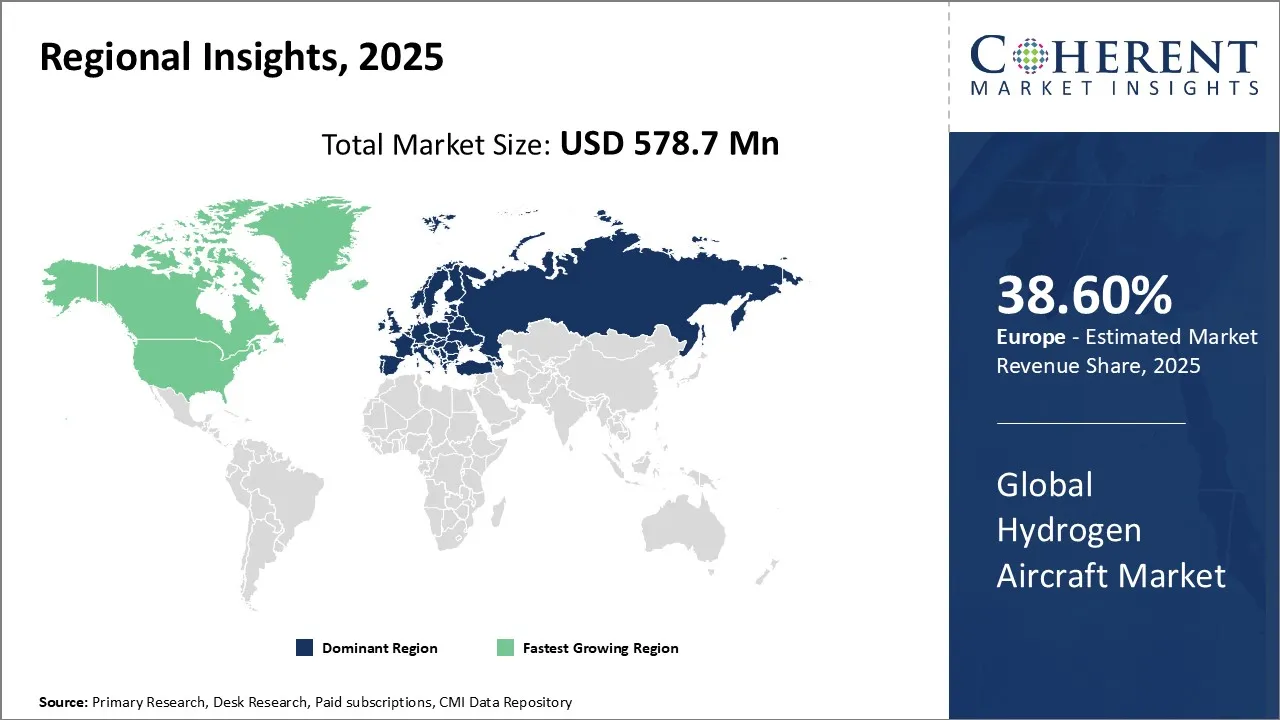
- Asia Pacific will dominate the hydrogen aircraft market in 2026 with an estimated 38.6% share.
- North America will hold 26% share in 2026 and is expected to record the fastest growth over the forecast period.
Current Events and Its Impact
Current Events | Description and its Impact |
Airbus and MTU Aero Engines Memorandum of Understanding |
|
Segmental Insights
- Current Industry Events of 2026
- Market Size Estimation
- Regional Breakdown
- Competitive Landscape
- Customer Intelligence
- Segmental Analysis
- Pricing Analysis
- Key Market Drivers, Challenges & Future Trends
- Customized Insights Section
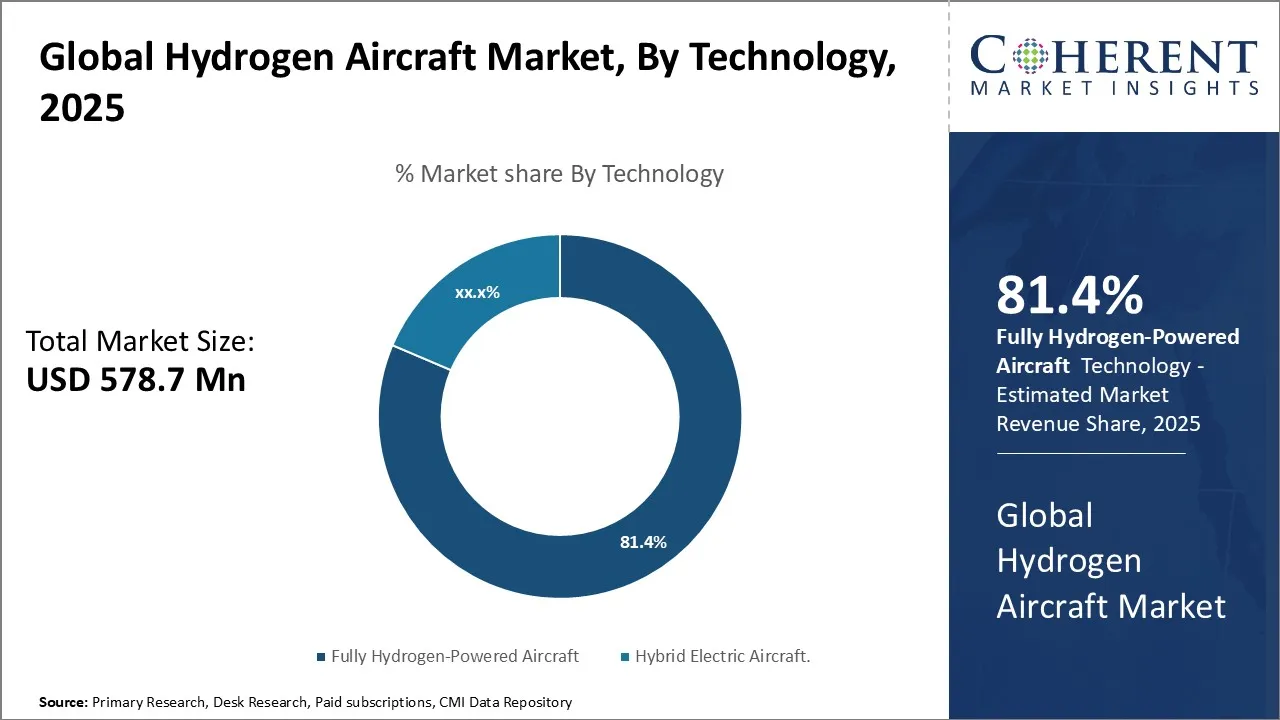
Why Does the Hydrogen Fuel Cell Aircraft Segment Dominate the Global Hydrogen Aircraft Market in 2026?
The hydrogen fuel cell aircraft segment is expected to account for 37.1.% of the global hydrogen aircraft market share in 2026. Mainly, progress comes from providing a clear, effective option instead of standard engines. Such emissions drop sharply ties to tighter worldwide rules on air travel’s impact. With outcomes so aligned toward greener targets, makers and fleets find these units hard to overlook. Performance stays steady even as climate effects shrink under this method.
For instance, on November 17, 2025, ZeroAvia announced that it has been awarded design organization approval (DOA) by the UK CAA, a critical milestone on its path to certifying a hydrogen-electric engine intended for Part 23 aircraft.
(Source: zeroavia.com)
Short-Range Segment Dominates the Global Hydrogen Aircraft Market
The short-range segment is expected to capture 39.3% of the hydrogen aircraft market share in 2026. Rising interest follows expanding urban air mobility along with emerging regional shuttles. As shorter flights usually cover under 500 miles, they suit hydrogen power more easily than extended routes. With less need for stored fuel, these planes allow simpler handling of supply chains. Smaller tanks mean fewer complications and this helps introduce hydrogen systems without overwhelming demands.
Why is Linefit the Most Preferred Integration Type in the Global Hydrogen Aircraft Market?
The linefit segment is expected to account for 62% of the global hydrogen aircraft market share in 2026. As hydrogen propulsion integrates early in production, gains emerge. When builders include hydrogen fuel setups at the start, structural design improves. Airframes adapt more easily, mass balances shift advantageously. Storage solutions fit better within original layouts. Challenges common in upgrading older models fade under such forward planning.
Global Hydrogen Aircraft Market - Hydrogen Fuel Cost Forecast Vs Conventional Fuel TCO
Metric | Conventional Jet Fuel | Hydrogen Fuel / Hydrogen Aircraft |
Baseline Relative Cost | Baseline (1×) | ~4.7–5.2× higher cost (liquid hydrogen) |
Fuel Unit Cost | Jet fuel with no carbon tax | Hydrogen fuel ~2–4× jet fuel cost per MWh |
Operating Cost Comparison | Base cost | Hydrogen ~8% higher than kerosene |
Operating Cost with Fossil Fuel Tax | Base cost + tax applied | Hydrogen ~2% cheaper than taxed kerosene |
2030–2050 Total Fuel Spending | Kerosene-only baseline (USD 13.41 billion) | Mixed hydrogen scenario (~USD 15.53 billion) |
Global Hydrogen Aircraft Market - Airport Infrastructure Readiness & H₂ Hub Indexing
Airport / Hub Category | H₂ Hub Capacity / Daily LH₂ Delivery Estimate | Infrastructure Readiness Stage |
Small Regional Hub (e.g., Long Beach, PSP) | ~60–100 t/day | Early planning / conceptual |
Medium Intermediate Hub (e.g., Oakland, Sacramento, Manchester) | ~100–1,000 t/day | Feasibility phase / early studies |
Large Major International Hub (e.g., LAX, London Heathrow) | ~1,000–1,800 t/day | Strategic planning / draft infrastructure needs |
Kansai Region Airports (KIX, ITM, UKB) | Requirements forecasted in tons/day (early stage) | Feasibility studies under MoU |
Hamburg Airport (Germany) | Pilot LH₂ infrastructure in place | Participating hydrogen hub partner |
Regional Insights
Asia Pacific Hydrogen Aircraft Market Analysis and Trends
The Asia Pacific region is projected to lead the market with a 38.6% share in 2026. Steady expansion marks the semiconductor solvent industry in Asia Pacific, tied closely to rising output in nations like Japan, South Korea, Taiwan, and China. Demand grows not only from gadgets but also electric transport, intelligent systems, along with high-performance computation, each requiring precise chemical inputs. Fabrication plants appear more frequently, backed by state policies aiming at self-reliant microchip creation, adding momentum to consumption patterns.
Purity levels now reach extreme thresholds because modern processes - such as treating wafers or preparing surfaces - allow little room for contamination. Alongside these shifts, makers shift focus toward greener formulations that align with tightening ecological rules without compromising performance expectations.
For instance, on October 18, 2024, Airbus, Kansai Airports, and Kawasaki Heavy Industries (Kawasaki) have signed a Memorandum of Understanding (MoU) to study the feasibility of hydrogen infrastructure at three airports operated in the Kansai region, Kansai International Airport, Osaka International Airport, and Kobe Airport.
(Source: airbus.com)
North America Hydrogen Aircraft Market Analysis and Trends
The North America region is expected to exhibit the fastest growth in the market contributing 26% share in 2026. Expansion continues within the North American semiconductor solvent sector, fueled by fresh capital flowing into homegrown chip fabrication and next-generation R&D infrastructure. Demand rises steadily for powerful microchips embedded in artificial intelligence systems, vehicles, communication networks, and server hubs - each requiring flawless purity in chemical agents during silicon wafer treatment, resist removal, and intricate manufacturing stages. Supported by policy-driven efforts to bolster regional output and minimize external sourcing risks, industry players adapt through scaled operations and modernized equipment installations. Amid shifting production landscapes, confidence grows that long-term resilience will emerge from these layered advancements.
Global Hydrogen Aircraft Market Outlook for Key Countries
Why is China Emerging as a Major Hub in the Hydrogen Aircraft Market?
China pushes forward through heavy spending on hydrogen networks and flight technology. State-backed firms like COMAC along with AVIC now test early models and trial flights using hydrogen power. Backed by official support together with growing labs and expertise, mass production becomes possible due to large industrial capacity across the nation. This foundation allows quicker adoption of clean engines inside a fast-growing airline industry.
Is Germany the Next Growth Engine for the Hydrogen Aircraft Market?
Supported by steady policy initiatives, Germany's sector benefits from deep-rooted aerospace capabilities. As public investment flows into hydrogen exploration, progress emerges through groups including Airbus and niche operators like H2Fly. Driven by long-term renewable goals, transportation frameworks evolve alongside clean energy targets. As joint ventures form across automotive and flight industries, pathways to market entry gain momentum steadily.
France Hydrogen Aircraft Market Analysis and Trends
Driven by strong governmental policies, France sees growth in its hydrogen aircraft sector. Major players such as Airbus and Safran operate within this space, adding momentum through industrial capability. Alongside them, the Air France-KLM group examines flight options powered by hydrogen, aligning with studies conducted at ONERA. Support emerges not only from industry but also via national funding for infrastructure and technology hubs.
Japan Hydrogen Aircraft Market Analysis and Trends
Under Japan’s national energy plan, government backing gives hydrogen technology firm ground. Instead of waiting, progress emerges through industrial effort - Kawasaki Heavy Industries and Mitsubishi Heavy Industries shape early steps in aviation propulsion. Fuel cell knowledge combines with advancements in storing hydrogen, forming a base for movement forward. Commercial rollout gains momentum not by chance but through joint work - with airlines and technology partners aiming at lower emissions. Outcomes take form slowly, yet direction remains set by long-term alignment across sectors.
South Korea Hydrogen Aircraft Market Analysis and Trends
Backed by a national strategy for hydrogen energy, South Korea sees growing potential in hydrogen-powered flight. Fuel-cell progress led by firms such as Hyundai opens paths into air mobility applications. Korean Air's interest in alternative propulsion adds momentum toward zero-emission planes. Collaboration between universities and businesses shapes a supportive environment for innovation. Spending on facilities and shared research strengthens positioning within global aerospace trends. Progress unfolds steadily, shaped by policy direction and technological testing across sectors.
Market Players, Key Development, and Competitive Intelligence
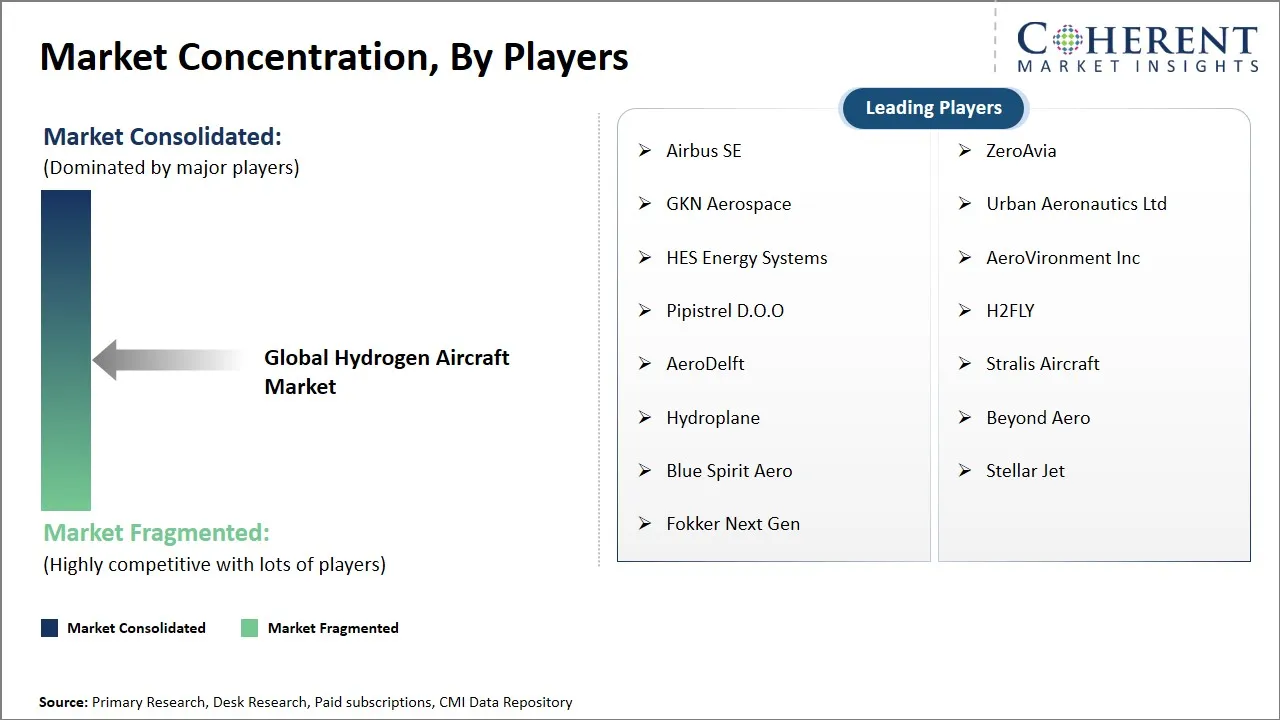
Key Developments
- On March 25, 2025, Airbus announced an update on its roadmap to pioneer the future of commercial aviation in the decades to come, outlining plans to prepare a next-generation single-aisle aircraft that could enter service in the second half of the 2030s, as well as its revised ZEROe project roadmap to mature the technologies associated with hydrogen-powered flight.
- On November 10, 2025, ZeroAvia and Hybrid Air Vehicles announced that they have signed a Memorandum of Understanding to partner on the development of a hydrogen-electric variant of Airlander 10. Airlander 10 is a new type of hybrid aircraft that uses a combination of aerostatic lift, aerodynamic lift, and vectored thrust, with a 10 ton payload and 4,000 nautical mile maximum range.
Top Strategies Followed by Global Hydrogen Aircraft Market Players
Player Type | Strategic Focus | Example |
Established Market Leaders | ZeroAvia’s Expansion Strategy | On May 21, 2025, ZeroAvia announced that it will build a major manufacturing facility for production of its hydrogen-electric powertrains at the Advanced Manufacturing Innovation District Scotland, close to Glasgow Airport in Renfrewshire, Scotland. |
Mid-Level Players | Business Collaboration | On July 22, 2024, GKN Aerospace announced the launch of H2FlyGHT. This collaborative initiative with Parker Meggitt and the Universities of Manchester and Nottingham, supported by the U.K. Government’s Aerospace Technology Institute will develop a 2-megawatt (MW) cryogenic hydrogen-electric propulsion system, setting new standards for the future generation of larger sustainable aircraft. |
Small-Scale Players | Trial Completion | On January 20, 2026, Beyond Aero completed the first wind tunnel tests of its BYA-1 hydrogen-electric business jet as it approaches the end of the program's preliminary design review. |
Market Report Scope
Hydrogen Aircraft Market Report Coverage
| Report Coverage | Details | ||
|---|---|---|---|
| Base Year: | 2025 | Market Size in 2026: | USD 3.50 Bn |
| Historical Data for: | 2020 To 2024 | Forecast Period: | 2026 To 2033 |
| Forecast Period 2026 to 2033 CAGR: | 33% | 2033 Value Projection: | USD 19 Bn |
| Geographies covered: |
| ||
| Segments covered: |
| ||
| Companies covered: | Airbus SE, ZeroAvia, GKN Aerospace, Urban Aeronautics Ltd, HES Energy Systems, AeroVironment Inc, Pipistrel D.O.O, H2FLY, AeroDelft, Stralis Aircraft, Hydroplane, Beyond Aero, Blue Spirit Aero, Stellar Jet, and Fokker Next Gen | ||
| Growth Drivers: |
| ||
| Restraints & Challenges: |
| ||
Global Hydrogen Aircraft Market Dynamics
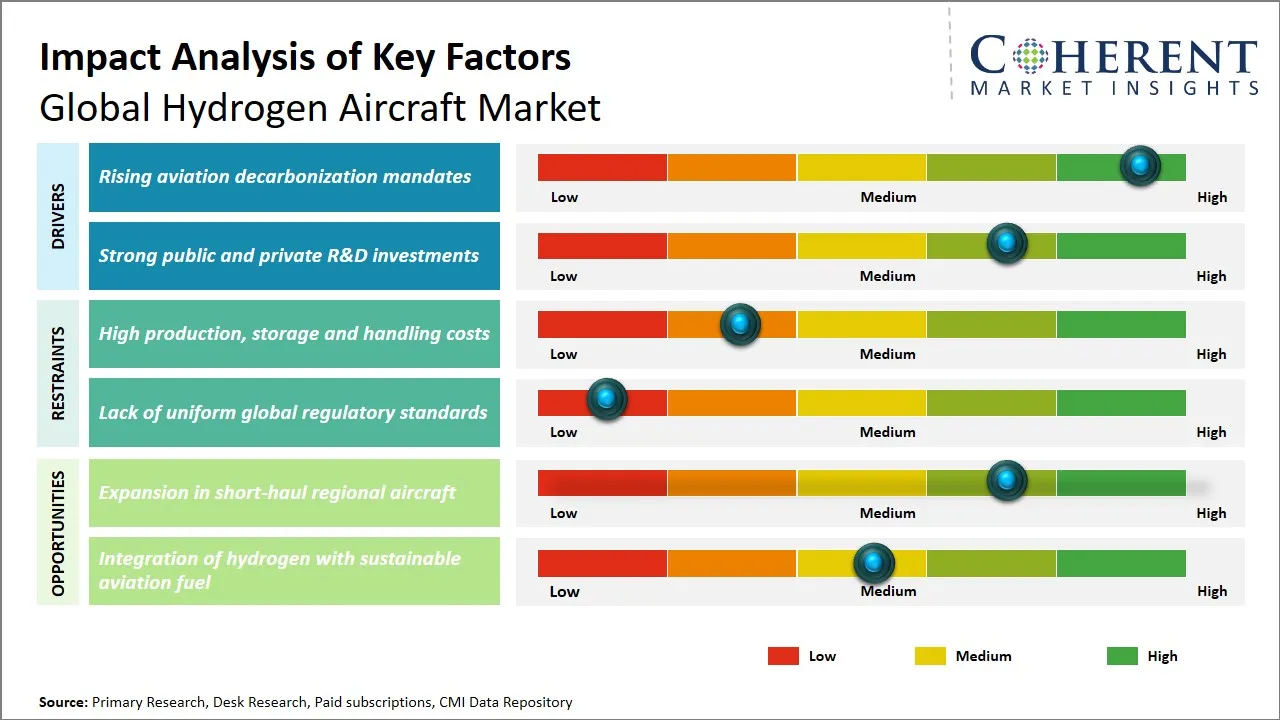
Global Hydrogen Aircraft Market Driver - Rising Aviation Decarbonization Mandates
With growing focus from state and global regulators, strict rules now push aviation toward lower carbon output, urging movement toward options like planes powered by hydrogen. As air travel contributes heavily to worldwide CO₂ levels, authorities set firm goals for cutting emissions, nudging carriers and builders toward greener systems. Requirements frequently involve financial costs tied to pollution, market-style exchange programs for emissions, and pledges aiming at zero-net impact flights around 2050, factors that together intensify urgency in leaving traditional fuel-driven propulsion behind.
For instance, on May 16, 2024, Airbus launched the GOLIAT liquid hydrogen ground operations project, which builds airport refueling and hydrogen handling systems to enable decarbonized aircraft operations, a direct industry response to emerging mandates that require not only low or zero‑emission aircraft technologies but also the supporting fuel infrastructure.
(Source: airbus.com)
Global Hydrogen Aircraft Market Opportunity - Expansion in Short ‑ Haul Regional Aircraft
The global hydrogen aircraft market presents a significant growth opportunity through the expansion of hydrogen-powered solutions in the short-haul regional aircraft segment. With tighter environmental rules emerging, short-haul air travel - flights under 1,000 kilometers - is seeing growing interest in hydrogen power because of how these planes operate. Instead of relying on traditional fuel, such aircraft could use hydrogen-based engines, producing no harmful exhaust and supporting broader climate targets. As regional services tend to include many departures and arrivals at smaller fields with briefer runways, lighter models fueled by hydrogen become practical options. Infrastructure changes would be minimal when compared to what long-distance fleets might require.
For instance, on November 6, 2025, ZeroAvia announced that its application to the Innovation Fund for a USD 25 million grant to support the introduction of hydrogen-electric aircraft has been selected for grant agreement preparation. The project will support the retrofit of 15 Cessna Caravan aircraft with ZeroAvia’s ZA600 hydrogen-electric engines and the establishment of the supporting airport hydrogen fuel technologies, with operations planned to commence in 2028.
(Source: zeroavia.com)
Analyst Opinion (Expert Opinion)
- Emerging slowly yet steadily, the worldwide market for hydrogen-powered airplanes now shapes a distinct path in flight technology. Because of increasing demands to lower greenhouse gases, attention shifts toward cleaner alternatives in air travel. Progress in engines that run on hydrogen, along with improvements in energy cells, pushes experimentation further each year. Backed by public financial support, large plane makers and new companies alike explore these designs more deeply. Joint projects between nations and private groups help lay groundwork for future emission goals. With time, such initiatives gain structure, forming early versions of what aviation might become.
- Though long-term prospects appear strong, progress hinges on resolving issues around storing hydrogen, building facilities, setting verification rules, along with steep upfront expenses. Gradual change seems probable - starting small, with local and limited-range planes leading the shift prior to broader adoption across major airline models. Achievement rests less on isolated advances but more on synchronized growth: clean hydrogen supply must match pace with fueling setups at airports and unified policy frameworks. Even with obstacles standing, craft powered by hydrogen offer a viable route to lower-emission flight, possibly altering industry dynamics well into the future.
Speak to the analyst
Want personalized insights?
Take the findings above to one of our principal consultants, or have the report rebuilt around the segments, geographies and competitors you actually track.
Market Segmentation
- Technology Insights (Revenue, USD Billion, 2022 - 2033)
- Hydrogen Fuel Cell Aircraft
- Hydrogen Combustion Aircraft
- Hybrid Electric–Hydrogen Aircraft
- Range Insights (Revenue, USD Billion, 2022 - 2033)
- Short-Range
- Medium-Range
- Long-Range
- Integration Type Insights (Revenue, USD Billion, 2022 - 2033)
- Linefit
- Retrofit
- Regional Insights (Revenue, USD Billion, 2022 - 2033)
- North America
- U.S.
- Canada
- Latin America
- Brazil
- Argentina
- Mexico
- Rest of Latin America
- Europe
- Germany
- U.K.
- Spain
- France
- Italy
- Russia
- Rest of Europe
- Asia Pacific
- China
- India
- Japan
- Australia
- South Korea
- ASEAN
- Rest of Asia Pacific
- Middle East
- GCC Countries
- Israel
- Rest of Middle East
- Africa
- South Africa
- North Africa
- Central Africa
- North America
- Key Players Insights (Revenue, USD Mn, 2021 - 2033)
- Airbus SE
- ZeroAvia
- GKN Aerospace
- Urban Aeronautics Ltd
- HES Energy Systems
- AeroVironment Inc
- Pipistrel D.O.O
- H2FLY
- AeroDelft
- Stralis Aircraft
- Hydroplane
- Beyond Aero
- Blue Spirit Aero
- Stellar Jet
- Fokker Next Gen
Sources
Primary Research Interviews
- Hydrogen aircraft manufacturers and technology developers
- Aviation fuel suppliers and hydrogen infrastructure providers
- Airlines and aircraft operators
- Aerospace engineering consultants and technical experts
Databases
- International Energy Agency (IEA) Database
- Federal Aviation Administration (FAA) Aircraft Registry Database
- International Civil Aviation Organization (ICAO) Database
- Aerospace Industries Association (AIA) Statistical Database
Magazines
- Aviation Week & Space Technology
- Aerospace Manufacturing Magazine
- Hydrogen Fuel News Magazine
- Flight International Magazine
Journals
- Journal of Aircraft Engineering and Aerospace Technology
- International Journal of Hydrogen Energy
- Aerospace Science and Technology Journal
Newspapers
- Aviation Daily
- Flight Global News
- Aerospace America News
- Clean Energy Wire
Associations
- International Association for Hydrogen Energy (IAHE)
- Aerospace Industries Association (AIA)
- International Air Transport Association (IATA)
- Hydrogen Europe Association
Public Domain Sources
- NASA Technical Reports Server
- European Aviation Safety Agency (EASA) Publications
- International Civil Aviation Organization (ICAO) Reports
- U.S. Department of Energy Hydrogen Program Reports
Proprietary Elements
- CMI Data Analytics Tool
- Proprietary CMI Existing Repository of information for last 8 years
Get access to 250+ pages report
Every segment, forecast, competitor profile and data table behind the analysis above — available for instant download.
- ESOMAR Member
- ISO 9001:2015 Certified
- D-U-N-S Registered
- GDPR & CCPA Compliant
Missing comfort of reading report in your local language? Find your preferred language:
Transform your Strategy with Exclusive Trending Reports
Frequently Asked Questions
The global hydrogen aircraft market is projected to stand at USD 3.50 Bn in 2026 and is expected to reach USD 19 Bn by 2033.
The CAGR of global hydrogen aircraft market is projected to be 33% from 2026 to 2033.
Rising aviation decarbonization mandates and strong public and private R&D investments are the major factors driving the growth of the global hydrogen aircraft market.
High production, storage and handling costs and lack of uniform global regulatory standards are the major factors hampering the growth of the global hydrogen aircraft market.
In terms of technology, hydrogen fuel cell aircraft is estimated to dominate the market revenue share in 2026.
Hydrogen offers cleaner emissions but requires larger storage volumes and new infrastructure compared to jet fuel.
Governments support the market through funding programs, regulatory frameworks, and sustainability mandates.