

Synthetic Aperture Radar Market Size and Forecast — 2026 - 2033
The Global Synthetic Aperture Radar Market size is estimated to be valued at USD 4.5 billion in 2026 and is expected to reach USD 9.7 billion by 2033, exhibiting a compound annual growth rate (CAGR) of 11.3% from 2026 to 2033.
Overview
The Synthetic Aperture Radar (SAR) market offers advanced radar imaging solutions used across defense, aerospace, environmental monitoring, and commercial applications. Products include airborne and spaceborne SAR systems capable of high-resolution imaging under all weather conditions and during day or night. Key product categories encompass X-band, C-band, and L-band SAR systems, each designed for specific imaging ranges and penetration capabilities. Additional offerings include miniaturized SAR for drones, portable ground-based SAR units, and integrated SAR payloads for satellites. These products provide capabilities such as terrain mapping, surveillance, disaster monitoring, and maritime tracking, driving adoption across both government and commercial sectors.
Key Takeaways
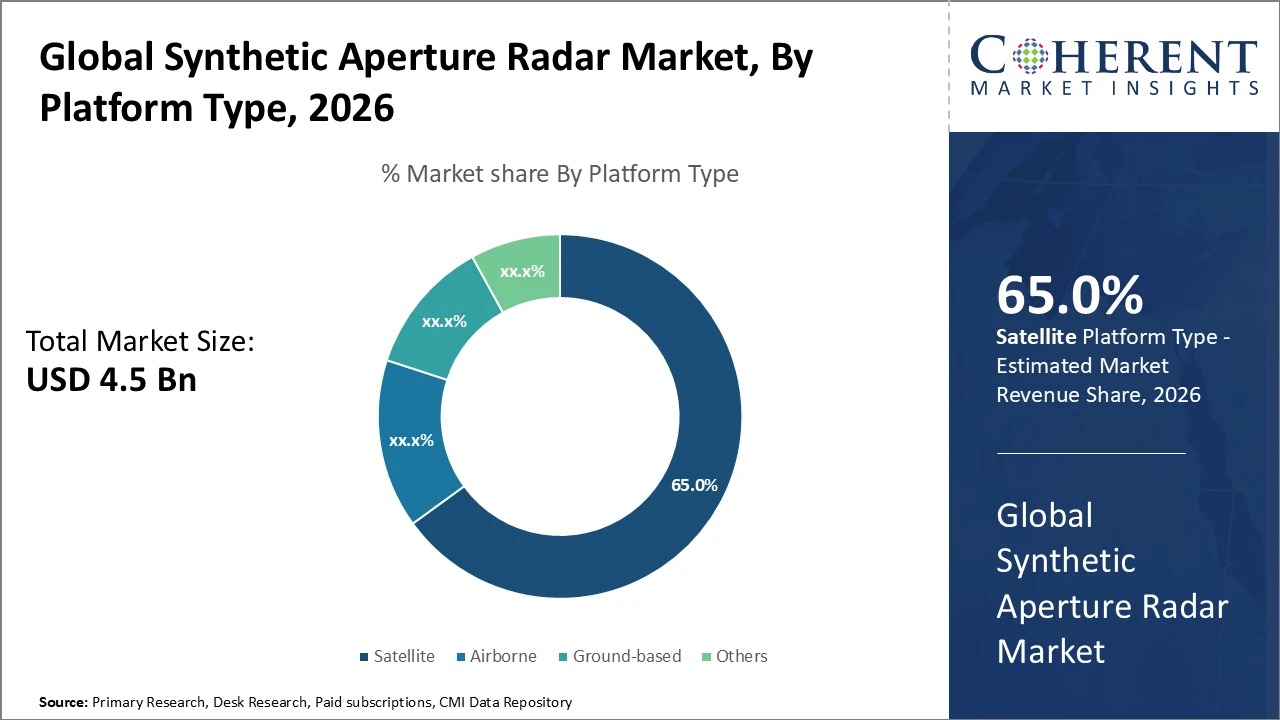
The satellite platform segment dominates the market with more than 65% share due to the global surge in satellite constellation launches enhancing data accessibility.
Defense and intelligence applications remain the highest revenue contributors, holding over 58% industry share as geopolitical scenarios escalate demand.
Asia Pacific is the fastest-growing region, driven by expanding governmental investments and active participation by leading market companies in countries like China and Japan.
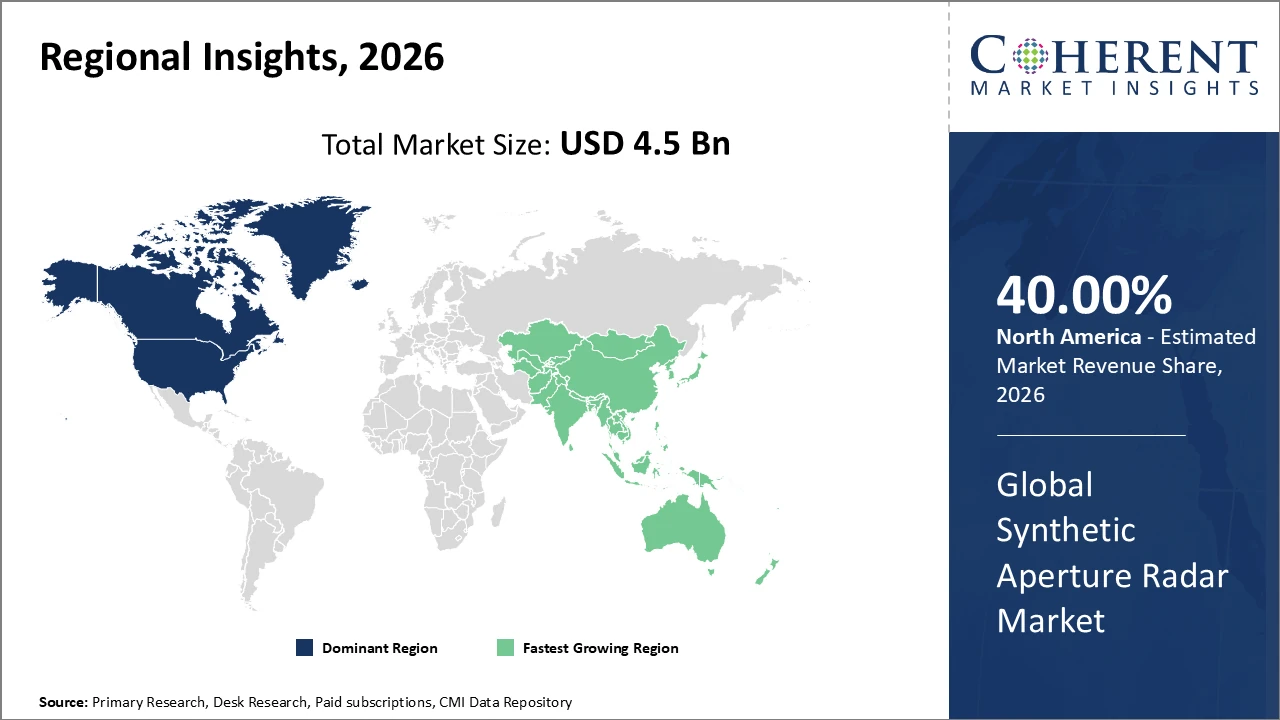
North America holds a dominant regional market share, benefiting from a mature ecosystem, robust defense budgets, and advanced AI integration in SAR data analytics.
Synthetic Aperture Radar Market Segmentation Analysis
Synthetic Aperture Radar Market Insights, By Platform Type
The Satellite segment dominates the Synthetic Aperture Radar market with around 65% share, driven by increasing satellite constellation launches that enable broader coverage and frequent data revisit cycles. Satellite SAR payloads provide continuous global surveillance for defense and civilian applications, with trends toward miniaturized, cost-effective satellites further boosting growth. The Airborne segment is the fastest-growing, fueled by tactical, flexible imaging and UAV-mounted SAR systems that reduce costs and enhance high-resolution data for disaster management and infrastructure inspection. Ground-based SAR maintains a niche role for persistent monitoring, while shipborne platforms support maritime surveillance and oceanographic research.
Synthetic Aperture Radar Market Insights, By Frequency Band
X-Band holds the dominant position in the Synthetic Aperture Radar market with around 48% share, favored for its high resolution and precision, particularly in defense and intelligence applications requiring detailed imaging. Its shorter wavelength enables superior tactical reconnaissance and accurate surveillance. L-Band is the fastest-growing subsegment, valued for its deeper penetration capabilities essential in vegetation analysis, soil moisture monitoring, and geological studies, as well as environmental and disaster applications. C-Band offers a balanced mix of resolution and penetration for commercial remote sensing. S-Band and Ka-Band serve niche roles, with Ka-Band advancing next-generation high-resolution SAR, while Others cover specialized experimental bands.
Synthetic Aperture Radar Market Insights, By Application
Defense & Intelligence dominates the Synthetic Aperture Radar market with approximately 58% share, driven by the demand for all-weather, day-night surveillance amid rising geopolitical tensions. Applications include border security, battlefield reconnaissance, and threat detection, supported by government contracts and defense modernization programs. Environmental Monitoring is the fastest-growing application, fueled by climate change awareness and sustainable resource initiatives, with SAR used for forest tracking, ice sheet observation, and agricultural assessments. Disaster Management leverages SAR’s resilience for reliable post-calamity data. Oil & Gas and Mining utilize SAR for remote monitoring, while other applications, such as maritime domain awareness and urban planning, continue to expand steadily.
Synthetic Aperture Radar Market Trends
The market is shifting towards ultra-small SAR satellites, enabled by smaller sensor sizes and lower launch costs, allowing more frequent revisit times.
Increased revisit frequency is critical for applications such as disaster response and precision agriculture.
Initiatives like ICEYE’s constellation expansion in 2025 reduced imaging latency for commercial customers by 50%.
Integration of SAR with AI and machine learning is enhancing object detection and classification capabilities.
South Korea’s 2026 maritime surveillance program reduced false detection rates by 15% using AI-enhanced SAR data.
Synthetic Aperture Radar Market Insights, By Geography
North America Synthetic Aperture Radar Market Analysis and Trends
In North America, the Synthetic Aperture Radar market is dominated by strong defense budgets, advanced manufacturing capabilities, and a robust space technology ecosystem. The United States leads the region, with major contracts awarded to companies such as Lockheed Martin and Raytheon Technologies, driving innovation and market revenue. Government-backed space missions and commercial satellite launches further strengthen market growth. North America accounts for approximately 40% of the global SAR market, benefiting from continuous technological advancements, strategic collaborations, and a mature regulatory and operational framework supporting both defense and civilian SAR applications.
Asia Pacific Synthetic Aperture Radar Market Analysis and Trends
The Asia Pacific region is experiencing the fastest growth in the Synthetic Aperture Radar market, with a CAGR exceeding 14%, led by countries such as China, Japan, and South Korea. This rapid expansion is driven by increasing government investments in surveillance systems, infrastructure monitoring, and environmental applications. Regional growth is further supported by numerous emerging market players actively developing SAR technologies and participating in government-sponsored satellite programs. Initiatives focused on disaster management, maritime surveillance, and precision agriculture are also boosting adoption. These factors collectively accelerate market dynamics, positioning Asia Pacific as a key growth hub in the global SAR industry.
Synthetic Aperture Radar Market Outlook for Key Countries
USA Synthetic Aperture Radar Market Analysis and Trends
The United States continues to be a critical market for Synthetic Aperture Radar, supported by substantial defense spending and ongoing technological innovation. Key government initiatives, such as NASA’s upcoming NISAR mission scheduled for 2026, are expected to advance both research and commercial applications. Leading U.S.-based companies, including Lockheed Martin and Raytheon Technologies, are driving growth through AI-integrated SAR solutions and multi-mission satellite platforms. Their efforts enhance technological sophistication, operational capabilities, and reinforce the United States’ dominant position in the global SAR market.
Germany Synthetic Aperture Radar Market Analysis and Trends
Germany’s Synthetic Aperture Radar market is experiencing steady growth, driven by strong government support for defense, environmental monitoring, and industrial applications. Investments in advanced satellite programs and collaborations with the European Space Agency (ESA) enhance research and development in high-resolution SAR systems. German companies are increasingly adopting AI and machine learning for improved image analysis, object detection, and disaster monitoring. Key applications include border security, infrastructure inspection, and environmental surveillance, reflecting rising demand for precision data. The market benefits from Germany’s robust aerospace ecosystem, skilled workforce, and strategic participation in European SAR initiatives, positioning the country as a key hub for innovation and adoption.
Analyst Opinion
Increasing launches of SAR satellite constellations enhance market size: Surge in SAR satellite deployments, such as ICEYE’s 2025 constellation, boosted market revenue by enabling higher revisit rates and expanded coverage, supported by miniaturized radar payloads.
Adoption in non-defense sectors driving market growth: Agriculture and infrastructure monitoring leveraged SAR data for real-time analytics in 2024, with regional reports showing a 20% increase in SAR data utilization compared to 2023, strengthening demand for imaging services.
Pricing optimization and competitiveness stabilize market revenues: Industry pricing indices recorded a 4% decrease in per-square-kilometer imaging costs in 2025, stimulating commercial and governmental purchases.
Integration of AI and machine learning propelling advanced analytics: Pilot programs in Japan and South Korea during 2026 enhanced SAR data analytics for applications like urban change detection and maritime surveillance, supporting emerging market growth.
- Current Industry Events of 2026
- Market Size Estimation
- Regional Breakdown
- Competitive Landscape
- Customer Intelligence
- Segmental Analysis
- Pricing Analysis
- Key Market Drivers, Challenges & Future Trends
- Customized Insights Section
Market Scope
| Report Coverage | Details | ||
|---|---|---|---|
| Base Year: | 2025 | Market Size in 2026: | USD 4.5 billion |
| Historical Data for: | 2020 To 2024 | Forecast Period: | 2026 To 2033 |
| Forecast Period 2026 to 2033 CAGR: | 11.3% | 2033 Value Projection: | USD 9.7 billion |
| Geographies covered: |
| ||
| Segments covered: |
| ||
| Companies covered: | Thales Group, ICEYE, NEC Corporation, MDA Corporation, L3Harris Technologies, European Space Agency, Raytheon Technologies, Airbus Defense and Space, Capella Space, Lockheed Martin Corporation | ||
| Growth Drivers: |
| ||
Synthetic Aperture Radar Market Growth Factors
The Synthetic Aperture Radar market is being driven by the expansion of satellite constellations, with the rise of small SAR satellites increasing data acquisition frequency and boosting revenues, exemplified by China’s launches during 2024–2025. Growing demand from defense and intelligence, fueled by geopolitical tensions and modernization programs in the U.S. and Europe, led to a 12% increase in SAR defense spending in 2026. Government-backed environmental monitoring projects, such as deforestation and flood mapping initiatives in Brazil and Canada, have further expanded adoption. Advances in AI-integrated data analytics enhance interpretability and operational efficiency, enabling applications in urban planning and maritime domain awareness, demonstrated by South Korea in 2026.
Synthetic Aperture Radar Market Development
In November 2025, ICEYE expanded its constellation of small SAR satellites, significantly reducing imaging latency and increasing revisit frequency for commercial and government customers. This development enabled real-time monitoring for disaster management, precision agriculture, and infrastructure projects, strengthening market adoption and driving higher revenues for SAR service providers. The miniaturization of radar payloads allowed for cost-effective satellite launches, making high-resolution SAR data more accessible to a broader range of end users.
Key Players
Leading Companies of the Market
Thales Group
ICEYE
NEC Corporation
MDA Corporation
L3Harris Technologies
European Space Agency
Capella Space
Airbus Defense & Space
Lockheed Martin Corporation
Raytheon Technologies
Among leading market companies, Airbus Defence and Space upgraded its TerraSAR-X constellation in 2025, improving revisit times and spatial resolution, which directly increased their market share in the satellite segment. ICEYE pursued a competitive strategy centered on rapid satellite deployment, securing multiple contracts in Asia Pacific markets in 2026 and driving significant business growth. Meanwhile, Raytheon Technologies invested in AI-based image processing, achieving a 15% efficiency gain in defense-related applications during 2024. These strategic initiatives highlight how technological upgrades, rapid deployment, and advanced analytics are shaping competitive positioning and accelerating growth in the Synthetic Aperture Radar market.
Synthetic Aperture Radar Market Future Outlook
The future of the Synthetic Aperture Radar market is poised for rapid expansion, driven by increasing satellite constellation deployments, miniaturization of radar payloads, and growing adoption across defense, environmental, and commercial sectors. Advances in AI and machine learning will enhance SAR data analytics, enabling higher accuracy in applications such as disaster management, urban planning, maritime surveillance, and precision agriculture. Emerging markets in Asia Pacific and Europe are expected to see accelerated growth due to government-backed satellite programs and infrastructure monitoring initiatives. Continued investments in next-generation SAR technologies, combined with cost-effective launch strategies, will strengthen market penetration and open new opportunities globally.
Synthetic Aperture Radar Market Historical Analysis
The Synthetic Aperture Radar market has experienced steady growth over the past decade, driven initially by defense and intelligence applications requiring all-weather, day-night surveillance. Early developments focused on large, high-resolution satellite and airborne SAR systems, primarily in North America and Europe, supported by government contracts and space programs. Over time, technological advancements, including miniaturized sensors and UAV-mounted platforms, broadened adoption across environmental monitoring, disaster management, and infrastructure inspection. The launch of early satellite constellations improved revisit times and data accessibility, while increasing commercial interest in agriculture, forestry, and maritime applications further diversified market demand, establishing a foundation for the rapid growth observed in recent years.
Sources
Primary Research Interviews:
Defense and intelligence agencies and SAR program managers
Satellite manufacturers and aerospace system integrators
Commercial satellite operators and service providers
AI and geospatial analytics companies leveraging SAR data
Industry consultants and remote sensing experts
Magazines:
Space News – Satellite Technology and Market Updates
Aviation Week & Space Technology – Aerospace & SAR Systems
GPS World – Remote Sensing and Earth Observation
Jane’s Defence Weekly – Defense Applications of SAR
Journals:
IEEE Transactions on Geoscience and Remote Sensing – SAR Research
Remote Sensing of Environment – Imaging & Earth Observation
Journal of Aerospace Engineering – Satellite and Radar Systems
Newspapers:
The Wall Street Journal – Aerospace and Defense Markets
Financial Times – Satellite Industry & Geospatial Technologies
Reuters – Space Technology and Defense News
Bloomberg – Satellite Launches and Remote Sensing Markets
Associations:
International Society for Photogrammetry and Remote Sensing (ISPRS)
European Space Agency (ESA) – Earth Observation Programs
Space Foundation – Aerospace and Satellite Industry
Institute of Electrical and Electronics Engineers (IEEE) Geoscience & Remote Sensing Society
Get access to 250+ pages report
Every segment, forecast, competitor profile and data table behind the analysis above — available for instant download.
- ESOMAR Member
- ISO 9001:2015 Certified
- D-U-N-S Registered
- GDPR & CCPA Compliant
Missing comfort of reading report in your local language? Find your preferred language:
Transform your Strategy with Exclusive Trending Reports
Frequently Asked Questions
Dominant players in the Synthetic Aperture Radar market include Airbus Defence and Space, Lockheed Martin Corporation, ICEYE, and Raytheon Technologies, who hold significant market share through innovations and strategic satellite deployments.
The market size is projected to expand from USD 4.5 billion in 2026 to approximately USD 9.7 billion by 2033, reflecting a CAGR of 11.3% driven by satellite proliferation and diversified applications.
Defense & Intelligence applications present the largest growth opportunity due to increasing adoption in surveillance, reconnaissance, and threat detection missions worldwide.
Market trends will shift towards miniaturized payloads, software-defined radar systems, and enhanced AI integration, supporting more frequent, accurate, and versatile SAR data utilization.
The competitive landscape is marked by rapid innovation, growing market entry from startups, and strategic alliances; however, challenges remain in the high cost of satellite launches and technological integration complexities.
Market players adopt strategies including rapid constellation deployment, partnerships for data analytics services, and vertical integration of radar hardware with software solutions for enhanced value delivery.