

Global AI in Predictive Toxicology Market Size and Forecast – 2026-2033
The Global AI in Predictive Toxicology Market is estimated to be valued at USD 825.9 Mn in 2026 and is expected to reach USD 5,154.6 Mn by 2033, exhibiting a compound annual growth rate (CAGR) of 29.9% from 2026 to 2033.
Key Takeaways of the Global AI in Predictive Toxicology Market
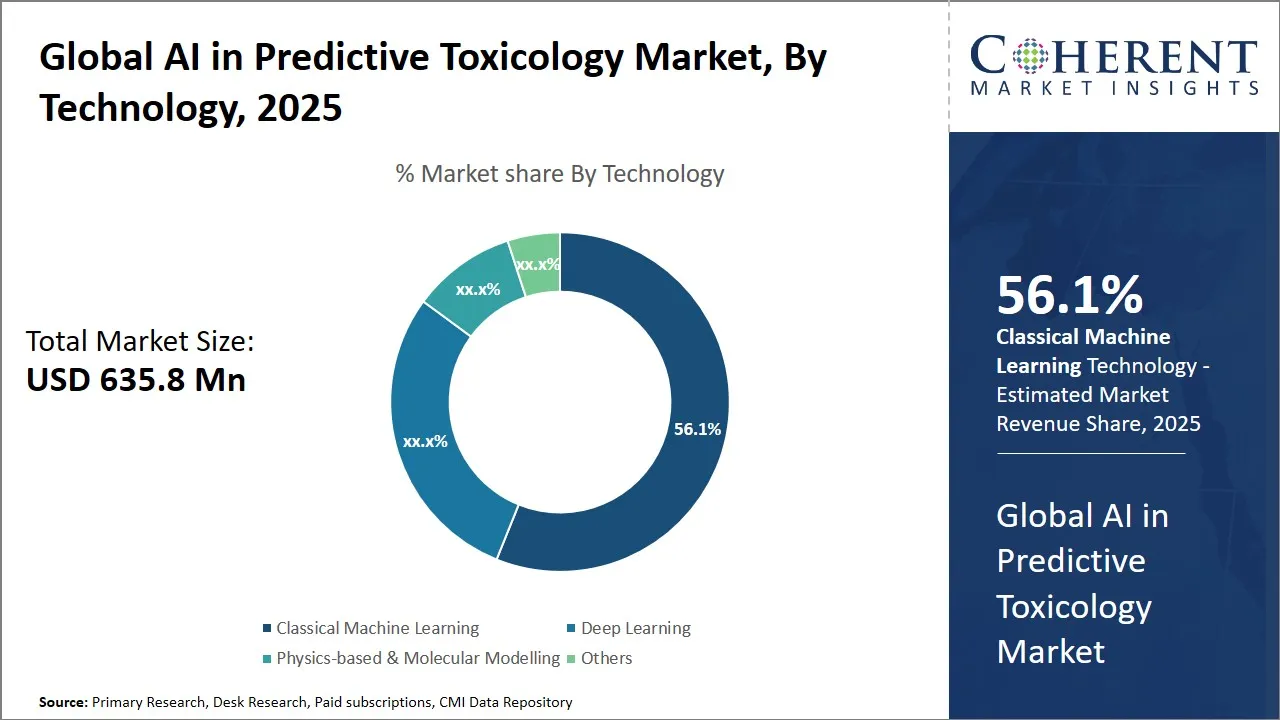
- The classical machine learning segment leads the market holding an estimated share of 57.1 % in 2026.
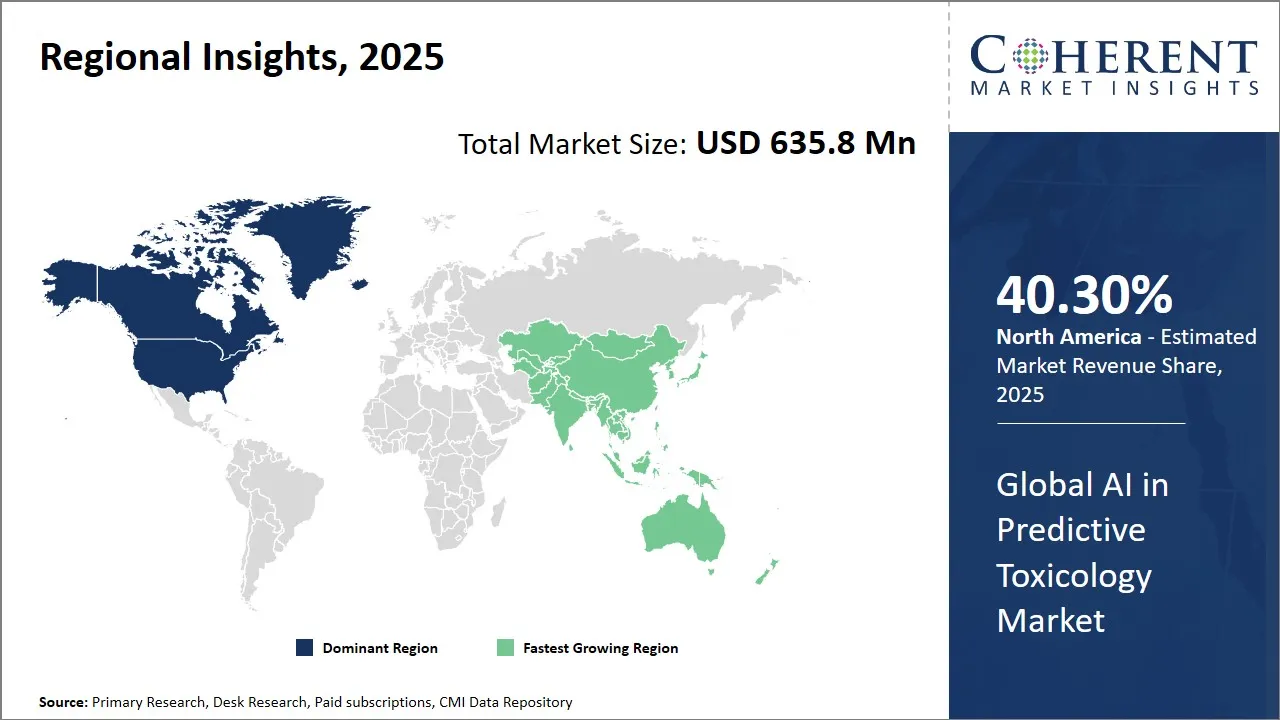
- North America is estimated to lead the market with a share of 40.3 % in 2026.
- Asia Pacific, holding a share of 21.5 % in 2026, is projected to be the fastest growing region.
Market Overview
The market trend indicates a strong shift towards integrating advanced machine learning algorithms and big data analytics to improve predictive accuracy and reduce reliance on animal testing. Furthermore, the rising demand for personalized medicine and the expansion of AI-driven platforms in pharmaceutical R&D are accelerating market adoption. Continuous advancements in computational toxicology tools and growing investments in AI-based drug safety solutions will further propel the market growth during the forecast period.
Current Events and Its Impact
Current Events | Description and its impact |
Collaborations & Partnerships |
|
Corporate Initiatives |
|
Segmental Insights
- Current Industry Events of 2026
- Market Size Estimation
- Regional Breakdown
- Competitive Landscape
- Customer Intelligence
- Segmental Analysis
- Pricing Analysis
- Key Market Drivers, Challenges & Future Trends
- Customized Insights Section
Global AI in Predictive Toxicology Market Insights, by Technology – Classical Machine Learning Contributes the Highest Share of the Market Owing to its Versatility and Proven Effectiveness
In the global AI in predictive toxicology market, the classical machine learning segment holds a dominant position, holding an estimated share of 57.1% in 2026. One of the key drivers propelling this segment is the extensive availability of structured toxicology datasets that classical ML algorithms can efficiently process. These algorithms excel at identifying patterns and correlations within large volumes of historical toxicological data, enabling accurate prediction of chemical toxicity profiles without relying solely on costly or time-consuming laboratory experiments. Additionally, classical machine learning models such as support vector machines (SVM), random forests, and decision trees offer interpretability, which is highly valued in toxicology. Regulatory bodies and pharmaceutical companies often require transparent methodologies to understand the rationale behind predictions, making classical ML models more favorable compared to certain black-box deep learning approaches.
Moreover, the adaptability of classical ML techniques to diverse datasets across different chemical classes and biological endpoints further strengthens their appeal. The comparatively lower computational requirements of classical machine learning algorithms also contribute to their widespread adoption. Unlike deep learning models that demand significant computational power and large-scale labeled data, classical ML methods can operate effectively with moderate computing resources and smaller datasets, making them accessible for organizations with limited infrastructure. Furthermore, ongoing improvements in feature engineering and integration of domain expertise into classical ML workflows have enhanced the precision of toxicity predictions.
End User Feedback & Unmet Needs in the AI in Predictive Toxicology Market
- Pharma companies and CROs note that while AI models show strong internal validation, regulators are still cautious in accepting AI-only predictions. Standardized validation frameworks and clearer regulatory guidelines are needed to allow AI toxicology outputs to be used in formal submissions. The U.S. FDA and EMA continue to request supplemental in-vitro/in-vivo data alongside AI-based predictions, slowing adoption despite promising results.
- End users struggle with fragmented, siloed, or proprietary toxicology datasets, limiting model robustness and generalization. Broader access to high-quality, curated datasets is needed for training and benchmarking AI tools.
- Users report challenges embedding AI predictive toxicology tools seamlessly into existing discovery and preclinical pipelines. They need better interoperability with lab information systems (LIMS), cheminformatics platforms, and cloud-based collaboration tools.
Regional Insights
North America AI in Predictive Toxicology Market Analysis and Trends
North America, holding a share of 40.3% in 2026, is expected to dominate the global AI in predictive toxicology market, stemming from a robust ecosystem composed of advanced healthcare infrastructure, extensive R&D capabilities, and significant government support. The presence of top-tier biotechnology and pharmaceutical companies actively integrating AI to streamline drug safety assessments accelerates market maturity.
Regulatory agencies such as the U.S. FDA have increasingly endorsed AI-driven toxicological evaluations, fostering trust and adoption of these technologies. Additionally, a high concentration of AI startups and academic institutions specializing in computational toxicology enriches innovation. Notable companies like IBM Watson Health, Numerate, and Schrödinger are contributing substantially, developing sophisticated AI platforms that enhance predictive accuracy in toxicity profiling within the region.
Asia Pacific AI in Predictive Toxicology Market Analysis and Trends
The Asia Pacific region, holding a share of 21.5% in 2026, is projected to exhibit the fastest growth in the AI in predictive toxicology market. This surge is largely driven by expanding pharmaceutical manufacturing hubs, increased healthcare investments, and rising demand for safer drug development processes. Governments in countries like China, Japan, and South Korea are aggressively promoting AI adoption through favorable policies and funding schemes aimed at digital healthcare transformation.
The rapid expansion of biotech ecosystems and collaborations between academia and industry foster a fertile environment for AI innovation. Companies such as Ping An Healthcare, Insilico Medicine, and Astellas Pharma are pioneering AI applications that advance predictive toxicology capabilities, underscoring the region’s dynamic momentum.
AI in Predictive Toxicology Market Outlook for Key Countries
U.S. AI in Predictive Toxicology Market Analysis and Trends
The U.S. is a global leader, driven by its combination of cutting-edge AI technology providers and pharmaceutical giants focused on predictive safety assessments. The government’s supportive regulatory framework encourages integrating AI tools to reduce animal testing and expedite drug approvals. Corporate innovators like IBM Watson Health and startups such as Atomwise are reshaping toxicology by deploying machine learning models that can predict adverse reactions with high precision, positioning the U.S. at the forefront of this market.
Germany AI in Predictive Toxicology Market Analysis and Trends
Germany benefits from its strong pharmaceutical industry base and commitment to technological advancements within the healthcare sector. The country’s prominence in regulatory rigor ensures AI applications in predictive toxicology meet high standards of safety and efficacy. Companies like Bayer and BioNTech invest heavily in AI-powered toxicology platforms to optimize drug safety profiles, while collaborations between industry and research institutions underpin constant innovation in this field.
China AI in Predictive Toxicology Market Analysis and Trends
China continues to lead the Asia Pacific growth narrative by melding government-backed AI initiatives with expansive pharmaceutical development. Incentives from the Chinese government, such as the “Made in China 2026” strategy, emphasize AI adoption across healthcare sectors, including drug safety evaluation. Companies such as Ping An Healthcare and Insilico Medicine leverage large datasets and AI to accelerate toxicity predictions, making China a rapidly emerging power in this market.
Japan AI in Predictive Toxicology Market Analysis and Trends
Japan is shaped by a strong governmental focus on AI innovation paired with a notable pharmaceutical sector. Efforts to integrate AI into predictive toxicology align with the country’s broader push for digitalization in healthcare. Firms like Astellas Pharma and Fujifilm are active in deploying AI methodologies to minimize adverse drug reactions and streamline preclinical testing, reflecting Japan’s commitment to improving drug safety and regulatory compliance through technology.
South Korea AI in Predictive Toxicology Market Analysis and Trends
South Korea’s growing emphasis on precision medicine and AI technology enables its expanding role in predictive toxicology. The government’s investments in smart healthcare and AI startups fuel advancements in computational toxicology tools. Companies such as Lunit and Vuno develop AI-driven software that assists pharmaceutical developers in early toxicity risk assessment, signaling the region’s rapid adoption of innovative predictive toxicology solutions.
Market Players, Key Development, and Competitive Intelligence
Key Developments
- In July 2025, Simulations Plus, Inc., a leading provider of cheminformatics, biosimulation, simulation-enabled performance and intelligence solutions, and medical communications to the biopharma industry, announced that experimental results of its artificial intelligence-driven drug design (AIDD) in collaboration with the Institute of Medical Biology of the Polish Academy of Sciences (IMB PAS) have been published in the American Chemical Society (ACS) Medical Chemistry Letters.
- In June 2025, Simulations Plus, Inc. announced the release of ADMET Predictor 13, its flagship machine learning (ML) modeling platform for the design, optimization, and selection of new molecules during various stages of drug discovery.
- In June 2025, Lhasa Limited announced the latest release of Derek Nexus (version 6.4.2) and Sarah Nexus (version 5.0.0) – expert-knowledge and statistically driven decision-support tools designed to help scientists make confident, evidence-based safety assessments. This release advances approaches to chemical risk assessment and supports evolving regulatory expectations.
- In February 2025, Lhasa Limited announced the release of new pharmaceutical excipient data to its Vitic Excipients database. This pre-competitive data sharing initiative facilitates anonymous sharing of excipient and vehicle toxicity data, providing members with proprietary formulation information to establish safe limits for pharmaceutical excipients while strengthening regulatory submissions.
Top Strategies Followed by AI in Predictive Toxicology Market Players
- Established companies dominate the scene through substantial investments in research and development, driving the innovation of high-performance AI-driven toxicology platforms and predictive models.
- Schrödinger expanded its predictive toxicology initiative (2024–2025), investing in advanced deep-learning safety models (e.g., hERG inhibition, CYP450 liability) to strengthen its position as a leading AI-driven discovery company.
- Mid-level players in the AI predictive toxicology market differentiate themselves by offering cost-effective solutions that strategically balance performance and affordability.
- MultiCASE continues to offer relatively low-cost QSAR-based predictive toxicology tools widely used in academic and mid-tier research labs, providing accessible alternatives compared to premium enterprise solutions.
- Small-scale players in the AI-driven predictive toxicology space employ more focused strategies to carve out competitive niches.
- Lhasa Limited’s Vitic Excipients database expansion (February 2025) targets a highly specific gap in excipient safety data, enabling niche adoption among formulation scientists and regulatory agencies.
Market Report Scope
AI in Predictive Toxicology Market Report Coverage
| Report Coverage | Details | ||
|---|---|---|---|
| Base Year: | 2025 | Market Size in 2026: | USD 825.9 Mn |
| Historical Data for: | 2020 To 2024 | Forecast Period: | 2026 To 2033 |
| Forecast Period 2026 to 2033 CAGR: | 29.9% | 2033 Value Projection: | USD 5,154.6 Mn |
| Geographies covered: |
| ||
| Segments covered: |
| ||
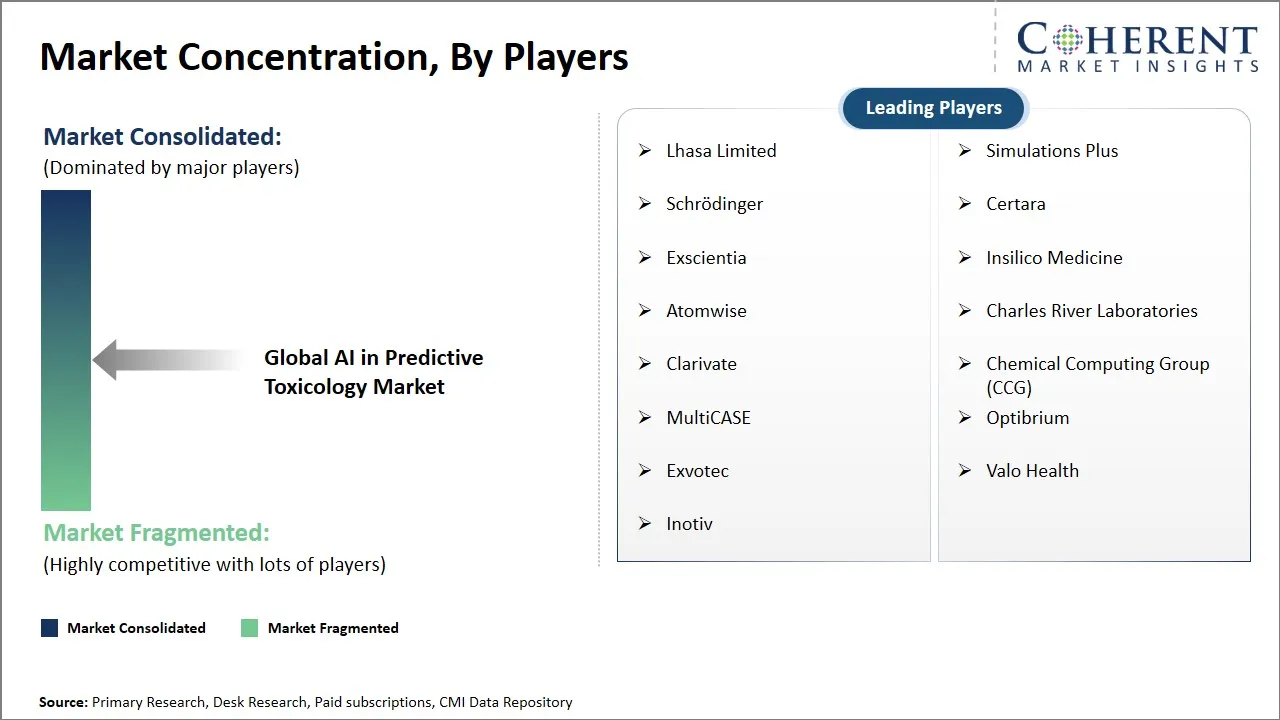
| Companies covered: | Lhasa Limited, Simulations Plus, Schrödinger, Certara, Exscientia, Insilico Medicine, Atomwise, Charles River Laboratories, Clarivate, Chemical Computing Group (CCG), MultiCASE, Optibrium, Exvotec, Valo Health, and Inotiv | ||
| Growth Drivers: |
| ||
| Restraints & Challenges: |
| ||
Market Dynamics
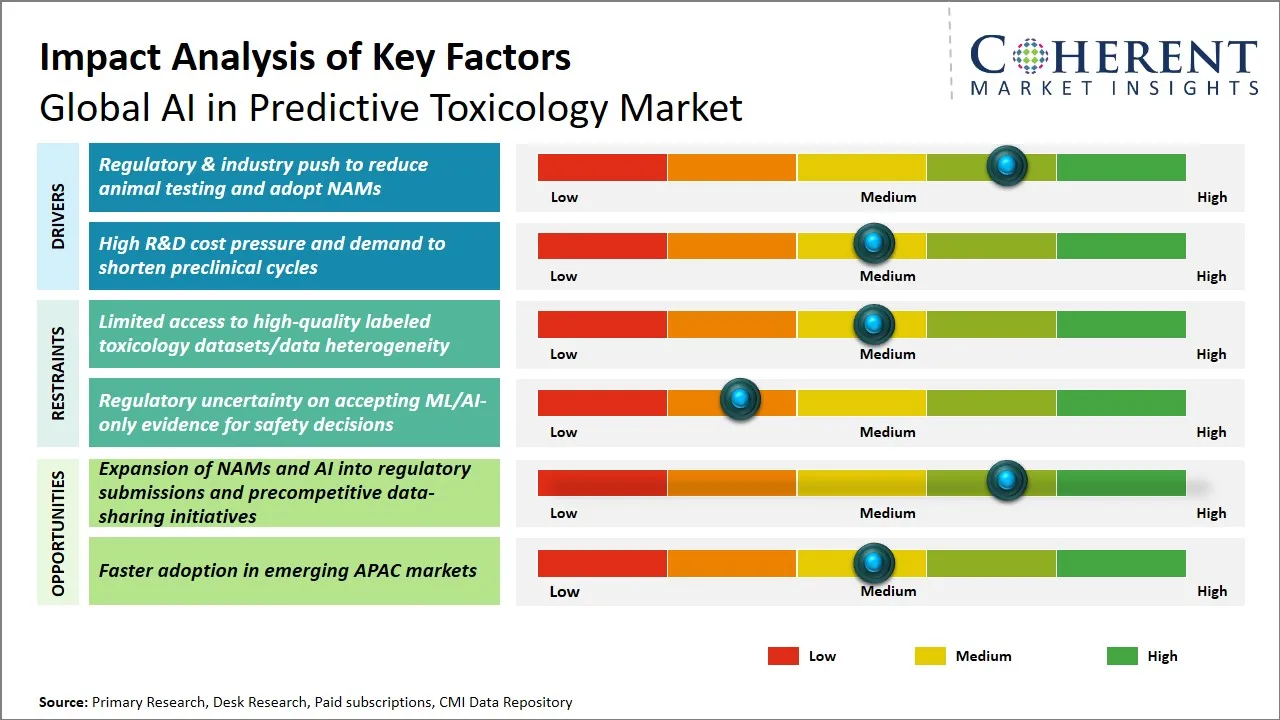
Global AI in Predictive Toxicology Market Driver – Regulatory & Industry Push To Reduce Animal Testing And Adopt NAMs
Governments and regulatory agencies worldwide are implementing stricter guidelines and mandates that encourage or require the reduction of animal use in safety testing, promoting the integration of new approach methodologies (NAMs) such as computational modeling, in vitro assays, and AI-driven predictive tools. These NAMs offer a more ethical, cost-effective, and time-efficient alternative to traditional toxicology studies, aligning with growing public and scientific demand for humane research practices.
Moreover, the pharmaceutical, chemical, and consumer product industries are actively investing in innovative AI technologies to comply with evolving regulations while ensuring safety and efficacy standards are met. In September 2022, the U.S. FDA Modernization Act 2.0 was signed into law, allowing drug developers to use non-animal testing methods (including AI-based predictive toxicology) to demonstrate drug safety and efficacy. This regulatory momentum not only incentivizes the development of advanced AI models capable of accurately predicting toxicological outcomes but also fosters collaboration between stakeholders to validate and adopt these technologies, ultimately accelerating the transition towards animal-free testing paradigms in toxicology.
Global AI in Predictive Toxicology Market Opportunity – Expansion of NAMs and AI into Regulatory Submissions and Precompetitive Data-Sharing Initiatives
NAMs, which emphasize non-animal testing techniques and advanced computational models, are increasingly gaining acceptance by regulatory agencies worldwide as reliable alternatives to traditional toxicity testing. Integrating AI-driven predictive toxicology tools with NAMs offers enhanced accuracy, faster turnaround times, and reduced costs, addressing long-standing challenges in chemical safety assessment. This integration supports regulatory bodies like the U.S. Environmental Protection Agency (EPA), European Chemicals Agency (ECHA), and Food and Drug Administration (FDA) in modernizing their frameworks to incorporate more mechanistic, human-relevant data, facilitating more informed decision-making processes.
Additionally, the growth of precompetitive data-sharing platforms enables multiple stakeholders—including pharmaceutical companies, regulatory authorities, and academic institutions—to collaboratively pool toxicological data sets, fostering the development of more robust AI models. Such initiatives reduce duplication of efforts and accelerate validation and adoption of AI-enabled NAMs in regulatory contexts.
Analyst Opinion (Expert Opinion)
- Pharmaceutical and biotech companies are the largest demand drivers, using AI toxicology models to predict adverse effects early and cut preclinical attrition rates. As more regulatory agencies recognize NAMs, the adoption for Investigational New Drug (IND) submissions is expected to grow steadily.
- Demand is rising from chemical, agrochemical, and cosmetics industries, where stricter EU and U.S. regulations are phasing out animal testing. AI-driven predictive toxicology offers a compliant and cost-effective alternative, especially for high-volume safety assessments.
- Academic institutes and regulatory bodies are increasingly adopting AI-enabled NAMs for method validation and database development. Precompetitive collaborations (e.g., Lhasa’s Vitic Excipients database) indicate growing institutional demand for AI models in establishing toxicology reference standards.
Speak to the analyst
Want personalized insights?
Take the findings above to one of our principal consultants, or have the report rebuilt around the segments, geographies and competitors you actually track.
Market Segmentation
- Technology Insights (Revenue, USD Mn, 2021 - 2033)
- Classical Machine Learning
- Deep Learning
- Physics-based & Molecular Modelling
- Others
- Regional Insights (Revenue, USD Mn, 2021 - 2033)
- North America
- U.S.
- Canada
- Latin America
- Brazil
- Argentina
- Mexico
- Rest of Latin America
- Europe
- Germany
- U.K.
- Spain
- France
- Italy
- Russia
- Rest of Europe
- Asia Pacific
- China
- India
- Japan
- Australia
- South Korea
- ASEAN
- Rest of Asia Pacific
- Middle East
- GCC Countries
- Israel
- Rest of Middle East
- Africa
- South Africa
- North Africa
- Central Africa
- North America
- Key Players Insights
- Lhasa Limited
- Simulations Plus
- Schrödinger
- Certara
- Exscientia
- Insilico Medicine
- Atomwise
- Charles River Laboratories
- Clarivate
- Chemical Computing Group (CCG)
- MultiCASE
- Optibrium
- Exvotec
- Valo Health
- Inotiv
Sources
Primary Research Interviews
Stakeholders
- Pharmaceutical & Biotechnology Companies (e.g., R&D Directors, Preclinical Safety Managers)
- Contract Research Organizations (CROs) (e.g., Toxicology Project Leads, Study Directors)
- Academic & Research Institutions (e.g., Professors in Pharmacology, Computational Toxicology Researchers)
- Regulatory Agencies (e.g., U.S. FDA, EMA Scientific Reviewers, OECD NAMs Experts)
- AI Software Developers & Vendors specializing in predictive toxicology platforms (e.g., Lhasa Limited, Simulations Plus, Schrödinger)
- Industry Consortia & Precompetitive Collaborators (e.g., data-sharing initiatives on excipient and ADMET safety)
Databases
- PubChem
- ChEMBL
- ToxNet (archived)
- OECD QSAR Toolbox
- NIH NCATS Data Portal
- U.S. FDA Adverse Event Reporting System (FAERS)
Magazines
- Drug Discovery Today
- Pharma Tech Outlook
- AI in Pharma Review
- Computational Toxicology Insights
- R&D World
Journals
- Archives of Toxicology
- Computational Toxicology (Elsevier)
- Journal of Applied Toxicology
- Frontiers in Pharmacology (Toxicology section)
- Journal of Cheminformatics
Newspapers
- BioPharma Dive
- Chemical & Engineering News (C&EN)
- The Pharma Letter
- Fierce Biotech
- The Economic Times (India)
Associations
- Society of Toxicology (SOT)
- European Society of Toxicology In Vitro (ESTIV)
- International Union of Toxicology (IUTOX)
- American Society for Pharmacology and Experimental Therapeutics (ASPET)
- OECD Working Group on Non-Animal Testing (NAMs)
Public Domain Sources
- U.S. Food and Drug Administration (FDA)
- European Medicines Agency (EMA)
- Organisation for Economic Co-operation and Development (OECD)
- National Institutes of Health (NIH)
- World Health Organization (WHO)
- ResearchGate
Proprietary Elements
- CMI Data Analytics Tool
- Proprietary CMI Existing Repository of information for last 8 years
Get access to 250+ pages report
Every segment, forecast, competitor profile and data table behind the analysis above — available for instant download.
- ESOMAR Member
- ISO 9001:2015 Certified
- D-U-N-S Registered
- GDPR & CCPA Compliant
Missing comfort of reading report in your local language? Find your preferred language:
Transform your Strategy with Exclusive Trending Reports
Frequently Asked Questions
The global AI in predictive toxicology market is estimated to be valued at USD 825.9 million in 2026 and is expected to reach USD 5,154.6 million by 2033.
The CAGR of global AI in predictive toxicology market is projected to be 29.9% from 2026 to 2033.
Regulatory & industry push to reduce animal testing and adopt NAMs and high R&D cost pressure and demand to shorten preclinical cycles are the major factors driving the growth of the global AI in predictive toxicology market.
Limited access to high-quality labeled toxicology datasets/data heterogeneity and regulatory uncertainty on accepting ML/AI-only evidence for safety decisions are the major factors hampering the growth of the global AI in predictive toxicology market.
In terms of technology, classical machine learning is estimated to dominate the market revenue share in 2026.
AI in predictive toxicology uses machine learning and computational models to forecast the toxic effects of chemicals, drugs, or compounds.
Pharmaceutical and biotechnology companies, CROs, academic institutions, and regulatory agencies are the major end users.