

Asia Pacific Group Health Insurance Market Size and Forecast – 2026 To 2033
The Asia Pacific group health insurance market is expected to grow from USD 160,680.2 Mn in 2026 to USD 320,793.1 Mn by 2033, registering a compound annual growth rate (CAGR) of 10.4% from 2026 to 2033. The Asia Pacific group health insurance market is poised for significant expansion fueled by the rising formal workforce and proliferating adoption of employer-sponsored healthcare coverage across the region.
According to India's Ministry of Labour & Employment, approximately 1.54 million (15.43 lakh) new employees were enrolled under the Employees' State Insurance (ESI) Scheme in February 2025, while 23,526 new establishments were brought under the scheme during the same month. The growth in formal and insured employment base and higher employer coverage in health benefit plans is likely to continue fueling the demand for group health insurance across the region.
(Source: Ministry of Labour & Employment)
Key Takeaways of the Asia Pacific Group Health Insurance Market
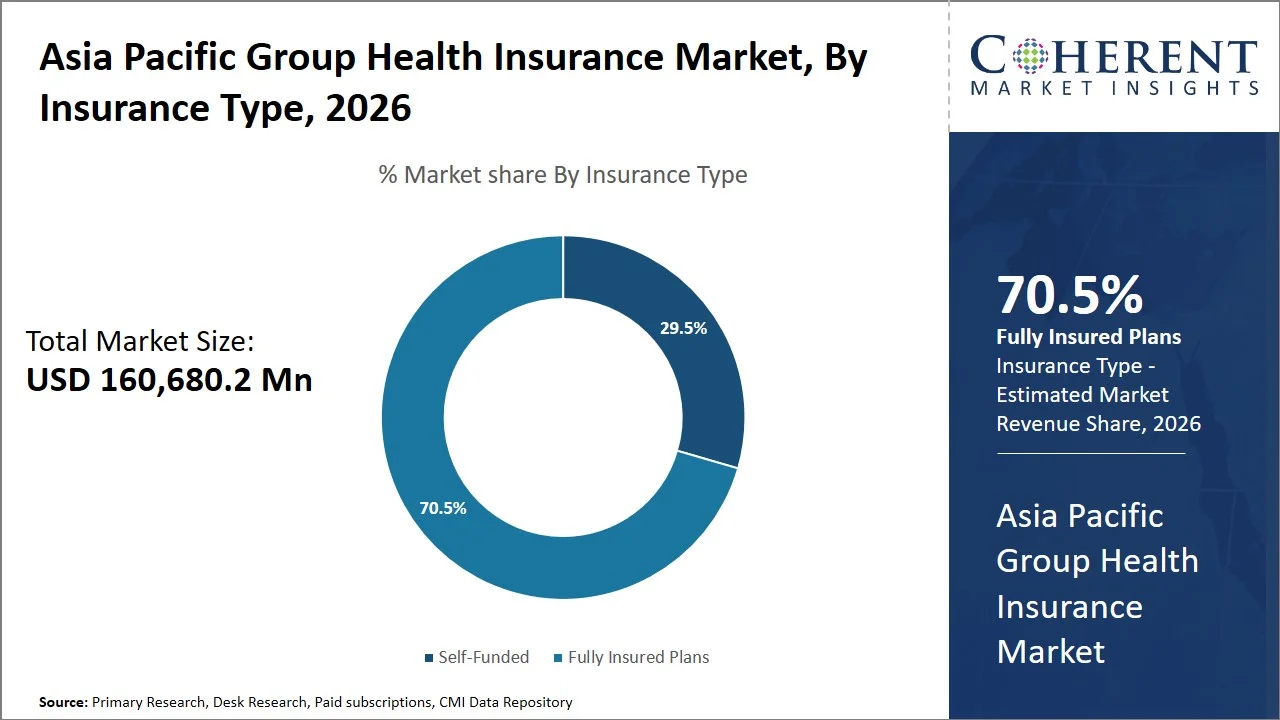
- Fully insured plans are projected to hold a market share of 70.5 % in the Asia Pacific group health insurance market in 2026, making it the dominant insurance type segment, due to their predictable premium structure, comprehensive risk coverage, and reduced administrative burden for employers. The segment continues to benefit from government initiatives promoting preventive healthcare and broader insurance participation. For instance, Singapore's Ministry of Health continues to advance its Healthier SG strategy, which emphasizes preventive care, regular health screenings, and stronger primary healthcare engagement among residents. (Source: The Lancet) Such initiatives are expected to encourage employers and insurers to adopt comprehensive fully insured health plans that support long-term healthcare management.
- Employer-employee groups are projected to hold 87.7 % of the Asia Pacific group health insurance market share in 2026, making it the dominant group segment, due to growing formal workforce and increasing employer investment in employee healthcare benefits. The segment continues to benefit from the expansion of employer-linked social health protection programs and rising health insurance participation across the region. For instance, according to China's National Healthcare Security Administration (NHSA), more than 1.33 billion people were covered by the country's basic medical insurance system as of the end of 2025, with the coverage rate remaining around 95%. (Source: The People’s Republic of China) The extensive reach of employer-linked and social health insurance programs is expected to continue supporting the growth of group health insurance across Asia Pacific.
- Family coverage is projected to hold 62.4 % of the Asia Pacific group health insurance market share in 2026, making it the dominant coverage option segment, due to the increasing demand for dependent healthcare protection and comprehensive employee welfare benefits. Employers are increasingly extending health coverage to spouses and children to improve workforce retention and financial security. For instance, Australia's Department of Health and Aged Care continues to support private health insurance reforms and initiatives aimed at improving the affordability and accessibility of family health coverage. (Source: Department of Health, Disability, and Ageing) Such policy support is encouraging broader adoption of family-inclusive health insurance plans across Asia Pacific.
- Expansion of SME-Focused Group Health Insurance Programs: In Asia Pacific, Small and medium-sized enterprises (SMEs) are increasingly offering group health insurance to attract and retain talent in a competitive labor market. Insurers are responding with affordable, modular plans for smaller workforces opening a huge growth avenue beyond large corporate accounts. Increased government support for SME formalization is likely to boost the uptake of employer-sponsored health coverage.
- Growing Integration of Digital Health and Wellness Benefits: The growing demand for group health insurance plans with telemedicine, preventive care, wellness programs and digital health management tools among employers is forcing insurers to look beyond traditional hospitalization cover and provide value-added services to improve employee health outcomes. This will likely improve policy retention rates and open opportunities for premium product offerings across the region.
Segmental Insights
Why Do Fully Insured Plans Dominate the Asia Pacific Group Health Insurance Market?
Fully insured plans are projected to hold a market share of 70.5% in 2026, as these products enable employers to transfer the risks of claims and administration functions to an insurance company and then pay a predetermined rate. This plan type appeals the most to small and medium-sized businesses (SMEs) because they may not have the budget and actuarial competencies that are necessary to implement and operate a self-funded health insurance scheme. Full coverage ensures predictable healthcare spending, aids regulatory compliance, and grants access to a broad network of healthcare professionals across most Asia Pacific markets. For instance, in January 2026, the Karnataka Government approved a group health insurance scheme for workers implementing the Mahatma Gandhi National Rural Employment Guarantee Act (MGNREGA) under the Family Floater model, offering coverage to workers and their families through an insurer-managed setup. (Source: SouthFirst )
- Current Industry Events of 2026
- Market Size Estimation
- Regional Breakdown
- Competitive Landscape
- Customer Intelligence
- Segmental Analysis
- Pricing Analysis
- Key Market Drivers, Challenges & Future Trends
- Customized Insights Section
Why are Employer-Employee Groups the Most Preferred Group in the Asia Pacific Group Health Insurance Market?
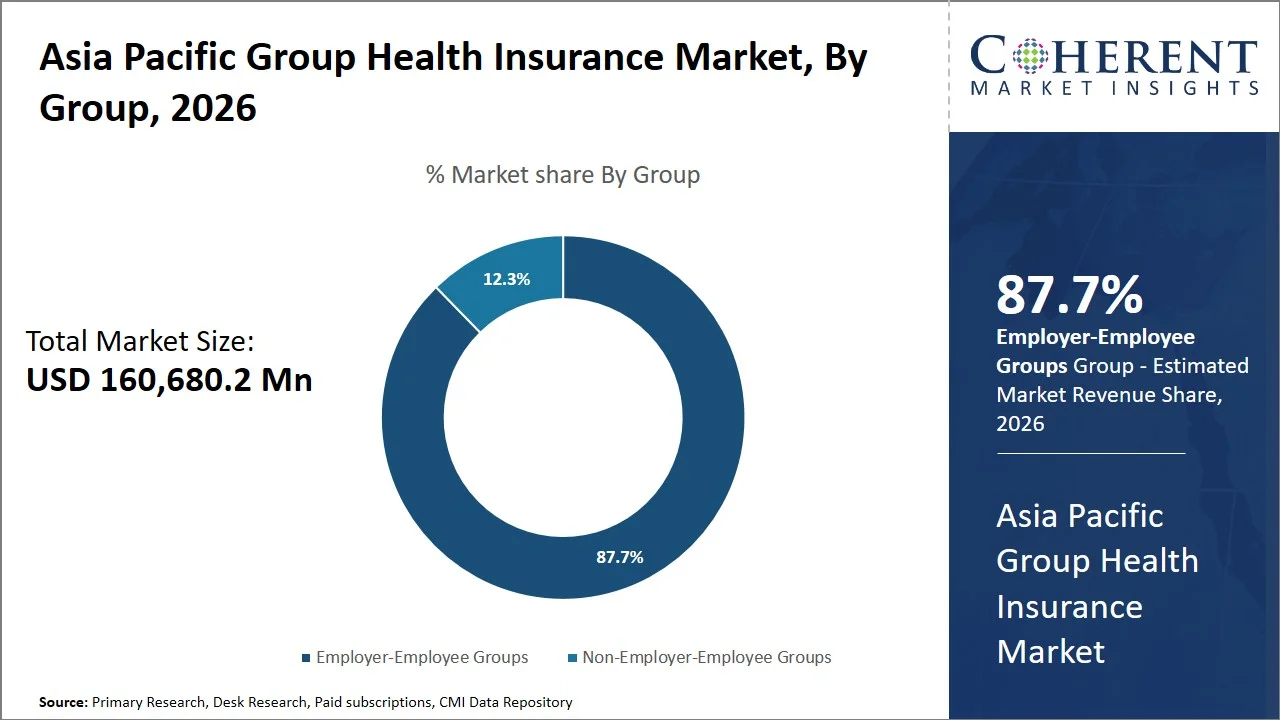
Employer-employee groups are projected to hold 87.7% of the market share in 2026, propelled by the growth of the formal labor force and by the heightened emphasis that employers place on the well-being of their staff as well as competition to recruit talented workers. Increasingly, companies are including employer sponsored plans as compensation benefits to make their workers feel secure and appreciated and to boost their performance. Employee groups also allow pooling of risk at lower premium prices than individual plans. For instance, according to Singapore's Ministry of Manpower, total employment (resident and non-resident) grew by 44,500 in 2024. The growth was supported by strong economic performance and positive business sentiments. (Source: Ministry of Manpower) The persistent growth of the formal workforce and employer-sponsored benefits across these sectors is reinforcing the adoption of employer-employee group health insurance plans.
Family Coverage Segment Dominates the Asia Pacific Group Health Insurance Market
The family coverage segment is expected to hold 62.4% of the Asia Pacific group health insurance market share in 2026, as employers are increasingly appreciating the benefit to extend medical coverage to the dependents of employees. Insurance for spouses, children, and parents increase the appealing power of employee benefits and covers for increasing cost of healthcare. With the trend to cater to family wellness, and with employers placing more value on long-term employee retention and care, family-focused group health insurance continues to become a trend in the Asia Pacific region. For instance, under Hong Kong Civil Service Medical and Dental Benefits Scheme, a civil servant can extend his or her own healthcare benefits to his/her spouse and dependents by way of an employer group healthcare coverage. (Source: Civil Service Bureau)
Currents Events and their Impact
Current Events | Description and its Impact |
Indonesia's OJK Issues New Health Insurance Regulation (November 2025) |
|
Finance Ministry Reviews Expansion of National Health Claims Exchange (NHCX) Platform (April 2025) |
|
Asia Pacific Group Health Insurance Market Dynamics
Market Drivers
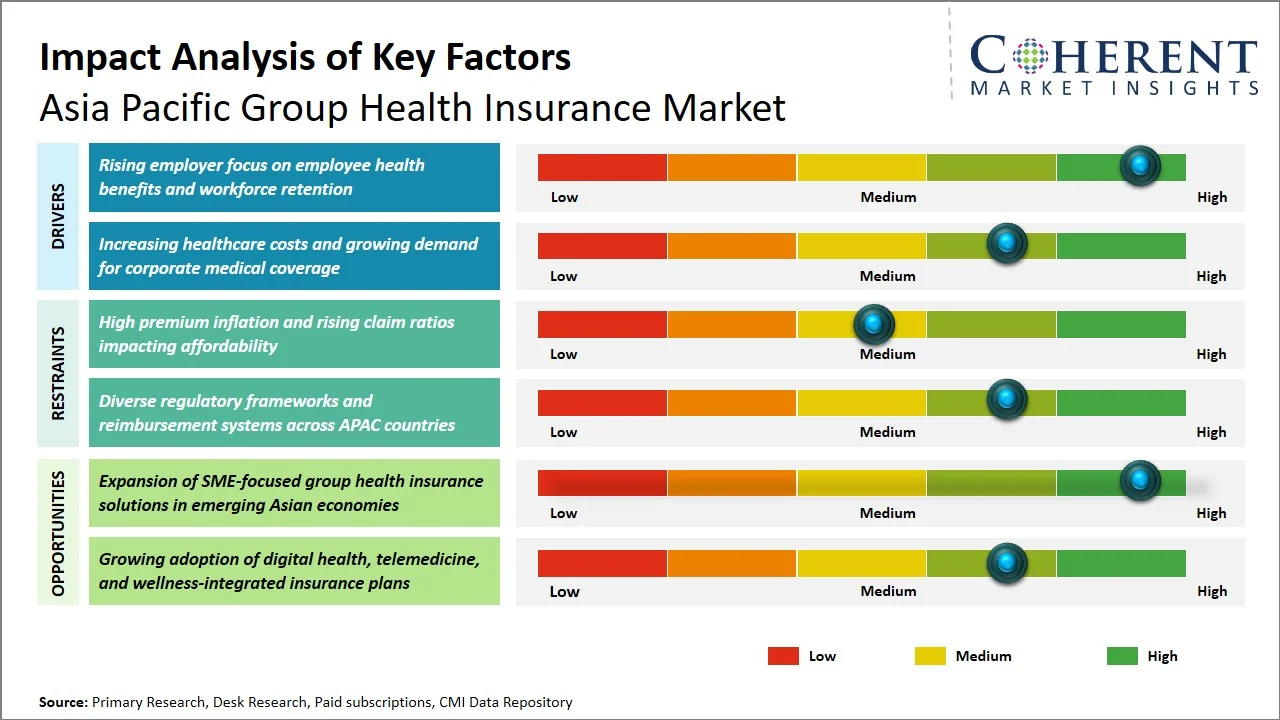
- Rising employer focus on employee health benefits and workforce retention: The growing demand for talented workforce in Asia Pacific makes employers to revise employee benefits and coverage, among which group health insurance plays a prominent role in attracting and retaining employees. More organizations extend their health and well-being benefits to improve employee satisfaction and efficiency, as well as decreasing staff turnover, so as to stimulate the need for group health insurance packages. For instance, according to the 2025 Asia Employee Benefits Report, 41% of employers across Asia identified health and well-being benefits as a key area for future investment, reflecting the growing emphasis on employee healthcare support and workforce retention. (Source: CIPD)
- Increasing healthcare costs and growing demand for corporate medical coverage: To safeguard the employees from the escalating costs and ease the financial pressure accompanying the healthcare cost rise, the employers are rolling out group health insurance. To boost employees' wellbeing and their output at work, corporations are investing more in complete corporate health packages including hospitalization, outpatient and preventive care. For instance, according to the Australian Institute of Health and Welfare (AIHW), in 2023–24, Australia spent an estimated USD 270.5 billion on health goods and services– an average of approximately USD 10,037 per person, accounting for 10.1% of the country's GDP. (Source: Australian Institute of Health and Welfare) The persistent rise in healthcare expenditure encourages employers to expand medical coverage benefits, thereby supporting growth in the health insurance market in the Asia Pacific region.
Emerging Trends
- Increasing Adoption of Flexible and Customizable Employee Benefit Packages: Insurers are responding with modular benefit structures, optional riders and tiered coverage plans that enable companies to offer differentiated healthcare benefits while optimizing costs. There is a growing demand for customized group health insurance plans that can be tailored to workforce demographics, healthcare needs and budget requirements among employers across the Asia Pacific region.
- Growing Use of Data Analytics for Risk Assessment and Cost Management: Insurers are employing predictive analytics and population health data to evaluate employee health risks, improve the accuracy of pricing and proactively manage costs in health claims management. With this, insurers can offer focused intervention programs, improve underwriting efficiency and affordable, sustainable group health insurance coverage to their corporate customers.
Regulatory Developments and their Impact on the Asia Pacific Group Health Insurance Market
Regulatory Area | Key Regulatory Focus | Countries/Markets | Impact on Group Health Insurance Market |
Employer-Sponsored Health Coverage | Expansion of mandatory or employer-linked health benefits | China, Japan, South Korea, India | Increases demand for employer-sponsored group health insurance plans |
Digital Insurance Regulations | E-policy issuance, digital claims processing, InsurTech adoption | Singapore, India, Australia | Improves operational efficiency and customer experience |
Data Privacy & Health Information Protection | Protection of employee health and insurance data | Singapore, Australia, Japan | Strengthens trust in digital health insurance ecosystems |
Preventive Healthcare & Wellness Policies | Promotion of wellness programs and preventive care | Singapore, Australia, Japan | Encourages insurers to integrate wellness benefits into group plans |
Consumer Protection & Claims Transparency | Standardization of disclosures, claims settlement, grievance redressal | India, Malaysia, Australia | Enhances policyholder confidence and market penetration |
How is the growing adoption of digital health, telemedicine, and wellness-integrated insurance plans creating new growth opportunities in the Asia Pacific group health insurance market?
This convergence between health insurance and digital health solutions is driving an enormous growth in the group health insurance market across Asia Pacific. Employers are more focused on benefits which includes teleconsultations, wellness monitoring, preventive care and managing chronic conditions as part of improving the health of their employees and productivity levels, thereby stimulating insurance companies to move beyond traditional reimbursement and toward offering integrated health ecosystem. For instance, in August 2024, Prudential signed an agreement with Google Cloud to leverage artificial intelligence and advanced analytics into its insurance operations in Asia. The objective of the deal is to strengthen customer engagement and personalize the insurance and health solutions and services and to enhance claims handling speed. The partnership is an indicator of the trend towards digitization within the insurance sector and will facilitate the development of integrated group health insurance in the Asia Pacific region. (Source: Prudential)
Market Players, Key Development, and Competitive Intelligence
Key Developments
- In April 2026, Deloitte launched its Asia Pacific Health Institute, accompanied by a report aimed at understanding how digital health technology can be employed to enhance access to health care in the Asia Pacific. The increase in use of telehealth, artificial intelligence-based medical services, and telemonitoring is being increasingly adopted to overcome the issue of health access, coupled with increased costs of health services. It is projected that this trend will contribute to insurers enabling better preventive health services and digital group health insurance products in Asia Pacific.
- In October 2025, Asia Insurance launched its fully digitalized health insurance platform through cooperation with CoverGo in Hong Kong and Macau, with the platform allowing digital policy administration, automated claims processing, and online customer servicing. The solution enables both the operational efficiency and customer experience to be enhanced. The project marks a great step forward in using insurtech solutions and the rise of digital health insurance ecologies throughout the Asia Pacific, which facilitate the renovation of group health insurance services.
Competitive Landscape
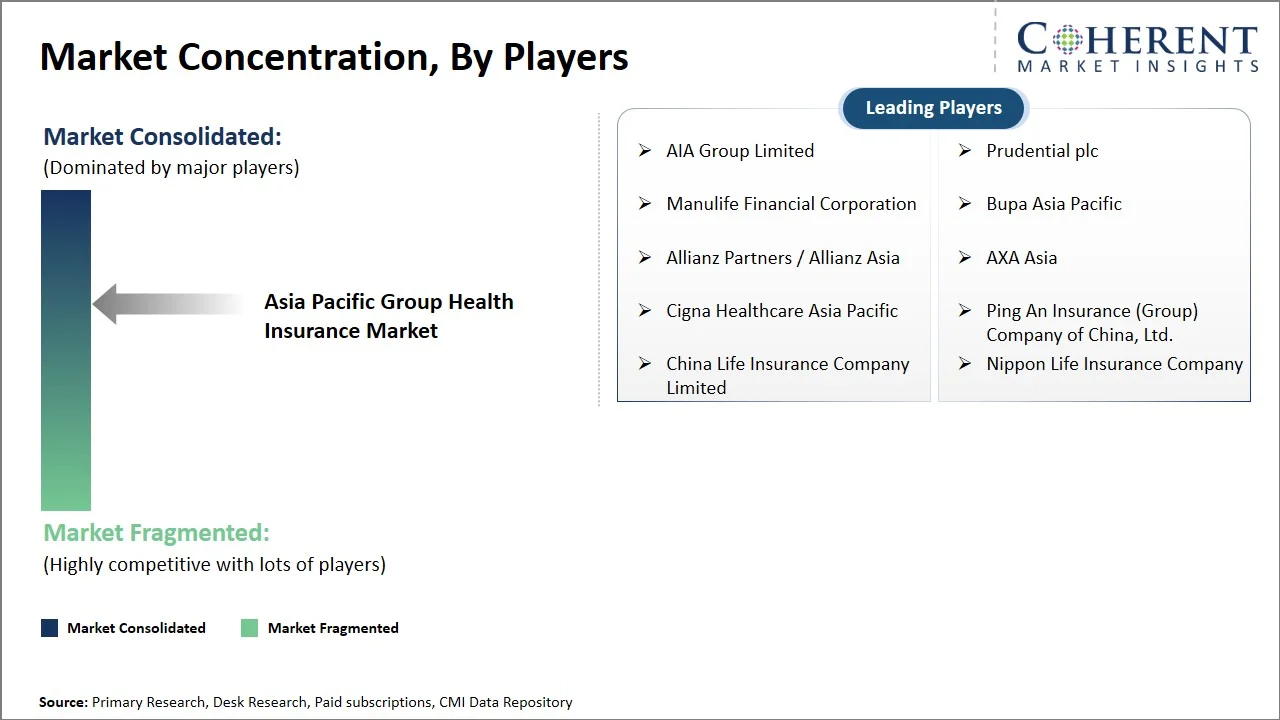
The Asia Pacific group health insurance market is highly competitive, dominated by multinational insurers, regional providers, and government sponsored health programs competing to increase coverages and enhance employer relationships. Insurance companies are turning their focus on digital transformation, value added health services and tailor-made corporate health plans to create a differentiation. Key focus areas include:
- Expansion of digital enrollment, claims processing, and telehealth-enabled insurance platforms
- Development of comprehensive employer-sponsored plans incorporating wellness, preventive care, and chronic disease management benefits
- Strengthening partnerships with healthcare providers, hospitals, and corporate employers to enhance network access and customer retention
Market Report Scope
Asia Pacific Group Health Insurance Market Report Coverage
| Report Coverage | Details | ||
|---|---|---|---|
| Base Year: | 2025 | Market Size in 2026: | USD 160,680.2 Mn |
| Historical Data for: | 2020 To 2024 | Forecast Period: | 2026 To 2033 |
| Forecast Period 2026 to 2033 CAGR: | 10.4% | 2033 Value Projection: | USD 320,793.1 Mn |
| Segments covered: |
| ||
| Companies covered: | AIA Group Limited, Prudential plc, Manulife Financial Corporation, Bupa Asia Pacific, Allianz Partners / Allianz Asia, AXA Asia, Cigna Healthcare Asia Pacific, Ping An Insurance (Group) Company of China, Ltd., China Life Insurance Company Limited, and Nippon Life Insurance Company | ||
| Growth Drivers: |
| ||
| Restraints & Challenges: |
| ||
Analyst Opinion (Expert Opinion)
- The future trends of Asia Pacific group health insurance market is expected to be driven by healthcare cost escalation, greater awareness on workforce wellness, and digital health service integration with health insurance services. Employers' efforts to gain and retain talented employees under tight labor market conditions will drive demand for comprehensive group health plans encompassing preventive care, telehealth and wellness benefits in the Asia Pacific region.
- The most promising opportunity are expected within fully insured employer-sponsored health insurance cover in India and Southeast Asian countries where formal employment is growing rapidly and insurance penetration is still low. Rise in support from the government to provide coverage for healthcare of the workforce and the increasing number of SMEs will present great opportunity for insurers targeting this segment.
- In order to gain an edge, market players must seek to create digitally empowered insurance ecosystems in addition to health insurance, and incorporate telemedicine services, wellness programs, preventive care and simple claims processing. Enhancing relationships with employers, healthcare organizations and digital health platforms, coupled with flexible and data-rich benefit plans, would prove essential for customer retention and market share growth.
Speak to the analyst
Want personalized insights?
Take the findings above to one of our principal consultants, or have the report rebuilt around the segments, geographies and competitors you actually track.
Market Segmentation
- Insurance Type Insights (Revenue, USD Mn, 2021 - 2033)
- Self-Funded
- Fully Insured Plans
- Group Insights (Revenue, USD Mn, 2021 - 2033)
- Employer-Employee Groups
- Non-Employer-Employee Groups
- Coverage Option Insights (Revenue, USD Mn, 2021 - 2033)
- Individual Coverage
- Family Coverage
- Payor Type Insights (Revenue, USD Mn, 2021 - 2033)
- Private Insurers
- Public/Government Insurers
- Distribution Channel Insights (Revenue, USD Mn, 2021 - 2033)
- Direct Sales
- Agents/Brokers
- Vendors/Third-party Platforms
- Bancassurance
- Others
- Key Players Insights
- AIA Group Limited
- Prudential plc
- Manulife Financial Corporation
- Bupa Asia Pacific
- Allianz Partners / Allianz Asia
- AXA Asia
- Cigna Healthcare Asia Pacific
- Ping An Insurance (Group) Company of China, Ltd.
- China Life Insurance Company Limited
- Nippon Life Insurance Company
Sources
Primary Research Interviews
- Group Health Insurance Product Managers (AIA, Prudential, Manulife, Allianz, AXA)
- Corporate Benefits & Employee Wellness Managers
- Health Insurance Underwriters and Actuarial Experts
- Insurance Brokers and Employee Benefits Consultants
- Human Resource (HR) & Compensation Heads of Large Enterprises
- Third-Party Administrators (TPAs) and Claims Management Specialists
Stakeholders
- Group Health Insurance Providers (e.g., AIA, Prudential, Manulife, Allianz, AXA)
- Corporate Employers and Business Associations
- Third-Party Administrators (TPAs)
- Insurance Brokers and Employee Benefits Consultants
- Government Health Insurance Agencies
- Digital Health and InsurTech Solution Providers
- End-use Sectors
- Large Enterprises and Multinational Corporations
- Small and Medium-sized Enterprises (SMEs)
- Government and Public Sector Organizations
- Educational Institutions
- Manufacturing and Industrial Enterprises
- Healthcare and Service Sector Employers
- Regulatory & Health Bodies
- Insurance Regulatory and Development Authority of India (IRDAI)
- Monetary Authority of Singapore (MAS)
- Australian Prudential Regulation Authority (APRA)
- National Healthcare Security Administration (NHSA), China
- Financial Services Agency (FSA), Japan
- Bank Negara Malaysia (BNM)
Databases
- IRDAI – Health insurance premium and claims statistics
- NHSA (China) – Medical insurance coverage and reimbursement data
- APRA (Australia) – Private health insurance statistics
- Ministry of Health, Singapore – Healthcare financing and insurance coverage data
- OECD Health Statistics – Healthcare expenditure and insurance coverage indicators
- World Bank Data – Healthcare spending and workforce statistics
Magazines
- Asia Insurance Review – Insurance industry developments and health insurance trends
- Insurance Asia News – Group health insurance and regulatory updates
- Asia Advisers Network – Employee benefits and insurance market developments
- Asia-Pacific Journal of Risk and Insurance – Insurance market and risk management trends
- The Insurer Asia – Health insurance and InsurTech developments
Journals
- Geneva Papers on Risk and Insurance
- Asia-Pacific Journal of Public Health
- International Journal of Health Planning and Management
- Health Policy and Planning
- Journal of Insurance Issues
Newspapers
- The Straits Times – Singapore healthcare and insurance policy developments
- South China Morning Post – China healthcare financing and insurance reforms
- The Japan Times – Health insurance regulations and demographic trends
- The Australian Financial Review – Private health insurance and healthcare policy developments
- The Hindu BusinessLine – Indian health insurance and employee benefits developments
Associations
- Asia Pacific Risk and Insurance Association (APRIA)
- Life Insurance Association Singapore (LIA Singapore)
- General Insurance Association of Japan (GIAJ)
- Insurance Council of Australia (ICA)
- Federation of ASEAN Insurance Associations (FAIA)
Public Domain Sources
- Insurance Regulatory and Development Authority of India (IRDAI)
- National Healthcare Security Administration (NHSA), China
- Australian Prudential Regulation Authority (APRA)
- Ministry of Health, Singapore
- OECD Health Statistics
- World Health Organization (WHO) Western Pacific Region
- World Bank Open Data
Proprietary Elements
- CMI Data Analytics Tool, Proprietary CMI Existing Repository of information for last 10 years.
Get access to 250+ pages report
Every segment, forecast, competitor profile and data table behind the analysis above — available for instant download.
- ESOMAR Member
- ISO 9001:2015 Certified
- D-U-N-S Registered
- GDPR & CCPA Compliant
Missing comfort of reading report in your local language? Find your preferred language:
Transform your Strategy with Exclusive Trending Reports
Frequently Asked Questions
The Asia Pacific group health insurance market is estimated to be valued at USD 160,680.2 Mn in 2026 and is expected to reach USD 320,793.1 Mn by 2033.
Fully insured plans dominate due to their predictable premium structure, comprehensive risk coverage, and reduced administrative burden for employers, making them the preferred option for organizations seeking outsourced healthcare benefit management.
Group health insurance is a health coverage policy purchased by an employer or organization to provide medical benefits to a group of employees or members under a single plan.
The CAGR of the Asia Pacific group health insurance market is projected to be 10.4% from 2026 to 2033.
Rising employer focus on employee health benefits and workforce retention, and increasing healthcare costs and growing demand for corporate medical coverage are the major factors driving the growth of the Asia Pacific group health insurance market.
High premium inflation and rising claim ratios impacting affordability, and diverse regulatory frameworks and reimbursement systems across APAC countries are the major factors hampering the growth of the Asia Pacific group health insurance market.
In terms of group, employer-employee groups are estimated to dominate the market revenue share in 2026.