

Global Group Health Insurance Market Size and Forecast – 2026 to 2033
The global group health insurance market is estimated to be valued at USD 3.41 Tn in 2026 and is expected to reach USD 6.52 Tn by 2033, exhibiting a compound annual growth rate (CAGR) of 9.7% from 2026 to 2033. This robust growth reflects increasing corporate focus on employee well-being, rising healthcare costs, and expanding insurance coverage in emerging markets, driving substantial demand for comprehensive group health insurance solutions worldwide.
Key Takeaways of the Global Group Health Insurance Market
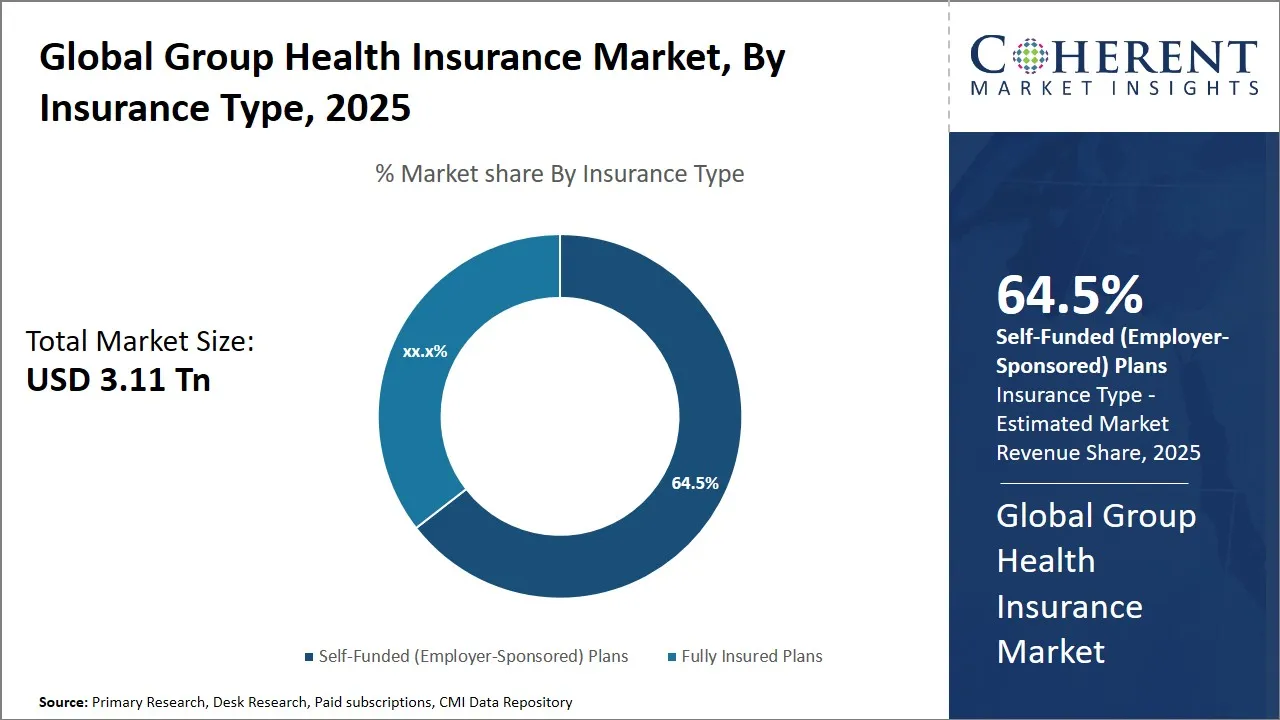
- In 2026, the self-funded (employer-sponsored) plans segment is expected to account for the largest share of the group health insurance market at 65.5%.
- By plan type, the Health Maintenance Organization (HMO) segment leads the market with an estimated share of 26.8% in 2026.
- By coverage type, the inpatient coverage segment is expected to dominate with 33.2% share in 2026.
- North America is expected to lead the market, holding a share of 39.9% in 2026. Asia Pacific is anticipated to be the fastest-growing region, with an estimated market share of 24.5% in 2026.
Market Overview
The market trend indicates a significant shift towards personalized and technology-driven insurance offerings, leveraging artificial intelligence and data analytics to enhance policy customization and claims management. Additionally, there is a growing emphasis on mental health coverage and wellness programs integrated into group insurance plans, aligning with broader organizational goals to improve workforce productivity and satisfaction. Digital platforms and telemedicine adoption are further accelerating the market evolution, making group health insurance more accessible and efficient.
Currents Events and their Impact
Current Events | Description and its Impact |
AI Integration in Claims and Risk Analytics |
|
Rising Chronic Disease Burden |
|
Segmental Insights
- Current Industry Events of 2026
- Market Size Estimation
- Regional Breakdown
- Competitive Landscape
- Customer Intelligence
- Segmental Analysis
- Pricing Analysis
- Key Market Drivers, Challenges & Future Trends
- Customized Insights Section
Group Health Insurance Market Insights, By Insurance Type - Self-Funded (Employer-Sponsored) Plans Drive the Growth through Cost Control and Flexibility
The self-funded (employer-sponsored) plans segment is expected to capture 65.5% in 2026, owing to their inherent advantages in cost control and plan flexibility. Employers are increasingly opting for self-funded plans because they offer significant benefits in managing healthcare expenses directly, rather than paying fixed premiums to traditional fully insured plans. This direct financial responsibility motivates companies to implement effective cost-containment strategies, including the use of wellness programs, targeted disease management, and negotiation of provider rates.
The flexibility of self-funded plans is a major driver of adoption. Employers can tailor plan designs to better suit the specific needs of their workforce, which is especially valuable in industries with diverse employee demographics or unique health requirements.
For instance, in January 2022, Stealth Partner Group, an Amwins company and a leading stop-loss general agency, introduced Stealth Captive Solutions to give employers more flexibility in managing self-funded healthcare plans. The new program allows employer groups from any industry to pool resources under a captive risk-sharing model, benefiting from economies of scale while keeping control over their medical, prescription, and wellness programs.
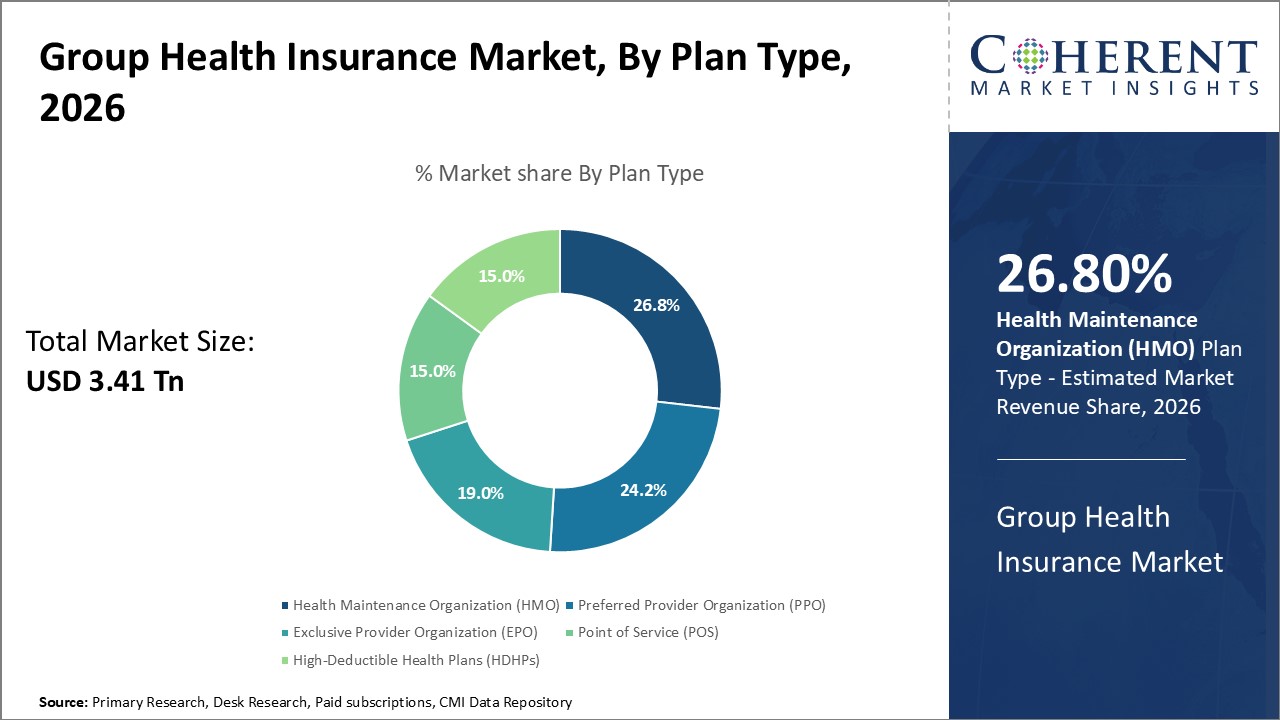
Group Health Insurance Market Insights, By Plan Type - Health Maintenance Organization (HMO) Segment is Lead to Cost Efficiency and Coordinated Care
The Health Maintenance Organization (HMO) segment is projected to hold 26.8% share in 2026, driven by their cost efficiency and emphasis on coordinated care. HMOs offer comprehensive healthcare coverage while maintaining lower premium costs for employers and employees, making them an attractive option within the group health insurance market. Their structured approach requires members to choose a Primary Care Physician (PCP) who manages and coordinates all healthcare services, leading to better oversight of patient care and reduced unnecessary medical interventions.
The coordinated care model inherent in HMOs supports prevention and early intervention strategies, which help in mitigating the progression of chronic diseases and avoiding costly hospitalizations. This focus on preventive care is increasingly critical as employers seek to manage long-term healthcare expenditures and improve workforce productivity.
For instance, in November 2022, Athina Healthcare, a new entrant in India’s healthcare sector, launched the country’s first Health Maintenance Organization (HMO) along with its debut health application, bringing a structured model that combines preventive care, digital tools, and managed services. The offering also integrates group health insurance to provide affordable and coordinated coverage for employees and families, aiming to enhance access to quality care while reducing overall medical costs.
Group Health Insurance Market Insights, By Coverage Type - Inpatient Coverage Dominates through High Demand for Hospital Care and Complex Treatments
The inpatient coverage segment is projected to account for 33.2% share in 2026, due to the critical nature and high cost of hospital-based care. Inpatient services cover a wide range of complex medical treatments, including surgeries, emergency care, intensive care, and maternity services, which are indispensable components of any comprehensive health insurance plan. The provision of inpatient coverage represents a fundamental protection for employees against catastrophic health expenses that can arise from extended hospital stays.
The rising prevalence of chronic conditions such as cardiovascular diseases, diabetes, and cancer drives the demand for inpatient care, thus amplifying the value of robust inpatient coverage within group health insurance schemes. Employers recognize that offering strong inpatient benefits helps reduce financial stress on employees and supports faster health recovery, ultimately contributing to workforce stability. In addition, the global surge in medical advancements has led to more sophisticated inpatient procedures that, while costly, are essential for effective treatment and better health outcomes.
Reimbursement Claims in Group Health Insurance
- A reimbursement claim in group health insurance allows employees to first pay their medical expenses out of pocket and then request repayment from the insurer. This option is especially useful when treatment is taken at a non-network hospital or when cashless facilities are not available. It provides flexibility in hospital choice, access to specialized care, and financial security during emergencies. To initiate the process, employees must promptly inform the insurer typically within 24–48 hours—while submitting essential documents such as hospital bills, prescriptions, discharge summaries, and a completed claim form. The insurer then reviews the details and, if approved, reimburses the expenses as per policy terms.
- For smooth claim settlement, employees should carefully follow timelines, submit complete and accurate documentation, and comply with policy guidelines to prevent delays or rejections. Best practices include coordinating between multiple insurers if covered under more than one policy, submitting pre- and post-hospitalization expenses within the stipulated time, and maintaining proper records. Once submitted, claims may sometimes undergo detailed verification, which can extend the settlement period up to four months. However, if an official investigation is required, insurers are obligated to conclude it within 45 days, and any delay beyond this may result in a 2% interest payout to the claimant.
Regional Insights
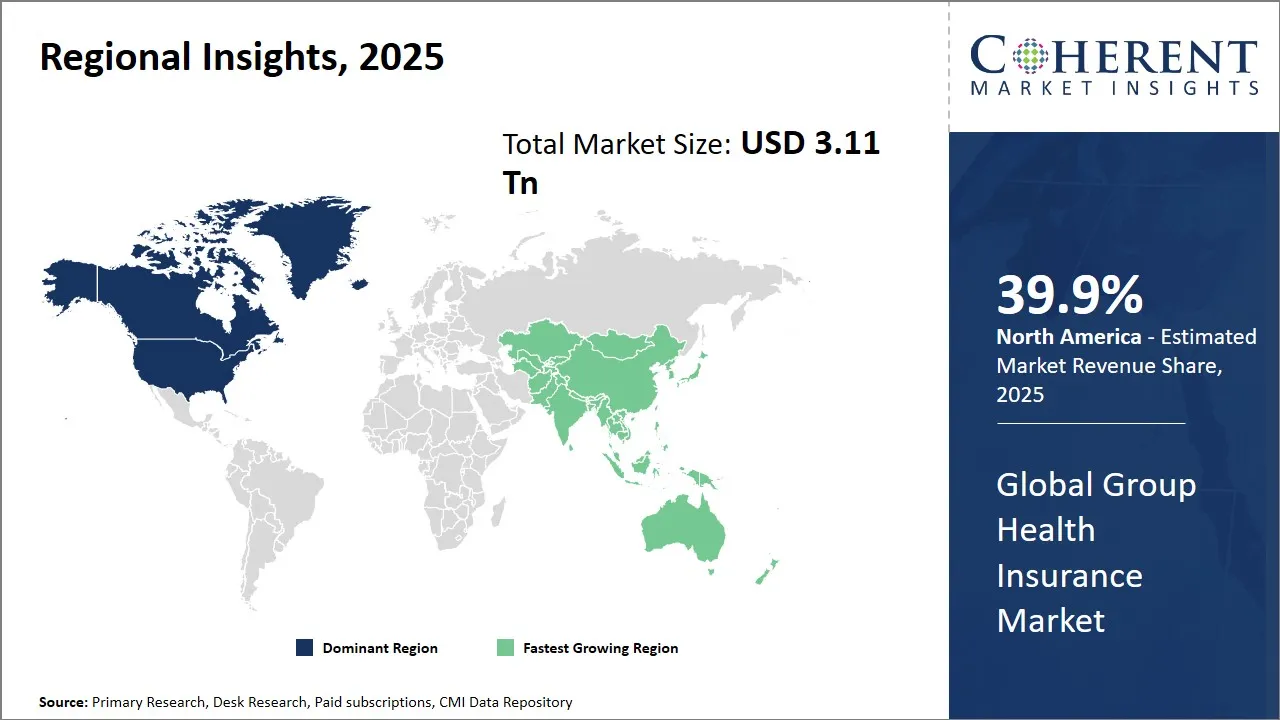
North America Group Health Insurance Market Analysis and Trends
North America region is projected to lead the market with a 39.9% in 2026 due to widespread employer-sponsored insurance programs and robust regulatory frameworks supporting employee benefits. The U.S., with its significant private healthcare sector and complex insurance regulations, strongly influences market dynamics. Employers emphasize comprehensive group health plans to attract and retain talent, supported by government policies such as the Affordable Care Act that encourage coverage expansion. The presence of major industry players like UnitedHealth Group, Anthem, Aetna, and Cigna further consolidates North America's leadership by offering diverse and innovative health insurance solutions tailored to large organizations and multinational corporations.
For instance, in January 2024, Sun Life U.S., a leading provider of employee benefits and insurance solutions, expanded its Health Navigator service to large employer group benefits clients, helping more workers access timely and accurate healthcare. The service, powered by PinnacleCare, a health navigation company acquired by Sun Life in 2021, provides personalized guidance to connect employees with the right doctors, treatments, and diagnoses while improving confidence in medical decisions.
Asia Pacific Group Health Insurance Market Analysis and Trends
The Asia Pacific region is expected to exhibit the fastest growth in the group health insurance market due to rising economic development with share of 24.5% in 2026, increasing employee awareness of health benefits, and expanding corporate sectors in emerging economies like India, China, and Southeast Asia. Governments in many Asia Pacific countries have introduced regulatory reforms to improve healthcare accessibility and promote employer-based insurance adoption.
The evolving market ecosystem features increased collaboration between local insurers and global insurance providers, enhancing product offerings and penetration. Notable companies such as AIA Group, Allianz, and Manulife have expanded aggressively into this region, leveraging digital channels and innovative insurance products tailored to local needs. Rapid urbanization, rising healthcare costs, and growing chronic disease awareness further stimulate demand for group health insurance across businesses of various sizes.
Group Health Insurance Market Outlook for Key Countries
U.S. Group Health Insurance Market Analysis and Trends
The U.S. group health insurance market is characterized by a heavily regulated yet competitive environment, with a strong emphasis on employer-sponsored health insurance plans. Major insurers like UnitedHealth Group, Anthem, and Aetna dominate by offering customizable group insurance schemes catering to diverse employee demographics. Government initiatives to increase healthcare coverage alongside rising healthcare costs influence market offerings and pricing strategies. The sophisticated healthcare ecosystem and advanced digital infrastructures support efficient claims management and customer engagement, sustaining market leadership.
For instance, in March 2026, Transcarent, a U.S.-based digital health platform, completed its USD 621 million merger with Accolade, a virtual healthcare and benefits navigation company. The combined entity will serve over 20 million members and more than 1,700 employer and health plan clients, offering a comprehensive health and care experience.
India Group Health Insurance Market Analysis and Trends
India group health insurance market is rapidly evolving amid increasing corporate sector growth and government encouragement for health coverage expansion. Companies such as ICICI Lombard, Max Bupa, and HDFC ERGO lead the market by designing affordable and flexible group policies suitable for small and medium enterprises. Initiatives promoting employee welfare and rising awareness of preventative healthcare are key drivers. Additionally, technology-enabled platforms and the rising adoption of telemedicine complement insurance offerings, fueling demand in urban and semi-urban areas.
For instance, in January 2026, the Karnataka, India government, approved a new group health insurance scheme for workers implementing the Mahatma Gandhi National Rural Employment Guarantee Act, aiming to strengthen social security for rural staff. The scheme, offered under the Family Floater model, will cover MGNREGA workers and their families, excluding those already under the Employee State Insurance programme, and will also extend to outsourced staff.
China Group Health Insurance Market Analysis and Trends
China group health insurance market is witnessing significant transformation driven by a growing middle class, increased corporate insurance adoption, and evolving healthcare infrastructure. Key players such as Ping An Insurance, China Life, and AIA are actively expanding group health insurance services, integrating data analytics and AI for improved risk assessment and customer service. Government reforms aimed at broadening healthcare access and encouraging employer-provided benefits create fertile conditions for market expansion. The combination of traditional insurance models with innovative tech-driven solutions positions China as a critical market in the Asia Pacific region.
For instance, in January 2026, Huize Holding Limited, a leading NASDAQ-listed insurance technology platform in Asia Pacific, launched “PrimeMed,” a customized mid-tier medical and group health insurance product in partnership with China Continent Property & Casualty Insurance Co., Ltd. (CCIC), a major Chinese insurer, and MSH CHINA Enterprise Services Co., Ltd. (MSH CHINA), a high-end health insurance service provider. The plan combines flexible deductibles, children’s coverage, and affordable premiums starting at RMB958 with broader benefits such as access to specialized and international hospital departments, out-of-hospital medications, and imported medical devices.
U.K. Group Health Insurance Market Analysis and Trends
The U.K. group health insurance market benefits from a strong private healthcare sector operating alongside the National Health Service (NHS). Companies like Bupa, Aviva, and AXA provide flexible group health insurance plans aimed at multinational corporations and SMEs seeking to supplement public healthcare services. The market dynamics are influenced by regulatory oversight promoting transparency and consumer protection. Additionally, wellness-oriented benefits and mental health coverage are increasingly integrated into group health policies, aligning with employer focus on employee wellbeing and productivity.
For instance, in March 2026, Prudential Plc, a U.K.-based FTSE100 financial services group with a long history in India through its life insurance and asset management businesses, partnered with Vama Sundari Investments, a promoter company of HCL Group, to launch a standalone health insurance venture in India.
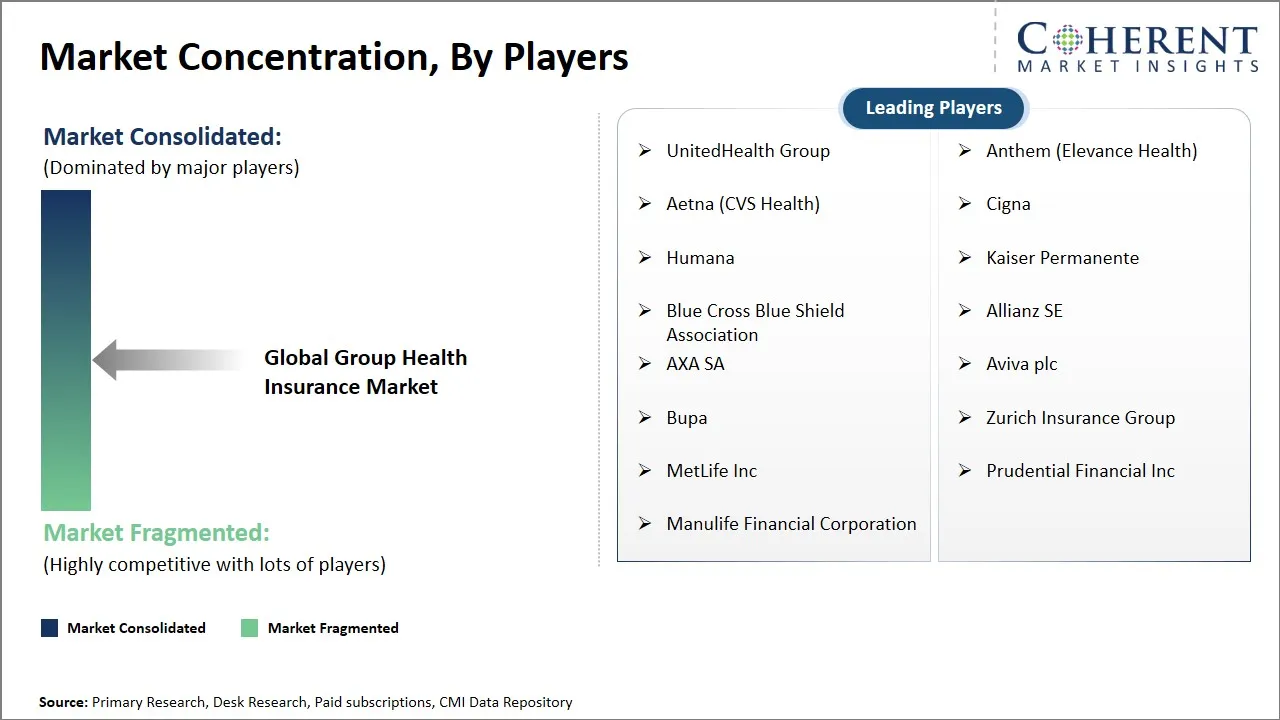
Market Players, Key Developments, and Competitive Intelligence
Key Developments
- On August 07, 2025, Allianz SE, a Germany-based global financial services and insurance leader, reported strong growth and record operating profit in the second quarter and first half of 2025. The company highlighted solid performance across all segments, particularly in its property-casualty business, along with higher shareholder income and earnings per share.
- On August 01, 2025, Policybazaar for Business, the corporate arm of India’s leading online insurance platform Policybazaar, launched ClaimSetu, the country’s first AI-powered claims insights and scoring engine for group health insurance. The solution is designed to simplify and speed up reimbursement claims by providing predictive insights on approval, reducing errors, and giving HR teams, insurers, and employees greater visibility, enabling claims to be processed up to 50 percent faster.
- In July 2025, Great American Insurance Group, a Cincinnati-based specialty property and casualty insurer, expanded its portfolio with the acquisition of Radion Health, a managing general underwriter focused on healthcare coverage for small and midsize businesses. Radion, which has been the exclusive MGU for Great American’s medical stop-loss product since 2022, will continue operating under its leadership team while bringing expertise in small group health, compliance, and product development.
- In June 2025, Cigna Healthcare, the health benefits division of the Cigna Group, launched new AI-powered digital tools designed to make health insurance interactions simpler and more reliable for customers. The features support everyday needs such as checking coverage, estimating costs, and finding care, using clear and conversational language to improve understanding.
Top Strategies Followed by Global Group Health Insurance Market Players
- Established players dominate the market through substantial investments in research and development (R&D), aiming to innovate high-performance insurance products tailored to the evolving needs of corporate clients. By focusing on R&D, these market leaders enhance product features such as wellness programs, digital health monitoring, and customizable coverage options, ensuring they remain ahead of rivals. Additionally, they form strategic partnerships with major industry players and Original Equipment Manufacturers (OEMs) to strengthen their market positions and leverage complementary capabilities.
- In April 2024, Pivot Health, a U.S. health insurance provider, partnered with Pan-American Life Insurance Group, a leading life and health insurer across the Americas, to launch SureCare STM. This proprietary short-term medical insurance product is designed to offer individuals flexible and comprehensive health coverage options.
- Mid-level players in the global group health insurance market adopt a different competitive approach centered around providing cost-effective solutions that strike a balance between quality and affordability. Their primary focus is on catering to price-sensitive consumers, including small and medium-sized enterprises, which seek comprehensive coverage without the premium costs associated with high-end offerings. These companies often emphasize streamlined administrative processes and digital platforms to keep operational costs low while maintaining satisfactory service levels.
- In January 2025, HDFC Ergo General Insurance, a leading private insurer in India, introduced Optima Lite, a cost-effective version of its widely used Optima Health Insurance plan. This new variant of the flagship my:Optima Secure product offers features such as coverage for organ donor expenses, home hospitalization, emergency ambulance services, and unlimited restoration of the base sum insured.
- Small-scale players in the group health insurance market carve out their niche by focusing on specialized features or highly innovative products that address specific client needs unmet by larger competitors. These insurers often lead the adoption of cutting-edge technologies such as blockchain for secure claims processing, telemedicine integrations, or personalized health plans driven by machine learning insights.
- In April 2025, TATA AIG General Insurance Company, a leading private insurer in India, launched MediCare Select, a new retail and group health insurance policy aimed at strengthening its overall health portfolio and expanding its presence in Tier 2 and Tier 3 markets. The company plans to grow its hospital network from 11,500 to over 14,000 facilities by FY27, targeting an increase in the retail health segment’s contribution to 35% of revenue.
Market Report Scope
Group Health Insurance Market Report Coverage
| Report Coverage | Details | ||
|---|---|---|---|
| Base Year: | 2025 | Market Size in 2026: | USD 3.41 Tn |
| Historical Data for: | 2020 To 2024 | Forecast Period: | 2026 To 2033 |
| Forecast Period 2026 to 2033 CAGR: | 9.7% | 2033 Value Projection: | USD 6.52 Tn |
| Geographies covered: |
| ||
| Segments covered: |
| ||
| Companies covered: | UnitedHealth Group, Anthem (Elevance Health), Aetna (CVS Health), Cigna, Humana, Kaiser Permanente, Blue Cross Blue Shield Association, Allianz SE, AXA SA, Aviva plc, Bupa, Zurich Insurance Group, MetLife Inc, Prudential Financial Inc, and Manulife Financial Corporation | ||
| Growth Drivers: |
| ||
| Restraints & Challenges: |
| ||
Group Health Insurance Market Dynamics
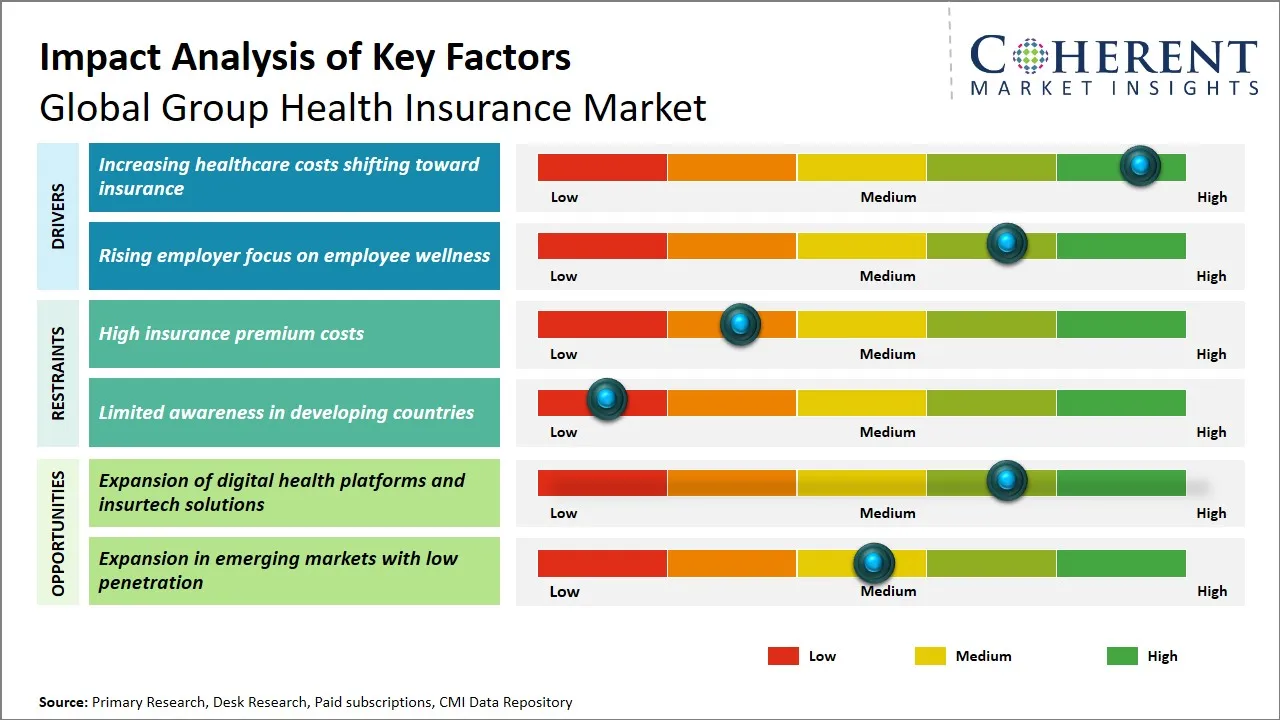
Group Health Insurance Market Driver - Increasing Healthcare Costs Shifting Toward Insurance
The continuous escalation in healthcare expenses has become a significant factor driving the adoption of group health insurance worldwide. With medical treatments, hospital stays, and prescription drug prices surging across many regions, individuals and employers alike face mounting financial burdens when addressing health-related needs out-of-pocket. This economic pressure prompts organizations to increasingly turn to group health insurance plans as a more predictable and manageable means to provide adequate medical coverage for their employees. By pooling risk across groups, these insurance schemes offer cost advantages and enhanced bargaining power with healthcare providers, mitigating the impact of rising medical costs on both employers and employees.
In July 2025, PwC, a global professional services firm, projects healthcare costs for U.S. businesses to rise 8.5% in 2026, matching the 2025 increase and putting added pressure on employers covering 125 million workers and families. Mercer, a leading benefits consulting firm, found more large employers plan to manage these rising costs by shifting expenses to employees through higher deductibles, out-of-pocket payments, and non-traditional plan options. The reports highlight mounting financial strain on hospitals as inflation, wage pressures, and stagnant public reimbursements force providers to seek higher commercial insurance rates, intensifying cost challenges for insurers and employers and ultimately increasing healthcare costs shifting toward insurance.
Group Health Insurance Market Opportunity - Expansion of Digital Health Platforms and Insurtech Solutions
The global group health insurance market stands to benefit significantly from the rapid expansion of digital health platforms and insurtech innovations. The integration of digital technologies into health insurance processes is transforming the way insurers design, distribute, and manage group health insurance policies. Digital health platforms enable real-time health monitoring, telemedicine services, and personalized wellness programs, which improve overall customer engagement and satisfaction. These technologies provide insurers with enhanced data analytics capabilities, allowing for more accurate risk assessment and tailored policy offerings. Additionally, insurtech solutions are streamlining underwriting, claims processing, and customer service through automation and artificial intelligence, reducing operational costs and increasing efficiency.
In June 2025, Appian, a Nasdaq-listed low-code and AI-driven automation platform provider, launched Connected Claims 2.0 to transform insurance claims management with AI-powered workflows. The new solution streamlines data-driven processes, enhances fraud detection, and boosts straight-through processing rates to cut manual work and improve customer satisfaction.
Analyst Opinion (Expert Opinion)
- The global group health insurance market is being shaped by a mix of strong demand drivers and evolving challenges. Rising awareness about employee wellness, regulatory mandates in emerging economies, and growing digital adoption in claims processing and underwriting are pushing insurers to innovate. Employers are increasingly using group health insurance as a key retention and productivity tool, especially as workforce demographics change and chronic diseases rise. At the same time, opportunities lie in technology-led customization, such as AI-enabled risk assessment and telemedicine integration, while insurers also face pressure from rising healthcare costs and compliance complexities across multiple jurisdictions. Over the past few years, forums such as the World Health Summit, Global Health Insurance Conference, and regional events like Asia Healthcare Insurance Congress have provided platforms where insurers, regulators, and health-tech firms exchange ideas on digital integration, cost control, and inclusive coverage. These gatherings have played a critical role in shaping policies and accelerating technology adoption in group health insurance.
- Real-world moves highlight the market’s momentum. For instance, TATA AIG recently expanded its retail and group health network in India to over 14,000 hospitals, strengthening its coverage in Tier 2 and Tier 3 regions. Governments too are pushing initiatives India’s Ayushman Bharat, Europe’s cross-border eHealth projects, and employer-driven wellness programs in the U.S., all reshaping the competitive landscape. Collaborative models, like insurer-hospital partnerships to standardize treatment packages, and pilot projects on digital claims through blockchain, signal a market preparing for both scale and efficiency. Together, these developments point to a future where group health insurance is no longer just an employee benefit, but a core pillar of inclusive, tech-driven healthcare access.
Speak to the analyst
Want personalized insights?
Take the findings above to one of our principal consultants, or have the report rebuilt around the segments, geographies and competitors you actually track.
Market Segmentation
- Insurance Type Insights (Revenue, USD Tn, 2021 - 2033)
- Self-Funded (Employer-Sponsored) Plans
- Fully Insured Plans
- Plan Type Insights (Revenue, USD Tn, 2021 - 2033)
- Health Maintenance Organization (HMO)
- Preferred Provider Organization (PPO)
- Exclusive Provider Organization (EPO)
- Point of Service (POS)
- High-Deductible Health Plans (HDHPs)
- Coverage Type Insights (Revenue, USD Tn, 2021 - 2033)
- Inpatient Coverage
- Outpatient Coverage
- Dental and Vision Coverage
- Maternity and Newborn Care Coverage
- Prescription Drug Coverage
- Other (Mental Health and Wellness Coverage)
- Coverage Option Insights (Revenue, USD Tn, 2021 - 2033)
- Individual Coverage (employee-only protection)
- Family Coverage (employee + dependents, such as spouse, children, parents)
- Policy Duration Insights (Revenue, USD Tn, 2021 - 2033)
- Lifetime Coverage
- Term Insurance
- Enterprise Size Insights (Revenue, USD Tn, 2021 - 2033)
- Small Enterprises
- Medium Enterprises
- Large Enterprises
- Product Type Insights (Revenue, USD Tn, 2021 - 2033)
- Contributory Plans (Premiums shared by employer and employee)
- Non-Contributory Plans (Fully paid by employer)
- Payor Insights (Revenue, USD Tn, 2021 - 2033)
- Private Insurers
- Public/Government Insurers
- Distribution Channel Insights (Revenue, USD Tn, 2021 - 2033)
- Direct Sales (Insurers to Employers)
- Agents/Brokers
- Bancassurance
- Others (Online Platforms)
- Regional Insights (Revenue, USD Tn, 2021 - 2033)
- North America
- U.S.
- Canada
- Latin America
- Brazil
- Argentina
- Mexico
- Rest of Latin America
- Europe
- Germany
- U.K.
- Spain
- France
- Italy
- Russia
- Rest of Europe
- Asia Pacific
- China
- India
- Japan
- Australia
- South Korea
- ASEAN
- Rest of Asia Pacific
- Middle East
- GCC Countries
- Israel
- Rest of Middle East
- Africa
- South Africa
- North Africa
- Central Africa
- North America
- Key Players Insights
- UnitedHealth Group
- Anthem (Elevance Health)
- Aetna (CVS Health)
- Cigna
- Humana
- Kaiser Permanente
- Blue Cross Blue Shield Association
- Allianz SE
- AXA SA
- Aviva plc
- Bupa
- Zurich Insurance Group
- MetLife Inc.
- Prudential Financial Inc.
- Manulife Financial Corporation
Sources
Primary Research Interviews
Industry Stakeholders list
- Chief Actuaries of Insurance Companies
- Underwriting Managers of Group Health Plans
- Claims Management Heads in TPAs
- HR Directors of Large Employers
- Health Insurance Brokers & Consultants
- Wellness Program Providers
End Users list
- Employees enrolled in Group Health Plans
- Union Representatives of Employee Groups
- Small Business Owners using Group Plans
- Corporate Benefit Managers
- Retirees under Employer-Sponsored Plans
- Members of Cooperative/Association Health Plans
Government and International Databases
- U.S. Department of Health & Human Services (HHS)
- Centers for Medicare & Medicaid Services (CMS)
- World Health Organization (WHO) Health Expenditure Database
- Organization for Economic Co-operation and Development (OECD) Health Data
- Insurance Regulatory and Development Authority of India (IRDAI)
- European Insurance and Occupational Pensions Authority (EIOPA)
Trade Publications
- Business Insurance
- Insurance Journal
- Health Affairs Blog (Policy Section)
- Employee Benefit News
- Modern Healthcare
- BenefitsPRO
Academic Journals
- Health Affairs
- The Lancet Public Health
- Journal of Health Economics
- American Journal of Public Health
- International Journal of Health Policy and Management
- Journal of Insurance Regulation
Reputable Newspapers
- The Wall Street Journal – Healthcare & Insurance Section
- The New York Times – Business/Health Section
- Financial Times – Insurance & Healthcare Reports
- The Guardian – Health Policy Coverage
- The Hindu BusinessLine – Insurance Section
- Nikkei Asia – Healthcare & Insurance News
Industry Associations
- America’s Health Insurance Plans (AHIP)
- National Association of Insurance Commissioners (NAIC)
- Health Insurance Association of America (HIAA)
- International Federation of Health Plans (iFHP)
- European Insurance and Reinsurance Federation (Insurance Europe)
- Confederation of Indian Industry (CII) – Healthcare & Insurance Council
Public Domain Resources
- U.S. Congressional Budget Office (CBO) Reports
- National Health Expenditure Accounts (NHEA)
- European Union Open Data Portal (Healthcare Section)
- World Bank Health Indicators
- UN Data – Health & Insurance Statistics
- National Sample Survey Office (NSSO) – India Health Expenditure Data
Proprietary Elements
- CMI Data Analytics Tool: Proprietary analytics tool to analyze real-time market trends, consumer behavior, and technology adoption in market
- Proprietary CMI Existing Repository of Information for Last 8 Years
Get access to 250+ pages report
Every segment, forecast, competitor profile and data table behind the analysis above — available for instant download.
- ESOMAR Member
- ISO 9001:2015 Certified
- D-U-N-S Registered
- GDPR & CCPA Compliant
Missing comfort of reading report in your local language? Find your preferred language:
Transform your Strategy with Exclusive Trending Reports
Frequently Asked Questions
The global group health insurance market is estimated to be valued at USD 3.41 Tn in 2026 and is expected to reach USD 6.52 Tn by 2033.
The CAGR of the global group health insurance market is projected to be 9.7% from 2026 to 2033.
Increasing healthcare costs shifting toward insurance and rising employer focus on employee wellness are the major factors driving the growth of the global group health insurance market.
High insurance premium costs and limited awareness in developing countries are the major factors hampering the growth of the global group health insurance market.
In terms of insurance type, the self-funded (employer-sponsored) plans segment is estimated to dominate the market revenue share in 2026.
UnitedHealth Group, Anthem (Elevance Health), Aetna (CVS Health), Cigna, Humana, Kaiser Permanente, Blue Cross Blue Shield Association, Allianz SE, AXA SA, Aviva plc, Bupa, Zurich Insurance Group, MetLife Inc, Prudential Financial Inc, and Manulife Financial Corporation are the major players.
North America is expected to lead the group health insurance market in 2026.