

Global Aspirating Smoke Detector Market Size and Forecast – 2026-2033
The Global Aspirating Smoke Detector Market is estimated to be valued at USD 976.5 Mn in 2026 and is expected to reach USD 1,507.6 Mn by 2033, exhibiting a compound annual growth rate (CAGR) of 6.4% from 2026 to 2033.
Key Takeaways of the Aspirating Smoke Detector Market
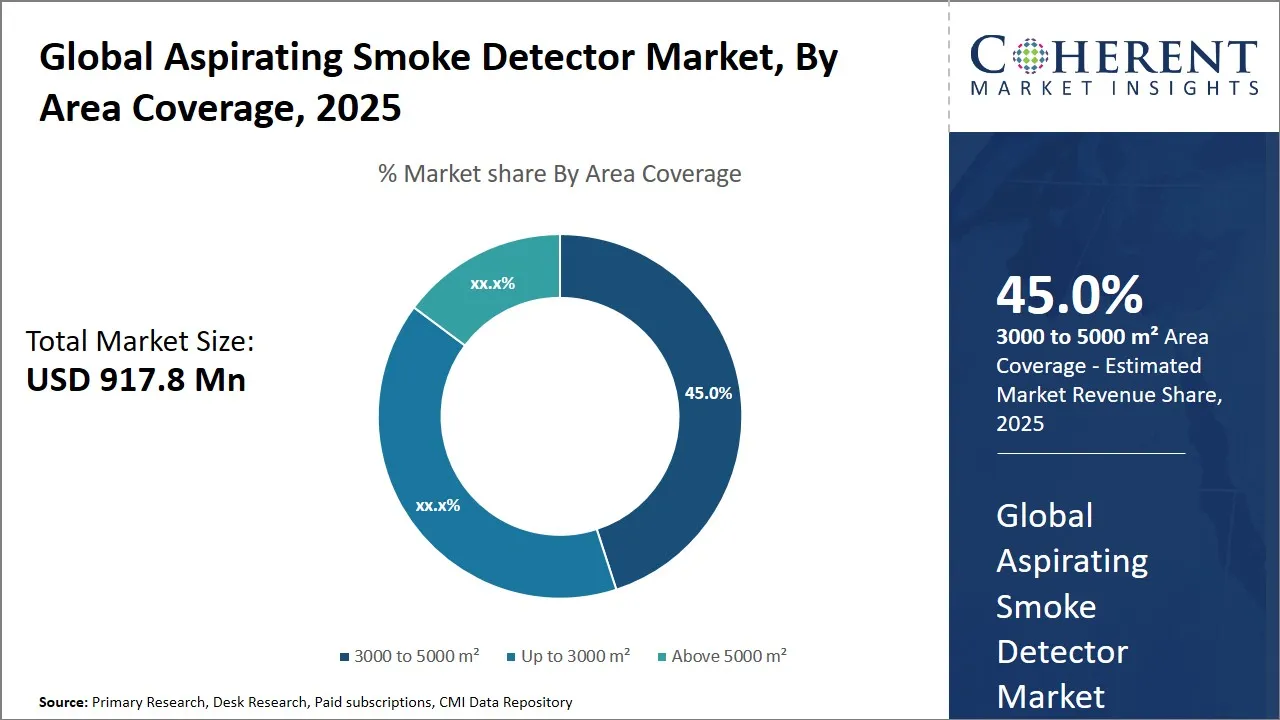
- The 3000 to 5000 m2 segment leads the market holding an estimated share of 46.0 % in 2026.
- The Single segment is projected to dominate with a share of 66.9 % in 2026.
- North America is estimated to lead the market with a share of 38.3 % in 2026.
- Asia Pacific, holding a share of 23.2 % in 2026, is projected to be the fastest growing region.
Market Overview
The market is seeing a shift toward the integration of aspirating smoke detectors with IoT and smart building management systems, enhancing real-time monitoring and rapid response capabilities. Also, there is a growing preference for highly sensitive and reliable detection solutions in commercial and industrial applications, especially in data centers and critical infrastructure. Innovations working on reducing false alarms and improving air sampling techniques are also shaping market dynamics, making aspirating smoke detectors a vital component in modern fire safety frameworks.
Current Events and Its Impact
Current Events | Description and Impact |
Geopolitical and Trade Developments |
|
Regulatory & Safety Mandates |
|
Technological Innovation & Smart Building Integration |
|
Economic and Infrastructure Trends |
|
Segmental Insights
- Current Industry Events of 2026
- Market Size Estimation
- Regional Breakdown
- Competitive Landscape
- Customer Intelligence
- Segmental Analysis
- Pricing Analysis
- Key Market Drivers, Challenges & Future Trends
- Customized Insights Section
Global Aspiring Smoke Detector Market Insights, by Area Coverage – 3000 to 5000 m² Leads Due to its Optimal Balance of Coverage and Efficiency
The 3000 to 5000 m² segment of the global aspirating smoke detector market is expected to command a significant share of 46.0% in 2026. This area coverage bracket represents an ideal balance for facilities that require comprehensive monitoring without the complexity or costs associated with larger coverage areas. Buildings such as medium-sized warehouses, data centers, manufacturing units, and educational institutions often fall within this range, thus driving the demand for aspirating smoke detectors tailored to these spatial requirements. In 2024, Patol Ltd., a U.K.-based fire detection specialist, deployed its ASD 532 systems—designed specifically for medium-sized spaces—in the University of Reading’s life sciences research facility, covering approximately 4500 m².
Aspirating smoke detectors designed for the 3000 to 5000 m² range offer highly sensitive detection capabilities while maintaining manageable installation and operational complexity. The ability to cover a moderate area allows these detectors to efficiently draw in air samples from multiple points through a network of pipes and chambers, increasing the probability of early smoke detection.
Furthermore, this segment benefits from regulatory trends and safety standards mandating sophisticated fire detection systems in mid-sized commercial environments. Compliance requirements incentivize organizations to adopt aspirating smoke detectors that can efficiently monitor large but not overly expansive spaces. Cost-effectiveness is another pivotal driver for this segment’s dominance. Compared to detectors covering areas exceeding 5000 m², those within the 3000 to 5000 m² bracket typically offer reduced installation and maintenance costs due to optimized piping layouts and fewer hardware components.
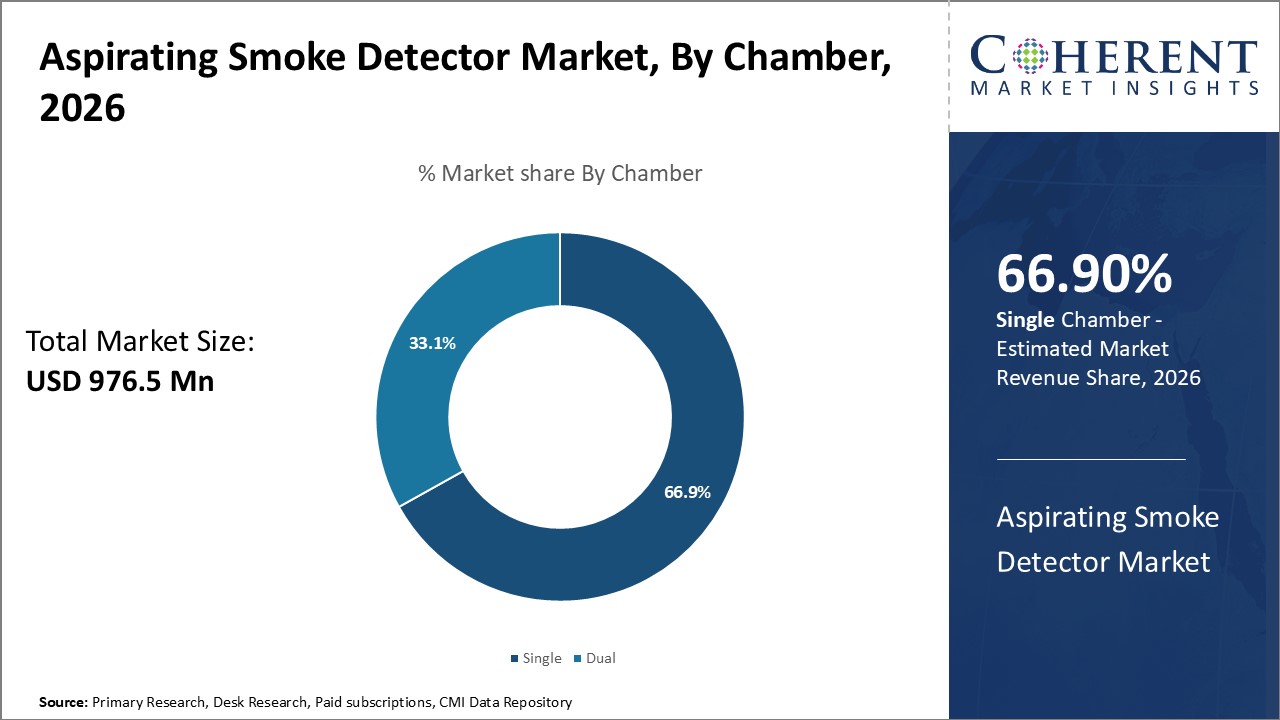
Global Aspiring Smoke Detector Market Insights, by Chamber – Single Chamber Segment Leads Due to Simplicity, Reliability, and Cost-Efficiency
The Single Chamber aspirating smoke detector segment is projected to hold the highest market share of 66.9% in 2026. Single chamber systems incorporate one detection chamber where air samples are analyzed, making the system less complex and more user-friendly compared to dual chamber counterparts. Facilities such as offices, retail spaces, and smaller industrial sites prefer single chamber detectors because they satisfy critical performance benchmarks while avoiding the intricacies associated with dual chamber setups. In early 2026, Zeta Alarm Systems completed a wide deployment of its Aspiration Plus single-chamber ASD devices across a network of small and mid-sized warehouses for a UAE-based logistics company.
Moreover, the installation and maintenance of single chamber aspirating smoke detectors require comparatively less effort and cost. The reduced hardware and fewer components streamline the setup process, enabling quicker deployment and fewer disruptions during maintenance. Cost-efficiency further bolsters the demand for single chamber detectors. These systems are generally more affordable due to their less elaborate construction.
Technological advancements have also enhanced the capabilities of single chamber aspirating smoke detectors. Improvements in sensor sensitivity and signal processing allow these systems to detect a wide range of fire signatures with high precision, closing the gap previously seen between single and multi-chamber setups in terms of detection accuracy. In addition, the compact and modular nature of single chamber systems allows integration with various building management and fire safety infrastructures, further increasing their market penetration.
Impact of AI on the Aspirating Smoke Detector Market
Artificial Intelligence (AI) is transforming the aspirating smoke detector market by enhancing detection accuracy, reducing false alarms, and enabling predictive maintenance. Traditional ASD systems are now being integrated with AI algorithms that analyze smoke particle patterns, airflow data, and environmental conditions in real time. This allows the systems to differentiate between actual fire threats and benign particulates like dust or steam, thereby minimizing nuisance alarms—especially in sensitive environments like data centers, clean rooms, and healthcare facilities. Moreover, AI-powered systems can learn from historical data and improve their response over time, providing building managers with more actionable insights and faster reaction capabilities.
Honeywell’s VESDA-E series incorporates advanced analytics and AI-assisted detection. These detectors use multiple sensors combined with machine learning to assess threats in high-risk environments such as hyperscale data centers. Honeywell’s systems can even integrate with fire suppression and building automation systems, enabling a coordinated, intelligent emergency response.
Regional Insights
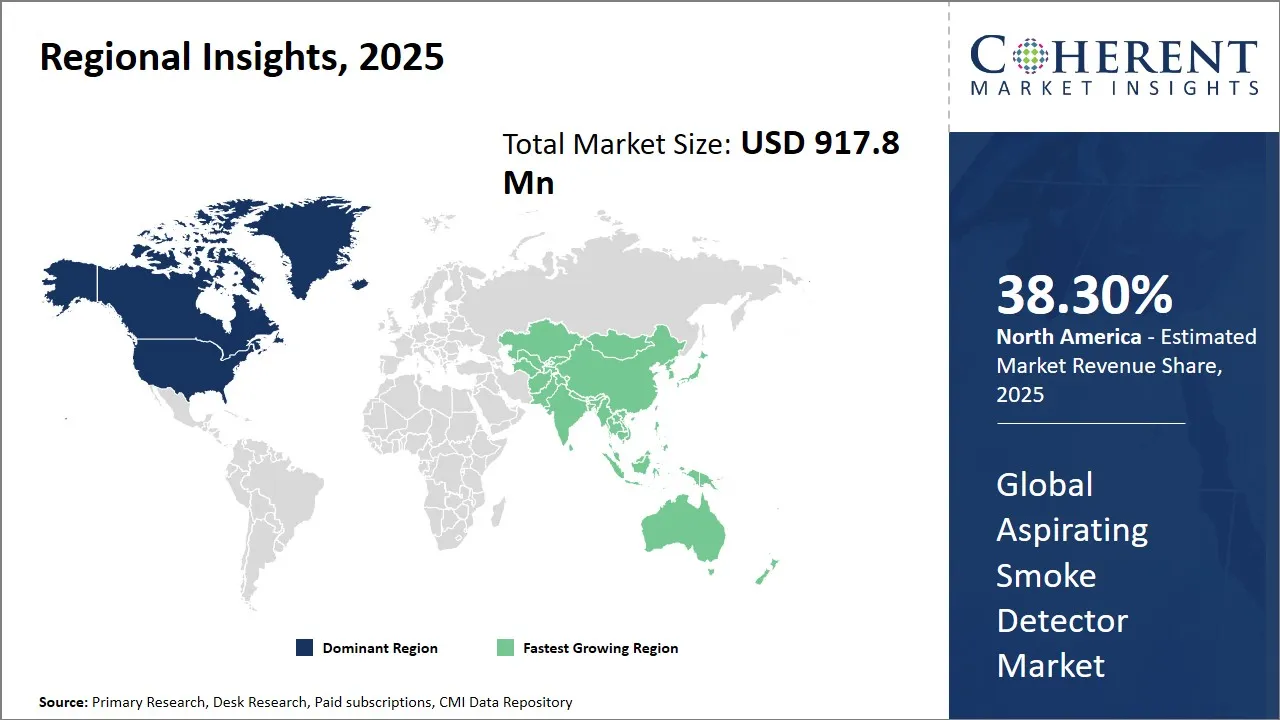
North America Aspirating Smoke Detector Market Analysis and Trends
North America, holding an estimated share of 38.3% in 2026, dominates the global aspirating smoke detector market. This can be attributed to several factors, including a mature market ecosystem, stringent fire safety regulations, and higher adoption rates in commercial and industrial sectors. The region benefits from well-established infrastructure and a strong presence of leading manufacturers like Honeywell International Inc. and Johnson Controls. These companies continuously innovate with advanced ASD systems, integrating IoT and smart building technology.
Additionally, U.S. and Canadian government policies emphasize rigorous fire safety standards, driving demand for early-warning smoke detection systems, particularly in data centers, healthcare, and critical infrastructure. The robust trade environment and supply chain networks also facilitate market stability and access to cutting-edge components.
Asia Pacific Aspirating Smoke Detector Market Analysis and Trends
The Asia Pacific region, holding a share of 23.2% in 2026, exhibits the fastest growth in the aspirating smoke detector market. This accelerated expansion is fueled by rapid industrialization, urbanization, and increasing government initiatives focusing on fire safety and smart infrastructure development across emerging economies such as China, India, and Southeast Asian nations.
Significant investments in new construction, including commercial complexes, transportation hubs, and high-tech industrial facilities, contribute to higher ASD adoption. Regional players like Siemens AG (with strong operations in Asia), and local manufacturers such as Notifier by Honeywell in China and Panasonic in Japan, are instrumental in expanding market penetration.
Global Aspirating Smoke Detector Market Outlook for Key Countries
U.S. Aspirating Smoke Detector Market Analysis and Trends
The U.S. is characterized by the widespread adoption of technologically advanced aspirating smoke detection systems, driven by stringent national fire safety standards and extensive infrastructure in commercial and industrial applications. Key market players include Honeywell International Inc., Siemens Industry, and Johnson Controls, who lead innovations in ASD technology, integrating analytics, and improved sensitivity features.
Germany Aspirating Smoke Detector Market Analysis and Trends
Germany thrives on its strong industrial base and rigorous enforcement of safety regulations. Companies such as Bosch Security Systems and Siemens play critical roles in shaping the market by offering customized, high-quality ASD solutions tailored for industrial environments, data centers, and transportation sectors. The country’s emphasis on engineering excellence and standards compliance fosters an ecosystem that propels the demand for reliable and scalable aspirating smoke detection technologies.
China Aspirating Smoke Detector Market Analysis and Trends
China's emerging economy and rapid urban development have bolstered the need for advanced fire detection systems, with the government pushing for enhanced safety protocols in commercial and industrial buildings. Local subsidiaries of global players such as Honeywell and Siemens collaborate with indigenous manufacturers to expand distribution and service networks. The increasing installation of smart city projects and data centers elevate the demand for ASDs, while government policies supporting infrastructure safety further stimulate growth.
India Aspirating Smoke Detector Market Analysis and Trends
India is witnessing notable growth due to rapid urbanization, infrastructure projects, and increasing awareness regarding fire safety in both public and private sectors. Government initiatives and evolving fire safety codes encourage the integration of sophisticated detection systems. Players like Honeywell, Siemens, and local firms such as Safex Fire and the Kirloskar Group contribute to market expansion by offering cost-effective and adaptable ASD solutions suitable for diverse applications ranging from IT parks to manufacturing units.
U.K. Aspirating Smoke Detector Market Analysis and Trends
The U.K. maintains a significant presence in the aspirating smoke detector market due to strict fire safety legislation and demand from commercial real estate, healthcare, and transportation sectors. Companies including Advanced Electronics Ltd. and Carrier Global Corporation support the market by delivering innovative ASD systems focused on reliability and system integration. The U.K.'s trade openness and regulatory environment sustain the adoption of cutting-edge technologies, encouraging continual reinvestment in fire detection infrastructure.
Market Players, Key Development, and Competitive Intelligence
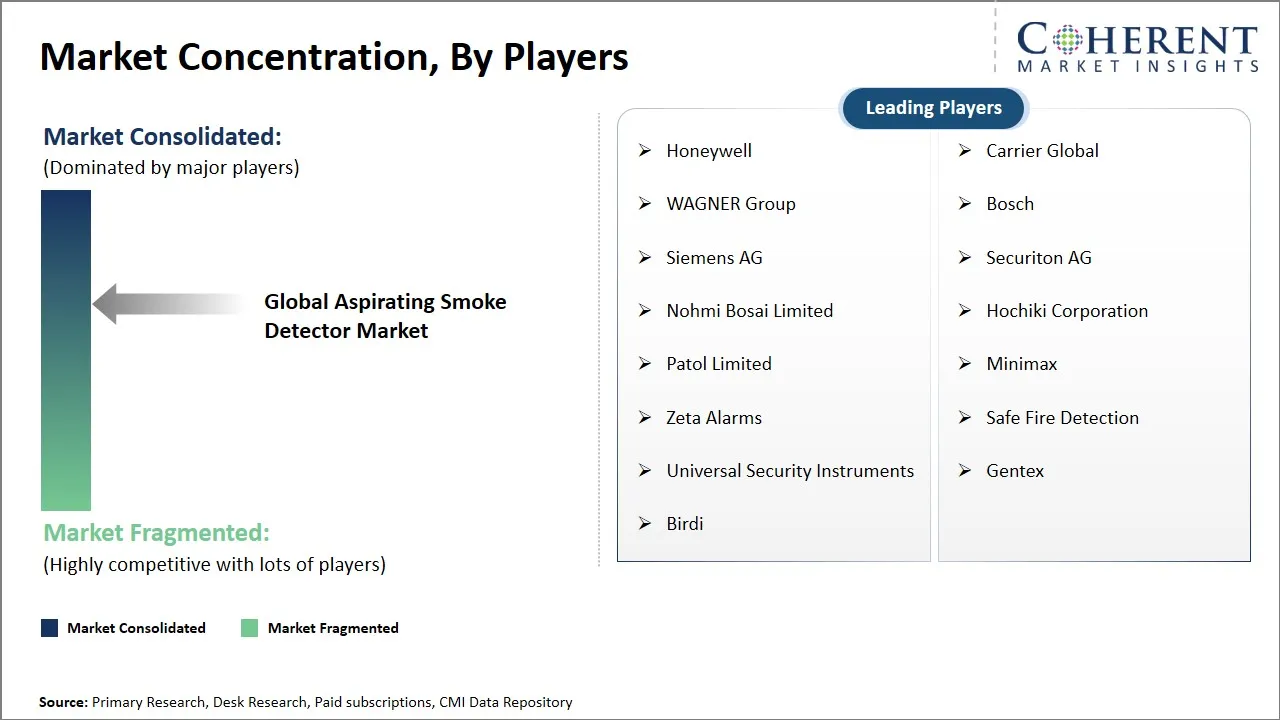
Key Developments
- In March 2024, Hochiki Europe, a global leader in life safety solutions, launched its latest generation of UL listed smoke detectors. These detectors are designed to meet the stringent requirements of the UL268 7th Edition standards, addressing a vital need for conventional applications requiring UL approval.
- In January 2023, Siemens introduced two new aspirating smoke detectors (ASD), FDA261 and FDA262, catering to particularly challenging fire safety installations that extend over wide areas, such as large data centers, e-commerce warehouses, or industrial manufacturing sites. A single device can cover up to 6,700 m2.
- In September 2022, Honeywell launched a first-of-its-kind solution that combines early warning smoke detection with advanced indoor air quality (IAQ) monitoring. Built on the flagship VESDA-E line of aspirating smoke detectors, the VESDA Air solution has a unique five-in-one IAQ sensor within a single box, which can help improve building safety by identifying life safety, asset protection, or IAQ issues before they escalate into problems.
- In September 2022, WAGNER showcased its holistic solutions for individual fire protection at Security 2022. Particular focus was on the TITANUS aspirating smoke detection systems for early fire detection and the WinGuard system for organization/hazard management.
Top Strategies Followed by Aspirating Smoke Detector Market Players
- Established industry leaders, often multinational corporations with substantial resources, prioritize heavy investments in research and development (R&D) to innovate high-performance, reliable, and technologically advanced aspirating smoke detectors.
- Honeywell continues to invest substantially in R&D and AI-powered ASD systems, such as the VESDA-E series with advanced analytics, laser-based smoke detection, and IoT integration.
- Mid-level players in the aspirating smoke detector market focus on balancing quality with cost efficiency to effectively address a growing segment of price-sensitive consumers and small to medium enterprises.
- Zeta Alarms has focused on offering affordable aspirating smoke detection systems for use in warehouses, mid-size office buildings, and retail facilities—particularly in emerging markets across Southeast Asia and the Middle East.
- Small-scale players in the aspirating smoke detector arena tend to carve out specialized niches by focusing on unique or innovative product features that distinguish them from larger competitors.
- Patol specializes in linear heat detection and niche aspirating systems tailored for conveyor belts, tunnels, and underground facilities.
Market Report Scope
Aspirating Smoke Detector Market Report Coverage
| Report Coverage | Details | ||
|---|---|---|---|
| Base Year: | 2025 | Market Size in 2026: | USD 976.5 Mn |
| Historical Data for: | 2020 To 2024 | Forecast Period: | 2026 To 2033 |
| Forecast Period 2026 to 2033 CAGR: | 6.4% | 2033 Value Projection: | USD 1,507.6 Mn |
| Geographies covered: |
| ||
| Segments covered: |
| ||
| Companies covered: | Honeywell, Carrier Global, WAGNER Group, Bosch, Siemens AG, Securiton AG, Nohmi Bosai Limited, Hochiki Corporation, Patol Limited, Minimax, Zeta Alarms, Safe Fire Detection, Universal Security Instruments, Gentex, and Birdi | ||
| Growth Drivers: |
| ||
| Restraints & Challenges: |
| ||
Market Dynamics
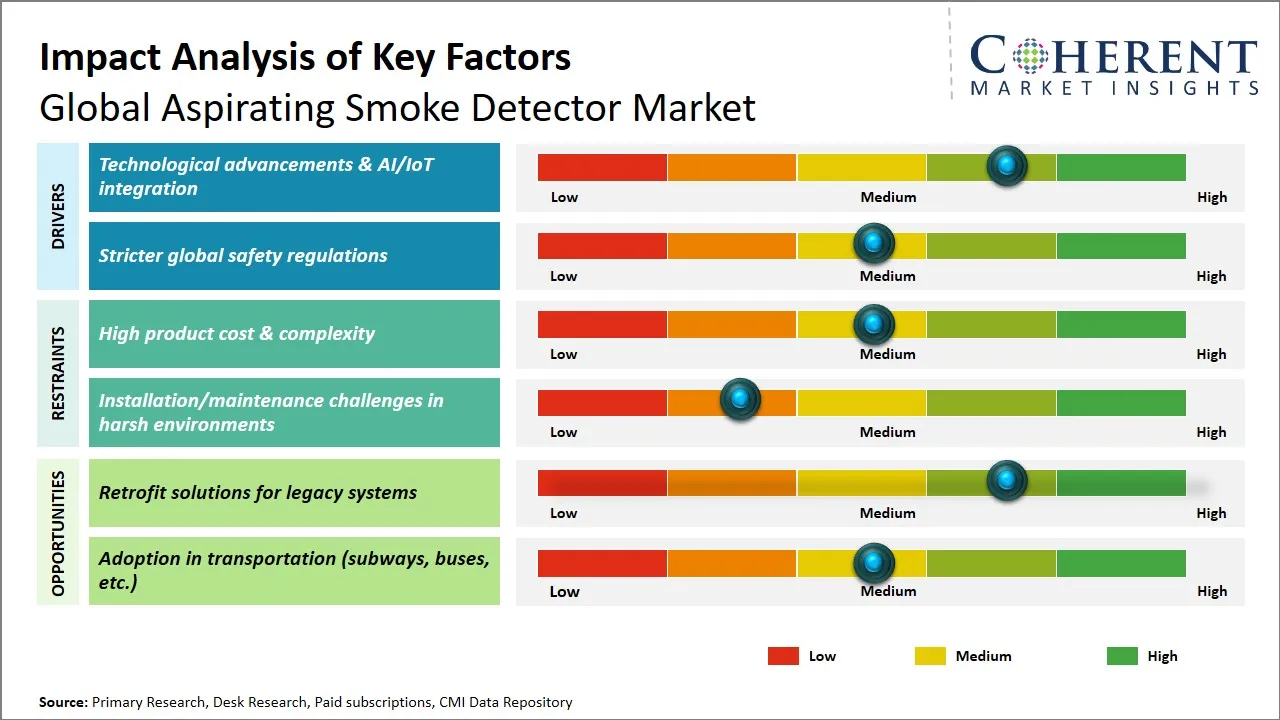
Global Aspirating Smoke Detector Market Driver - Technological Advancements & AI/IoT Integration
The integration of advanced technologies such as artificial intelligence (AI) and the Internet of Things (IoT) has significantly transformed the aspirating smoke detector market, enabling more accurate, real-time fire detection and prevention systems. These detectors now leverage AI to analyze vast streams of data collected from multiple air-sampling points, improving the precision of smoke and fire identification while minimizing false alarms.
Siemens has integrated its ASAtechnology (Advanced Signal Analysis) aspirating smoke detectors into the Desigo CC building management platform. This enables real-time monitoring and centralized control of fire safety across large facilities like airports and hospitals.
Moreover, advancements in sensor sensitivity, machine learning algorithms, and predictive analytics empower these devices to detect even the earliest signs of smoke and potential fire hazards across diverse environments, including large commercial buildings, data centers, and industrial facilities.
Global Aspirating Smoke Detector Market Opportunity – Retrofit Solutions for Legacy Systems
Existing buildings, particularly older constructions and facilities with outdated fire safety setups, lack advanced smoke detection capabilities compatible with modern safety regulations. Retrofit solutions offer a cost-effective alternative to complete system overhauls by enabling the integration of state-of-the-art aspirating smoke detection technology into these legacy environments. Increasing awareness among facility managers and regulatory bodies about the shortcomings of conventional smoke detectors in certain environments further fuels demand for retrofitting advanced ASDs. Additionally, evolving fire safety standards globally emphasize early warning systems that are more sensitive and reliable, encouraging upgrades in existing setups.
In late 2024, Equinix, a global leader in digital infrastructure, began retrofitting several of its older data center facilities in North America and Europe with Honeywell’s VESDA-E series aspirating smoke detectors. These sites, originally equipped with conventional point detectors, were upgraded due to increasing demands for ultra-early smoke detection that minimizes false alarms and ensures compliance with evolving data center fire codes (e.g., NFPA 75 & EN 54-20).
Analyst Opinion (Expert Opinion)
- The surge in hyperscale data centers and telecom infrastructure globally is creating strong demand for ultra-sensitive, low-latency detection systems like ASDs. These industries prioritize early detection and minimal false alarms to protect critical assets and ensure uninterrupted uptime.
- Hospitals, labs, and pharmaceutical manufacturing facilities are increasingly adopting ASDs for sterile and controlled environments. Their ability to detect low-level smoke without disrupting airflow or hygiene standards makes them indispensable in these regulated sectors.
- Warehouses, cold storage, and industrial plants are favoring aspirating systems due to their adaptability to large, high-ceiling structures and dusty conditions. Demand is particularly strong for multi-zone, scalable systems that can integrate with broader industrial safety networks.
Speak to the analyst
Want personalized insights?
Take the findings above to one of our principal consultants, or have the report rebuilt around the segments, geographies and competitors you actually track.
Market Segmentation
- Area Coverage Insights (Revenue, USD Mn, 2021 - 2033)
- 3000 to 5000 m²
- Up to 3000 m²
- Above 5000 m²
- Chamber Insights (Revenue, USD Mn, 2021 - 2033)
- Single
- Dual
- Regional Insights (Revenue, USD Mn, 2021 - 2033)
- North America
- U.S.
- Canada
- Latin America
- Brazil
- Argentina
- Mexico
- Rest of Latin America
- Europe
- Germany
- U.K.
- Spain
- France
- Italy
- Russia
- Rest of Europe
- Asia Pacific
- China
- India
- Japan
- Australia
- South Korea
- ASEAN
- Rest of Asia Pacific
- Middle East
- GCC Countries
- Israel
- Rest of Middle East
- Africa
- South Africa
- North Africa
- Central Africa
- North America
- Key Players Insights
- Honeywell
- Carrier Global
- WAGNER Group
- Bosch
- Siemens AG
- Securiton AG
- Nohmi Bosai Limited
- Hochiki Corporation
- Patol Limited
- Minimax
- Zeta Alarms
- Safe Fire Detection
- Universal Security Instruments
- Gentex
- Birdi
Sources
Primary Research Interviews
Stakeholders
- Facility Management Companies (e.g., Data Center Managers, Building Maintenance Heads)
- Fire Safety Engineers and Consultants
- Aspirating Smoke Detector Manufacturers and OEM Suppliers (e.g., product development managers, R&D heads)
- Electrical & HVAC Contractors involved in fire safety integration
- Healthcare Infrastructure Planners and Safety Officers
- Smart Building System Integrators
- Public Safety and Regulatory Officials from Fire Safety Departments
Databases
- U.S. Department of Homeland Security – Fire Safety Statistics
- Fire Equipment Manufacturers Index (FEMI)
- Japan National Institute of Fire and Disaster
- Smart Cities Development Database (GovTech Global)
- Canadian Infrastructure Monitoring Agency (CIMA)
Magazines
- Fire Safety Engineering International
- Modern Buildings & Infrastructure Magazine
- Facility Safety Journal
- Smart Infrastructure Today
- Smoke Detection and Suppression Digest
Journals
- International Journal of Fire Protection Engineering
- Journal of Building Automation & Controls
- Applied Fire Science and Safety Engineering Journal
- Journal of Smart Systems for the Built Environment
- Advanced Fire Detection and Safety Technology Review
Newspapers
- Global Construction News (UK)
- FireTech News Daily (USA)
- The Infrastructure Chronicle (Singapore)
- Business Standard (India)
- The Smart Building Times (Australia)
Associations
- National Fire Protection Association (NFPA)
- European Fire Safety Alliance (EFSA)
- Asia-Pacific Smart Cities Association (APSCA)
- International Fire Safety Standards Coalition (IFSSC)
- Building Automation & Life Safety Forum (BALS Forum)
Public Domain Sources
- U.S. Census Bureau
- EUROSTAT
- United Nations Economic Commission for Europe (UNECE)
- World Bank
- ResearchGate
Proprietary Elements
- CMI Data Analytics Tool, Proprietary CMI Existing Repository of Information for Last 8 Years
Get access to 250+ pages report
Every segment, forecast, competitor profile and data table behind the analysis above — available for instant download.
- ESOMAR Member
- ISO 9001:2015 Certified
- D-U-N-S Registered
- GDPR & CCPA Compliant
Missing comfort of reading report in your local language? Find your preferred language:
Transform your Strategy with Exclusive Trending Reports
Frequently Asked Questions
The global aspirating smoke detector market is estimated to be valued at USD 976.5 million in 2026 and is expected to reach USD 1,507.6 million by 2033.
The CAGR of global aspirating smoke detector market is projected to be 6.4% from 2026 to 2033.
Technological advancements & AI/IoT integration and stricter global safety regulations are the major factors driving the growth of the global aspirating smoke detector market.
High product cost & complexity and Installation/maintenance challenges in harsh environments are the major factors hampering the growth of the global aspirating smoke detector market.
In terms of Area Coverage, 3000 to 5000 m² segment is estimated to dominate the market revenue share in 2026.
Honeywell, Carrier Global, WAGNER Group, Bosch, Siemens AG, Securiton AG, Nohmi Bosai Limited, Hochiki Corporation, Patol Limited, Minimax, Zeta Alarms, Safe Fire Detection, Universal Security Instruments, Gentex, and Birdi are the major players.
North America is expected to lead the global aspirating smoke detector market in 2026.