

Australia Carbon Credits Market Size and Forecast – 2026-2033
The Australia carbon credits market is estimated to be valued at USD 8,973.5 Mn in 2026 and is expected to reach USD 41,371.7 Mn by 2033, exhibiting a compound annual growth rate (CAGR) of 24.4% from 2026 to 2033.
Key Takeaways of the Australia Carbon Credits Market
- The compliance carbon markets segment is projected to account for 90.3 % share in 2026.
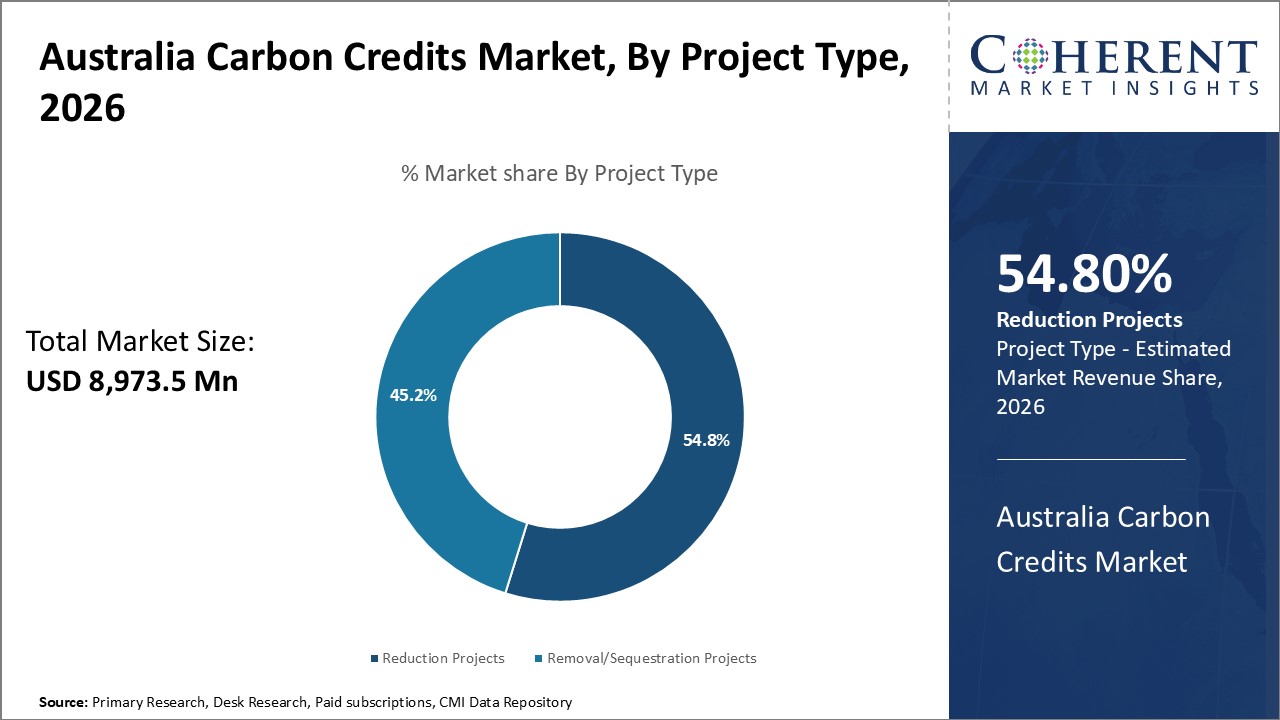
- The reduction projects segment is expected to account for 54.8 % of the market share in 2026.
- The manufacturing and industrial processes segment is projected to represent 31.8 % of the market share in 2026.
Market Overview
Market trends indicate a significant shift towards sustainable practices, with businesses and governments actively adopting carbon credit trading to carbon offset emissions. Increasing regulatory support, coupled with growing awareness of climate change impacts, has fueled the demand for innovative carbon offset projects. Additionally, advancements in technology and transparent monitoring systems are enhancing the credibility and efficiency of carbon credit markets, promoting wider adoption and investment in this sector.
Current Events and Its Impact
Current Events | Description and its Impact |
Chevron’s Gorgon Plant Carbon Credits Controversy |
|
Expansion of Nature-Based Offset Projects |
|
Segmental Insights
- Current Industry Events of 2026
- Market Size Estimation
- Regional Breakdown
- Competitive Landscape
- Customer Intelligence
- Segmental Analysis
- Pricing Analysis
- Key Market Drivers, Challenges & Future Trends
- Customized Insights Section
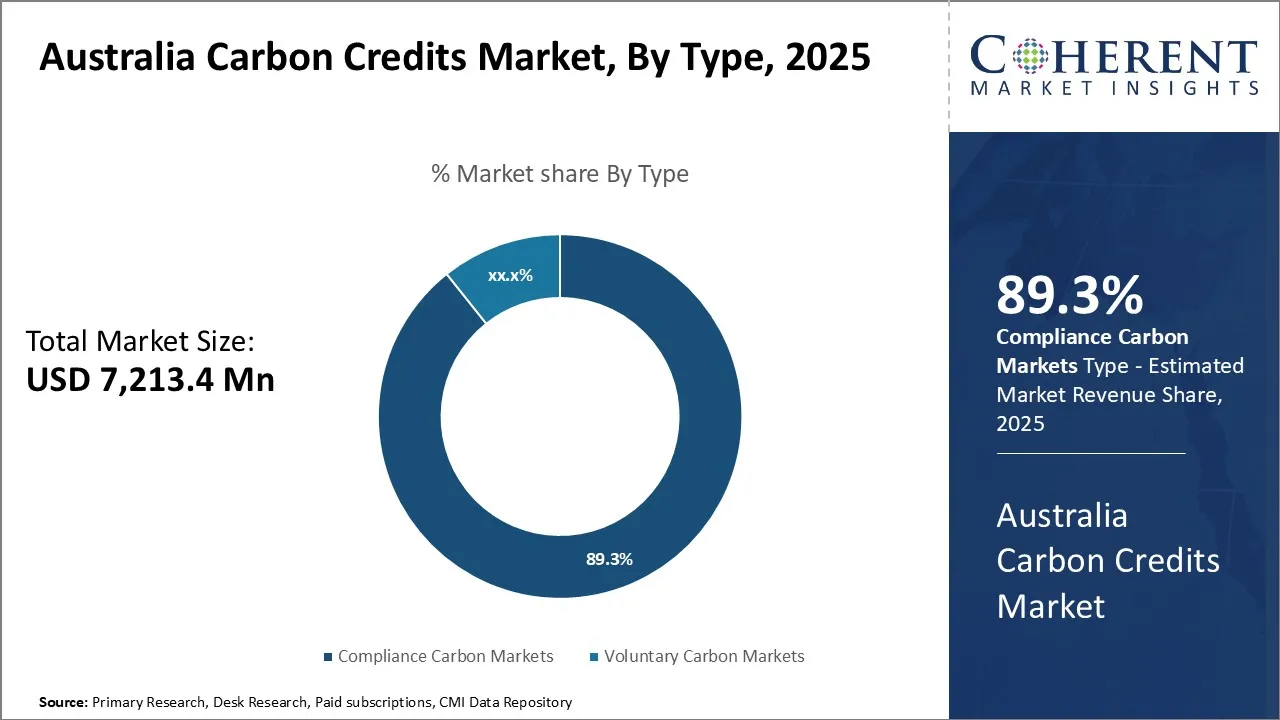
Australia Carbon Credits Market Insights, by Type - Compliance Carbon Market Segment Dominates the Market due to Large Emitters Face Legally Binding Obligations Under the Safeguard Mechanism
The compliance carbon markets segment is projected to account for 90.3% share in 2026. This is mainly due to strict regulations and required targets for reducing emissions. The Australian government's commitment to international climate agreements, like the Paris Agreement, has established compliance markets as essential for making sure businesses stick to legally binding carbon limits. Various state and federal policies set limits on greenhouse gas emissions for high-emission sectors. This makes it crucial for companies operating under these rules to participate in compliance carbon markets. This regulatory environment creates a steady demand for carbon credits, as organizations aim to offset emissions they cannot cut entirely. This drives continuous investment in verified carbon reduction projects.
For example, Chevron’s Gorgon LNG project in Western Australia has been required under the federal safeguard mechanism to offset excess CO₂ emissions through compliance carbon credits. The project’s higher-than-expected emissions made participation in the compliance carbon market necessary, illustrating how large industrial operators must rely on this segment to stay within mandated emission limits.
Australia Carbon Credits Market Insights, by Project Type - Reduction Projects Segment Dominates the Market due to Policy-Driven Demand for Emission Cuts
The reduction projects segment is projected to hold 54.8% of the market share in 2026. Their significance comes from their immediate and measurable impact on lowering greenhouse gas emissions. This makes them appealing for both compliance and voluntary market participants. Reduction projects usually involve actions like improving energy efficiency, switching to cleaner fuels, and optimizing industrial processes. These initiatives produce concrete reductions in a relatively short time. The clear link between project activities and the emissions they reduce allows for easy measurement and verification, which helps in issuing and trading credits.
Australia Carbon Credits Market Insights, by End Use Sector - Manufacturing and Industrial Processes Segment Dominates the Market due to Regulatory Obligations under the Safeguard Mechanism
The manufacturing and industrial processes segment is expected to capture 32.8% of the market share in 2026. This is due to the high energy use and emissions from these sectors, which creates a strong need for carbon credits to comply with environmental rules and achieve corporate sustainability goals. Manufacturing plants and industrial facilities must often meet strict emission limits. This pushes them to buy credits to offset emissions that cannot be avoided, even after upgrades for efficiency or fuel changes.
The importance of this sector stems from its role as both a major source of emissions and a key player in carbon markets. Australian industries such as mining, metal fabrication, chemical production, and heavy manufacturing face constant pressure to reduce their carbon footprints.
Macro and Micro Economic Factors Impacting Australia Carbon Credits Market Growth
Macroeconomic Factors
- Regulatory Initiatives: Government schemes like the Emissions Reduction Fund (ERF) and the Safeguard Mechanism set stricter emissions baselines and compliance requirements, driving demand for credits. These policies reinforce market stability and encourage innovation.
- International Climate Commitments: Australia’s obligations under the Paris Agreement and related pacts create system-wide pressure to lower national emissions, boosting demand for credible domestic credits to meet targets and support export competitiveness.
- Global Trade and Investment: The market benefits from recognition of Australian Carbon Credit Units (ACCUs) internationally, opening revenue streams and boosting foreign investment in local offset projects. Export-oriented sectors see carbon credits as strategic assets for global trade alignment.
- Sectoral Development: Growth in renewable energy, land sector offsets, and biodiversity project areas expands the credit supply and supports broader economic development. Corporate sustainability reporting and ESG integration further mainstream carbon offset purchases.
- Market Volatility and Uncertainty: Political or regulatory changes, international market linkages, and supply-demand imbalances can cause price volatility and affect planning for long-term emission reduction initiatives.
Microeconomic Factors
- Project Costs and Returns: The viability of offset projects, such as reforestation and energy efficiency, depends on upfront capital, ongoing costs, and the returns from selling credits. Smaller players face barriers from high implementation costs and verification requirements.
- Landholder Participation: Engagement of rural and Indigenous landholders is vital for supply, as Australia’s natural resources make it ideal for land-based sequestration. Involvement depends on educational support, profit potential, and policy incentives.
- Technological Innovations: Advances in carbon accounting, monitoring, and carbon farming techniques lower costs and improve credibility, stimulating more project proposals and higher market liquidity.
- Consumer and Corporate Pressure: Businesses increasingly view carbon credits as a way to enhance CSR, respond to stakeholder demands, and meet supply-chain sustainability requirements, influencing buying behavior and credit demand.
- Price Volatility: The ACCU market is affected by swings in the number of buyers and sellers, regulatory changes, and market confidence, making pricing unpredictable and planning challenging for investors and project developers.
Market Players, Key Development, and Competitive Intelligence
Key Development
- In April 2025, Chevron’s Gorgon gas export facility in Western Australia was identified as the country’s largest industrial climate polluter. It received federal carbon credits valued in the millions of dollars in 2024, even though its total emissions increased. This situation has sparked worries about how well Australia’s carbon credit system works in promoting real cuts in emissions.
Top Strategies Followed by Australia Carbon Credits Market Players
- Established companies lead this market by making significant investments in research and development (R&D). They aim to create high-performance carbon credit products that meet strict environmental standards while attracting both corporate and government clients. These market leaders also focus on forming partnerships with key players and Original Equipment Manufacturers (OEMs) to strengthen their presence in vital sectors.
- For instance, South Pole and Climate Friendly have developed strong portfolios by launching large-scale reforestation and savannah burning projects in Australia. These projects not only generate a large number of credits but also satisfy strict environmental and indigenous community standards.
- Mid-level players in the Australia carbon credits market set themselves apart by providing cost-effective solutions that balance quality and affordability. They recognize the increasing demand from price-sensitive consumers and smaller businesses. These companies customize their offerings to be accessible while maintaining essential features and minimizing environmental impact. To compete with larger companies, mid-tier firms often pursue partnerships, like joint ventures or technology-sharing agreements, which improve their production abilities and technological skills.
- For example, Carbon Neutral Australia provides affordable biodiversity-based offsets, making them accessible to SMEs in retail and services.
- Small-scale players in the Australia carbon credits market find their niche by highlighting specialized features and innovative carbon offset methods that distinguish them from larger, more general providers. They frequently use advanced technologies like blockchain for transparency, remote sensing for precise carbon measurement, or new verification techniques to stay competitive in specific or localized market segments.
- For example, Localized innovators in Western Australia have implemented satellite-based monitoring and AI-driven soil carbon measurement, providing modern verification methods that differ from traditional techniques.
Market Report Scope
Australia Carbon Credits Market Report Coverage
| Report Coverage | Details | ||
|---|---|---|---|
| Base Year: | 2025 | Market Size in 2026: | USD 8,973.5 Mn |
| Historical Data for: | 2020 To 2024 | Forecast Period: | 2026 To 2033 |
| Forecast Period 2026 to 2033 CAGR: | 24.4% | 2033 Value Projection: | USD 41,371.7 Mn |
| Segments covered: |
| ||
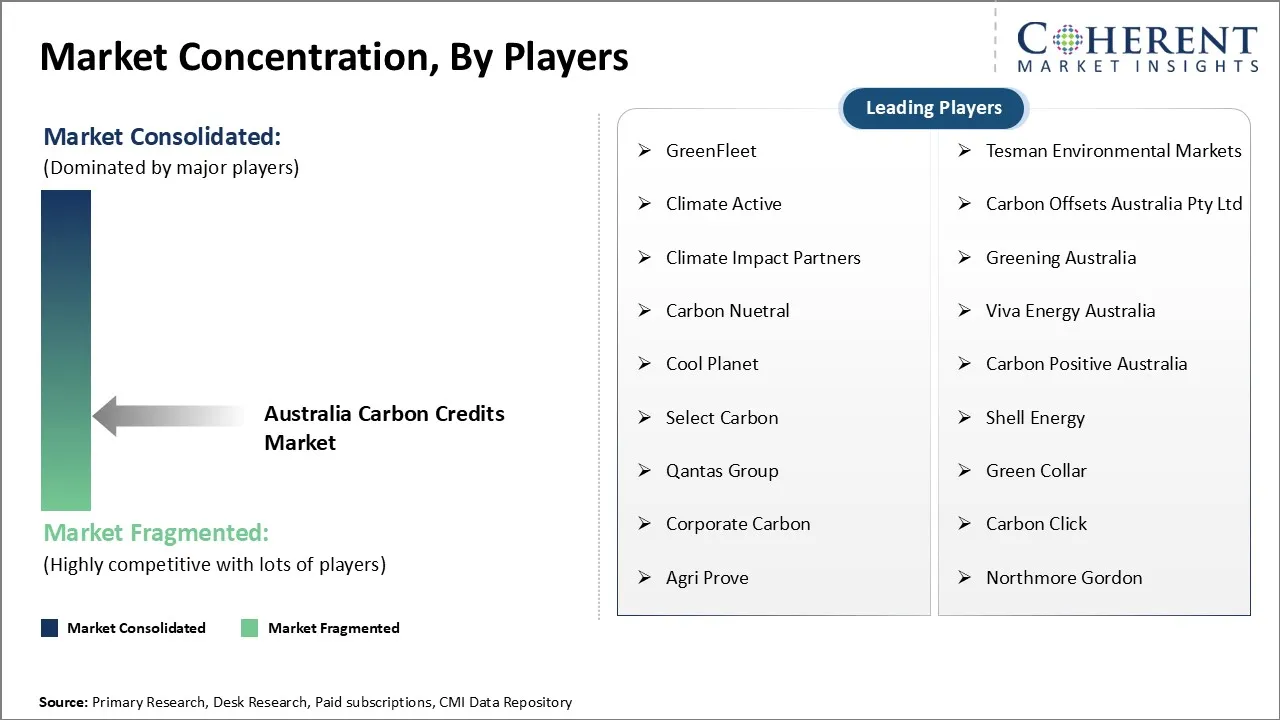
| Companies covered: | GreenFleet, Tesman Environmental Markets, Climate Active, Carbon Offsets Australia Pty Ltd, Climate Impact Partners, Greening Australia, Carbon Nuetral, Viva Energy Australia, Cool Planet, Carbon Positive Australia, Select Carbon, Shell Energy, Qantas Group, Green Collar, Corporate Carbon, Carbon Click, Agri Prove, and Northmore Gordon | ||
| Growth Drivers: |
| ||
| Restraints & Challenges: |
| ||
Australia Carbon Credits Market Dynamics
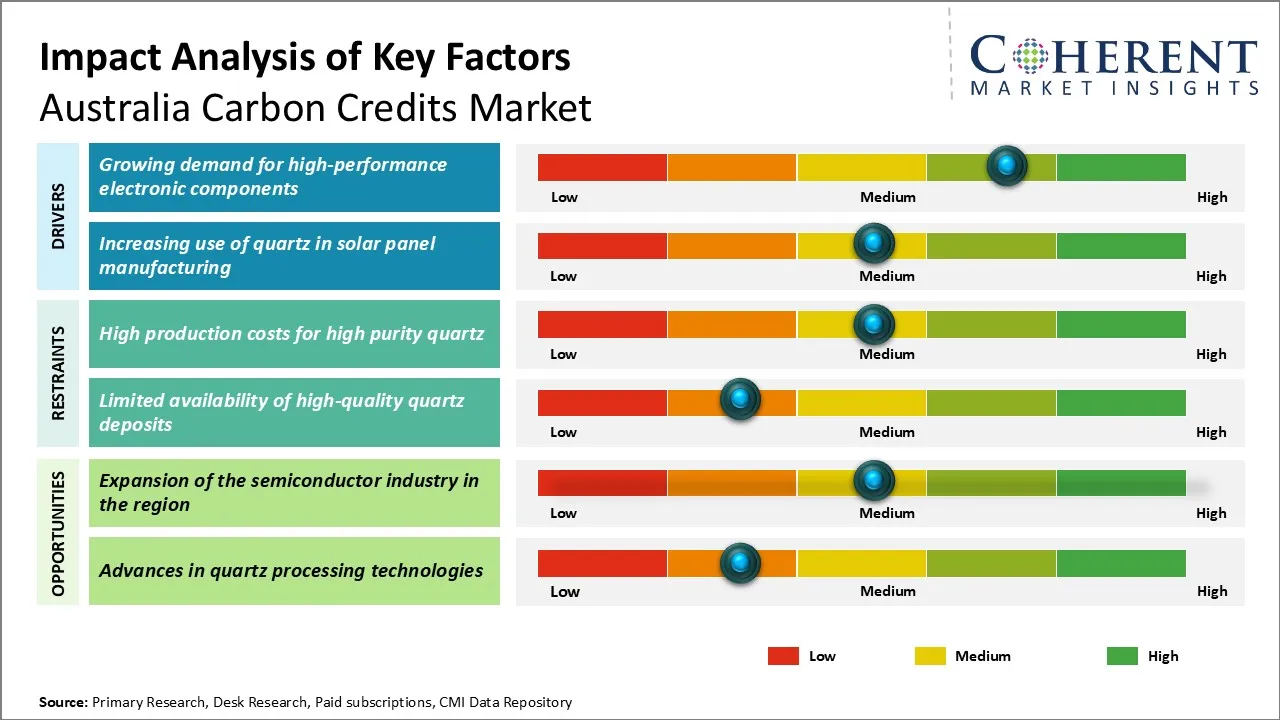
Australia Carbon Credits Market Driver - Growing Demand for High-Performance Electronic Components
The growing integration of high-performance electronic components in industries like telecommunications, automotive, and consumer electronics is leading to greater energy use and resource consumption. This increase raises the carbon footprint linked to their manufacturing processes. As companies work to achieve global sustainability goals and follow regulations, they are more focused on reducing emissions tied to producing these advanced components. This push boosts the demand for carbon credit, as organizations look for reliable ways to offset their environmental impact.
For instance, Taiwan Semiconductor Manufacturing Company (TSMC), one of the largest chip manufacturers supplying to global tech companies, reported that its production process consumed over 7% of Taiwan’s total electricity in 2022. To manage its environmental impact, TSMC committed to achieving 100% renewable energy by 2050 and is actively purchasing carbon credits to complement its decarbonization strategies.
Australia Carbon Credits Market Opportunity - Expansion of the Semiconductor Industry in the Region
The rapid expansion of the semiconductor industry in Australia presents a significant opportunity for the country’s carbon credits market. As semiconductor manufacturing is an energy-intensive process with substantial greenhouse gas emissions, companies in this sector are increasingly seeking sustainable solutions to minimize their carbon footprint. This heightened environmental consciousness is driving demand for carbon credits as a means to offset emissions and comply with stringent regulatory frameworks aimed at reducing industrial carbon output.
Australia’s Critical Minerals Strategy (2023–2030) emphasizes strengthening domestic semiconductor and advanced manufacturing capabilities, particularly given the country’s rich reserves of lithium, cobalt, and rare earth elements—critical inputs for chip production.
Analyst Opinion (Expert Opinion)
- The Australia carbon credits market is rapidly changing, driven by the country’s aim to achieve net-zero emissions by 2050. This approach effectively addresses environmental and social responsibility goals. The discussions at these conferences highlighted the growing demand for voluntary carbon markets, especially from businesses looking to offset emissions due to consumer interest in sustainability.
- GreenCollar's recent restoration of native vegetation illustrates an active strategy for creating carbon credits while creating biodiversity, both effectively meeting environmental and corporate social responsibility objectives.
- Additionally, forming partnerships with community groups and stakeholders will be crucial for successfully carrying out projects. Ultimately, the future of the Australia carbon credits market will hinge on its ability to innovate and keep up with global sustainability goals while maintaining market credibility.
Speak to the analyst
Want personalized insights?
Take the findings above to one of our principal consultants, or have the report rebuilt around the segments, geographies and competitors you actually track.
Market Segmentation
- Type Insights (Revenue, USD Mn, 2021 - 2033)
- Compliance Carbon Markets
- Voluntary Carbon Markets
- Project Type Insights (Revenue, USD Mn, 2021 - 2033)
- Reduction Projects
- Removal/Sequestration Projects
- Nature-based
- Technology Based
- End Use Sector Insights (Revenue, USD Mn, 2021 - 2033)
- Manufacturing and Industrial Processes
- Transportation
- Commercial and Residential
- Others (Agriculture & Forestry, etc.)
- Key Players Insights
- GreenFleet
- Tesman Environmental Markets
- Climate Active
- Carbon Offsets Australia Pty Ltd
- Climate Impact Partners
- Greening Australia
- Carbon Nuetral
- Viva Energy Australia
- Cool Planet
- Carbon Positive Australia
- Select Carbon
- Shell Energy
- Qantas Group
- Green Collar
- Corporate Carbon
- Carbon Click
- Agri Prove
- Northmore Gordon
Sources
Primary Research Interviews
- Head of Carbon & Energy, Safeguard-covered industrial facility (mining, LNG, steel)
- Project Developer – ACCU (human-induced regeneration, savanna burning, landfill gas, soil carbon)
- Trading/Broker Desk Lead – ACCU & voluntary offsets (spot/forward)
- Compliance Manager – Electricity/Gas utility with NGER & Safeguard obligations
- Policy/Regulatory Affairs – Carbon Market Institute member company
Stakeholders
- Landholders and Carbon Project Developers
- End-use Sectors:
- Regulatory Compliance Buyers (utilities, mining, large manufacturers)
- Voluntary Offset Purchasers (corporates, finance, travel, technology)
- Regulatory and Certification Bodies (Clean Energy Regulator, Commonwealth Govt.)
- Carbon Credit Exchanges and Brokerage Platforms
Databases
- UN Comtrade Database
- Australia National Greenhouse and Energy Reporting (NGER) System
- Clean Energy Regulator – ACCU Scheme Project and Contract Register
Magazines
- Carbon Market News Australia – Insights on carbon trading, pricing, and compliance
- Environmental Finance Australia – Trends in finance and carbon asset management
- Sustainability Review Magazine – Innovation in land-based carbon credit generation
- Climate & Policy Australia – Regulatory changes and carbon market analysis
Journals
- Australian Journal of Environmental Management – Policy analysis and land restoration
- Climate Policy – Market mechanism performance and developments
- Journal of Carbon Research – Sequestration, project methodologies, emerging credit types
- Environmental Science & Policy Australia – National scheme comparisons, audit outcomes
Newspapers
- The Australian Financial Review – Market growth and policy effects
- The Guardian Australia – Public debate and regulatory response
- The Sydney Morning Herald – Regional carbon project impacts
- Asia-Pacific Carbon Update – Trade flows, international credit interest
Associations
- Carbon Market Institute (CMI)
- Clean Energy Regulator (CER)
- International Emissions Trading Association (IETA)
- Australasian Emissions Reduction Association (AERA)
- Australian Land Restoration Fund
Public Domain Sources
- Clean Energy Regulator – Legislation, market rules, compliance resources
- Australian Government – Carbon Credits (Carbon Farming Initiative) Act 2011
- Commonwealth Parliament – Market Performance and Integrity Reports
Proprietary Elements
- CMI Data Analytics Tool, Proprietary CMI Existing Repository of information for last 8 years.
Get access to 250+ pages report
Every segment, forecast, competitor profile and data table behind the analysis above — available for instant download.
- ESOMAR Member
- ISO 9001:2015 Certified
- D-U-N-S Registered
- GDPR & CCPA Compliant
Missing comfort of reading report in your local language? Find your preferred language:
Transform your Strategy with Exclusive Trending Reports
Frequently Asked Questions
The Australia carbon credits market growth is estimated to be valued at USD 8,973.5 Mn in 2026 and is expected to reach USD 41,371.7 Mn by 2033.
The CAGR of Australia carbon credits market is projected to be 24.4% from 2026 to 2033.
Growing demand for high-performance electronic components and increasing use of quartz in solar panel manufacturing are the major factors driving the growth of the Australia carbon credits market.
High production costs for high purity quartz and limited availability of high-quality quartz deposits are the major factors hampering the growth of the Australia carbon credits market.
In terms of type, the compliance carbon markets segment is estimated to dominate the market revenue share in 2026.
GreenFleet, Tesman Environmental Markets, Climate Active, Carbon Offsets Australia Pty Ltd, Climate Impact Partners, Greening Australia, Carbon Nuetral, Viva Energy Australia, Cool Planet, Carbon Positive Australia, Select Carbon, Shell Energy, Qantas Group, Green Collar, Corporate Carbon, Carbon Click, Agri Prove, and Northmore Gordon are the major players.