

Global Automated Labeling Equipment Market Size and Forecast – 2026 to 2033
The global automated labeling equipment market is estimated to be valued at USD 5,223.4 Mn in 2026 and is expected to reach USD 7,498.2 Mn by 2033, exhibiting a compound annual growth rate (CAGR) of 5.3% from 2026 to 2033.
Key Takeaways of the Automated Labeling Equipment Market
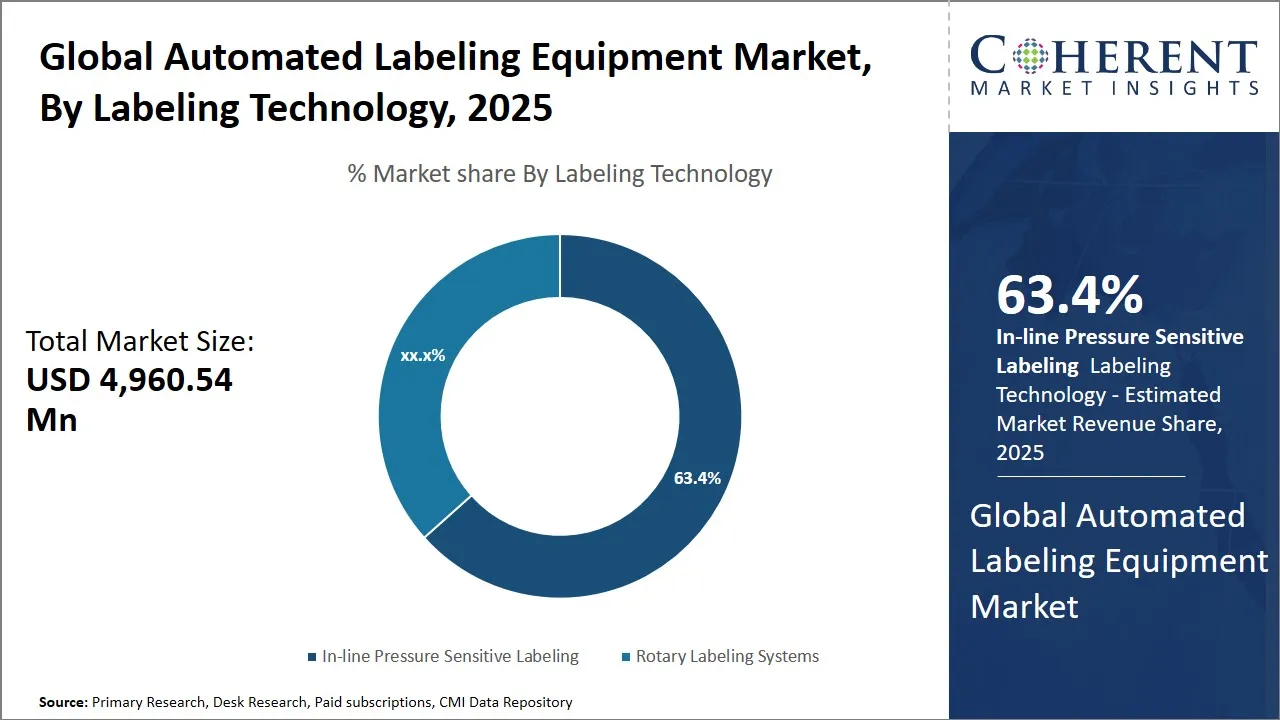
- The in-line pressure sensitive labeling segment is expected to capture 64.4% of the global automated labeling equipment market share in 2026.
- The front labeling segment is projected to hold 21.5% of the automated labeling market share in 2026.
- The bottles (round, flat, oval) segment is expected to hold 29.9% of the market share in 2026.
- Asia Pacific is set to lead the global automated labeling equipment market in 2026 with a 37.2% share. North America, with an estimated share of 22.2% in 2026, is projected to be the fastest-growing region.
Market Overview
The present market trends suggest that there will be a considerable move towards the adoption of new labeling technologies that would incorporate IoT and AI for the purposes of real-time monitoring and predictive maintenance. To add to this, the sustainability issue has become a major factor in the market since the industry is gradually turning towards the usage of eco-friendly labeling materials along with the adoption of energy-efficient equipment. These advancements, in conjunction with the desire for flexible and high-speed labeling solutions, are influencing the automated labeling equipment market. The manufacturers are thus motivated to spend more on research and development to keep up with the changing requirements of the industry.
Currents Events and Its Impact
Current Events | Description and its Impact |
Rising e‑commerce and packaging automation boom |
|
Stricter food & beverage labelling/traceability rules in the U.S. |
|
Segmental Insights
- Current Industry Events of 2026
- Market Size Estimation
- Regional Breakdown
- Competitive Landscape
- Customer Intelligence
- Segmental Analysis
- Pricing Analysis
- Key Market Drivers, Challenges & Future Trends
- Customized Insights Section
Automated Labeling Equipment Market Insights, By Labeling Technology - In-line Pressure Sensitive Labeling Segment Dominates the Market due to its Versatility and Efficiency in High-Speed Production Environments
The in-line pressure sensitive labeling segment is expected to account for 64.4% of the global automated labeling equipment market share in 2026, because it meets the key operational requirements of various industries. Its capacity to provide fast, accurate, and clean labeling without any drying or curing processes has made it a highly efficient solution for manufacturers who want to maximize the throughput and minimize the bottlenecks on production lines. The pressure-sensitive labels contain an adhesive layer that sticks to the product immediately during application, thus significantly cutting down the downtime and the label waste that would otherwise occur with other processes.
For example, a major beverage manufacturer implemented in-line pressure sensitive labeling systems to streamline its production line. The technology enabled them to achieve up to a 30% reduction in labeling errors and a 20% increase in overall production speed, demonstrating its operational effectiveness and cost-saving benefits in large-scale manufacturing.
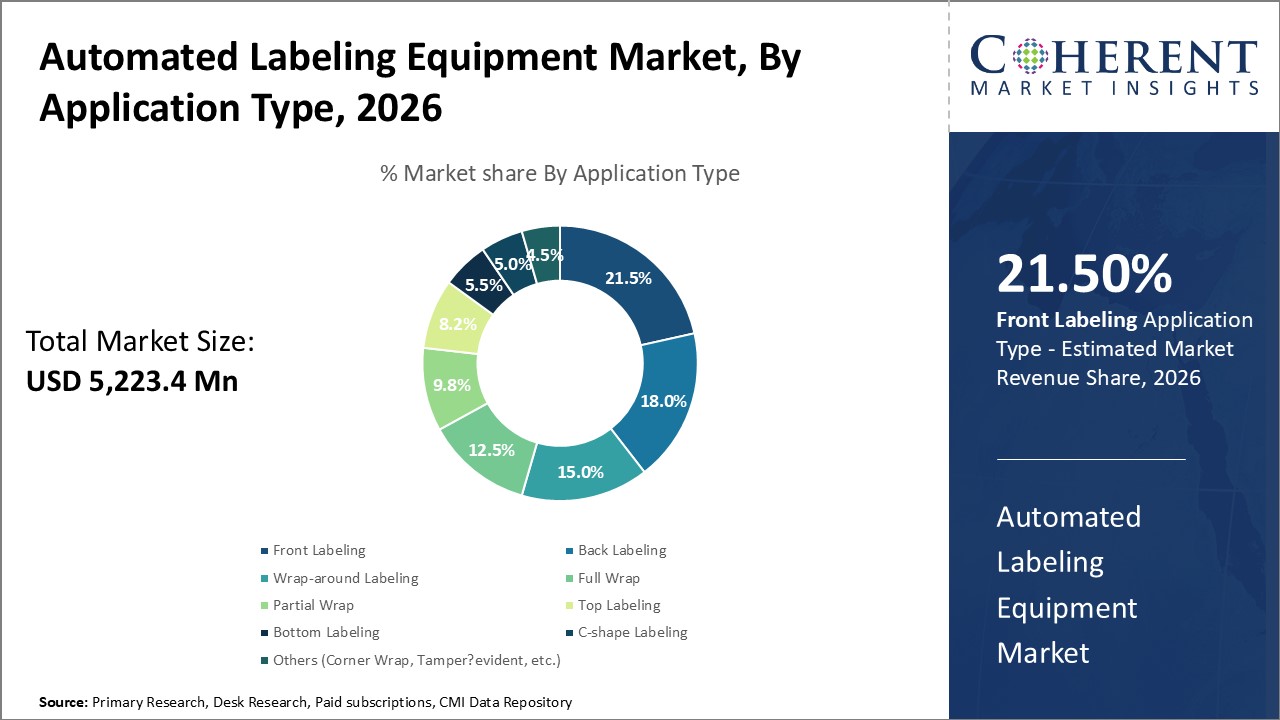
Automated Labeling Equipment Market Insights, By Application Type - Front Labeling Segment Dominates the Market Driven by its Critical Role in Brand Visibility and Consumer Engagement
The front labeling segment occupies a substantial portion of the automated labeling market with an estimated share of 21.5% in 2026, due to the fact that it is the first point of contact for a product and a consumer. The front label showcases the company's core values, product details, and marketing messages which are a major factor in retail location sales. Instead of only being able to compete with one another for shelf space, companies aimed at gaining consumer attention thus the need for precision as well as high quality for the front labeling systems will keep on rising and that will also lead to companies' investment in those automated systems which can deliver impeccably correct placement and print quality.
Another factor influencing the growth of the front labeling segment is the highlighted need for compliance with the regulations. In the food and beverages, pharmaceutical, and personal care sectors, for instance, the front label must prominently and legibly state such information as ingredients, dietary facts, expiration dates, and warnings about safety. When people use manual labeling, there is a great chance that mislabeling or incorrect placement will happen, resulting in regulatory penalties or recalls. But with the automated equipment, there is a much lesser chance since the data-rich labels are applied perfectly every time.
Automated Labeling Equipment Market Insights, By Packaging Type - Bottles (Round, Flat, Oval) Segment Dominates the Market due to their Widespread Use and the Complexity they Bring to Labeling Processes
The bottles (round, flat, oval) segment is expected to dominate the automated labeling market in 2026 with a share of 29.9%, owing to the fact that its utilization is widespread in various industries, such as beverages, pharmaceuticals, cosmetics, and household products, all of which require different kinds of labeling. There are several shapes of these containers, such as round, flat, and oval, and each one has its particular challenges, thus requiring specialized labeling equipment that can not only adjust to the different shapes but also keep the speed and accuracy at a high level.
The need for automated labeling systems specifically designed for bottles is a matter of fact; the necessity for precise label alignment is what actually drives the whole thing. Precise label alignment will not only enhance shelf appeal but will also allow product differentiation.
Regional Insights
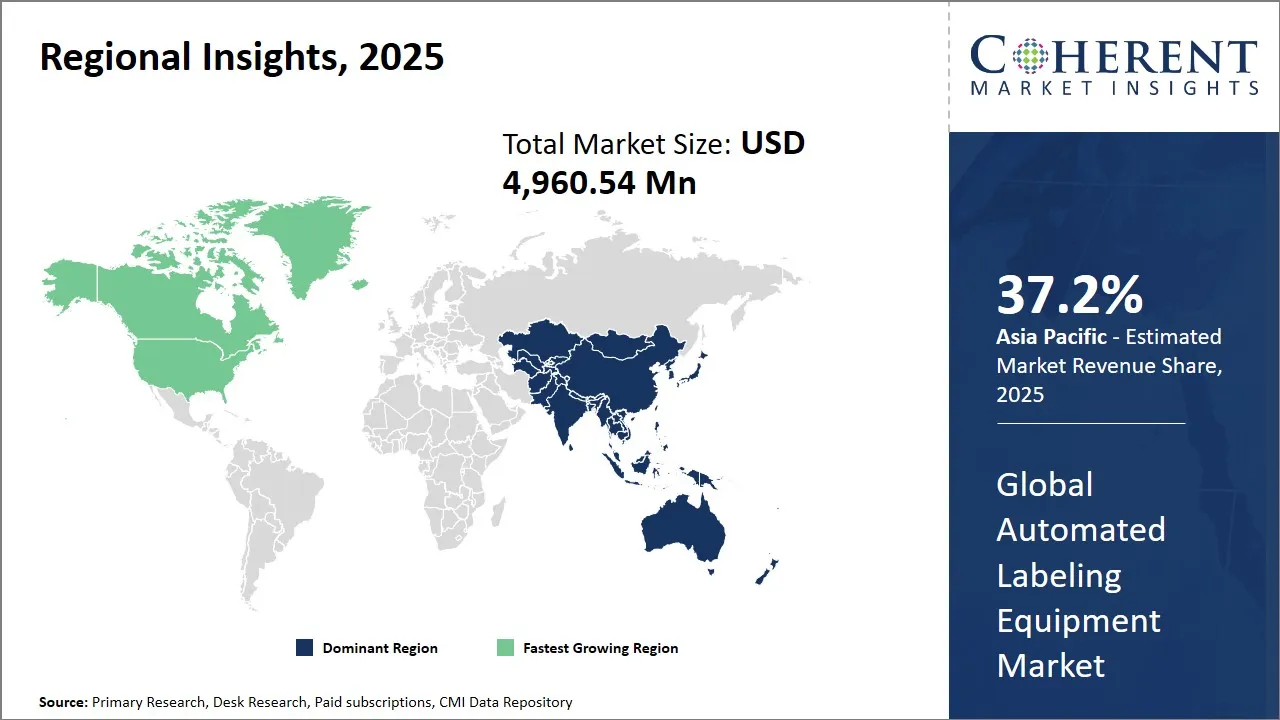
Asia Pacific Automated Labeling Equipment Market Analysis and Trends
The automated labeling equipment market foresees the Asia Pacific region to be the market leader in 2026 with an estimated contribution of 37.2% share. The main factors behind this forecast are the fast pace of industrialization, the ever-growing manufacturing sectors, and the countries like China, India, Japan, and South Korea are increasingly adopting automation technologies. The domestic production and export capabilities of these nations are being enhanced through government policies and industrial automation infrastructure investments, which have led to a more rapid market acceptance.
Moreover, the demand for automated labeling solutions in the region will be fueled by emerging sectors such as pharmaceuticals, personal care, and food processing, which are the major ones contributing to the demand for automation in labeling. The businesses, such as ACME Manufacturing Co., Krones AG (which has a strong presence in the region), and Nishina Labeling Systems, are aggressively expanding their reach to take advantage of this opportunity. Trade facilitation measures and the establishment of special economic zones further catalyze the provision of equipment and aftersales services across borders.
North America Automated Labeling Equipment Market Analysis and Trends
The North America region will be the leader in market growth with 22.2% share in 2026. The reason as stated is a well-established industrial ecosystem, tech-savvy industries, and the presence of major end-user sectors such as pharmaceuticals, food, and consumer goods. Besides, the region is taking advantage of its manufacturing infrastructure, strict regulations, and implementation of policies that promote automation and help production to be of good quality and in compliance with the regulations.
Also, important players like Weber Packaging Solutions, Label-Aire, and Markem-Imaje are providing the best labeling equipment that meets the quality and traceability demands.
Automated Labeling Equipment Market Outlook for Key Countries
U.S. Automated Labeling Equipment Market Trends
The U.S. automated labeling equipment market has a big concentration of high-tech manufacturing and pharmaceutical industries that need precision and compliance in labeling solutions due to their nature. Companies like Weber Packaging Solutions and Domino Printing Sciences are facilitating the deployment of equipment that is integrated with advanced printing and inspection features.
China Automated Labeling Equipment Market Trends
China is rapidly increasing its market for automated labeling equipment thanks to aggressive investments in manufacturing plants and the large-scale production of consumer goods. Krones AG and Shanghai Auto Coding Technology are examples of companies that are penetrating the market with their strategic alliances and joint ventures. The promotion of “Made in China 2026” by the government is a push to the industry for more automation technologies that would eventually lead to a broader use of labeling systems in different sectors.
Germany Automated Labeling Equipment Market Trends
Germany continues to be a center of excellence for innovations in industrial automation and the manufacturing of automation equipment. Among these are Krones AG, HERMA GmbH, and Optima Packaging Group whose modern automated labeling solutions are not only reliable but also adaptable to the tailor-made demands of the rigorous European regulators. Germany’s advanced industrial infrastructure, along with unremitting R&D expenditures, guarantees that the market, to a large extent, is in the first place regarding technology and product quality.
India Automated Labeling Equipment Market Trends
India automated labeling equipment market is developing very fast with the backing of the pharmaceutical, food processing, and e-commerce industries that demand efficient and scalable labeling solutions. The local manufacturers and integrators are more and more cooperating with foreign suppliers to provide cheap labeling equipment that is fully automated and adapted to the unique requirements of the Indian market. The government's initiatives to promote "Make in India" and the infrastructure development plans are powering this trend, while the retail sector's growing concern for branding and traceability is even more drawing up the demand.
Japan Automated Labeling Equipment Market Trends
Japan automated labeling equipment market takes advantage of a very advanced manufacturing ecosystem that is dedicated to precision and sophistical technology. Companies like Ishida Co. Ltd. and Sato Holdings, which are at the forefront of the industry, produce advanced labeling machines that can be integrated with robotics for the automatic production line, thus making the production line system seamless.
End-use Industry Breakdown
- Food & Beverage: Increased automation driven by demand for speed and accuracy in high-throughput packaging lines, compliance with hygiene and safety standards, and the rise of smart packaging that includes traceability via IoT labels.
- Pharmaceuticals: Strong regulatory-driven demand for precise label placement and verification to ensure patient safety and traceability; uses AI quality control systems to detect label defects and confirm batch coding and regulatory information.
- Consumer Goods: Growth supported by demand for premium product labeling (e.g., cosmetics, skincare) requiring high precision and flexibility in label application, often using wrap-around labeling machines.
- Logistics & Warehousing: IoT-enabled smart labels and automated labelers improve asset tracking, real-time inventory management, and supply chain transparency, critical for omnichannel retail and cold chain monitoring.
Market Players, Key Development, and Competitive Intelligence
Key Developments
- In October 2025, TEKLYNX International, barcode labeling solutions provider, and NIC Systems, app developer, partnered to release a new TEKLYNX SENTINEL Connector for Microsoft Dynamics 365 Business Central. The app NIC Systems developed combined with the power and reliability of TEKLYNX software, enables Microsoft users to quickly and easily print accurate labels directly from their Business Central interface.
- In October 2024, HERMA, a manufacturer of high-precision labeling machines, in collaboration with Norwalt Automation Group, an expert in automation systems integration, will debut their latest labeling solution at PACK EXPO International 2024, November 3-6 in Chicago. At Booth W-16049, the two companies will jointly showcase their 211RHC labeling cell.
Top Strategies Followed by Global Automated Labeling Equipment Market Players
- Established market in the drive for innovation, established market leaders usually make substantial investments in research and development (R&D) with an eye towards the future and the development of high-end labeling, technologically advanced solutions. Through R&D, these firms want to be at the front of the pack in terms of technology, accuracy, speed, and reliability by supplying the industries that demand the most, such as pharmaceuticals, food and beverage, and logistics with their products.
- For example, Sato Holdings has been a constant innovator in the labeling area, coming up with breakthrough RFID labeling technology and ultra-fast labeling solutions to meet the demand for automation and traceability that keeps growing and to be an active player in the market.
- The middle-tier companies in the automated labeling equipment market are not taking the same route as the leading companies but are still very effective with their strategic approach, which is aimed to gain a competitive edge in the market place. These companies as a rule try to sell their products at a price that is not too high and not too low and is especially attractive to the price-sensitive and small-to-medium-size enterprise customer segments. They usually have a diverse range of equipment that is easy to operate and can be adjusted to fit different labeling needs, and all this without the luxury price tag of the top-notch models.
- For example, Epson Robots, which provides various labeling solutions that are both versatile and easy to operate, thus making them more affordable. Epson's small labeling robots, for instance, the RC90, are designed specifically for small companies in sectors like retail and local manufacturing and provide them with high performance at a much lower cost as compared to the larger automated systems which generally come with a premium price tag.
- The small players often survive through the establishment of specialized niches and the investment in innovation that is directly related to the specific applications or the unusual customer needs. The companies use the latest technologies such as AI-based vision systems, IoT devices, and advanced robotics in order to make their products more attractive than common mass-market ones. For the sake of innovations startups or small manufacturers will give priority to ultra-precise labeling for fragile goods or the design of modular, compact machines that fit well in limited-space scenarios.
- For example, ProMach, a smaller firm that offers modular and compact labeling solutions for space-limited areas, is a great example of a company that has found its niche in the market. The Trine Modular Labeling System from ProMach is a small, flexible, and economical solution suitable for small business from the sectors of cosmetics and boutique food products, for instance.
Technology & Integration Trends in Automated Labeling
- IoT-enabled labeling equipment is increasingly integrated for real-time tracking and inventory management, improving supply chain efficiency and cold-chain monitoring, with smart labels incorporating environmental sensors and cloud data analytics.
- Robotics integration advances labeling precision by enabling millimeter-accurate label placement through robotic arms and collaborative robots (cobots) which operate alongside human workers safely, optimizing floor space and boosting throughput.
- Labeling systems are customizable for various label materials and sizes, supporting hygienic pharmaceutical requirements, fragile electronics, and high-speed food & beverage operations.
Market Report Scope
Automated Labeling Equipment Market Report Coverage
| Report Coverage | Details | ||
|---|---|---|---|
| Base Year: | 2025 | Market Size in 2026: | USD 5,223.4 Mn |
| Historical Data for: | 2020 To 2024 | Forecast Period: | 2026 To 2033 |
| Forecast Period 2026 to 2033 CAGR: | 5.3% | 2033 Value Projection: | USD 7,498.2 Mn |
| Geographies covered: |
| ||
| Segments covered: |
| ||
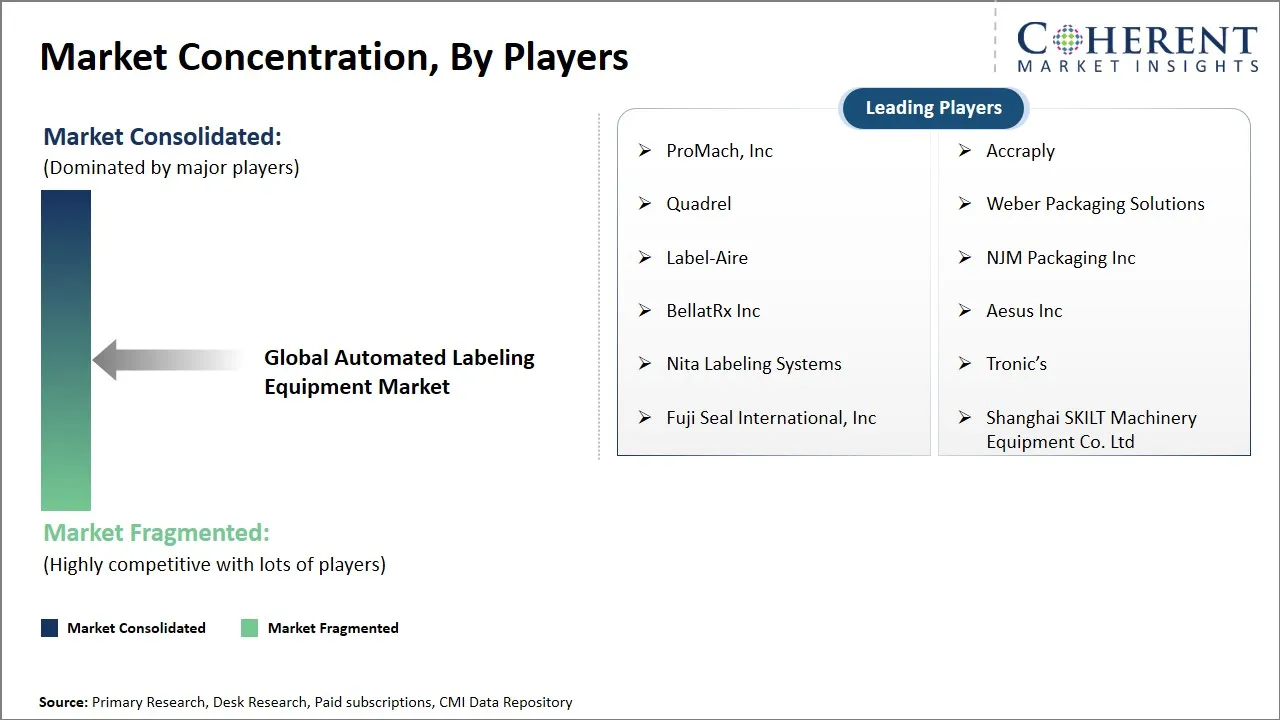
| Companies covered: | ProMach, Inc, Accraply, Quadrel, Weber Packaging Solutions, Label-Aire, NJM Packaging Inc, BellatRx Inc, Aesus Inc, Nita Labeling Systems, Tronic’s, Fuji Seal International, Inc, and Shanghai SKILT Machinery Equipment Co. Ltd | ||
| Growth Drivers: |
| ||
| Restraints & Challenges: |
| ||
Automated Labeling Equipment Market Dynamics
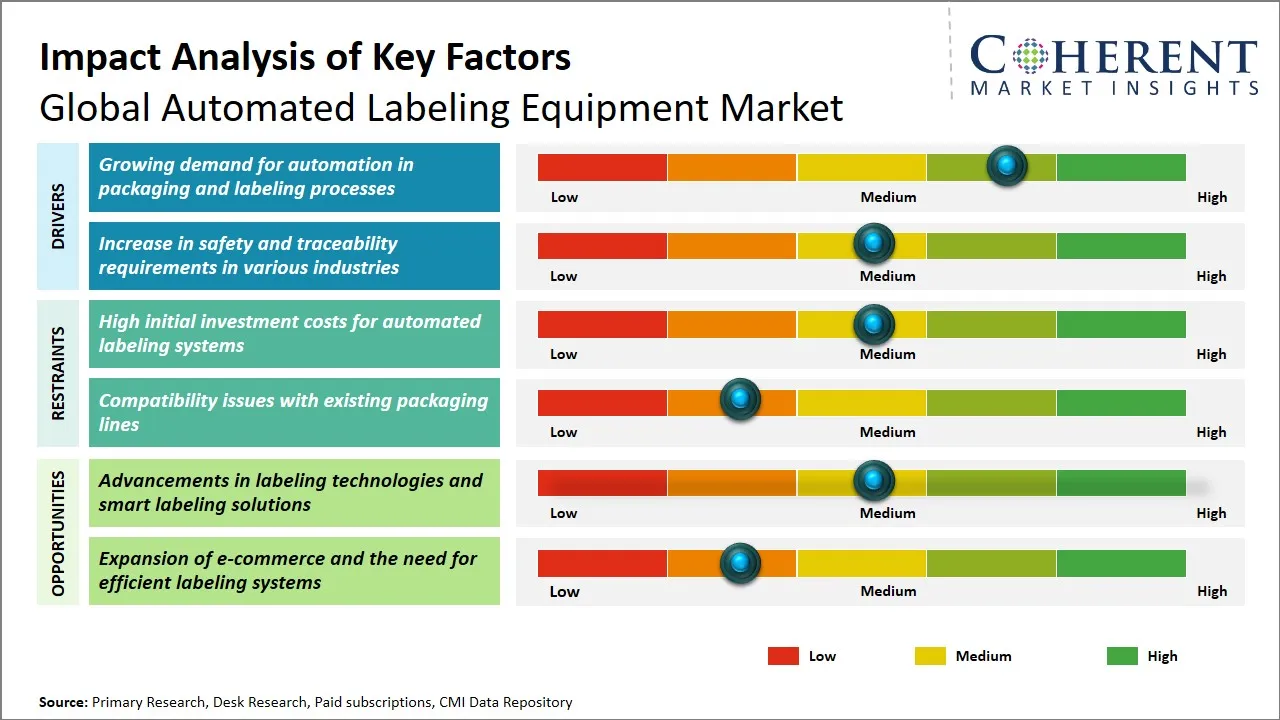
Automated Labeling Equipment Market Driver - Growing Demand for Automation in Packaging and Labeling Processes
The demand for automation in packaging and labeling processes is being fueled by the growing operational efficiency and accuracy requirement in various industries. The automated labeling equipment gives significant benefits, such as shorter production cycles, less human error, and uniform application of labels, all of which are very important for the quality and compliance with the legal standards of the product. The manufacturers driven by customer demands for product personalization and traceability are taking the advantages of automated solutions that make it possible to integrate with the latest technologies like vision systems and robotics thus attaining higher accuracy and speed.
For example, Krones AG is a leading provider of automated labeling equipment, Krones has been incorporating the state-of-the-art automation into its packaging solutions such as flexible packaging. The Krones Control is one of the high-performance labeling systems designed to cater to the need of rapid and accurate labeling.
Automated Labeling Equipment Market Opportunity - Advancements in Labeling Technologies and Smart Labeling Solutions
The global automated labeling equipment market will gain a lot from labeling technologies and the integration of smart labeling solutions. RFID (Radio Frequency Identification) tags, NFC (Near Field Communication) enabled labels, and QR codes, barcodes scanners are some of the innovations that are changing the traditional labeling processes by providing good traceability, accessing data in real-time, and engaging consumers better. These smart labeling systems help in managing the supply chain in a more efficient way, which ensures better product authentication, and counterfeit risks are reduced, especially in the pharmaceutical, food and beverage, and luxury goods industries where such measures are very important.
For example, Zebra Technologies, which has led the way in the adoption of smart labeling solutions by developing RFID-enabled labels. These RFID tags offer not only better traceability but also real-time data access, which is especially useful in the pharmaceutical and food sectors.
Analyst Opinion (Expert Opinion)
- The automated labeling equipment market is experiencing considerable progress, the main factor being the increased needs for speed and precision in packaging of the food and beverage, pharmaceutical, and consumer goods sectors. Major industry players like Videojet Technologies and Labeling Solutions are already triggering label application tech and integration innovations and their presence was noticeable in the significant trends at Pack Expo International (2023) and the Label Expo Europe (2022) events.
- Videojet's high-speed labeling machine with smart tech for real-time monitoring and quality control is just one example of the direction the industry is going – towards automation and data-driven practices – and it is again proving the market's technological evolution. The discussions during the conferences emphasized that companies have to prioritize operational efficiency as a response to consumer demand for shorter delivery times and higher-quality products.
- On the other hand, one of the barriers to widespread adoption mentioned often was the hefty initial investment followed by the skilled-trainer requirement for the sophisticated systems. By catering to companies with the provision of economical solutions coupled with solid backup services, they will surely be the ones to gain a bigger share of the market pie. Yet, the overall performance of the automated labeling equipment market will depend on its capacity to come up with ground-breaking ideas whilst conquering the continuously changing quality and efficiency expectations of a fiercely competitive market.
Speak to the analyst
Want personalized insights?
Take the findings above to one of our principal consultants, or have the report rebuilt around the segments, geographies and competitors you actually track.
Market Segmentation
- Labeling Technology Insights (Revenue, USD Mn, 2021 - 2033)
- In-line Pressure Sensitive Labeling
- Rotary Labeling Systems
- Application Type Insights (Revenue, USD Mn, 2021 - 2033)
- Front Labeling
- Back Labeling
- Wrap-around Labeling
- Full Wrap
- Partial Wrap
- Top Labeling
- Bottom Labeling
- C-shape Labeling
- Others (Corner Wrap Labeling, Tamper evident Labeling, etc.)
- Packaging Type Insights (Revenue, USD Mn, 2021 - 2033)
- Bottles (Round, Flat, Oval)
- Jars & Tubs
- Boxes & Cartons
- Trays & Clamshells
- Cylindrical Containers
- Pouches
- Blister Packs
- Others (Vials & Ampoules, Shrink-wrapped Bundles, etc.)
- Automation Level Insights (Revenue, USD Mn, 2021 - 2033)
- Fully Automatic Labeling Systems
- Semi-automatic Labeling Systems
- End-use Industry Insights (Revenue, USD Mn, 2021 - 2033)
- Food & Beverage
- Pharmaceuticals & Nutraceuticals
- Cosmetics & Personal Care
- Chemicals
- Consumer Goods
- Logistics & Warehousing
- Regional Insights (Revenue, USD Mn, 2021 - 2033)
- North America
- U.S.
- Canada
- Latin America
- Brazil
- Argentina
- Mexico
- Rest of Latin America
- Europe
- Germany
- U.K.
- Spain
- France
- Italy
- Russia
- Rest of Europe
- Asia Pacific
- China
- India
- Japan
- Australia
- South Korea
- ASEAN
- Rest of Asia Pacific
- Middle East
- GCC Countries
- Israel
- Rest of Middle East
- Africa
- South Africa
- North Africa
- Central Africa
- North America
- Key Players Insights
- ProMach, Inc
- Accraply
- Quadrel
- Weber Packaging Solutions
- Label-Aire
- NJM Packaging Inc
- BellatRx Inc
- Aesus Inc
- Nita Labeling Systems
- Tronic’s
- Fuji Seal International, Inc
- Shanghai SKILT Machinery Equipment Co. Ltd.
Sources
Primary Research Interviews
- R&D Director – Leading Automated Labeling Equipment Manufacturer
- Procurement Manager – Major Packaging Machinery Retailer
- Product Development Head – Well-Known Labeling Solutions Brand
- Sustainability Manager – Industry Certification Body for Packaging Equipment
Stakeholders
- Manufacturers
- End-use Sectors
- Food & Beverage Packaging
- Pharmaceutical Packaging
- Consumer Goods Packaging
- E-commerce and Logistics
- Regulatory & Certification Bodies
- E-commerce Platforms and Retailers
Databases
- UN Comtrade Database
- Global Trade Database for Packaging Machinery (various country EXIM databases)
Magazines
- Packaging World – Trends in labeling equipment and smart packaging
- Packaging Digest – Innovations in automated packaging solutions
- Label & Narrow Web Magazine – Label technology and market updates
- Automation World – Industrial automation in packaging and labeling
Journals
- Journal of Packaging Technology and Science – Advances in labeling machinery
- International Journal of Manufacturing Technology – Automation in packaging lines
- Food Packaging and Shelf Life – Regulatory compliance and labeling tech
- Journal of Industrial Automation – Smart factory integration of labeling equipment
Newspapers
- Financial Times – Packaging equipment market growth and trends
- The Guardian – Impact of automation on manufacturing and packaging
- Asia Packaging – Regional market insights on labeling equipment in Asia-Pacific
- European Packaging News – Regulations and innovations in labeling technology
- The New York Times – E-commerce growth driving packaging automation
Associations
- PMMI (The Association for Packaging and Processing Technologies)
- International Packaging Machinery Manufacturers Association
- European Federation of Packaging Machinery Manufacturers (Euromap)
- Food and Drug Administration (FDA) – Labeling regulations
Public Domain Sources
- FDA – Guidelines on labeling machinery and packaging compliance requirements
- European Commission – Packaging and labeling directives and compliance standards
- World Health Organization – Safety standards relevant to packaging and labeling
- OECD – Automation and manufacturing technology assessments in packaging
Proprietary Elements:
- CMI Data Analytics Tool
- Proprietary CMI Existing Repository of information for last 8 years.
Get access to 250+ pages report
Every segment, forecast, competitor profile and data table behind the analysis above — available for instant download.
- ESOMAR Member
- ISO 9001:2015 Certified
- D-U-N-S Registered
- GDPR & CCPA Compliant
Missing comfort of reading report in your local language? Find your preferred language:
Transform your Strategy with Exclusive Trending Reports
Frequently Asked Questions
The global automated labeling equipment market is estimated to be valued at USD 5,223.4 Mn in 2026 and is expected to reach USD 7,498.2 Mn by 2033.
The CAGR of the global automated labeling equipment market is projected to be 5.3% from 2026 to 2033.
Growing demand for automation in packaging and labeling processes and increase in safety and traceability requirements in various industries are the major factors driving the growth of the global automated labeling equipment market.
High initial investment costs for automated labeling systems and compatibility issues with existing packaging lines are the major factors hampering the growth of the global automated labeling equipment market.
In terms of labeling technology, the in-line pressure sensitive labeling segment is estimated to dominate the market revenue share in 2026.
ProMach, Inc, Accraply, Quadrel, Weber Packaging Solutions, Label-Aire, NJM Packaging Inc, BellatRx Inc, Aesus Inc, Nita Labeling Systems, Tronic’s, Fuji Seal International, Inc, and Shanghai SKILT Machinery Equipment Co. Ltd are the major players.
Asia Pacific is expected to lead the global automated labeling equipment market in 2026.