

Global Automotive Engine Cover Market Size and Forecast: 2026-2033
The global automotive engine cover market is estimated to be valued at USD 2.04 Bn in 2026 and is expected to reach USD 2.98 Bn by 2033, exhibiting a compound annual growth rate (CAGR) of 5.6% from 2026 to 2033.
Key Takeaways of the Global Automotive Engine Cover Market
- The acoustic covers segment leads the market holding an estimated share of 37.4% in 2026.
- North America is estimated to lead the market with a share of 30. 5% in 2026.
- Asia Pacific, holding an estimated share of 28. 2% in 2026, is projected to be the fastest growing region.
Market Overview
A prominent trend shaping the automotive engine cover market is the rising adoption of eco-friendly materials such as composites and aluminum to enhance fuel efficiency and reduce overall vehicle weight. Additionally, manufacturers are increasingly integrating smart features into engine covers, such as improved heat resistance and sound insulation, to meet enhanced performance standards. The growing shift toward electric and hybrid vehicles further propels innovation within this market segment, emphasizing sustainability and efficiency.
Current Events and their Impact
Current Events | Description and its Impact |
Geopolitical and Trade Developments |
|
Materials & Sustainability Moves by Tier-1s |
|
Segmental Insights
- Current Industry Events of 2026
- Market Size Estimation
- Regional Breakdown
- Competitive Landscape
- Customer Intelligence
- Segmental Analysis
- Pricing Analysis
- Key Market Drivers, Challenges & Future Trends
- Customized Insights Section
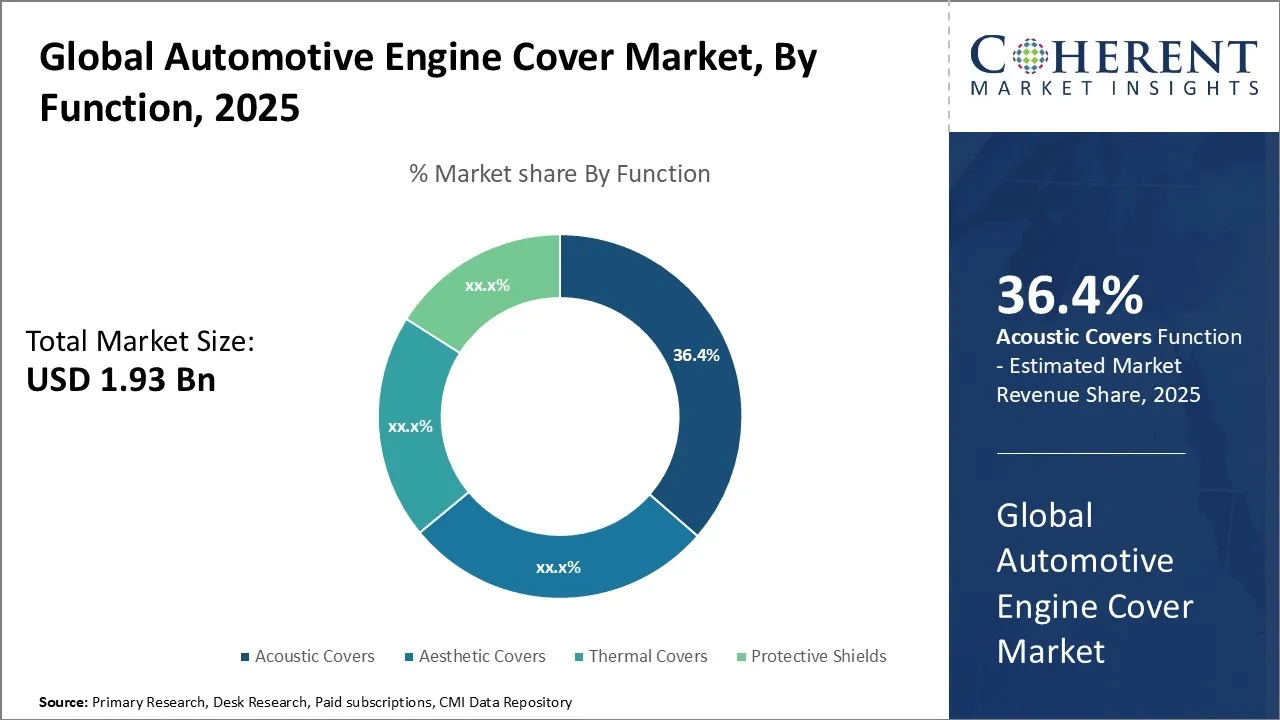
Global Automotive Engine Cover Market Insights, By Function – Rising Demand for Noise Reduction Fuels the Growth of Acoustic Covers Segment
The acoustic covers segment is projected to account for 37.4% share in 2026. With stringent regulations globally aimed at minimizing noise pollution, automotive manufacturers are prioritizing the integration of acoustic covers to reduce engine noise and vibrations. Furthermore, advancements in material technology have allowed for the production of lightweight yet efficient acoustic covers, which do not add significant weight to the vehicle. The ability of these covers to serve dual purposes—sound insulation and thermal protection—also enhances their appeal.
Consumer expectations for premium vehicle interiors also play a pivotal role in driving the adoption of acoustic covers. As buyers increasingly demand comfort features traditionally associated with luxury cars, acoustic covers have become a standard inclusion across a wider vehicle range, from economy to high-end models. Automakers are also investing in research and development to optimize the design and placement of acoustic covers, improving their efficiency in sound attenuation without compromising engine performance or maintenance access. The durability and ease of installation of acoustic covers add to their preference, confirming their critical role in the aftermarket and OEM segments.
End User Feedback and Unmet Needs in the Automotive Engine Cover Market
- Vehicle owners frequently note that while acoustic covers reduce engine noise, they often add weight, highlighting the unmet need for lighter materials with equal or better Noise, Vibration, and Harshness (NVH) performance.
- Maintenance professionals report frustration with engine covers that are difficult to remove, pointing to the demand for user-friendly designs that balance functionality with ease of serviceability.
- End users increasingly expect sustainable, recyclable, and aesthetically appealing engine covers, yet many current solutions fall short in integrating eco-friendly materials without compromising durability or cost.
Regional Insights
North America Automotive Engine Cover Market Analysis and Trends
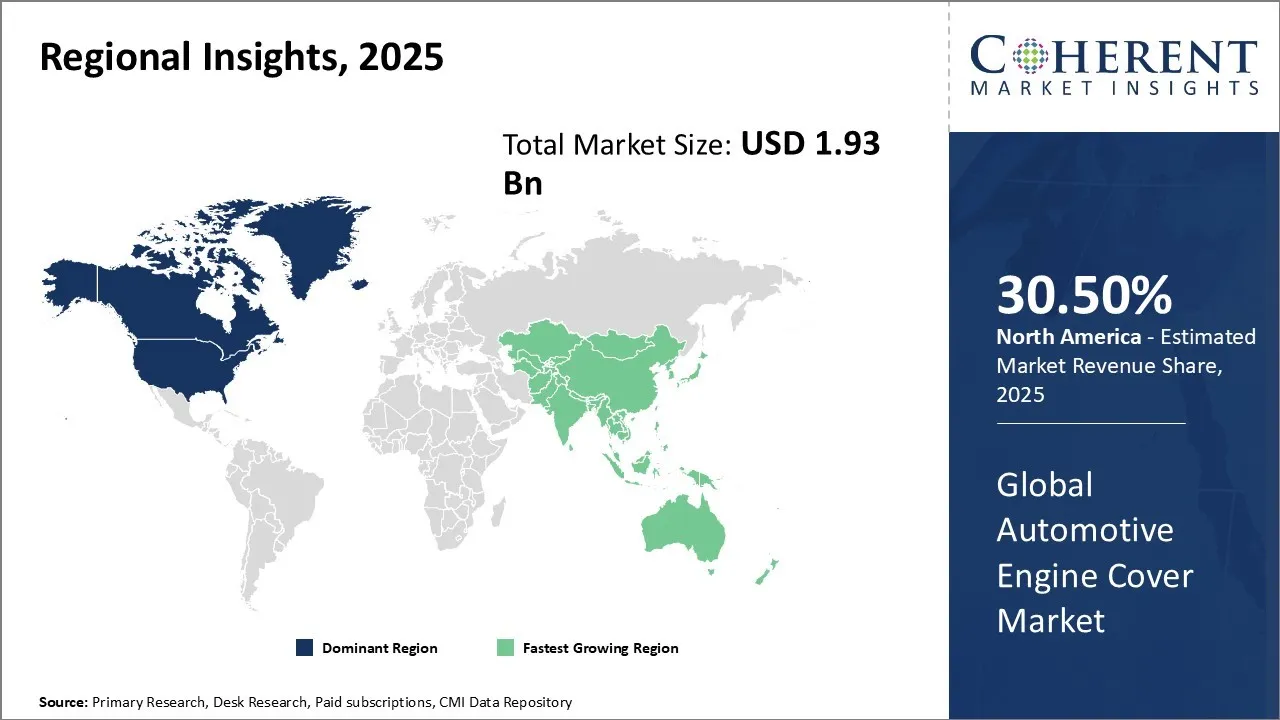
The North America region is projected to lead the market with a 30.50% share in 2026, influenced by advanced automotive technologies and stringent regulatory norms on emissions and engine noise reduction. The strong presence of major Original Equipment Manufacturers (OEMs) like Ford, General Motors, and Stellantis, alongside a thriving aftermarket segment, drives the demand for enhanced engine covers.
Government policies aimed at promoting greener vehicles and lightweight materials spur innovation and product adoption. Moreover, trade agreements and well-established supplier networks foster market expansion. Companies such as BorgWarner and Federal-Mogul (a Tenneco company) are key players delivering technologically advanced engine covers that cater to regional requirements concerning durability, efficiency, and environmental compliance.
Asia Pacific Automotive Engine Cover Market Analysis and Trends
The Asia Pacific region holding an estimated share of 28.2% in 2026, exhibits the fastest growth in the market. Countries like China, Japan, India, and South Korea are home to numerous automobile production plants, supporting a robust supply chain for engine components, including engine covers. The region benefits from government initiatives promoting electric and fuel-efficient vehicles, which necessitate advanced engine covers to meet new performance and emission standards.
Additionally, trade dynamics favor Asia Pacific due to its integration into global automotive supply chains and cost-efficient manufacturing capabilities. Prominent companies like Denso Corporation (Japan), Hyundai Mobis (South Korea), and Motherson Sumi Systems (India) have significantly invested in R&D and production facilities in this region, consolidating its leadership. Their innovations in lightweight materials and noise reduction contribute to the market growth and product advancement.
Global Automotive Engine Cover Market Outlook for Key Countries
China Automotive Engine Cover Market Analysis and Trends
China stands as the backbone of the Asia Pacific region's dominance. The country’s massive automotive production volume, coupled with increasing consumer preference for electric and hybrid vehicles, fuels the demand for innovative engine covers. Chinese manufacturers like Wanxiang Group and Yuchai Machinery actively collaborate with global automotive giants to supply components tailored to rigorous emission norms. Government policies emphasizing "Made in China 2026" and subsidies for clean energy vehicles encourage integration of durable and sound-insulating engine covers, enhancing vehicle performance and compliance.
Japan Automotive Engine Cover Market Analysis and Trends
Japan continues to lead with its advanced automotive technology and well-established OEMs, including Toyota, Honda, and Nissan, which demand high-quality engine covers to optimize engine performance and reduce noise. Japanese companies such as Denso and Aisin Seiki have pioneered the use of composite and lightweight materials in engine covers. The country's stringent environmental regulations and focus on hybrid technology promote continuous product innovation, bolstering the market. Japan's mature supply chain and export-oriented production also strengthen its position in the market.
India Automotive Engine Cover Market Analysis and Trends
India automotive engine cover market is rapidly expanding, driven by a growing domestic automotive industry and rising exports. Companies like Motherson Sumi and Sundaram Clayton are essential contributors, leveraging cost advantages and government initiatives such as the Automotive Mission Plan. The shift towards BS-VI emission standards and enhanced consumer awareness about vehicle durability increase the demand for sophisticated engine covers. India’s strategic location and expanding industrial infrastructure attract foreign investments, further bolstering the market growth.
U.S. Automotive Engine Cover Market Analysis and Trends
The U.S. reflects the highest growth momentum due to rigorous regulatory standards on emissions and sound pollution, prompting OEMs and aftermarket suppliers to adopt advanced engine cover technologies. Major automakers like Ford and GM focus on integrating engine covers that improve thermal management and reduce under-hood noise. Suppliers such as Federal-Mogul and Dana Incorporated provide innovative polymer and metal engine covers designed for durability and lightweight properties. Government incentives for electric and hybrid vehicle production also play a critical role in shaping the demand in this market.
Germany Automotive Engine Cover Market Analysis and Trends
Germany is a critical hub in Europe automotive engine cover market landscape, with globally renowned automakers including Volkswagen, BMW, and Mercedes-Benz driving the demand for premium engine covers. The country emphasizes sustainable and efficient automotive technologies, fostering innovation in lightweight composites and thermal insulation in engine cover design. Companies such as Mahle GmbH and ElringKlinger contribute advanced products that comply with stringent European Union emission and noise regulations. Germany’s extensive R&D infrastructure and strong export orientation sustain its significant influence on the market.
Market Players, Key Development, and Competitive Intelligence
Key Developments
- In February 2025, a global investment firm, Carlyle, entered the Indian auto components industry by setting up a platform through two acquisitions. The deal size is about USD 400 million where Carlyle will own 65-70% stake in the platform. The U.S. fund has acquired a controlling stake in Highway Industries and Roop Automotives, through its Asia focused buyout fund Carlyle Asia Partners (CAP).
- In November 2024, Standard Motor Products, Inc., a leading automotive parts manufacturer and distributor, announced the completion of the acquisition of AX V Nissens III APS, a leading European manufacturer and distributor of aftermarket engine cooling and air conditioning products with a growing array of vehicle control technologies.
Top Strategies Followed by Automotive Engine Cover Market Players
- Established market leaders generally invest heavily in research and development to innovate high-performance engine covers that meet the evolving needs of modern vehicles.
- Faurecia (FORVIA) launched its MATERI’ACT NAFILean Vision bio-composites (June 2025), developed after sustained R&D investment, to deliver lightweight, sustainable solutions for under-hood applications including engine covers.
- Mid-level players in the automotive engine cover market adopt a different approach by focusing on delivering cost-effective solutions that balance quality with affordability.
- Samvardhana Motherson Group, expanding its plastics and components portfolio by acquiring regional molding firms to produce cost-efficient plastic modules, targeting OEMs in cost-sensitive markets like India and ASEAN.
- Small-scale players typically carve out niche positions by focusing on specialized features or highly innovative products that cater to specific customer needs.
- Röchling Automotive, developed advanced lightweight acoustic shielding covers using LWRT hybrid composites, specifically aimed at premium and EV platforms requiring superior NVH control.
Market Report Scope
Automotive Engine Cover Market Report Coverage
| Report Coverage | Details | ||
|---|---|---|---|
| Base Year: | 2025 | Market Size in 2026: | USD 2.04 Bn |
| Historical Data for: | 2020 To 2024 | Forecast Period: | 2026 To 2033 |
| Forecast Period 2026 to 2033 CAGR: | 5.6% | 2033 Value Projection: | USD 2.98 Bn |
| Geographies covered: |
| ||
| Segments covered: |
| ||
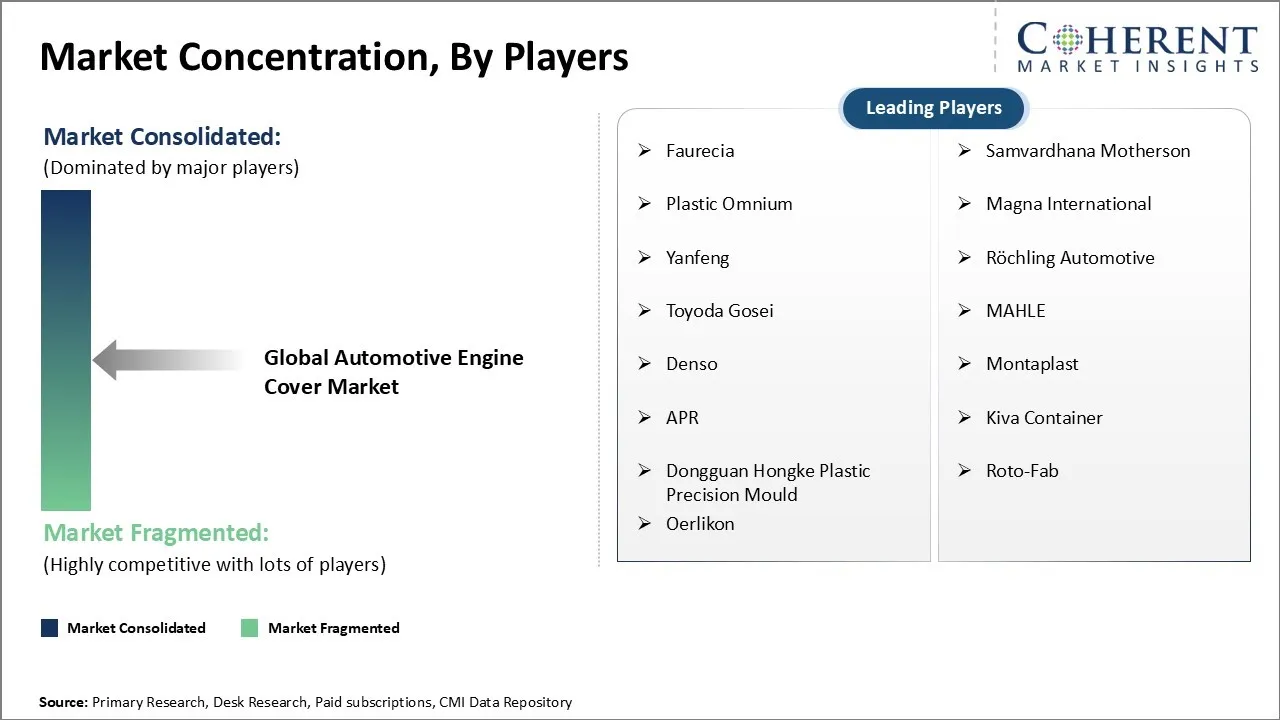
| Companies covered: | Faurecia, Samvardhana Motherson, Plastic Omnium, Magna International, Yanfeng, Röchling Automotive, Toyoda Gosei, MAHLE, Denso, Montaplast, APR, Kiva Container, Dongguan Hongke Plastic Precision Mould, Roto-Fab, and Oerlikon | ||
| Growth Drivers: |
| ||
| Restraints & Challenges: |
| ||
Market Dynamics
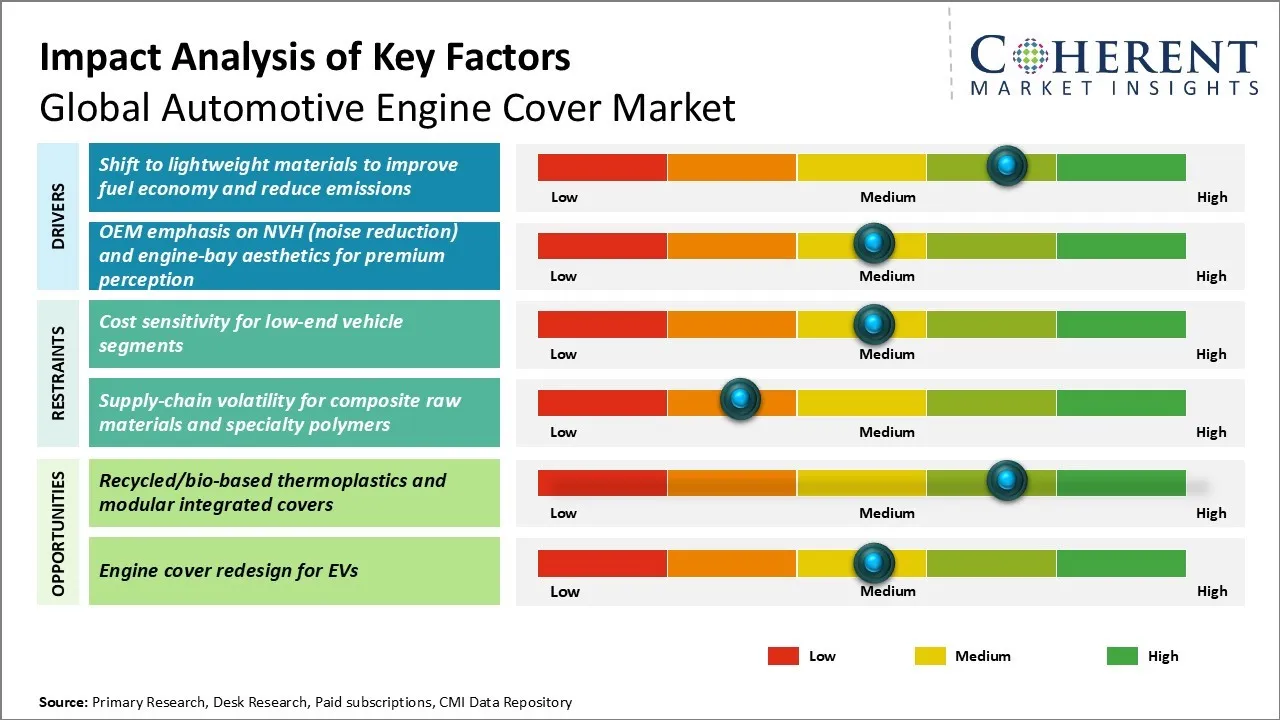
Global Automotive Engine Cover Market Driver - Shift to Lightweight Materials to Improve Fuel Economy and Reduce Emissions
The increasing emphasis on environmental sustainability and stringent regulatory norms globally have intensified the automotive industry's focus on reducing vehicle weight, driving a significant shift towards lightweight materials in engine cover manufacturing. Traditional heavy metals are progressively being replaced by advanced composites, aluminum alloys, and high-strength plastics that offer comparable durability while significantly reducing mass. Magna International, with BASF, has develop Ultramid Advanced polyamide composite engine covers, which are significantly lighter than metal alternatives while maintaining durability and heat resistance.
Automakers are also motivated by the need to comply with evolving emission standards and meet consumer demand for greener, more efficient vehicles. Furthermore, the adoption of lightweight engine covers supports enhanced engine performance through better thermal management and vibration damping, reinforcing their critical role in modern vehicles.
Global Automotive Engine Cover Market Opportunity – Recycled/Bio-based Thermoplastics and Modular Integrated Covers
As environmental regulations become stricter and consumer demand for sustainable automotive components increases, manufacturers are increasingly exploring eco-friendly materials to reduce carbon footprints and enhance vehicle recyclability. Recycled thermoplastics, derived from post-consumer and post-industrial waste, offer a cost-effective and sustainable alternative to traditional petroleum-based plastics without compromising durability and thermal resistance essential for engine covers. Similarly, bio-based thermoplastics sourced from renewable biomass such as corn starch and sugarcane present a viable solution to decrease dependency on fossil fuels while aligning with the global sustainability agenda. FORVIA (Faurecia) MATERI’ACT launched the NAFILean Vision line in June 2025, a bio-composite made from natural fibers and recycled plastics. It is being designed for under-hood and structural parts, including engine covers, providing OEMs with sustainable and modular solutions to meet circular-economy and Scope-3 emissions targets.
Alongside material innovation, the shift towards modular integrated engine covers presents a compelling opportunity to streamline production processes, reduce assembly costs, and improve aftermarket serviceability. These covers combine multiple functional elements, such as heat shields, sound insulators, and aesthetic panels, into a single integrated unit, thereby enhancing design flexibility and reducing vehicle weight. The integration of advanced materials with modular design is expected to drive product differentiation and support automakers’ goals for lightweight, eco-friendly, and cost-efficient engine components, reinforcing growth prospects in this evolving the market segment.
Analyst Opinion (Expert Opinion)
- Composites are emerging as the premium choice for engine covers due to their superior heat resistance, acoustic dampening, and weight-saving advantages, making them especially attractive in premium and performance vehicle segments.
- Thermoplastics remain the dominant volume material, as their cost-effectiveness, recyclability, and compatibility with high-speed injection molding cater to mass-market passenger cars where affordability and scalability are key.
- Metals, while declining in share, still hold relevance in heavy-duty and commercial vehicles where extreme durability and structural rigidity are prioritized over lightweighting, though even here hybrid metal-polymer solutions are gaining ground.
Speak to the analyst
Want personalized insights?
Take the findings above to one of our principal consultants, or have the report rebuilt around the segments, geographies and competitors you actually track.
Market Segmentation
- Function Insights (Revenue, USD Bn, 2021 - 2033)
- Acoustic Covers
- Aesthetic Covers
- Thermal Covers
- Protective Shields
- Regional Insights (Revenue, USD Bn, 2021 - 2033)
- North America
- U.S.
- Canada
- Latin America
- Brazil
- Argentina
- Mexico
- Rest of Latin America
- Europe
- Germany
- U.K.
- Spain
- France
- Italy
- Russia
- Rest of Europe
- Asia Pacific
- China
- India
- Japan
- Australia
- South Korea
- ASEAN
- Rest of Asia Pacific
- Middle East
- GCC Countries
- Israel
- Rest of Middle East
- Africa
- South Africa
- North Africa
- Central Africa
- North America
- Key Players Insights
- Faurecia
- Samvardhana Motherson
- Plastic Omnium
- Magna International
- Yanfeng
- Röchling Automotive
- Toyoda Gosei
- MAHLE
- Denso
- Montaplast
- APR
- Kiva Container
- Dongguan Hongke Plastic Precision Mould
- Roto-Fab
- Oerlikon
Sources
Primary Research Interviews
Stakeholders
- Automotive OEMs
- Tier-1 Component Suppliers
- Material Suppliers (Polymer/Composite Producers – BASF, SABIC, Lanxess – Application Engineers)
- Automotive Design Engineers (specializing in NVH and thermal management)
- Aftermarket Engine Cover Manufacturers and Distributors
- Automotive Recycling and Sustainability Experts (focused on bio-based and recycled thermoplastics)
Databases
- Eurostat
- U.S. International Trade Commission Automotive Data
- OECD Transport and Automotive Statistics
- ACEA (European Automobile Manufacturers’ Association) Vehicle Production Data
Magazines
- Automotive Manufacturing Solutions
- Plastics Today (Automotive Section)
- Automotive World
- Lightweight Materials for Automotive Magazine
Journals
- SAE International Journal of Materials and Manufacturing
- Journal of Automotive Engineering and Technology
- Composite Structures Journal
- Journal of Polymer Engineering
Newspapers
- Automotive News (U.S.)
- The Economic Times (India – Auto Section)
- Nikkei Asia (Automotive Coverage)
- The Guardian (U.K. – Business & Automotive)
Associations
- Society of Automotive Engineers (SAE)
- Automotive Components Manufacturers Association of India (ACMA)
- European Automobile Manufacturers’ Association (ACEA)
- American Composites Manufacturers Association (ACMA)
- International Organization of Motor Vehicle Manufacturers (OICA)
Public Domain Sources
- U.S. Census Bureau (Automotive Manufacturing Data)
- EUROSTAT (Automotive & Plastics Production Statistics)
- United Nations Economic Commission for Europe (UNECE Vehicle Regulations)
- World Bank (Automotive and Industrial Indicators)
- ResearchGate (Academic studies on NVH and lightweight materials)
Proprietary Elements
- CMI Data Analytics Tool
- Proprietary CMI Existing Repository of information for last 8 years
Get access to 250+ pages report
Every segment, forecast, competitor profile and data table behind the analysis above — available for instant download.
- ESOMAR Member
- ISO 9001:2015 Certified
- D-U-N-S Registered
- GDPR & CCPA Compliant
Missing comfort of reading report in your local language? Find your preferred language:
Transform your Strategy with Exclusive Trending Reports
Frequently Asked Questions
The global automotive engine cover market is estimated to be valued at USD 2.04 Bn in 2026 and is expected to reach USD 2.98 Bn by 2033.
The CAGR of the global automotive engine cover market is projected to be 5.6% from 2026 to 2033.
Shift to lightweight materials to improve fuel economy and reduce emissions and OEM emphasis on NVH (noise reduction) and engine-bay aesthetics for premium perception are the major factors driving the growth of the global automotive engine cover market.
Cost sensitivity for low-end vehicle segments and supply-chain volatility for composite raw materials and specialty polymers are the major factors hampering the growth of the global automotive engine cover market.
In terms of function, the acoustic covers segment is estimated to dominate the market revenue share in 2026.
Faurecia, Samvardhana Motherson, Plastic Omnium, Magna International, Yanfeng, Röchling Automotive, Toyoda Gosei, MAHLE, Denso, Montaplast, APR, Kiva Container, Dongguan Hongke Plastic Precision Mould, Roto-Fab, and Oerlikon are the major players.
North America is expected to lead the global automotive engine cover market in 2026.