

Global Base Station Market Size and Forecast – 2026-2033
The global base station market is estimated to be valued at USD 122.82 Bn in 2026 and is expected to reach USD 611.02 Bn by 2033, exhibiting a compound annual growth rate (CAGR) of 25.8% from 2026 to 2033.
Key Takeaways of the Global Base Station Market
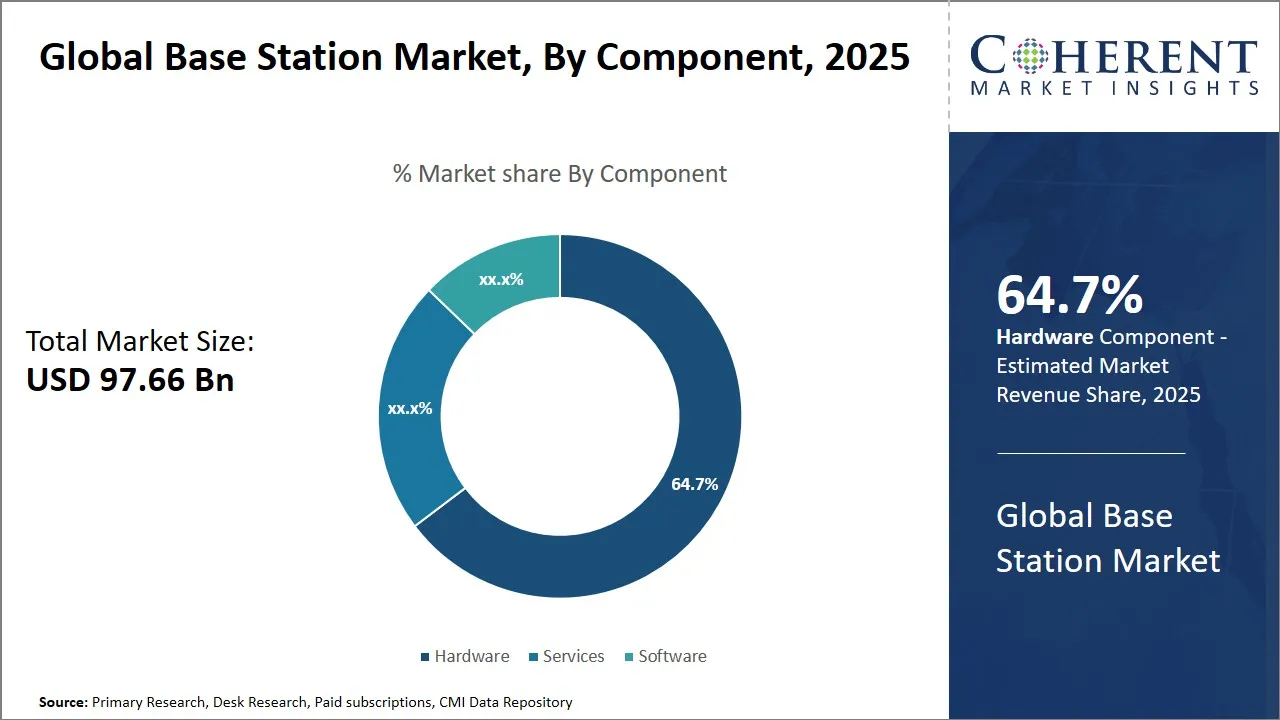
- The hardware segment is expected to lead the market holding a share of 65.7 % in 2026.
- The macro cells segment is projected to dominate with a share of 63.6 % in 2026.
- The 4G base stations segment leads the market holding an estimated share of 49.9 % in 2026.
- Asia Pacific, holding an expected share of 53.94 % in 2026, dominates the market.
- North America, holding an estimated share of 23.66 % in 2026, is projected to show the fastest growth in the market.
Market Overview
The market is highly influenced by fast advancements in telecommunication technologies, especially the widespread deployment of 5G networks, which needs a high increase in base station installations. Also, the adoption of Internet of Things (IoT) devices and smart city initiatives are propelling the demand for more efficient and higher-capacity base stations. Vendors are focusing a lot on energy-efficient solutions and software-defined networking to optimize performance and reduce operational costs, shaping the future landscape of the base station market.
Current Events and Its Impact
Current Events | Description and its Impact |
Geopolitical and Trade Developments |
|
Economic & Infrastructure Trends |
|
Segmental Insights
- Current Industry Events of 2026
- Market Size Estimation
- Regional Breakdown
- Competitive Landscape
- Customer Intelligence
- Segmental Analysis
- Pricing Analysis
- Key Market Drivers, Challenges & Future Trends
- Customized Insights Section
Global Base Station Market Insights, By Component – Hardware Dominance in Base Station Components Because of Network Infrastructure Expansion
The hardware segment, holding 65.7% of the market share in 2026, is expected to lead because of its indispensable role in telecom infrastructure. This includes antennas, RF modules, and baseband units making the physical core of base stations. The growth is propelled by fast 5G rollout and network densification, especially across developing regions. Continuous hardware upgrades are needed for 5G modernization while maintaining backward compatibility with 4G. In 2024, Nokia launched its AirScale baseband portfolio, improving performance and reducing power consumption, a move showing industry-wide hardware innovation trends.
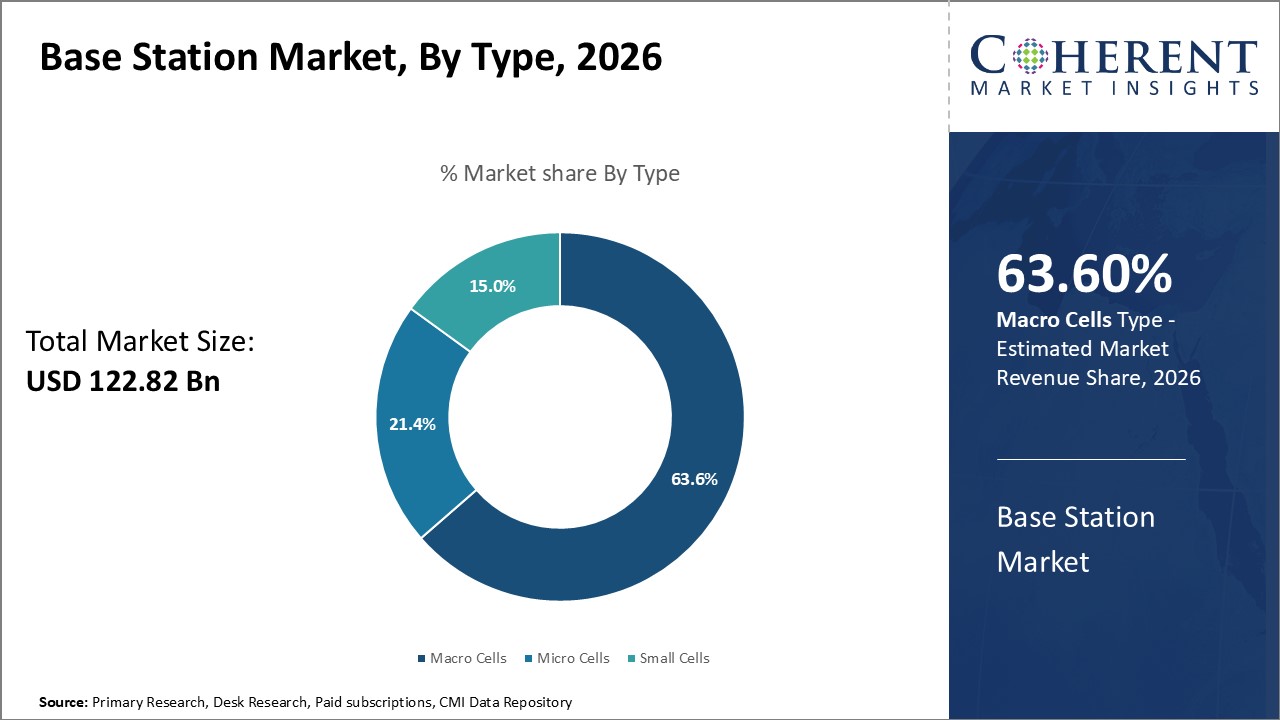
Global Base Station Market Insights, By Type – Macro Cells Lead Because of Their Wide Coverage and Network Reliability
Macro cells, accounting for 63.6% share in 2026, is expected to dominate because of their wide coverage and cost-effectiveness in large-area deployments. They make the foundation of mobile networks, ensuring connectivity across both rural and urban zones. Operators choose macro cells for stable, large-scale service and reduced operational complexity compared to small-cell networks. AT&T grew its macro cell network across rural U.S. states in 2024 as part of its 5G coverage initiative, improving service quality and reliability in underserved regions.
Global Base Station Market Insights, By Cellular Network Type – 4G Base Stations Retain Leading Position Because of Massive User Base and Network Stability
4G base stations, with an estimated 49.9% of the market share in 2026, remain dominant because of their massive global user base and dependable performance. Despite growing 5G adoption, many operators continue optimizing 4G networks to handle heavy data demand in regions where 5G penetration is still limited. Upgrades to 4G infrastructure allow network stability and cost efficiency. Reliance Jio (India) is continuing to grow its 4G infrastructure alongside 5G, ensuring seamless connectivity for its big rural customer base.
Pricing Analysis of the Global Base Station Market
Segment | Price Range/Typical Unit Cost |
Macro-cell 5G base-station (complete site, outdoor) | ≈ USD 100,000 – USD 200,000 per site |
5G base-station hardware (RRU/BBU modules) | Example: USD 29,000 for 5G NR BBU (China OEM) |
Smaller module/equipment listing (micro or RRU) | USD 849–USD 900 (Alibaba listing for RRU) |
Historical 4G-era base-station cost (BBU) | USD 7,461 to USD 54,773 |
Regional Insights
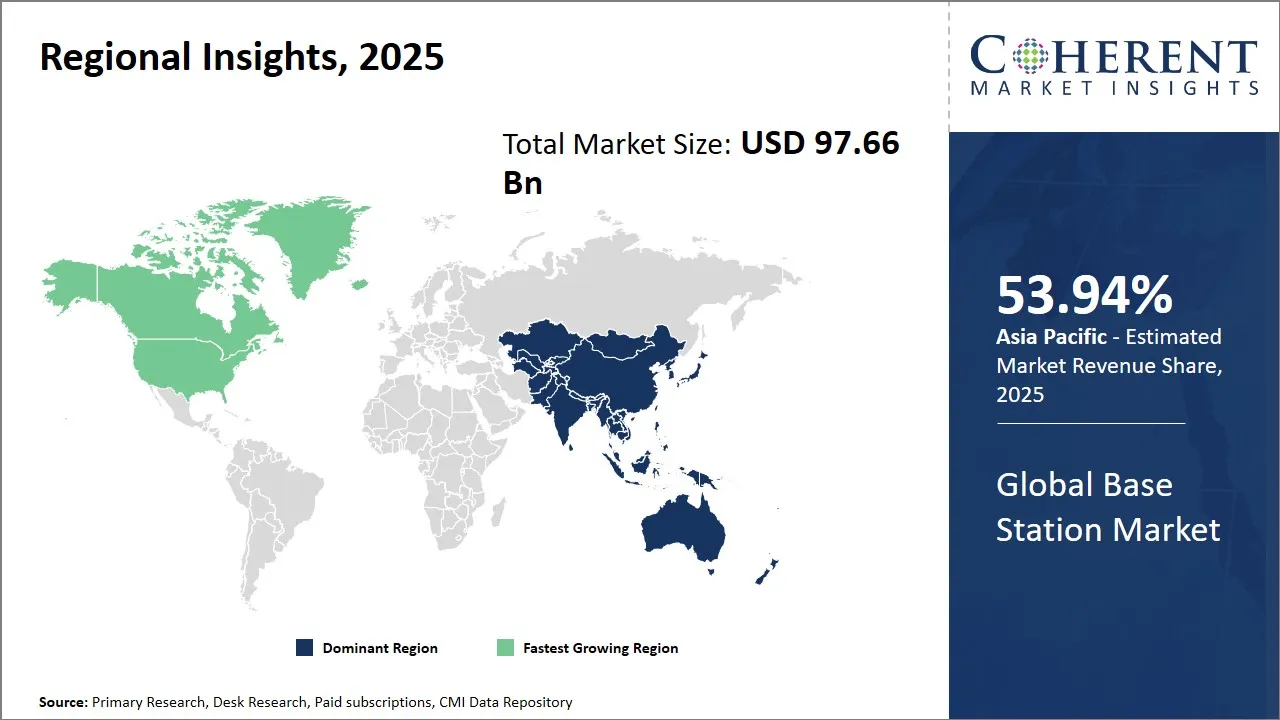
Asia Pacific Base Station Market Analysis and Trends
The Asia Pacific region, holding an estimated share of 53.94% in 2026, dominates the global base station market, driven by the massive telecom infrastructure developments and significant investments in 5G deployment by countries such as China, Japan, and South Korea. The region sees a strong market ecosystem comprising leading telecom operators, equipment manufacturers, and technology innovators. Strong government support in terms of supportive policies, spectrum allocation, and subsidies add to infrastructure expansion. The presence of big base station manufacturers like Huawei, ZTE, and Samsung in Asia Pacific fosters technological advancements and competitive pricing. Also, a large, growing consumer base with increasing demand for high-quality connectivity further solidifies the region’s leadership.
North America Base Station Market Analysis and Trends
North America, holding a share of 23.66% in 2026, is expected to show the fastest growth in the global base station market, driven by large-scale 5G deployments, network modernization, and the rapid adoption of edge and cloud-native RAN solutions. The U.S. and Canada are at the forefront of network innovation, with big telecom operators such as Verizon, AT&T, and T-Mobile investing heavily in expanding 5G coverage and upgrading existing 4G LTE infrastructure.
Supportive regulatory initiatives by the Federal Communications Commission (FCC) and increasing enterprise demand for private 5G networks further add to market momentum. Also, collaborations between global technology leaders like Qualcomm, Samsung, and Nokia are making the ecosystem stronger through advanced base station hardware and software innovation. The region’s strong digital economy, added with ongoing smart infrastructure projects and the integration of IoT and AI technologies, continues to reinforce North America’s position as a key growth hub in the global market.
Global Base Station Market Outlook for Key Countries
China Base Station Market Analysis and Trends
China base station market sees the extensive presence of base station manufacturers such as Huawei and ZTE, which dominate both domestic and international markets with comprehensive product portfolios. The government’s promotion of 5G infrastructure, through initiatives like “Made in China 2026,” streamlines the adoption of advanced base station technologies. Telecom giants like China Mobile and China Telecom continuously expand network coverage and capacity. The country's strong manufacturing base added with large-scale deployments underpins China’s leadership position and fosters innovation in energy-efficient and massive MIMO base stations.
U.S. Base Station Market Analysis and Trends
The U.S. base station market sees the involvement of big telecom operators such as Verizon, AT&T, and T-Mobile, which play crucial roles in driving infrastructure modernization and 5G rollout. Key industry players including Nokia, Ericsson, and Cisco provide cutting-edge base station solutions tailored for complex urban environments. Government policies supporting spectrum auctions and infrastructure investments add to market expansion. Robust research and development activities, alongside a mature market ecosystem, stimulate innovation in small cells, open RAN technologies, and network virtualization.
India Base Station Market Analysis and Trends
India base station market grows because of both government and private sector efforts to improve rural and urban connectivity simultaneously. The government's initiatives like Digital India and BharatNet aim to increase broadband access, accelerating base station deployment. Indian telecom operators such as Reliance Jio, Bharti Airtel, and Vodafone Idea are growing their network footprints with support from equipment manufacturers like Ericsson, Huawei, and Samsung. The competitive telecom landscape pushes cost-efficient infrastructure rollouts, while local manufacturing and assembly units are gaining traction because of import policy incentives.
South Korea Base Station Market Analysis and Trends
South Korea continues to lead because of early adoption and high deployment of advanced telecom networks, making it a technology hotspot in the base station market. Big companies like Samsung Electronics have pioneered 5G base stations, using cutting-edge technology to ensure exceptional network performance. Government policies support R&D and nationwide 5G infrastructure, with KT, SK Telecom, and LG Uplus as dominant service providers fueling demand. The country’s highly connected population and dense urban centers add to the need for sophisticated base station solutions, making South Korea a hub of innovation.
U.A.E. Base Station Market Analysis and Trends
The U.A.E. base station market is growing fast, because of strong governmental initiatives focused on smart cities, IoT, and 5G ecosystems. Telecommunications providers such as Etisalat and Du are investing a lot in upgrading network infrastructure to support the country’s vision for a digital economy. Partnerships with global players like Ericsson and Nokia add to the availability of advanced base station technologies. The U.A.E. sees open trade policies and strategic location, making possible faster deployment and technology adoption. The concentration of enterprise and consumer demand in urban hubs further adds to network expansion efforts.
Market Players, Key Development, and Competitive Intelligence
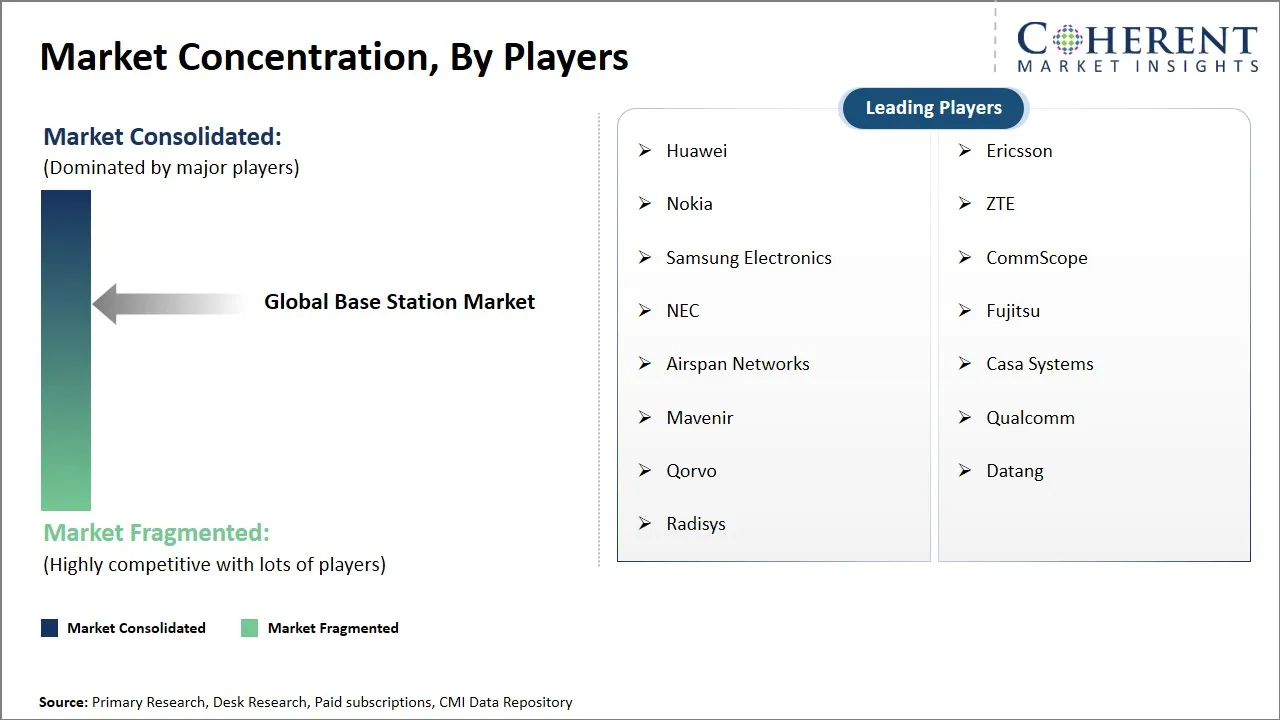
Key Developments
- In October 2025, NVIDIA and Nokia announced a strategic partnership to add NVIDIA-powered, commercial-grade AI-RAN products to Nokia’s industry-leading RAN portfolio, enabling communication service providers to launch AI-native 5G-Advanced and 6G networks on NVIDIA platforms.
- In June 2025, Ericsson and Telstra announced the commercial deployment of the AIR 3284, the world’s first 5G triple-band FDD Massive MIMO radio, delivering a step-change in coverage, capacity, and performance that will serve as a cornerstone of Telstra’s four-year network transformation.
- In June 2025, Leading telecom operator, Vodafone Idea (Vi), announced the commercial launch of 5G services by partnering with Samsung Electronics Co., Ltd. in Bengaluru region, one of the key telecom markets in India and a global IT hub known as the "Silicon Valley of India".
- In November 2024, SK Telecom detailed a plan to deploy an AI-based 5G optimization technology developed with Samsung after verifying it improved the performance of sites in its commercial network. The pair complied data from its networks using AI and deep learning, which can predict various wireless environments and service characteristics and determine optimal parameters for improving quality.
Top Strategies Followed by Base Station Market Players
- Established players dominate the sector by investing a lot in research and development (R&D) to innovate high-performance products that meet the evolving demands of telecommunications providers.
- Ericsson invests over USD 4.5 billion annually in R&D and launched its “Radio 6646” triple-band 5G radio and AI-driven RAN Energy Smartness programs in March 2025.
- Mid-level players in the base station market adopt a different, yet complementary approach largely focused on delivering cost-effective solutions that strike a balance between quality and affordability.
- ZTE’s ultra-economical 5G NR base stations are aimed at developing markets that cut site costs by ~30%.
- Small-scale players in the global base station market carve out niches by concentrating on specialized features or highly innovative products that cater to specific customer demands.
- Parallel Wireless focuses on rural coverage and small-cell Open RAN deployments in Africa and the Middle East.
Market Report Scope
Base Station Market Report Coverage
| Report Coverage | Details | ||
|---|---|---|---|
| Base Year: | 2025 | Market Size in 2026: | USD 122.82 Bn |
| Historical Data for: | 2020 To 2024 | Forecast Period: | 2026 To 2033 |
| Forecast Period 2026 to 2033 CAGR: | 25.8% | 2033 Value Projection: | USD 611.02 Bn |
| Geographies covered: |
| ||
| Segments covered: |
| ||
| Companies covered: | Huawei, Ericsson, Nokia, ZTE, Samsung Electronics, CommScope, NEC, Fujitsu, Airspan Networks, Casa Systems, Mavenir, Qualcomm, Qorvo, Datang, and Radisys | ||
| Growth Drivers: |
| ||
| Restraints & Challenges: |
| ||
Market Dynamics
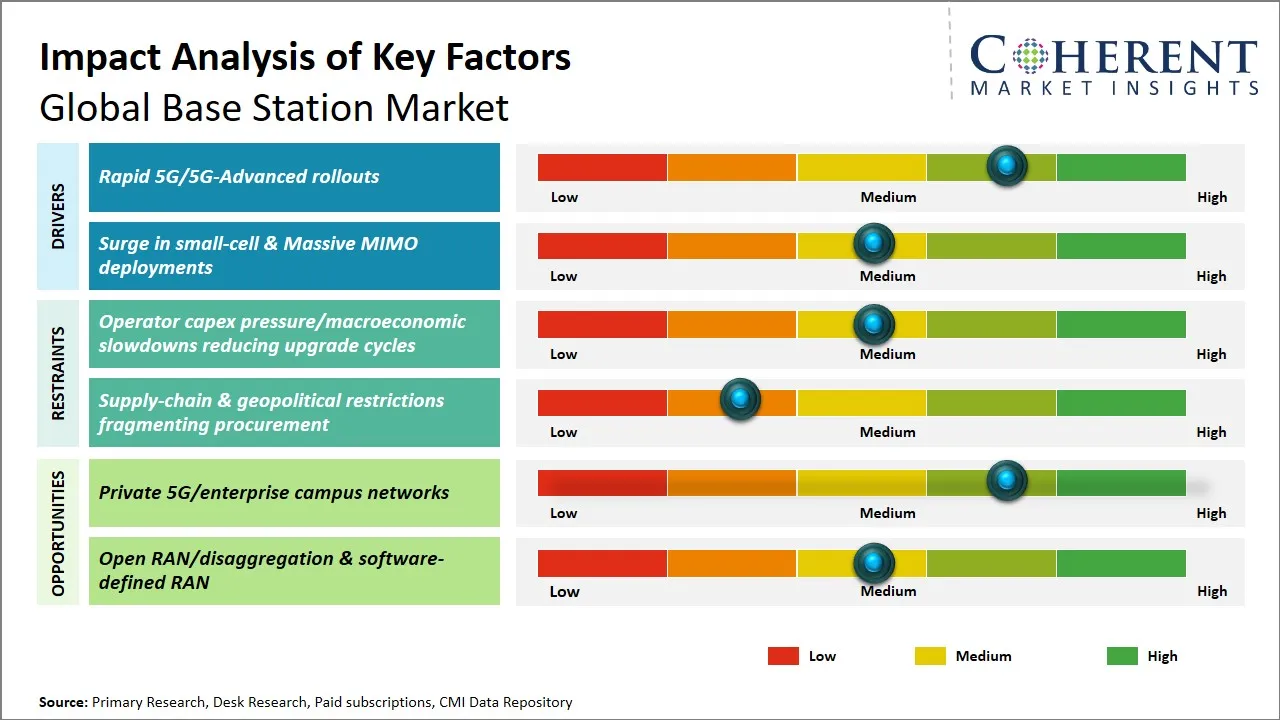
Global Base Station Market Driver – Rapid 5G/5G-Advanced Rollouts
The accelerated rollout of 5G and 5G-Advanced networks is a key growth driver for the global base station market. Operators are rapidly upgrading from 4G to 5G to meet the need for ultra-low latency, high-speed data, and massive connectivity. These upgrades demand a surge in new base station deployments, especially to handle higher frequency bands and denser network requirements. The move toward 5G-Advanced, adding AI and improved spectral efficiency, is pushing vendors to deliver smarter, high-performance base stations. In 2024, China Mobile deployed over 1.8 million 5G base stations, showing the global acceleration toward advanced network infrastructure.
Global Base Station Market Opportunity – Private 5G/Enterprise Campus Networks
The growth of private 5G and enterprise campus networks presents a big market opportunity as industries seek secure, low-latency, and high-reliability wireless systems. Sectors like manufacturing, healthcare, and logistics are increasingly using private 5G to power automation, IoT, and edge-based operations. Supportive spectrum policies and addition of technologies like network slicing and edge computing are further adding to enterprise investment in dedicated base stations. In 2025, Ericsson and BMW Group expanded their private 5G network partnership in Germany to enable advanced smart manufacturing and automated logistics, demonstrating growing enterprise adoption.
Analyst Opinion (Expert Opinion)
- After years of aggressive 5G rollouts, operators are tightening budgets, resulting in a visible slowdown in new base-station orders. Despite vendors pushing 5G-Advanced and Open RAN innovations, the truth is that telcos remain cautious—ROI from 5G investments hasn’t yet matched expectations. This financial fatigue is creating a strategic bottleneck for further large-scale deployments.
- The industry is being pulled apart by regionalization. U.S.–China tensions, export restrictions on semiconductors, and vendor bans in parts of Europe have fractured the once-global supply ecosystem. Vendors now face dual challenges: securing component continuity while adapting to country-specific vendor policies—an expensive and logistically painful process that disproportionately hurts non-diversified suppliers.
- While Open RAN promises flexibility and competition, deployment complexity and performance gaps persist. Many operators are realizing that integration costs and multi-vendor interoperability issues are higher than expected. The narrative of rapid democratization is meeting the practical reality of delayed commercial rollouts, leaving smaller vendors struggling to scale and larger ones hesitant to fully commit.
Speak to the analyst
Want personalized insights?
Take the findings above to one of our principal consultants, or have the report rebuilt around the segments, geographies and competitors you actually track.
Market Segmentation
- Component Insights (Revenue, USD Bn, 2021 - 2033)
- Hardware
- Services
- Software
- Type Insights (Revenue, USD Bn, 2021 - 2033)
- Macro Cells
- Micro Cells
- Small Cells
- Cellular Network Type Insights (Revenue, USD Bn, 2021 - 2033)
- 4G Base Stations
- 5G Base Stations
- 2G/3G Base Stations
- Base Station Architectures Insights (Revenue, USD Bn, 2021 - 2033)
- Non-Standalone Base Station
- Standalone Base Station
- Application Insights (Revenue, USD Bn, 2021 - 2033)
- Commercial
- Industrial
- Residential
- Regional Insights (Revenue, USD Bn, 2021 - 2033)
- North America
- U.S.
- Canada
- Latin America
- Brazil
- Argentina
- Mexico
- Rest of Latin America
- Europe
- Germany
- U.K.
- Spain
- France
- Italy
- Russia
- Rest of Europe
- Asia Pacific
- China
- India
- Japan
- Australia
- South Korea
- ASEAN
- Rest of Asia Pacific
- Middle East
- GCC Countries
- Israel
- Rest of Middle East
- Africa
- South Africa
- North Africa
- Central Africa
- North America
- Key Players Insights
- Huawei
- Ericsson
- Nokia
- ZTE
- Samsung Electronics
- CommScope
- NEC
- Fujitsu
- Airspan Networks
- Casa Systems
- Mavenir
- Qualcomm
- Qorvo
- Datang
- Radisys
Sources
Primary Research Interviews
Stakeholders
- Network Infrastructure Providers and Operators (e.g., Ericsson, Huawei, Nokia, ZTE, Samsung Networks)
- Telecom Tower Companies and Site Management Firms (e.g., American Tower, Helios Towers)
- Radio Access Network (RAN) Equipment Suppliers and Integrators
- Telecom Engineers and Field Deployment Contractors
- Semiconductor and RF Component Manufacturers (e.g., Qualcomm, Qorvo, Broadcom)
- Cloud & Edge Computing Service Providers involved in vRAN/ORAN implementation
- 5G Private Network System Integrators and Enterprise IT Managers
- Regulatory Experts and Spectrum Policy Advisors
Databases
- International Telecommunication Union (ITU)
- GSMA Intelligence
- World Bank Digital Infrastructure Statistics
- U.S. Federal Communications Commission (FCC) Database
- European Telecommunications Standards Institute (ETSI) Archives
- OECD Telecommunications Data Repository
- Telecom Regulatory Authority of India (TRAI) Open Data Portal
Magazines
- Telecom Review
- Light Reading
- Mobile World Live
- RCR Wireless News
- Telecom Asia Magazine
- Wireless Network Engineering Review
Journals
- IEEE Communications Magazine
- Journal of Wireless Networks and Communications
- Telecommunication Systems Journal
- Journal of Network and Systems Management
- IEEE Access – RAN Technologies Section
- International Journal of Mobile Network Design and Innovation
Newspapers
- The Economic Times (India)
- The Financial Times (UK)
- Nikkei Asia
- The Wall Street Journal – Tech Section
- South China Morning Post – Technology
- Reuters Telecoms and Media Desk
Associations
- GSM Association (GSMA)
- Telecom Infra Project (TIP)
- 3rd Generation Partnership Project (3GPP)
- Cellular Operators Association of India (COAI)
- European Telecommunications Network Operators’ Association (ETNO)
- Next Generation Mobile Networks Alliance (NGMN)
- Open RAN Policy Coalition
Public Domain Sources
- International Telecommunication Union (ITU)
- United Nations Conference on Trade and Development (UNCTAD)
- U.S. Federal Communications Commission (FCC)
- European Commission Digital Economy Reports
- World Bank ICT Data Portal
- ResearchGate (peer-reviewed telecom studies)
Proprietary Elements
- CMI Data Analytics Tool, Proprietary CMI Existing Repository of Information for the Last 8 Years
Get access to 250+ pages report
Every segment, forecast, competitor profile and data table behind the analysis above — available for instant download.
- ESOMAR Member
- ISO 9001:2015 Certified
- D-U-N-S Registered
- GDPR & CCPA Compliant
Missing comfort of reading report in your local language? Find your preferred language:
Transform your Strategy with Exclusive Trending Reports
Frequently Asked Questions
The global base station market is estimated to be valued at USD 122.82 billion in 2026 and is expected to reach USD 611.02 billion by 2033.
The CAGR of the global base station market is projected to be 25.8% from 2026 to 2033.
Rapid 5G/5G-Advanced rollouts and surge in small-cell & Massive MIMO deployments are the major factors driving the growth of the global base station market.
Operator capex pressure/macroeconomic slowdowns reducing upgrade cycles and supply-chain & geopolitical restrictions fragmenting procurement are the major factors hampering the growth of the global base station market.
In terms of component, the hardware segment is estimated to dominate the market revenue share in 2026.
A base station is a fixed point of communication in mobile networks that connects user devices to the core network via radio signals.
Open RAN introduces flexibility and vendor diversity but increases integration complexity and testing costs.