

Global Blockchain Gaming Market Size and Forecast – 2026-2033
The Global Blockchain Gaming Market is estimated to be valued at USD 21.23 Bn in 2026 and is expected to reach USD 398.06 Bn by 2033, exhibiting at a compound annual growth rate (CAGR) of 52.0% from 2026 to 2033.
Key Takeaways of the Blockchain Gaming Market
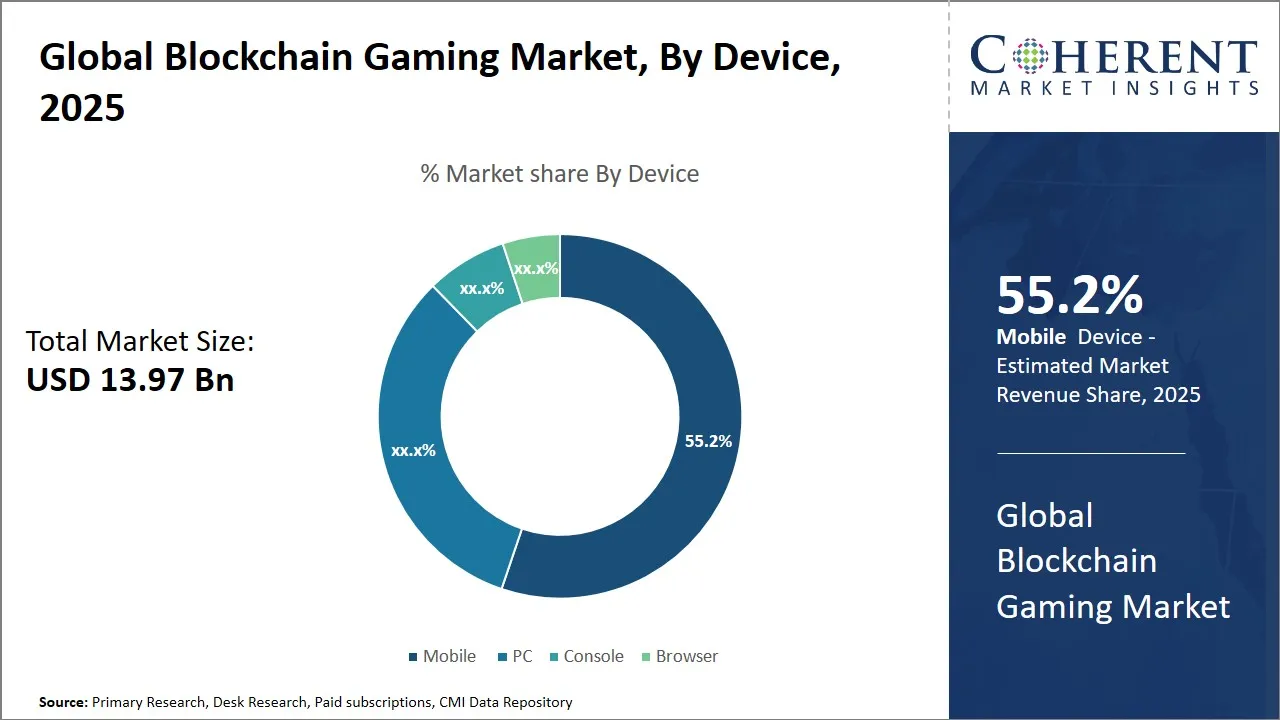
- The mobile segment leads the market holding an estimated share of 56.2% in 2026.
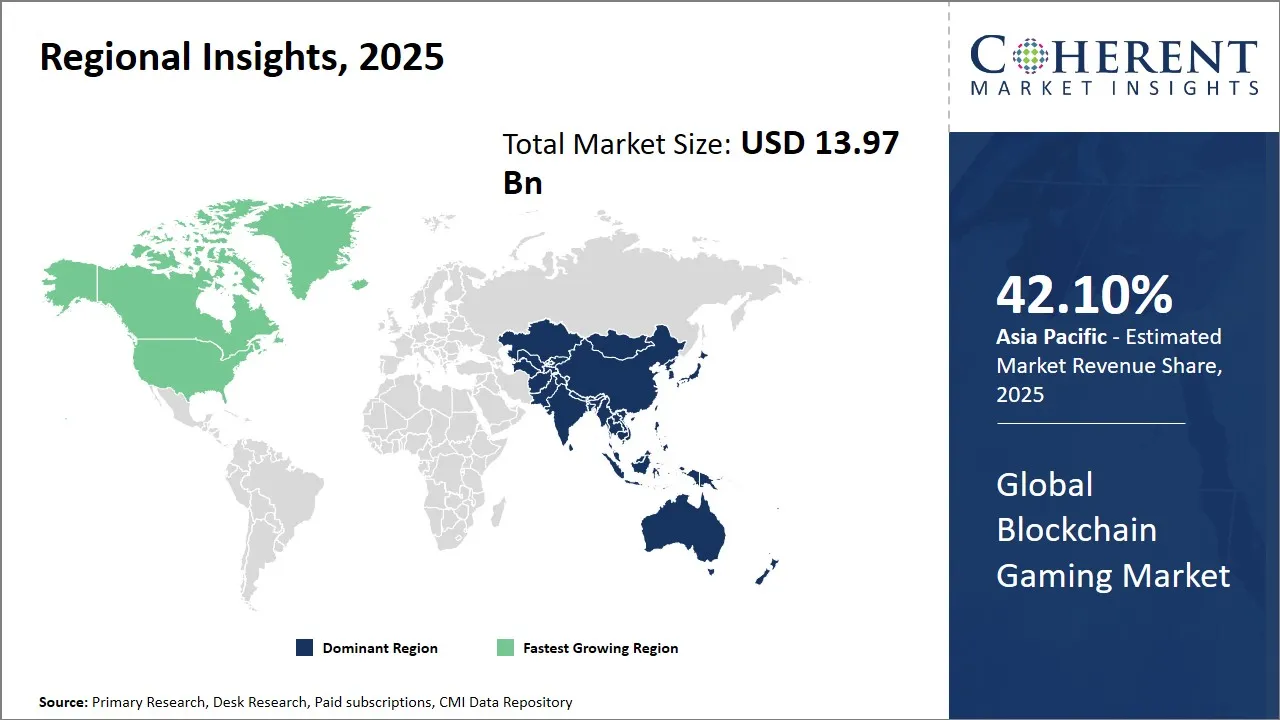
- Asia Pacific is estimated to lead the market with a share of 42.1 % in 2026.
- North America, holding a share of 25.4 % in 2026, is projected to be the fastest growing region.
Market Overview
The market is seeing the integration of Non-Fungible Tokens (NFTs) and Decentralized Finance (DeFi) mechanisms into gaming platforms, offering gamers true ownership of in-game assets and play-to-earn opportunities. Also, advancements in Blockchain scalability and interoperability are adding to the development of cross-platform gaming ecosystems, attracting a broader audience and stimulating innovation.
Current Events and Its Impact
Current Events | Description and its Impact |
Geopolitical and Trade Developments |
|
Economic and Infrastructure Trends |
|
Segmental Insights
- Current Industry Events of 2026
- Market Size Estimation
- Regional Breakdown
- Competitive Landscape
- Customer Intelligence
- Segmental Analysis
- Pricing Analysis
- Key Market Drivers, Challenges & Future Trends
- Customized Insights Section
Global Blockchain Gaming Market Insights, by Device – Mobile Segment Leads Owing to its Widespread Accessibility and Seamless User Experience
In the global blockchain gaming market, the mobile segment dominates holding an estimated share of 56.2% in 2026. Mobile phones have become the most ubiquitous computing devices globally, helping blockchain gaming developers tap into a huge and diverse user base. The portability of smartphones helps gamers engage with blockchain-based games anytime and anywhere.
Also, increasing processing power, higher screen resolutions, and longer battery life have improved the gaming experience on mobile devices, making complex blockchain games more accessible and enjoyable. To add, improvements in internet connectivity across the globe, including the expansion of 4G and 5G networks, make possible smoother gameplay and faster transactions essential for blockchain-related functionalities such as playing, trading, or earning digital assets.
User-friendly interfaces and app stores also add to the mobile blockchain segment growth. Mobile platforms provide simpler installation processes and better app discovery mechanisms compared to PCs or consoles. Moreover, the integration of digital wallets and in-app purchase systems within mobile platforms streamlines access to blockchain assets. Players can easily connect their wallets, trade NFTs, and monetize their gaming activities without complicated setups, which encourages higher engagement and transaction volumes within the mobile ecosystem.
Impact of AI on the Blockchain Gaming Market
AI-powered game mechanics can create adaptive gameplay, personalizing challenges and in-game events based on player behavior, which increases engagement and retention. On the blockchain side, AI can help detect fraudulent transactions, bot activity, and exploit patterns by analyzing on-chain data in real time—critical for safeguarding token economies and NFT marketplaces. Additionally, AI-driven asset generation allows developers to produce large volumes of high-quality in-game items and environments more efficiently, lowering production costs and accelerating release cycles.
A notable example is Treasure’s “AI Treasure Agents” launched on the Ronin blockchain in August 2025. This initiative integrates AI companions into its gaming ecosystem, enabling dynamic interactions and quest generation tailored to individual players’ progress and preferences.
Regional Insights
Asia Pacific Blockchain Gaming Market Analysis and Trends
The Asia Pacific region, holding a share of 42.1% in 2026, is expected to dominate the blockchain gaming market, with rapidly advancing technological adoption, a burgeoning gaming culture, and proactive government support for digital economies. Countries in this region, including South Korea, Japan, and China, have seen increased investments in blockchain infrastructure and digital asset regulations that facilitate the use of cryptocurrency and tokenized gaming content.
The expansive mobile gaming market and a large population of tech-savvy youth also add to its growth momentum. Notable players such as Netmarble and WEMADE have pioneered blockchain game development, introducing play-to-earn models and decentralized asset ownership, resonating strongly with regional gamers.
North America Blockchain Gaming Market Analysis and Trends
North America, holding a share of 25.4% in 2026, is expected to exhibit the fastest growth in the global blockchain gaming market, driven by a mature technological ecosystem, strong venture capital presence, and robust adoption of blockchain innovations within the gaming industry. The region benefits from an established infrastructure that supports high computing power and internet penetration, essential for blockchain-based platforms. Favorable government policies emphasizing innovation and intellectual property protection further cultivate a conducive environment for blockchain startups and large enterprises alike.
Major technology hubs such as Silicon Valley fuel collaboration between blockchain developers and gaming studios, enhancing product offerings and user engagement. Leading companies like Ubisoft and Animoca Brands have established significant operations or partnerships here, developing blockchain-integrated gaming platforms and NFT-based digital assets that elevate gamer experiences.
Blockchain Gaming Market Outlook for Key Countries:
U.S. Blockchain Gaming Market Analysis and Trends
The market in the U.S. is characterized by a high concentration of innovation-driven startups and established game publishers integrating blockchain technology. Robust intellectual property laws and investor interest create an ecosystem favorable to experimentation with NFTs and decentralized gaming economies. Companies like Epic Games and Dapper Labs are instrumental in advancing blockchain gaming experiences, focusing on scalability and mainstream adoption. The U.S. benefits from cross-sector collaborations, including with the financial and NFT marketplaces, enhancing the overall market structure.
South Korea Blockchain Gaming Market Analysis and Trends
South Korea continues to lead with a tech-forward user base and government initiatives aimed at fostering blockchain technology applications. The South Korean government’s strategic roadmap to integrate blockchain into various industries accelerates adoption within gaming. Local giants such as Wemade and Krafton leverage blockchain to enhance in-game asset ownership and enable secure transactions through digital wallets. South Korea’s established esports sector also integrates blockchain for transparent tournament management and rewarding ecosystems, expanding blockchain gaming’s reach.
Japan Blockchain Gaming Market Analysis and Trends
Japan has been an early adopter of blockchain technologies within gaming, supported by supportive regulatory measures and a deep-rooted gaming culture. Japanese companies such as Double Jump.Tokyo and Bandai Namco utilize blockchain to innovate around collectible digital assets and decentralized game economies. Japan’s unique blend of traditional and mobile gaming experiences provides fertile ground for blockchain innovation, amplified by partnerships with major cryptocurrency exchanges facilitating smoother user transactions.
Germany Blockchain Gaming Market Analysis and Trends
Germany reflects a growing European hub for blockchain gaming, boosted by clear regulatory frameworks around cryptocurrency use and digital asset trading. The country benefits from a strong developer community and supportive trade organizations driving innovations in blockchain-based multiplayer games and NFT marketplaces. Companies like Ubisoft (with operational bases in Europe) and emerging startups contribute to Germany’s increasing participation in the global blockchain gaming landscape, focusing on security and compliance.
Brazil Blockchain Gaming Market Analysis and Trends
Brazil is emerging rapidly as a notable player in the Latin America blockchain gaming scene, fueled by expanding internet access and increasing interest in cryptocurrency. The government’s cautious yet progressive stance on digital currencies supports the exploration of blockchain applications in gaming. Companies such as Horizon Blockchain Games have begun fostering partnerships in Latin America, while local studios are exploring play-to-earn frameworks tailored to regional preferences. Brazil’s young gamer population is highly engaged with mobile and blockchain-integrated games, creating a vibrant market environment.
Market Players, Key Development, and Competitive Intelligence
Top Strategies Followed by Blockchain Gaming Market Players
- Leading established companies invest heavily in research and development (R&D) to drive innovation, developing high-performance blockchain gaming products that differentiate them in this rapidly evolving sector.
- Animoca Brands has been investing significantly in R&D for advanced interoperability frameworks and metaverse integration. Its work on The Sandbox includes developing creator tools and cross-chain asset support, ensuring it remains at the forefront of blockchain-based User-generated Content (UGC) platforms.
- Mid-level market players adopt a more balanced strategy aimed at capturing a significant share among cost-conscious and price-sensitive consumers.
- SuperGaming (India) launched GameChain on Base L3 in February 2025 to offer low-cost infrastructure for mobile-first blockchain games. This reduces transaction fees and on-chain costs, making Web3 gaming more affordable for emerging markets.
- In contrast, small-scale players in the blockchain gaming market concentrate on carving out distinct niches through specialization and innovation.
- Parallel Studios focuses exclusively on the blockchain trading card game Parallel, building deep lore, high-quality art, and strategic gameplay rather than competing in mass-market genres.
Key Developments
- In August 2025, Alpha and Omega Semiconductor Limited (AOS), a designer, developer, and global supplier of a broad range of discrete power devices, wide bandgap power devices, power management ICs, and modules, announced the release of its AOZ17517QI series, a 60A eFuse in a compact 5mm x 5mm QFN package. AOS optimized this new eFuse product series for 12V power rails in servers, data centers, and telecom infrastructure.
- In March 2025, Texas Instruments (TI) debuted new power-management chips to support the rapidly growing power needs of modern data centers. TI's new TPS1685 is the industry's first 48V integrated hot-swap eFuse with power-path protection to support data center hardware and processing needs.
- In November 2024, Infineon launched five PROFET Wire Guard devices that come in the proven TSDSO-14 and TSDSO-24 packages. They offer full pin-to-pin compatibility within the family and high compatibility with PROFET +2 12V devices and are targeting currents of up to 27 A.
- In October 2024, Toshiba Electronics Europe GmbH added 2 new products to its electronic fuse (eFuse IC) offering. The TCKE903NL and TCKE905ANA products are reusable, thereby reducing maintenance costs and recovery time for equipment repairs, and support various functions to protect power supply line circuits.
Market Report Scope
Blockchain Gaming Market Report Coverage
| Report Coverage | Details | ||
|---|---|---|---|
| Base Year: | 2025 | Market Size in 2026: | USD 21.23 Bn |
| Historical Data for: | 2020 To 2024 | Forecast Period: | 2026 To 2033 |
| Forecast Period 2026 to 2033 CAGR: | 52.0% | 2033 Value Projection: | USD 398.06 Bn |
| Geographies covered: |
| ||
| Segments covered: |
| ||
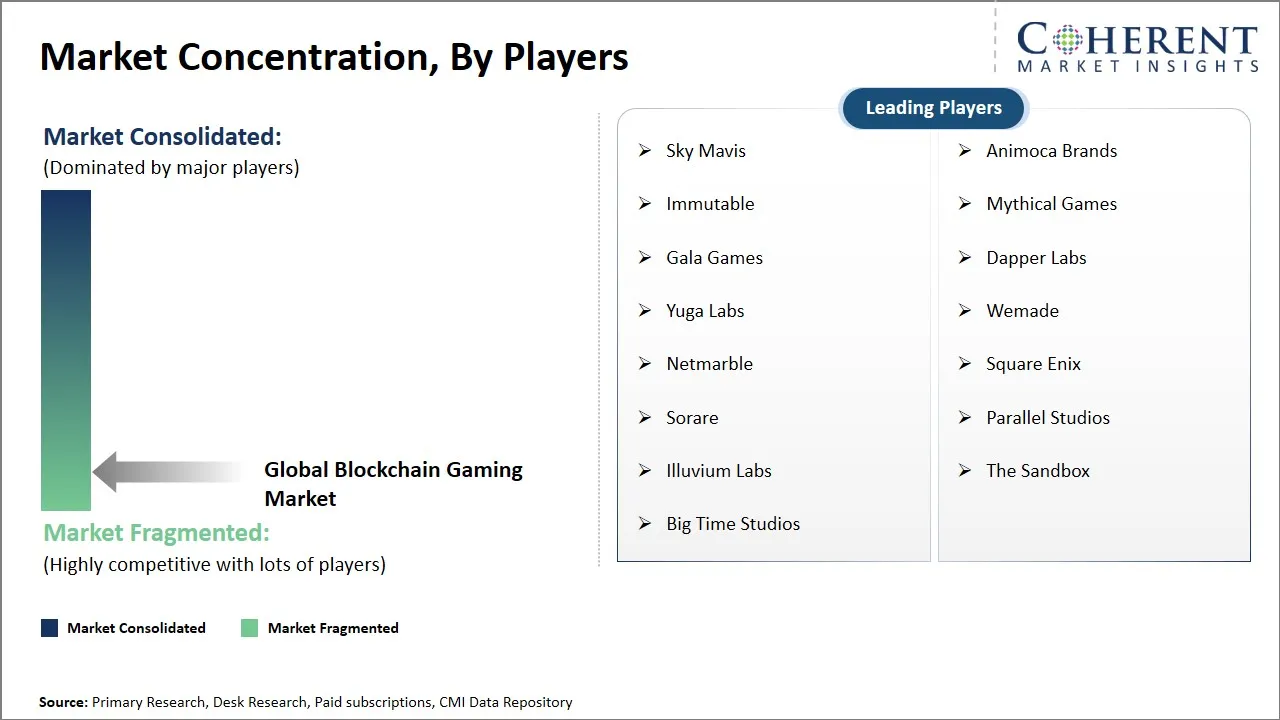
| Companies covered: | Sky Mavis, Animoca Brands Corporation Limited, Immutable, Mythical, Inc., Gala Games, Dapper Labs, Inc., Yuga Labs, Wemade Co., Ltd., Netmarble Corp., SQUARE ENIX, Sorare, SAS, Parallel Studios, Illuvium, The Sandbox, and Big Time Studios | ||
| Growth Drivers: |
| ||
| Restraints & Challenges: |
| ||
Market Dynamics
Global Blockchain Gaming Market Driver – True Digital Asset Ownership & Secondary Liquidity
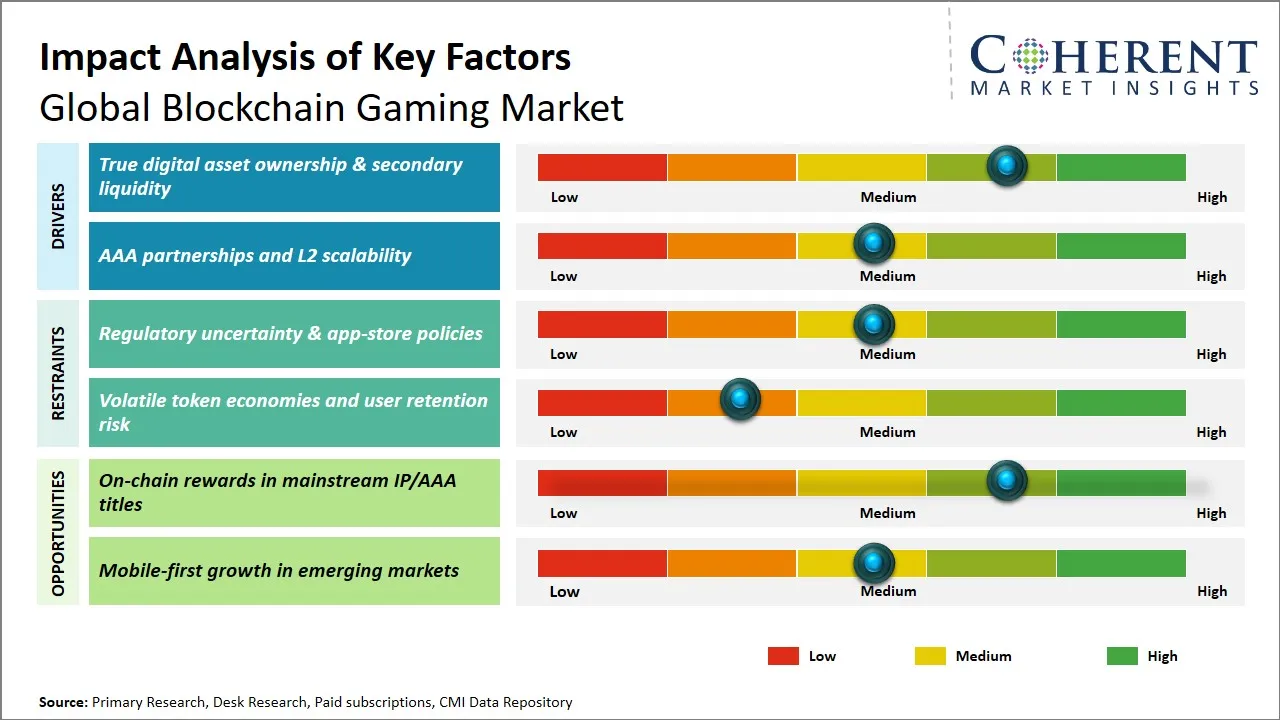
Unlike traditional gaming environments, blockchain-based games empower players to own, trade, and monetize in-game assets—such as characters, skins, weapons, and collectibles—as unique, verifiable tokens secured on decentralized ledgers. This ownership is not confined to the game developer’s platform, providing players with the ability to transfer or sell these assets across various marketplaces and platforms, enhancing player autonomy and value retention. For instance, Sky Mavis’ Axie Infinity allows players to own in-game creatures (Axies) and items as NFTs, which can be freely traded on the Ronin marketplace. This model ensures players have verifiable ownership and the ability to monetize their assets in secondary markets, reinforcing long-term engagement.
The availability of secondary markets further fuels this trend by unlocking real-world economic opportunities, enabling gamers to capitalize on their time and skills invested. This liquidity and transparency create a compelling incentive for users, fostering increased engagement and investment in blockchain gaming, while simultaneously attracting developers to innovate with new game mechanics centered around asset interoperability and monetization.
Global Blockchain Gaming Market Opportunity – On-Chain Rewards Integration in Mainstream IP/AAA Titles
As blockchain technology matures, game developers and publishers are increasingly exploring ways to enhance player engagement and retention by embedding cryptographically secured assets such as Non-Fungible Tokens (NFTs) and cryptocurrency-based rewards directly into high-profile games. On-chain rewards facilitate true ownership and transferability of in-game assets, allowing players to not only earn but also trade or sell unique items across decentralized marketplaces, thereby creating novel revenue streams and user experiences.
Leveraging well-established IPs and AAA franchises ensures a built-in fan base and high visibility, accelerating adoption rates compared to smaller, indie blockchain games. Ubisoft’s “Might & Magic: Fates” (in partnership with Immutable) integrates blockchain-based items that players can earn in-game and trade on-chain. This bridges AAA gaming with Web3 economies, giving mainstream players a tangible, tradable reward system tied directly to a well-known franchise. Additionally, this integration aligns with growing player demand for transparency, fairness, and real-world value in digital ecosystems. By tying exclusive rewards, achievements, and collectibles to blockchain networks, developers can foster deeper community engagement and incentivize long-term play.
Analyst Opinion (Expert Opinion)
- The convergence of AI and blockchain is enabling dynamic, adaptive in-game content creation, personalized quest lines, and predictive matchmaking, which can significantly boost player retention and monetization potential.
- With Layer 0 and Layer 2 innovations, players will increasingly be able to transfer NFTs and in-game currencies across multiple blockchain ecosystems, unlocking new economic models and broader secondary market liquidity.
- The adoption of blockchain rewards and asset ownership in major IP-driven titles (e.g., sports leagues, film franchises, AAA game studios) will act as a catalyst for mainstream entry, blending fan engagement with verifiable digital asset ownership.
Speak to the analyst
Want personalized insights?
Take the findings above to one of our principal consultants, or have the report rebuilt around the segments, geographies and competitors you actually track.
Market Segmentation
- Device Insights (Revenue, USD Bn, 2021 - 2033)
- Mobile
- PC
- Console
- Browser
- Regional Insights (Revenue, USD Bn, 2021 - 2033)
- North America
- U.S.
- Canada
- Latin America
- Brazil
- Argentina
- Mexico
- Rest of Latin America
- Europe
- Germany
- U.K.
- Spain
- France
- Italy
- Russia
- Rest of Europe
- Asia Pacific
- China
- India
- Japan
- Australia
- South Korea
- ASEAN
- Rest of Asia Pacific
- Middle East
- GCC Countries
- Israel
- Rest of Middle East
- Africa
- South Africa
- North Africa
- Central Africa
- North America
- Key Players Insights
- Sky Mavis
- Animoca Brands Corporation Limited
- Immutable
- Mythical, Inc.
- Gala Games
- Dapper Labs, Inc.
- Yuga Labs
- Wemade Co., Ltd.
- Netmarble Corp.
- SQUARE ENIX
- Sorare, SAS
- Parallel Studios
- Illuvium
- The Sandbox
- Big Time Studios
Sources
Primary Research Interviews
Stakeholders
- Blockchain Game Developers & Publishers (e.g., Game Directors, Product Leads)
- Blockchain Infrastructure Providers (e.g., Layer 1 & Layer 2 Network Operators)
- Game Asset Marketplace Operators (e.g., NFT Platform Managers)
- Esports Organizations & Tournament Hosts integrating Web3 rewards
- Venture Capital Firms specializing in GameFi & Metaverse investments
- Guild Operators & Play-to-Earn Community Leaders
- Regulatory & Compliance Experts in Web3 Gaming
Databases
- GameChain Insights Database
- Global Web3 Gaming Index (GWGI)
- ChainPlay Data Repository
- On-Chain Gaming Metrics Hub (OGMH)
- Play2Earn Global Database
Magazines
- Blockchain Gamer Magazine
- Metaverse & Gaming Monthly
- GameFi World Review
- Next-Gen Gaming Times
- Play-to-Earn Digest
Journals
- Journal of Blockchain in Gaming & Metaverse Studies
- International Journal of GameFi Economics
- Journal of Interactive Digital Assets
- Decentralized Applications & Gaming Journal
- Peer-Reviewed Journal of Web3 Technologies
Newspapers
- Gaming Ledger Daily
- Metaverse News Network (MNN)
- Crypto Gaming Chronicle
- The Play-to-Earn Times
- Digital Asset Observer
Associations
- Blockchain Game Alliance (BGA)
- Asia Blockchain Gaming Association (ABGA)
- North America GameFi Council (NAGC)
- European Digital Gaming & Metaverse Association (EDGMA)
- Global NFT & Gaming Association (GNGA)
Public Domain Sources
- World Bank – Digital Economy Reports
- United Nations Conference on Trade and Development (UNCTAD) – Creative Economy Statistics
- ResearchGate – Blockchain Gaming Publications
- OECD Digital Economy Outlook
- GitHub Public Repositories for GameFi Projects
Proprietary Elements
- CMI Data Analytics Tool, Proprietary CMI Existing Repository of information for last 8 years
Get access to 250+ pages report
Every segment, forecast, competitor profile and data table behind the analysis above — available for instant download.
- ESOMAR Member
- ISO 9001:2015 Certified
- D-U-N-S Registered
- GDPR & CCPA Compliant
Missing comfort of reading report in your local language? Find your preferred language:
Transform your Strategy with Exclusive Trending Reports
Frequently Asked Questions
The global blockchain gaming market is estimated to be valued at USD 21.23 billion in 2026 and is expected to reach USD 398.06 billion by 2033.
The CAGR of global blockchain gaming market is projected to be 52.0% from 2026 to 2033.
True digital asset ownership & secondary liquidity and AAA partnerships and L2 scalability are the major factors driving the growth of the global blockchain gaming market.
Regulatory uncertainty & app-store policies and volatile token economies and user retention risk are the major factors hampering the growth of the global blockchain gaming market.
In terms of device, the mobile segment is estimated to dominate the market revenue share in 2026.
It is gaming that incorporates blockchain technology to enable verifiable digital asset ownership, decentralized economies, and secure in-game transactions.
Ethereum Layer 2s (Immutable, Arbitrum, Base), Ronin, BNB Chain, and Polygon are the major blockchain networks used in gaming.